Talk to an Expert

Top 10 Blockchains for RWA Tokenization Platform Development

Tokenizing real-world assets such as property titles, treasury notes, or equity shares on the blockchain has transitioned from theory to practice, fundamentally altering the methods of value storage and exchange. Investment companies and fintech startups are increasingly developing platforms that connect traditional finance with decentralized networks. However, at the foundation of every successful RWA project is a pivotal decision: selecting the appropriate blockchain. 

As of May 2025, tokenized U.S. Treasury goods have surpassed $1.28 billion in total value locked (TVL), propelled by platforms such as Ondo and Matrixdock. As DeFi protocols progressively include real-world assets into their yield plans, developers and corporations are evaluating the most appropriate blockchains for constructing and deploying their tokenization platforms.

In this blog, we will explore the top blockchains for RWA tokenization platform development, assessing each according to scalability, compliance support, ecosystem maturity, and acceptance rates.

Key Criteria for Choosing a Blockchain for RWA Tokenization

Choosing the right infrastructure is crucial when building RWA tokenization platform solutions, as it directly impacts regulatory readiness, scalability, and long-term trust. The blockchain you choose will determine not just technical performance, but also how well your platform can align with legal standards, scale with users, and support long-term innovation. Here are 6 key factors to consider when evaluating potential chains:

1. Regulatory Compliance and Identity Support: Tokenizing real-world assets often requires compliance with KYC/AML regulations. Look for blockchains that support permissioned tokens, verifiable credentials, and integration with compliance providers.

2. Customizable Smart Contracts: Flexibility in smart contract development allows you to create asset-specific logic, handle revenue sharing, and implement liquidation or governance mechanisms with precision.

3. Scalability and Fee Structure: A chain’s throughput and cost per transaction matter significantly when your platform processes high volumes of transfers or recurring events like interest payouts.

4. Tailored for RWA Tokenization Platform Solutions: Not all blockchains are equally suited for RWA needs. Choose one that supports standards like ERC-1400 or ERC-3643 and is built with financial asset representation, compliance layers, and access control in mind.

5. Interoperability and Ecosystem Access: Tokenized assets thrive in open ecosystems. Select a chain that offers solid bridge support, connects easily to custodians or oracles, and enables interaction with external systems.

6. Reliable and Secure Blockchain Technology: A stable and well-audited network is non-negotiable. Ensure the underlying blockchain technology has a proven track record in uptime, decentralization, and protection against attacks.

Read Also: White-Label Tokenization Vs. Custom Blockchain

Top Blockchains for RWA Tokenization to Look Out for in 2025

Discover the most reliable blockchains powering next-gen asset tokenization in 2025. From Ethereum to Hyperledger, here’s what’s shaping the future of on-chain RWAs.
1. Ethereum

Ethereum remains the go-to blockchain when it comes to tokenizing real-world assets, its well-established ecosystem, regulatory compatibility, and extensive developer tooling. Its smart contract capabilities offer a flexible base for projects aiming to tokenizing everything from real estate to U.S. Treasury bills. Ethereum accommodates to multiple RWA tokenization standards like ERC-3643 and ERC-1400, making it the preferred chain for projects.

What sets Ethereum apart is its reputation among RWA tokenization companies and its acceptance by institutional players. If you’re planning on building an RWA platform that needs strong community support, long-term reliability, and access to institutional DeFi, Ethereum is hard to beat.
Polygo

2. Polygon

Polygon offers the scalability and affordability that Ethereum struggles with, while still being compatible with the Ethereum Virtual Machine (EVM). This makes it ideal for projects that want Ethereum-grade security but without the high transaction costs. Polygon has gained serious traction among startups and mid-sized projects looking to offer real-world asset tokenization solutions without pricing out everyday users.

For top blockchain platforms that are both accessible and future-focused, Polygon checks many boxes. Its carbon-neutral commitment, developer-friendly infrastructure, and active ecosystem funding make it an attractive destination for RWA projects. Platforms like AQRU and Superstate are already building on or integrating with Polygon,

Avalanche

3. Avalanche

Avalanche is carving out a niche as a high-speed, low-latency blockchain that is well-suited for asset tokenization. Its Subnet architecture allows developers to create permissioned environments with specific compliance features—ideal for financial institutions or governments looking to bring assets on-chain securely.

Its growing support towards an RWA tokenization company comes from more than just tech. As more players seek real-world asset tokenization solutions with lower latency and stronger infrastructure control, Avalanche continues to rise as a viable alternative to legacy chains.

Stellar

4. Stellar

Stellar has always focused on financial inclusion, making it a natural fit for tokenizing fiat currencies, remittances, and trade finance instruments. Unlike general-purpose blockchains, Stellar was designed for value transfers and has built-in support for multi-currency transactions and KYC-compliant anchors.

Projects such as Franklin Templeton’s tokenized money market fund have launched on Stellar, showing its practical use in bringing traditional finance into Web3. For enterprises interested in blockchain-as-a-service options for digitizing financial assets across borders, Stellar offers a fast, compliant, and frictionless experience.
Tezos

5. Tezos

Tezos brings an edge to the RWA space with its on-chain governance and energy-efficient consensus model. Its ability to upgrade without hard forks ensures long-term stability, a crucial factor for tokenized assets that may exist on-chain for years. Tezos also supports formal verification for smart contracts, allowing mission-critical asset logic to be mathematically proven and highly secure.

As regulatory clarity increases, platforms with upgradable governance and formal verifiability are gaining interest among top blockchain development companies. It’s a strong pick for teams building an RWA platform that values both innovation and institutional-grade assurance.

Algorand

6. Algorand

Algorand is engineered with institutional-grade performance in mind, making it a favorite for enterprise use cases involving government bonds, commodities, and digitized gold. Its Pure Proof-of-Stake mechanism offers near-instant finality, making transactions predictable and ideal for financial applications. Built-in Layer 1 features like atomic swaps and standardized asset issuance reduce development time and technical risk.

Algorand has formed strong ties with governments and global institutions. For companies seeking blockchain tokenization solutions that are scalable, secure, and regulator-friendly, Algorand is often part of the shortlist.

Polkadot

7. Polkadot

Polkadot stands out for its interoperability-first architecture. With parachains, developers can build specialized environments tailored to asset classes, whether it’s real estate, carbon credits, or intellectual property. This makes Polkadot ideal for multi-asset ecosystems that require secure cross-chain functionality.

The chain is particularly appealing for RWA tokenization companies creating modular or jurisdiction-specific solutions. Teams can create fully customizable chains that interact seamlessly with Ethereum or other ecosystems. In 2025, as the demand for regulated, interoperable asset networks grows, Polkadot remains one of the most forward-looking options for blockchain platforms.
Binance Smart Chain (BSC)

8. Binance Smart Chain (BNB Chain)

BNB Chain offers speed, simplicity, and global reach, making it a solid contender in the tokenization space, especially for consumer-facing or retail-investor platforms. Its EVM compatibility allows for easy migration from Ethereum while offering cheaper gas fees and faster confirmations. BNB Chain has already been used for tokenized real estate, art, and crowdfunding projects that require affordability and scale.

With Binance’s global brand and access to large user bases, the network offers unmatched distribution potential for asset-backed tokens. For businesses seeking mass-market reach with fast deployment and liquidity access, BNB Chain presents a practical and cost-effective infrastructure layer.

Cosmos

9. Cosmos

Cosmos promotes a modular approach to blockchain development through its “Internet of Blockchains” vision. Each project can build its own independent chain while still connecting to others using the Inter-Blockchain Communication (IBC) protocol. For tokenized assets that may need to interact with custodians, DeFi platforms, and regulators, this flexibility is extremely valuable.

Cosmos enables developers to fine-tune for compliance and transaction speed while maintaining interoperability. It’s particularly well-suited for multi-jurisdictional RWA projects or hybrid financial models. Cosmos is gaining traction among those looking for frameworks that support both private and public asset blockchain use cases.
Hyperledger Fabric

10. Hyperledger Fabric

Hyperledger Fabric is a permissioned blockchain framework often chosen by enterprises and regulated entities that need more control over their infrastructure. Its modular architecture allows organizations to create private channels, enforce strict access permissions, and tailor consensus mechanisms to specific use cases. This is especially useful in sectors where data confidentiality and transaction transparency must coexist.

Fabric has been widely adopted across industries like supply chain, banking, and insurance, where operational complexity requires more than a simple public ledger. For many enterprise-level applications, Fabric offers a practical and proven foundation for long-term adoption.

How to Evaluate the Right Blockchain for Your RWA Project?

Selecting the right blockchain for a real-world asset tokenization project isn’t just a technical choice; it’s a strategic business decision. It impacts how your asset is governed, who can access it, how it moves, and how investors perceive its credibility. Before committing to a platform, ask yourself: Does the chain align with your long-term goals, user base, and asset class?

  • Nature of the Asset

Start by assessing what exactly you’re tokenizing: is it real estate, a treasury bill, or a private fund? Some blockchains are better suited to liquid assets, while others are optimized for illiquid, long-term holdings. Understanding the asset’s behavior will guide your choice.

  • Who Will Use the Platform?

Is your end user an institution, a retail investor, or a government entity? Each audience has its own expectations for speed, transparency, and control. The right blockchain should match the expectations of your core user base in terms of experience and trust.

  • Lifespan of the Tokenized Asset

Some tokenized assets may exist for decades, think land deeds or long-term bonds. Will the chain you choose still be around in 10 or 20 years? Stability and continuity are often overlooked but are vital for asset-backed platforms.

  • Data Transparency vs. Privacy

Certain blockchains expose every transaction publicly, while others offer selective disclosure. Depending on your asset class and region, this could make or break your compliance and investor trust.

  • Availability of Local Node Infrastructure

It’s one thing to have a fast chain; it’s another to ensure your region or industry can actually support it. Check for node access, latency, and availability of managed services that suit your geography or sector.

  • Exit Strategy and Upgradability

Can you modify or migrate your smart contracts without uprooting the whole system? Whether it’s upgrades, patching, or governance changes, your chain should offer a smooth pathway for growth or exit without disruption.

  • Custom RWA Tokenization Platform

Finally, ask yourself: Does this chain give me room to innovate? If you’re not just replicating existing models but trying to design something tailored to your market, you’ll need the flexibility, modularity, and independence to build a custom RWA tokenization platform that doesn’t force trade-offs.
Blockchain Development Company

Conclusion

As the tokenization of real-world assets continues to reshape how value is stored and transferred, the importance of choosing the right blockchain cannot be overstated. Each chain brings something unique to the table, be it regulatory alignment, transaction efficiency, or long-term scalability. Whether you’re tokenizing real estate, private equity, or government securities, the foundation you build on will define how well your platform performs under pressure.

As an experienced RWA tokenization platform development company, SoluLab has helped businesses bring complex tokenization ideas into reality. One of our standout projects, Token World, was built as a next-gen cryptocurrency launchpad that connects blockchain ventures with investors through a clean, accessible interface. It’s a strong example of how utility-driven design, paired with deep development expertise, can create real market impact.

From technical consulting to full-stack development, SoluLab is ready to support your journey with purpose-built solutions and deep domain expertise!

FAQs

1. What types of assets can be tokenized using blockchain?

Almost anything with real-world value can be tokenized, including real estate, precious metals, corporate bonds, art, intellectual property rights, and even commodities like oil or carbon credits. The goal is to represent ownership or rights to that asset digitally, making it easier to transfer, divide, and manage.

2. Is tokenizing real-world assets legally recognized in most countries?

Legal recognition varies widely. Some jurisdictions, like Switzerland, Singapore, and parts of the U.S., have introduced clearer frameworks to support asset tokenization. However, in many regions, the regulatory landscape is still evolving. It’s crucial to consult legal counsel when launching a tokenized asset project.

3. How does asset tokenization benefit investors?

For investors, tokenization lowers the barrier to entry. It allows fractional ownership, making high-value assets like commercial buildings or private equity accessible to smaller investors. It also improves liquidity, tokens can be traded more easily than traditional paper-based ownership records.

4. Do I need to build a custom blockchain to tokenize assets?

No, you don’t have to build a blockchain from scratch. Most projects use existing platforms like Ethereum, Polygon, or Tezos, which already support smart contract capabilities. What matters more is choosing a chain that aligns with your compliance needs and technical goals.

5. Can tokenized assets generate passive income?

Yes, many tokenized assets can be programmed to distribute income streams, like rental income, dividends, or interest, directly to token holders. This is especially attractive for investors seeking yield-generating opportunities in decentralized finance (DeFi) settings.
Why Prefer a Multichain Tokenization Platform for Web3 Projects?

Multichain Tokenization Platform for Web3 Projects

Today’s blockchain initiatives go beyond the boundaries of a single chain. Developers and teams are increasingly turning to multichain tokenization platforms to have access to more liquidity, reach new user bases, and ensure long-term scalability. These systems allow digital assets to operate fluidly across various blockchain networks, enabling use cases that were not viable in walled settings.

The stats speak for themselves. Over 35% of active Web3 developers contribute to multichain ecosystems, indicating a significant industry-wide effort for interoperability. 

This blog breaks down how multichain tokens are designed, why they’re becoming essential infrastructure for modern Web3 initiatives, and what makes this approach so powerful for creating resilient, adaptable digital economies. Let’s delve in!

What are Multichain Tokenization Platforms?

It is quite similar to the concept of creating a digital token that isn’t limited to one blockchain but instead moves freely across many. That’s the promise of a multichain tokenization platform. It’s not just about flexibility, it’s about breaking down the invisible walls that divide ecosystems.

One of the biggest drawbacks of single-chain setups is isolation. Tokens and apps are confined to the features and flaws of one environment. In contrast, multichain platforms open the door to broader communities and let developers use the specific strengths of different networks. It’s a more resilient model that reduces dependency and opens up greater reach. This model plays a growing role in the broader rise of blockchain tokenization, where digital assets are built to move and evolve across systems.

Cross-Chain Functionality

The functionality of these platforms hinges on a few critical methods:

  • Token wrapping works by locking the original asset on one chain and issuing a copy on another, for example, creating Wrapped Bitcoin (WBTC) from BTC to allow its use in Ethereum-based DeFi.
  • Burn and mint models maintain balance during transfers. To ensure the overall supply remains constant, a token may be burned on the origin chain and minted on the destination chain.
  • Dynamic liquidity routing enables tokens to travel through the most efficient and cost-effective cross-chain paths.

These technical processes are the core of multichain asset tokenization, allowing tokens to retain their value and functionality no matter which chain they traverse.

The Infrastructure Enabling Multichain Interoperability

To support seamless operation across chains, several foundational technologies work together:

  • Cross-chain bridges serve as links that enable secure asset and data transfer between blockchains.
  • Interoperability protocols, such as LayerZero and IBC, ensure that chains can communicate reliably, maintaining transactional accuracy across different environments.
  • Smart contracts play a vital role by executing logic that allows one blockchain to trigger functions or responses on another.

In the debate of multi-chain vs. cross-chain, multichain solutions are often seen as more scalable since they enable native operation on multiple networks rather than simply bridging between them.

Key Features of Multichain Tokenization Platforms

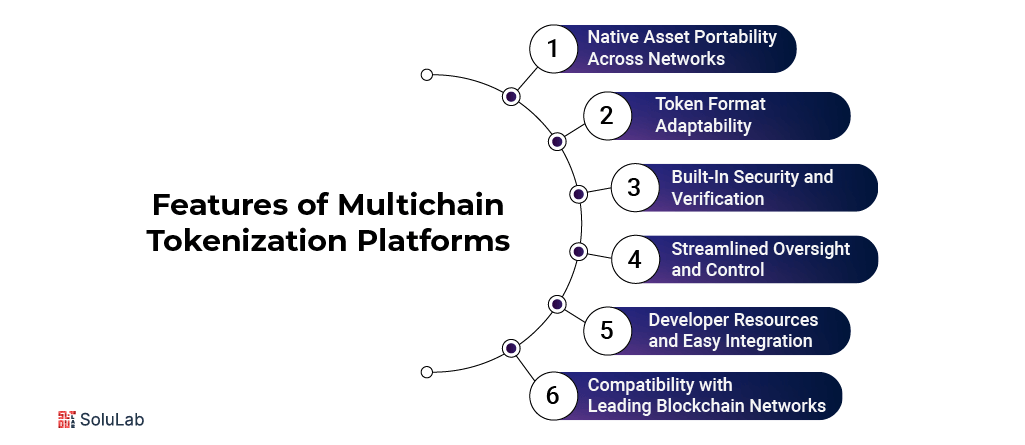
Multichain Tokenization Platforms Features

Multichain tokenization platforms are changing how digital assets are created and managed across blockchain ecosystems. This shift empowers projects to operate at a broader scale, unlocking utility and access that would otherwise be out of reach.

  • Native Asset Portability Across Networks

One of the most practical features is the ability to manage tokens across different chains without depending on manual swaps or third-party bridges. Assets created using these platforms can be moved across networks without losing their identity or functionality. This seamless movement encourages broader adoption and improves the user experience significantly.

  • Token Format Adaptability

These platforms don’t restrict developers to a single technical format. They make it possible to issue tokens compatible with various blockchain standards such as ERC-20, BEP-20, and more. This versatility gives teams the freedom to build tokens that align with each chain’s technical requirements and community expectations.

  • Built-In Security and Verification

When assets move between blockchains, the risk of fraud or error increases. That’s why these platforms place a strong focus on verification. They include built-in mechanisms to validate each action, ensuring tokens aren’t duplicated and transactions reflect true ownership. This level of safety builds trust in both the platform and the assets it manages.

  • Streamlined Oversight and Control

Project owners often deal with multiple dashboards when managing tokens on different networks. Multichain platforms eliminate this hassle by providing a unified interface where developers can track movement, check supply levels, and monitor activity all from one place. It makes asset oversight much simpler and helps prevent critical errors.

  • Developer Resources and Easy Integration

Teams working on token creation and deployment often look for tools that speed up development. A well-designed multichain tokenization platform development suite includes everything from prebuilt code templates to detailed documentation and support. These resources reduce friction for builders and help projects go live faster.

  • Compatibility with Leading Blockchain Networks

Support for multiple blockchains expands reach. These platforms typically allow token deployment on Ethereum, Polygon, Solana, BNB Chain, and newer networks as they emerge. This level of reach gives projects the freedom to engage different communities and optimize for cost, speed, or decentralization, depending on what matters most to them.

Read Also: Entertainment Tokenization in Media & Film

How Does it Differ From Single-Chain Tokenization?

Unlike single-chain tokenization, which keeps digital assets locked within one blockchain, multichain tokenization allows tokens to operate across several networks simultaneously. This not only expands utility but also improves accessibility, flexibility, and ecosystem reach. Projects using multichain tokens can tap into different blockchain communities without duplicating effort or compromising user experience.

Compared to single-chain models, which are often limited by the performance and fees of one platform, multichain asset tokenization supports a more fluid, scalable approach. Many top blockchain platforms are already moving in this direction, helping creators and businesses build tokenized ecosystems that are future-ready and interoperable. Here are some of the key differences:

Aspect Single-Chain Tokenization Multichain Tokenization
Blockchain Scope Tokens are restricted to one blockchain network. Tokens can operate across multiple blockchain ecosystems.
Flexibility Limited adaptability due to reliance on one network’s features. Greater flexibility to use the best tools and functions from different chains.
User Reach Access is limited to the user base of one chain. Wider access across different communities and user groups.
Scalability Bound by the scalability and transaction limits of a single platform. Easier to scale using parallel networks with different performance strengths.
Risk Mitigation Heavily dependent on the health of one chain. Reduces dependency by distributing asset presence across chains.
Ecosystem Integration Less adaptable when integrating with diverse DeFi, NFT, or dApp ecosystems. Seamless integration with varied ecosystems supporting multichain tokens.
Development Strategy Requires redeployment on new chains to expand. Simplifies expansion using multichain asset tokenization methods.
Platform Examples Runs on one chain like Ethereum or BNB Chain. Often supported by top blockchain platforms like Polkadot, Avalanche, and Cosmos.

Benefits of Multichain Tokenization for Web3 Projects

Multichain tokenization gives Web3 projects the flexibility to operate beyond the limits of a single blockchain, opening up new possibilities for growth, efficiency, and user engagement. By using a reliable multichain tokenization platform, developers can create tokens that function across multiple ecosystems, improving reach and reducing operational risks, all while streamlining development and integration processes. Here are some of the key benefits:

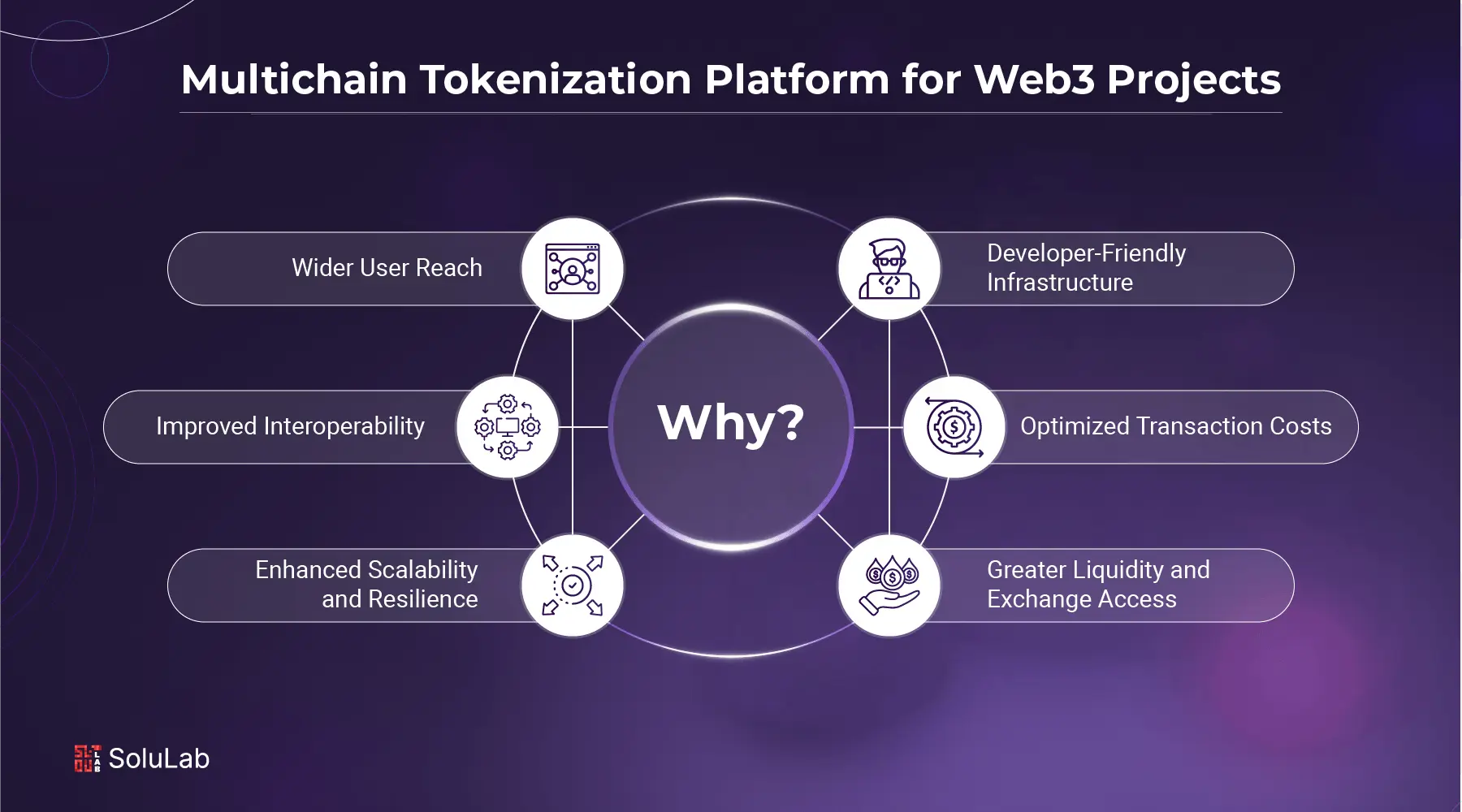
1. Wider User Reach

Multichain tokenization allows projects to connect with users across different blockchain communities, expanding visibility and adoption without being tied to one ecosystem.

2. Improved Interoperability

Tokens can seamlessly interact with DeFi protocols, NFT marketplaces, and dApps on various chains like Ethereum, BNB Chain, Solana, and Avalanche, enhancing overall utility.

3. Enhanced Scalability and Resilience

Distributing token operations across multiple blockchains reduces pressure on any one network and ensures the project stays functional even if one chain faces congestion or downtime.

4. Optimized Transaction Costs

By using lower-fee chains for certain activities (e.g., minting NFTs or microtransactions), projects can reduce gas expenses and improve the user experience.

5. Greater Liquidity and Exchange Access

Multichain tokens can be listed and traded on a wider range of exchanges, giving users more options and driving increased token flow across platforms.

6. Developer-Friendly Infrastructure

A robust multichain tokenization platform provides APIs, SDKs, and prebuilt smart contracts that simplify cross-chain deployment, saving development time and reducing risk.

CTA1

Who Can Use the Multichain Tokenization Platform?

Multichain tokenization platforms are built for a wide spectrum of users aiming to create, manage, or scale digital assets across several blockchain environments. By offering chain abstraction, these platforms handle the complex background processes while giving users a straightforward way to build for multiple networks. This opens up valuable opportunities for creators, developers, businesses, and communities alike.

  • Web3 Startups: New blockchain-based ventures can launch tokens that function across several chains, helping them reach wider audiences and avoid being locked into one ecosystem.
  • DeFi Protocol Developers: Builders of decentralized finance solutions can design tokens that interact with lending pools, DEXs, and liquidity hubs on different chains without needing to duplicate code.
  • NFT Artists and Collectible Platforms: Creators and platforms can mint NFTs compatible with different blockchain marketplaces, offering users more choices while minimizing gas fees and platform limitations.
  • Enterprises Exploring Tokenized Assets: Businesses that want to tokenize ownership of real-world assets such as real estate, inventory, or intellectual property can benefit from secure and compliant multichain deployment.
  • DAOs With Growing Communities: Decentralized communities can distribute governance tokens and manage cross-chain treasuries with ease, allowing for more transparent and flexible participation.
  • Cross-Border Payment Solutions: Projects working in international finance or remittances can issue interoperable stablecoins and digital assets that function smoothly across regions and blockchain infrastructures.
  • Token Launchpads and Crypto Incubators: These platforms can empower new projects by simplifying token launches with ready-made multichain deployment tools that speed up go-to-market timelines.

Essential Components for Building Effective Tokenization Platforms

Tokenization Platforms Components

To develop a multichain tokenization platform that actually delivers performance and scales over time, there’s no room for shortcuts. It demands a reliable core backed by the right mix of protocols, frameworks, and development tools. Here’s a closer look at what it takes:

1. Asset Tokenization Engines

Tokenization engines function as the gateway between real-world assets and digital ecosystems. They’re the foundation that enables tangible or intangible items like property, patents, art, or contracts to be turned into tradeable blockchain tokens.

Today’s tokenization engines go far beyond simple minting. They support an entire asset lifecycle, including:

  • Creating and registering tokens across various blockchain networks
  • Embedding governance features such as dividend sharing or voting rights
  • Providing real-time oversight, audits, and proof of asset backing

2. Smart Contract Frameworks

If tokenization engines give a token its form, smart contracts define its function. These frameworks act as the rulesets that automate how tokens operate across apps, wallets, users, and different chains.

Strong smart contract frameworks typically offer:

  • A modular structure, so updates or feature enhancements don’t require starting over
  • Built-in multichain compatibility, allowing seamless interaction across networks
  • High security standards with pre-integrated testing, audits, and permission systems

3. Compliance-First Infrastructure

Moving forward, regulation isn’t optional, it’s a built-in requirement. Platforms must be designed to comply with financial and legal frameworks across borders from the start.

Key features of a regulation-ready platform include:

  • KYC and AML verification tools that streamline onboarding
  • Region-based access controls to filter out restricted jurisdictions
  • Ongoing audit mechanisms for monitoring suspicious activity or unusual behavior

4. Token Lifecycle Management

The lifecycle of a token doesn’t stop at creation. It includes ongoing operations, updates, and at times, removal. Lifecycle tools help platforms manage this journey responsibly and flexibly.

These tools include:

  • Multi-chain minting and issuance workflows
  • Smooth migration processes to shift tokens to updated networks or standards
  • Burn and freeze functions for asset control or regulatory enforcement
  • Upgrade paths that allow tokens to evolve without losing value or continuity

Read Also: What is Cross-Chain Compatibility? 

5. Developer and User Experience

Even the most technically advanced platform won’t succeed if it’s too hard to use. For any solution to thrive, it must balance backend sophistication with frontend simplicity, both for developers and end users.

Key elements include:

  • SDKs that make it easy for developers to embed token features in existing tools and products
  • Intuitive APIs that simplify integration and abstract away complex blockchain logic
  • User dashboards that enable non-technical users, such as asset managers or IP holders, to tokenize, manage, and track assets with ease

Bringing all these components together is the foundation of effective multichain tokenization platform development. It’s about building more than just technology, it’s about creating trust, usability, and longevity for tokenized assets in a multichain world.

Real-World Use Cases of Multichain Tokenization

Multichain tokenization is not just a technical breakthrough, it’s already reshaping how businesses, creators, and institutions operate in the digital world. Here are some of the real-world use cases of multichain tokenization:

1. Fractional Real Estate Ownership: Real estate developers are tokenizing high-value properties and distributing fractional ownership across chains. This approach improves liquidity, allows smaller investors to participate, and enables seamless global trading.

2. Tokenized Financial Instruments: Banks and fintech firms are issuing digital bonds, securities, and equity tokens using blockchain-as-a-service platforms. These assets are managed across compliant networks, reducing intermediaries and enabling faster settlements.

3. Cross-Chain NFT Marketplaces: Digital artists and game studios are launching NFTs that live on multiple chains, letting users trade them on different platforms without friction. This widens the collector base and increases long-term token utility.

4. Decentralized Identity and Records: Governments and enterprises are building digital ID systems and registries that use multichain in blockchain structures. These allow identity credentials to be verified and stored across secure, sovereign networks.

5. Supply Chain Transparency: Manufacturers are tokenizing inventory and logistics data to track goods in real time. Multichain setups allow parties across different chains, like Ethereum for compliance and Avalanche for speed, to access unified records.

6. Loyalty and Rewards Programs: Brands are issuing multichain-compatible loyalty tokens that can be used across ecosystems. Customers can earn, redeem, and trade these rewards on various networks without being tied to a single platform.

7. Tokenized Carbon Credits: Environmental projects are creating carbon offset tokens that can be verified and traded across blockchains. This supports transparency, traceability, and easier integration with global ESG reporting systems.

Future Trends in Multi-Chain Tokenization

Nowadays, multichain tokenization platforms are entering a new phase of innovation, driven by user demands, regulatory complexity, and emerging technologies. These upcoming shifts will shape how digital assets are created, governed, and exchanged across multiple networks. Here are some of the future trends in multi-chain tokenization:

  • Universal Interoperability Protocols

Instead of relying on custom-built bridges for each pair of blockchains, future platforms will adopt standardized interoperability protocols. This shift will allow digital assets to move effortlessly between different chains, enabling smoother integration across ecosystems without the need for tailor-made solutions every time.

  • Automated Compliance Engines

Regulatory expectations are growing, and tokenization platforms will begin incorporating smart compliance layers that update in real time. These systems will help projects stay aligned with local laws automatically, adjusting KYC (Know Your Customer), access rights, and reporting processes as rules change, making legal adaptation far less burdensome.

  • Bridging Traditional and Decentralized Finance

The line between traditional finance and Web3 will continue to blur. Tokenized platforms will increasingly connect to established banking systems, custody services, and investment infrastructure, enabling institutions to benefit from blockchain functionality while retaining regulatory oversight and user familiarity.

  • AI-Powered Platform Optimization

Artificial intelligence will soon play a central role in managing and improving multichain platforms. From auto-detecting compliance red flags to optimizing liquidity across chains and predicting market shifts, AI will help automate decisions that previously required manual oversight.

These trends are not just speculation, they’re already taking shape. Many of the top blockchain development companies are exploring these innovations to make tokenization smarter, safer, and more scalable. As the technology matures, multichain tokenization is set to become not only more powerful but also more user-centric and adaptable to the needs of a global financial system.

CTA2

The Final Words

Multichain tokenization is no longer a futuristic concept—it’s already reshaping how digital assets are created, managed, and exchanged. By enabling tokens to operate across different blockchains, this approach opens the door to greater flexibility, broader access, and a more connected user experience. 

SoluLab has been at the forefront of this transformation, working with forward-thinking clients to bring real-world utility to tokenized ecosystems. As a trusted asset tokenization development company, we helped develop Borrowland, a decentralized crypto lending and borrowing platform. Designed to make digital asset management easier and more rewarding, Borrowland allows users to lend, borrow, swap, and earn interest in a secure and transparent environment powered by blockchain.

FAQs

1. Why choose multichain tokenization instead of a single blockchain?

Single-chain launches can limit audience reach and ecosystem access. Multichain tokenization allows assets to function across several networks, helping projects tap into broader user bases and diverse blockchain utilities.

2. Can multichain tokenization help reduce gas fees for users?

Absolutely. By shifting token interactions to chains with lower transaction costs, like Polygon or Optimism, projects can offer more affordable user experiences without sacrificing overall utility.

3. Is multichain tokenization suitable for non-crypto industries?

Yes. Sectors like real estate, supply chain, and intellectual property are using tokenization to digitize assets. Multichain support ensures these tokens interact with more platforms and reach a wider set of stakeholders.

4. How does token liquidity improve with multichain deployment?

When a token exists on multiple chains, it can be listed and traded on more exchanges and integrated into various DeFi protocols. This broad presence typically results in higher liquidity, more consistent pricing, and easier access for users.

5. What tools are required to implement multichain tokenization?

You’ll typically need cross-chain smart contracts, secure bridges, asset tracking dashboards, and a well-structured backend to ensure token consistency and performance.