Talk to an Expert

Are smart contracts a viable future of the rapidly developing market?

Smart Contracts With Blockchain

What is a contract? 

An agreement two or more parties arrive at and agree to implement on a legally enforceable basis is called a contract. A contract defines the rights and duties of each involved party provided it fulfills a certain set of requirements. The exchanges that it monitors are mostly of goods, services, money, or the promise of any of those in the future. A simple example would be money kept in a bank at the promise of a certain interest rate or the provision of a certain service to a company with the promise of getting a salary at the end of the month, provided the work is finished satisfactorily. 

Coming to a contractual agreement is a little more complex than it sounds. Since contracts are legally enforceable, drafting it with precision becomes extremely important for it too- 1. even qualify as a contract, and 2. avoid conflict in the future. For the first part, it must contain four parts: an offer- a clearly stated offer with unambiguous metrics must be made, and acceptance- it must be officially accepted by the other party(s), an agreement- terms and conditions must be discussed and a consideration- a formal exchange must happen or be promised in the future. For the second part, a fallback mechanism needs to be put in place in case any of the involved parties fail to deliver. This leads to certain requirements. 

Cost- third party intervention, especially in case of a conflict, becomes extremely relevant in order to maintain fairness and ensure professional conduct. 

  • Introduction to smart contracts 

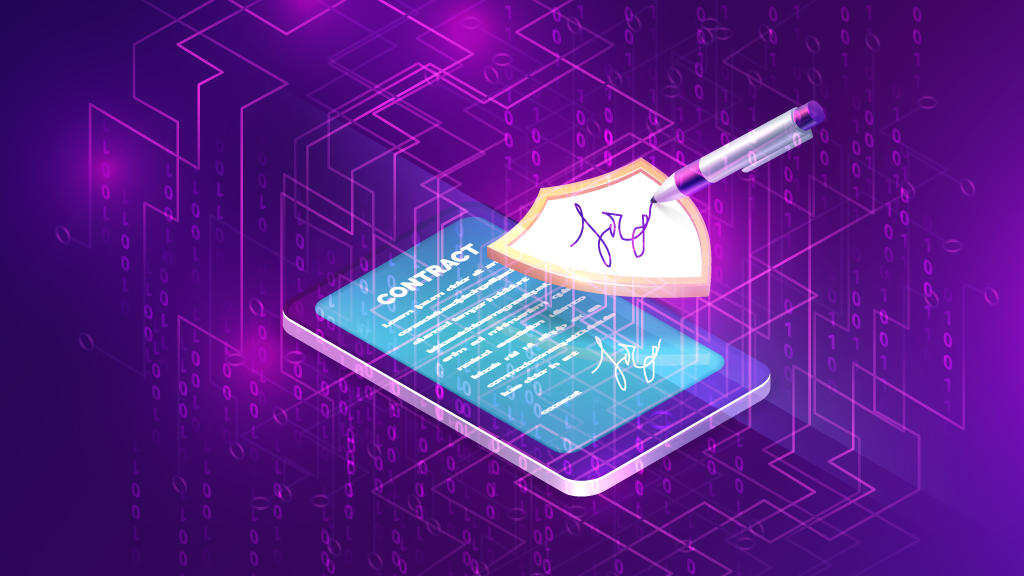
When a contract’s execution is not left in the hands of the people involved but upto computer code, it is a smart contract. Smart contracts are self-executing and do not require third-party intervention. All terms and conditions, details of the exchange, policy and time constraints are converted into sentences of computer language (such as Java and fed into the system. Once it has been validated, the contract executes itself without any further involvement by any party. Such processes are irreversible, traceable, and transparent. 

Perhaps the simplest example of a smart contract would be a vending machine. When a coin is put into the machine, provided its value is equal to or greater than the cost of the product, the product rolls out.

  • Role of blockchain 

Blockchain technology is currently the largest, most secure distributive ledger technology (DLT) available. A DLT can be looked at as a huge, computer-based record keeper/book which has the entire data copied over every single device in use. What this implies is that every bit of data stored on a blockchain is universally available to users without discrepancies and not centralized, exponentially increasing transparency. What blockchain brings with itself to DLT technology is unmatched security. There are multiple reasons behind it. 

Scams are difficult on blockchain because a hash (or the public key) is derived by performing complex and irreversible mathematical operations on the private key, which are nearly impossible to decode. In addition to this, every block on the chain is unanimously approved and for additional security, rigorously time stamped. Every programming happens and is visible in a particular order, and time details cannot be altered. These details become relevant with respect to smart contracts. 

Smart contracts are designed and carried out inside a distributed blockchain. Certain steps are involved from creation to execution. 

Most of the time, several sub-conditions are left upto customization by the user. For instance, some conditions may be introduced/verified, and the code would function, taking the particular line of code. 

  • Examples of smart contracts on the blockchain 

Here are some relatable examples of distributive ledger powered smart contracts. 

Blockchain developers write the contract in the form of computer code. They use a programming language to do so. While writing the script, developers implement the logic behind the contract, which enables its execution when respective commands are given by users. 

Once the code is uploaded to the blockchain, it is made available to all systems using the technology. This is done in such a way that for every identical input, the output is also identical. 

  1. Online shopping and supply chain: With nearly everything being on our phones these days and online shopping and ordering being the latest trends, a fast system to deal with these transactions is imperative, and blockchain smart contracts are exactly that. The process of registration of orders, the transmission of them to warehouses, and the initializing of the shipping process are no longer manual or fed step-but-step but largely automated. Verification through OTPs and passwords are all triggers that take the process from one stage to another. Once both parties ‘okay’ the transaction, the majority of intermediate steps are carried out automatically.
  2. Copyrighting and proof of ownership: It has now become much simpler for artists and content creators to put their content out there without facing a large magnitude of risk of losing their rights or relenting control to the bigger sharks. Distributive and irreversible records of blockchain provide a large level of objectivity, and claiming rights has become less complicated. In addition to this, the terms that each firm or creator can set are varied. This means some licenses can be pre-given to readers, whereas some other uses might be prohibited and, in some cases, even punishable. The process of spotting controversies and a portion of verification becomes computerized instead of manual.
  3. Insurance: The way smart contracts in insurance work is the conditions are verified on computers, and when they are met, the compensation or agreed upon payout is automatically processed. One sub-example of this would be flight delay insurance. Airlines often collaborate with blockchain to set up flight delay insurances where once a passenger is registered and the flight is shown to be delayed, payouts are automatically granted. This not only saves a massive amount of time and labor but also increases the goodwill of airlines and consumer trust.

Industries that are using Smart Contracts

  • Getting copyrights and patents: verification of the authenticity of claims is faster, more detailed, and more efficient when they are computerized, and that is about what happens when a claim is made on the blockchain. To check for explicit or implicit plagiarism is carried out. 
  • Protection of intellectual property: as discussed in the previous column. This comes into the act when an approved right is infringed upon. Verifications take place to determine the validity of the claim. 
  • Transfer of money or assets: cryptocurrency or even bank money can be transferred on a click without third party involvement, much like depositing or withdrawing money at an ATM. 
  • Theft protection: sale of non-existent, pre-sold, or unregistered products is not possible on the blockchain or smart contracts. Hence they have found a use in law enforcement and are used in catching thefts since some loophole is always left behind. 
  • Authentication: from the granting of diplomas to job certificates, many of these written contracts are generated via smart contracts. 
  • Insurance: also, as discussed in the previous column. Processing payouts is automated on the fulfillment of criteria. 

The Upside 

  • The level of objectivity smart contracts bring is unparalleled. Terms and conditions are not left upto interpretation, and, especially in cases of insurance, the customer is subjected through much less physical and mental trauma. This also makes it easier for content creators since the concrete proof is much more easily available. 
  • Time taken is minimized. Every procedure is not carried by people; machines are doing it by using a pre-fed algorithm. 
  • The absence of third party intervention minimizes human resource used. 
  • The traceability is high. Hence every action can be tracked and checked in case disputes arise. 

The Downside 

  • Since actions on the blockchain are irreversible; there is no room for error. Changes cannot be made post-facto and fallback mechanisms need to be completely separate. 
  • Contracts remain untampered only if the coding is perfect. Hence flawless programs are a prerequisite to dependency on smart contracts, which results in high dependency on programmers. Unlike traditional contracts where technological knowledge was not a prerequisite, only coders can make these contracts. 
  • Lawyers are not completely eliminated. After a point, coders working for large companies also need lawyers for legal input. 

Conclusion – Future of the sale of goods 

Smart contracts have not been here forever, which is why people are still suspicious about it, but if more information is spread and blockchain development becomes more and more bug-free and popular, people might abandon their stigma. Instead of writing and signifying long drawn contracts and doing procedures to participate in the investment or buying and selling market, buying, selling, and investing with a click is much more accessible. Ambiguity is much lesser, and security is much more. The coder dependency might be a little intimidating, but just like only a surgeon can perform surgeries, this is something that needs getting used to. With more and more programmers coming up in the industry, smart contracts can become more common and doable. The need for lawyers in a new industry can be seen as a new and upcoming prospect. Looking at the whole picture, factoring in the technology trend, and the fast pacing world, there is no doubt that smart contracts can become a viable future of marketing.
How can the Internet of Things benefit from Blockchain?

Introduction: Benefits of Blockchain for IoT

The Internet of Things does connect several individuals from different corners. It is a revolutionary technology that bridges the gap between the machines and individuals by collecting and sharing information using different devices. Such devices do include sophisticated chips, actuators, sensors, and much more. Such devices are connected to physical devices, which collect data and send it across the IoT network. It does have capabilities to share data from different locations.

With the use of different technologies, such as AI and ML, IoT becomes more revolutionary. Whatever data is collected using the Internet of Things, different AI and ML algorithms are used to analyze data. The Internet of Things does build a network that transmits sensitive data; hence the security of such data is necessary. With the use of technologies like Blockchain, it has become easy to secure the IoT network. 

Security in IoT devices

Security of the IOT network is a significant concern as it does heifers massive scale deployment. Different IoT devices do have lots of vulnerabilities, which makes it easy for hackers to perform DDoS attacks. In DDoS attacks, different computers are targeted and vast data request areas are made, which causes the denial of service attacks for users. Various DDoS attacks have generated lots of issues for industries and individuals. AN unsecured IoT network is much vulnerable to different attacks. 

Another main concern is Scalability. IoT networks grow and are controlled by centralized authorities that authenticate, connect, and authorize different nodes in the IoT network. Huge investments are needed to make such big servers to handle large information exchange. If the entire network goes down, the server is not available. 

Blockchain technology is a revolutionary technology or distributed ledger technology. Such technology has great usability to secure different IoT networks and solve different challenges related to security and scalability. Blockchain is a game-changer due to some unique features. Blockchain technology involves the use of distributed ledgers, where no central authority is there. All data validation and recording are done on different nodes of the network. Blockchain does not allow any user to delete or amend any data stored in the Blockchain. 

How Blockchain technology solves different challenges such as security and scalability

Different IoT networks are capable of processing different kinds of data transactions across different industries. It makes it difficult to find any data leakages if any cyber attack is done by cybercriminals. IoT generates a huge amount of data, and different stakeholders are available in the network. And due to a large number of stakeholders, different data is not clear. 

Blockchain. Technology would build an infrastructure for different devices, which can directly connect and transfer a piece of property like money or data. To enable different exchanges of information, IoT devices can be used and smart contracts would enable agreement between two different parties. Such features would enable the autonomous functioning of different smart contracts. 

Blockchain technology helps in different ways to make the IoT network more secure and scalable. 

  • A distributed ledger is a blockchain network that stores data in an immutable form. It means that data in the blockchain network is not edited. Hence it becomes difficult for different hackers to make changes in data stored in a blockchain. 
  • With the use of blockchain technology, the IoT network would have another layer of security. Hackers would be required to use different techniques to make the security layer vulnerable and access the network. Blockchain technology does build a robust level of encryption of data in the Internet of Things network which makes it very difficult to override the data.
  • Blockchain technology brings transparency and it allows only authorized users to access the network. It builds a reliable way of accessing different data in the IoT network.
  • Blockchain technology makes its network more scalable since it increases the processing of different transactions in the IoT network. Different IoT devices can be connected to the IoT network. It makes a distributed ledger technology that makes a viable solution. 
  • Blockchain technology allows different stakeholders to trust each other. Blockchain allows different industries to reduce fees by eliminating costs by eliminating the processes for different IoT gateways. 
  • Blockchain technology would make sure that IoT based devices are reliable. Different IoT networks do have a central gateway for communication. But with the use of Blockchain, it would make sure that no single source can control the device and gain all different information.

The Internet of things has rolled out different consumers as well as businesses. Different devices are great to use cases of the Internet of things. Blockchain technology is not only underlying technology for digital currencies. But Blockchain technology has different use cases along with digital currencies. 

Blockchain technology with IoT would lead to great devices that will share information without any involvement of centralized authority. Blockchain and IoT would make everything more secure, scalable, and useful for everyone. It would connect different devices securely and increase the scalability for sharing data.

Use of smart contracts in Internet things devices

Different smart contracts work like traditional contracts. Smart contracts are self-executable contracts that can be used by different stakeholders. Such contracts would automate that payment without any need for manual work. 

Blockchain technologies and the Internet of things

A very basic problem with different IoT devices is the security structure. IoT networks work based on a client-server model which is managed by a centralized authority. It does cause a single point of failure. Blockchain technology does address such a problem by making the whole network decentralized. While building IoT devices with the use of blockchain ledger, different challenges need to be considered.

Scalability

  • Networks need to be scalable, and it does allow users to handle massive amounts of data collected using large networks. It does have low transaction speeds lattices. With a great model, it would make it easier to make solutions with fewer difficulties and quickly.

Sensors

  • It does need to have sensors that could measure data correctly and according to need. It would make sure that the transaction executed is secure and correct. With Blockchain technology, it would be easy to ensure the integrity of different IoT devices, which cannot be altered using external interventions.

Network Security and confidentiality

  •  The security of the Internet of Things network is essential. And it can be done using Blockchain only. Blockchain technology would make sure to save the identities of users using the public key. Different industries would be able to make more private networks by sharing any details about the users.

Different Industries working in Blockchain and IoT, and its use cases

The Internet of Things is the technology behind different smart sensors. Such make devices more portable and interactive with different blockchain networks. Both Blockchain technology and the Internet of things has a large potential to create a marketplace of different services and devices. It gives different industries to create valuable information from the collected data. With a large number of blockchain protocols, IoT devices, and devices, it shows that blockchain technology has a great use case.

The Internet of Things is the technology behind different smart sensors. Such make devices more portable and interactive with different blockchain networks. Both Blockchain technology and the Internet of things has a large potential to create a marketplace of different services and devices. It gives different industries to create valuable information from the collected data. With a large number of blockchain protocols, IoT devices, and devices, it shows that blockchain technology has a great use case.

According to different statistics, the scope of blockchain technology and the Internet of things is huge. It is used in insurance and would be used in different industries. It builds a great model using telematics. 

Different Industries where both Blockchain and IoT can be used are the following

  • Blockchain and IoT can be used in the insurance industry. Such a use case would allow data analysis more easily and it would automate everything.
  • IoT and Blockchain are different security and manufacturing. Blockchain would make it easy to secure data and solve different security problems. IoT and Blockchain would solve different security challenges. 
  • Another main use case of IoT and Blockchain is in the building management and industry management. Blockchain technology would store all different transactions that occur between different machines. With the use of blockchain technology, energy sharing would be and decentralized. With IoT devices, it would be easy to sell renewable energy.

Some more scenarios where IoT and Blockchain can converge

Blockchain technology and the Internet of Things have great use cases. Blockchain technology can be used in different industries like the electricity industry to buy or sell energy using smart contracts. Smart contracts are autonomous contracts that automate different transactions.

Different security and control reasons lead to more efficiency in music systems. With the use of different technologies, like AI and mL, decision making can be more efficient and it would enable some new use cases. Several areas are available where Blockchain and pity can be used. 

Different use cases of IoT and Blockchain are smart contracts, network sharing, end-user authentication, network management, and supply chain. 

Conclusion

Blockchain technology and IoT both are revolutionary technology and have great potential, but due to different constraints, it lacks widespread adoption. Such concerns are caused due to technicality and security concerns. Different industries are using the combination of technologies to increase security and work with different scalable solutions.

How ML, Blockchain Technology & IoT can bring Innovation in Healthcare?

With technological advancements, several things have been simplified. Now many of us own a smartphone and computer and have access to the internet. The Healthcare Industry has hugely benefited from such emerging technologies. 

Blockchain IoT and ML is an amazing trio of Emerging technologies. Blockchain technology makes data more secure, ML analyses the data, and IoT makes Data more Secure. In the coming few decades, a blockchain-based ecosystem will emerge. Blockchain would reduce several issues like Applications, growth opportunities, Identity Management, supply chain province, and many more. 

As per the conclusion drawn by the report made by Frost and Sullivan’s, Blockchain technology will be used in Healthcare in the coming years. Also, the report discussed how blockchain could solve several issues like billing fraud, notarization, drug supply chain, and many more.

How IoT can be used in Healthcare

IoT devices can help patients to interact with doctors in a much better way. IoT based devices can innovatively connect doctors and patients. Also, there are several applications where the Internet of things applications can be used for things like remote monitoring, medical device integration, and smart sensors. All these will help to monitor the patient’s data in realtime continually, and it will give realtime data to doctors for the health of patients.

Also, these IoT devices will be able to collect, analyze, and make a report of data instantaneously. It will help to provide a complete analysis of the data collected that will also assist doctors in understanding much more about patients’ health. 

With the help of realtime devices, it will let doctors diagnose the health of doctors in realtime. IoT devices have huge potential to improve the treatment process of the patients and save their lives. It will make it easy for doctors to monitor critical patients.

How Machine Learning can be used in Healthcare

Several health providers, using IoT devices, get a huge amount of data. With the help of that data, doctors can create a bot and several applications that will help to track the health regimen. ML-based chatbots will be considered as assistants that will provide feedback and coaching based on data.

All the data could be captured using wearable IoT devices like Smart Watches. And these bots can provide realtime information and feedback to the patients or people using these services. It will make customer care service more interactive.

Another significant use of ML in healthcare is that it leads doctors to store information easily. Also, analysis can be done in a better way. It will also minimize waiting time in healthcare.

How Blockchain can be used in the Healthcare 

Blockchain promises to bring more transparency and accessibility to the patient’s record. Also, it will increase the healthcare providers, patients’ numbers, and much more. As the data will increase, it will become more difficult to handle such information. Blockchain would help to make a hyper ledger for the patient data that will be more tamper-proof and reliable. 

Blockchain would bring more transparency, integration, and immutability. It will make health records updated securely. Also, with the use of smart contracts, this will make sure that the data is correct and can be cross-checked with various patients. And much more. It will also allow the data to be shared in different organizations in the healthcare blockchain network.

Blockchain can Be used with IoT

The convergence of Emerging technologies like Machine Learning Blockchain, ML, and IOT will bring a lot more opportunities for digital healthcare. Also, blockchain is very potential to bring decentralization in health care that would ensure authenticity, access control, security, and integrity. It will help to build a new Value-based System for reimbursement and healthcare.

How IOT can be used with ML in Healthcare

IOT or internet of things can help devices, to allow doctors, and collect a record of patients . all this data can be stored in an online database, which could be easily accessible by doctors. Such data can be used for ML-based chatbots developments., and ML-enabled devices, which will help doctors to understand patients in a much better way.

Such new technologies will allow doctors to store information that could be later stored as an archive. According to the professional editor of trust my paper, creating medical histories of the patient is already a hectic task. It leads to making mistakes, and there are chances that the information can be missed. Hence with the use of technologies like ML and IOT and Blockchain, All the data can be stored securely and analyzed. Hence ML and IOT or internet of thing applications has huge potential to bring Innovation in the healthcare industry.

Conclusion

As there is huge innovation done in the technologies, several patients are becoming more aware and involved in the healthcare process. Such improvements in healthcare will lead to making it more usable and secure. Several healthcare providers can make use of these high potential technologies, to enhance the experience of healthcare. And also, it will reduce several costs on board and would make them winners in the competitive health care sector.

Especially technologies, IOT, ML, and blockchain would make the healthcare industry run more accurately and easily. It helps to create a better experience of the patients, also with such technologies healthcare.

In conclusion, everyone would be given proper healthcare facilities. Also, it will reduce the huge number of frauds happening in healthcare since all the medical data would be stored securely on the blockchain.

If you are looking to know more about the convergence of innovative technologies like ML, IOT and blockchain in health care, then you should join an exclusive webinar exclusively for the enthusiasts by the Solulab. Such kind of webinars would give you more information and let you learn more about the technologies and their use cases in different industries.

If you want to bring such innovations as a healthcare provider, well companies like SoluLab will assist you in making several solutions using several innovative technologies like ML, IOT, and blockchain.

Can Blockchain transform the way we communicate?

Introduction

Several cryptocurrencies such as litecoin and Bitcoin are making a huge revolution in the transactions and financial world. But the technology behind cryptocurrencies, ie, Blockchain has much more huge potential, and it can revolutionize communication. As you know that there are a large number of transactions in a day growing, and the amount of time needed to communicate is analogous to the number of transactions. 

Blockchain technology has a huge potential to change the way we do communication. Blockchain leads to more fast transactions and transparency. Also, it aims to reduce expenses. Various permissions blockchains are useful since they try to protect companies and operate with safety for customers. Several advantages of using blockchain technologies can track actions, temperatures, movement, and details of certain products. Also, it builds trust between customer and seller.

What is Blockchain technology?

A blockchain is a distributed decentralized ledger that stores the information in encrypted form, all the blocks tend to have a certain number of transactions.it is a transparent ledger and decentralized, which means there is no central authority for authorizing the transactions. All the users in a blockchain network are known as nodes. It creates a self-sufficient process with no regulation of a single party.

Well, there are several reasons why Blockchain can bring innovation in communication. It has the potential to improve efficiency and data privacy. Also, it brings the ability to communicate with each other without any censorship issues.

Best Reasons for companies adopting Blockchain Technology

It could be integrated with policymaking.

  • Several big entities, such as the EU, forecast the potential of blockchain technology that will revolutionize the way society operates. It could be connections with different industries or in your industry. But blockchain is not all about this. 
  • Crypto Currencies like bitcoins deal with the permissionless blockchain. But offers less privacy and easy to track all details of the transaction. Hence it is not considered to be suitable for industries. Apart from several other industries, various companies have huge potential for blockchain technology. 
  • According to the report made by the EU, it was found that the blockchain is at the age of infancy and there are several small challenges.

As per the survey done by Deloitte, more than fifty per cent of fintech companies are using blockchain for developing products. According to PwC’s survey, it has confirmed that around 90% of companies have already used blockchain technology for their businesses. 

There are several reasons why blockchain is considered to be a medium for transforming the way we communicate.

  • Blockchain promotes decentralization

According to the definition of blockchain, and its property of decentralization, it is not controlled by the single node. It is a decentralized ledger where all the information. It means that if a single node fails in the blockchain, it won’t affect much more since other nodes would be working. Due to blockchain’s decentralization nature, it promotes the peer to peer to communication without any need of authority.

  • Blockchain secures the data

Since data security is the most important concern for the business, it ensures that there are no attacks to breach data. Blockchain platform provides a secure platform, where it uses several cryptographic techniques to make next to impossible for hackers to breach data. All the data stored in Blockchain is immutable, hence it cannot be changed once it is added in the blockchain whether public or private. Several blockchain projects are enhancing the way of communicating the data with several companies and industries.

  • All the data stored in Blockchain is private

Blockchain is categorised into two different categories, permission blockchain and permissionless blockchain. Permissioned blockchain makes sure that all the information is stored in such a way that it is kept away from everyone. Also, the data in the blockchain is encrypted. Several blockchain projects such as dust and debrief are working to find several ways to increase data efficiency, privacy and much more. Also, it has the potential to reduce the sensitive information.

  • Blockchain makes transactions more transparent

Blockchain technology fosters trust among all the network participants since it makes sure that all the transactions are secure and safe. Everyone in the network can have a record of all the transactions. Also, the most important benefit of transparency is that it improves the trust and accountability among several business participants.

Also, the immutable nature of blockchain offers several advantages like data integrity and immutability of the content. Healthcare industry can be benefited since it will prevent fraud and improve revenue cycle management.

  • Blockchain let’s easy tracking of data

Blockchain technology lets users track all the real-time data, which brings several benefits in business. It contains all the accurate information, and all the participants in blockchain networks have access to the same information. Hence it enables large enterprises to communicate easily and coordinate in logistics and supply chain management.

It is really important to track the goods and products since customers would be easily able to know where the products were sourced and also makes customers more confident about the authentic products they have bought.

Advantages of Blockchain

  • Well, in today’s world, censorship is an important topic. It talks about several concerns related to the regulations and rules on what to say, sends, and does. Blockchain and its features such as decentralization, it allows an individual to send any data without any interference.
  • Blockchain technology has a lot of potential when it comes to making communication efficient. It improves the protection of messages and information sent on the blockchain network. Well, as you know, the freedom of speech is the most important right of humans, but many times, you feel censored and are not able to send messages, due to various concerns such as censorship, tracking or blocking.
  • But Blockchain makes sure that your identity is anonymous, and there is no involvement of any third party while a user makes a transaction.
  • Blockchain in communications would improve several services such as emails, instant messages. Also, it aims to protect the data and speed at which it is shared. Also, sharing efficiently takes place. There is no way in which data can be blocked, or censorship issues should occur.

Blockchain technology can be used with several other disrupting technologies such as following

  • Cyber Security

Blockchain helps in data verification since all the data stored in the blockchain is encrypted using the advanced concepts of cryptography. Also, it makes it resistant to any changes or hacks. Due to its property of decentralization, data cannot be deleted or corrupted.

  • Internet of things

In today’s time, the internet of things has gained huge popularity. It is being used in vehicles, homes, and several more places. IoT without Blockchain are prone to hack and it is less secure. But when blockchain is integrated with IoT, it makes it more secure and impossible to hack.

  • Unified Communications

Blockchain leads to more reliable communication and that to automated, fast, and secure. Various automated algorithms can be used that will communicate on its own. It can include emails, call notifications or system alerts, and much more. 

  • Government

In government, Blockchain can increase security and bureaucracy, transparency, and efficiency. Also, several unemployment sectors would be benefited since it would be easily verified the votes and can be distributed accordingly. 

  • Donation and Charities

It is good to work, to account for charities and noble work, and Blockchain helps to build us the best system that can be used to ensure that all the money a user donates gets to the right person for charity. With the help of Blockchain, transactions will occur more transparently, and it will create an automated environment and an immutable record of communication.

An example is the United Nations Food Programme, they are trying to implement blockchain technology that will allow the purchase of foods without the use of cash, credit cards, and vouchers but with an iris scan.

Blockchain has huge potential to transform the future of communication in business

Blockchain has huge potential to transform the communication, as it is useful in several industries like instant messaging applications, email boxes and much more. It secures the data and increases the speed for transactions. Blockchain has several applications in different industries, and several corporations and industries are using them.

 If we talk about the telecommunication industry, data can be easily transferred to private blockchain in the company. Various organizations are working in several areas where they can use blockchain. IBM and Microsoft have even set a budget that helps investments. 

Conclusion

If we talk about the future of Blockchain, well it depends on the business and investment done by the ICT industry. Blockchain communication will increase in the future for sure. Are you looking to build a blockchain for your industry, well, you can take assistance from companies like Solulab? Since several blockchain developers and researchers would assist you to build the best blockchain network for your company. Blockchain based applications for your business will enhance the way of communication with other clients.

Quick Read: Tangle Vs Blockchain: Concepts & Differences

Top 5 Blockchain Development Companies in California

Blockchain Developers Are Working Towards A New Age in Technology Revolution

Blockchain development companies in California implement blockchain technology to reduce the risk in transferring large funds and stop money laundering. This is possible with the encryption of data provided by blockchain. Each user has a unique decryption key without which, no data stored can be stolen. This helps in stopping digital identity theft too.

blockchain development in california

Blockchain also reduces the traditional methods of storing data and information in the form of paperwork. With blockchain, data and information are stored digitally and can be accessed anywhere, anytime by all parties involved which also adds value to the transparency in operation.

Companies That Develop Blockchain Applications in California

SoluLab

They are well-known for their punctuality in delivering the promised and expected service and solution to the requirements of their clients. They have more than 80 plus staff who work tirelessly towards ensuring the vision of SoluLab, to make SoluLab a one stop destination for all next generation trending IT solutions in a global manner.

They charge USD 50 to USD 100 per hours for their expertise service in providing blockchain solutions. They ensure to provide their clients with a least cost approach to achieve the set goals, expectations and results. They also do not compromise on quality in order to achieve a optimal cost solution.

Some of their key clients are Georgia Tech and Mercedes-Benz.

Quest Global Technologies

They have employees around 50 to 250 and charge around USD 25 to USD 50 per hour for developing blockchain applications. They are well known for their uniqueness in expertise, experience, research and development and their enhanced interpersonal skills. They have an open-door policy to eradicate miscommunication between developers and their clients.

They provide blockchain services such as cryptocurrency development and wallet development that accepts all types of cryptocurrencies.

Some of their key clients are HSBC and Kraft Cellar.

Sphinx Solutions

They have employed around 50 to 250 employees who are experts in customizing software and developing high end applications for blockchain platform as per the client requirements. They charge around USD 25 to USD 50 per hour for rendering their talented skills in blockchain application development.

They focus on smart contract developing to provide initial coin offering (ICO) that operates on solidarity and ethereum. They develop smart contracts with their clients customer preferences to enhance security in data management and transactions. They also develop decentralized applications (dApps) with improved security infrastructure. One of their unique propositions is integrating third-party application programming interface (API’s) with dApps that operate on ethereum blockchain too.

Some of their key clients are WhizzTips and PricePerPint.

S-PRO

They have employees of around 50 to 250 who are dedicated towards creating something new that provides a unique selling proposition for their clients in terms of blockchain solution. Blockchain by itself is new, and S-PRO strives hard to make sure that the solutions they provide is also newer comparatively.

They provide blockchain solutions to stop digital identity theft and handle operations via blockchain based digital distributed ledgers. They respect every one of their clients privacy and thus they strive harder to ensure security without compromising the ideas that their clients want to them to build and develop.

Some of their key clients are Hubble golf and Regiondo GmbH.

10 Clouds

They have more than 100 plus experienced employees who are help their clients every step of the way, starting from gathering their requirements till the end providing efficient blockchain based application. They charge USD 50 to USD 100 per hour for getting their expert advice and services.

They are well-known for creating blockchain applications that are flawless and stunning in the eyes of clients and users. Their blockchain services include building a strong private blockchain infrastructure and helping clients integrate them into all their operations hassle-free.

Some of their key clients are Baidu and Pinterest.

Read more -: Trusted Blockchain Development Companies In Ukraine

Conclusion: Blockchain never ceases to amaze the world

blockchain

Blockchain with its features provide enterprises and users with n number of possibilities and opportunities to enhance all and any operation and transaction. Say goodbye to the good old days of handling huge amounts of paperwork and wasting precious time and cost in transacting data and information of value. These top 5 blockchain development companies from California are here to enhance all your business operations as per your need and requirement.