

- AI Development
- AI App Development
- AI Consulting
- AI Software Development
- ChatBot Development
- Enterprise AI ChatBot
- AI Chatbot Development
- LLM Development
- Machine Learning Development
- AI Copilot Development
- MLOps Consulting Services
- AI Agent Development
- Deep Learning Development
- AI Deployment Services
- Deep Learning Consulting
- AI Token Development
- AI Development Company
- AI Development Company in Saudi Arabia
- AI Integration Services
The automotive sector is quickly coming to a time where AI agents are essential to consumer interaction and operational effectiveness rather than merely being an add-on.
These artificial intelligence (AI) agents, also known as chatbots and phone bots, are highly developed programs created to communicate with clients in real-time on car marketplaces and dealership websites. They instantly understand user queries and provide remarkably accurate answers by using natural language processing.
These AI assistants can always provide immediate, individualized help, whether it’s with basic automobile questions or with duties like setting up test drives.
Here, in this blog, we will look at some of the applications of AI agents in the automotive industry and see how they might help firms achieve strategic goals.
What are AI Agents in the Automotive Industry?
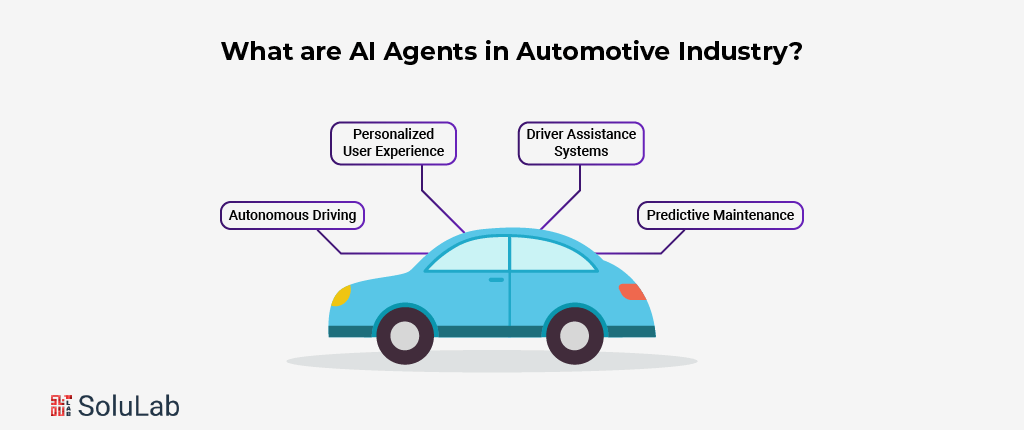
AI agents in the automotive industry are intelligent systems that can sense their surroundings, make decisions, and take actions to accomplish certain objectives. These agents can work autonomously or help human drivers, radically altering how vehicles work and interact with their surroundings.
- Autonomous Driving: AI agents in the automotive sector form the foundation of self-driving technology, allowing vehicles to move around without human involvement. They analyze data from a variety of sensors, including cameras, LiDAR, and radar, to gain insight into their surroundings and make real-time judgments.
- Driver Assistance Systems: Many modern automobiles include AI-powered technologies such as adaptive cruise control, lane-keeping assistance, and automatic emergency braking. These devices improve safety by assisting drivers in avoiding collisions and maintaining control of their vehicles.
- Predictive Maintenance: AI agents in automotive systems can evaluate vehicle data to predict possible faults and prescribe maintenance, thereby increasing vehicle reliability and minimizing downtime.
- Personalized User Experience: AI agents may gain information from driver behavior and preferences to provide personalized directions, entertainment, and vehicle settings.
Understanding AI agents in the automotive setting is critical for realizing their promise to transform transportation and improve road safety.
The Historical Evolution of AI in Automotive
The historical history of artificial intelligence (AI) in the automotive sector has been an intriguing path filled with key milestones and technological advancements.
- Early Days: The origins of AI in automotive may be traced back to the 1950s and 1960s when academics began to investigate the concepts of machine learning and automation. The early experiments concentrated on simple algorithms for guidance and control systems.
- Expert Systems: Expert systems were first introduced into the automotive industry in the 1980s. These systems used rule-based logic to help in decision-making processes, especially during diagnostics and maintenance. They laid the groundwork for future advanced AI applications, such as automobile artificial intelligence. The development of self-driving cars was a watershed moment in the 1990s. Projects such as Carnegie Mellon University’s Navlab and the DARPA Grand Challenge in the early 2000s showed the possibility of artificial intelligence in driving. These projects emphasized the relevance of computer vision, sensor fusion, and real-time data processing, preparing the way for artificial intelligence applications in the automotive industry.
- Machine Learning and Big Data: The 2010s saw the rise of machine learning and big data analytics. Automobile manufacturers began using massive volumes of data generated from vehicles to build AI systems. This time saw the introduction of modern driver-assistance systems (ADAS), which improved car safety and convenience features, illustrating the usage of artificial intelligence in the automobile industry.
- Current Trends: Artificial intelligence is being used in a variety of automotive applications, such as predictive maintenance, personalized in-car experiences, and completely autonomous driving. Companies such as Tesla, Waymo, and traditional automakers are making investments extensively in AI research and development to remain relevant in the changing market, with an emphasis on AI in automotive sector research paper and machine learning for the automotive industry.
Technologies Used for AI in the Automotive Industry
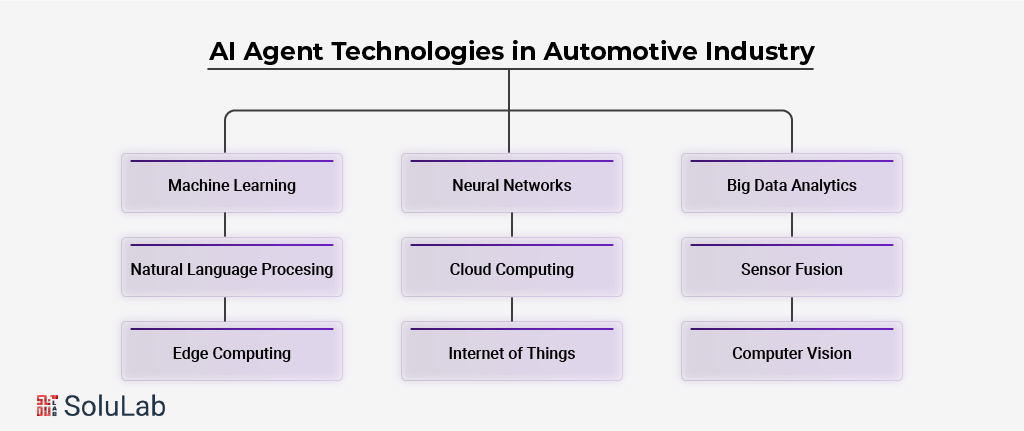
The development and implementation of AI agents for the automotive industry rely on a combination of advanced technologies. These technologies enable vehicles to perform tasks like autonomous driving, predictive maintenance, and personalized user experiences, making them smarter and safer. Here are the key technologies driving automotive AI agents:
1. Machine Learning (ML)
Machine learning is at the heart of AI systems in vehicles. It helps in analyzing vast amounts of data collected from sensors, cameras, and other systems to make real-time decisions. From recognizing traffic signs to detecting pedestrians, machine learning in automotive allows automotive AI agents to adapt and improve over time. Machine learning in transportation also optimizes route planning by analyzing traffic patterns, ensuring efficient and timely journeys. Additionally, it enhances energy management in electric vehicles, helping automotive AI agents improve battery performance and sustainability.
2. Computer Vision
Computer vision enables vehicles to “see” and interpret their surroundings by processing images and videos captured by cameras. This technology is crucial for autonomous vehicles, helping them identify road conditions, obstacles, and other vehicles. It also plays a role in advanced driver-assistance systems (ADAS) to enhance safety.
3. Natural Language Processing (NLP)
NLP powers voice recognition systems in vehicles, allowing drivers to interact with their cars using natural speech. From controlling navigation to adjusting vehicle settings, this technology enhances the user experience and supports hands-free operation.
4. Sensor Fusion
Sensor fusion combines data from multiple sensors, such as cameras, radar, lidar, and ultrasonic sensors, to create a comprehensive understanding of the vehicle’s environment. This integrated approach ensures that AI agents for the automotive industry can make accurate and reliable decisions, even in complex scenarios.
5. Edge Computing
Edge computing enables real-time data processing directly within the vehicle, reducing latency and dependence on cloud connectivity. This is essential for critical applications like collision avoidance, where split-second decisions are required.
6. Big Data Analytics
With the increasing connectivity of vehicles, massive amounts of data are generated every second. Big data analytics processes this information to identify patterns, predict maintenance needs, and optimize vehicle performance. Automotive AI agents use these insights to deliver a seamless driving experience.
7. Neural Networks
Neural networks mimic the human brain’s functioning, making them ideal for recognizing complex patterns and making decisions. They are widely used in autonomous driving systems to process data from various inputs and determine the best course of action.
8. Cloud Computing
Cloud computing supports the storage and processing of vast datasets, enabling AI models to be updated and refined continuously. It also facilitates vehicle-to-vehicle (V2V) and vehicle-to-infrastructure (V2I) communication, enhancing traffic management and safety.
9. IoT (Internet of Things)
IoT connects vehicles to a broader network of devices, enabling automotive AI agents to gather and share data. This connectivity supports smart features like predictive traffic management and over-the-air updates for AI models.
These technologies collectively empower AI agents for the automotive industry to deliver intelligent, responsive, and reliable solutions, impacting how vehicles operate and interact with their environment.

Core Characteristics of Smart AI Agents for Connected Cars
The use of AI in the automotive industry has led to the development of intelligent systems that enhance vehicle performance and safety. Here are the key characteristics that define these systems:
- Perception: Smart AI agents rely on sensors and cameras to collect detailed information about their surroundings. This includes identifying obstacles, interpreting traffic signs, and evaluating road conditions. Advanced perception technology enables real-time data analysis, helping vehicles respond effectively to changing environments.
- Decision-Making: These intelligent systems use complex algorithms to analyze the collected data and make well-informed decisions. By evaluating factors like speed, distance, and potential hazards, they determine the safest and most efficient actions. This capability is essential for ensuring smooth navigation while complying with traffic regulations.
- Learning and Adaptation: One of the most significant features of these AI agents is their ability to learn and adapt. By leveraging machine learning, they continuously improve their performance based on past experiences and new data. This includes incorporating methods like multi-agent reinforcement learning, enabling them to adapt to new environments and interact intelligently with other systems.
- Communication: Effective communication is a critical component of these systems, enabling vehicles to interact with other cars, infrastructure, and pedestrians. This is achieved through technologies like Vehicle-to-Everything (V2X), which enhances awareness and improves safety by sharing real-time information.
- Autonomy Levels: Smart AI agents operate across different levels of autonomy, ranging from basic assistance features to fully self-driving vehicles. The autonomy levels, as defined by the Society of Automotive Engineers (SAE), range from Level 0 (no automation) to Level 5 (full automation), showcasing the progressive capabilities of these systems.
- Safety and Reliability: Ensuring safety is a cornerstone of these AI systems. They are designed with redundant mechanisms and fail-safe protocols to minimize risks. Extensive testing and validation are conducted under diverse conditions to guarantee consistent and reliable performance.
These core characteristics underscore how smart AI agents are transforming connected cars, offering safer, more efficient, and adaptive driving experiences.
Management and Logistics Optimization for the Automotive Industry
The automotive industry depends on efficient management and logistics optimization to maintain smooth operations, reduce costs, and meet customer expectations. Advanced technologies, especially AI, have introduced innovative approaches like agentic RAG (Retrieval-Augmented Generation) to modernize logistics and supply chain practices, making them more efficient and sustainable.
1. Supply Chain Management
AI-driven tools allow automakers to monitor and optimize their supply chains in real-time. By analyzing data from multiple sources, these systems predict demand, detect potential disruptions, and provide actionable solutions. This ensures consistent availability of parts and materials while avoiding overstock or shortages.
2. Inventory Optimization
Effective inventory management is crucial in the automotive sector, where overstocking or delays can significantly affect profitability. AI-powered systems accurately forecast inventory needs, ensuring production lines remain active without excessive storage.
3. Fleet Management
AI and IoT technologies improve fleet management for logistics and distribution. These systems enable real-time tracking, route planning, and maintenance predictions, reducing downtime, lowering fuel consumption, and increasing operational efficiency.
Read Also: Retrieval-Augmented Generation (RAG) vs LLM Fine-Tuning
4. Route Optimization
Advanced algorithms analyze traffic, weather, and delivery schedules to find the most efficient routes for transporting goods. This reduces delivery times, transportation costs, and environmental impact.
5. Predictive Maintenance
AI-based predictive maintenance tools continuously monitor the condition of vehicles and machinery used in logistics. By identifying issues early, these tools minimize unexpected breakdowns and extend the lifespan of equipment.
6. Warehouse Automation
AI-powered automated warehouses streamline storage and retrieval processes. Automation reduces errors, enhances efficiency, and accelerates order fulfillment, improving the overall logistics workflow.
7. Sustainability Initiatives
AI supports green logistics by optimizing transportation networks to minimize emissions and energy use. It also improves recycling and waste management practices, helping the automotive industry align with sustainability goals.
AI and data analytics enable the automotive industry to achieve smarter, more reliable, and sustainable management and logistics processes, ensuring cost-effectiveness and better customer outcomes.
Improving Road Safety With AI Agents
The integration of responsible AI agents for the automotive industry has significantly enhanced road safety by enabling vehicles to make smarter and faster decisions. These systems leverage real-time data, advanced algorithms, and communication technologies to prevent accidents and protect both drivers and pedestrians.
1. Advanced Driver Assistance Systems (ADAS)
AI-powered systems like adaptive cruise control, lane-keeping assist, and automatic emergency braking are essential components in improving road safety. By using sensors and cameras, these technologies enable vehicles to detect and respond to potential hazards, reducing human error and fostering a safer driving experience.
2. Real-Time Data Analysis
Smart AI agents for connected cars analyze data from the vehicle’s surroundings, such as traffic patterns, road conditions, and pedestrian activity. Utilizing hybrid AI approaches—combining rule-based systems with machine learning models—these agents make split-second decisions, such as avoiding collisions or adjusting speed to match traffic flow dynamically.
3. Vehicle-to-Everything (V2X) Communication
AI systems facilitate communication between vehicles, infrastructure, and other road users through V2X technology. This enhances situational awareness, enabling vehicles to anticipate and react to dynamic road conditions, such as sudden stops or weather-related hazards, in a manner aligned with the principles of responsible AI.
4. Driver Monitoring
AI agents monitor driver behavior to ensure alertness and adherence to road safety standards. Features like fatigue detection and distraction alerts help prevent accidents caused by drowsy or inattentive driving. The use of hybrid AI ensures the system adapts to individual driver patterns while maintaining robust safety protocols.
5. Enhanced Traffic Management
AI systems optimize traffic flow by analyzing congestion patterns and suggesting efficient routes. By integrating responsible AI practices, these systems prioritize reducing accident risks and ensuring equitable traffic solutions, ultimately minimizing incidents caused by heavy congestion or sudden bottlenecks.
By employing hybrid AI methodologies, the automotive industry is advancing road safety, empowering vehicles to act as proactive safety agents, and creating a more secure and reliable transportation experience for everyone.
Role of AI Agents in Vehicle Design and Manufacturing
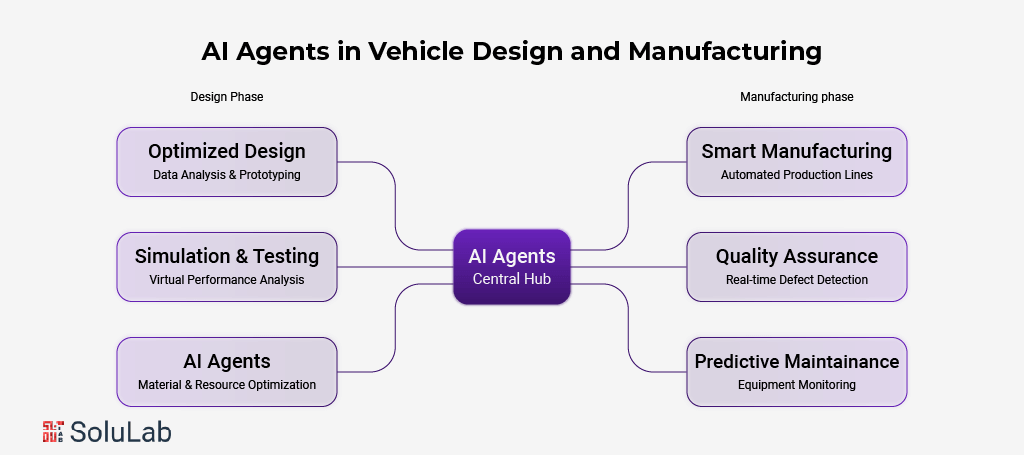
AI agents for the automotive industry are impacting how vehicles are designed and manufactured, driving efficiency, innovation, and cost-effectiveness. Automakers can streamline processes and create smarter, more sustainable vehicles by integrating advanced technologies like Retrieval Augmented Generation.
1. Optimized Design Processes
AI tools assist designers by analyzing large datasets, including customer preferences, market trends, and performance metrics. These insights allow AI agents for automotive enterprises to suggest innovative designs that meet both aesthetic and functional goals. Generative design, powered by AI, enables the rapid creation of multiple prototypes, reducing development time.
2. Simulation and Testing
AI systems simulate real-world conditions to test vehicle designs before production begins. By predicting performance, durability, and safety outcomes, manufacturers can identify and resolve potential issues early in the process, ensuring high-quality results while cutting costs.
3. Smart Manufacturing
In manufacturing, smart AI agents for connected cars enhance production lines through automation and real-time monitoring. Robotic systems equipped with AI can assemble components with precision, reducing errors and increasing efficiency. AI also ensures that production schedules are optimized, balancing supply and demand seamlessly.
4. Quality Assurance
AI agents play a crucial role in quality control by analyzing data from sensors and cameras on production lines. They can detect defects or inconsistencies in real-time, ensuring that only high-quality vehicles are delivered to customers.
5. Predictive Maintenance for Equipment
AI monitors the condition of manufacturing equipment, predicting when maintenance is needed to avoid unexpected downtime. This keeps production lines running smoothly and reduces operational costs.
6. Sustainability and Material Optimization
AI systems help manufacturers select sustainable materials and optimize their usage, reducing waste and environmental impact. By analyzing production processes, they identify opportunities to improve energy efficiency and minimize resource consumption.
The use of AI agents in vehicle design and manufacturing not only enhances efficiency but also fosters innovation, helping automakers deliver high-quality, advanced vehicles to meet the demands of the market.
Use Cases of AI Agents in the Automotive Industry
Software applications that use artificial intelligence to carry out activities on their own are known as AI agents. They are being incorporated into more and more industries, offering notable advantages in terms of production and efficiency. Here are some of the AI applications in automotive industry:
- Virtual Assistants: AI agents such as Google Assistant, Alexa, and Siri assist users with task management, question answering, and voice control of smart devices. Rapid Innovation can improve user engagement by creating personalized virtual assistants that are suited to certain company requirements.
- Customer Support: AI-powered chatbots that handle questions and fix problems around the clock without the need for human assistance are known as chatbots. Through effective support systems, our solutions can assist companies in lowering operating expenses while raising customer satisfaction.
- Personalization: In social media, streaming services, and e-commerce, AI agents examine user behavior to provide customized suggestions. Advanced customization techniques that boost sales and foster client loyalty can be used by Rapid Innovation.
- Autonomous Systems: AI agents operate robots and drones in sectors like manufacturing and logistics to automate procedures, increasing accuracy and speed. We can help clients implement self-sufficient solutions that lower labor expenses and increase production.
- Data Analysis: AI systems are capable of sorting through enormous information to find patterns and insights, which helps companies make strategic decisions. Our proficiency in data analytics can enable businesses to make wise choices that encourage expansion and creativity.
With projections indicating that the global AI market will reach $390 billion by 2025, the use of AI agents is expected to increase considerably. This expansion demonstrates how AI agents are being used more and more in a variety of industries, spurring efficiency and creativity.
Benefits of AI Agents in the Automotive Industry
The adoption of AI in automotive has brought transformative benefits to the industry, enhancing efficiency, safety, and user experiences. By integrating intelligent systems, automakers can address challenges across design, manufacturing, operations, and customer interaction while paving the way for sustainable and innovative solutions.
1. Enhanced Safety Features
AI-powered systems like advanced driver-assistance systems (ADAS) and autonomous driving technologies make vehicles safer for both drivers and pedestrians. Features such as lane-keeping assist, adaptive cruise control, and automatic emergency braking reduce accidents by minimizing human error. AI agents analyze real-time data from cameras and sensors, enabling vehicles to react quickly to unexpected situations on the road.
2. Optimized Manufacturing Processes
In manufacturing, AI in automotive improves production efficiency through automation and predictive analytics. AI agents monitor assembly lines, identify bottlenecks, and streamline workflows to increase productivity. They also ensure consistent quality by detecting defects in real-time, reducing waste and rework costs.
3. Personalized Customer Experience
AI agents enhance the driving experience by personalizing in-car systems. Voice assistants powered by natural language processing (NLP) allow drivers to control navigation, music, and climate settings seamlessly. AI also enables personalized recommendations for maintenance schedules and driving habits, creating a tailored experience for each user.
4. Efficient Fleet Management
For logistics and transportation enterprises, AI agents optimize fleet operations by analyzing data on fuel usage, routes, and vehicle conditions. AI-driven route planning reduces fuel consumption and delivery times, while predictive maintenance ensures fleet reliability.
5. Sustainability and Energy Efficiency
AI plays a crucial role in making the automotive industry more sustainable. By optimizing energy usage in electric vehicles (EVs) and reducing emissions through efficient route planning, AI contributes to greener transportation. It also supports the use of recyclable materials and reduces waste during manufacturing processes.
6. Improved Design and Innovation
AI in automotive design accelerates innovation by analyzing consumer preferences, market trends, and engineering constraints. Generative design powered by AI allows engineers to explore multiple design options quickly, ensuring vehicles are both functional and aesthetically appealing.
7. Advanced Traffic Management
AI agents improve traffic flow by analyzing real-time data from connected vehicles and infrastructure. This helps reduce congestion, shorten travel times, and minimize the environmental impact of idling vehicles.
8. Cost Savings
AI reduces operational costs across the automotive lifecycle. From optimizing manufacturing workflows to enabling predictive maintenance and improving fuel efficiency, these intelligent systems help automakers and users save money while maintaining quality.
The integration of AI in automotive continues to redefine the industry, offering solutions that enhance safety, efficiency, sustainability, and customer satisfaction. As technology changes, its role in shaping the future of transportation will only grow.
How to Implement AI in the Automotive Industry?
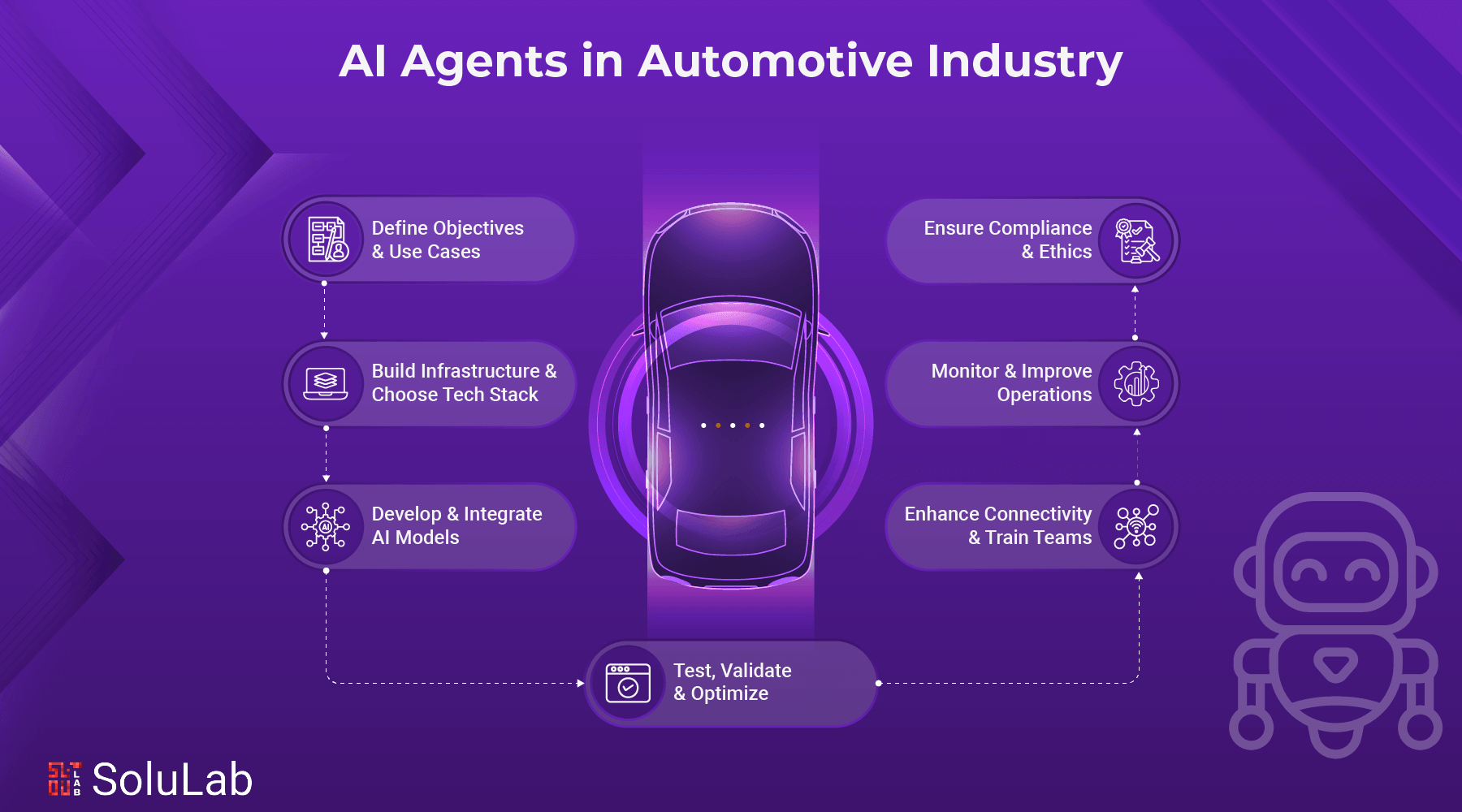
Integrating AI agents for the automotive industry requires a strategic approach that balances technological innovation with practical execution. Here’s a step-by-step guide to implementing automotive AI agents effectively:
-
Identify Objectives and Use Cases
Start by defining clear goals for implementing AI. Determine whether the focus is on enhancing safety, improving manufacturing efficiency, enabling autonomous driving, or personalizing customer experiences. For example, automotive AI agents can be used to develop advanced driver-assistance systems (ADAS) or optimize supply chain operations.
-
Invest in the Right Technology Stack
Select the appropriate technologies based on your objectives. This may include machine learning models for data analysis, computer vision for object detection, and natural language processing for voice-enabled systems. Ensure compatibility with existing infrastructure to minimize disruptions.
-
Utilize Data and Build Infrastructure
AI systems thrive on data. Collect and organize relevant datasets from sensors, cameras, and operational systems. Establish a robust infrastructure for data storage and processing, such as cloud-based platforms, to handle large volumes of real-time information.
-
Develop Custom AI Models
Train AI models tailored to the automotive application. For example, build machine learning algorithms for predictive maintenance or reinforcement learning models for autonomous vehicle navigation. Collaborate with AI experts and engineers to ensure these models address specific industry challenges.
-
Integrate AI Agents into Operations
Seamlessly incorporate automotive AI agents into existing processes. For instance:
- Use AI-driven robotics on production lines to improve efficiency.
- Implement AI-powered software for route optimization in logistics.
- Integrate in-vehicle AI systems for safety features like lane detection or adaptive cruise control.
- Test and Validate
Thoroughly test AI systems in simulated and real-world scenarios to ensure reliability and safety. For critical applications like autonomous driving, perform extensive validation to meet regulatory standards and customer expectations.
-
Enhance Connectivity and Communication
AI agents benefit from interconnected systems. Enable Vehicle-to-Everything (V2X) communication for real-time data exchange between vehicles, infrastructure, and other devices. This improves decision-making and enhances safety features.
-
Train Employees and Stakeholders
Educate employees, technicians, and stakeholders about the new AI systems. Provide training on using, maintaining, and troubleshooting AI-based solutions. This ensures smooth adoption and maximizes the benefits of the technology.
-
Monitor and Improve
Post-implementation, continuously monitor the performance of AI agents for the automotive industry. Collect feedback, analyze results, and refine the systems based on evolving needs and technological advancements.
-
Prioritize Regulatory Compliance and Ethics
Adhere to industry regulations and ethical standards throughout the implementation process. Ensure transparency, data privacy, and safety to build trust among customers and stakeholders.
Implementing AI in the automotive industry is a transformative process that requires careful planning, collaboration, and innovation. By following these steps, businesses can effectively use automotive AI agents to transform their operations and offerings.
Challenges and Limitations of AI in the Automotive Industry
The integration of AI in automotive brings significant advancements but also presents notable challenges. One major issue is the high cost of development and deployment, requiring substantial investment in data infrastructure, advanced technology, and skilled personnel. Smaller enterprises often struggle to afford these resources, limiting their ability to adopt AI agents for automotive enterprises. Additionally, AI systems depend on vast amounts of high-quality data, and any inaccuracies or biases in this data can lead to unreliable decision-making, especially in critical areas like autonomous driving. Handling complex, real-world scenarios such as extreme weather or unusual road conditions remains a significant technical hurdle for artificial intelligence in vehicles.
Another challenge lies in cybersecurity and regulatory compliance. As vehicles become increasingly connected, they face greater risks of cyberattacks, necessitating robust protective measures to safeguard sensitive data and vehicle systems. At the same time, navigating diverse and evolving regional safety and privacy regulations can slow the implementation process. Ethical concerns, such as programming AI to make life-or-death decisions in emergencies, further complicate development. Public skepticism about these technologies, coupled with a lack of trust in their safety and reliability, adds to the difficulties in achieving the adoption of AI-driven innovations. Overcoming these limitations will require collaboration among automakers, regulators, and technology providers to ensure AI systems are safe, reliable, and accessible to all.
Conclusion
AI agents are redefining the automotive industry, bringing efficiency, safety, and innovation to every corner of the sector. From improving production processes to enabling smarter vehicles with autonomous driving and personalized experiences, these intelligent solutions are transforming how we move and interact with technology. By minimizing downtime, enhancing safety, and optimizing vehicle performance, AI agents are driving the future of transportation, making it more reliable and connected.
At SoluLab, we help AI development companies in the automotive industry utilize AI agents to stay ahead of the curve. SoluLab helped Turboplus improve its e-charging app by adding key features for iOS and Android. We developed charging station mapping, charging status, and remote charger control. Our contributions improved user experience, making EV charging and efficient artificial general intelligence enabling us to develop intelligent, adaptive systems that enhance the performance and sustainability of electric vehicles. Contact us to learn how we can help you overcome these challenges and drive innovation in the electric vehicle industry.
FAQs
1. What are AI agents in the automotive industry?
AI agents in the automotive industry are intelligent systems that use artificial intelligence to perform tasks such as autonomous driving, predictive maintenance, and optimizing vehicle performance. These agents can analyze data, make decisions, and interact with users to improve overall efficiency and safety.
2. How do AI agents contribute to autonomous driving?
AI agents play a key role in autonomous driving by processing data from sensors, cameras, and GPS to make real-time decisions. They enable vehicles to detect obstacles, follow traffic rules, and navigate complex environments safely without human intervention.
3. Can AI agents improve vehicle maintenance?
Yes, AI agents can monitor a vehicle’s condition in real time, predict potential issues, and alert owners before breakdowns occur. This predictive maintenance reduces downtime and repair costs while ensuring optimal vehicle performance.
4. How are AI agents used to enhance the driving experience?
AI agents enhance the driving experience by offering personalized in-car services like voice assistants, entertainment recommendations, and navigation aids. They also adjust settings such as seat position, climate control, and music preferences based on the driver’s habits and preferences.
5. What is the future of AI agents in the automotive industry?
The future of AI agents in the automotive industry includes advancements in fully autonomous vehicles, smarter traffic management systems, and enhanced safety features. AI will also play a significant role in electric and connected vehicles, transforming the way we interact with transportation.

