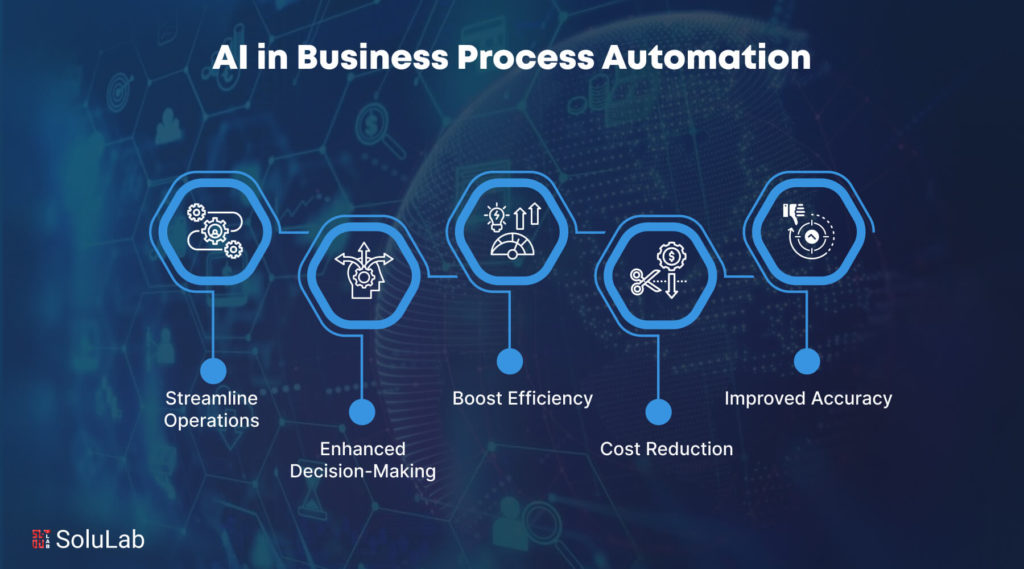
AI in business process automation takes the monotonous work off people’s plates, freeing employees to spend time on more strategic tasks while improving accuracy, processing speed, decision-making, and cost savings along the way.
Business process automation (BPA) and artificial intelligence (AI) are two technologies reshaping what modern business looks like. As businesses chase clarity, efficiency, and creativity, the case for combining the two keeps getting stronger.
Putting AI into BPA can deliver real cost savings. Amazon’s investment in AI and robotics cut operational costs by 25% at its Shreveport fulfillment center. In this blog, we’ll walk through AI in business process automation use cases, benefits, challenges, and more.

AI and BPA: Complementary Technologies
Artificial Intelligence (AI) and Business Process Automation (BPA) have their own distinct strengths, but they overlap in several important places: business enhancement, automation, data dependency, integration, scalability, ongoing evolution, and decision-making support. Worth pointing out, though: they’re not the same thing. BPA is built around rule-based automation, while AI covers more advanced ground like machine learning and computer vision. Combine the two, and you get a synergistic effect that opens up business potential and pushes innovation forward.
Use Cases Of AI In Business Automation
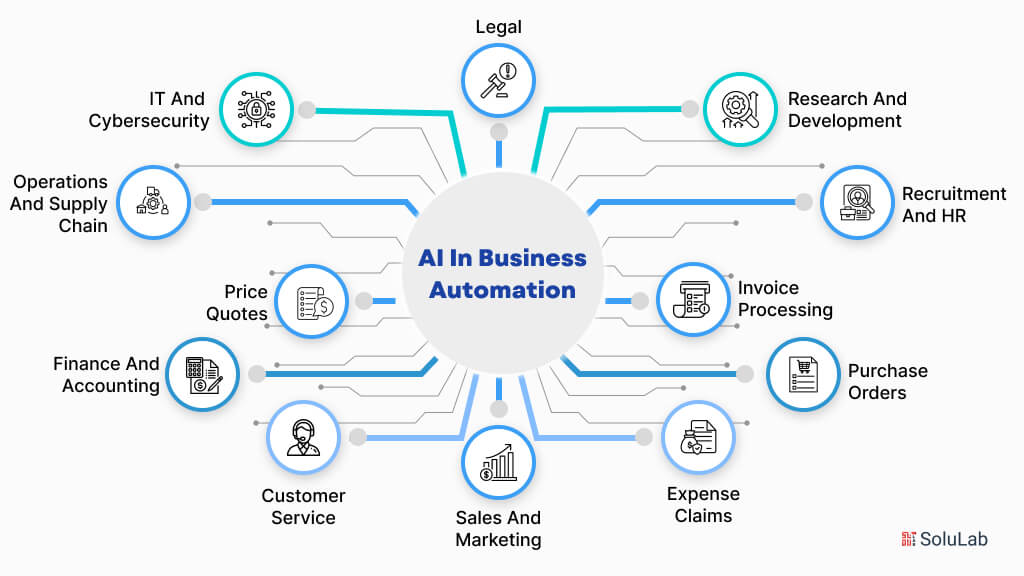
In business today, AI and BPA get put to work across several important AI use cases, including:
1. Research And Development:
AI plays a real role in automating R&D work across sectors. It helps with idea generation and innovation by analyzing market trends, consumer behavior, and competition. It can automate project management tasks like scheduling, resource allocation, and progress tracking, keeping teams coordinated. It also automates the collection and analysis of market data, customer feedback, and competitor information, which feeds directly into strategic decisions for R&D.
2. Recruitment And HR:
AI can reshape HR by streamlining onboarding, job ads, compliance checks, timesheet tracking, exit interviews, and performance management. That frees HR teams to focus on things like employee training, culture, and wellness programs instead of paperwork. Key AI agent in HR include automating resume screening, improving the onboarding experience, and using predictive analytics to spot early signs of turnover so retention efforts can start sooner. Done well, AI helps HR teams move faster, work smarter, and build a better employee experience.
3. Invoice Processing:
Automated invoice processing cuts manual errors and speeds things up. BPA systems can pull relevant invoice data, automate approval workflows, tie AI into ERP systems, run three-way matching, handle exceptions, and keep an audit trail. That frees the accounts team to focus on higher-priority work, tightens financial accuracy, and makes audits and compliance simpler. To accelerate digitization, finance teams can standardize invoice layouts and line-item fields before feeding them into OCR/RPA workflows. For SMEs without a full ERP, free resources can jumpstart this effort, with customizable invoice templates for Excel that include formula-driven subtotals/totals, professional formatting, and printable layouts. A consistent template means fewer errors during data capture, faster approvals, and cleaner datasets for AI-driven analytics.
4. Purchase Orders:
AI powered RFx and automated business process software give procurement a real boost by digitizing purchase order forms and connecting them straight to databases. That kills off manual data entry, cuts repetitive work, and improves both accuracy and speed. Key wins here: automated data entry, real-time inventory updates, smoother vendor communication, expense tracking, and budget management. The end result is fewer errors, more transparency, stronger supplier relationships, and real cost savings up and down the supply chain.
5. Expense Claims:
An automated expense management system simplifies expense reporting and keeps things aligned with company policy. It handles submission and approval of claims, automates policy compliance checks, gives real-time tracking and visibility, and helps catch fraud through data analytics. On the budget side, BPA automates workflows for budget approvals, which streamlines financial planning and cuts manual busywork. All of it adds up to more accuracy, saved time, and more transparency in expense and budget management.

6. Sales And Marketing:
BPA brings real gains to sales and marketing by automating tasks and putting resources where they matter most. On the sales side, automation speeds up price quoting and approvals, which means faster deal closures and happier customers. On the marketing side, it powers automated email campaigns, lead scoring, and nurturing, which lifts engagement, conversion, and revenue. It also streamlines time-off requests, giving employees an easy way to submit them and see where they stand in the approval process. Put together, BPA solutions boost operational efficiency, sharpen the customer experience, and drive better business outcomes.
7. Price Quotes:
Automation upgrades the quoting process, generating and sending price quotes fast for managerial review. That speeds things up, improves the customer experience, and supports real-time pricing for ecommerce, custom quotes for services, and tiered pricing for bulk orders. The same software automates discount approvals too, keeping everything aligned with the company’s pricing strategy. Net result: a smoother quoting process, happier customers, and a better shot at closing the sale.
8. Customer Service:
AI-driven tools are reshaping customer service. Chatbots handle instant answers to common questions, virtual assistants give personalized help, automation streamlines ticket management, and sentiment analysis pulls insight straight out of customer feedback. All of that boosts engagement, lifts satisfaction, and frees human agents to focus on the harder problems. Done right, AI gives businesses a more efficient, more proactive customer service experience that builds loyalty and drives growth.
9. Finance And Accounting:
AI has meaningfully sharpened the efficiency and accuracy of financial processes. AI-driven expense management systems automate submission, categorization, and reimbursement, cutting down on discrepancies and tightening compliance. AI in finance also speeds up invoice processing by pulling relevant data, automating approval workflows, and cutting manual handling down to size. On top of that, AI can flag anomalies in expense reports and catch unusual spending patterns, protecting financial integrity. And by analyzing historical data, market trends, and outside factors, AI algorithms produce forecasts that help businesses make informed calls and sharpen their financial strategy.
10. Operations And Supply Chain:
AI in supply chain plays a real role across industries by improving demand forecasting, inventory optimization, and fleet management. In retail, AI-driven demand forecasting uses historical data and outside factors to predict product demand accurately, which lets retailers dial in inventory levels and keep customers happier. In manufacturing, AI helps optimize inventory by analyzing production data and supplier lead times, cutting down excess stock and stockouts alike. In transportation, AI-driven predictive maintenance reads vehicle sensor data and historical records to predict component failures before they happen, keeping fleets running and cutting unplanned repairs. Across all three, the payoff looks the same: better decisions, lower costs, and smoother operations.
11. IT And Cybersecurity:
Gen AI in cybersecurity plays a real role in strengthening cybersecurity and streamlining IT operations. It offers real-time threat detection, behavioral analysis for catching threats early, rapid response to phishing incidents, services such as automated patch management, efficient troubleshooting help, and smart ticket routing and prioritization. These AI-driven tools let organizations respond fast to cybersecurity threats, cut downtime, and run IT support more efficiently, which ultimately strengthens security posture and business resilience.
12. Legal:
AI in legal is reshaping the legal industry by automating and streamlining large parts of legal work. It speeds up contract review by scanning legal documents for key terms, conditions, and potential issues. AI-powered document automation streamlines the creation of legal documents, generating drafts from predefined templates. In M&A transactions, AI helps review extensive documentation and flag potential legal risks, speeding up due diligence. It also supports efficient contract lifecycle management by automating various stages, improving compliance, and cutting the risk of disputes. Put AI to work in these areas and legal teams get more efficiency, fewer errors, and more time for the complex, strategic work that actually needs a human.
Read Also: AI Observability
How To Implement AI In Business Processes?
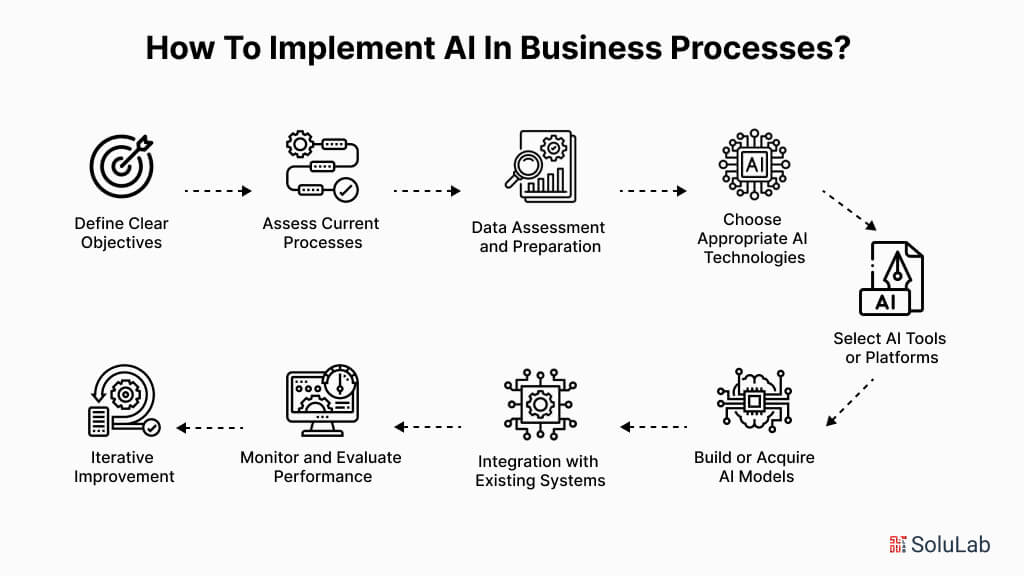
Getting AI into your business processes takes a strategic approach if you want it to actually pay off. Here’s a general playbook for making that integration work:
- Define Clear Objectives: Spell out exactly what you’re trying to achieve with AI, whether that’s improving efficiency, cutting costs, sharpening customer experience, or gaining an edge on competitors. Clear objectives keep your automation efforts pointed at your actual strategic goals instead of drifting.
- Assess Current Processes: Take stock of existing processes to find where AI can move the needle most. Look for repetitive tasks, data-heavy operations, or areas ripe for optimization. Understanding the real benefits and identifying concrete use cases helps you zero in on what actually matters.
- Data Assessment and Preparation: AI runs on data, full stop. Check the quality, quantity, and accessibility of yours. Make sure it’s clean, organized, and actually reflects the processes you want to automate. Solid data governance is non-negotiable here.
- Choose Appropriate AI Technologies: Pick the right technology for the job, whether that’s machine learning, natural language processing, computer vision, or some mix of the three. The choice should track your business goals and the nature of the process you’re automating.
- Select AI Tools or Platforms: Depending on your resources and needs, pick tools or platforms that fit, anywhere from pre-built solutions to custom builds. A lot of cloud providers now bundle AI services you can plug straight into your existing infrastructure.
- Build or Acquire AI Models: Going custom means training models on relevant data to make predictions, classifications, or automate tasks. Or you can start from pre-trained models and customize them for your specific needs instead of building from scratch.
- Integration with Existing Systems: Make sure AI slots cleanly into your existing systems. That usually means working with IT to connect AI tools to databases, applications, and other infrastructure without breaking what already works.
- Monitor and Evaluate Performance: Put monitoring in place to track how your AI applications are actually performing using performance management software. Check regularly whether the AI is meeting business goals and adjust as needed, whether that means refining models, updating data, or tweaking algorithms based on real-world feedback.
- Iterative Improvement: AI implementation is never really “done.” Use feedback from users and performance metrics to keep improving your AI applications over time. Stay on top of advances in AI technology that could push your processes even further.
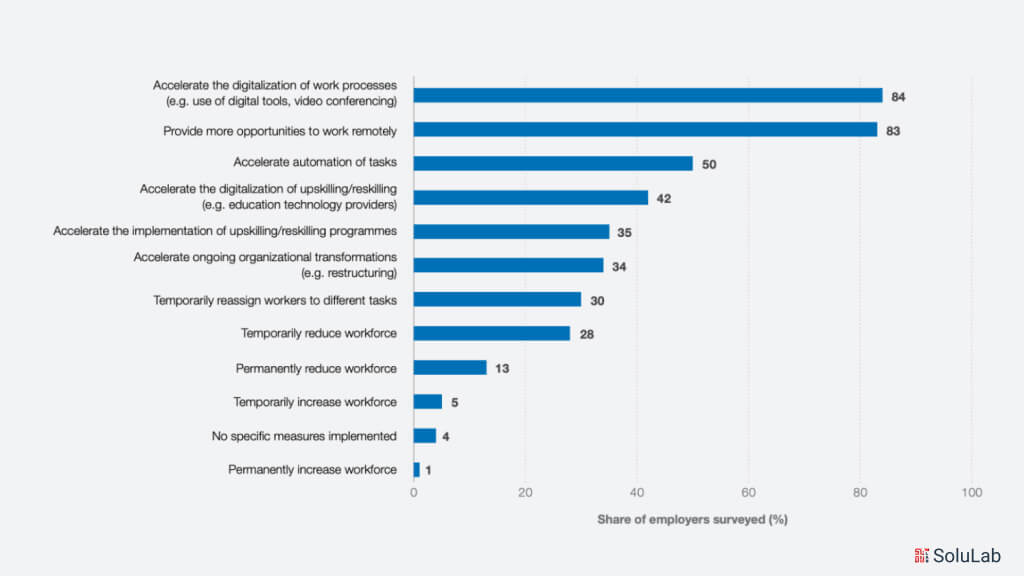
Benefits of AI in Business Automation
AI and BPA together create something bigger than either alone, value that reaches across revenue generation, cost control, customer satisfaction, and brand growth. Weave AI into your automation strategically, and you position the business for long-term growth and innovation in a genuinely competitive market.
A handful of important use cases show up again and again once you pair AI’s capabilities with BPA. Here’s what those look like:
1. Enhancing Revenue Streams
Every business wants to grow revenue and keep it growing. Common levers: attract more customers, boost sales, roll out new products or services, adjust pricing. Using AI and BPA to automate sales and marketing can move that needle meaningfully. CRM platforms streamline lead management, while AI in banking and AI-powered chatbots hand out personalized recommendations that open up more sales. Invoicing tools speed up billing, and predictive analytics helps forecast sales, so businesses can make informed calls and optimize revenue streams instead of guessing.
2. Decreasing Operational Expenses
Tightening operations, automating what you can, and offloading non-essential functions are the core moves for businesses trying to cut costs and grow profit. BPA plays a big part here by automating routine tasks, which frees up resources and sharpens efficiency. workflow automation tools can generate real savings by streamlining processes and cutting out manual labor. AI-driven finance applications also surface insights into spending patterns, helping businesses spot where to cut and make decisions backed by data instead of guesswork.
3. Boosting Customer Satisfaction
Success comes down to keeping customers happy. High-quality products, exceptional service, and genuinely listening to feedback matter most. AI-powered chatbots can deliver round-the-clock support, quick issue resolution, and recommendations tailored to the customer. Automating order fulfillment through CRM tools also gives an integrated view of the customer, enabling the kind of personalized interaction that builds satisfaction and loyalty.
4. Increasing Brand Recognition
Building a strong business means building a strong brand alongside it. That takes marketing, a sharper online presence, and a consistently positive brand image. AI and BPA can meaningfully support this by refining marketing strategy and boosting online visibility. Tools for social media management and SEO can improve both the quality and reach of website content. AI-powered sentiment analysis lets businesses read customer reactions accurately, leading to communication that’s more targeted and more personal.
5. Expanding Market Share
To gain an edge, expand, or merge, growing market share matters. AI and BPA offer real insight into customer behavior and sharpen operational efficiency, both of which feed directly into market share growth. AI-powered analytics tools spot where growth is possible, and supply chain management software simplifies working with suppliers. BPA helps businesses stay competitive and claim more of the market.
6. Fostering Innovation
Innovation keeps a business competitive. Doing it well means genuinely understanding customer demand across every feedback channel available. AI and BPA play a real role here by surfacing insight and uncovering opportunities nobody’s tapped yet. AI-powered analytical tools can scrutinize customer feedback to spot potential new products that actually match what people want. BPA software, meanwhile, streamlines processes, cuts inefficiencies, and raises quality. Put the two together and you get an environment that’s actually built for innovation and operational efficiency.
7. Automating Routine
AI-driven business process automation cuts down manual tasks and reduces errors, which boosts efficiency across the board. AI algorithms handle data processing and analysis at speeds humans simply can’t match. That same automation lifts employee productivity too, freeing up time for the strategic and creative work that actually needs a person. AI-powered business automation tools give employees real help with data analysis, research, and decision-making, letting them make informed choices and push growth forward.
8. Facilitating Seamless Integration
Where tools and technology matter most, AI-powered business process automation solutions stand out for how cleanly they fit with other systems and tools. From CRM systems and ERP software to project management platforms, these solutions slot into existing systems without much friction, working across different platforms at once. That means businesses can improve existing workflows without a total overhaul, sharpening operations and squeezing out more efficiency.
9. Driving Continuous Improvement
Businesses stay competitive by weaving AI into how they automate. AI solutions scale naturally, handling growing workloads and adapting as business needs shift. They also keep learning and improving over time, optimizing processes for better results as they go. That’s what keeps a business current and sets it up for long-term success.
10. Optimizing Resource Allocation
Bringing AI into business process automation sharpens how resources get allocated and used. AI-driven automation lets businesses monitor inventory, forecast demand, and optimize logistics, all of which adds up to better resource utilization. AI tools read historical data to anticipate what’s coming, improving inventory management, demand forecasting, and logistics along the way. The payoff: lower costs and higher productivity.
11. Improved Decision Making
AI-powered business process automation helps businesses make sharper decisions through advanced analytics and machine learning. By processing large datasets, AI surfaces patterns and turns them into actionable insight, supporting data-driven, predictive, real-time decisions. That kind of automation improves accuracy, cuts down human error, and supports strategic planning, letting organizations respond fast to whatever the market throws at them. With AI-driven insight behind them, businesses can make calls that actually drive better outcomes and lasting success. Bring AI and business process automation together and you get flexible solutions across revenue growth, cost optimization, customer satisfaction, brand building, market expansion, and innovation, all pointed toward sustainable growth and a real competitive edge.
Challenges and risks of AI business process automation
Bringing artificial intelligence (AI) into business process automation (BPA) opens the door to real efficiency gains. But this kind of technological leap comes with its own set of challenges and risks worth taking seriously.
- Data Security and Privacy Concerns:
AI systems run on huge amounts of data, often including sensitive details about customers, employees, and business operations. That raises real questions about data security and privacy. Without solid security measures, that data becomes vulnerable to unauthorized access, theft, or misuse, and the fallout can mean financial losses, reputational damage, and legal trouble. Organizations need strong data encryption, access controls, and intrusion detection to keep that information protected.
- Workforce Adaptation and Training:
AI-powered BPA solutions often shift what employee roles and responsibilities look like, pushing workers to adapt to new technology and new tasks. That’s a real challenge for employees without much tech background or limited access to training. Organizations need to invest in solid training programs so employees can actually understand and run AI systems, plus clear communication that addresses fears about job displacement and career growth head-on.
- Ethical Considerations:
AI systems can end up carrying forward biases baked into the data, leading to decisions that aren’t exactly fair. An AI-powered resume screening tool trained on biased data, for instance, might unfairly discriminate against certain groups without anyone intending it. Organizations need to carefully weigh the ethical implications of AI in business process automation and put measures in place to catch and reduce bias. That means clear ethical guidelines, regular bias audits of AI business process automation systems, and a way for users to actually push back on decisions that seem biased.
- Lack of Human Oversight:
Leaning too hard on AI without human oversight leads to errors and missed context. AI systems aren’t infallible, and they can get things wrong because of bad data, flawed algorithms, or scenarios nobody planned for. Skip the human oversight, and those errors can go unnoticed with real consequences. Organizations need to treat AI for business process automation as a decision-making aid, not a replacement for human judgment, with clear roles for people to step in and correct course when needed.
- Integration Challenges:
Getting AI solutions to work inside existing systems and workflows can get messy fast. AI systems often need specialized hardware, software, and data formats that don’t always play nicely with legacy systems. Organizations need to plan AI business process automation projects carefully, weighing data compatibility, system interoperability, and user experience. Adequate training and support for users matters just as much, so they can actually adapt to the new AI-enabled systems and workflows instead of fighting them.
Future Of AI in Business Process Automation
As AI keeps reshaping business process automation, a handful of trends are deciding where it goes next. Advances in AI technology, natural language processing, computer vision, and deep learning among them, will sharpen communication, analysis, and decision-making. Pairing AI with the Internet of Things (IoT) will bring smart devices and predictive maintenance into the picture. AI and Robotic Process Automation (RPA) will build more intelligent robotic systems. AI-driven predictive analytics will optimize resource planning and strategic decisions. Autonomous decision-making systems will execute tasks and make data-driven calls on their own. AI’s democratization will put advanced tools within reach of smaller businesses too. Hyper Automation, an extension of what AI can already do, will automate multiple processes at once and build comprehensive automation frameworks. Together, these trends point toward more efficiency, more personalization, and better decisions across industries. As adoption picks up speed, AI’s transformative potential in business process automation will keep pushing toward a more automated, more intelligent future. Partnering with an AI consulting company can help businesses navigate these shifts and actually capture the upside.
Conclusion
AI in Business Process Automation is changing how businesses operate, cutting costs while boosting efficiency at the same time. Automate the repetitive tasks, optimize the workflows, and organizations free themselves up to focus on innovation and growth, while AI-powered solutions unlock new levels of performance and customer satisfaction.
To get the most out of AI in your operations, partnering with an experienced AI development company matters. If you’re looking to hire AI developers who can tailor solutions to your specific needs, SoluLab brings the expertise to help businesses implement advanced AI technologies that actually drive success and innovation.
FAQs
Bhavya is driving growth through data-backed demand generation for AI and Web3 solutions. With 9+ years in digital marketing, he has spearheaded initiatives that led to a 40% increase in qualified inbound leads. Bhavya shares insights on marketing ROI and scaling a digital presence via AI workflows. He is open to connecting with startups and enterprise teams to help them overcome their challenges.