Almost everything runs through a screen now. Which makes one old question surprisingly hard to answer: are you actually the person you claim to be? Know Your Customer, or KYC, is how banks, fintechs, and plenty of other businesses try to settle it. They check identities to block fraud, satisfy regulators, and give users a reason to trust them with money.
And the honest version of the story? Legacy KYC is slow, costs a fortune, and is not even especially safe. Blockchain KYC is the answer a lot of teams have landed on. It moves identity checks onto a shared ledger, so verification runs faster, holds up under scrutiny, and leaves an audit trail nobody can quietly edit. The timing works in its favour, too.
| Statista puts the digital identity verification market on track to reach $18 billion by 2027 , while the blockchain market is expected to hit $39.7 billion globally by 2025. |
Two curves pointing the same way. KYC blockchain is not a passing fashion; it is where identity verification is headed. Businesses are already bringing in blockchain KYC companies in the USA to tighten security, pull cost out of every check, and keep pace with rules that seem to shift every other quarter.
What Is Blockchain-Based KYC?
Blockchain KYC is a decentralized way of doing identity checks. Rather than parking customer records inside private systems that a bank or a trading platform happens to own, a KYC blockchain writes that information to a distributed ledger. The data sits encrypted. It cannot be rewritten after the fact. And it only moves when the person it belongs to says yes.
Blockchain smart contracts do the heavy lifting here. They are small automated programs that verify a customer, apply the compliance rule that applies, and log every step as it happens. The result is a KYC/AML process that runs in real time instead of over several weeks, with better security and a much smaller bill.
Why KYC Needs Innovation?
Traditional Know Your Customer workflows are showing their age. They hold businesses back and they annoy the people being verified.
Here’s what’s wrong with the old way:
- Verifying a single customer can drag on for as long as 30 days.
- People upload the same passport scan again and again, platform after platform.
- Businesses spend $60 to $80 per user on KYC checks, sometimes more.
- Personal information sits in centralized databases, which makes leaks and identity theft a standing risk.
So companies have started moving their KYC onto blockchain technology. With blockchain KYC verification, the whole thing gets quicker, cheaper, and harder to attack.
Instead of one honeypot database, blockchain KYC companies spread the record across a decentralized network. Users end up owning their own verified identity and reusing it across platforms rather than starting from zero each time.
That is not a tweak to the old model. It is a different model. Blockchain based KYC hands control back to the person being verified, and the experience gets noticeably less painful along the way.
How Does Blockchain Improve KYC Processes?
Put blockchain inside the KYC/AML process and a lot of the familiar headaches stop being headaches. Five reasons why:

1. Immutability
Write something to a blockchain KYC system and it stays written. No edits, no deletions, no quiet corrections six months later. What you get is a tamper-proof record of customer data that fraudsters cannot rewrite and that regulators and businesses can actually rely on. Immutability is one of the strongest benefits of using a KYC DLT System.
2. Transparency for Regulators
Every verification lands on the ledger in a form a regulator can follow. When an examiner asks for compliance records, pulling them is a query rather than a two-week scramble across four departments. That goes a long way with authorities, and it keeps blockchain KYC systems inside the legal lines they have to stay within.
3. User Ownership of Data
In the old arrangement, copies of your documents live at every institution you ever signed up with. On a blockchain based KYC platform, the customer holds the private keys and decides who gets to look. Privacy improves and there is simply less data lying around to be misused. Finance and healthcare feel this most, because that is where the records are most sensitive.
4. Automation Using Smart Contracts
Blockchain smart contracts can take over most of the routine checking. For example, the moment a user uploads their documents, a contract can validate the data on the spot instead of routing it to an analyst queue. Less waiting, fewer typos, lower cost. It also scales, which matters enormously for blockchain KYC companies onboarding thousands of people at once.
5. Higher Security with Cryptography
Identities live on the blockchain based KYC platform in encrypted form. Stealing or altering them is a far taller order than raiding a conventional KYC database, where one set of admin credentials can undo everything. That gap in protection is a big part of why so many blockchain development companies in USA have moved secure identity management to the top of their roadmap.
Key Features of Blockchain KYC Systems
Blockchain KYC systems are rewriting how businesses verify people. These are the features that make them worth the migration:
1. Reusable Digital Identity
Verify once, reuse everywhere. Nobody has to photograph the same driving licence for the fifth time this year, because an already-verified digital identity can be shared securely with any approved institution. Onboarding gets shorter and users stop dropping out halfway through.
2. Permissioned Access
The data is decentralized rather than pooled in one vault, and the user decides who is allowed to read it. Access runs through permissioned layers, so only vetted parties, a blockchain consulting company in the USA or a regulated financial institution, for instance, ever see the underlying documents.
3. Fraud Detection with AI Agents
Add AI and blockchain to the stack and odd behaviour gets flagged the moment it appears, not in next month’s review. These models watch the KYC workflow continuously, which is exactly when fraud is cheapest to stop.
4. Global Regulatory Compliance
A bank in Europe, an insurer in Asia, a fintech in the UAE: each answers to a different rulebook. Blockchain KYC systems are built to carry local and international KYC/AML processes side by side, which is what keeps a cross-border operation from maintaining five separate compliance stacks.
Top blockchain development companies already run most of these features in production across finance, insurance, and healthcare blockchain solutions.
The payoff shows up in three places at once: operations get more efficient, costs come down, and compliance risk stops being the thing that keeps the chief risk officer awake. Customer data ends up better protected as a side effect.
Top Benefits of Blockchain KYC for Businesses
Move to blockchain KYC and the gains are the measurable kind, for the business and for the people it onboards:
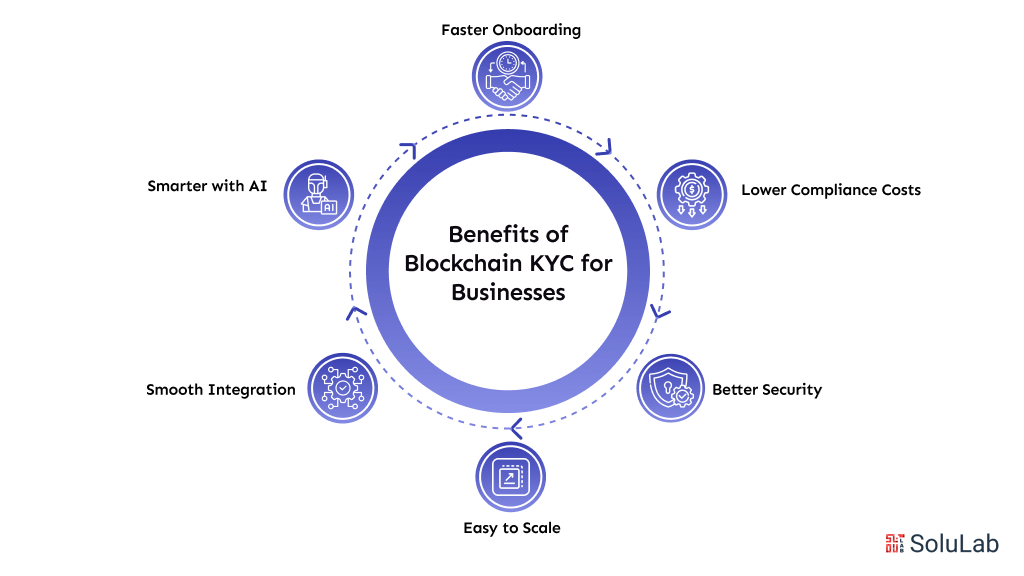
1. Faster Onboarding
Decentralized verification is quick verification. Onboarding time can fall by as much as 90%, and anyone who has watched sign-up funnels knows what that does to conversion.
2. Lower Compliance Costs
Conventional KYC burns money and calendar time in roughly equal measure. Using Blockchain as a Solution for KYC can take 40% to 50% off compliance spend, which is why financial services firms, crypto exchanges, and e-commerce platforms keep showing up on the adopter list.
3. Better Security
Data spread across a decentralized network gives an attacker no single door to kick in. Hacking, leaks, tampering: all of it gets considerably harder. As ways to hold sensitive customer information go, few are safer right now.
4. Easy to Scale
Grow into a new country and the rulebook changes with it. Blockchain KYC companies USA can adjust the system to fresh regulations and requirements without a rebuild, so expansion does not turn into a compliance project.
5. Smooth Integration Across Platforms
Blockchain smart contracts and Layer 1 and Layer 2 systems talk to each other properly. Verified data travels between platforms without anybody being asked to prove who they are all over again.
7. Smarter with AI
Layer on AI in finance and AI workflow automation and the whole pipeline sharpens. Fraud patterns get predicted instead of discovered, manual review shrinks to the genuinely ambiguous cases, and trust in the output goes up.
Top 5 Companies Developing Blockchain KYC Solutions
Five companies doing the interesting work in blockchain KYC and digital identity verification:
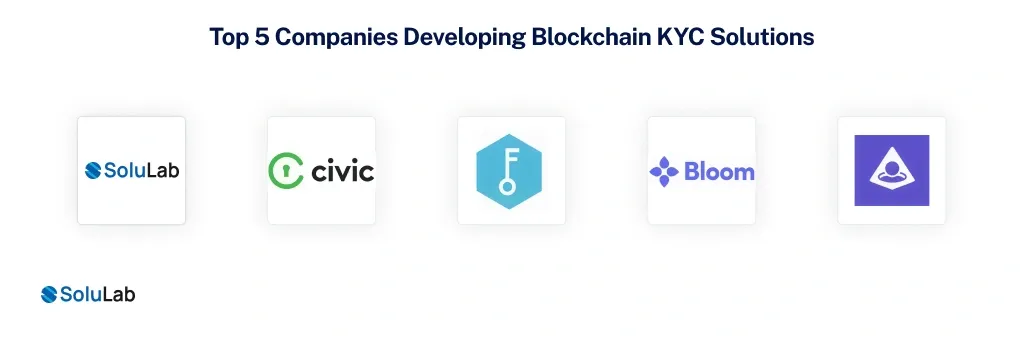
1. SoluLab
SoluLab is a top-rated blockchain development company in the USA, and its KYC work pairs blockchain with AI agent technology rather than treating the two as separate projects. The builds target e-commerce and finance, where compliance pressure and onboarding friction collide hardest.
2. Civic
Civic runs identity verification through mobile apps that ordinary people can actually operate. Blockchain-based KYC underneath, full user control of the data on top, KYC requirements still met.
3. SelfKey
SelfKey is a decentralized KYC identity system for individuals and companies who want to manage, control, and share their own information. It was designed from the start to work across many platforms and services rather than inside one.
4. Bloom
Bloom builds privacy-first credit scoring and digital identity. AI plus blockchain smart contract logic keeps user data protected while verifications still come back instantly.
5. uPort
uPort is an open-source identity platform on Ethereum. Users manage and verify their identity straight on chain, and the centralized middleman disappears from the picture entirely.
Behind most of these products sits specialist engineering help, often a smart contract development company brought in to get the thing shipped.
Key Use Cases Across Industries
1. Banking
Banks run identity checks in real time on blockchain KYC instead of waiting on a slow third-party verifier. Speed is the obvious win; regulatory compliance is the quieter one. Verified customer data can also be stored and passed between branches and internal systems without anyone emailing a scanned passport again.
2. Healthcare
Healthcare blockchain companies use blockchain KYC systems to confirm that a patient is who the chart says they are. Tie medical records to a verified identity through blockchain smart contracts and two old problems shrink at once: mixed-up patient data and outright fraud.
3. E-commerce
Marketplaces reach for AI-powered chatbots when they need sellers and buyers onboarded fast. The bots handle identity onboarding through blockchain KYC utility, running verification against blockchain KYC companies solutions so operations keep moving and compliance holds.
4. Insurance
Insurers are wiring AI in finance into KYC blockchain systems to take the friction out of claims. Verified customer data is available on demand, so there is less paperwork, less room for a fraudulent claim to slip past, and a better experience for the honest majority. New policyholders get onboarded faster too, through a KYC with AI and blockchain.
5. Crypto
Anyone looking to start a cryptocurrency exchange gets a lot out of a blockchain based KYC platform. Verification happens on the spot against records nobody can doctor. That is how an exchange earns trust, meets global compliance standards, and keeps its trading environment clean.
Token-based identity models are catching on as well. Built on asset tokenization and backed by secure blockchain based KYC platforms, they give finance, healthcare, e-commerce, and everyone else a different way to think about digital identity.
The Future of Blockchain KYC solutions
So what lands next? Several shifts are already underway, and none of them are speculative:
1. Smarter KYC with AI agents
Capable AI agents working alongside blockchain will take customer verification in real time, cutting the waiting and the misreads. Faster KYC, tighter KYC, with far less of it touched by hand.
2. Cross-Chain Identity Systems
As multi-chain vs. cross-chain designs mature, one verified identity will hold good across several blockchain platforms at once. Run the KYC DLT systems once, not once per chain.
3. Web3 Integration
Web3 development companies are carrying KYC blockchain systems into the decentralized internet, where users keep more privacy and more say over their own data. Call it Web3-ready blockchain KYC utility.
4. Self-Sovereign Identity (SSI)
You own your digital identity outright. No middleman holds it for you. Plenty of blockchain KYC companies have been aiming at this for years, and parts of it are shipping now rather than someday.
5. Regulatory-Ready Blockchain KYC
Governments are adapting, slowly but genuinely. AI development companies and blockchain companies in USA are building alongside them, aiming for KYC that is secure, scalable, and defensible in front of a regulator.
Add it all up and the KYC of the next few years looks decentralized, efficient, and fully digital.

Final Thoughts
Blockchain KYC has moved past the pilot stage. As KYC blockchain solutions mature, businesses get a way to verify users that is quicker, harder to compromise, and still defensible under global regulation. The teams that get stuck are usually the ones treating it as an IT upgrade instead of a change in who holds the data.
Looking at decentralized KYC, or trying to build an onboarding flow with AI that people will actually trust? SoluLab, top blockchain development company, does this work. Smart, secure platforms with real AI agent integration built in.
Book a free consultation and let’s map out what your blockchain-based KYC platform should look like.
FAQs
Shipra Garg is a tech-focused content strategist and copywriter specializing in Web3, blockchain, and artificial intelligence. She has worked with startups and enterprise teams to craft high-conversion content that bridges deep tech with business impact. Her work translates complex innovations into clear, credible, and engaging narratives that drive growth and build trust in emerging tech markets.