Talk to an Expert

How Can Blockchain Enable Green Real Estate Platforms in the UAE?

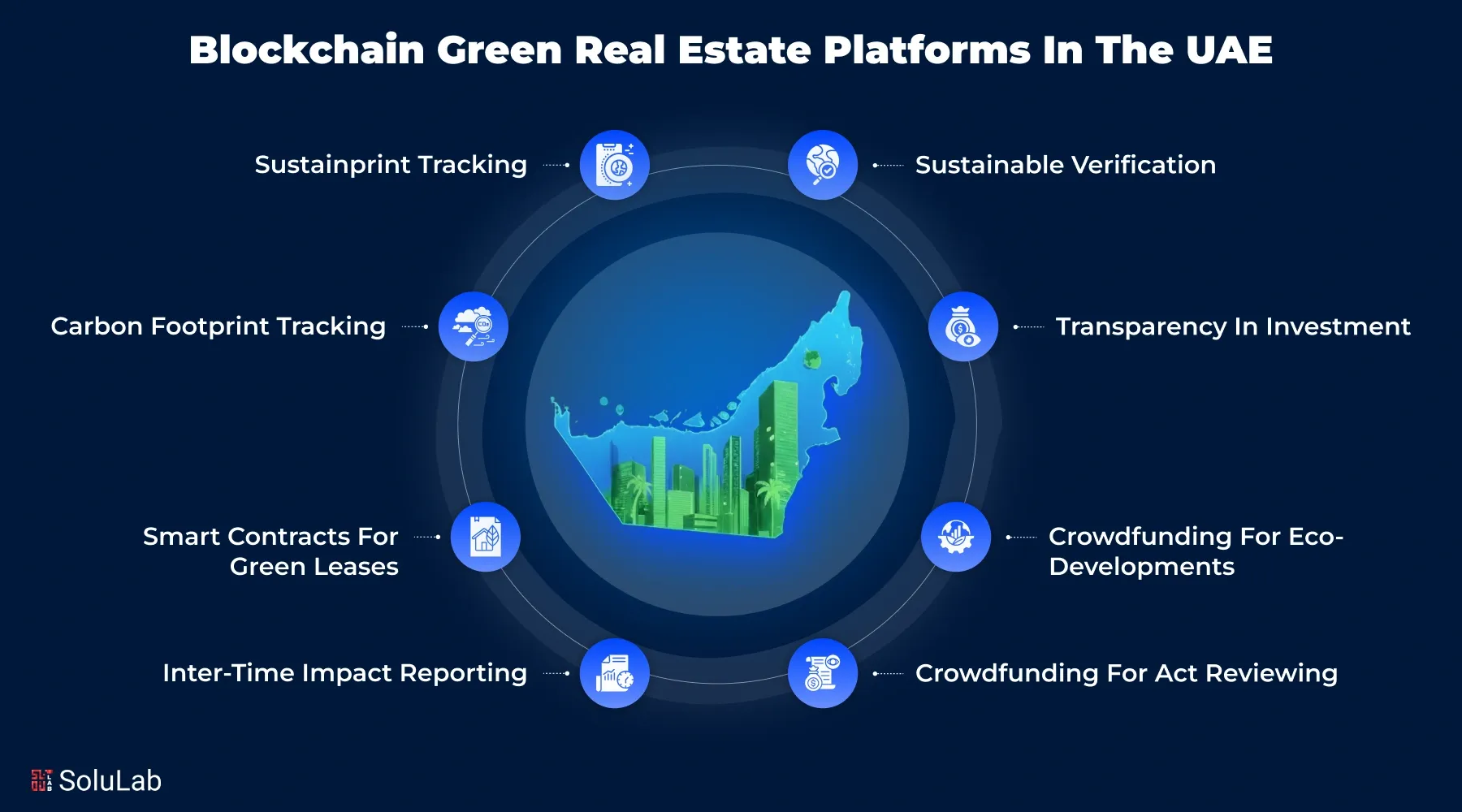
Blockchain Green Real Estate Platforms in the UAE

Dubai’s real estate market is shifting from bold architecture to measurable sustainability. UAE strategies: UAE Vision 2021, the Energy Strategy 2050, and Dubai Clean Energy Strategy 2050 are directing towards green real estate growth. 

Also, landmark projects like Masdar City and The Sustainable City demonstrate how blockchain plays a key role in sustainable real estate enhancement. 

UAE climate-forward development looks like: energy-efficient design, extensive water recycling, and integrated renewable systems. With blockchain technology support UAE is trying to reduce emissions and build sustainable real estate.  

Key Takeaways

  • Through green real estate, you can reduce its environmental footprint, especially in a sector responsible for nearly 40% of global CO₂ emissions.
  • Blockchain technology strengthens sustainable real estate in the UAE by providing verifiable data to get certificates like LEED and Estidama. 

Dubai’s Green Real Estate Market Is Entering Its Next Phase

Dubai is shifting from basic green initiatives to data-driven, digitally monitored, and finance-ready sustainability models. This new phase is powered by technologies like AI-based energy optimization, IoT-driven real-time monitoring, blockchain for water management, and Web3-enabled ESG verification, ensuring every sustainability claim is backed by transparent, tamper-proof data.

  • Market evolution emphasizes continuous performance data rather than single-point green features on buildings.
  • Investors now reward verified operational savings and transparent ESG reporting when pricing assets and risk.
  • Green buildings are becoming essential because the real estate sector is responsible for nearly 40% of global CO₂ emissions. Of this footprint, 70% comes from building operations, and 30% comes from construction activity.
  • The UAE aims for net-zero emissions by 2050, increasing pressure on developers and investors to adopt sustainable practices.
  • Developers who embed monitoring and measurement early gain certification advantages and faster project approvals.

CTA1

Why Is Blockchain Becoming a Must-Have for Green Real Estate Platforms?

Blockchain combines immutable records, real-time data flows, and programmable rules, a strong match for sustainability needs. And Dubai is not an exception to using blockchain and AI for futuristic growth. With this integration in the green real estate sector verification, automation of tasks, and compliance quickens.

  • Buildings with verified green credentials command 7-10% higher rental premiums.
  • Verified performance also reduces insurance premiums by 5–15% for compliant buildings.
  • Increase the installed clean energy capacity from 14.2 GW to 19.8 GW by 2030
  • Efficient blockchain-enabled systems can reduce operational energy costs by 20–30%.

 Below are the concrete benefits written as solution-focused statements for business readers.

Ensures transparent tracking of sustainable real estate materials and provenance

Blockchain in supply chain events is immutable; developers can prove origin, certifications, and recycled content.

  • Verifiable material origin reduces greenwashing and supports certification audits quickly and reliably for regulators worldwide.
  • Immutable supplier records speed up procurement approvals and lower disputes between contractors and buyers.
  • On-chain provenance enables faster, clearer claims for recycled or low-carbon construction materials.

Makes compliance and certification straightforward with verifiable evidence

Certifications like LEED and Estidama require proof. Therefore, blockchain integration comes into the picture: to store audit trails and performance data for easy verification.

  • On-chain documentation simplifies audits and reduces the administrative time required for certification submission and review.
  • Automated evidence pulls lower manual reconciliation and provides assessors with clean, tamper-proof files.
  • Continuous performance logs demonstrate compliance over time, improving certification renewal outcomes and investor confidence.

Automates payments and approvals to reduce project delays

Smart contracts execute payments, incentives, and warranty releases automatically when predefined performance or delivery milestones are met.

  • Smart contracts reduce payment disputes and accelerate cash flow for real estate contractors and suppliers working on green measures.
  • Milestone-based automated disbursements improve trust among stakeholders and shorten project timelines substantially.
  • Programmable incentives align subcontractors with sustainability real estate outcomes, improving delivery quality and schedule adherence.

Enables verified carbon accounting and blockchain carbon credits

Immutable energy and emissions records permit credible carbon accounting and creation of tradable, verifiable carbon credits.

  • On-chain emissions ledgers create trusted data for carbon credit minting, sale, and retirement processes.
  • Verified carbon credits open new revenue lines and funding options for developers and building owners.
  • Transparent carbon accounting supports investor due diligence and strengthens environmental claims for assets.

Strengthens investor trust through tamper-proof sustainability performance

Investors need credible, auditable data. Blockchain solutions deliver a single source of truth for operational performance and ESG metrics.

  • Tamper-proof performance data reduces perceived investment risk and supports better pricing for green assets.
  • Clear audit trails make underwriting simpler and shorten investment committee review cycles.
  • Transparent metrics help asset managers report reliably to stakeholders and regulatory requirements.

Applications of Blockchain in Sustainable Real Estate Development, UAE 
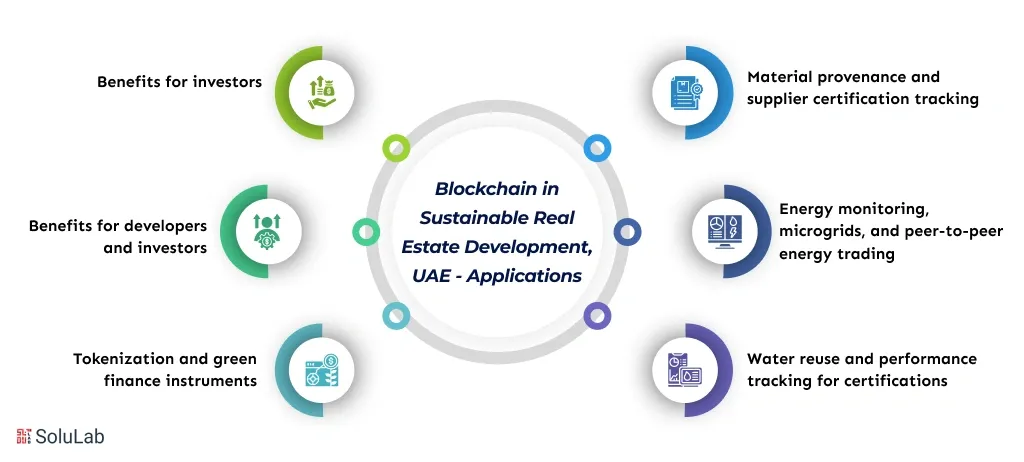
Blockchain in Sustainable Real Estate Development, UAE - Applications

Blockchain trends can be woven into multiple use cases across design, construction, operations, and finance. Each application drives business outcomes and supports Dubai’s sustainable real estate development targets. Luxury under a safe environment is the main action in the UAE’s Net Zero Emission 2050. 

1. Material provenance and supplier certification tracking

Record every supply event on-chain from quarry to site, enabling verifiable material claims and faster approvals.

  • Traceable supply chains reduce procurement friction and help validate low-carbon or recycled material claims instantly.
  • On-chain supplier ratings encourage sustainable sourcing through market visibility and accountability.
  • Integration with certification bodies speeds acceptance of innovative eco-materials in projects.
  • Material transparency matters because 30% of real estate emissions come from construction.

2. Energy monitoring, microgrids, and peer-to-peer energy trading

Combine smart meters with blockchain to record production, consumption, and enable direct trading of surplus renewable energy.

  • Real-time energy data on-chain enables automated billing, settlement, and renewable energy tracking.
  • Microgrid settlements reduce system losses and let owners monetize excess solar generation reliably.
  • P2P trading supports local resilience and creates tangible returns from embedded renewables.

3. Water reuse and performance tracking for certifications

Log greywater and rainwater recycling performance to prove water efficiency gains and support Estidama or local regulations.

  • On-chain water performance evidence simplifies the demonstration of targeted freshwater reductions during certification.
  • Reliable water data supports operational optimization and tenant engagement programs for conservation.
  • Measured savings improve asset valuation and unlock water-focused green financing instruments.

4. Tokenization and green finance instruments

Fractional ownership and tokenized green assets expand investor pools and enable new funding for sustainable development.

  • Tokenized assets increase liquidity for green projects and diversify capital sources for developers.
  • Blockchain-enabled green bonds or sukuk can deliver automated interest and environmental reporting.
  • Fractional ownership attracts smaller investors into high-quality, certified sustainable real estate.

5. Benefits for developers and investors

Blockchain reduces barriers to green building delivery and improves margins through automation and better capital access.

  • Verified operational savings of 20–30% increase long-term competitiveness.
  • Buildings with verified credentials achieve 7–10% higher rental premiums.
  • On-chain data improves financing access due to transparent sustainability performance metrics.

6. Benefits for investors

Investors gain clearer signals on risk, verified sustainability returns, and optional liquidity from tokenized instruments.

  • 10 to 15% operational savings increase the predictability of cash flows and support stronger valuation models.
  • Transparent ESG records reduce compliance risk and simplify reporting to limited partners or institutions.
  • Tokenization creates exit options and fractional exposure to high-quality green assets. 

Implementation Roadmap of Blockchain in Green Real Estate in Dubai

Adopt a phased, pragmatic roadmap that aligns policy, certification needs, and operational targets. Start small, prove value, then scale.

Pilot and data foundation

Deploy smart meters, integrate building management systems, and record baseline data on a permissioned chain.

  • Pilots show measurable energy and water savings and validate smart contract workflows before wider rollout.
  • Establish data governance, privacy controls, and stakeholder access rules to ensure regulatory compliance.
  • Use pilot results to refine KPI definitions used for certifications and investor reporting.

Green certification and finance integration

Connect on-chain performance to certification processes and green finance instruments like green sukuk or bonds.

  • Link verified performance to finance triggers and automate reporting for lenders and rating agencies.
  • Enable tokenization pilots for fractional investment and test secondary market liquidity options.
  • Scale supplier onboarding to include provenance data for major building materials across projects.

Sustainable real estate ecosystem scale and marketplace

Open access to a broader set of developers, auditors, and investors to create network effects and liquidity.

  • Create standardized on-chain data models and APIs for seamless integration across PropTech platforms.
  • Launch a marketplace for verified carbon credits, green certificates, and tokenized assets to attract global capital.
  • Embed automated compliance and reporting as standard operating procedure across new developments.

Future of Blockchain-Powered Green Real Estate Development in Dubai

The long-term outcome is a resilient real estate ecosystem where sustainability is measurable, financeable, and valuable. Buildings will be judged by continuous performance, not claims. 

Companies that combine design excellence with verified operational data will command premiums and easier financing. Investors will favor assets with immutable sustainability proofs. Dubai, with clear national targets and leading projects, is well-positioned to lead this transition.

  • Verified performance will become the baseline for asset valuation and investor decision-making across the UAE.
  • Blockchain carbon credits and tokenized assets will unlock new capital and monetize sustainability outcomes.
  • Early adopters will gain regulatory headroom, faster certification, and stronger market positioning.
  • AI-powered green real estate will take a new shape in the coming days. 

Conclusion

Dubai’s real estate sector is entering a new era where sustainability is no longer optional. As mentioned above, blockchain supporting green real estate is adding a long list of benefits to businesses. Tokenization, carbon credits, and real-time ESG reporting will only accelerate the UAE’s moves towards its Net Zero 2050 target.

At SoluLab, we help in developing blockchain platforms for material provenance, smart contracts, certification automation, tokenization, and carbon accounting. Whether you plan to build a green real estate platform, integrate energy monitoring, introduce tokenization, or automate LEED/Estidama reporting. Our expert blockchain developers can build solutions for:

  • Up to 40% lower operational and administrative costs by replacing paper-heavy processes with secure blockchain transactions. 
  • Enterprise-grade blockchain APIs built for real estate, asset management, and green building platforms.

If you are ready to accelerate your sustainable real estate business in the UAE, contact us today to make your vision come true!

FAQs

1. How much does it cost to build a blockchain-powered green real estate platform?

Costs typically start from $10k. Most projects fall between moderate MVP budgets and enterprise-level investments, depending on certification, tracking, and automation needs.

2. How long does it take to develop a blockchain-based green real estate solution?

Most platforms take 2–4 months, depending on complexity, required integrations, certification workflows, smart contracts, and data pipelines.

3. How do carbon credits and green real estate reduce operational costs?

Verified performance improves resource efficiency, enabling 20–30% energy savings while generating revenue through carbon credits, lowering long-term operating expenses.

4. Why should I choose SoluLab for blockchain-enabled green real estate development?

SoluLab offers deep PropTech experience. It has blockchain experts and proven experience with sustainability tracking, tokenization, and certification automation. 

5. Is a blockchain-based green real estate platform secure?

Yes. Blockchain ensures tamper-proof data, encrypted transactions, permissioned access, and decentralized verification, providing a highly secure environment for sustainability and compliance workflows.
 

Why Dubai, London & New York Lead in Real Estate Tokenization?

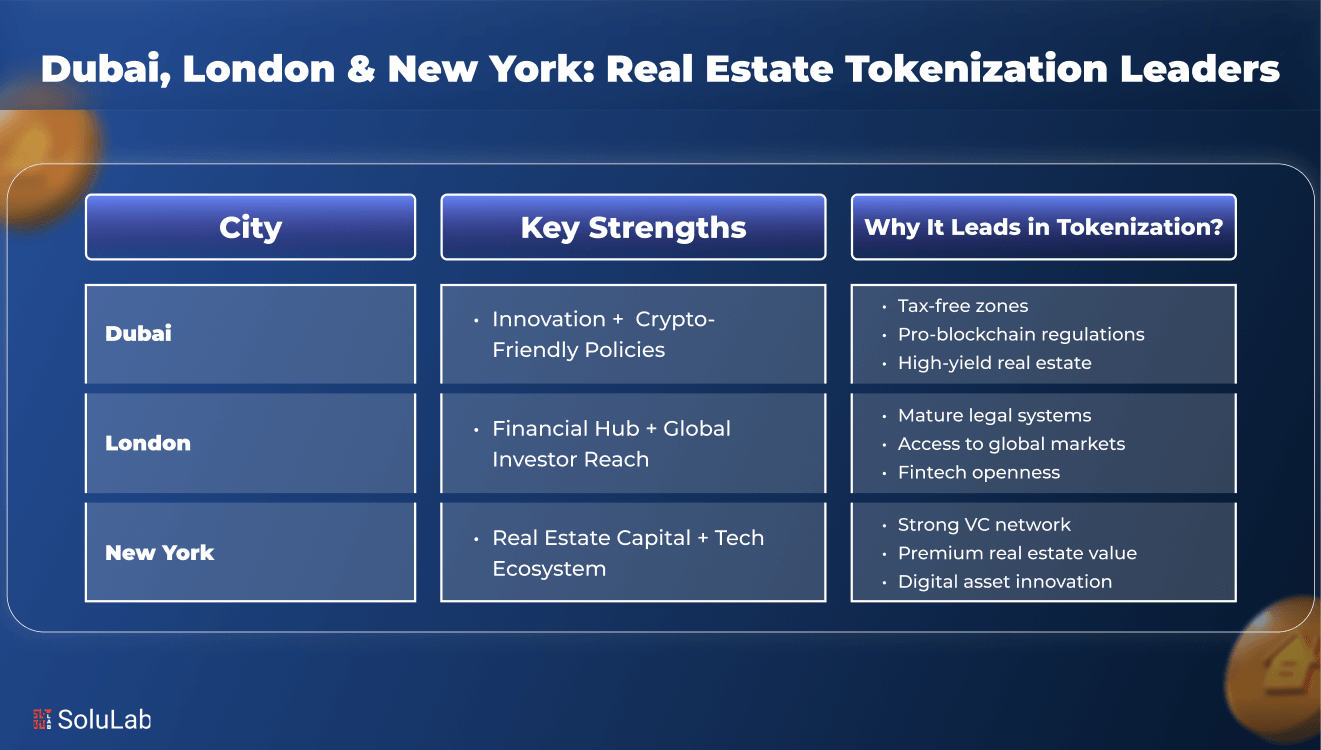
Dubai, London & New York_ Real Estate Tokenization Leaders

In 2025, Real Estate Tokenization is no longer a future concept; it’s already changing how the world buys, sells, and invests in real estate. According to Deloitte, tokenized real estate transactions are expected to surpass $4 billion by 2026, showing how fast the industry is growing.

Many developers, real estate firms, and investment companies are turning to tokenization of real estate assets to increase liquidity, reduce entry barriers, and attract global investors. With the right platform and strategy, property owners can fractionalize real estate and open up new revenue streams while staying compliant with evolving global regulations.

Whether you’re a real estate developer, a proptech startup, or an institutional investor, this guide will help you understand the opportunity and how to tap into it with the right tech and partners.

Why is Real Estate Tokenization Transforming Global Markets?

Real estate tokenization is changing the way businesses and investors handle property ownership. Instead of buying an entire property, investors can now own small digital shares of it. This approach, known as fractional ownership, makes it possible to invest in high-value real estate with much smaller amounts.

Through asset tokenization, real estate is turned into digital tokens on a blockchain. These tokens can be bought, sold, or traded, helping previously illiquid properties become easy to access and transfer.

This shift also boosts transparency and liquidity. Every transaction is recorded securely on the blockchain, giving businesses and investors more confidence.

More importantly, blockchain ensures compliance. Built-in KYC/AML processes verify users and track funds, making transactions safer and aligned with global regulations.

CTA1

Why Dubai, London & New York Are the Top 3 Cities for Real Estate Tokenization?

Choosing the right city to launch your real estate tokenization platform matters. Regulation, investor demand, and technology support play key roles. Here’s why Dubai, London, and New York lead the way in this fast-growing space.

1. Dubai

Dubai is leading the region in the tokenisation of real estate in the UAE. Government bodies like DIFC and ADGM have created regulatory sandboxes and clear frameworks that support digital assets. If you’re planning tokenized real estate developments in Dubai, this is one of the safest and most innovative environments.

Working with an experienced asset tokenization company in Dubai helps you stay compliant while reaching both local and global investors. Dubai is especially ideal for developers, investment firms, and proptech startups exploring fractional ownership and global liquidity.

2. London

London remains a stronghold for global finance, and now it’s blending that strength with blockchain and Web3. Leading tokenization companies in London are creating hybrid models that meet institutional standards while integrating modern digital infrastructure.

The city’s financial ecosystem supports an enterprise-grade real estate tokenization platform, making it a top pick for launching or expanding in the UK and Europe. Our team offers full support through our in-house Web3 development company and smart contract development company, so your platform can scale securely and legally.

3. New York

New York is where traditional finance and blockchain truly converge. Wall Street firms are already investing in real estate on-chain. Many are actively working to develop your real estate tokenization platform in New York as part of their digital transformation strategies.

Partnering with experienced tokenization companies in New York City ensures your platform meets U.S. legal standards and connects with high-value investors. Whether you’re building for commercial, residential, or REIT-based assets, New York offers both reach and trust.

Factor Dubai London New York
Regulatory Support Strong government backing via DIFC & ADGM sandboxes; pro-crypto stance Clear guidance evolving through the FCA; crypto is regulated under broader financial laws Strict but clear compliance under SEC, FinCEN, and state-level rules
Innovation & Technology Blockchain-first policies; early mover in tokenisation of real estate in the UAE Mature Web3 landscape with strong ties to legacy tech stacks Rapidly advancing with tech investments from Wall Street and large institutions
Access to Investors Growing global and regional investor interest, especially from Asia & GCC Access to institutional capital, VCs, and European property investment funds Home to high-net-worth investors, REITs, and U.S.-based funds
Ease of Market Entry Sandbox frameworks simplify testing and compliance Supportive but requires local partners for full compliance High legal barriers; requires strong local legal and compliance advisors
Ideal For Developers, tokenization startups, mid-sized real estate firms Institutional players, family offices, fintech, and proptech firms Large platforms, REITs, and established real estate investment funds
Tokenization Use Cases Fractional ownership, cross-border real estate investment Institutional-grade asset tokenization, cross-asset platforms Digitized securities, REITs, and commercial real estate tokenization
Local Expertise Availability An asset tokenization company in Dubai and a crypto-friendly talent pool High-quality tokenization companies in London, Web3, and legal experts Access to leading tokenization companies in New York City with finance and tech experience
Regulatory Speed & Flexibility Agile and proactive Balanced, evolving regulations Structured but less flexible; strict U.S. laws

What a Tokenization Platform Needs to Succeed in Dubai, London & New York?

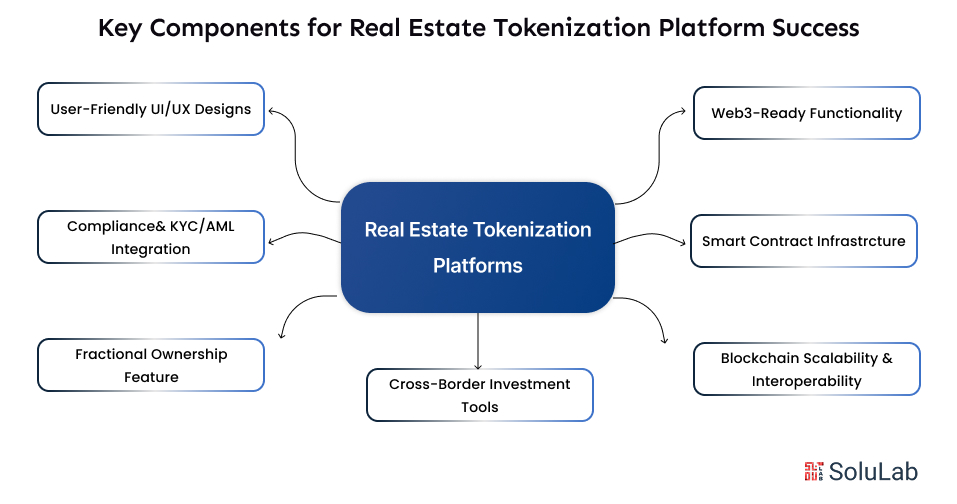
Key Components for Real Estate Tokenization Platform Success

If you’re planning to build a real estate tokenization platform, success in global cities like Dubai, London, or New York requires more than just a great idea. You need a solid foundation with the right technology, compliance features, and investor-friendly tools. Here’s what your platform must include:

1. Compliance & KYC/AML Integration

To operate in these cities, your platform must include KYC/AML processes that meet local regulatory standards. These help build trust with investors and ensure you meet legal requirements in Dubai, the UK, and the US.

2. Smart Contract Infrastructure

Operate with an experienced smart contract development company to create secure, transparent contracts that automate property transfers, dividends, and investor rights. Smart contracts are the backbone of safe and reliable real estate tokenization.

3. Blockchain Scalability & Interoperability

Your platform should be able to scale and operate across multiple blockchains. A trusted Blockchain Development Company can build a multi-chain architecture that supports a wide range of blockchains in the Real Estate ecosystem, making it future-ready and flexible.

4. Fractional Ownership Features

Integrate fractional ownership so users can buy and sell smaller portions of high-value properties. This opens access to more global investors and boosts liquidity on your platform.

5. User-Friendly UI/UX Design

A clean and easy interface matters. Work with a team that ensures smooth onboarding, dashboard navigation, and seamless property browsing for both issuers and investors. A good real estate tokenization development company will offer this as part of its service.

6. Web3-Ready Functionality

Partner with a Web3 development company to include wallet integration, DAO governance, staking, or even NFT support if needed. Web3 features can increase engagement and future-proof your platform.

7. Cross-Border Investment Tools

For platforms targeting Dubai, London, or New York, it’s critical to include multi-currency support, local compliance layers, and access to regional property databases. This makes your platform adaptable to different jurisdictions.

So, if you are looking for a solution, let’s build a platform that your investors trust and your competitors can’t match.

Read Also: How to Select the Best Crypto Development Company in the UAE?

What Is the Cost of Entering These Markets?

Building a successful real estate tokenization platform involves both technology and compliance costs.

  • Platform development: Typically starts from USD 50,000 and beyond, depending on features like smart contracts, investor dashboards, secondary market support, and wallet integration.
  • Regulatory & legal setup: Jurisdictions like the UAE, UK, and USA each have different licensing, KYC/AML processes, and legal frameworks.
  • Timeline to launch: On average, it takes 6 to 12 months to go from MVP (Minimum Viable Product) to full go-live.

Partnering with a proven real estate tokenization development company ensures faster execution, reliable compliance, and seamless integration. Teams that also specialize as a DeFi development company can help you enable token liquidity, secondary trading, and fractional investment, all crucial for scaling your tokenized assets globally.

For best results, work with a full-stack team that covers everything from smart contract development, blockchain infrastructure, and real estate tokenization services to platform deployment and investor onboarding.

Read Blog: Daos in Real Estate Tokenization

How to Build a Competitive Real Estate Tokenization Platform?

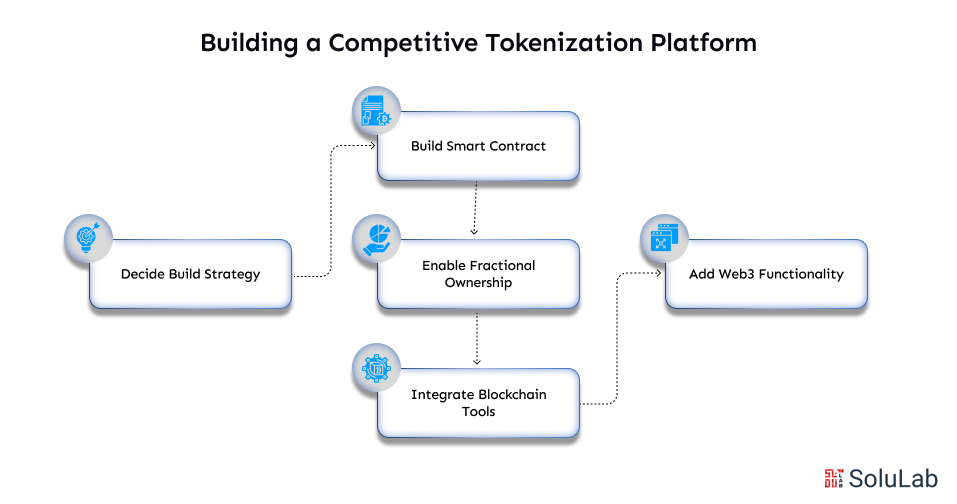
Building a Competitive Tokenization Platform

If you’re looking to enter the growing digital property investment space, building a solid and compliant real estate tokenization platform is key. Here’s how to do it right, especially if you’re a business looking to scale fast and attract global investors.

1. Decide Your Build Strategy

You have two options:

  • White-label: Faster and more affordable. Good for MVPs or pilot projects.
  • Custom Build: Ideal if you need advanced features, branding, or regulatory flexibility.

Work with an experienced tokenization platform development company that understands real estate compliance, tech scalability, and security.

2. Build Secure Smart Contracts

Smart contracts are the backbone of any tokenized platform. They handle asset issuance, ownership transfers, payouts, and more. Partner with a smart contract development company to write, test, and deploy these contracts on the right blockchain.

3. Enable Fractional Ownership

Fractional Ownership lets multiple investors own shares in a single property. This lowers the entry barrier and expands your investor pool. Your platform should allow users to buy, sell, and manage their fractions easily, with clear ownership records on-chain.

4. Integrate Blockchain Tools for Real Estate

Use tools that apply Blockchain in Real Estate, such as:

  • Title deed management
  • Real-time compliance tracking
  • Transparent property records
  • In-app trading UI

These tools reduce fraud, improve trust, and speed up transactions.

5. Add Web3 Functionality

To stay competitive, your platform should offer:

  • Web3 wallets for secure logins and payments
  • Secondary market support so investors can trade tokens
  • Built-in governance tools for investor voting and compliance changes

All the aforementioned steps will render you a fully functional and infallible platform. Though doing it on your own can be a bit risky and tricky as well, so it’s better to take professional assistance for a market-driven solution that ensures minimal effort but unmatchable ROI.

Read More: Top Countries to Launch Real Estate Tokenization Platform

CTA2

Conclusion

Dubai, London, and New York stand out because of their strong regulations, high liquidity, and fast adoption of new technology. To succeed in these markets, your business needs a trusted blockchain development company that provides complete solutions, from building your real estate tokenization platform and creating secure smart contracts to managing the tokenization of real estate assets and ensuring full KYC/AML processes compliance.

At SoluLab, we specialize in delivering end-to-end real estate tokenization development services that combine technology, strategy, and regulation. Partner with us to create a smooth, secure, and scalable platform that meets global standards and helps you lead in the tokenized real estate market.

Have a unique idea on your mind? Let’s connect today!

FAQs

1. Is real estate tokenization legal in Dubai?

Yes. Clear laws back tokenized real estate developments in Dubai. The government supports the Tokenization of Real Estate in the UAE, making it safe for businesses to operate. Work with a licensed Asset tokenization company in Dubai to ensure compliance.

2. What services do tokenization platforms offer?

A Real Estate Tokenization Platform helps you create and manage tokens, onboard investors, and stay compliant. Features often include KYC/AML processes, dashboards, and wallet integration.

3. What does it cost to build a tokenization platform?

Costs range from $100K to $500K, depending on features and regulations. Whether you’re doing real estate tokenization development in London or want to develop your Real Estate Tokenization Platform in New York, pricing depends on your scope.

4. Can one platform work for Dubai, London, and New York?

Yes, but you need market-specific KYC/AML processes and compliance tools. A well-built platform can work across Dubai, London, and New York when customized for each region.

5. What makes a tokenization platform competitive?

Top platforms offer easy onboarding, compliance tools, and real-time asset management. If you’re in a tokenized real estate development in Dubai or real estate tokenization development in London, work with a firm that offers full support.