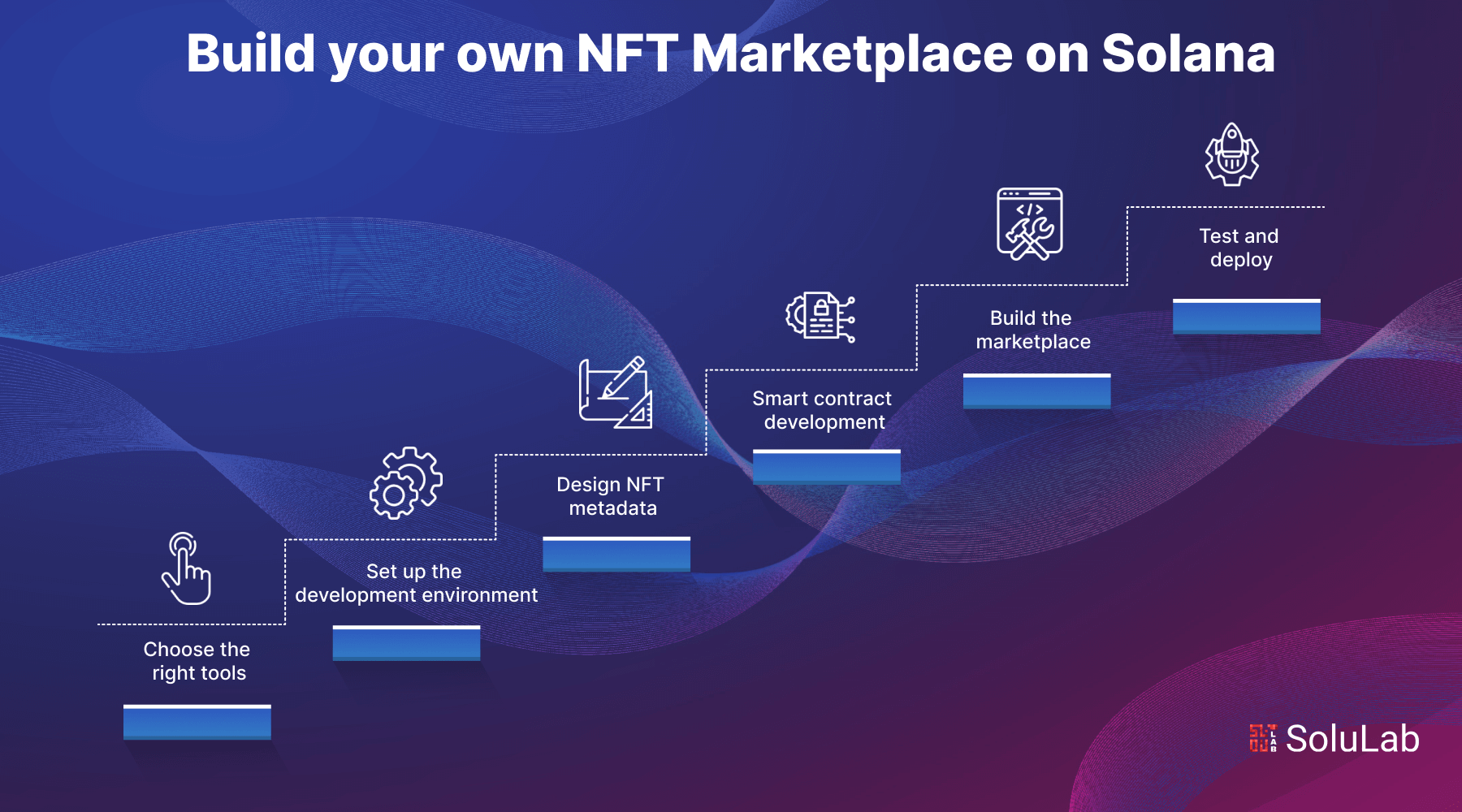
Talk to an Expert

How to build your own NFT Marketplace on Solana?

NFT Marketplace on Solana

As reported by Delphi Digital, a crypto research platform, Solana’s market share within the NFT market has experienced significant growth, expanding from 6% to 14% in less than a year. This claim aligns with the data provided by Cryptoslam, an aggregator in the NFT space.

The Ethereum blockchain claimed 81% of the NFT sales volume, down 5% from 86% in 2022. While Solana possessed 14% of the total NFT sales volume, the next highest is tied between Immutable X, Cardano, Polygon, Flow, and BNB, each with only 1% of the NFT sales volume from February 2022 to February 2023.

Fundamentals Of NFTs

By exploring the value of non-fungible tokens, you can uncover the answer to “Why should I create NFTs on Solana?” NFTs, or non-fungible tokens, are unique crypto assets with distinct on-chain signatures. These represent various digital assets, including digital art, certificates, virtual collectibles, online tickets, and proof of ownership on blockchain networks.

The true value of Solana NFTs lies in their ability to verify the uniqueness of a specific asset through cryptographic proof. Before embarking on Solana NFT projects, it is vital to understand that NFTs come in various forms, such as MP3s, PDFs, JPEGs, MP4s, and PNGs. However, while these files serve as tangible aspects of NFTs, they can be copied like any other digital file.

When utilizing the Solana NFT maker tool, you are essentially minting NFTs or storing NFT metadata with unique cryptographic identifiers on the blockchain. Creating an NFT requires an on-chain transaction, and the details included in the NFT metadata will vary based on the type of NFT standard.

What Is An NFT Marketplace?

In digital asset exchange, Sol NFT marketplaces share similarities with e-commerce platforms, enabling the trade of various items. However, the distinction lies in the nature of the goods being traded. While e-commerce platforms facilitate the buying and selling of physical goods, Sol NFT marketplaces focus solely on digital assets known as NFTs.

To cater to the unique requirements of NFT trading, developers of NFT marketplaces integrate a range of globally accepted and recommended features. These features are designed to ensure a smooth and seamless trading experience for users, eliminating potential obstacles and enhancing the overall functionality of the marketplace.

The Top Features Of An NFT Marketplace

NFT marketplaces have emerged as prominent platforms for trading digital assets known as NFTs. These marketplaces share similarities with e-commerce platforms but cater specifically to NFTs. When building an NFT marketplace on Solana, developers integrate a range of globally accepted and recommended features. These features are designed to ensure a smooth and seamless trading experience for users, eliminating potential obstacles and enhancing the overall functionality of the marketplace. Some of the top features of an NFT marketplace include:

1. Crypto Wallet

In an NFT marketplace, the user’s crypto wallet serves as a crucial component, facilitating every NFT transaction. To ensure seamless trading, the user must establish a synchronized connection between their crypto wallet and the NFT Marketplace. Metamask and Coinbase stand as prominent examples of widely recognized NFT wallets in today’s market, which are often integrated by a solana NFT marketplace development company.

2. Shop Window

To enhance the visibility and marketability of NFTs, marketplaces must provide comprehensive information, including price, ownership details, and a detailed description. Additionally, implementing a shop window feature within NFT marketplaces can significantly increase the likelihood of successful sales by creating an engaging and user-friendly browsing experience for potential buyers.

3. Registration Process

An NFT marketplace must feature a powerful search engine, enabling users to swiftly locate NFTs related to music, videos, or photography. To ensure accuracy and relevance, the search algorithm should possess the ability to discern the user’s intent and purpose, presenting correct information instantaneously.

Read Blog: How to Build and Deploy Solana Smart Contracts?

4. A Search Feature

NFT marketplaces should facilitate the recording, storage, and presentation of comprehensive user history, including trading data, transaction history, and details of approved, purchased, and sold NFTs. This functionality necessitates the platform’s integration of robust user management capabilities.

5. User history

In order to facilitate efficient tracking and transparency, NFT marketplaces should possess the capability to meticulously record, securely store, and visually present the complete history of user interactions. This encompasses not only trading data and transaction records but also the documentation of NFTs that have been approved, purchased, and sold. If you’re looking to make NFT on Solana, the implementation of this feature necessitates the integration of comprehensive user management functionalities into the platform’s architecture.

6. Alerts

To enhance user engagement and facilitate timely decision-making, the NFT marketplace should incorporate a robust notification system. This system should leverage the user’s transaction and search history to send personalized alerts and notifications regarding new NFT listings. By receiving instant notifications, users can assess the potential value and relevance of the new NFT, enabling them to make informed decisions about their next actions within the marketplace, particularly in the context of Solana NFT marketplace development.

7. Support

To provide a seamless NFT trading experience for users, NFT marketplaces should incorporate a comprehensive customer support system that offers chat/live call options and a knowledge center to address all user inquiries effectively.

These key components help ensure a smooth NFT trading process. Having explored the structure and functioning of NFT marketplaces, let’s delve into why Solana stands out as the preferred platform for developing Solana NFT smart contracts.
CTA1

Why To Develop NFT Marketplace On Solana?

Solana, an open-source blockchain network, Increases transaction speeds through its innovative Proof of History (PoH) consensus model. Designed to support decentralized and scalable applications, Solana outperforms numerous legacy blockchains, such as Ethereum, in transaction processing speed and offers significantly lower gas fees. This has attracted entrepreneurs, investors, and content creators who flock to Solana not only to create NFTs but also to establish marketplaces facilitating NFT trading. Furthermore, the Solana NFT launchpad and minting provisions provide creators with unparalleled flexibility. Let’s explore the advantages of leveraging a Solana NFT marketplace for your business.

  • Transactions 

The Solana blockchain showcases its remarkable speed by processing an impressive 2500 transactions per second. This swiftness ensures that transactions made on any Solana custom NFT marketplace are completed instantaneously. However, it’s essential to note that transactions per second (TPS) are based on a metric that is calculated based on runtime data, such as measurements taken while a program is running subject to fluctuations over time.

  • Cost

Solana is the ideal platform for creating NFTs and NFT marketplaces of various sizes, thanks to its high throughput and low transaction fees of $0.00025. If you’re wondering how to create an NFT on Solana, the platform’s impressive throughput and incredibly low transaction fees make it the optimal choice for developing NFTs and NFT marketplaces of diverse scales.

  • Mempool Issue

Within the Solana network, there is no concept of a mempool. The mempool is a temporary storage area where processed transactions are held before they are validated and added to the blockchain. The absence of a mempool in Solana eliminates transaction delays, allowing for instant transactions on its Solana NFT marketplace. This feature enables faster and smoother trading experiences for users, ensuring that transactions are confirmed and processed swiftly.

  • Environment

Within the profitable Solana ecosystem, network congestion is effectively managed, enabling the simultaneous operation of multiple decentralized applications (dApps), smart contracts, and cryptocurrencies.

  • Programming

With its Rust-based software, Solana’s blockchain simplifies programming and enables the development of diverse applications. This flexibility makes Solana an ideal platform for building NFT marketplaces, dApps, and other solutions, offering developers a versatile environment to bring their ideas to life.

How To Create An NFT Marketplace On Solana?

NFT marketplaces have emerged as popular platforms for trading digital assets such as art, music, and collectibles. To ensure a seamless NFT trading experience for users, several key components must be incorporated into an NFT marketplace, including a user-friendly interface, a powerful search engine, comprehensive user history, and robust customer support. By integrating these features, Solana NFT development can provide users with an engaging and efficient trading environment.

1. SOL Wallet

Starting an NFT marketplace requires you to first set up a browser wallet. Given Solana’s compatibility with a wide range of browser wallets, you have the flexibility to choose your preferred platform. After creating your wallet, ensure it is funded with SOL tokens to facilitate transactions within your marketplace.

2. Metaplex Repository

To ensure easy hosting on GitHub pages, navigate to your GitHub account and fork the Metaplex repository. Afterward, proceed to copy all the Metaplex files onto your system.

  • On your desktop, create a new folder named “myNFTMarketplace.”
  • Copy the path to the newly created folder.
  • In your command line, navigate to the “myNFTMarketplace” folder using the “cd” command followed by the folder’s path.
cd /Users/yourusername/Desktop/myNFTMarketplace

To proceed, navigate to the folder you created and clone the repository there.

git clone https://github.com/yourusername/metaplex.git

To create a repository in your personal GitHub account, you can duplicate all the Metaplex repository files into your directory by following these steps:

1. Navigate to the Metaplex repository on GitHub.

2. Click on the “Fork” button in the top-right corner.

3. Select your personal GitHub account as the destination for the fork.

4. Click on the “Confirm fork” button.

5. Clone the forked repository to your local machine.

6. Change the directory to the cloned repository.

7. Add the original Metaplex repository as a remote.

8. Push your local changes to your forked repository.

3. Github Address

To ensure a successful online marketplace launch and maximize its success, consider implementing the following essential steps:

  • First, you will need to change the deployment address to your GitHub username.
  • Next, change the wallet address of your store.

This is where the public address of your browser wallet needs to be added, to tell the store who to give administrative access to.

Setting Up And Deploying The NFT Marketplace

You’re nearly there! Here are the final steps before your Solana marketplace for NFTs goes live:

1. In your command line, navigate to the “js” folder by changing the directory.

cd metaplex/js

To proceed, you must install all of the dependencies. To do this, run the following command:

yarn

This instruction is to download the required dependencies to work with the code. When you cloned the Metaplex repository, you only received the code that specifies the necessary packages and dependencies; the packages themselves were not downloaded.

The download process can take a while, but once it’s complete, the command will display “Done” at the end.

To verify if all the dependencies are functioning properly, run the following command:

yarn bootstrap

Before uploading your NFT marketplace to Github Pages, you can now test it locally.

To verify that the dependencies are in place and functioning as intended, run the following command:

yarn start

The compilation process may take a few minutes. Once complete, the terminal will display “Compiled successfully.” To view the newly created NFT marketplace, simply visit localhost:3000/#/.

The next step is to connect the marketplace to a wallet and enable NFT minting, making it live and functional.

To build the project files, use the following command:

yarn build

Once the process is finished, you will receive the message “Done” as output. You can now locate the build folder created within the js folder.

Next, switch the directory to the web folder.

cd packages/web

To deploy the application, navigate to the packages/web directory and execute the following command:

yarn deploy

Once the deployment is complete, the “Done” message will reappear, indicating a successful deployment. The provided command enables the deployment of your marketplace site to your GitHub repository. This deployment signifies that your marketplace is now live and accessible. You can now visit your Solana NFT marketplace hosted on GitHub Pages and built on the Solana blockchain.
CTA2

Launch Your NFT Marketplace on Solana with SoluLab!

In conclusion, building your own NFT marketplace on Solana offers a range of benefits, from low transaction fees and high speed to seamless scalability. By following the right steps, including setting up a wallet, forking the Metaplex repository, and incorporating essential features, you can create a platform to tap into the booming NFT ecosystem. Solana’s rapid growth makes it a prime choice for developers and entrepreneurs aiming to launch a successful NFT marketplace.

When it comes to ensuring a smooth and professional development process, partnering with an experienced NFT Marketplace Development Company like SoluLab can make all the difference. With a team of skilled blockchain developers and deep expertise in the NFT space, SoluLab can help you create a custom, scalable, and feature-rich marketplace on Solana or any other blockchain. Whether you’re looking to hire NFT developers or need end-to-end development support, SoluLab offers specific solutions to meet your business needs and deliver exceptional results.

Let us help you turn your vision into reality with a marketplace that stands out in the NFT field. Schedule a free consultation and get your marketplace project rolling. Contact SoluLab today for top-tier NFT development solutions!

FAQs

1. What is Solana NFT marketplace?

A Solana NFT marketplace is a platform that facilitates the buying, selling, and trading of NFTs built on the Solana blockchain. Unlike traditional marketplaces, Solana marketplaces are designed to handle high transaction volumes with lower fees, allowing users to trade Sol NFTs efficiently. These marketplaces often provide various features, including wallet integration, auction capabilities, and community engagement tools.

2. What are the key benefits of building an NFT marketplace on Solana?

Building on Solana offers advantages like high transaction speed, low fees, scalability, and strong security, making it ideal for NFT marketplaces that need to handle large volumes of transactions efficiently.

3. Do I need a technical background to build an NFT marketplace?

While having technical knowledge can help, it’s not necessary. By partnering with an NFT Marketplace Development Company like SoluLab, you can focus on your business objectives while we handle the technical development.

4. What is the cost of building an NFT marketplace on Solana?

The cost of development depends on various factors such as the complexity of the features, security requirements, and design elements. You can request a personalized quote from SoluLab to get an accurate estimate.

5. How can SoluLab help me develop my NFT marketplace?

SoluLab provides end-to-end development services for NFT marketplaces. From smart contract development to UX/UI design, we ensure your platform is robust, scalable, and user-friendly. You can hire NFT developers from our team to bring your vision to life.

6. How to build an NFT marketplace on Solana?

Building an NFT marketplace on Solana involves several steps, including defining your marketplace’s purpose, selecting a technology stack, and ensuring a seamless user experience. Begin by setting up a Solana NFT development environment, utilizing Solana’s blockchain capabilities. You can create smart contracts using Solana NFT smart contracts to manage transactions and ownership of NFTs. Employ a front-end framework to develop an engaging user interface, allowing users to easily navigate and trade their Sol NFTs.

7. What is the best Solana NFT marketplace?

Determining the best Solana NFT marketplace depends on your specific needs, such as user experience, transaction fees, and the types of NFTs offered. Popular options include Magic Eden, Solanart, and DigitalEyes, which have established themselves within the community. Consider factors such as platform security, community engagement, and the marketplace’s focus on specific NFT categories when choosing the right one for you.
Metaverse NFT – Foundation Of Next Blockchain Revolution!


Metaverse NFT – Foundation Of Next Blockchain Revolution!

The idea of the Metaverse is one of the new digital frontiers that has emerged as a result of the quick development of technology. We are moving from a physical reality to a digital one as technology advances, where virtual experiences and interactions are very valuable. The idea of the Metaverse, a virtual environment that incorporates both real and digital locations and offers consumers an immersive and linked experience, is at the core of this change.

The Metaverse can be defined as a collective virtual shared space that encompasses various virtual worlds, augmented reality, and virtual reality environments. It is a digital realm where users can interact with each other, engage in activities, and create and consume content. In the Metaverse, boundaries between physical and virtual realities blur, allowing users to transcend the limitations of the physical world and enter a realm of endless possibilities.

Non-Fungible Tokens, commonly known as NFTs metaverse, have gained immense popularity in recent years. NFTs metaverse are unique digital assets that are stored on a blockchain, making them secure, transparent, and immutable. Unlike cryptocurrencies such as Bitcoin or Ethereum, which are fungible and interchangeable, NFTs metaverse is indivisible and holds distinct characteristics that set them apart from one another. In this blog, we will talk about the foundation of the next blockchain revolution.

What is the Role of NFTs Metaverse?

The role of Non-Fungible Tokens (NFTs metaverse) cannot be overstated. NFTs metaverse plays a pivotal role in shaping and defining the virtual universe by providing unique digital assets, ownership verification, and enabling vibrant economies within the Metaverse.

CTA 1

  • Unique Digital Assets

NFTs Metaverse serves as the building blocks, offering a wide range of unique digital assets. These assets can include virtual real estate, virtual identities, artwork, fashion, collectibles, virtual goods, and much more. 

Each NFT represents a distinct and irreplaceable item, making it possible for users to own and trade virtual assets that hold inherent value. These digital assets contribute to the immersive and customizable experiences within the Metaverse, allowing users to express themselves and engage with the virtual world on a personal level.

  • Ownership Verification

One of the most significant contributions of the NFTs metaverse to its ability to establish ownership and provenance of digital assets. Through the use of blockchain technology, the NFTs metaverse offers transparent and immutable records of ownership, ensuring that users can prove their rightful ownership of virtual assets. 

This ownership verification is essential in the Metaverse, where the value of virtual assets can be substantial. NFTs Metaverse eliminates the risk of fraudulent claims and provides a secure platform for users to buy, sell, and trade their digital assets with confidence.

  • Enabling Vibrant Economies

NFTs metaverse has revolutionized the concept of virtual economies. With the NFTs metaverse, users can participate in dynamic and thriving digital marketplaces, where they can buy, sell, and trade virtual assets. These virtual economies operate on top blockchain platforms, allowing for secure and transparent transactions. 

NFTs Metaverse provides creators and artists with new avenues for monetization by tokenizing their work and earning royalties whenever their assets are sold or used. Additionally, users can invest in and speculate on the value of the rare and desirable NFTs metaverse, creating a dynamic market driven by supply and demand.

Read Our Blog Post: Everything You Need to Know About Metaverse NFT Marketplace Development

  • Interoperability and Cross-Platform Functionality

NFTs Metaverse also enables interoperability and cross-platform functionality. By utilizing open standards and protocols, the NFTs metaverse can be transferred and used across various virtual worlds, platforms, and applications. 

This interoperability allows users to carry their virtual assets and identities seamlessly between different Metaverse environments, enhancing their overall experience and eliminating the need for asset duplication. NFTs Metaverse enables users to build a digital presence that transcends individual platforms, contributing to a more cohesive and interconnected Metaverse ecosystem.

  • Community Engagement and Participation

NFTs Metaverse fosters vibrant communities. Users can come together to trade, collect, and showcase their NFTs metaverse, creating a social fabric within the virtual realm. These communities provide opportunities for collaboration, creativity, and social interactions. 

Users can connect with like-minded individuals, join virtual events, and participate in collaborative projects, all facilitated by the ownership and exchange of the NFTs metaverse. This community-driven aspect adds depth and richness to the Metaverse, making it a truly immersive and engaging environment.

What is the Relationship Between the Metaverse and Non-Fungible Tokens (NFTs)?

NFTs serve as the foundational elements that power the Metaverse, while the Metaverse provides a fertile ground for the growth and adoption of the NFTs Metaverse. Together, they create a dynamic and transformative digital ecosystem.

CTA 2

  • NFTs as Building Blocks of the Metaverse

NFTs metaverse acts as the building blocks, providing unique digital assets that populate the virtual universe. These assets can represent virtual real estate, virtual identities, artwork, fashion, collectibles, virtual goods, and much more. 

NFTs Metaverse gives users ownership over these assets, allowing them to buy, sell, and trade within the Metaverse. Without NFTs, the Metaverse would lack the distinct and valuable digital assets that make it an immersive and engaging environment.

  • Ownership and Provenance in the Metaverse

One of the key challenges in the virtual realm is establishing ownership and provenance of digital assets. NFTs Metaverse solves this problem by utilizing blockchain technology to create transparent and immutable records of ownership. 

In the Metaverse, users can prove their ownership of NFTs, ensuring that their digital assets are secure and protected. This ownership verification adds value and trust to the virtual assets within the Metaverse, enabling users to confidently engage in transactions and interactions.

  • Monetization and Empowerment of Creators

NFTs empower creators within the Metaverse by offering new avenues for monetization. Artists, musicians, game developers, and other content creators can tokenize their work as NFTs metaverse, retaining ownership rights and earning royalties whenever their creations are sold or used. 

This model allows creators to showcase their talent, reach a global audience, and establish sustainable revenue streams. NFTs Metaverse provides a direct and decentralized means for creators to engage with their audience and monetize their digital creations within the Metaverse.

Check Out Our PR Article: SoluLab Bridging the Gap Between Technology And Innovation

  • Interoperability and Cross-Platform Functionality

The Metaverse is a vast and interconnected digital landscape that encompasses various virtual worlds, platforms, and applications. NFTs metaverse enables interoperability and cross-platform functionality within this complex ecosystem. Through the use of open standards and protocols, the NFTs can be transferred and used across different Metaverse environments. 

Users can carry their NFTs metaverse seamlessly between virtual worlds, ensuring the continuity and consistency of their digital assets. This interoperability enhances the overall user experience and facilitates the seamless integration of NFTs into the Metaverse.

  • Community Engagement and Participation

NFTs foster vibrant communities within the Metaverse. Users can come together to trade, collect, and showcase their NFTs metaverse, creating a social fabric within the virtual realm. These communities provide opportunities for collaboration, creativity, and social interactions. 

Users can connect with like-minded individuals, join virtual events, and participate in collaborative projects, all facilitated by the ownership and exchange of the NFTs metaverse. This community-driven aspect adds depth and richness to the Metaverse, making it a truly immersive and engaging environment.

What is the Usability of NFTs and Metaverse?

What is the Usability of NFTs and Metaverse?

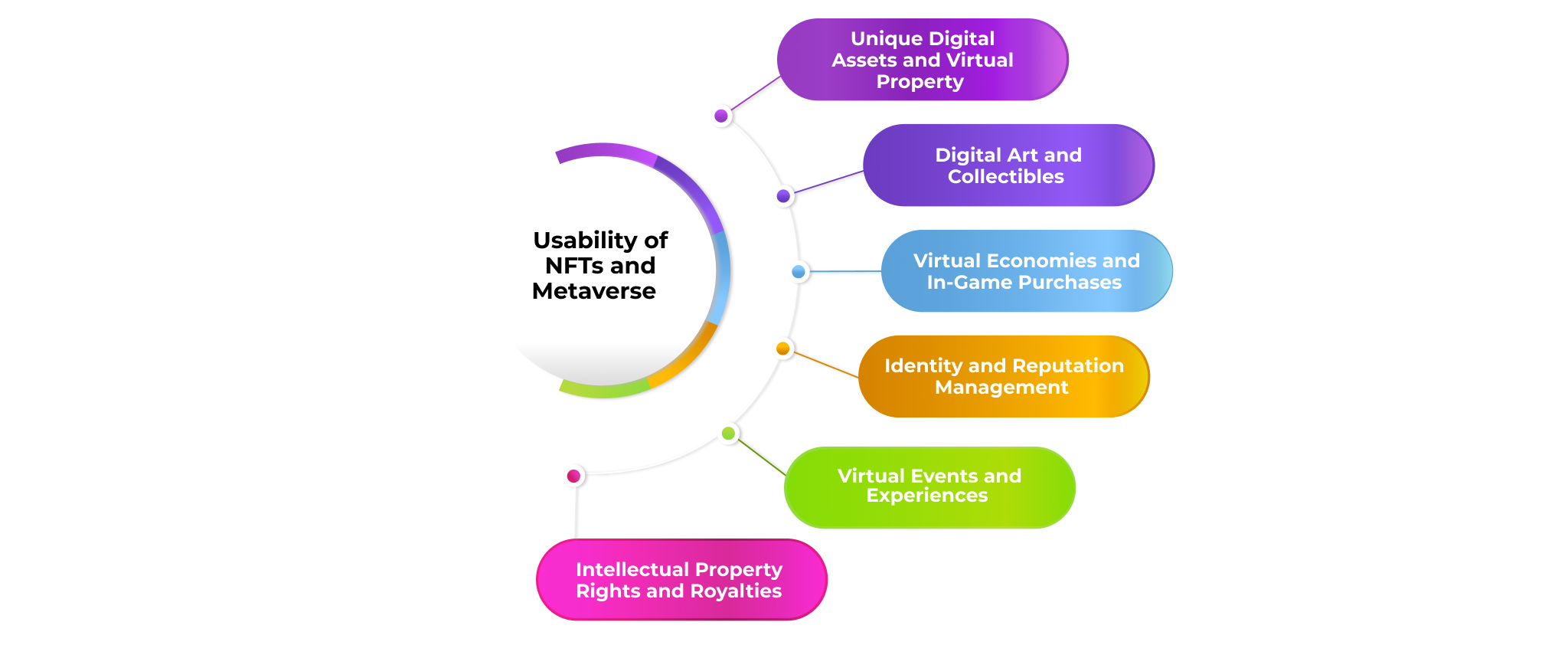
The usability of Non-Fungible Tokens (NFTs metaverse) within the Metaverse holds tremendous potential, offering users a wide range of practical applications and benefits. As the Metaverse continues to evolve, NFTs play a crucial role in enhancing user experiences, facilitating transactions, and enabling seamless interactions within the virtual realm.

  • Unique Digital Assets and Virtual Property

NFTs Metaverse provides users with the ability to own and trade unique digital assets. These assets can include virtual real estate, virtual identities, artwork, fashion, collectibles, and more. By utilizing the NFTs metaverse, users can establish ownership of virtual properties, customize their virtual identities, and showcase their collections. This usability feature allows individuals to express their creativity, establish their digital presence, and engage with the Metaverse on a personal level.

  • Digital Art and Collectibles

NFTs Metaverse has revolutionized the world of digital art and collectibles. Artists can tokenize their creations as NFTs metaverse, providing unique and verifiable proof of ownership. Collectors can then purchase and own these digital artworks and collectibles, knowing they possess a one-of-a-kind item. The usability of the NFTs metaverse in this context not only enables artists to monetize their work but also empowers collectors to build valuable and curated collections within the Metaverse.

  • Virtual Economies and In-Game Purchases

NFTs metaverse serves as a foundation for virtual economies, allowing for the creation and exchange of digital currencies and goods. Users can utilize the NFTs metaverse to purchase virtual assets, participate in in-game transactions, and engage in virtual commerce. This usability feature facilitates a seamless and secure environment for buying, selling, and trading virtual goods, enhancing the overall user experience and enabling vibrant virtual economies within the Metaverse.

Read Our Blog: What is the Virtual Reality Metaverse?

  • Identity and Reputation Management

NFTs metaverse can be employed for identity and reputation management. Users can create and customize their virtual identities, attaching NFTs metaverse that represents their unique characteristics, achievements, and reputation. These NFT-based identities can be utilized for social interactions, networking, and establishing trust within the virtual realm. The usability of the NFTs metaverse in this context allows for seamless and reliable identity management, enabling users to build their digital personas and participate in virtual communities.

  • Virtual Events and Experiences

NFTs Metaverse offers usability in the realm of virtual events and experiences. Event organizers can issue limited-edition NFT tickets, granting access to exclusive virtual gatherings, concerts, conferences, and more. These NFT tickets can provide unique perks, bonuses, or collectible elements, enhancing the overall value and experience for attendees. The usability of NFTs metaverse in this context ensures secure and verifiable access to virtual events, while also providing additional benefits to participants.

  • Intellectual Property Rights and Royalties

NFTs Metaverse provides usability in terms of intellectual property rights and royalty management. Creators can tokenize their work as NFTs metaverse, retaining ownership rights and setting up smart contracts that automatically distribute royalties whenever their NFTs metaverse is sold or used. This usability feature ensures that creators receive fair compensation for their contributions to the Metaverse, while also protecting their intellectual property rights in a transparent and enforceable manner.

How Can You Purchase a Metaverse NFT?

How Can You Purchase a Metaverse NFT?

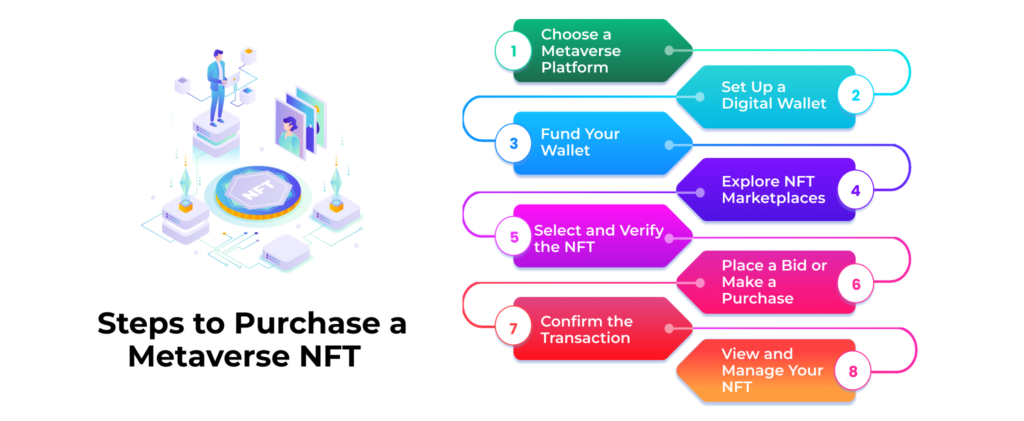
Purchasing a Metaverse NFT (Non-Fungible Token) is an exciting process that allows individuals to own unique digital assets within the virtual realm. While the specific steps may vary depending on the platform or marketplace, here is a general guide on how you can purchase a Metaverse NFT:

1. Choose a Metaverse Platform

First, you need to identify the Metaverse platform where the NFTs metaverse you’re interested in is available. Popular platforms include Decentraland, Cryptovoxels, Sandbox, Somnium Space, and others. Research and explore these platforms to find the one that aligns with your interests and preferences.

2. Set Up a Digital Wallet

To purchase and store NFTs metaverse, you’ll need a digital wallet that supports the blockchain network on which the NFTs metaverse are minted. Ethereum is the most commonly used blockchain for the metaverse, so a wallet compatible with Ethereum (such as MetaMask or Trust Wallet) is often necessary. Set up your wallet by following the instructions provided by the wallet provider and ensure you secure your private keys or seed phrases.

3. Fund Your Wallet

Once your wallet is set up, you’ll need to acquire the cryptocurrency (usually Ether, or ETH) used on the platform to purchase NFTs Metaverse. You can buy ETH from popular cryptocurrency exchanges and transfer it to your wallet. Ensure that you have enough funds in your wallet to cover the cost of the NFT you want to purchase, as well as any transaction fees associated with the blockchain network.

Check Out Our Press Release: SoluLab Honored By GoodFirms as Winner of the Trusted Choice Award 2023

4. Explore NFT Marketplaces

NFTs Metaverse is typically bought and sold on specialized marketplaces. Each platform may have its marketplace, or there might be dedicated NFT marketplaces like OpenSea, Rarible, or SuperRare that support multiple Metaverse platforms. Browse through these marketplaces to find the NFTs metaverse that captures your interest.

5. Select and Verify the NFT

Once you find an NFT you want to purchase, click on the listing to view its details, including the description, artwork, and any additional information provided by the creator. Take the time to understand what you are buying and ensure that the NFT meets your expectations. Pay attention to factors such as the rarity, provenance, and authenticity of the NFT.

6. Place a Bid or Make a Purchase

Depending on the marketplace, you may have different options to acquire the NFT. You can either place a bid or make an outright purchase. If you place a bid, you’ll need to wait for the auction to end and see if your bid is successful. If you choose to make an immediate purchase, you can typically do so by clicking the “Buy Now” button and following the prompts to complete the transaction.

7. Confirm the Transaction

After you’ve selected the purchase option, you’ll be prompted to confirm the transaction. Review the details, including the price, gas fees (transaction fees), and any other relevant information. Once you’re satisfied, approve the transaction using your wallet. This will initiate the transfer of funds and the ownership of the NFT to your wallet address.

8. View and Manage Your NFT

Once the transaction is confirmed and completed, you can view and manage your NFT in your wallet. The NFT will be associated with a unique token ID and metadata, which you can access through your wallet interface or by exploring the blockchain explorer specific to the blockchain network.

CTA 3

Conclusion

Non-Fungible Tokens (NFTs metaverse) are undeniably the foundation of the next blockchain revolution within the Metaverse. The intersection of the NFTs metaverse has ushered in a new era of digital ownership, unique virtual assets, and immersive experiences. NFTs serve as the backbone of the Metaverse, providing users with ownership of one-of-a-kind digital assets that range from virtual real estate and artwork to collectibles and virtual identities.

The Metaverse, a virtual universe where users can interact, create, and engage with digital environments, relies on NFTs to establish ownership, provenance, and value within its vast landscape. NFTs metaverse ensures that each digital asset is distinct, verifiable, and securely owned by an individual. This ownership verification fosters trust and enables vibrant virtual economies to thrive, where users can buy, sell, and trade the NFTs metaverse seamlessly and transparently.

Moreover, NFTs play a vital role in enhancing the user experience within the Metaverse. Through the NFTs metaverse, users can customize their virtual identities, express their creativity, and engage with virtual communities. Artists and creators can tokenize their work as NFTs, empowering them to monetize their digital creations and establish direct relationships with their audience. NFTs also enable participation in virtual events, access to exclusive experiences, and the establishment of reputations and identities within the Metaverse.

SoluLab is a reputable company renowned for its extensive expertise in developing a diverse range of NFT solutions. They are known for their meticulous attention to detail and a wide array of features in their NFT marketplace development services. With a proven track record in delivering top-notch solutions, SoluLab excels in various NFT-related endeavors, including artwork, digital collectibles, gaming, and asset tokenization. Additionally, as a leading provider of metaverse development services, SoluLab specializes in turning visionary Metaverse projects into reality. Utilizing cutting-edge tools and state-of-the-art technologies, their skilled team of metaverse experts is dedicated to delivering tailored solutions that align with the specific needs of clients. For further information and assistance, contact SoluLab today.

FAQs

1. How do the NFTs and the Metaverse intersect?

NFTs Metaverse intersects by allowing users to purchase, own, and trade unique digital assets within the virtual realm. NFTs Metaverse provides ownership verification enables monetization for creators, facilitates virtual economies, and enhances community engagement.

2. Can NFTs Metaverse be used on multiple platforms?

Yes, NFTs Metaverse can be used on multiple platforms, thanks to its interoperability and cross-platform functionality. Open standards and protocols allow the NFTs metaverse to be transferred and used across various virtual worlds, platforms, and applications, providing users with seamless access and utilization of their digital assets.

3. How do the NFTs contribute to the Metaverse?

NFTs Metaverse contributes to the Metaverse by serving as unique digital assets that can represent virtual real estate, artwork, fashion, collectibles, and more. They establish ownership and provenance, enable vibrant virtual economies, foster community engagement, and facilitate interoperability within the virtual realm.

4. Is NFT part of metaverse?  

NFTs Metaverse provides a mechanism for establishing ownership and authenticity of digital assets. Each NFT is unique and verifiable, ensuring that users can prove their ownership of virtual properties, artwork, collectibles, and more. This ownership verification adds value and trust to the assets within the Metaverse, enabling secure and transparent transactions.

How to Build an NFT Marketplace on Ethereum Blockchain?

How to Build an NFT Marketplace on Ethereum Blockchain?

For many individuals, the thought of being able to sell their valued assets at a reasonable price was irresistible. The NFT marketplace is currently the preferred method of trading digital goods for people, companies, artists, and just about everyone else. The ease with which ownership and rights may be obtained during NFT trade is one of the reasons for the growing popularity of NFT markets. As an added convenience, NFT provides a comprehensive history of each asset for its users.

Why not benefit from the billions of dollars that individuals spend on these lavish digital goods without giving them a second thought? If you’re planning to build an NFT marketplace on Ethereum, you may check out this blog to learn more about the process.

What is an NFT Marketplace?

What is an NFT Marketplace?

The NFT marketplace is a stage where consumers can store, display, trade, or produce NFTs (Non-Fungible Tokens). A Non-Fungible Token is a digital asset that is mainly built on Ethereum Blockchain technology and reflects real-world things. NFT marketplaces enable creators to reach a big audience with their NFT work. You can purchase or sell NFT artworks at a fixed price using these services. However, in order to access and operate on these marketplaces, you will require the following:

  • A cryptocurrency wallet.
  • In the wallet, there is cryptocurrency or coins.

The Non-Fungible Token marketplace features an extensive variety of NFT artworks from diverse sectors such as images, arts, movies, and other digital collectibles. Typically, niche marketplaces are in higher demand than ordinary ones since they offer what a client necessitates, concentrate on marketing specialized artwork, and aim at a detailed set of people.

Read Our Blog: Solana Marketplace NFT: How to build your own NFT Marketplace

Benefits of Ethereum Blockchain

1. Coordination of data:

The Ethereum blockchain enables efficient coordination of data by providing a decentralized platform where multiple parties can store, access, and update information in a transparent and secure manner. This allows for real-time data synchronization and eliminates the need for intermediaries, enhancing trust and reducing the chances of data manipulation or fraud.

2. Rapid mobilization:

Ethereum enables rapid mobilization of resources by allowing smart contracts to automate and streamline various processes. With programmable logic, tasks such as fundraising, supply chain management, and decentralized applications (dApps) can be executed quickly and efficiently, saving time and resources while promoting scalability.

3. Networks that need authorization:

Ethereum facilitates networks that require authorization, allowing permission access to specific participants. This feature is beneficial in industries where privacy and confidentiality are paramount, such as finance, healthcare, and supply chain management. It ensures that only authorized individuals or entities can participate and interact within the network.

4. Dimensions of the network:

The Ethereum network is designed to be highly scalable and adaptable to different use cases. It offers various solutions to address scalability challenges, such as layer 2 solutions like sidechains and state channels, allowing for increased throughput and improved performance. This flexibility enables the Ethereum blockchain to support a wide range of applications and accommodate a growing number of users.

5. Transactions between individuals:

Ethereum enables secure and direct transactions between individuals without the need for intermediaries, such as banks or payment processors. By utilizing the native cryptocurrency, Ether (ETH), individuals can transact peer-to-peer globally, with lower transaction fees and faster settlement times compared to traditional financial systems. This empowers individuals by giving them greater control over their financial interactions.

6. Finality:

Ethereum offers finality in transactions and smart contract execution. Once a transaction or smart contract is included in a block and added to the blockchain, it becomes immutable and tamper-proof. This ensures that transactions are irreversible, providing certainty and trust in the integrity of the network’s operations.

7. A layer of incentive:

Ethereum incorporates a layer of incentive through its native cryptocurrency, Ether (ETH), and its consensus mechanism known as proof-of-stake (PoS). Participants who validate and secure the network by staking their ETH are rewarded with additional tokens. This incentivizes network security, participation, and decentralization, creating a self-sustaining ecosystem that fosters innovation and growth.

Read Also: Everything You Need to Know About Metaverse NFT Marketplace Development

Steps For Developing An NFT Marketplace Based On Ethereum

Steps For Developing An NFT Marketplace Based On Ethereum

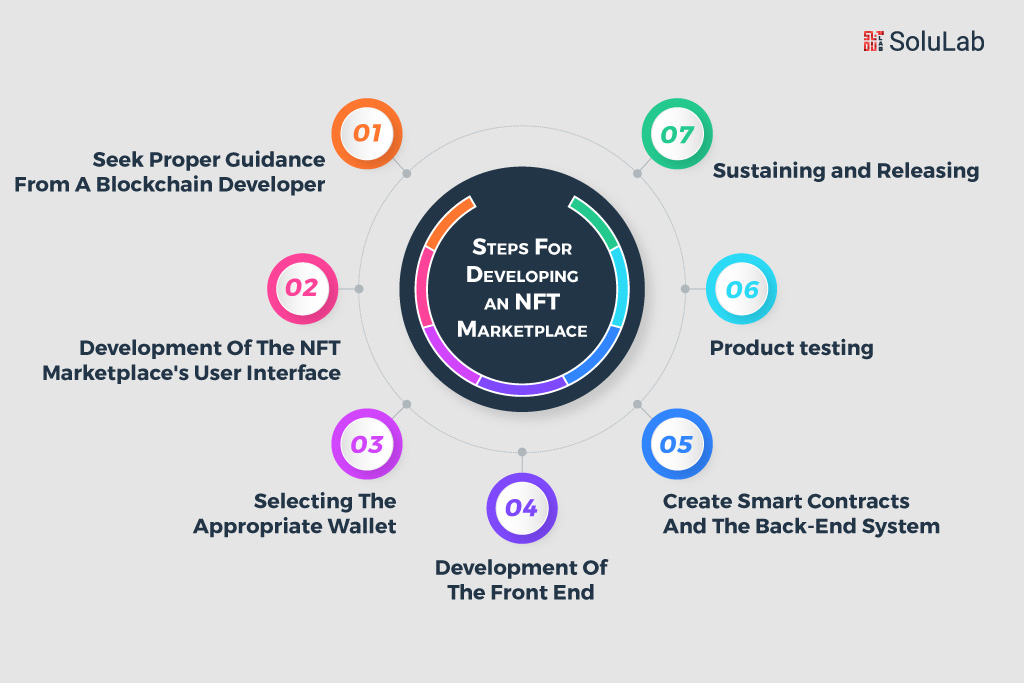
Step 1: Seek Proper Guidance From A Blockchain Developer

Ethereum serves as a forerunner in the blockchain network by ensuring its trustworthiness, consistency, security, and stability. Apart from the Ethereum network’s security, protocol developers always consider the types of apps and tools that users and developers prefer. Businesses should seek advice from a reputable blockchain development service provider when selecting an appropriate blockchain.

Step 2: Development Of The NFT Marketplace’s User Interface

An NFT marketplace must have a common user interface (UI) to facilitate interaction. It should have a search bar, filters, and a large number of categories, a community section, a dashboard, and an administration panel. All of these distinct categories and search bar filters are critical to providing an exceptional user experience since they lower the user’s search time.

Step 3: Selecting The Appropriate Wallet

Cross-chain interoperability is required for the integrated crypto-wallets, which must be utilized to acquire or use the cryptos stored in the wallet. To construct an Ethereum-based NFT, you must first create an Ethereum wallet, Metamask.

Step 4: Development Of The Front End

Front-end development is a component of the NFT trading platform that is used to communicate with the user. It has an intuitive UI, increased productivity, and security precautions.

Step 5: Create Smart Contracts And The Back-End System

A reputable NFT development business will provide assistance in establishing smart contracts. All logic for the NFT platform will be implemented at the back end. As previously stated, the NFT marketplace operates as a decentralized system, and smart contracts aid in the management of large data flows and their validation on the Blockchain. Ethereum is used to make the trading features of the NFT market work. A variety of smart contracts are used to make this happen.

It also helps set up a number of marketplace and business logic services that use Blockchain, digital wallets, auction processes, and so on to help people buy and sell things.

Step 6: Product Testing

Numerous test cycles will be used to determine the functioning of the created product. The QA team will guarantee that no defects or faults are left in order to ensure that the product is secure, useful, dependable, and productive. Throughout the testing process, the product must adhere to the project’s objectives and aims.

Step 7: Sustaining And Releasing

After completing the testing phase, it’s time to deploy your NFT platform to a cloud server. However, do not become complacent because this is not the final stage; you must continue to maintain and upgrade the program on a regular basis. Ascertain that the NFT platform you develop adheres to all market trends and meets the needs of your users.

CTA 1

Things to look out for when choosing an Ethereum NFT Marketplace

When we hunt for an Ethereum NFT marketplace, we may select one of the two processes:

1. Scratch-based NFT Marketplace on Ethereum

Scratch-based NFT Marketplace solutions require time to build all the features that satisfy the user’s expectations, and safety is deemed better in this category. Here, we may incorporate new features and upgrade an existing platform at any moment. It is a hard one, yet it delivers an apparent profit.

2. Opting White label NFT Marketplace on Ethereum

White label NFT Marketplace solutions are already developed, tested, and ready for implementation. It is an efficient and hassle-free approach that enables you to start your company sooner. This is useful for those who wish to launch their platform at a minimal cost. The key benefit is that there is no requirement for a huge development team as compared to producing new ones.

The Advantages of Developing an NFT Marketplace on Ethereum

1. Established Ecosystem:

Ethereum has the most mature and widely adopted blockchain ecosystem for NFTs. It has a strong developer community, extensive tooling support, and a wide range of existing decentralized applications (dApps) and wallets that support NFTs. This established ecosystem provides a solid foundation for building and integrating NFT marketplaces.

2. Interoperability and Standards:

Ethereum has defined and popularized key NFT standards, such as ERC-721 and ERC-1155, which have become industry standards for creating and exchanging NFTs. These standards ensure interoperability between different NFT projects, allowing seamless integration and transfer of assets between various platforms.

3. Network Effects:

Ethereum’s network effects contribute to its dominance in the NFT space. It has a large user base and a substantial number of active wallets, which enhances the visibility and discoverability of NFTs listed on Ethereum-based marketplaces. This widespread adoption helps attract buyers, sellers, and collectors to your marketplace.

4. Security and Immutability:

Ethereum is built on a secure and decentralized blockchain, providing robust security and immutability for NFT transactions. The distributed nature of the network ensures that NFT ownership records are resistant to censorship and tampering, instilling trust and confidence in users.

Read Our Blog: How To Launch Your Own NFT Marketplace Website in Less Than 2 Days?

5. Smart Contract Functionality:

Ethereum’s smart contract functionality is a powerful tool for developing advanced features and functionalities within an NFT marketplace. Smart contracts enable the automation of various processes, such as royalties, licensing, and secondary sales. They can also facilitate escrow services, auctions, and other complex transactions, enhancing the functionality and user experience of your marketplace.

6. Ecosystem Integration:

Ethereum offers extensive integration possibilities with other decentralized finance (DeFi) protocols and services. This integration allows for seamless liquidity pools, decentralized exchanges, lending platforms, and more, expanding the utility and potential use cases of NFTs within your marketplace.

7. Future Upgrades:

Ethereum is constantly evolving, with several improvements and upgrades planned. One of the significant upgrades is Ethereum 2.0, which aims to enhance scalability, reduce transaction costs, and improve overall network efficiency. Building on Ethereum ensures that your NFT marketplace can benefit from these upcoming improvements.

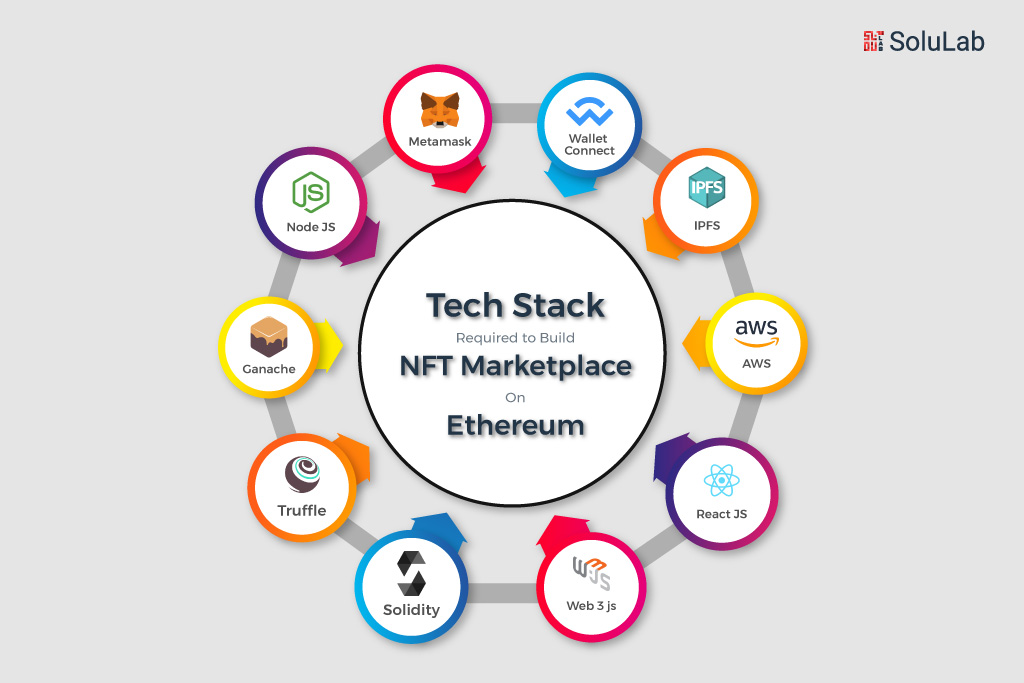
What Technological Stack Is Necessary For The Building Of An NFT Marketplace On Ethereum?

What Technological Stack Is Necessary For The Building Of An NFT Marketplace On Ethereum?

1. Solidity

A statically-typed curly-braces programming language, Solidity was created for use with the Ethereum Virtual Machine to develop smart contracts. Tokens of value, ownership, voting, and other types of logic may be implemented using smart contracts since they run on a peer-to-peer network with no central authority.

Use the most recent Solidity version for deploying contracts. This is due to the fact that new features, bug fixes, and breaking changes are released regularly.

2. Web3.js

Web3.js is a required JavaScript package that is used to establish connections to Ethereum’s blockchain technology. It is a collection of libraries that allow you to communicate with an Ethereum node via HTTP, IPC, or WebSocket.

3. Truffle

Truffle was made to help with the testing and deployment of Ethereum smart contracts and custom code. For private and public networks, Ethereum decentralized applications (dApps) are supported.

With Truffle –

  • The compilation, linking, deployment, and binary management of smart contracts are all built-in.
  • Automated contract verification is possible.
  • Custom build procedures are supported as part of the pipeline’s configuration.
  • There is a framework for scriptable deployments and migrations.
  • Implementation on several public and private networks is managed by a single system.
  • Direct contract communication through an interactive interface.
  • Immediate re-creation of assets while a project is in development can be done. 
  • Scripts may be executed in a Truffle environment using an external runner.

4. Ganache

Personal blockchains, such as Ganache, allow developers to rapidly build distributed applications on the Ethereum and Corda blockchains. If you’re developing, deploying, and testing your dApps in a deterministic environment, you can utilize Ganache. There are two versions of Ganache: a graphical user interface and a command-line interface.

5. IPFS

It is possible to store and access data in IPFS or InterPlanetary File System in a distributed fashion. While it doesn’t have its own incentive program, it may be utilized in conjunction with one or more contracts to ensure long-term success. Working with a pinning service, which “pins” your data for you, is another option for preserving IPFS data. It’s possible to operate your own IPFS node and contribute to the network in order to store your own and/or other people’s files for free.

6. React.js

React.js, which stands for React JavaScript, is a free and open-source front-end framework. JavaScript’s React framework lets you create user interfaces declaratively, efficiently, and with a lot of flexibility. It allows you to build complicated user interfaces out of tiny and separated “components” of code.

7. Metamask

Using MetaMask, you may access the Ethereum blockchain using a software wallet that connects to the network. In order to connect with decentralized apps, users may access their Ethereum wallets through a browser extension or mobile app.

8. Node. js

Node.js is a JavaScript runtime environment that is open-source and cross-platform. Node.js runs the V8 JavaScript engine, the basis of Google Chrome, outside of the browser. This enables Node.js to be incredibly performant.

Node.js software operates in a single process, without launching a new thread for every request. Node.js includes a set of asynchronous I/O primitives in its standard library that prevent JavaScript code from blocking and typically, libraries in Node.js are designed following non-blocking paradigms, making blocking behavior the exception rather than the rule.

CTA 2

Conclusion

Having gone over the specifics of Ethereum and the NFT Marketplace, anyone interested in understanding how to develop an NFT marketplace will be on the correct track.

SoluLab stands out as the ideal choice for NFT marketplace development and blockchain development. As a leading company in the industry, SoluLab offers comprehensive solutions tailored to the unique requirements of businesses. With their deep expertise in blockchain development, they ensure secure and efficient NFT marketplace platforms. Their services encompass end-to-end development, smart contract integration, and robust security measures. Partner with SoluLab to unlock the full potential of NFTs and blockchain technology, achieving success in the ever-evolving digital landscape, and hire blockchain developers from SoluLab today to get work experience like never before.

FAQs

1. What is an NFT marketplace on the Ethereum blockchain?

An NFT marketplace on the Ethereum blockchain is a platform where users can buy, sell, and trade non-fungible tokens (NFTs). NFTs are unique digital assets that can represent artwork, collectibles, virtual real estate, and more. Ethereum provides the underlying infrastructure for creating, storing, and transacting NFTs, making it a popular choice for building NFT marketplaces.

2. How can I build an NFT marketplace on the Ethereum blockchain?

Building an NFT marketplace on the Ethereum blockchain involves several key steps. First, define the scope and features of your marketplace. Then, choose a suitable development framework or partner with a blockchain development team. Next, design the user interface and implement functionalities such as NFT listing, search, bidding, and transaction management. Finally, integrate Ethereum smart contracts to handle NFT ownership and transfers securely.

3. What programming languages and tools are commonly used for building NFT marketplaces on Ethereum?

When building an NFT marketplace on Ethereum, the most commonly used programming language is Solidity, which is used for writing smart contracts. Additionally, web development languages like JavaScript, HTML, and CSS are used for building the front-end user interface. Popular tools and frameworks for Ethereum development include Truffle, OpenZeppelin, Web3.js, and Metamask for wallet integration.

4. How can I ensure the security and integrity of my NFT marketplace?

Ensuring the security and integrity of your NFT marketplace is crucial. Employ security best practices such as conducting thorough smart contract audits and testing for vulnerabilities. Implement strong user authentication and authorization mechanisms to protect user accounts and sensitive data. Regularly update and patch your platform’s dependencies to address any security vulnerabilities. Additionally, educate your users about best practices for secure wallet usage and transaction handling.

5. How do I handle transactions and payments on my NFT marketplace?

Handling transactions and payments on your NFT marketplace involves integrating cryptocurrency wallets and implementing secure payment gateways. Users will need to connect their Ethereum wallets (such as Metamask) to your marketplace to interact with the blockchain. Use appropriate libraries and APIs to process transactions, calculate fees, and handle escrow services if necessary. Provide clear instructions and user-friendly interfaces to guide users through the payment process.

How To Launch Your Own NFT Marketplace Website in Less Than 2 Days?


How To Launch Your Own NFT Marketplace Website in Less Than 2 Days?

The number of online marketplaces for digital collectibles is growing every day. If you want to join the market, you’ll need to build your own marketplace. Many people use different marketplaces to buy or sell products, and we already know about Blockchain technology and various cryptocurrencies.

NFT (non-fungible token) is a marketplace that runs on a public Blockchain platform. While this platform is still developing, it’s becoming more and more popular, which is why developers and entrepreneurs are creating similar marketplaces nowadays.

If you’re curious about how to make an NFT marketplace in less than 2 days check out this blog. We’ve covered everything you need to know when creating a marketplace.

What is an NFT Marketplace?

An NFT or Non-Fungible Token marketplace, is a platform where users can buy, sell, and trade unique digital assets known as NFTs. NFTs are cryptographic tokens that represent ownership or proof of authenticity of a specific digital item or piece of content, such as artwork, music, videos, collectibles, virtual real estate, and more. 

Unlike cryptocurrencies like Bitcoin or Ethereum, which are fungible and can be exchanged on a one-to-one basis, NFTs are indivisible and have unique properties that make them distinct from one another.

In an NFT marketplace, creators or artists can mint and list their digital assets as NFTs for sale. Buyers can browse through the marketplace to discover and purchase these one-of-a-kind digital items using cryptocurrency. The marketplace acts as a platform for creators to monetize their digital creations and for collectors to acquire and own digital assets that have value and scarcity.

NFT marketplaces provide a decentralized and transparent environment for conducting transactions. The use of blockchain technology ensures the immutability and provenance of NFTs, providing a verifiable record of ownership and enabling secure and trustless transactions. 

The rise of NFT marketplaces has revolutionized the digital art and collectibles industry, opening up new possibilities for creators and collectors alike. It has created a digital economy where unique digital assets can be bought, sold, and traded, unlocking value and ownership in the virtual realm.

How To Make NFT Marketplace?

How To Make NFT Marketplace?

We have merely scratched the surface of this captivating NFT revolution, which is both intriguing and rewarding for those with an entrepreneurial spirit. Individuals interested in launching their own NFT marketplace will discover it to be a profitable business opportunity. If that’s the case, please refer to the section on “How to construct an NFT marketplace?” for further details.

1. Identify Your Target Audience

Choosing a specific target demographic and area of expertise can aid in kickstarting your NFT marketplace development endeavor successfully. If you have a general concept, discuss it with developers to establish a strategy to launch your own NFT marketplace website in less than 2 days. Experts suggest concentrating on a specialized market rather than a broad one.

2. Creating User Interface Design

Developing the UI design is the most crucial step in creating any web product. When users first visit your platform, the UI design is the initial element they encounter. Therefore, the focus should be on crafting an exceptional user interface design that allows your users to easily navigate. After analyzing all aspects and objectives of NFT marketplace app development, experts create an optimal user interface to attract users.

3. Selecting the Architecture of the NFT Marketplace

NFT markets based on microservice architecture, ensure the best user experience and enable seamless platform operation. The microservice design permits individual components of the application to be updated or fixed without redeploying the entire program. 

The microservice architecture consists of multiple independent components that are loosely connected to form an application. If one microservice experiences an issue, it won’t impact the rest of the services in a large application.

We can scale the necessary services at any time because they are separate. With smaller codebases, these services can be deployed more rapidly. Microservices make managing large-scale solutions more feasible while providing flexibility, productivity, and scalability. Major companies like Netflix, Uber,  Amazon, and others also utilize microservice architecture.

4. Incorporating NFT Tokens

Once the blockchain network is chosen, the NFT requirements are established with the customer in mind. The token is developed to interact with the primary functions of the software. The NFT token is created to meet high standards and involves several steps, including constructing the domain name, minting the token, ensuring security, and setting up the token address.

5. Creating NFT-Based Smart Contracts

The NFT marketplace relies on various smart contracts that are built to perform different functions. From listing to trading NFTs, all the processes within the marketplace rely on smart contracts. For a decentralized NFT marketplace, smart contracts are designed to ensure smooth auctions, verification, and other purposes.

After examining the key characteristics and functionalities of the marketplace, experts create smart contracts. These self-executing programs carry out specified tasks and record all metadata associated with each generated NFT.

Check Out Our Article: SoluLab Recognized by GoodFirms as the Best Company to Work With

6. Including NFT Minting Attributes

The process of NFT minting can be classified into two types.

  • Single-mode NFT Minting: This involves the smart contract code for ERC721 (Non-Fungible Tokens) that are unique and cannot be duplicated or altered.
  • Multi-mode NFT Minting: This pertains to ERC1155 (Semi-Fungible Tokens) that can be replicated, allowing for the production of smart contract code.

Based on the client’s business requirements, smart contract codes for both single-mode and multi-mode NFT minting can now be developed and integrated into the platform’s backend.

7. Configuration of Database and IPFS NFT Storage

Database storage and IPFS are necessary for business and research purposes. The database ensures consistent data storage, efficient query execution, and high-performance usage. IPFS is a widely used file storage system that automatically backs up and versions files.

A well-designed database ensures quick access and retrieval of information. It is known for secure file sharing, fast streaming speed, and encrypted messaging. 

8. Testing the Project Using Test Cases

The testing phase is crucial in ensuring the quality of the NFT marketplace apps or other products. It begins after the development and integration of the basic functionalities into the platform’s backend. The entire product undergoes a series of tests to identify defects, malfunctions, and address underlying concerns.

This phase employs various testing methodologies to ensure the smooth functioning of the platform. It can be categorized into two significant stages: verification and validation, which enhance the platform’s quality and foster client satisfaction.

9. Testnet Release or Final Deployment

Once the entire product has undergone testing to evaluate real-time activities, such as platform speed and module functionality flow, as well as gather client feedback, the NFT marketplace will be transitioned to testing networks. This step confirms the platform’s real-time operations.

This is a crucial stage that should never be overlooked, as it ensures the product is ready for use. Upon completion of the preceding processes, the fully tested, bug-free, resilient, and fully functional NFT marketplace is deployed on the client’s production server and made available to the public.

Undoubtedly, the concept of the NFT business is still in its early stages. There are a few established and well-known NFT markets that have exemplified how to develop a flawless NFT marketplace by adopting the best features while addressing any shortcomings.

CTA 1

Functions of the NFT Marketplace

The marketplace platform should be filled with features that facilitate easy actions for both artists and customers.

1. Interface of the store

The interface of the marketplace is the first thing that captures the attention of the customer. The user interface should be user-friendly and present a captivating preview of the artwork. Additionally, it should consider the amount of information displayed on the screen for items available for sale.

2. Search and Filtering Options

Customers should be able to easily discover and filter the items they want to purchase amidst the listings. Filtering can be done based on the artist, the focal point of art, or the type of production using keywords or tags. 

Other filtering options include sorting by date, distinguishing between auctions and direct purchases, and arranging prices in ascending or descending order. It’s important to note that the easier it is for customers to find what they want, the more successful the platform will be.

3. Listings by the Creators

Users should have a seamless experience with the user interface, while artists should find it effortless to create their listings. They should be able to upload their artwork, generate a token for it, provide a name, set a price, and choose whether to auction it or offer it for direct purchase. Although this step may seem simple, it requires thorough research for artists to decide on the appropriate pricing and listing type for their creations.

Read Also: Things you need to know about NFT Marketplace

4. NFT Purchases

Both creators and customers should encounter no difficulties when purchasing an NFT. Customers should be able to make swift payments using the marketplace’s cryptocurrency wallet. After deducting the platform’s commission for facilitating the transaction, the creator should be able to quickly benefit from the sale.

5. Cryptocurrency Wallet

As you may already know, the crypto wallet plays a crucial role in the NFT marketplace ecosystem. The wallet should be highly secure and support multiple cryptocurrencies. 

It’s important to note that, like a cryptocurrency exchange, the NFT marketplace has a certain level of centralization, which inevitably entails a decrease in security. Therefore, simple yet effective measures such as two-factor authentication and multi-signature login should be implemented to safeguard the crypto wallet.

6. Evaluations and Rankings

Evaluations and ratings are vital in motivating creators and guiding customers to the right artists. Creators should be rated based on the type of art they produce, the level of complexity, the conceptual strength behind their work, and the value they offer. Likewise, creators should be able to provide ratings for customers based on their interactions and transactions.

Strategies to Launch and Promote Your Marketplace Website

Strategies to Launch and Promote Your Marketplace Website

Outlined below are some promotional tactics to focus on during your pre-launch marketing campaign and promotional events. A marketing campaign is crucial before your product is unveiled. You should not hesitate to employ techniques that best align with your needs and objectives. The goal is to gain maximum traction and generate buzz around your platform.

 Read Also: How to Create your own NFT Marketplace: Step-by-Step Guide

1. Craft a Sign-Up Message for Launching Your Marketplace Website

To generate pre-launch interest among your audience and garner initial sales figures, consider creating a sign-up message and sending it to your contacts. This message should pique their curiosity about your product’s pre-launch. Utilize a landing page as the foundation for your sign-up campaign. Begin gathering user sign-ups a few months before your actual release to have an established audience at launch.

2. Engage Online Marketplace Communities

Utilize social media platforms like Facebook, Twitter, LinkedIn, and Instagram to reach a broader audience. If your target customers are active in Facebook groups, join those groups and start participating in discussions, sharing your marketplace ideas and benefits, and inviting feedback. 

If you manage to generate interest, direct people to your landing page to sign up for emails. Create captivating visuals, short videos, and compelling posts revolving around your marketplace to capture people’s attention. You can also enhance the reach of your content through paid advertisements.

3. Harness the Power of Media

Thoroughly understand your audience, particularly the channels they follow for the latest news. Media can be a powerful tool to create a buzz around the launch of your online marketplace business. Media coverage can also attract investors. Ensure that you select the news channels followed by your target audience.

4. Highlight the Key Advantages of Your Product

You have recognized the need for a dynamic online platform and put in the effort to create one. Ensure that you understand all the obstacles your platform overcomes and the solutions it provides. Now, you need to communicate these benefits to your audience. 

Examples of potential value propositions include reduced fees, user-friendly navigation, impressive user experience, a wide variety of brands, or a secure payment platform. Whichever promotional channel you choose, make sure to incorporate your value proposition.

5. Surprise Your Audience

Everyone loves surprises, and you can be creative in your approach to promoting your marketplace. Giveaways can leave a lasting impression on people, ensuring that they remember you and your cause. Consider offering personalized postcards or sending gifts to your subscribers’ doorsteps. Such surprises will capture attention and spark excitement around your marketplace launch among the recipients. The public will likely appreciate your creativity and enthusiasm for introducing your marketplace in a personalized manner.

6. Utilize Email Marketing

If you have accumulated a substantial number of contacts over time, leverage them to remind your contacts about your business goals. When you are nearing the launch of your online marketplace, send direct emails to inform your contacts about the upcoming launch. Establish communication through an initial email and provide updates. Later, include a link for them to register on your marketplace.

7. Start Blogging

Create a blog and publish relevant articles related to eCommerce, online business, and the benefits of engaging with your marketplace. Write compelling content on topics associated with your marketplace to drive more traffic. Include a call-to-action with a sign-up link at the end of each post to generate leads and build an email list of individuals interested in your marketplace.

8. Engage Influencers

Collaborate with influencers who have a strong online presence to generate positive exposure for your marketplace pre-launch and enhance its credibility. Reach out to bloggers, social media marketers, and other industry figures. 

To get people talking about and promoting your marketplace, you might offer them free trials, early access to the website or app, or other incentives.

Cost of Creating an NFT Marketplace

Creating a venue where individuals may buy, sell, and exchange non-fungible tokens (NFTs) is the goal of developing such a marketplace. The cost of creating an NFT marketplace will vary from case to case.

One of the most important factors that might affect how much it costs to create an NFT marketplace is the technological stack that is used. The total cost of the platform’s creation will change depending on the specific languages, frameworks, and databases that are used in its creation.

Read Our Blog: Everything You Need to Know About Metaverse NFT Marketplace Development

1. Designing for the Front End

Designing the website’s interface and any client-side NFT marketplace script required to enable user interaction is what’s known as “front-end programming.”

Front-end development may cost anything from $5,000 to $20,000 (or more, depending on the hourly rate of the NFT marketplace developer) based on the intricacy of the design and the number of pages or screens needed. Front-end developers’ starting hourly pay is about $30/hr, however, this might go up as their expertise and experience grow.

2. Creation of the Backend

Creating the database architecture and server-side code for handling transactions, NFT management, and user authentication is part of this process. Back-end development might cost anywhere from $10,000 to $50,000, depending on the complexity of the project and the requirement for scalability.

3. Adopting Blockchain Technology

Integrating a blockchain network (like Ethereum or Binance Smart Chain) into an NFT exchange is a crucial aspect of the process. Depending on the scope of the integration and the blockchain platform used, the price tag for incorporating a blockchain might range from $10,000 to $50,000.

4. Verification and Quality Control

Finding and fixing software flaws is a major part of testing and quality assurance. Depending on the degree of complexity of the application and the number of tests needed, the cost of testing and quality assurance might be anywhere from $5,000 to $15,000.

Depending on the scope of the project, the overall cost of creating an NFT marketplace might vary from $35,000 to $150,000. Please keep in mind that these are only ballpark values, and the actual cost will likely vary considerably dependent on the exact features and functions required.

5. Privacy

SSL certificates, encryption, and two-factor authentication are all part of the security infrastructure that must be set up. Security costs may run as high as $15,000, depending on how intricate your needs are.

CTA 2

Advantages of Your Own NFT Marketplace Website

NFTs employ blockchain technology, similar to cryptocurrencies, which also applies to non-fungible token marketplaces. Consequently, your digital platform for NFT sales reaps all the benefits associated with blockchain. Let’s explore the key advantages of NFT marketplaces.

1. Decentralization

A decentralized NFT marketplace involves creating a platform where users can freely trade assets without relying on traditional financial institutions or regulators. This decentralization is made possible through the utilization of blockchain technology.

2. High Level of Security

Blockchain technology empowers NFT marketplaces to benefit from robust security features. These features include cryptography and consensus algorithms, ensuring top-notch security measures are in place.

3. Indivisible Nature of NFTs

Every NFT possesses a unique digital identifier and distinct characteristics. Users can instantly access exclusive assets available through your marketplace. The distinctiveness of indivisible tokens makes them highly desirable.

4. Complete Transparency

Blockchain technology ensures that all NFT transactions are transparent and visible within a distributed database. Imagine it as a ledger of transactions that showcases real-time activity on your marketplace.

5. Liquidity

The demand for cryptocurrencies and NFTs continues to rise. Individuals value decentralization and the absence of standardized regulation, leading them to actively invest in digital assets. Consequently, the NFT sector experiences increased liquidity.

6. Authenticity and Unique Ownership

Building an NFT marketplace presents an opportunity to earn the loyalty and trust of users. A non-fungible token serves as a publicly accessible record of ownership, which can be verified if needed. As a result, forging an NFT becomes impossible.

Conclusion

Launching your own NFT marketplace website in less than two days requires careful planning, leveraging existing solutions, utilizing user-friendly website builders, focusing on key development elements, and implementing effective marketing strategies. With the right approach and dedication, you can turn your vision into a reality and join the exciting world of NFTs in no time.

When it comes to NFT marketplace development, SoluLab emerges as the perfect choice. With its extensive expertise in blockchain technology and a proven track record of delivering successful projects, SoluLab offers unparalleled benefits and services. From end-to-end NFT marketplace solutions to the seamless integration of smart contracts and secure transactions, SoluLab ensures a reliable and innovative platform for individuals and businesses venturing into the world of non-fungible tokens. Trust SoluLab to bring your NFT marketplace vision to life with efficiency and excellence.

FAQs

1. How can I make an NFT marketplace in less than 2 days? 

To create an NFT marketplace quickly, you need to identify your target audience, design the user interface, choose the right architecture, incorporate NFT tokens and smart contracts, configure database and IPFS storage, conduct thorough testing, and deploy the finalized marketplace.

2. What are the functions of an NFT marketplace? 

An NFT marketplace should have a user-friendly store interface, search and filtering options for easy item discovery, listings by creators, smooth NFT purchases with cryptocurrency wallets, evaluations, and rankings for creators and customers, and secure transactions.

3. How can I promote my marketplace website? 

To promote your marketplace website, you can craft a sign-up message, engage online marketplace communities, leverage media coverage, highlight key advantages, surprise your audience with giveaways, utilize email marketing, start blogging, and collaborate with influencers.

4. What is the cost of creating an NFT marketplace? 

The cost of creating an NFT marketplace depends on factors such as front-end and back-end development, adopting blockchain technology, and verification and quality control. The overall cost can range from $35,000 to $150,000, depending on the complexity of the project.

Everything You Need to Know About Metaverse NFT Marketplace Development

Everything You Need to Know About Metaverse NFT Marketplace Development

The notion of the metaverse NFT has gained great popularity in recent years, capturing the imaginations of both consumers and companies. Non-Fungible Tokens (NFTs) have emerged as an essential component of the metaverse as it continues to expand. The NFT marketplace, which acts as a venue for trading, buying, and selling these unique digital assets, is a critical component of the metaverse. 

The metaverse’s development has transformed the digital world, providing immersive virtual experiences and a new frontier for interaction. Non-fungible tokens (NFTs), digital assets that grant ownership and authenticity to distinct virtual goods, are at the heart of this breakthrough technology. Metaverse NFT Metaverse Marketplace has become a haven for producers, collectors, and fans to exchange and display virtual goods. This blog will cover all you need about Metaverse NFT Marketplace creation, from important principles to the process.

The metaverse is a virtual world in which people may interact with one another and their surroundings in a highly immersive and linked way. It is a communal virtual shared area that blurs the distinction between the physical and digital worlds. Consider it a massive digital world comprising linked virtual environments such as video games, social networks, virtual reality experiences, and more. This blog article will review everything you need to know regarding establishing a Metaverse NFT Marketplace.

What Exactly are NFTs?

Non-fungible Tokens (NFTs) are one-of-a-kind digital assets kept on a blockchain, often Ethereum’s blockchain, through the ERC-721 or ERC-1155 specifications. NFTs, unlike cryptocurrencies such as Bitcoin or Ethereum, cannot be swapped one-to-one due to their distinct properties. Each NFT Metaverse has individual indivisible features, making replication or interchange impossible. Because of these characteristics, NFTs are suitable for expressing ownership of digital assets like artwork, collectibles, virtual real estate, virtual products, and more.

What is the Metaverse’s Role in NFT Marketplaces Development?

NFT markets are online marketplaces where anyone may purchase, sell, and exchange  Metaverse NFT. They serve as go-betweens, connecting makers and collectors from all over the world.

These platforms ensure digital asset validity, provenance, and ownership by providing a safe and user-friendly environment for NFT transactions.

What are the Key Concepts in Metaverse NFT Marketplaces Development?

Non-fungible tokens (NFTs) are one-of-a-kind digital assets representing ownership of virtual goods such as artwork, collectibles, virtual real estate, and more. Each NFT is unique and indivisible, giving evidence of ownership and validity on the blockchain.

These platforms allow users to buy, sell, and trade NFTs. They provide creators with a smooth and safe place to promote and sell their digital works, while collectors can find and purchase unique virtual items.

Smart contracts are self-executing agreements allowing parties to conduct transactions without using intermediaries. They are critical components of Metaverse NFTs Marketplace. They are providing safe ownership transfer and automating royalty payments to authors.

CTA 2

How to Create a Metaverse NFT Marketplace? 

Creating a Metaverse NFT Marketplace development entails many critical phases. Here are some important considerations:

  • Conceptualisation and Planning

Identify your NFT Metavercce marketplace’s objective, target audience, and unique selling characteristics. Investigate current platforms to discover gaps and possibilities that may be capitalized on.

  • Platform Selection

Choose an appropriate blockchain platform that supports NFTs. Ethereum is now the most popular option, but other blockchains, such as Binance Smart Chain and Flow, are gaining steam. When selecting a blockchain platform, consider scalability, transaction costs, and community support.

  • Smart Contract Development

Create smart contracts using Solidity or another programming language relevant to your blockchain platform of choice. The rules and functionality of NFTs, such as ownership, transferability, and royalties, are defined via smart contracts.

  • User Interface and Experience

Create an easy-to-use interface for your NFT marketplace. To appeal to desktop and mobile consumers, consider elements like ease of navigation, smooth onboarding, and responsive design.

Read Our Blog: What Are NFT dApps and How To Launch A Full-Stack NFT Marketplace dApp?

  • Security and Scalability

Security is a top priority in the Metaverse NFT marketplace to safeguard user data, digital assets, and transactions. Implement strong security mechanisms to safeguard user data, prevent fraud, and assure transaction integrity. Using open-source database managers helps developers ensure secure, transparent, and customizable data handling.

  • Wallet Integration

Integrate popular cryptocurrency wallets such as MetaMask or Trust Wallet to promote smooth transactions and give users a convenient experience.

  • Community and Social Features

Include social features like user profiles, comments, and sharing options to encourage interaction and community-building inside your NFT marketplace.

  • Marketing and Promotion

Develop a complete marketing approach to attract artists, collectors, and fans to your platform. Social media, influencers, and partnerships increase awareness and user uptake.

How Does NFT Marketplace Work on the Metaverse?

The NFT and metaverse have arisen as a virtual cosmos in which people may connect and exchange. Integrating Non-Fungible Token (NFT) markets is one of the fundamental aspects driving this digital ecosystem. This article examines how NFT markets work in the metaverse, including the underlying technology, buying and selling NFTs, and the impact on producers and users.

Before entering into an NFT Marketplace development, it’s critical to understand the principles of NFTs and blockchain technology. NFTs are one-of-a-kind digital assets on a blockchain, typically developed on platforms such as Ethereum. Each NFT has unique properties and cannot be traded one for one.

The Metaverse’s NFT Marketplaces: How Do They Work?

  • Creation & Minting

To begin the metaverse journey of an NFT, creators mint their digital assets as NFTs. This procedure entails using specific platforms or markets that allow producers to post digital files such as artwork, virtual fashion, music, or collectibles. During the minting process, metadata identifying the NFT’s unique qualities, ownership information, and any further details the author desires to provide are added to the NFT.

  • Listing and Discoverability

Once an NFT is minted, it may be listed for sale on the metaverse’s NFT marketplaces. These marketplaces serve as virtual shops for potential purchasers to view NFTs. They are detailing the NFT, its price, and the creator’s terms of sale. Users may search the marketplace for and browse through a variety of NFTs.

  • Buying and Selling

When a buyer discovers an NFT they like, they may purchase it. NFT markets support transactions through cryptocurrency, most often Ether (ETH). The buyer submits a bid or buys the NFT at the quoted price. When the transaction is completed successfully, ownership of the NFT is transferred to the buyer’s digital wallet, and the transaction details are recorded on the blockchain.

Read Also: Solana NFT Marketplace: How to build your own NFT Marketplace on Solana

  • Secondary Market Trade 

Besides main sales, Metaverse NFT Marketplace markets enable secondary market trade. An individual who has an NFT has the opportunity to sell or exchange it with others. These secondary market transactions occur on the marketplace platform, with the marketplace serving as a middleman to ensure secure and transparent trades.

  • Royalties and Smart Contracts

NFT and Metaverse price creators can include smart contracts in their digital assets. Smart contracts are agreements that self-execute and automate certain activities depending on predetermined parameters. Creators may establish royalty rates using smart contracts, allowing them to earn a percentage of future sales if their NFT is purchased in the secondary market. When a resale happens, these royalties are immediately sent to the inventor’s wallet, guaranteeing that the original creator continues to benefit.

  • Interoperability and Cross-Platform Integration 

Metaverse NFT price Marketplace markets encourage interoperability by allowing users to transfer and use their digital assets across multiple virtual worlds and platforms. This implies that an NFT bought in one metaverse may be used or shown in another, broadening the scope and utility of these virtual assets.

What are the Different Types of Metaverse NFT Marketplace?

What are the different Types of Metaverse NFT Marketplace?

The metaverse is constantly growing, with a wide spectrum of metaverse NFT price catering to various hobbies and user preferences. These markets act as portals to the virtual world, letting users purchase, sell, and trade unique digital assets known as Non-Fungible Tokens (NFTs). This article will look at many Metaverse NFT Marketplace development, each with its features, purpose, and target audience. 

1. General NFT markets

General NFT markets are the core of the metaverse ecosystem, offering a diverse range of digital goods in various categories. These markets are the go-to sites for consumers who want to discover and interact with a diverse spectrum of NFTs, such as digital art, collectables, virtual fashion, gaming equipment, and more. OpenSea is an example of a generic NFT marketplace.

2. Virtual Real Estate Marketplaces

These sites specialize in the purchase and sale of virtual land and properties within the NFTs and metaverse. These markets allow users to purchase virtual land plots for various uses, such as erecting virtual constructions, organizing events, or starting virtual enterprises. Virtual real estate marketplaces in the metaverse include Decentraland and Sandbox.

3. Gaming NFT markets

Gaming NFT markets cater to the gaming community, particularly providing a venue for trading in-game products, characters, and accessories as NFTs. These markets let users monetize their gaming experiences by selling unique or valuable virtual items to other players. Gaming NFT markets include Axie Infinity, NBA Top Shot, and Gods Unchained.

4. Art and Collectibles Marketplaces

Metaverse art and collectibles marketplaces focus on displaying and exchanging digital art, rare collectibles, and limited edition items. These platforms connect artists and collectors by allowing artists to exhibit and sell their digital creations and collectors to buy and display unique digital artworks. SuperRare and KnownOrigin are well-known metaverse art and collectibles marketplaces.

Read Also: Metaverse NFT – Foundation Of Next Blockchain Revolution!

5. Social NFT markets

In the metaverse, social NFT in the Metaverse prices prioritizes community involvement and social interaction. Virtual galleries, social profiles, discussion rooms, and the opportunity to follow and connect with other users are all available on these platforms. 

They provide creators and enthusiasts a place to network, share ideas, and cooperate. Social NFT markets that generate a feeling of community in the metaverse include Async Art and Mintbase.

6. Clothing and Avatar Marketplaces

Fashion and avatar marketplaces in NFT in the Metaverse focus on virtual apparel, accessories, and customizable avatars. Users may purchase and modify their virtual identities on these markets, allowing them to show their style and uniqueness. 

Users may improve their virtual presence by purchasing virtual apparel, accessories, haircuts, and other configurable aspects. Decentraland’s Fashion District and Cryptovoxels are two examples.

7. Niche and Specialized Marketplaces

Aside from the major categories described above, the metaverse offers smaller, specialized marketplaces catering to certain hobbies and sectors. These marketplaces specialize in music, sports, virtual pets, virtual reality experiences, etc. 

They give enthusiasts technical forums to study and engage with NFTs relevant to their interests. NBA Top Shot is an example of a basketball-related NFT, while CryptoKitties is an example of a virtual pet NFTs Metaverse price.

What are the Benefits of Metaverse NFT Marketplace Development Company?

What are the Benefits of Metaverse NFT Marketplace development company?

Metaverse NFT Marketplace markets have grown in prominence, and they are changing how we see and interact with digital goods. These metaverse markets provide a venue for users to purchase, sell, and trade unique digital assets known as Non-Fungible Tokens (NFTs). Let’s examine these markets’ multiple advantages to authors, collectors, and the larger metaverse community.

  • Authenticity and Ownership

NFT uses blockchain technology to ensure digital asset authenticity and ownership in the Metaverse NFT Avatar market. Each NFT symbolizes a one-of-a-kind digital object or piece of artwork, and its request is recorded on the blockchain, assuring transparency and removing the potential of counterfeit or replicated assets. 

This ensures artists and collectors that their digital assets are authentic and verifiable.

  • Opportunity for Monetization

NFT in metaverse development companies provides authors an unparalleled opportunity to monetize their digital works. Artists, musicians, and content providers can create NFTs of their work and sell them on various channels. 

This allows them to engage their audience directly, create market value for their products, and earn royalties from future sales. 

  • Worldwide Reach and Accessibility

The worldwide reach and accessibility of NFT in metaverse development are one of their most notable features. These platforms cross borders, allowing artists to display their work globally. Collectors and purchasers, meanwhile, may access and acquire digital assets from anywhere in the globe. 

This worldwide marketplace promotes cultural exchange, cooperation, and new opportunities for artists and collectors.

  • Transparency and traceability

Transparency is a key feature of Metaverse NFT Marketplace development. All transactions, ownership transfers, and interactions with NFTs are recorded on the distributed ledger and are available to all participants thanks to blockchain technology. 

This openness eliminates the need for intermediaries while lowering the possibility of fraud or manipulation. Collectors can verify the ownership history and provenance of NFTs, increasing market trust and confidence.

Read Our Blog: Top 10 NFT Marketplace Development Companies

  • Increased Creativity

Metaverse NFT Marketplace development company provides innovators greater creative flexibility. Unlike conventional art marketplaces, these platforms do not have gatekeepers or intermediaries, allowing creators to engage directly with their audience while maintaining ownership over their work. 

Artists may try new mediums, investigate emerging digital art forms, and interact with a wide spectrum of collectors and enthusiasts. This independence promotes artistic inquiry and invention.

  • Community Engagement and Collaboration

NFT in metaverse development companies generate lively producers, collectors, and fan communities. These platforms enable people with similar interests to connect, cooperate, and communicate with one another. 

Users may join discussions, attend virtual events, and keep track of their favorite artists or collections. These markets foster a healthy ecology in which ideas are shared, partnerships are developed, and relationships are forged.

  • Interoperability and Cross-Platform Integration

Metaverse NFT Marketplace development value interoperability, allowing users to move and use their digital assets across virtual worlds and platforms. An NFT acquired in one metaverse can be displayed, exchanged, or used in another. 

This seamless connection increases the usefulness and worth of digital assets by giving users a larger canvas to express themselves and participate in various metaverse activities.

  • Preservation of Digital Art and Culture

The creation and trading of digital assets in Metaverse NFT Marketplace development company contribute to conserving digital art and culture. These markets keep a permanent and decentralized record of digital works, ensuring their long-term viability and accessibility for future generations. 

These platforms identify and verify the cultural relevance of digital inventions by providing a market for digital art and collectibles, preventing them from being lost or forgotten.

What are the Technological Attributes Present in Metaverse Marketplace Development?

The creation of the Metaverse development relies on various cutting-edge technologies to construct immersive and dynamic virtual worlds in which users may buy, sell, and exchange digital goods. 

These technological characteristics are critical in facilitating smooth transactions, assuring security, and improving overall user experience. In this essay, we will look at some of the important technological components involved in establishing metaverse marketplaces.

1. Blockchain Technology

The cornerstone of metaverse markets is blockchain technology. It offers a decentralized and transparent ledger that records all Non-Fungible Token (NFT) transactions and ownership data. 

Metaverse markets use blockchain to provide the legitimacy, provenance, and immutability of digital goods by employing blockchain. It facilitates safe peer-to-peer transactions, reduces the need for intermediaries, and builds market confidence.

2. Smart contracts 

They are self-executing digital agreements that automate asset exchange depending on established criteria. Smart contracts are essential in metaverse markets for enabling transactions and enforcing selling agreements. 

When an NFT is acquired, they automate the transfer of ownership, disburse royalties to artists, and facilitate smooth secondary market trade. Smart contracts provide transaction execution transparency, efficiency, and correctness.

3. Interoperability Protocols

Interoperability protocols allow for the smooth integration and interoperability of various virtual worlds and platforms inside the metaverse. These protocols ensure that NFTs may be moved, shown, and used in multiple metaverse contexts. 

They allow users to display their digital assets in different virtual environments, broadening the scope and utility of NFTs. Protocols for interoperability improve the overall user experience and boost the value of digital assets.

4. Decentralised Storage

Metaverse markets require strong and secure digital asset storage solutions. Decentralized storage solutions, which frequently include distributed ledger technology, ensure that NFTs are kept securely and reliably. 

Data is distributed among numerous nodes in these systems, lowering the risk of data loss or manipulation. Decentralized storage ensures the safety of digital assets in the metaverse by providing scalability, redundancy, and anonymity.

5. Virtual Reality (VR) and Augmented Reality (AR) technology

Virtual Reality (VR) and Augmented Reality (AR) technologies are important in generating immersive and interactive experiences in metaverse markets. VR immerses viewers in a completely immersive virtual experience, whereas AR superimposes digital features on the actual world. 

Metaverse markets improve the visualization and presentation of NFTs by combining VR and AR, allowing consumers to tour virtual galleries, engage with digital art, and try on virtual apparel.

6. Artificial Intelligence (AI) and Machine Learning (ML)

AI and ML technologies are rapidly used in metaverse markets to improve search engines, recommendation systems, and fraud detection methods. 

To deliver tailored suggestions and improve the overall user experience, AI systems may assess user preferences, behavior patterns, and transaction history. ML algorithms may also aid in detecting fraudulent activity and the security of transactions.

7. Cryptocurrencies and Wallet Integration

Metaverse markets frequently make transactions using cryptocurrencies such as Ethereum (ETH). For purchasing and selling NFTs, cryptocurrency provides a safe and efficient medium of exchange. 

Users may safely store, manage, and exchange digital assets by integrating cryptocurrency wallets into metaverse markets. Wallet integration allows smooth and simple transactions while protecting consumers’ funds.

8. Scalability and Performance Optimization:

Scalability and performance improvement are becoming increasingly important as metaverse markets draw more users and transactions. Technologies like sharding, layer-2 solutions, and off-chain scaling assist in minimizing blockchain congestion, enhancing transaction speed, and reducing costs. 

These scaling solutions ensure that metaverse markets can accommodate rising user demand while providing a fluid and responsive user experience.

Read Also: Top 10 Metaverse Development Companies

What is Metaverse NFT?

In recent years, the metaverse concept has gained significant attention and sparked the imagination of individuals and businesses worldwide. At the heart of this virtual realm lies the concept of Non-Fungible Tokens (NFTs). NFTs are unique digital assets that are stored on a blockchain, typically utilizing Ethereum’s ERC-721 or ERC-1155 standards.

Unlike cryptocurrencies such as Bitcoin or Ethereum, which are fungible and can be exchanged on a one-to-one basis, NFTs are indivisible and possess distinct properties that make them one-of-a-kind. Each NFT represents ownership and authenticity of a specific digital asset, whether it’s a piece of artwork, a collectible item, virtual real estate, or even a virtual identity.

NFTs provide a mechanism for proving the ownership and provenance of digital assets in the metaverse. By leveraging blockchain technology, NFTs offer a transparent and secure way to establish virtual goods’ uniqueness, scarcity, and value of virtual goods. The metaverse is a virtual world where these NFTs can be bought, sold, and traded, creating an ecosystem that fosters creativity, ownership, and immersive experiences.

How to Buy Metaverse NFTs

Buying metaverse NFTs can be an exciting and rewarding experience. Here’s a step-by-step guide on purchasing these unique digital assets:

Step 1: Choose a Metaverse NFT Marketplace

Start by identifying a metaverse NFT marketplace that aligns with your interests and preferences. Some popular metaverse NFT marketplaces include OpenSea, Rarible, SuperRare, and Decentraland Marketplace. Each platform has its own unique features, collections, and user base, so take the time to explore and find the marketplace that suits your needs.

Step 2: Create a Digital Wallet

To buy and store NFTs, you’ll need a digital wallet that supports the blockchain on which the NFTs are based. The most common wallet for Ethereum-based NFTs is MetaMask, which is available as a browser extension or a mobile app. Install and set up your wallet, following the instructions provided by the wallet provider.

Step 3: Fund Your Wallet

Once your wallet is set up, you must add funds. Depending on the wallet you’re using, you may be able to purchase cryptocurrencies like Ethereum directly within the wallet or transfer them from another exchange. Ensure that your wallet has sufficient funds to cover the cost of the NFTs you wish to purchase, as well as any associated transaction fees.

Step 4: Browse and Discover NFTs

Explore the marketplace’s collections and discover the NFTs that catch your interest. Metaverse NFT marketplaces typically categorize NFTs by type, artist, popularity, and more, making it easier for you to find what you’re looking for. Take your time to browse through the available options and explore the diverse range of digital assets.

Step 5: Place Your Bid or Make a Purchase

Once you’ve found an NFT you’d like to buy, you have a couple of options. If the NFT is listed at a fixed price, you can simply click on the “Buy” button and follow the prompts to complete the transaction. If the NFT is listed for auction or as a “bid only” item, you can place your bid or make an offer based on the instructions provided by the marketplace. Remember that there may be a time limit for auctions, and you’ll need to stay engaged to ensure you don’t miss out.

Read Our Blog Post: Benefits Of An NFT Marketplace On Cardano

Step 6: Confirm the Transaction

After you’ve selected the NFT and agreed on the price, the marketplace will prompt you to confirm the transaction. Review the transaction details, including the NFT’s description, price, and any associated fees. Ensure that all the information is accurate, and if you’re satisfied, proceed with confirming the transaction.

Step 7: Pay for the NFT

To complete the purchase, you’ll need to pay for the NFT using the marketplace-supported cryptocurrency. Typically, this involves transferring the required amount of Ethereum or another compatible cryptocurrency from your digital wallet to the designated wallet address provided by the marketplace. Follow the instructions provided by the marketplace and your wallet to initiate and confirm the transaction.

Step 8: Wait for Confirmation

Once you’ve submitted the transaction, it will be added to the blockchain network for verification and confirmation. The time it takes to confirm the transaction can vary depending on network congestion and other factors. Be patient and wait for the confirmation, which will be visible in your wallet’s transaction history.

Step 9: Transfer the NFT to Your Wallet

Once the transaction is confirmed, the NFT will be transferred to your digital wallet. The wallet will provide you with the necessary information to view and manage your NFT, including its unique identifier, metadata, and associated rights. You can store, display, or transfer the NFT as desired, depending on the capabilities of your wallet and the specific NFT.

Step 10: Enjoy and Engage with Your Metaverse NFT

Congratulations! You’re now the proud owner of a metaverse NFT. Take the time to appreciate and enjoy your digital asset. Depending on the metaverse and the capabilities of the NFT, you can showcase it in virtual galleries, use it within virtual worlds and games, or engage with other collectors and creators in the metaverse community.

What are the Fundamental Tools and Technologies Needed for Market Development?

A robust foundation of tools and technologies that enable rapid development, flawless functionality, and a wonderful user experience is required to build a successful marketplace. This post will look at some of the most important tools and technologies for marketplace development.

1. Programming Languages

Programming languages are fundamental to market development. Different wording might be utilized depending on the needs and preferences of the development team. Popular options include:

  • JavaScript is a flexible programming language used for both front-end and back-end development.
  • Python is extensively used for web development because of its simplicity and readability.
  • Ruby is well-known for its clean syntax and simplicity of use, and it is frequently used with the Ruby on Rails framework.
  • PHP is a popular web development language with frameworks like Laravel.

2. Frameworks

Frameworks give an organized approach to development, with pre-built components and libraries that help to speed up the process. Frameworks for marketplace development that are often utilized include

  • Ruby on Rails: A full-stack framework noted for its efficiency and simplicity of use that stresses convention over configuration.
  • Django: A high-level Python web framework that encourages rapid development while adhering to the “don’t repeat yourself” (DRY) philosophy.
  • Laravel: A PHP framework with clear and elegant syntax and many built-in capabilities.

3. Database Management Systems (DBMS)

A DBMS is required to store and manage data in a marketplace. Popular market development options include

  • MySQL: A popular open-source relational database management system noted for scalability and performance.
  • PostgreSQL: A powerful and feature-rich open-source database management system (DBMS) noted for its robustness and support for complex data formats.
  • MongoDB: A versatile and scalable NoSQL database that makes it simple to work with unstructured data.

Read Also: How is NFT Music Transforming The Music Industry?

4. Front-End Development Tools

Marketplace development must create an appealing, user-friendly front-end interface. Front-end development tools that are regularly used include

  • HTML/CSS: The building blocks of web development used to structure and style web pages.
  • Frameworks and Libraries for JavaScript: React.js, AngularJS, and Vue.js are popular solutions for creating interactive and responsive user interfaces.
  • Cloud Services and Hosting: Cloud services and hosting platforms guarantee that marketplace apps are scalable, reliable, and accessible. Among the prominent alternatives are:
  • AWS (Amazon Web Services): A complete cloud computing platform that provides various services such as hosting, storage, and database administration.
  • Microsoft Azure: It is a versatile and scalable cloud platform that offers a variety of hosting, storage, and analytics services.
  • GCP (Google Cloud Platform): A cloud computing service package that provides scalable infrastructure and several application development and deployment tools.

5. Analytics and Monitoring Tools

Monitoring and analyzing market performance is critical to detect and manage difficulties. Among the most often used analytics and monitoring tools are:

  • Google Analytics: Gives you precise information on user behavior, traffic sources, and conversion rates.
  • New Relic: Tracks application performance, finds bottlenecks and delivers real-time performance measurements.

What is the Cost of Developing the Metaverse Marketplace?

Several variables impact the overall cost of developing a metaverse marketplace. The project’s complexity, intended features, development methodology, technology stack, and team size are all important factors. While providing an accurate cost estimate with detailed project information is easier, we may investigate the aspects contributing to the total cost of establishing a metaverse marketplace.

  • Project Scope and Complexity

The extent and complexity of the metaverse marketplace substantially influence the development cost. The number of features, customization needs, and interaction with external systems increases the complexity. A marketplace with simple functionality will be less expensive than a platform with advanced features such as virtual reality (VR), augmented reality (AR), or blockchain integration.

  • Design and User Experience

A visually appealing and user-friendly design is essential for a metaverse marketplace. The cost is influenced by the intricacy of the invention, the number of displays, and the interactive aspects. Customized UI/UX design and immersive VR/AR experiences require additional development work and expenditure.

  • Technology Stack

The technology stack chosen has an impact on development costs. The development difficulties and expenses of various programming languages, frameworks, and libraries differ. Choosing well-established technologies may result in faster growth, but embracing newer or niche technologies may require more effort and knowledge, raising the cost.

  • Blockchain Integration

Integrating blockchain technology into a metaverse marketplace, particularly for NFT (non-fungible token) transactions, increases the development process’s complexity and expense. Blockchain deployment entails smart contracts, transaction verification, and safe storage, necessitating blockchain development knowledge and may require additional resources.

  • Third-Party Integrations

Third-party integrations, like payment gateways, analytics tools, and social networking platforms, can improve a metaverse marketplace’s functionality and user experience. However, each integration complicates the development process, necessitating more time and effort. The complexity of the APIs, documentation, and requirements determines the cost of these integrations.

CTA 1

Conclusion

Metaverse NFT Marketplace developments alter our perceptions of and interactions with digital assets. As the metaverse expands, these marketplaces provide intriguing options for artists, collectors, and entrepreneurs. You may build a thriving platform that enables the trade of unique digital assets inside this virtual reality by grasping the basic ideas and following best practices in Metaverse NFT Marketplace development. Accept this new frontier and let your imagination run wild in the metaverse!

Metaverse NFT marketplace development companies offer several advantages to producers, collectors, and the larger metaverse community. These markets have transformed how we view and interact with digital goods, from proving legitimacy and ownership to unleashing new revenue options. Metaverse NFT Marketplace markets are creating the future of the digital economy and the metaverse ecosystem by focusing on openness, accessibility, and creative freedom.

Check Out our Blog: Things you need to know about NFT Marketplace

The construction of a metaverse marketplace involves various technological features to build immersive, safe, and efficient virtual environments for buying, selling, and exchanging digital goods. The metaverse marketplace ecosystem is powered by blockchain technology, smart contracts, interoperability protocols, decentralized storage, VR/AR, AI/ML, cryptocurrency integration, and scalability solutions, to name a few major components. 

SoluLab, a leading provider of Metaverse development services, specializes in turning dream projects into reality. With a team of proficient Metaverse experts, they offer customized solutions tailored to meet the varied needs of clients. By leveraging top-notch tools and cutting-edge technologies, SoluLab ensures premium quality in its NFT marketplace development services. From artwork and digital collectibles to gaming and asset tokenization, they possess proven experience across a wide range of NFT solutions. Their marketplace development services are known for their feature-rich nature and commitment to perfectionism. To bring your Metaverse NFT marketplace vision to life, contact SoluLab today.

FAQs

1. What exactly is the Metaverse NFT marketplace?

A metaverse NFT marketplace is a virtual world or metaverse-based online platform where users may buy, sell, and trade non-fungible tokens (NFTs). It offers a digital marketplace for artists and collectors to engage, exchange, and monetize their one-of-a-kind digital assets.

2. What is the operation of a Metaverse NFT marketplace?

A Metaverse NFT marketplace uses blockchain technology to secure digital asset ownership, validity, and scarcity. Users may sell their NFTs, and others can browse, search, and buy those assets with cryptocurrency. Smart contracts enable safe transactions and the automated distribution of royalties to authors.

3. What are the advantages of creating a Metaverse NFT marketplace?

Creating a metaverse NFT marketplace has various advantages, including

  • Artists, musicians, game developers, and content creators may monetize their digital assets and receive royalties on subsequent sales.
  • User engagement increases because users may explore and interact with unique digital goods, boosting their immersion and experience in the metaverse.

4. What technologies are used to create the Metaverse NFT marketplace?

The development of the Metaverse NFT marketplace incorporates several technologies, including

  • NFTs, which are often developed on blockchain platforms like Ethereum, Binance Smart Chain, or Flow, offer the infrastructure required for asset ownership and transactions.
  • These self-executing contracts allow for the automated transfer of ownership, payment of royalties, and other preset activities without mediators.

How Will The Latest Ethereum Update “ERC-4337” Change Web3?

How will the latest Ethereum update "ERC-4337" Change Web3?

With its upgrade, unveiled at ETH Denver on March 1, 2023, and proposed by Ethereum co-founder Vitalik Buterin and others in September 2021, EIP-4337 and ERC-4337, Ethereum intends to change the routing of users into the cryptocurrency space. 

EIP-4337 and ERC-4337 are referred to as superchargers designed to boost web3 adoption and make Smart Accounts available to all web3 enthusiasts. This means that each cryptocurrency wallet can have its own unique authorization logic to suit the requirements of different users or programs. Contract accounts are the next step in wallet evolution needed to enhance web3’s user experience. 

Let’s examine ERC-4337 to better understand what it is, why it matters, and what it might portend for Web3.

Understanding ERC-4337

The term “request for comment” (or “ERC”), which stands for “Ethereum request for comment,” was developed by the Internet Engineering Task Force to communicate significant technical notes and requirements to a group of engineers and users.

Yoav Weiss, a security researcher at the Ethereum Foundation, observed, “The next billion users are not going to write twelve words on a piece of paper. Normal people don’t do that”. He said,” we need to give them better usability; they shouldn’t need to think about cryptographic keys.”

In order to change how users engage with wallet services, Ethereum introduced the ERC-4337 standard in 2023. The Ethereum update is known as ERC-4337, or “Ethereum Request for Comment 4337,” makes account abstraction possible. Account abstraction, to put it simply, is the suggestion to enable consumers to use smart contract wallets rather than EOAs. As a result, users are no longer required to conduct transactions using EOAs.

Yet why? What can’t EOAs do that contract accounts can? EOAs cannot compare to smart contracts in terms of flexibility. Several rules and configurations can be specified in the code of any smart contract.

In contrast to externally owned accounts (EOAs), account abstraction lets users use any cryptographic signature of their choice and authorize transactions securely over mobile devices. This allowed users to deploy smart contract wallets with flexible verification logic. Users could then add additional controls or features to their accounts, like two-factor authentication or alternatives for recovery with a friend or attorney.

How does Account Abstraction work?

There are two classifications of accounts available for Ethereum:

1. Contract Accounts (CA)—accounts managed by code rather than by private keys—cannot start transactions on their own. A contract account can be compared to a piece of code (smart contract) that lives on the blockchain and controls how the account operates.

2. Externally Owned Accounts (EOAs)- Consider EOAs as individuals (although a person could have many EOAs). They are the kind of account most Ethereum users choose to open, i.e., MetaMask and Coinbase Wallet.

EOAs are presumably already familiar to you. An EOA is your MetaMask wallet. Public and private cryptographic keys that manage account actions are included in EOAs. Nevertheless, contract accounts lack a private key. These smart contracts are driven by the internal logic of the code; users do not manage them. The main lesson from this is that users control what EOAs do, while code defines what contract accounts do. This is significant because, in contrast to EOAs, smart contracts may do any task that can be performed using code.
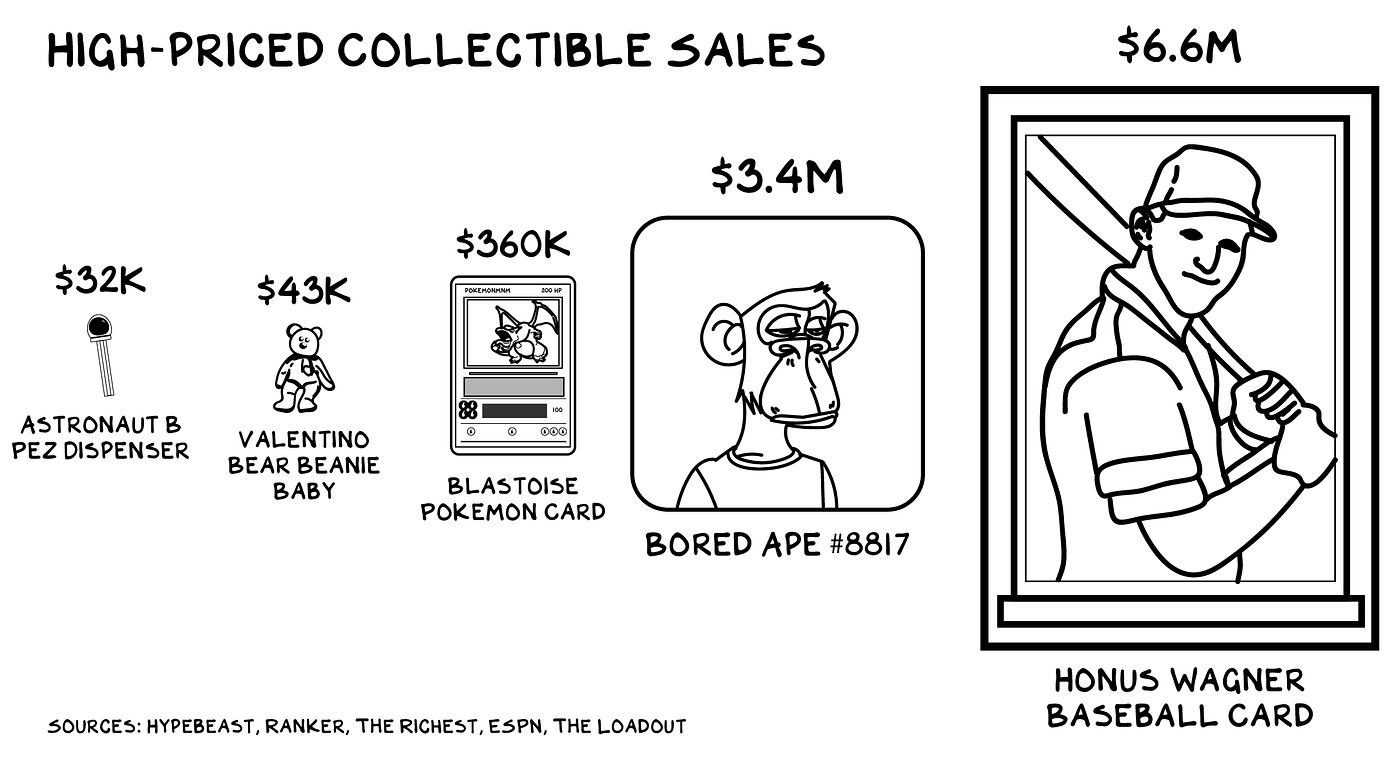
Read also: How to Create ERC-721 NFT Token?

Human mistake is at the root of the EOA problem; if users misplace their private keys, there is no way to get them back. By combining an EOA account with a CA, Account Abstraction handles the problems of an EOA account and constructs built-in mechanisms that permit users to maintain access to their cryptocurrency. A social recovery system is one of these built-in mechanisms. Multiple users can regain access to that account if someone loses their private key. Additionally, Account Abstraction allows users to create multi sig wallets, which require numerous users to sign off on transactions and grant access to an account to a group of users.

Why is ERC-4337 used?

Uses of ERC-4337

ERC-4337 resolves these major issues with current wallet structures:

Retrieve private keys 

The terrifying aspect of web3 is that it’s possible to forget the key with a crypto bit and lose access to one’s wallet. Using the “social recovery system” enabled by ERC-4337 development, authorized individuals can regain access to your wallet if they misplace their private keys. Several Account Recoveries choices, such as a normal Google or Bank account, are provided by this upgrade. Using reinvented cryptographic key storage, they transform your mobile device into something as useful as a hardware cryptocurrency wallet.

Negligible dependence on seed phrases

ERC-4337 Seed phrases, account managing code, and other developer-specific qualities are hidden away, resulting in a clear and usable user interface.ERC-4337 is anticipated to introduce “Group-Access” wallets for smart accounts. This implies that if you forget your seed phrase, you can contact the guardian contracts or accounts you previously chose to help you regain access. 

Users may now protect their wallets with 2FA (two-factor authentication) and biometrics, greatly enhancing their security and usability. Some users of Web 3 are there to safeguard themselves against the kind of institutional intrusion that security methods like biometrics imply. 

Furthermore, those users and others might not want to give up seed phrases because they offer an extra layer of security. Moreover, this measure would remove dependence on private keys through key abstraction. The seed phrase won’t even be required if someone attempts to build up a wallet after the ERC-4337 in order to reclaim the account if necessary. 

Gasless transactions

The ERC-4337 standard supports gasless transactions, further permitting the bundling of transactions to speed up and improve efficiency. With the help of this functionality, NFT collections and associated DAOs can sponsor users’ gas costs, lowering the cost of transactions.

This functionality also makes it possible to pay transaction fees using the tokens associated with an application, thus lowering transaction costs. To make this a primary feature, entire blockchains like Avalanche and its subnets have been created.

Automated DeFi and trading access

The level of involvement required to collect and trade NFTs is one of the most challenging aspects. Analyzing floor prices, timing mints, and tracking metrics all require almost constant effort.

However, ERC-4337 permits AI trading, adjusting yield farming positions, and automated trading with a monthly spend limit. Users of all levels may find trading NFTs much simpler and more accessible thanks to these features.

Bundled transactions

Sign-offs are required for every EOA transaction. Additionally, it may be tedious. With account reflection, it tends to be feasible to package exchanges and send them as one to save time and gas expenses.

User-specific benefits of ERC-4337

ERC-4337 would advance the idea of “Trustless Banks.” ERC-4337 smart accounts offer a number of advantages, some of which are listed here.

  • This innovation brings together all of the other aspects of Account Abstraction that other EIPs had in mind.
  • The decentralized relay system here is more secure and resistant to censorship.
  • They provide conventional mobile user onboarding.
  • Less likely a human error due to the deployment of smart contract wallets.
  • Modifications are simple to implement on other chains that are consistent with the Ethereum Virtual Machine.
  • The adaptability to activate features similar to those found in banks, such as auto-pay, account recovery, and multi-factor authentication.
  • Compatibility with upcoming signature schemes like Quantum resistance and BLS (Boneh-Lynn-Shacham), making the network less vulnerable to attacks.

Concluding remarks

How we communicate about ERC-4337 is crucial to realizing its potential. Anyone can start trading NFTs, join crypto newsletters, play web3 games, and create new smart account wallets with ERC-4337. ERC-4337 provides numerous features that traditional banks typically offer their customers without requiring trust. In general, ERC-4337 has the potential to revolutionize all industries. It might accelerate Ethereum’s daily transaction volume and active addresses in time. Additionally, with simple onboarding, gas-fee-specific revenue generation may improve.

CTA

Can phygital NFTs bridge the gap between Web2 and Web3?


                                       Credits: Azuki Golden Skateboard

With NFTs, the concept of phygital presents endless opportunities to the space. By definition, phygital bridges the gap between the physical world and the digital one.

It focuses on giving users a hybrid experience in terms of user interface and experience. Currently, this idea mainly exists for the fashion and luxury goods industry as it is easier for companies to link their digital offerings to that physically. Furthermore, Morgan Stanley predicts that the metaverse could bring the fashion and luxury goods industry an additional 50 billion dollars in sales by 2030.

Having physical goods linked to the digital world extends the utility of either physical or digital ownership. This is a great way for the community to feel that they are able to represent the project on both channels. In addition, it can also help to securitize the underlying physical goods by having ownership registered on the blockchain. A couple of NFT projects are at the forefront of venturing into the phygital realms with their unique proposition.

You can also read : An Ultimate Guide To NFT Gaming Development

NFT projects venturing into phygital

Azuki

Azuki launched a Proof of Skate (POS) initiative with the bidding of their golden skateboards for each of the top 8 bidders. They aim to bridge the gap between web2 and web 3 by introducing Physical Backed Tokens (PBT):

“The PBT standard is a solution which enables decentralized authentication and tracking of the full ownership lineage of physical items, all completely-chain and without a centralized server. This introduces trustless authentication. No entity has singular rights to authenticate or verify ownership of items — everyone is free to authenticate, verify, and build experiences on top of this technology.”

This was a huge success as the highest bid was 309 ETH and the total revenue of $2.5m. Each golden skateboard comes with a unique emblem with significance from Azuki lore, and also holders get to be enshrined in the Ruins world drop as part of Azuki mythology. The token pushes the boundary between physical ownership and trustless authentication. It is now easier for anyone to view the entire ownership of the skateboard since it is able to keep track of who has owned the item in the past, which is useful for the fine art world of establishing its provenance.

RTFKT

CloneX SZN 1 launched a Forging Mechanic for their existing NFT holders to redeem exclusive physical items from their NFTs collectibles such as fashion items (sneakers, hats, jackets, etc). What differentiates how RTFKT launch its phygital experience is the introduction of Near Field Communication:

“All forgeable items with the exception of Socks and Caps are equipped with NFC tags, allowing owners to link their physical to their NFT. This allows for new possibilities and unlocks in the future such as new items to mint or token-gated physical events.”

The launch of the Forging event is a huge success and the project was able to generate a revenue of $11.34m, with the top three fashion items being T-shirts (36%), Shoes (23.6%), and caps (12.9%). RTFKT launched its physical fashion items successfully because of Nike’s manufacturing expertise; this is an example of how existing fashion brands can tap into Web3 audiences through NFTs.

You can also read: Top 5 Fintech sources — Enhance your industry knowledge

Cult & Rain

Cult & Rain was created as a phygital Web3 fashion brand co-founded by fashion creative director George Yang. This project aims to create both physical and digital wearables such as luxury sneakers and varsity jackets paired with NFTs. With connections to the factory that produces for both LVMH and Kering, the corresponding physical product will be produced in Italy after the claiming of the NFTs is done.

Having a direct-to-consumer model avoids overproduction, which is a main issue for the traditional fashion industry. The digital asset sold as an NFT allows holders to experience the utility of its matching physical luxury product ensuring that they are of good quality.

How to have a successful Phygital plan?

With various projects having their phygital experience included for their community, how can projects measure success to ensure that phygital fit into the long-term of the brand instead of it being a once-off marketing tactic? Personally, I feel that there are a couple of key considerations:

  • An innovative bridge between physical and digital — It is not enough to just allow holders to claim merchandise physically just by holding the NFT. People are expecting more, especially with the foundation of blockchain in NFTs, and projects are pushed to think of ways to stand out. A great example is Azuki, where they introduced the PBT concept to the idea of being able to pass on ownership easily without someone having to verify the physical item.
  • Physical to resonate with the brand — Projects also need to bear in mind that the physical item needs to resonate with the brand and its vision. RTFKT does it well because they are acquired by Nike, which is known for its merchandise like shoes, shirts, and caps thus reinforcing to their holders that they are able to deliver on that end.
  • Physical to be part of the long-term roadmap — Using phygital as a marketing tactic works great as it is the buzzword in the NFT space. However, for a project to truly embrace the concept, it needs to be part of the roadmap where holders can get consistent utility from holding the physical despite already having the digital aspect.

It is great that projects are slowly starting to steer away from the typical merchandise launch and embracing the phygital concept. More web2 people will be willing to move towards web3 if they are able to see the value and tangible perks of owning the NFTs. How can projects incorporate phygital into their business model and continue bridging the gap between web2 and web3? A lot of trial and error is probably needed since we are early in this space.

Credit : Medium


The Future of NFTs: A Visual Exploration into the REAL use cases

NFTs are more important than you think…

In this article, I explored the REAL use cases of NFTs that are being built, and what they will be used for in the future.

Understanding The Hype Cycle

Have you heard of the Gartner Hype Cycle?

It suggests that disruptive technologies go through 5 key phases:

1. Technology Trigger: the emergence of a potentially disruptive technology.

2. Peak of Inflated Expectations: Early publicity creates hype. (Ex: 2021 Bubble)

3. Trough of Disillusionment: Early projects fail to deliver on promises and the public loses interest. I suspect NFTs are somewhere around this trough of disillusionment now.

4. Slope of enlightenment: The tech slowly starts to show successful use cases.

5. Plateau of Productivity: Mainstream adoption has arrived and broader market applications have proven themselves. Here’s a more detailed visual of the Gartner Hype Cycle from Wikipedia.

In the speculative NFT bubble of 2021, @beeple sold a collage of his artwork called “Everydays: the First 5000 Days” for $69 MILLION.

Similarly, @nbatopshot sold hundreds of millions of dollars of video-collectible moments.

This was probably the peak of inflated expectations.

Now, let’s dive into the real use cases of NFTs.

But first, if you’re not familiar with NFTs, I’d recommend watching this video I made.

Digital Art

Most people think that’s all NFTs are — a speculative bubble of rich people buying worthless JPEGs and MP4s.

But having a platform to buy, sell, and own digital artwork or collectibles is transformative for creators and fans.

NFT Profile Pictures

You might also have seen NFT profile pictures on Twitter.

For example: my profile picture is an NFT I minted using @skogard’s factoria app, which helps separate my account from fake accounts.

Profile pictures are a great starting point because they are unique representations of your identity, and have clear ownership.

NFTs are a way to represent proof-of-ownership. It’s easier to prove ownership of digital assets than physical assets, which is why artwork and pfps are the first use cases.

But they can be useful for a lot more.

NFTs can be used to represent anything that is unique, has an owner, and requires a digital certificate of ownership. Example: domains & usernames.

Domains & Usernames

@unstoppableweb, @ensdomains & @rarible let you buy NFT domains.

One of the big benefits of NFT domains is that they are transferrable.

Domains on Godaddy and other web2 providers are not easy to transfer or sell. In many cases, you’re just leasing the domain instead of buying them.

Tickets

Similarly, concert tickets and other event passes are also well suited to be represented by NFTs.

There’s a finite number of them, and access to the event requires proof.

NFTs can eliminate the problem of forgery and make it easy to verify authenticity and ownership.

NFT tickets are also tradeable on the secondary market, which unlocks a few things:

  1. Standardized marketplaces with buyer & seller protection (currently, tickets are traded on inefficient markets like FB & craigslist)
  2. Free market pricing
  3. Royalties for the original creator

4. Historical ownership data of tickets means performers can airdrop future passes, discounts, giveaways, etc to fans.

5. NFT passes can also serve as a badge to showcase your fandom.

The online ticketing market is estimated to be worth $30B+… and it’s growing fast.

A few projects I’ve seen working on NFT-based ticketing:

  • @GetProtocol
  • @SeatlabNFT
  • @YellowHeartNFT
  • @GUTStickets
  • @WicketEvents

Gaming Assets

In-game assets benefit from NFTs for many of the same reasons.

Imagine that someone spent 5 years of their life accumulating a rare in-game collectible sword, and then outgrows or quits the game. That collectible clearly has value for gamers.

The gaming industry is expected to make $200 BILLION in revenue this year, a significant portion of which comes from in-game purchases.

Royalties on secondary market trading of these gaming assets provide a strong incentive for gaming companies to create NFT based ecosystem.

But digital assets are just the beginning… Real-world assets can get much of the same value from on-chain NFT representation.

For example: Real Estate is unique, has an owner, and requires proof of ownership.

Real Estate

Tokenizing real estate has multiple benefits:

1. Can be fractionalized to increase access, liquidity

2. Can be collateralized to increase capital efficiency and access to loans backed by an on-chain asset

3. Allows investors to diversify or make bets on specific neighborhoods, towns or cities +++

I’ve written about this concept before as a thought experiment

I’ve even created an animated video explaining this concept.

So far, we’ve only discussed the benefits of NFTs for transferrable assets. But what about non-transferrable NFTs?

This is a concept that people are now calling Soul-Bound Tokens or SBTs. Vitalik Buterin (co-founder of Ethereum) wrote about this concept in his blog.

Like I said, NFTs are essentially digital certificates that anyone can verify.

Degrees & Diplomas

That lends well to use cases like Degrees & Diplomas. Of course, you wouldn’t want these to be tradable, so they can be made non-transferrable SBTs.

Having a standardized, public proof of diplomas, degrees, skills, and achievements on-chain means that anyone can verify their legitimacy.

The same is true for all other kinds of certificates or achievements.

For example: LinkedIn could give you a verified checkmark for your degree or skills.

Counterfeit Protection

In much the same way, NFTs can also be useful for Counterfeit protection.

Counterfeiting is the largest criminal enterprise in the world, estimated to be $2 TRILLION a year and growing.

So there’s a LOT of value to anti-counterfeit tech.

@ORIGYNTech is working on this, among others.

Identity

Speaking of counterfeiting, identity theft/verification is another massive real-world problem that can be solved using NFTs.

In the US, 15 million+ citizens face identity theft every year, suffering damages of over $50 billion a year.

This is not surprising at all since all you need for US identity theft is a 9-digit number that is regularly passed around in emails, documents, on the phone, etc.

🙋 How can Identity NFTs solve this problem?

  • NFTs are unique and can’t be forged.
  • NFTs provide a global standard.
  • NFTs can be easily verified.
  • Non-transferrable NFTs (SBTs) are locked to a specific wallet.
  • NFTs can be revoked in case of wallet loss or theft.

This could be one of the biggest use cases for NFTs.

Imagine a global identity standard that is standardized across countries, cannot be forged or stolen, is digital, easy to verify, and protects your private details.

And since your identity is more than just your Government ID, you would likely have multiple identity NFTs.

@0xPolygon and @civickey are working on on-chain identity, among others.

Memberships

Digital and physical memberships can also use NFTs to verify access requirements.

Voting

NFT identities can also solve problems like the verification of votes.

If you remember the 2020 US election, there’s no need to explain why this is a problem worth solving.

The simplicity of online voting can also increase voter turnout.

Intellectual Property

NFTs can also be used to protect intellectual property.

This can allow creators to earn royalties from their creations.

⚙️ NFTs have 2 key properties here:

  • Verifiability → IP ownership is clearly defined & publicly verifiable.
  • Standardization → unlocks door for platforms that let creators earn royalties from their IP.

Content Rights

Monetization without copyrighting = more opportunities for everyone.

Music is a pretty obvious use case for this.

Creators currently get screwed and earn very little from platforms like Spotify and Apple Music.

You can also read : How to Buy Real Estate Using Cryptocurrency?

Crowdfunding

NFTs can also be used by creators to crowdfund.

Investors can receive NFTs that represent rights to future royalties, for example.

This is particularly useful for fields where people who are not in the top 1% can’t make money. (Example: Professional sports players)

Mirror.xyz enables crowdfunding via blog posts.

Financial NFTs

This leads us to a broader concept of Financial NFTs (fNFTs). There are lots of financial contracts that are unique.

💰 Examples:

  • An individual’s basket of assets (unique portfolio)
  • A debt agreement with a lender that has been partially repayed
  • Time-locked tokens (ex: veCRV)

Legal Contracts

But this doesn’t have to be limited to financial contracts.

Generally speaking, any legal contract or document can benefit from NFT representation.

Emails & Messages

But why stop at legal contracts? Verbal agreements through emails and messages are also unique, but suffer as a means of verification since they are easily lost and can be forged.

Medical Records

Medical records or prescriptions are yet another example of documentation that has a high requirement for verification but lacks the proper systems for doing so.

Examples of Medical documents that can be represented through NFTs:

  • Vaccination certificates
  • Covid test results
  • Prescriptions
  • Medical conditions connected to one’s identity
  • Data tracked by health sensors

You can also read : Web3 Adoption Curve

Existing systems of proof by paper / PDF have photoshop-risk.

I tried to cover most of the use cases I could think of, but I think this barely scratches the surface.

People are finding other creative use cases for NFTs too.

For example: @ShaanVP minted an NFT called “5 Minutes of Fame” 👇

Here are 2 Twitter threads you can read to learn more about the future of NFTs:

  1. This piece of gold by @chriscantino

2. This conversation between @punk6529 and @RaoulGMI on @RealVision “The World According to @punk6529

Finally, if you find yourself asking why NFTs are uniquely well-suited for these use cases over the existing web2 database systems, see this Twitter thread I wrote:

If you enjoyed this piece, consider sharing it with your community to spread the word.

Credit : Medium

Actual, practical uses for NFTs.

This year I quit my job at Amazon Web Services, created a top 150 all time volume NFT collection, and started a software company called UTILITI, building the first web3 application platform.

These days I spend most of my time consulting game studios, enterprises, and consumer brands about how to think about implementing web3 & NFTs in a value-added way.

Here are a few of the cool things we’re working on for household names.

  • A digital loyalty app that also serves to identify counterfeit products.
  • A disruptive mobile game that can onboard mainstream users seamlessly, and makes NFT ownership a bonus, rather than a premise.
  • A geo-fenced loyalty token airdrop application that drives foot traffic.
  • Quite a few RPGs that allow players to earn upgrades to the visual appearance of their character avatar NFTs.

The common theme between all these implementations is that they’re not focused on selling NFTs directly to users who are expecting an arbitrage opportunity. In other words, the paradigm is starting to shift.

In the early days of 2021 when public interest and demand for NFTs and metaverses massively outpaced the number of people capable of creating them, the general public came to know NFTs as overpriced monkey JPEGs and digital land selling for hilariously inflated prices.

You can also read : What You Need to Know About Investing in Tokenized Real Estate

GME, AMC, and DOGE traders flocked into NFTs expecting the next 1000x. Shitty businessmen and outright scammers sold them and became rich. Once again the mainstream came to know yet another blockchain implementation as a clownish unregulated financial instrument, except this time some celebrities bought them, and some companies sold them.

The true value of blockchain technology was missed, in this case the potential for tangible ownership of intangible digital assets as a consumer benefit.

That is what we’re working with businesses to unlock.

Instead of selling NFTs to their already over-monetized customers, brands should instead seek to give them freely in exchange for specific actions, aiming to provide sentimental and exclusive value to their best customers.

Instead of encouraging investors to purchase in-game assets well before a game release, game studios should drop them for free to build a community of early users and feedback providers to inform their roadmaps.

Enterprises should seek to hand out NFTs to better engage and understand the top 10% of their customers who create 50+% of their revenue, turning communities of holders into customer focus groups.

You can also read : Blockchain in real estate: How technology is changing the industry

The trick is to rethink from first principles how to leverage this concept of bestowed digital asset ownership that’s beginning to permeate into the collective psyche in a way that benefits your target customers — bonus points if you can attract the massive web3 native audience.

If your goal is to sell an NFT to bootstrap a project then you should use the funds you raise to provide exclusive value and experiences for the community of holders you create no matter what.

Obviously more practical implementations like insurance claim settlement, supply chain tracking, and anti-counterfeiting are unlocked by blockchain technology, but I’m personally most excited about the way this concept of digital asset ownership through NFTs can blend with a framework for decentralized (non-value extractive) platforms to create holistically improved user experiences. More on that later.

We’re already starting to see DeFi eat banks, and I believe creator platforms are next. There’s a reason Linux powers the most virtual machines in the cloud.

Credit : Medium

The Real Potential of NFTs

Amidst the scams and bubbles, credible scarcity and authenticity will unlock real value in digital markets

Last week, Mark Zuckerberg announced NFTs are coming to Instagram. What does that … mean? The announcement was a word salad of platitudes, so we don’t know how the Zuck will bolt this latest thing onto his Frankenstein product structure. The good money is it won’t work — Meta is one of the best acquirers in history, and one of the least innovative. The broader, and more interesting, question is the half-life of NFTs.

As we ended 2021, NFTs were white-hot. Forty-one billion dollars hot, and everywhere. Twitter beat Zuckerberg to the NFT punch, letting tweeters use an NFT as their profile picture, Spotify is hiring for NFTs, and brands from Budweiser to Louis Vuitton are producing them. You can even buy a virtual NFT of the McDonald’s McRib. But there are signs the hype is fading. Trading is down, Google searches are down, scams and frauds are (still) up.

The sun may have passed midday on the hype cycle, but NFTs (or something similar) have real potential to be an unlock for a fundamental aspect of the digital economy.

So … WTF is an NFT? Technobabble aside, it’s similar to the deed to a house. A digital document that identifies one true owner of a digital product. Real estate deeds rely on an ecosystem of paper and electronic records, legal standards, and institutions staffed by experts. It’s worth the expense, as real estate is valuable. NFTs, or non-fungible tokens, are deeds rendered in the world of bits, not atoms. Digitally native, NFTS are (theoretically) lower cost than real estate deeds — thus they’re economically practical for digital items and lower-value property. Deeds … for anything. As private property and ownership are central to capitalism, and economic activity increasingly moves online, NFTs may become central to our economy.

You can also read : Understanding the Ethereum ICO Token Hype

Scarcity and Authenticity

NFTs offer digital commerce something the Internet lacks: scarcity and authenticity. A scarcity mentality is built into us at an instinctual level. Our cravings for sugar and fat (historically scarce) have resulted in an obesity crisis, because our instincts haven’t kept pace with industrial food production. Authenticity’s virtues are practical (we like to know where our food comes from and who we can sue if it makes us sick) and philosophical (if we buy music, is some of the money going to the artist who made it?).

Limited options for credible scarcity and authenticity have rendered digital commerce chaotic. Napster broke the barriers of scarcity that were inherent to physical distribution of music on plastic discs. The pirating of digital goods of all kinds reduces both tech profitability and long-term innovation. Google put the news media into intensive care by reproducing its content (ending scarcity), and Facebook drove another nail in the coffin by de-emphasizing the source (neutering authenticity).

Enter blockchain. Bitcoin became a trillion-dollar asset class because it cracked this code. A dollar bill is worth $1 because only the U.S. Treasury can make it (authenticity) and we trust Uncle Sam to mint a limited number (scarcity). Bitcoin’s “proof-of-work” system likewise ensures scarcity (there will only ever be 21 million bitcoins produced) and authenticity (all are tracked on an immutable public ledger).

NFTs offer the promise of scarcity and authenticity for digital goods. NFTs aren’t the only way to create scarcity and authenticity online — trusted, centralized entities such as banks (and platforms such as Twitter and Apple) do it within their verticals, and blockchain tech is evolving to address myriad environmental and security concerns. So the current implementation of NFTs may not be the best way, or even a good way (many reasons to be skeptical). But they’re … a way. A potentially widespread, inexpensive way to offer credible scarcity and authenticity online, opening up new vistas of digital commerce. Prospectors are rushing in.

Art

The world beyond crypto-obsessives started paying attention to NFTs a year ago, when digital artist Beeple sold an NFT mosaic of his daily digital images, Everydays, at Christie’s for $69 million. No asset class depends more on scarcity and authenticity than art. The Mona Lisa’s value relies on our belief that there’s only one (scarce); plus, we know it was created by da Vinci (authentic).

As deeds do for real estate, a whole industry of galleries, museums, and consultants, along with ancient documents and high-tech gadgets, props up the fine art market. We know this from the failures: A single successful forger, Pei-Shen Qian, formerly of Queens, brought down a 170-year-old art gallery and spawned 10+ lawsuits (and one Alec Baldwin podcast) with his oeuvre of fake Rothkos. NFTs offer a defense against digital forgery. Beeple’s Everydays is authenticated publicly, on the blockchain (and a less cryptic Opensea listing, with legibility brought to you by … centralization). The lower priced the art, the more it requires a scalable platform for establishing scarcity and authenticity.

You can also read : Initial Coin Offering (ICO): Everything You Need To Know!

Bored Ape

Bored Ape Yacht Club — a series of JPEGs of monkeys wearing different outfits — is no more or less risible than any other trend. There are 10,000 of them, each unique, and they’re collectively valued at $3 billion. The floor price for one is $311,000. The company behind les singes ennuyés, Yuga Labs, has consolidated its position as the dominant force in NFT-based collectible bubbles, buying up the NFT brands CryptoPunks (bored dudes) and Meebits (bored avatars) and raising $450 million at a $4 billion valuation.

Is this a JPEG ape bubble? Likely. Collectible bubbles are nothing new. Beanie Babies were individually unique, cartoonish figures produced at low cost and brilliantly marketed. In 1997, eBay sold $500 million worth in a month — 6% of the company’s annual sales. Garbage Pail Kids, Cabbage Patch Dolls, animation cells, POGS, tulips — the list goes on. Some endure, such as vintage baseball cards (outperforming the S&P 500 since 2008). There is a huge market for modestly priced art and un-bubbled collectibles that could benefit from digital scarcity and authenticity. NFTs also offer the potential for creators to collect royalties every time their art is sold in the secondary market, remedying some of the creative economy’s inequities.

How long will Bored Apes remain culturally relevant? Don’t know. They are trees, which live and die. Yet the forest is immortal.

Brands

For brands, scarcity and authenticity is everything. Chanel can sell sunglasses for $500 because they’re scarce and they’re Chanel. In exchange, the customer gets to say “I’m aspirational” without saying “I’m aspirational.” But branding goes beyond signaling wealth. Doc Marten boots say something, and Wrangler and Levi’s say something else. Oatly is not milk, but it is a statement about who you are.

People underestimate the power of brands; it’s a lie we tell ourselves. Branded beer tastes better than non-branded beer. Allergy medication is more effective after you watch branded advertisements. Labradoodle vs. Labrador, Star Wars vs. Dragon Ball, iOS vs. Android, NYU vs. Columbia — we are a tribal species, and we sort ourselves with logos. Logos that we insist are “authentic,” despite the availability of knock-offs. A robust ecosystem of intellectual property laws and institutions ensures a brand’s owners control scarcity, and NFTs augment that system in the digital economy.

Many companies are catching on to this in their own socially stunted, corporate, Zuckerbergian way. People want to show up to the Miller Lite metaverse tavern no more than they want to follow Miller Lite’s Instagram page. There’s no doubt that much of the fullness brands give to physical life is missing online.

Belongings

Every morning I put on a Panerai watch to signal my masculinity and success. I haven’t wound it in 10 years. Online I have something even more scarce: A Twitter blue check. The blue check is a digital Panerai (sort of): scarce and authentic, it signals that if you mate with me your kids are more likely to survive than if you couple with someone missing the blue check.

One of the keys to NFTs will be portability across mediums. A Twitter blue check can’t exist on Instagram, but the NFT equivalent of a Twitter blue check can — and deliver credible authenticity, thanks to that NFT deed. This is the metaverse vision of interoperability that could help make digital belongings feel similar to physical belongings.

Digital belongings exist on the internet, but there aren’t that many types of them. On Fortnite you can acquire guns and outfits. On Reddit you gain badges. Point is: There’s a lot of stuff on the internet, but there isn’t much stuff that’s yours.

Now ask yourself: How much physical stuff is yours? Think of every item in your house: books, paintings, photos, CDs, heirlooms, trophies, etc. What’s the market value of all that? As our lives move further online, so will our stuff, and we’ll need some sort of infrastructure that allows us to own it.

Money Changes Everything

I’m a capitalist and generally think that functioning markets improve lives. Bringing credible scarcity and authenticity to digital markets is a net positive — but the key word there is “net.” The flood of interest in NFTs has predictably resulted in scams and exploits. The market has cooled off recently, with the top corresponding pretty closely to former First Lady Melania Trump’s NFT scam. (She bought her own NFT through shell accounts to create false signals re the value.) When I interviewed Mark Cuban (owner of the Dallas Mavericks), he raised concerns about sports team NFTs injecting a money-making incentive between the fans and the team, replacing the emotional bond they feel with the team and players with the anxiety of a Robin Hood day trader sweating a position.

Scarcity and authenticity are powerful, and not always forces for good. Our instinctual craving for scarce sugar and fat has produced an obesity crisis, but we aren’t going to throw out the industrial food system and live off the land. Amidst the scams and bubbles, credible scarcity and authenticity will unlock real value in digital markets.

In sum, Madame First Lady Trump,

Learn the damn language: scarcity and authenticity.

Life is so rich,

Credit: Medium