

- AI Development
- AI App Development
- AI Consulting
- AI Software Development
- ChatBot Development
- Enterprise AI ChatBot
- AI Chatbot Development
- LLM Development
- Machine Learning Development
- AI Copilot Development
- MLOps Consulting Services
- AI Agent Development
- Deep Learning Development
- AI Deployment Services
- Deep Learning Consulting
- AI Token Development
- AI Development Company
- AI Development Company in Saudi Arabia
- AI Integration Services
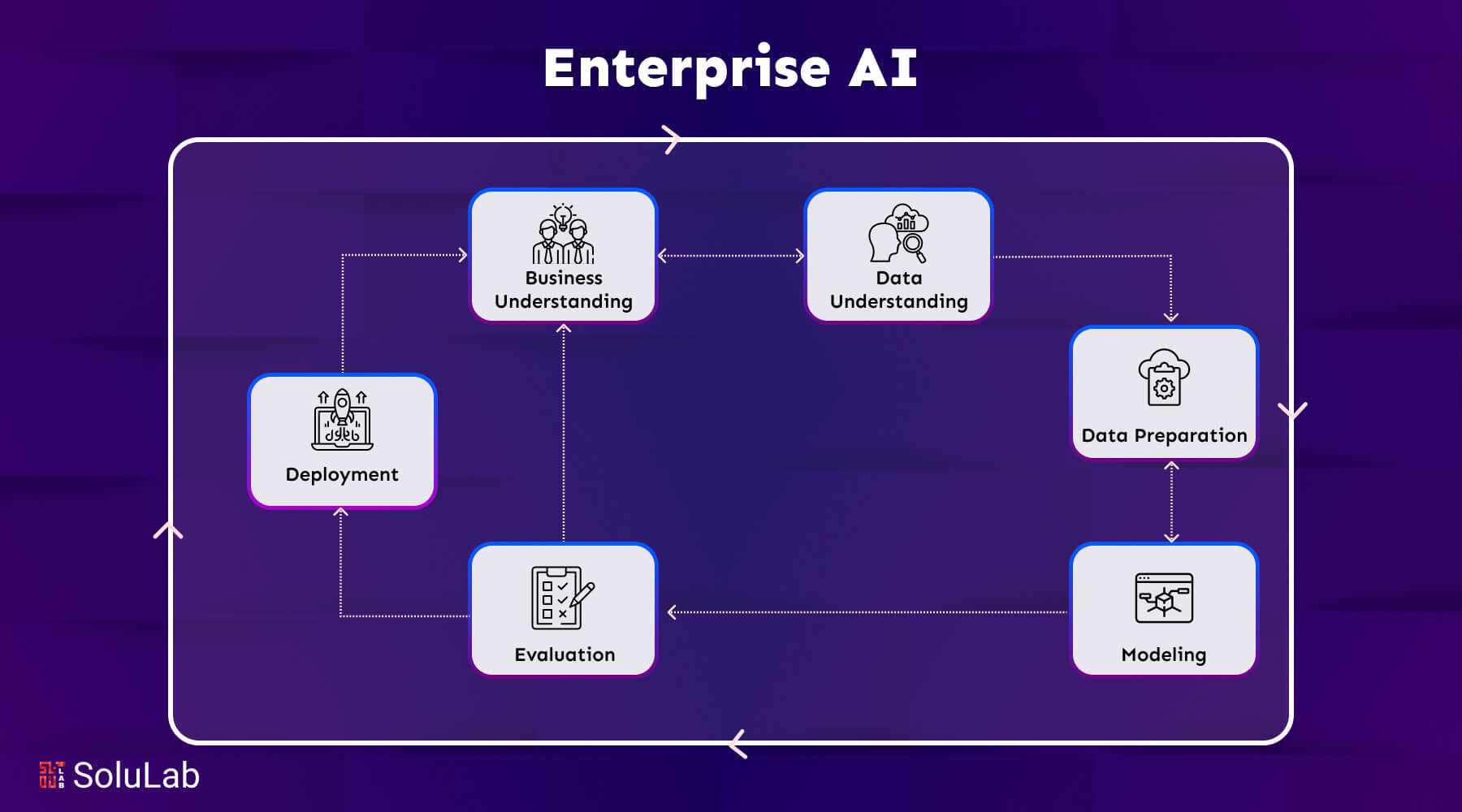
Managing repetitive tasks, sifting through piles of data, or making decisions without solid insights can be frustrating and time-consuming. These challenges often slow down productivity and growth. Studies show that 73% of businesses are already using analytical and generative AI. Additionally, 72% of top-performing CEOs believe that a competitive advantage depends on who is utilizing the most advanced AI technologies.
This is where Enterprise AI comes in. It can automate everyday tasks, spot trends in your data, and help you make decisions quickly and confidently. Imagine spending less time on routine work, improving customer service, leveraging NLP applications, and staying ahead of your competition—all while saving resources.
In this blog, we’ll explain what Enterprise AI is, why it’s important, and how it can make a real difference for your business. Let’s get started!
What is Enterprise AI?
Enterprise AI refers to how businesses use AI technologies to make their operations run more smoothly, make better decisions, and spark new ideas. It’s made to handle big, complicated jobs like customer service, data analysis, and automation. Businesses can get useful insights, improve workflows, and work more efficiently overall with business AI. Generative AI application is a key part of this transformation, enabling businesses to create new content and solutions dynamically. Enterprise AI is changing how businesses work, whether it’s in transportation, HR, or marketing. This helps them stay competitive in a digital world that is changing quickly.
What are the Use Cases of Enterprise AI?
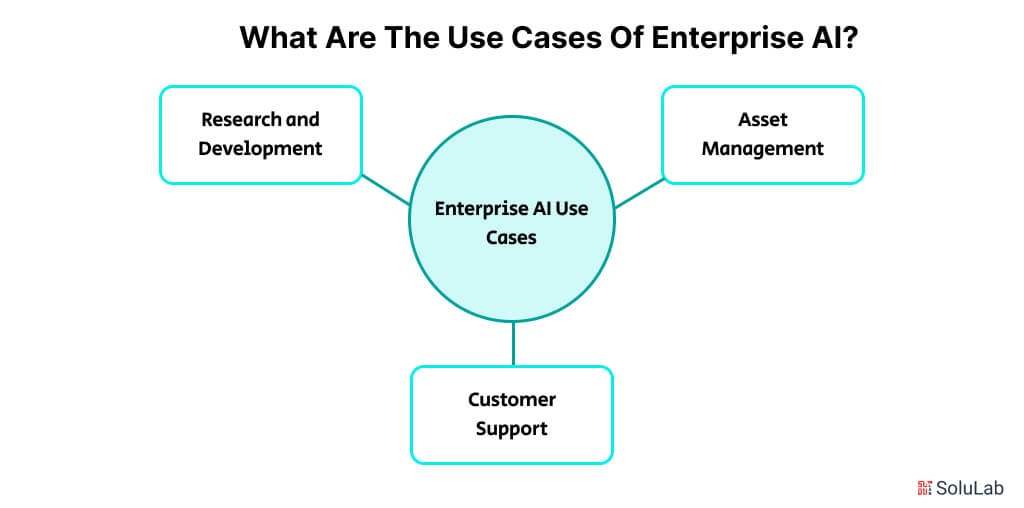
Artificial intelligence tools have the potential to transform numerous business functions, from managing supply chains to detecting fraud and tracking customers. Let’s explore a few case studies that demonstrate the impact of AI use cases on business operations.
1. Research and Development
AI can analyze large datasets, predict trends, and simulate outcomes, making product creation faster and more resource-efficient. By identifying patterns in past successes and failures, AI helps businesses create better products in the future. It also promotes collaborative innovation, enabling teams from different locations to work together on complex projects.
AstraZeneca, a global pharmaceutical company, developed an AI-driven drug discovery tool that enhances quality and reduces the time needed to identify potential drug candidates.
2. Asset Management
AI technologies simplify the management of both physical and digital assets. For example, automated maintenance algorithms can predict when machines or tools will likely break down or need servicing. They can suggest changes to equipment usage, improving efficiency, saving energy, and extending the lifespan of assets. AI-powered tracking systems also provide real-time visibility into the location and condition of assets.
Example: Baxter International Inc., a leader in medical technology, uses AI to reduce unplanned equipment downtime. At just one site, AI has prevented over 500 hours of downtime.
3. Customer Support
AI is revolutionizing customer interactions, making them faster, more personalized, and scalable. Generative AI in customer service enables AI-driven chatbots and virtual assistants to handle many customer queries, while real-time analysis of customer data allows businesses to provide tailored recommendations and support.
T-Mobile, a global telecommunications company, uses AI to enhance customer service. Human agents can respond more quickly and effectively, building stronger relationships with customers.
Types of Enterprise AI
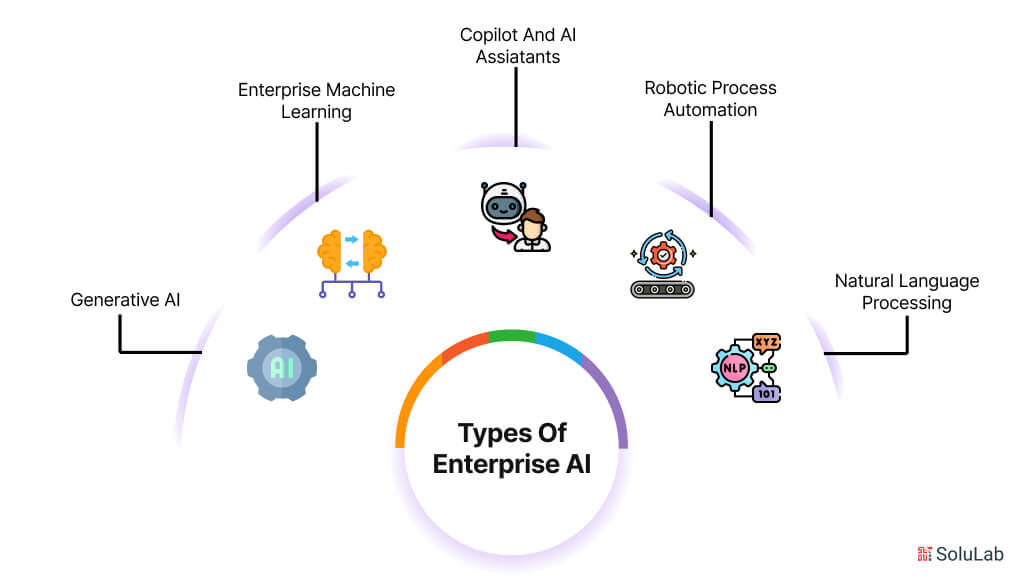
Here are some types of enterprise AI in finance you should know:
-
Enterprise Machine Learning
Enterprise machine learning analyzes data, predicts trends, and provides actionable insights using algorithms. Businesses can leverage it to automate decision-making, streamline operations, and gain deeper insights into customer behavior, enabling strategic planning and improved performance.
-
Copilot and AI Assistants
AI copilots and helpers enhance productivity by providing real-time assistance, automating processes, and simplifying workflows. They support tasks like scheduling, research, and problem-solving, making daily operations easier and fostering better collaboration among teams.
-
Natural Language Processing (NLP)
NLP enables machines to understand and interpret human language. Businesses utilize it for chatbots, sentiment analysis, and document processing, improving customer communication and operational efficiency.
-
Generative AI
Generative AI processes data to create new content, such as images, text, and designs. It plays a vital role in marketing, entertainment, and product development by driving creativity, personalization, and innovation.
-
Robotic Process Automation (RPA)
Robotic Process Automation (RPA) automates repetitive tasks like data entry, invoice processing, and report generation. It reduces errors, saves time, and allows employees to focus on more strategic activities, boosting operational efficiency and cutting costs.
Read More: What Is Manus AI? How to Build a Similar AI Agent for Your Business
What are the Benefits of Enterprise AI?
Businesses are finding new ways to use AI tools like copilots, chatbots, and creative AI as these technologies get smarter and more popular. But before we dive into specific use cases, let’s first look at some key benefits of AI for businesses.
1. Improving the Workplace: AI plays a big role in enhancing the workplace by helping employees do their jobs better:
- Productivity Boosters: AI copilots manage emails, set up meetings, and prioritize tasks, letting workers focus on more important work.
- Adaptive Learning Systems: AI-powered learning platforms offer personalized training that matches each employee’s style and pace, encouraging professional growth.
- Workplace Analytics: AI tools track work habits and suggest ways to improve performance and job satisfaction.
2. Making Smarter Decisions: Adaptive AI helps businesses make more accurate, timely decisions:
- Data-Driven Insights: AI tools analyze big data to provide quick, strategic recommendations.
- Better Predictions: AI tools use past data to predict future trends, helping businesses anticipate market needs and customer behavior.
- Scenario Analysis: Advanced simulations allow companies to test different outcomes, manage risks, and create smarter plans.
3. Enhancing Customer Experience: AI is transforming how businesses interact with customers, making services faster and more personalized:
- Personalization at Scale: AI analyzes customer data to deliver tailored marketing messages and product recommendations.
- 24/7 Customer Service: Chatbots offer instant responses to customer queries, improving availability and satisfaction.
- Customer Insights: AI helps businesses understand customer needs by analyzing feedback and behavior, leading to better products and services.

How Businesses Use Enterprise AI?
Enterprise-responsible AI is for businesses, boosting productivity, improving decision-making, and opening up new opportunities. Here’s a look at how it’s being used across different areas:
1. Support and Customer Service
- Virtual Assistants and Chatbots: AI-powered chatbots provide 24/7 support, answering questions, offering help, and suggesting ideas.
- Customer Sentiment Analysis: AI reviews customer feedback, comments, and social media to identify areas for service improvement.
2. Sales and Marketing
- Personalization and Customer Insights: AI analyzes customer data to tailor marketing campaigns and product suggestions.
- Predictive Analytics: AI predicts customer behavior, sales trends, and market potential, helping businesses make better decisions.
3. Logistics and Supply Chain
- Demand Forecasting: AI predicts demand, helping businesses optimize inventory and reduce costs.
- Route Optimization: AI improves delivery efficiency, cutting fuel costs and speeding up delivery times.
4. Human Resources
- Hiring: AI sorts through resumes, schedules interviews, and handles the initial stages of recruitment.
- Employee Engagement: AI tracks employee satisfaction and engagement, enhancing workplace culture and retention.
5. Finance and Accounting
- Fraud Detection: AI algorithms detect unusual transactions, helping prevent fraud.
- Financial Forecasting: AI-powered analytics improve accuracy in financial planning and forecasting.
6. Product Development
- Design and Prototyping: AI aids in designing, prototyping, and testing new products.
- Quality Control: AI systems spot defects and ensure production quality.
7. Maintenance and Operations
- Predictive Maintenance: AI predicts when equipment will fail, reducing downtime and maintenance costs.
- Process Optimization: AI improves operational efficiency, making processes more streamlined.
8. Security
- Cybersecurity: AI helps detect and prevent threats by monitoring network activity.
- Physical Security: AI-powered cameras detect unusual behavior, enhancing physical security.
9. Data Management and Analysis
- Big Data Analytics: AI analyzes massive datasets to uncover patterns and insights for strategic decision-making.
- Data Integration: AI consolidates data from multiple sources, improving reporting and research.
10. Healthcare
- Diagnostics: AI analyzes medical images and patient data to assist with diagnoses.
- Personalized Treatment: AI in healthcare customizes treatment plans based on a patient’s genetic and medical history.
11. Retail
- Stock Management: AI predicts when inventory needs reordering and automates the process.
- Enhanced Customer Experience: AI personalizes shopping experiences and speeds up checkout.
12. Manage Energy
- Smart Grids: AI optimizes energy distribution, saving costs.
- Renewable Energy: AI helps efficiently predict, manage, and distribute renewable energy.
In short, AI is boosting productivity, cutting costs, sparking innovation, keeping customers engaged, and helping businesses stay competitive across the board.
Enterprise AI Challenges
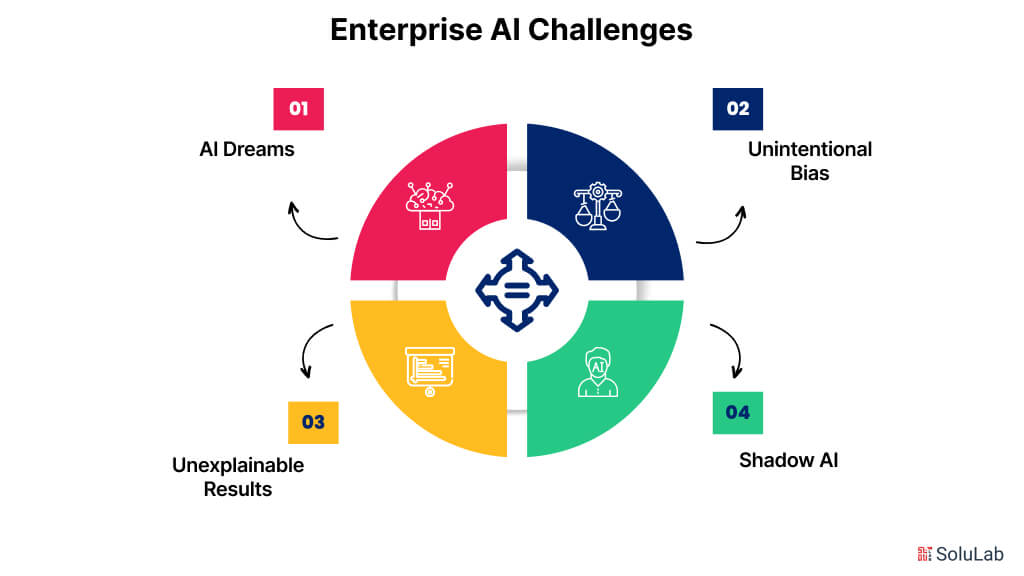
Many of the issues and risks associated with workplace AI stop common challenges in any technology deployment: poor planning, lack of the right skills, misalignment with business goals, and ineffective communication.
When companies face these challenges, it’s helpful to learn from the best practices of others who have successfully adopted new technologies. However, AI brings its unique risks, many of which businesses aren’t prepared for or even aware of, given how quickly the technology evolves.
1. Unintentional Bias: One of the biggest hurdles to successful AI adoption is worker mistrust. According to KPMG’s “Trust in Artificial Intelligence: Global Insights 2023” survey, 61% of people either weren’t sure about AI or didn’t trust it. A 2024 Salesforce poll of nearly 6,000 knowledge workers found that 56% of AI users struggled to get desired results, and 54% lacked trust in the data used to train AI systems. These concerns often result in lower usage of AI.
2. Unexplainable Results: Addressing these doubts about AI is challenging, as there are inherent flaws in the technology: AI algorithms rely heavily on the quality of the data they are trained on. If the data is biased, the AI system can produce inaccurate or socially unacceptable results, deepening mistrust.
3. AI Dreams: While deterministic systems give predictable results based on input, most AI systems today are probabilistic, using statistical models to make educated guesses. This can sometimes lead to fabricated or “made-up” responses, as seen with tools like ChatGPT.
4. Shadow AI: Another risk is the rise of “shadow AI,” where employees use AI tools without official approval. According to Microsoft and LinkedIn’s “2024 Work Trend Index Annual Report,” 78% of AI users bring their own AI tools to work. This highlights the importance of creating clear AI usage policies.
Businesses also face concerns about breaking AI laws, cybersecurity threats from AI-driven cyberattacks, and job losses due to automation. While some jobs will remain irreplaceable by AI, the technology is likely to take over more roles in the future, leading to both internal and societal challenges.
Businesses must stay ahead of these risks and adopt AI responsibly to ensure its successful integration into the workplace.
Enterprise AI Examples Across Industries
Enterprise AI is transforming industries in top AI development companies by streamlining operations, enhancing efficiency, and enabling innovation. Here are key examples across sectors.
1. Automotive: AI is transforming the automotive industry by enhancing quality control and developing safer technologies for self-driving cars.
2. Energy: AI is making green energy sources more effective and integrated by accurately predicting demand and adjusting to supply changes in real-time.
3. Entertainment: Streaming services use AI to offer personalized content recommendations, while gaming companies are creating more immersive and responsive environments for players.
4. Finance: In the financial sector, AI-powered fraud detection systems and robo-advisors make transactions safer and more efficient.
5. Healthcare: AI is revolutionizing healthcare by improving diagnostic accuracy, enabling personalized medicine, and delivering better treatment outcomes through smart data analysis.
6. Life Sciences: AI has accelerated drug development and genomics research, while also helping doctors customize treatments based on a patient’s genetic profile.
7. Manufacturing: AI improves production efficiency, reduces downtime with predictive maintenance, and creates more environmentally friendly products.
8. Public Sector: In the public sector, AI is simplifying administrative tasks, enhancing traffic and emergency services in cities, and fostering greater community engagement.
9. Software Development: Enterprise generative AI tools are streamlining coding and testing, speed up development cycles, identifying security gaps, and helping workers learn new programming languages and frameworks faster.
10. Telecommunications: AI-powered predictive analytics improve service delivery and network management in telecom, ensuring smooth network operations and a more personalized customer experience.
Enterprise AI Strategy and Planning
Adopting AI is about more than just choosing the right tools—it requires careful planning, teamwork, and a commitment to continuous learning. To maximize AI investments, businesses must set clear goals, foster collaboration, and embrace adaptability. Here are some key considerations for getting started:
1. Implementation: In-House vs. Partner
A. In-House Implementation
- Advantages: Full control over execution and greater privacy for sensitive data.
- Challenges: Requires significant internal expertise, time, and effort. Employees need to be trained extensively, which may strain resources.
B. Partner-Led Implementation
- Advantages: Access to specialized expertise and faster implementation. Helps fill skill gaps and ensures the best practices are followed.
- Challenges: Higher initial costs. Requires careful vendor selection to align with company goals and culture.
2. Assess Capabilities and Set Goals
- Goal Alignment: Define measurable objectives that align with overall business goals. For example, set a target for AI to reduce operational costs by a specific percentage.
- Data Assessment: Evaluate data quality, availability, and security to identify gaps before technical implementation.
3. Resource Allocation
- Budgeting: Account for initial and ongoing expenses, including software updates, cloud storage, and security.
- Talent Acquisition: Invest in hiring skilled professionals or training existing employees to effectively use AI tools.
4. Foster Collaboration
- Cross-Functional Teams: Form teams comprising IT, data analytics, managers, and end users to ensure comprehensive planning and execution.
- Regular Reviews: Schedule frequent check-ins to track progress and ensure alignment with business objectives.
5. Adapt and Continuously Learn
- Ongoing Training: Develop continuous training programs to keep employees updated on the latest AI developments.
- Feedback Mechanisms: Create channels for all stakeholders to share insights and suggestions, enabling iterative improvements to AI systems.

Conclusion
Enterprise AI, like machine learning, copilots, and generative AI, is changing how businesses work. It boosts productivity, improves decision-making, and sparks innovation as well. Early adopters are already seeing great results, proving that AI isn’t just a trend—it’s essential to stay competitive in a competitive market.
However, it’s not just about selecting the right AI tools. To succeed with AI, businesses need to create a culture that supports it. This means investing in training, ensuring data security, and using AI responsibly.
SoluLab helped AI-Build, a construction tech company, revolutionize CAD product development using generative AI and ML models. By automating design processes, enhancing precision, and enabling scalability, SoluLab an AI development company tackled challenges like design automation complexity, seamless AI integration, and robust architecture development. The result? Increased productivity and innovation in the CAD industry.
FAQs
1. Why is enterprise AI important for businesses?
It helps companies streamline processes, gain data-driven insights, reduce costs, improve customer experiences, and stay competitive in the digital era.
2. What industries benefit the most from enterprise AI?
Industries like healthcare, finance, retail, manufacturing, and logistics benefit significantly from enterprise AI solutions.
3. What are the key technologies driving enterprise AI?
Technologies include machine learning, natural language processing (NLP), computer vision, robotics, and advanced analytics tools.
4. Is enterprise AI only for large corporations?
No, small and medium-sized businesses can also leverage enterprise AI by using scalable and cloud-based solutions.
5. How can businesses prepare for enterprise AI adoption?
By setting clear goals, evaluating resources, ensuring data readiness, and fostering cross-functional collaboration, businesses can prepare effectively.

