Talk to an Expert

Custodial vs. Non-Custodial Wallets: How to Pick the Right Crypto Wallet in 2026

Custodial vs. Non-Custodial Wallets banner

Choosing between custodial wallets and non-custodial wallets really comes down to your goals. A custodial wallet is simple to use, great for beginners, and perfect for everyday trading. A self-custody wallet or non-custodial wallet gives you full control of your crypto, but you also take full responsibility for security.

The 2025 numbers say a lot. Crypto exchanges faced $2.37 billion in stolen funds in just the first half of the year, a 66% rise from H1 2024. Meanwhile, cold self-custody wallets with proper security show under 5% incident rates, while online software crypto wallets cross 15% breach rates.

This is why the debate around custodial vs non-custodial wallets is more important than ever. And if you’re exploring your own product, our agency builds secure, scalable solutions through expert crypto wallet development services, helping you choose the right model while keeping it cost-efficient.

Key Takeaways

Custodial wallets offer convenience and recovery support, making them ideal for beginners, exchanges, and enterprises that prioritize ease of use.

Non-custodial wallets provide full control and private-key ownership, suited for experienced users, DeFi investors, and those who value maximum security.

The right choice depends on your risk tolerance, technical comfort, and asset management goals, especially as regulations and Web3 apps evolve in 2026.

Why Choosing the Right Wallet Is Critical for Crypto Security?

Choosing the right crypto wallet matters because it controls how your private keys are stored, who can access your funds, and what happens if something fails. In crypto, your wallet is the main security layer; there is no reset button or customer support that can recover lost keys.

  • A custodial wallet stores your keys on a company’s servers.
  • A non-custodial wallet stores your keys on your own device.

The difference between custodial and non-custodial wallets impacts:

  • control over private keys
  • risk of hacks or server breaches
  • recovery options
  • compliance and regulation
  • how fast funds can be moved
  • responsibility during a failure

From a business point of view, especially for founders and teams handling project funds, the wallet type you choose affects security, operations, and trust. If your wallet setup is wrong, your entire system becomes vulnerable.

For companies building products, partnering with one of the best crypto wallet development companies ensures you choose a structure that is safe, scalable, and compliant.
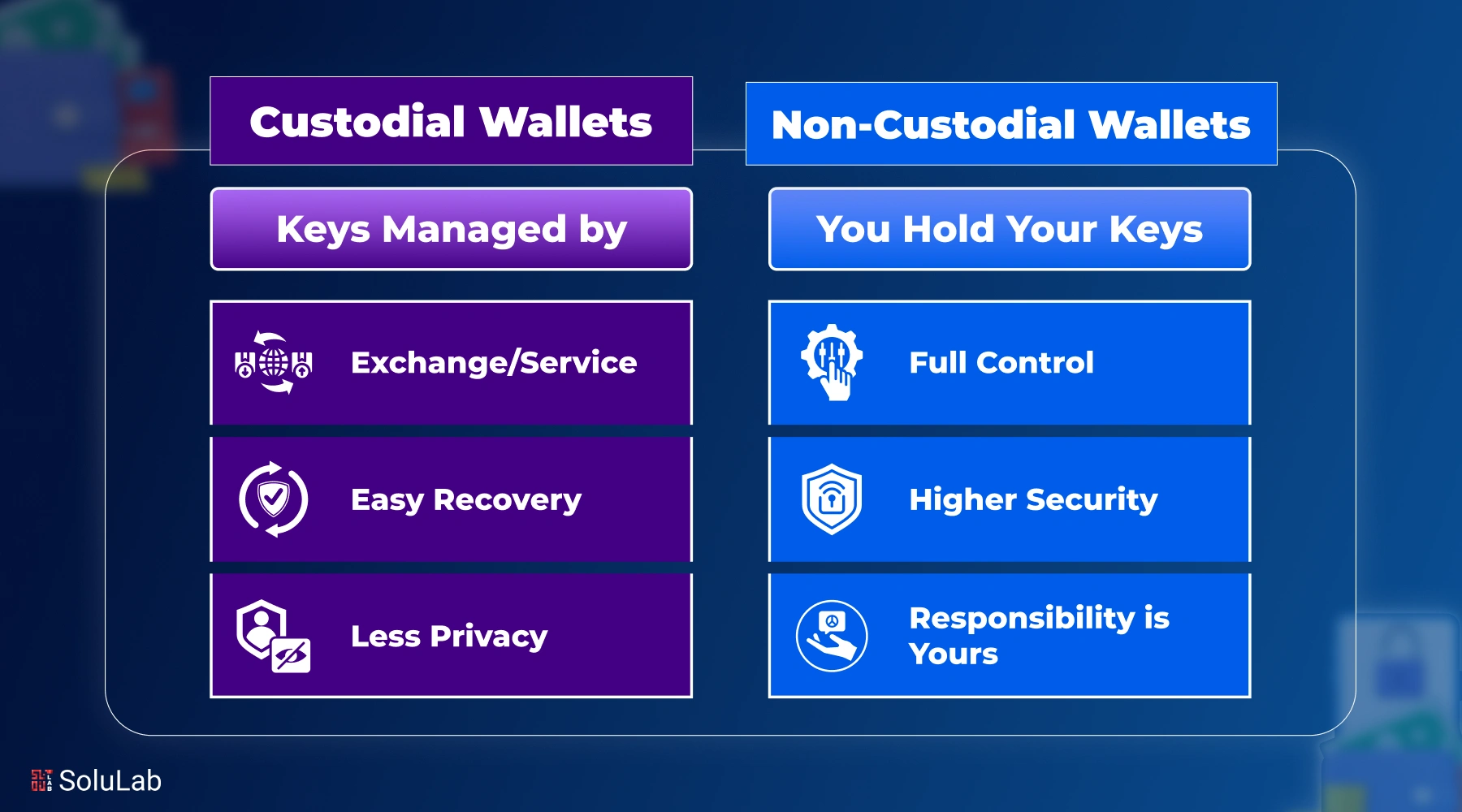
Custodial Vs Non-Custodial Wallet table chart

What Are Custodial and Non-Custodial Wallets?

When people talk about crypto wallets, they usually mean two types: custodial and non-custodial. The easiest way to understand them is by thinking of renting a house vs. owning a house.

1. Custodial Wallets

A custodial wallet is like renting. A company stores and manages your private keys for you. You get access to your assets, but the company holds the real control. This type is popular among beginners and teams who want simple access, low responsibility, and someone else handling the technical part.

Key points businesses care about:

  • Easy onboarding
  • Faster recovery if someone loses access
  • Customer support from the provider
  • Good for exchanges, apps, and new traders

This is where the benefits of custodial wallets matter because users want a safe and simple tool instead of managing keys on their own.

2. Non-Custodial Wallets

A non-custodial wallet is like owning your house. You hold the private keys yourself. You have full control of your assets, and no one can freeze or limit your funds. This is preferred by people who want independence and by advanced users who work with DeFi, NFTs, staking, or multi-chain apps.

Key points for businesses and pro users:

  • You fully own and control your crypto
  • No third-party risks
  • Works best for decentralized apps
  • Great for teams that want full transparency and security

This is where the benefits of non-custodial wallets come in: more freedom, more privacy, and more trustless control.

Crypto Wallet Market Trends & Consumer Preferences in 2026

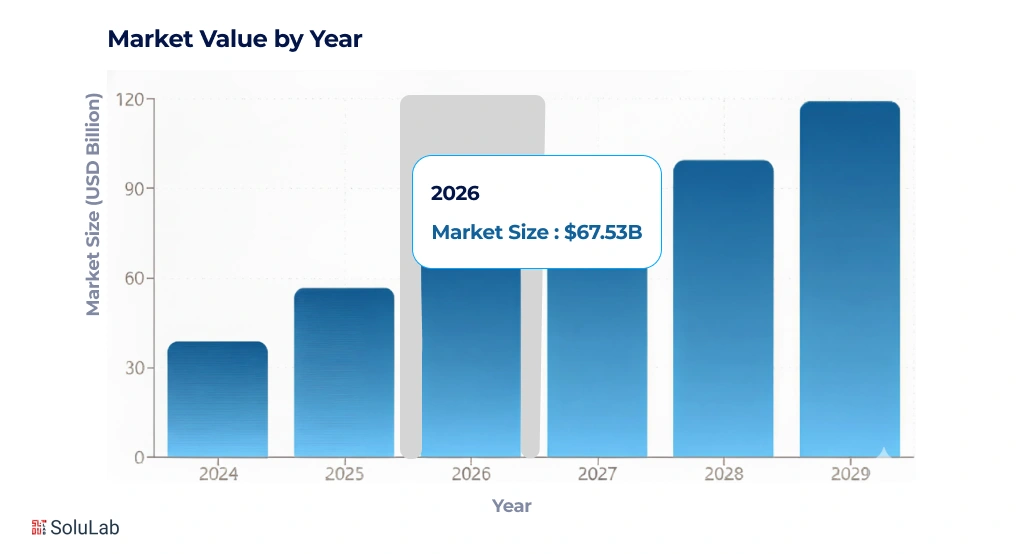
Crypto adoption in 2026 is rising faster than ever. The market is growing, and the way people store their assets is changing too. 

Here are the key trends:

  • 960M – 1.2B global crypto users by 2026.
  • 59% users prefer self-custody; 41% prefer custodial.
  • 300% increase in hardware wallet sales after FTX.
  • DeFi activity is pushing non-custodial wallet adoption further.
  • Enterprises are now building their own wallets using custom development for better control and security.
  • 24 countries updated wallet compliance rules in 2025, making secure design more important than ever.

These trends show one thing clearly: Users and businesses want safer, smarter, and more reliable wallet solutions.

So, if you’re a founder building the next big thing in Web3, now is the right time to invest in your own wallet system. With user adoption rising and compliance getting stricter, you need a setup that’s secure, scalable, and built for real-world use. 

Compliance & Regulation Changes Every Founder Should Know

Crypto rules became much stricter in 2026, and these changes directly affect how users choose between custodial and non-custodial wallets. For businesses building wallet products, these updates matter even more. Here are the key points:
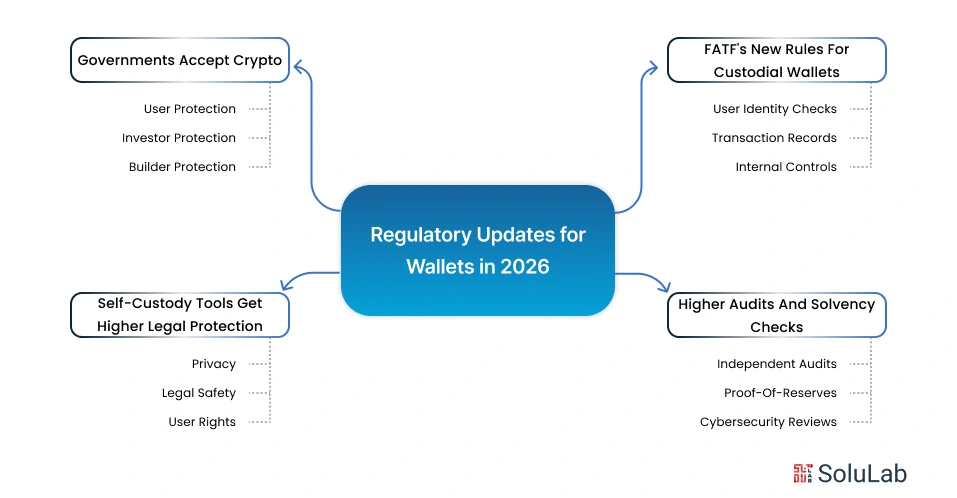
Regulatory Updates for Wallets in 2026

1. FATF’s New Rules for Custodial Wallets

Global regulators now require stronger KYC and monitoring for custodial wallets, especially for platforms offering the best custodial wallets. This means companies must show:

  • Clear user identity checks
  • Transparent transaction records
  • Strong internal controls

If you’re running or building a custodial wallet, this is no longer optional.

2. Self-Custody Tools Get Higher Legal Protection

Many countries now treat self-custody wallet systems as private digital vaults. This gives non-custodial wallets:

  • More privacy
  • More legal safety
  • More user rights

Basically, governments now respect non-custodial ownership as a valid form of digital property.

3. Higher Audits and Solvency Checks for Custodial Platforms

Any crypto exchange platform offering the Best custodial wallets must now pass:

  • Independent audits
  • Proof-of-reserves checks
  • Stronger cybersecurity reviews

This was pushed after past failures in the industry.

4. Governments Accept That Crypto Is Permanent

By 2026, regulators finally understood the simple truth is Crypto is staying. So they are building clearer rules to protect users, investors, and builders. For founders and teams building crypto products, this is the best time to focus on secure solutions. 

Advantages and Disadvantages of Custodial & Non-Custodial Wallets

Wallet Type Pros Cons
Custodial Wallets

Very easy to use

No private key or seed phrase to manage

24/7 customer support on many platforms

Password or email-based account recovery

Good for beginners, businesses, and teams that need shared access

You depend on the company holding your funds

Risk of exchange hacks or company failure

Possible withdrawal limits or delays

Must follow KYC and regulations

Not ideal for long-term storage

Non-Custodial Wallets

You fully own your crypto and private keys

No third-party control over your assets

Works smoothly with DeFi, NFTs, and Web3 apps

Better privacy and independence

If you lose your seed phrase, funds are lost forever

Slightly more technical to set up

No customer support for recovery

Responsibility for security is 100% on you

What FTX Taught Us About Crypto Wallet Security?

The FTX collapse delivered one of the most powerful lessons to the crypto world: if you don’t hold your private keys, you don’t control your crypto.

At its peak in 2021, FTX was valued at 32 billion USD and had over 1 million active users worldwide. Regarded as one of the safest and most reputable exchanges, it managed billions in daily trading volume. Yet, in November 2022, everything unraveled. Users discovered that customer funds, estimated at around 8 to 10 billion USD, had been misappropriated and used by FTX and its sister company, Alameda Research.

When the exchange collapsed, millions of users were locked out of their accounts, unable to withdraw their own assets. The reason was simple: FTX had full custody of customer funds. This is the clearest example of the risk inherent in custodial vs. non‑custodial wallet systems.

FTX didn’t fail because of blockchain technology or crypto protocols. It failed because users trusted a centralized entity with their private keys. In contrast, self‑custody wallets, whether hardware or software‑based, allow users to directly control their crypto through private keys stored only by them.

If those same users had stored their funds in non‑custodial wallets, the collapse of FTX would not have locked up their assets. Their crypto would have remained safely in their own wallets, untouched by the exchange’s failure.

Best Security Practices for Every Wallet Type

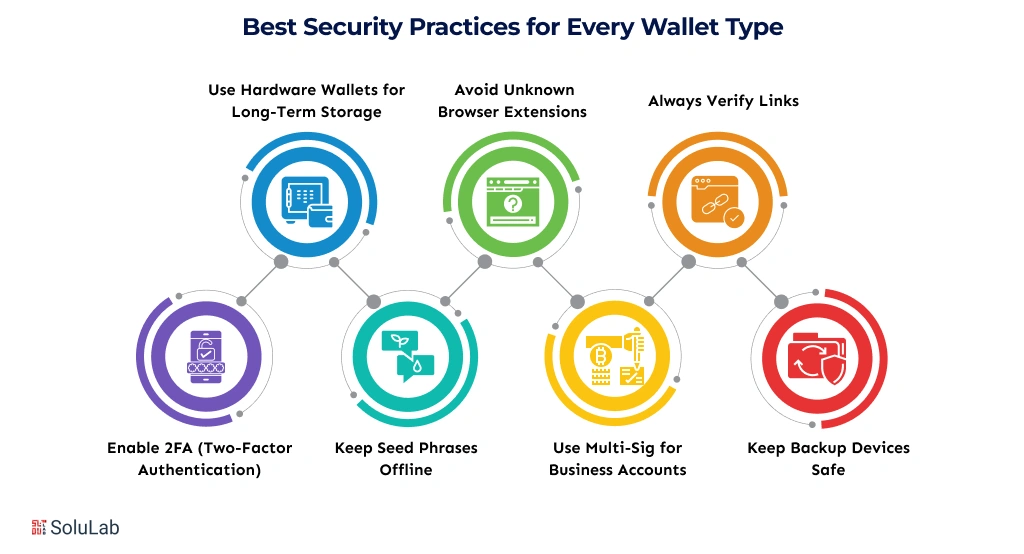
No matter which wallet you use custodial or non-custodial, security is the first thing you should care about. These simple steps help reduce risk and protect your user funds, project treasury, or personal assets.
Best Security Practices for Every Wallet Type

1. Enable 2FA (Two-Factor Authentication)

Always turn on 2FA for every custodial wallet or exchange account. It adds an extra layer of protection on top of your password.

2. Use Hardware Wallets for Long-Term Storage

For anyone holding large amounts of crypto, a hardware wallet is still one of the safest options. It keeps your private keys offline and away from common online attacks. This applies to users of both non-custodial wallets and hybrid setups.

3. Keep Seed Phrases Offline

Your seed phrase should never be stored in screenshots, notes apps, or cloud backups. Write it down, keep it offline, and store it in a secure place. If someone gets the seed phrase of your self-custody wallet, they get full control forever.

4. Avoid Unknown Browser Extensions

Extensions can secretly read your clipboard, access tabs, or inject scripts. Only install tools from trusted sources, especially when using online crypto wallets or any Web3 dApp.

5. Use Multi-Sig for Business Accounts

If you are a founder or managing project funds, set up a multi-sig wallet. This prevents a single team member from moving funds alone. It’s one of the most important steps for DAO treasuries, Web3 startups, and anyone building with crypto wallet development services.

6. Always Verify Links

Phishing attacks are still the number one reason for wallet hacks. Always double-check URLs, especially when logging into a custodial wallet or signing transactions in a non-custodial wallet.

7. Keep Backup Devices Safe

If you use backup hardware wallets or seed phrase copies, store them in separate safe places. Losing backups can lock you out. A stolen backup can drain your wallet.
Custodial vs. Non-Custodial Wallets cta

How to Pick the Best Wallet for Your Crypto Strategy?

Choosing the right wallet matters because it directly affects how safe your crypto is. Most users fall into two groups: people who want convenience and people who want full control. Here’s a simple and clear way to decide.

Wallet Type Best For Why Choose It? Key Needs
Custodial Wallet New crypto users, traders, and businesses that need easy access A third party manages your keys. This makes it simple to use and easier to recover if you lose access. Simple UI, customer support, recovery options, centralized control
Non-Custodial Wallet Users who want full ownership and high security You control your private keys. No one can freeze your funds or access your assets. Managing private keys, DeFi, NFTs, staking, and high privacy
Hybrid Setup (Most Recommended) Smart investors, founders, and teams handling project funds Use custodial wallets for daily trading and fast access, use non-custodial wallets for long-term storage and higher security. Balanced safety, flexibility, and risk management

Conclusion

Choosing the right wallet is not a small step. It decides how safe your crypto really is. This is not only a tech choice, but it is also a long-term financial security decision. If you prefer an easy setup and support, a custodial wallet may work better, and if you want full control and hold your own keys, a self-custody or non-custodial wallet is the right fit.

The goal is simple – pick the wallet that matches how you manage risk, how you store assets, and how your business operates.

And if you are building a wallet or a Web3 product, our team can help. SoluLab, as a crypto wallet development company, designs and builds wallets that are secure, compliant, scalable, and ready for real-world users. 

Whether you need a custodial, non-custodial, multi-chain, or enterprise-grade solution, we offer full-stack crypto wallet development services to match your product goals. 

If you want expert help, better security, and faster development, contact our experts. We’re here to build it with you!

FAQs

1. Can a business use both custodial and non-custodial wallets?

Yes, many businesses use both. This gives them more control and flexibility. A custodial wallet helps with quick payments and easy team access, while a non-custodial wallet protects long-term holdings and treasury funds. This balance reduces risk and keeps operations smooth.

2. How much does crypto wallet development cost?

The cost depends on the features and level of security needed. Adding support for multiple chains, KYC, staking, or DeFi will increase the price. Enterprise wallets with compliance layers, monitoring tools, and advanced security naturally cost more than simple personal wallets. The budget changes based on complexity and integrations.

3. Can I integrate both wallet types inside a single Web3 product?

Yes, this is common and useful. Many apps offer a simple custodial option when users sign up, and a non-custodial option for advanced users who want more control. This hybrid setup improves user experience, increases conversions, and gives businesses more flexibility.

4. How long does it take to build a crypto wallet from scratch?

A full wallet build usually takes between 4 to 12 weeks, depending on design, features, security needs, and chain integrations. Enterprise wallets may take longer due to compliance checks, deeper testing, and additional security layers. A proper development cycle includes planning, UI, blockchain integration, audits, and a stable launch.

5. Do custodial wallets charge more fees than non-custodial wallets?

Often yes, because custodial wallets may include trading fees, withdrawal charges, and platform service costs. Non-custodial wallets usually only charge blockchain network fees, making them more cost-efficient for long-term holding.
Hot vs Cold Crypto Wallets: Key Differences Every Investor Should Know

Hot vs Cold Crypto Wallets banner

If you’re a founder, builder, or investor diving into crypto, one of the first decisions you’ll face is how to store your digital assets safely. Choosing between a Hot wallet crypto and a cold, offline wallet can directly impact your business’s security, user trust, and regulatory compliance. 

The global crypto wallet market reached $14.39 billion in 2024 and is projected to grow to $18.96 billion in 2025, representing a 31.7% compound annual growth rate. 

This explosive growth underscores the critical importance of choosing the right wallet. In this guide, we’ll explain crypto hot wallet and cold wallet systems, compare their pros and cons, and show you how to choose the best setup to protect your startup while keeping operations smooth.

What Is a Hot and Cold Wallet?

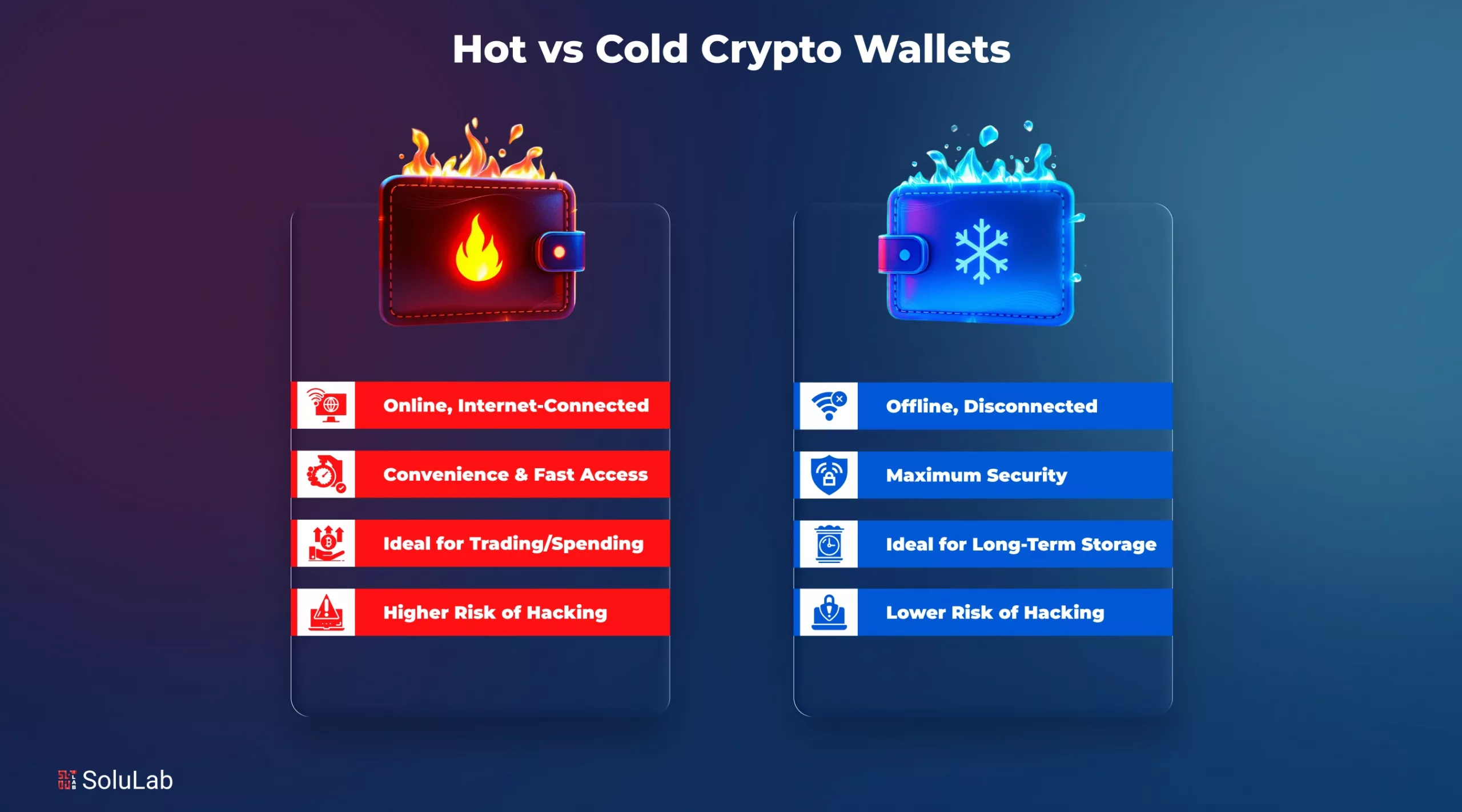
A Hot wallet is an online wallet connected to the internet. It’s designed for quick transactions, instant access, and DeFi integrations, making it perfect for founders, startups, and teams who need to manage daily liquidity efficiently. It’s like a digital checking account for your crypto assets that is always ready, always online.

On the other hand, a cold wallet (or offline wallet) keeps your private keys completely offline, stored in a hardware device or air-gapped solution. This makes it much safer against hacks and cyberattacks, ideal for long-term storage, treasury funds, or high-value crypto holdings.

A quick comparison of the two:

Wallet Type Accessibility Security Level Market Data (2024–2025)
Hot Wallet Online, instant transactions Moderate 61.5% global market share
Cold Wallet Offline, slower access High $511.46M market size, growing 33.7% CAGR

By 2025, 72–78% of crypto users will rely on hot wallets, while demand for hardware and cold wallets has risen 34% year-over-year, reflecting growing awareness around security in the crypto ecosystem.

How Is A Cold Wallet Different From A Hot Wallet?

The choice between hot wallet crypto and cold storage is not just technical; it’s about balancing convenience, liquidity, and security. Here is the key differentiator you should know:

1. Security and Risk Management

Security is the biggest factor in the cold vs hot crypto wallet discussion.

 In 2024, 43.8% of all crypto thefts came from online wallets losing private keys. Some of the biggest hacks were DMM Bitcoin ($305M) and WazirX ($234.9M).

If you want strong protection, cold wallets, especially Ledger crypto wallets, they are the safest choice. Ledger sold 3.5 million units in 2024, while Trezor shipped 2.4 million devices. The hardware wallet market is set to hit $2.06 billion by 2030, growing at 29.95% CAGR.

Hot wallets like MetaMask, Trust Wallet, and Phantom are popular because they’re easy to use and integrate with DeFi platforms, but their online connection makes them more vulnerable to phishing and keylogging attacks.

2. Market Performance and Adoption

When it comes to Best crypto hot wallets, the market leaders are clear:

  • MetaMask: 30+ million active users, 99.99% transaction success rate
  • Trust Wallet: Supports 70+ networks, 4.5+ million coins and tokens
  • Coinbase Wallet: Enterprise-ready with high-grade security

Cold wallets are also gaining traction. Adoption surged 34% in 2025, driven by rising security awareness and institutional interest. Top cold crypto wallets like Ledger Nano X and Trezor Safe 3 are now considered industry standards for offline crypto safety.

3. Cost and Implementation

Hot wallets are cheap or free, perfect for everyday business transactions. For example, MetaMask charges 0.875% for swaps, while Trust Wallet lets you swap coins without fees.

Cold wallets need an upfront investment, typically $49–$200, but this buys long-term security for your treasury or high-value crypto holdings.

For startups, the choice depends on transaction frequency and asset size:

  • If you do Daily transactions, use a crypto hot wallet 
  • For Long-term storage, use cold wallets

Read Our Blog: Custodial vs. Non-Custodial Wallets

Which Wallet Is Best for Your Startup in 2025?

For most startups, a hybrid approach works best, using both hot and cold wallets strategically.

1. Hot Wallet (for operations):

Use Hot wallet crypto tools like MetaMask or Trust Wallet

  • Keep 10–20% of assets for daily use
  • Enable multi-signature access for team transactions

2. Cold Wallet (for reserves):

  • Store 80–90% of holdings in Ledger crypto wallets 
  • Protect high-value assets with enterprise-grade custody solutions
  • Add biometric or hardware security

Choosing the right mix ensures speed, security, and compliance, especially with evolving regulations like MiCA in Europe and updated US crypto laws.

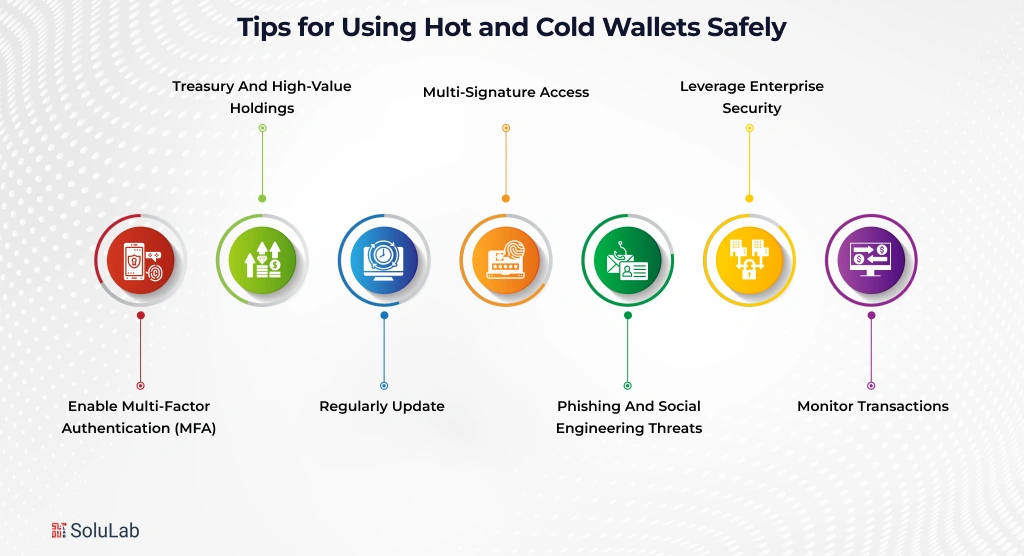
Tips for Using Hot and Cold Wallets Safely

Managing cryptocurrency for your business is not just about choosing between a Hot wallet crypto or a cold wallet, it’s about implementing strong, practical safety measures to protect your assets and your users. Here’s a detailed guide for startups and businesses:

Tips for Using Hot and Cold Wallets Safely

1. Enable Multi-Factor Authentication (MFA) on All Crypto Hot Wallet Accounts

Hot wallets are connected to the internet, making them convenient but more exposed to attacks. Adding MFA ensures that even if a password is compromised, unauthorized access is prevented. For B2B setups, consider team-level MFA where every operational wallet requires approval from multiple key holders.

2. Use Cold Wallets for Treasury and High-Value Holdings

Cold wallets are offline and provide top-tier security. Allocate 80–90% of your company’s crypto holdings to cold wallets, especially for reserves, long-term investments, or treasury funds. Popular options include Ledger crypto wallets and Trezor devices, which are recognized for enterprise-level security.

3. Regularly Update Wallet Firmware and Software

Outdated wallets are easy targets. Whether using Best crypto hot wallets like MetaMask or hardware wallets, ensure automatic updates are enabled. Scheduled maintenance and patching reduce the risk of exploits and keep your infrastructure compliant with emerging regulations like MiCA and U.S. crypto guidelines.

4. Implement Multi-Signature Access and Multiple Backups

A multi-signature setup means transactions need approval from several authorized team members. This reduces the risk of internal errors or misuse. Keep secure backups of wallet keys in geographically separated, encrypted locations. This ensures continuity even if one backup is lost or damaged.

5. Educate Your Team on Phishing and Social Engineering Threats

Technology alone cannot protect your assets. In 2024, 60% of crypto thefts happened due to human error, not technical flaws. Run regular training sessions for employees on recognizing phishing emails, suspicious links, and social engineering attempts. Encourage a security-first mindset for all wallet interactions.

6. Leverage Professional Wallet Development Companies for Enterprise Security

Partnering with a crypto wallet development company ensures your business adopts best practices for security, compliance, and scalability. Professional developers can implement features like multi-chain support, enterprise-grade custody solutions, and automated monitoring, reducing risks while giving your team peace of mind.

7. Monitor Transactions and Implement Alerts

Even with secure setups, active monitoring of wallet transactions is critical. Set up real-time alerts for unusual activities, especially for hot wallets used in daily operations. Combining monitoring with multi-signature approval strengthens your security posture.

Read Also: Crypto-as-a-Service to Launch Crypto Products

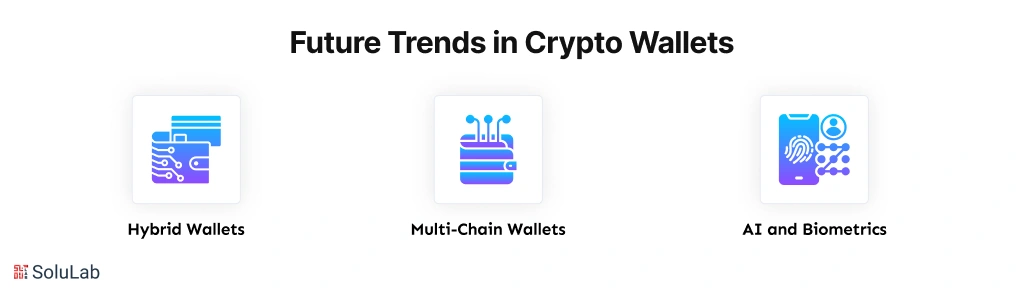
Future Trends in Crypto Wallets

Based on our observation, here are the main trends that can come up in crypto wallets by 2026 or ahead:

Future Trends in Crypto Wallets

1. Hybrid Wallets

The line between Hot wallet crypto and cold storage is fading fast. Businesses today need both speed and safety, and that’s exactly what hybrid wallets offer. These systems combine the convenience of a crypto hot wallet with the offline protection of a cold one.

In 2026, we’re seeing startups and enterprises adopt AI-powered hybrid wallets that automatically move funds between hot and cold crypto wallets based on risk levels and transaction size. 

For founders, this means you no longer have to choose between security and usability. You can have both and still maintain compliance with growing crypto regulations.

2. Multi-Chain Wallets

Managing multiple tokens across networks can be painful. That’s where multi-chain wallets come in. These modern solutions allow users to manage Bitcoin, Ethereum, Solana, and other assets under one dashboard.

Popular platforms like Rabby and Core Wallet are already leading this shift. For businesses building new wallet infrastructure, adding multi-chain support is now a must, not a feature. It saves users time, simplifies UX, and reduces the friction of switching between blockchains.

3. AI and Biometrics

Security in wallets is no longer about private keys alone. By 2025, biometric authentication adoption has increased by 46%, and AI-driven fraud detection is becoming standard across both Best crypto hot wallets and hardware cold wallets.

AI helps identify suspicious behavior like unusual transfers or repeated access attempts, before they become a threat. Biometrics, on the other hand, offer instant and password-free authentication, improving user trust.

For startups or enterprises developing their own wallets, AI integration and biometrics powered security ensure enterprise-grade security without adding friction. Partnering with experienced crypto wallet development companies can help you implement these features faster, with a compliance-ready design and minimal operational risk.

How Can SoluLab Help You Build One?

SoluLab is a leading Crypto wallet development company trusted by startups and businesses worldwide to build secure, scalable, and compliant crypto wallets.

Whether you need a custom DeFi wallet, hardware wallet integration, or a hybrid hot and cold wallet system, SoluLab provides:

  • End-to-end wallet development, from design to deployment
  • Multi-chain integration for managing multiple cryptocurrencies
  • Smart contract automation for secure custody and transactions
  • Compliance-ready solutions with KYC/AML and audit support

As one of the top crypto wallet development companies, SoluLab helps founders and businesses create user-friendly, secure, and scalable wallets that protect assets and improve customer trust.

Crypto Wallet Development Company

Conclusion

Choosing between a Hot wallet crypto and a cold wallet is more than a tech choice, it’s a strategic business decision.

  • Hot wallets are ideal for daily transactions and liquidity but require strong security.
  • Cold wallets are safer for storing large holdings as security becomes a priority.
  • Hybrid wallets combine the best of both, giving your business speed and safety.

In 2025, as Web3 adoption grows and regulations tighten, partnering with a trusted Web3 wallet development company like SoluLab ensures your wallet infrastructure is secure, compliant, and ready to scale.

Remember: your wallet isn’t just a tool, it’s the foundation of trust for your users and business growth. Contact us to get your wallet market ready in weeks!

FAQs

1. Can I use both hot and cold wallets together?

Yes. Many investors use a hybrid approach: a hot wallet for daily transactions and trading, and a cold wallet for storing the bulk of their crypto securely.

2. What types of cryptocurrencies can be stored in hot and cold wallets?

Both wallets support major cryptocurrencies and tokens, but compatibility depends on the wallet provider. Cold wallets often support multiple coins, including Bitcoin, Ethereum, stablecoins, and tokenized assets.

3. Are there costs associated with hot and cold wallets?

Hot wallets are often free or low-cost, especially mobile or web wallets. Cold wallets, particularly hardware devices, have a one-time purchase cost, but offer superior security for long-term storage.

4. Can cold wallets be used for staking or DeFi participation?

Yes, some cold wallets support staking and DeFi interactions when connected temporarily to the internet, though hot wallets remain more convenient for frequent activity.

5. Can I move crypto between hot and cold wallets easily?

Yes, cryptocurrencies can be transferred between hot and cold wallets, allowing investors to manage liquidity while keeping large funds secure offline.

Why Every Business Should Integrate POS Crypto Wallets in 2025?

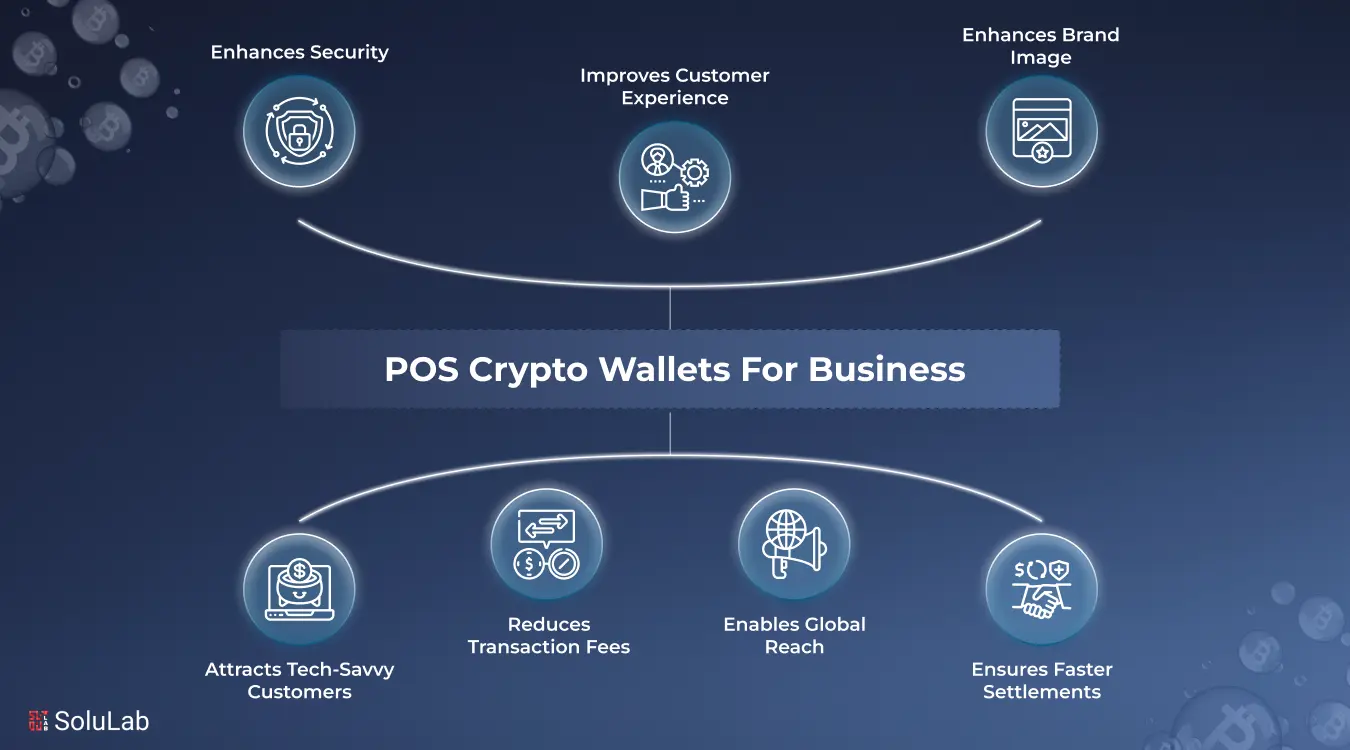
POS Crypto Wallets For Business

Traditional payment systems are getting outdated. High transaction fees, delayed settlements, and limited flexibility often frustrate both businesses and customers. In fact, sticking only to cash or card puts your business at a disadvantage.

As digital currencies become more mainstream globally, customers expect secure and fast payment options. Businesses that fail to adapt risk falling behind competitors who offer crypto checkout experiences. That’s where POS crypto wallet integration comes in.

Whether you’re a retailer or service provider, accepting crypto via POS boosts convenience, expands your customer base, and future-proofs your business. Let’s explore why now is the time to act.

What Is POS Crypto Wallet Integration?

POS Crypto Wallet Integration refers to connecting a Point of Sale (POS) system with a cryptocurrency wallet so that businesses can accept crypto payments directly at checkout, both online and offline. 

The global crypto wallet market is projected to grow from $14.39 billion in 2024 to $19.03 billion in 2025, marking a 32.2% CAGR.

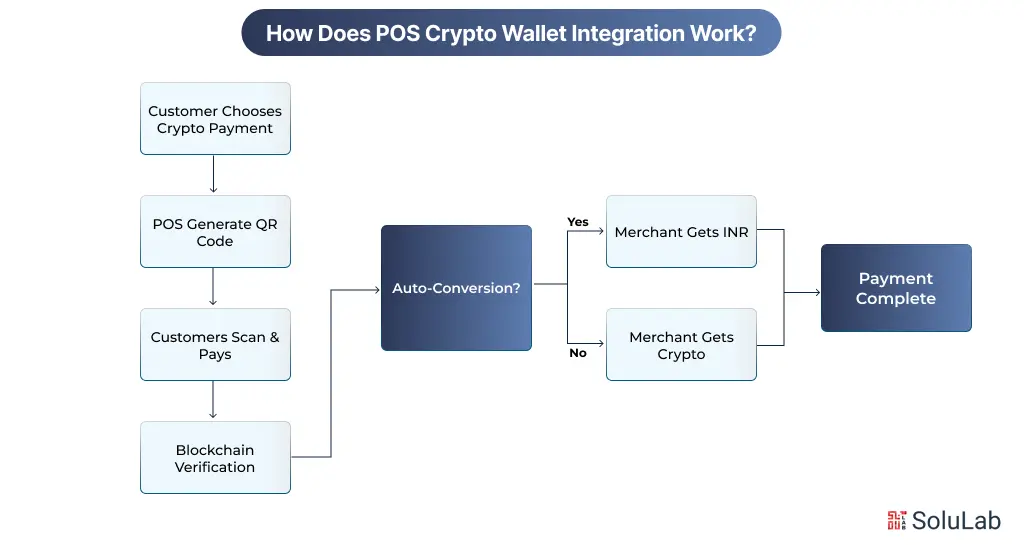
Here’s how it works

  •  A customer wants to pay with crypto like Bitcoin, Ethereum, or USDT
  •  The POS system (used at retail stores, cafes, or online shops) is integrated with a crypto wallet or gateway.
  • The system generates a QR code or wallet address
  • The customer scans it and pays from their crypto wallet
  • The payment is verified and confirmed on the blockchain
  • The merchant receives the crypto or an auto-converted INR value via the provider (if supported)

POS Crypto Wallet Integration Working

Why POS Crypto Wallet Integration Matters for Modern Businesses?

Integrating crypto wallet functionality into Point of Sale (POS) systems represents a strategic move that can transform how businesses operate and serve their customers.

1. Attracts Tech-Savvy Customers

Integrating crypto payments showcases your business as innovative and forward-thinking, appealing to a growing demographic of tech-savvy consumers who prefer digital currencies. 

2. Reduces Transaction Fees

Cryptocurrency transactions often incur lower fees compared to traditional payment methods, helping businesses save on processing costs. 

3. Enables Global Reach

Accepting cryptocurrencies allows businesses to tap into international markets without the complexities of currency conversions or cross-border fees.

4. Ensures Faster Settlements

Crypto transactions are processed quickly, often within minutes, improving cash flow and reducing waiting times associated with traditional banking systems.

5. Enhances Security

Blockchain technology provides a secure and transparent transaction method, reducing the risks of fraud and chargebacks.

6. Improves Customer Experience

Providing multiple payment options, including cryptocurrencies, caters to customer preferences and enhances the overall shopping experience

7. Enhances Brand Image

Embracing innovative payment methods like crypto can elevate your brand’s image, portraying it as modern and customer-centric.

CTA1

Key Features of a POS System

Here’s a quick rundown of the key features of a POS (Point of Sale) system that help modern businesses run smoothly and deliver a better customer experience, whether it’s a retail store, café, or service-based setup.

  • Payment Processing

Handles all types of payments, cash, card, UPI, wallets, and even crypto in some setups. It ensures fast and secure transactions, making the checkout experience seamless for both customers and staff.

  • Inventory Management

Tracks product stock levels in real-time. It notifies you when items are low, helps prevent overstocking, and ensures popular products are always available, saving time and avoiding manual errors.

  • Customer Relationship Management (CRM) Integration

Stores customer data like past purchases, birthdays, or preferences. This helps businesses offer personalized deals, send loyalty rewards, and improve retention with targeted marketing.

  • Resource Planning

Allows business owners to manage staff schedules, track hours worked, and allocate resources efficiently, useful in restaurants or multi-branch retail outlets.

  • Reporting and Analytics

Generates sales reports, customer insights, and performance dashboards. These analytics help business owners make smart, data-driven decisions quickly, from best-selling products to peak shopping times.

  • Invoicing

Automatically generates professional invoices for every transaction. Some systems also support GST-compliant billing and digital receipts via email or WhatsApp — which is especially handy in the Indian context.

  • Simple UX/UI for Staff and Customers

A good POS system offers a clean, intuitive interface. This ensures your team can learn it quickly and customers don’t face delays at checkout — no tech stress, just smooth selling.

How to Integrate Crypto into Your POS?

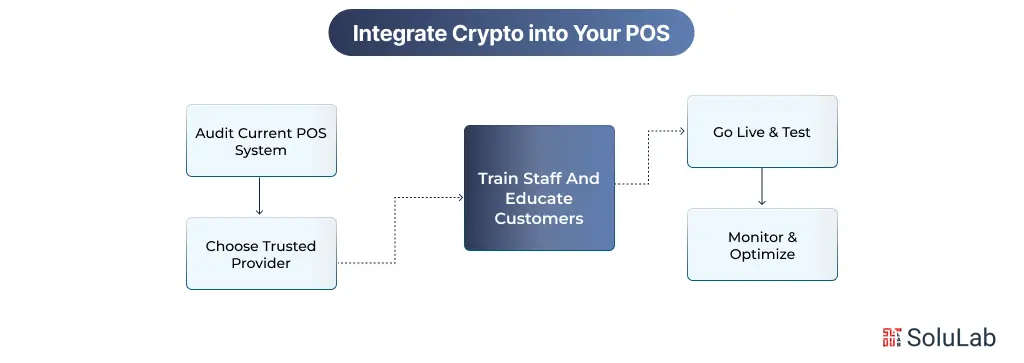
Integrate Crypto into Your POS

Integrating crypto into your POS system isn’t as complicated as it looks. Here’s a simple step-by-step guide to help you make the switch with confidence:

1. Audit Your Current System

Start by evaluating your existing POS setup. Check if it supports third-party integrations or crypto plugins. Knowing your system’s limitations and strengths will help you choose the right solution without disrupting daily operations.

2. Choose a Trusted Provider

Partner with a reliable crypto POS provider that supports popular cryptocurrencies, offers security, and complies with local regulations. Look for options that integrate well with your current system.

3. Educate Staff and Customers

Train your staff on how to accept crypto payments and handle any issues. Use simple signage or FAQs to educate customers, making them feel comfortable and secure while paying with digital currencies.

4. Optimize and Evolve

Monitor how crypto payments perform. Gather feedback, track transactions, and stay updated with new features or compliance needs. Keep improving the experience so it stays smooth and future-proof.

Future of POS Crypto Wallets

Blockchain, AI, and user preferences will result in rapid change in POS crypto wallets in 2025. As cryptocurrencies gain popularity, POS systems are adjusting to offer secure, efficient crypto payment alternatives.

  • Personalized financial insights: Predictive analytics and automated portfolio management are changing crypto wallets with AI. Smart wallets monitor user activity and market trends to make personalized recommendations, improving financial decision-making.
  • Real-Time Crypto-to-Fiat Conversion: Modern POS systems can instantly convert cryptocurrencies into local fiat currencies. This functionality stabilizes merchants’ revenue streams by reducing digital asset volatility.
  • Integration with Web3 and Metaverse: Crypto wallets are adapting to dApps and virtual worlds. Businesses can capitalize on burgeoning digital economies by letting customers manage NFTs, virtual properties, and in-game assets directly through their wallets.

Crypto wallets now use fingerprint scans and facial recognition for security. These characteristics and behavioral biometrics protect digital assets from illegal access.

CTA2

Conclusion

Integrating POS crypto wallets is no longer a futuristic option—it’s a smart business move for 2025. With benefits like faster transactions, lower fees, global reach, and enhanced security, crypto-ready POS systems help businesses stay competitive and customer-focused. 

They also open doors to a younger, tech-savvy audience that prefers decentralized payment methods. Whether you run a café or an e-commerce store, adopting crypto can future-proof your operations. Update your systems, and position your brand at the forefront of the next financial revolution.

SoluLab, a crypto wallet development company can help you set up POS crypto wallet plus, give you expert guidance. Contact us today to discuss further.  

FAQs

1. What is a POS crypto wallet?

A POS crypto wallet is a digital payment solution that allows businesses to accept cryptocurrencies like Bitcoin or Ethereum through their Point-of-Sale system.

2. Which cryptocurrencies can be accepted via POS?

Most crypto POS providers support major coins like Bitcoin (BTC), Ethereum (ETH), USDT, and sometimes local tokens, depending on the provider.

3. What is the cost of integrating a crypto POS?

Basic crypto POS integration can be cost-effective, with some providers charging flat fees or taking a small percentage per transaction.

4. Can I offer refunds on crypto transactions?

Yes, but it must be done manually. You’ll need to confirm wallet addresses and transaction IDs, as crypto is irreversible once sent.

5. Do customers want to pay with crypto?

The demand is growing, especially among Gen Z and global tourists. Accepting crypto can be a great differentiator and brand builder.


How much would it cost to create a Crypto wallet on Solana?

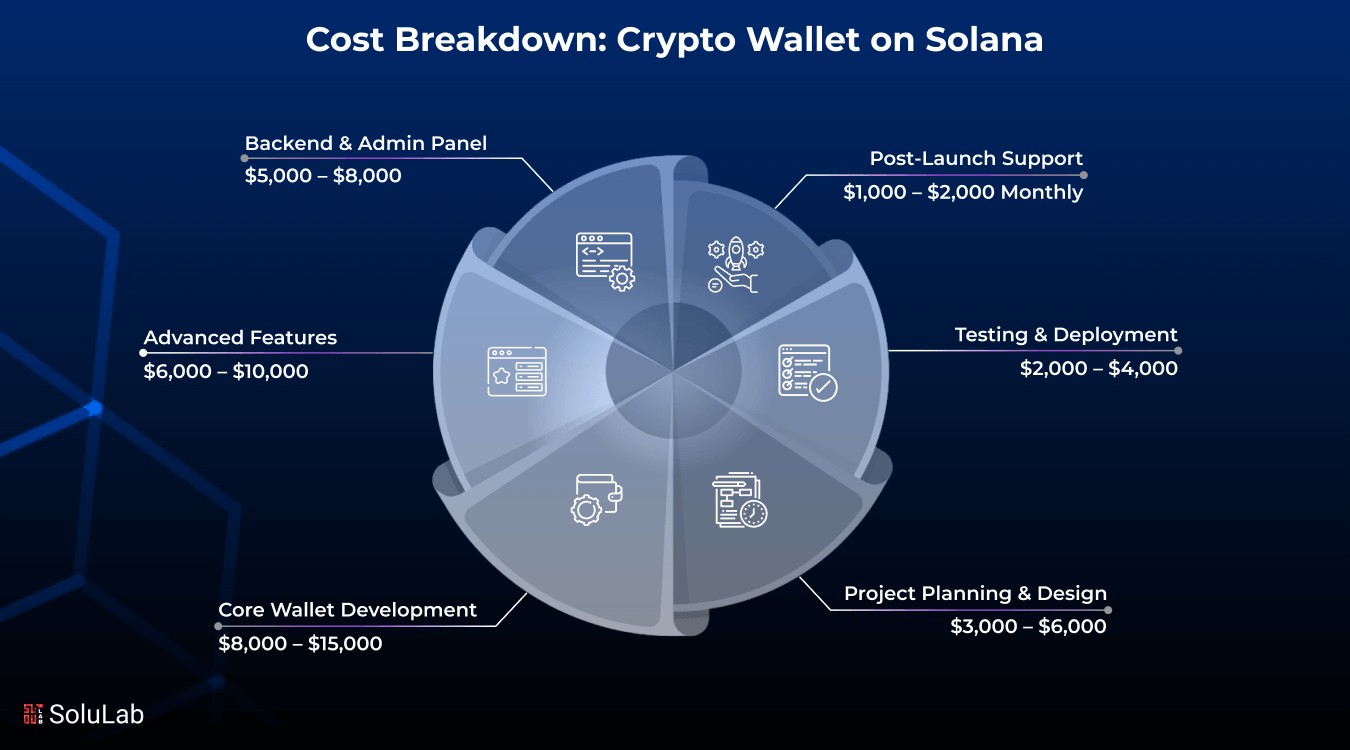
Cost Breakdown - Crypto Wallet on Solana

A crypto wallet on Solana is one of the fastest and scalable blockchains. Solana is a popular choice for developers and startups looking to launch secure, high-performance wallets. But before you start development, you should know how much it will cost. 

It depends on several factors, including the type of wallet (custodial or non-custodial), the features you want to include, the complexity of the design, and your choice of tech stack and development team. Whether you’re planning a simple wallet for basic transactions or a feature-rich app that supports NFTs, staking, and cross-chain compatibility, your budget needs to align with your goals. 

In this blog, we break down all the key cost components and help you understand what goes into building a crypto wallet on Solana from start to finish.

Crypto Wallet on Solana— A Quick Overview

A Solana crypto wallet allows you to store, send, and receive SPL tokens and SOL. It’s quick, affordable, and scalable. Solana wallets such as Solflare and Phantom wallet on Solana are user-friendly. You can link them to dApps, stake tokens, and even purchase NFTs. Installing is rapid. Just download, save your phrase, and you’re set. 

Solana’s market cap is projected to reach $250 billion by the end of 2025, driven by its high-speed transactions and increasing adoption in decentralized applications (dApps).

The Solana network supports more than 65,000 transactions per second. That’s why it’s perfect for users who demand speed and minimal fees. Whatever your level, Solana wallets make it go smoothly and safely.

Crypto Wallet Services

Unique Features of Crypto Wallets on Solana

Solana-based crypto wallets are making waves thanks to their speed, security, and user-friendly features. Let’s quickly break down what makes them stand out:

1. Transaction: The Solana wallets app offers lightning-fast transactions with minimal fees, making it perfect for users who don’t want to wait or overpay. Whether it’s sending tokens or interacting with decentralized applications (dApps), everything feels instant.

2. Security: Top-notch encryption, seed phrase protection, and biometric logins keep your assets safe. Plus, Solana’s secure blockchain adds an extra layer of trust to every transaction you make.

3. Multi-crypto Support: While Solana is the focus, most wallets now support multiple tokens like USDC, SRM, and even NFTs. This gives users flexibility to manage different digital assets all in one place.

4. Real-time Conversion Rates: You can track token values live within the wallet. This helps you make smart, timely decisions without switching apps or manually checking prices elsewhere.

5. Cross-platform Compatibility: Solana wallets usually work across Android, iOS, and even browser extensions. So whether you’re on mobile or desktop, your crypto is always within reach.

6. Push Notifications: Stay updated with real-time alerts for transactions, price changes, and app updates. It’s like having a mini crypto assistant in your pocket.

Read Our Blog Post: Custodial vs. Non-Custodial Wallets

Factors Influencing Solana Crypto Wallet Development Cost

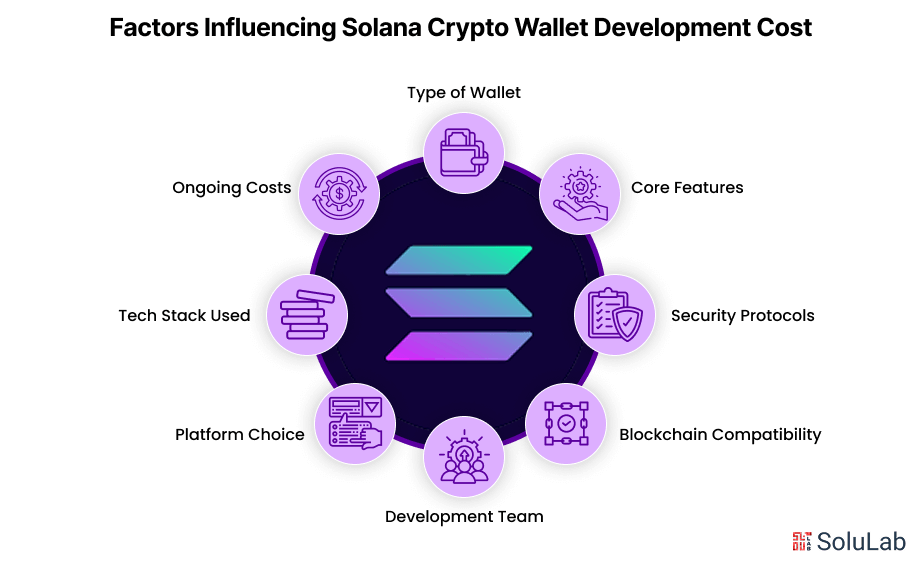
Developing a crypto wallet on the Solana blockchain involves various factors that influence the overall cost. Understanding these elements is crucial for budgeting and planning. Here’s a breakdown of the primary factors:

Factors Influencing Solana Crypto Wallet Development Cost

  • Type of Wallet

The choice between custodial and non-custodial wallets significantly affects development costs. Custodial wallets, where a third party manages user keys, are generally simpler and less expensive to develop. In contrast, non-custodial wallets, which give users full control over their keys, require advanced security features, increasing complexity and cost.

  • Core Features

The functionalities you wish to include—such as token swaps, NFT support, staking, and dApp integration—directly impact development time and expenses. Each added feature necessitates additional coding, testing, and potential third-party integrations, thereby elevating the overall cost. 

  • Security Protocols

Implementing robust security measures is non-negotiable in crypto wallet development. Features like two-factor authentication (2FA), biometric verification, and encryption protocols are essential to safeguard user assets. These security enhancements require specialized development efforts, contributing to higher costs.

Read Also: Why Every Business Should Integrate POS Crypto Wallets?

  • Blockchain Compatibility

While focusing on Solana, ensuring compatibility with other blockchains can broaden your wallet’s utility, but also adds complexity. Cross-chain compatibility demands additional development resources to handle different protocols and standards, thus increasing the development budget.

  • Development Team

The expertise and location of your development team play a pivotal role in cost determination. Hiring seasoned developers with proficiency in Rust and Solana’s architecture may command higher rates, but ensures quality and efficiency. Alternatively, outsourcing to regions with lower labor costs can be economical but may require more oversight.

  • Platform Choice

Deciding whether to develop for iOS, Android, web, or multiple platforms influences the scope and cost. Each platform has its development nuances, and supporting multiple platforms necessitates additional resources for coding, testing, and maintenance.

  • Tech Stack Used

The selection of technologies—such as programming languages, frameworks, and tools—affects both the development process and cost. For Solana wallet development, using Rust for Solana smart contracts and frameworks like React or Flutter for the frontend are common choices. The complexity and familiarity of these technologies with your team can influence development time and expenses.

  • Ongoing Costs

Post-launch, wallets incur ongoing expenses including server hosting, regular updates, security audits, and customer support. For instance, maintaining a Solana validator node can cost between $2,000 to $5,000 per month, and annual maintenance may range from $2,000 to $10,000, depending on the application’s complexity.

How much does it cost to create a Crypto wallet on Solana?

Developing a crypto wallet on the Solana blockchain in 2025 involves various factors that influence the overall cost. The total expense can range from $15,000 to over $200,000, depending on the wallet’s complexity, features, and development approach. Here’s a breakdown of the cost estimates based on wallet complexity:

Development Phase Estimated Cost (USD) Details
UI/UX Design $500 – $1,500 Designing intuitive and user-friendly interfaces.
Security Implementation $600 – $2,500 Integrating security protocols like multi-factor authentication and encryption.
Backend Development $1,000 – $5,000 Developing core functionalities and handling transactions.
API Integration $500 – $1,500 Implementing third-party services and payment gateways.
Quality Assurance & Testing $400 – $1,000 Conducting thorough testing to ensure functionality and security.

Note: These costs can vary based on the complexity and specific requirements of the wallet.

Solana Blockchain Development Services

Conclusion

Creating a crypto wallet on Solana can cost anywhere from $15,000 to over $200,000, depending on the wallet’s complexity, features, and security requirements. 

Basic wallets are more affordable and quicker to build, while advanced versions with multi-chain support, DeFi integration, and top-notch security need higher investment and longer timelines. 

Factors like the development team’s expertise, tech stack, and ongoing maintenance also play a major role in the final budget. Whether you’re a startup or an enterprise, it’s essential to define your goals clearly and work with an experienced team to ensure a secure, scalable, and user-friendly wallet solution.

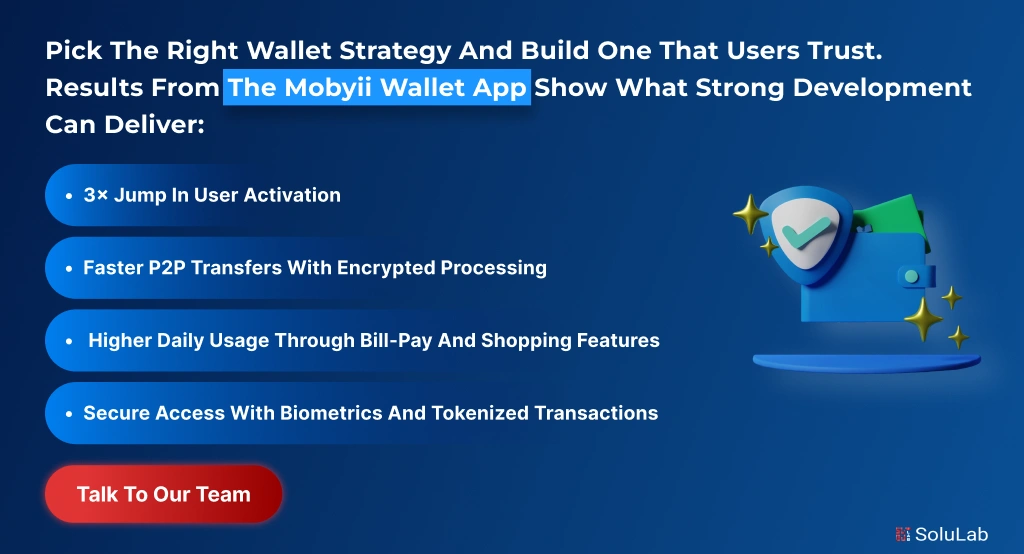
SoluLab got a chance to work on Mobyii, a secure and powerful digital wallet app designed for cashless payments. With features like P2P encryption, biometric access, and utility bill payments, it ensures security and convenience. The app’s minimalistic design and wallet management system simplify depositing and withdrawing funds. Mobyii is a success, offering users an easy, secure, and rewarding payment experience.

SoluLab, a crypto wallet development company, can help you create a wallet on Solana. Get in touch with us today!

FAQs

1. What is a Solana-based crypto wallet?

A Solana crypto wallet is a digital wallet designed to store, send, and receive SOL and other Solana-based tokens. It also allows interaction with Solana dApps and supports staking or NFTs, making it a key factor when estimating overall crypto wallet development cost.

2. Can Solana wallets support multiple cryptocurrencies?

Yes, Solana wallets can be built with multi-token support, allowing users to manage both SOL and tokens from other blockchains via cross-chain integrations.

3. How long does it take to develop a crypto wallet on Solana?

Depending on features and complexity, development can take anywhere from 2 to 6+ months.

4. Do Solana wallets need KYC/AML integration?

Only if you’re offering custodial services or want regulatory compliance. Non-custodial wallets typically don’t require KYC.

5. Do I need ongoing maintenance after launch?

Absolutely. Updates, security patches, performance improvements, and user support are essential to keep the wallet reliable and secure.

How to Create a Wallet like Phantom?

Create a Wallet like Phantom

Developing a high-quality wallet that meets security standards, offers a great user experience, and provides robust features is not easy. Many entrepreneurs and developers face the challenge of building a wallet that supports multiple cryptocurrencies while ensuring integration with blockchain networks. 

However, with the right approach, it’s possible to build a wallet that rivals the best in the market. By focusing on blockchain integration, encryption methods, and cross-platform compatibility, developers can create a wallet that users trust and love. Recently, Phantom Wallet is gained much traction.

In 2025, Phantom Wallet will have surpassed 15 million active users monthly, reflecting significant adoption and growth in the crypto space.

In this guide, we’ll explore the essential steps to help you build a wallet like Phantom, from concept to launch, things to consider when creating a wallet like Phantom, and more. Let’s get started!

What Makes Phantom Wallet Unique?

The main characteristic of Phantom Wallet is that it is non-custodial, and this implies that users maintain full control over their digital assets and keys but do not hold them on file in Phantom. It is a user-friendly platform that provides browser extensions and a mobile app for managing multiple cryptocurrencies and NFTs, particularly within the Solana blockchain environment. Phantom also provides a means for interacting with decentralized finance (DeFi) marketplaces and apps.

 Here is a more thorough explanation of what makes Phantom Wallet unique:

  • Non-custodial: Users are completely in charge of their funds and can interact with multiple blockchains since Phantom Wallet Solana does not hold their seed phrase or private keys.
  • Multi-support of blockchains: While Phantom was originally developed for the Solana blockchain, the app now supports Ethereum, Base, Polygon, and Bitcoin so that users can handle assets in different networks.
  • Easy-to-use interface: The Phantom Wallet app boasts a contemporary design, and an easy-to-use interface, which makes it accessible for both beginners and experienced users of cryptocurrencies and NFTs.
  • Browser extension and mobile app: Users can access Phantom Wallet through a mobile app (iOS and Android) or a browser extension (for popular browsers such as Chrome, Firefox, Brave, and Edge), providing ease and convenience.
  • NFT Administration and DeFi Integration: Phantom is a link for NFT administration and enables communication between users and their dApps or DeFi platforms.

CTA1

How To Develop a Wallet Like Phantom?

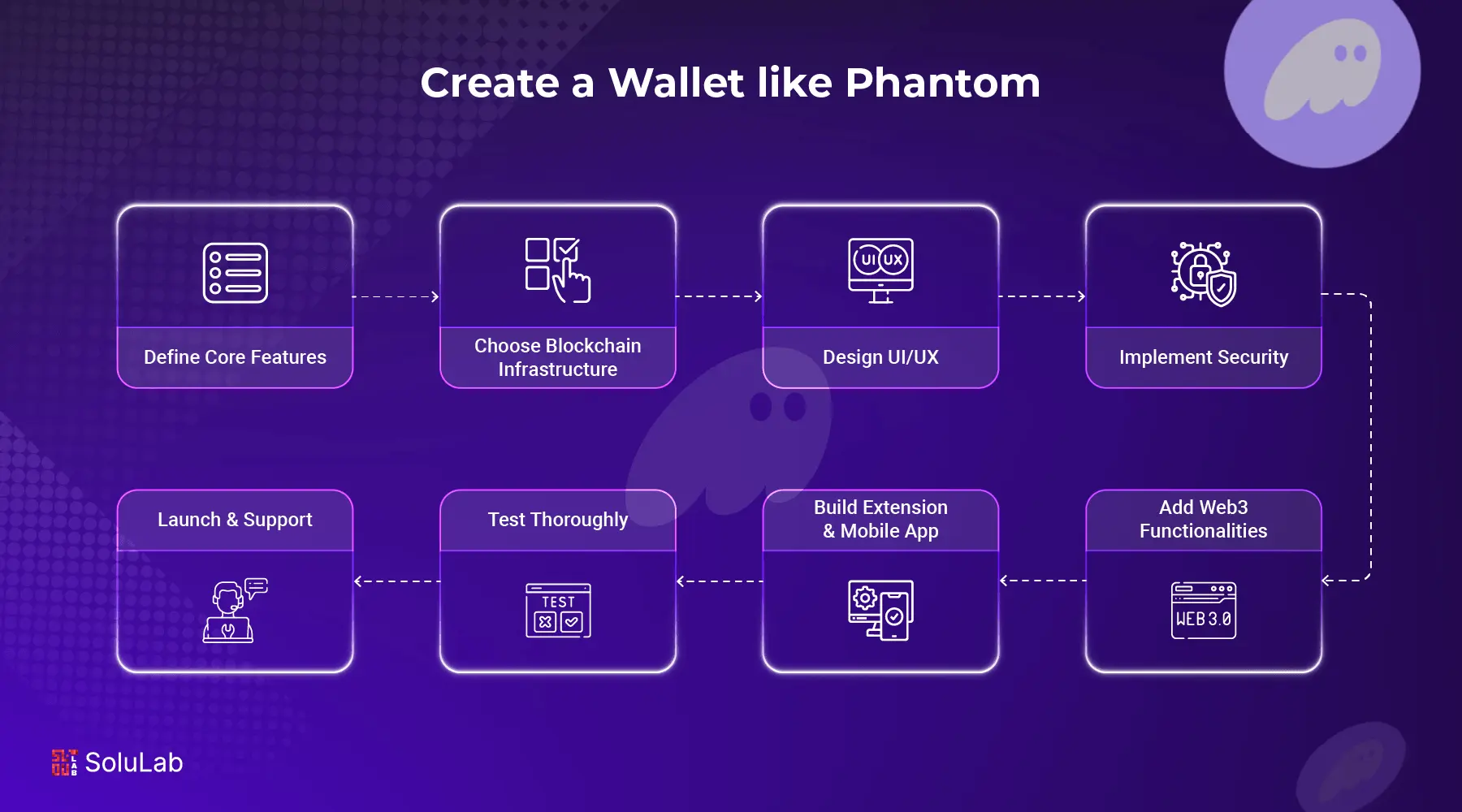
Developing a wallet like Phantom involves building a secure, user-friendly crypto wallet tailored for Solana blockchain users. Follow this step-by-step guide to start a wallet like Phantom on your own:

1. Define Core Features

Identifying the essential features your wallet must support to meet user expectations and match industry standards. Likewise, features of Phantom Wallet include:

  • Secure key management
  • Send/receive Solana and SPL tokens
  • Token swapping
  • NFT storage and management
  • Staking functionality

Read Also: AI-Integrated Smart Crypto Wallet

2. Choose the Right Blockchain Infrastructure

Select the appropriate blockchain tools and protocols to ensure smooth functionality—when building for Solana, this includes working with its JSON RPC API, SPL token standards, and key developer libraries like Solana Web3.js and SDKs.

  • Work with SPL token standards
  • Utilize the Solana SDK and Web3.js libraries

3. Design UI/UX for Accessibility

Design a wallet interface that’s visually clean, easy to navigate, and optimized for both beginners and pros:

  • Easy onboarding (create/import wallet)
  • QR code functionality for sending/receiving
  • Clear transaction history and wallet activity

4. Implement Security Protocols

Security must be built into every layer of your wallet, from generating and backing up seed phrases to encrypting private keys. 

  • Biometric login and password protection
  • Secure transaction signing and verification

5. Integrate Web3 Functionalities

Allow users to interact directly with decentralized apps (dApps), stake tokens, and perform in-app swaps to ensure:

  • Add support for Web3 dApp connections via injected wallet providers
  • Enable token swaps using Serum or Jupiter Aggregator on Solana
  • Integrate staking features directly within the wallet interface

6. Develop Browser Extension and Mobile App

Offer users a consistent and responsive wallet experience across devices by building a browser extension using :

  • Frameworks like React or Svelte for the browser extension
  • Build native or hybrid apps for iOS and Android using Flutter, React Native, or Swift/Kotlin

7. Test Thoroughly Before Launch

Ensure your wallet functions reliably in all scenarios by conducting detailed UI testing and blockchain interaction checks, like:

  • Smart contract interactions
  • UI responsiveness
  • Security audits
  • Stress and load tests
  • Beta testing with real users

8. Launch & Offer Continuous Support

After going live, maintain momentum by monitoring performance, releasing regular updates, and patching bugs:

  • Monitor performance and usage analytics
  • Identify vulnerabilities promptly
  • Offer user support and documentation

Read Also: Hot vs Cold Crypto Wallets

Why Build a Wallet like Phantom? 

Why Build a Wallet like Phantom

Opening a wallet such as Phantom can be a strategic move if you wish to take advantage of the explosive universe of crypto and Web3. Phantom is well-liked because it provides an easy, secure method for users to hold, send, and exchange cryptocurrencies, particularly on the Solana blockchain, which is renowned for low costs and speedy transactions. 

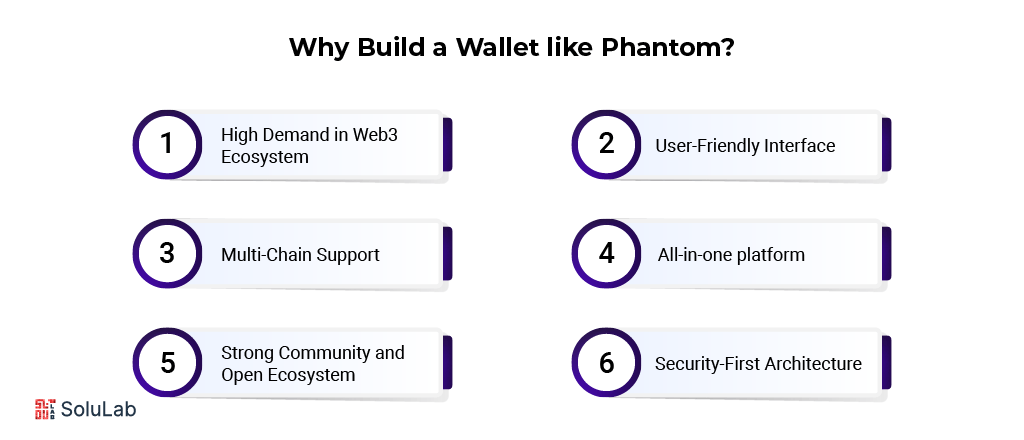
With the growth of decentralized applications (dApps), NFTs, and DeFi platforms, users require wallets that are not only secure but also user-friendly. Here are some benefits of a phantom wallet, which is why users should build a wallet like Phantom:

1. High Demand in Web3 Ecosystem: Phantom has millions of users and is growing, proving the market need for smooth crypto wallets.

2. User-Friendly Interface: Simple, sleek, and intuitive UX attracts both beginners and pros in the crypto space.

3. Multi-Chain Support: Phantom now supports Solana, Ethereum, and Polygon—users want flexibility.

4. All-in-one platform: Multiple features like DeFi, NFTs, and staking can all be performed and managed in one place, which boosts user engagement and retention.

5. Strong Community and Open Ecosystem: Wallets like Phantom become central to the Web3 experience (e.g., DeFi apps, games, NFT platforms).

6. Security-First Architecture: Phantom security with private key control and phishing protection—a must-have for any wallet.

Read Also: Build a dApps on Solana

Things To Consider When Creating A Wallet Like Phantom

When creating a wallet like Phantom, it’s important to focus on several key aspects to ensure it meets user expectations, stands out in a competitive market, and prioritizes security.

  • Security: Ensure robust encryption and multi-factor authentication to protect users’ assets. Wallets like Phantom use features such as seed phrases and password protection to prevent hacks.
  • User Experience (UX): A user-friendly and intuitive interface is crucial. Phantom’s simple design makes it easy for both beginners and experienced crypto users to navigate.
  • Blockchain Integration: Support for popular blockchains like Solana, Ethereum, or others helps expand the wallet’s usability. Make sure it’s multi-chain compatible for a larger user base.
  • Cross-platform Support: Phantom is available on both desktop and mobile, making it accessible for users wherever they are. Expanding to different platforms increases user adoption.
  • Speed and Efficiency: Low transaction fees and fast transaction processing are essential features that users expect from a wallet. Phantom excels by utilizing the Solana blockchain for speed. 

How Much Does It Cost to Build a Wallet Like Phantom?

Building a wallet like Phantom (a popular Solana-based crypto wallet) involves several factors, including design, development, security, and marketing. Partnering with a crypto wallet development company can help improve the process. 

The cost typically ranges from $50,000 to $150,000, depending on the complexity of the features, the development team’s location, and the timeline.

  • User Interface (UI) and User Experience (UX) Design
  • Blockchain Integration for Solana, Ethereum, or other networks
  • Security Features like encryption, backup, and two-factor authentication
  • Cross-Platform Support for iOS, Android, and web extensions

You’ll also need to consider ongoing maintenance, updates, and compliance with regulatory standards.

CTA2

Conclusion

Creating a wallet like Phantom requires a deep understanding of blockchain technology, security protocols, and a user-friendly design. 

You’ll need a skilled development team to integrate multiple networks, ensure top-notch security, and offer cross-platform support. The development process is complex but achievable with the right resources. 

As the demand for crypto wallets grows, focusing on a user experience will be key to success. Whether you’re building for Solana or another blockchain, attention to detail in both functionality and design will set your wallet apart.

SoluLab, a crypto wallet development company, can help you create a wallet like Phantom and solve all the queries you’ve about the same. Contact us today to discuss further. 

FAQs

1. What are the best tools for developing a wallet like Phantom?

Popular tools include React for the front end, Solana Web3.js for blockchain interaction, and Web3.js for Ethereum-based integrations. You’ll also need Metamask for wallet connection and Node.js for backend development.

2. How do I ensure my wallet is safe?

To assure top-level security, implement end-to-end encryption, multi-signature features, and secure key management practices while using the wallet. Regular security audits are also essential.

3. Do you offer white-label wallet solutions?

Yes! We provide white-label wallet development for businesses looking to launch fast with custom branding. These solutions are fully secure, scalable, and ready to integrate with various tokens, dApps, and DeFi protocols.

4. How do I integrate wallet functionalities with blockchain?

Use blockchain-specific libraries like Solana Web3.js or Web3.js for Ethereum, allowing interaction with blockchain networks for transactions, account creation, and balances. Consider partnering with a crypto wallet development company to ensure integration and professional development for your wallet project.

5. How long does it take to develop a crypto wallet like Phantom?

Typically, wallet development takes 3 to 6 months, but the actual time depends on the complexity, features, and other business requirements for your custom wallet platform.