Building a crypto wallet that actually earns user trust is hard. Security, a clean experience, solid blockchain integration, multi-chain support — the list is long, and getting even one piece wrong can sink the whole thing.
But it’s doable. Teams that get blockchain integration right, apply real encryption, and ship a consistent cross-platform experience keep building wallets people come back to. Phantom is the clearest proof of that right now.
By 2025, Phantom had crossed 15 million active users monthly, a number that says everything about where demand is sitting.
This guide covers what it actually takes to build a wallet like Phantom: the development steps, what to prioritize, and the real cost. Let’s get into it.
What Makes Phantom Wallet Unique?
Phantom is non-custodial. That’s the core of it. Your seed phrase and private keys never touch Phantom’s servers. Users stay in full control. Add to that a clean browser extension and mobile app for managing crypto and NFTs, mostly on Solana, and you get something genuinely different from the cluttered wallets that came before it. Phantom also connects directly to decentralized finance (DeFi) marketplaces and apps without extra steps.
Here’s what actually separates it:
- Non-custodial: Phantom never holds your seed phrase or private keys. Users own their funds outright and can interact with multiple blockchains.
- Multi-chain support: Started on Solana, but now handles Ethereum, Base, Polygon, and Bitcoin. Users can manage assets across networks from a single place.
- Interface that doesn’t get in the way: Clean design, nothing buried. First-time crypto users figure it out fast, and experienced users don’t feel slowed down.
- Browser extension plus mobile: Chrome, Firefox, Brave, Edge, iOS, Android. You reach users wherever they already are.
- NFT management and DeFi access: Phantom handles NFT storage and connects users directly to dApps and DeFi platforms.
How To Develop a Wallet Like Phantom?
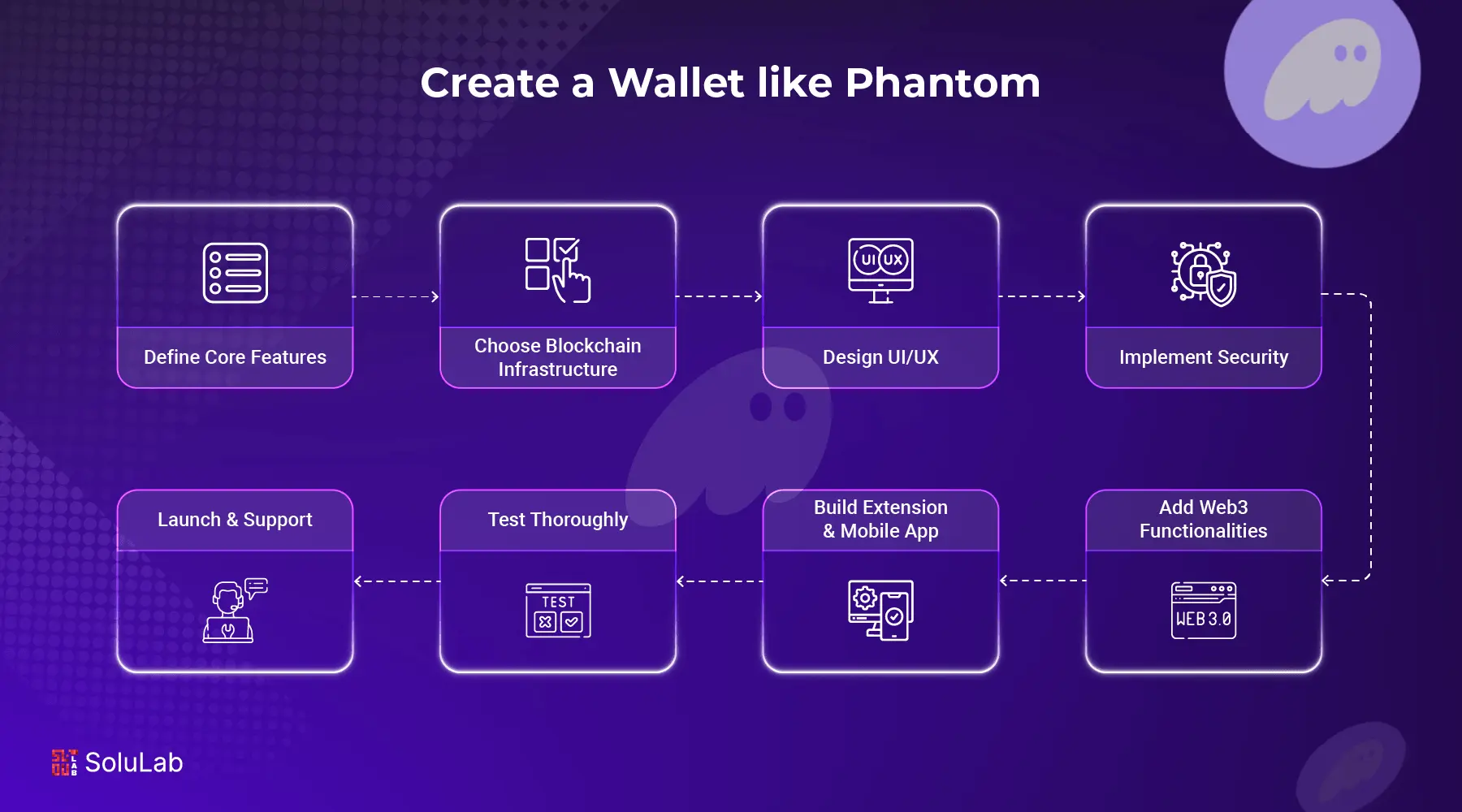
Building something like Phantom means delivering a secure, well-designed crypto wallet built for Solana users. Here’s how to approach it step by step:
1. Define Core Features
Start by pinning down exactly what the wallet must do. No feature should be on the list without a reason. For a Phantom-style wallet, the baseline includes:
- Secure key management
- Send/receive Solana and SPL tokens
- Token swapping
- NFT storage and management
- Staking functionality
Read Also: AI-Integrated Smart Crypto Wallet
2. Choose the Right Blockchain Infrastructure
Your stack choice shapes everything downstream. For Solana, that means working with the JSON RPC API, SPL token standards, and the main developer libraries: Solana Web3.js and the official SDK. Get this layer right and the rest of the build gets considerably easier.
- Work with SPL token standards
- Use the Solana SDK and Web3.js libraries
3. Design UI/UX for Accessibility
This is where a lot of crypto wallets fall apart. The interface needs to work for a first-time user who has never held crypto and for a DeFi power user who lives inside the thing. Both audiences matter. Keep it clean, keep navigation obvious, and do not bury the basics:
- Easy onboarding (create/import wallet)
- QR code functionality for sending/receiving
- Clear transaction history and wallet activity
4. Implement Security Protocols
Security is not a late-stage concern. It goes in at the foundation: seed phrase generation, private key encryption, backup handling. Every layer of the wallet should assume someone is trying to break it.
- Biometric login and password protection
- Secure transaction signing and verification
5. Integrate Web3 Functionalities
A wallet that can’t talk to decentralized apps (dApps) isn’t really a Web3 wallet. Connect it properly via injected providers, enable in-app swaps, and bring staking inside the interface rather than routing users somewhere else:
- Add support for Web3 dApp connections via injected wallet providers
- Enable token swaps using Serum or Jupiter Aggregator on Solana
- Integrate staking features directly within the wallet interface
6. Develop Browser Extension and Mobile App
Users expect to switch between desktop and phone without losing their place. Build the extension with React or Svelte; build mobile with Flutter, React Native, or Swift/Kotlin depending on how native you need to go. Consistency across surfaces is harder than it looks.
- Frameworks like React or Svelte for the browser extension
- Build native or hybrid apps for iOS and Android using Flutter, React Native, or Swift/Kotlin
7. Test Thoroughly Before Launch
This is where teams cut corners and regret it. A missed edge case in a wallet isn’t a UI bug, it’s a financial loss for users. Cover every scenario before you go live:
- Smart contract interactions
- UI responsiveness
- Security audits
- Stress and load tests
- Beta testing with real users
8. Launch & Offer Continuous Support
Shipping is step one, not the finish line. The wallets people keep using are the ones that stay current and respond fast when something breaks. Track performance, push updates, and treat bug reports as signals:
- Monitor performance and usage analytics
- Identify vulnerabilities promptly
- Offer user support and documentation
Read Also: Hot vs Cold Crypto Wallets
Why Build a Wallet like Phantom?
Building something like Phantom is a real business decision if you’re serious about the crypto and Web3 space. Phantom works because it gives users a fast, secure way to hold, send, and trade crypto, especially on Solana, which runs cheap and quick transactions. That combination attracts users.
As decentralized applications (dApps), NFTs, and DeFi keep pulling in new users, the gap between “technically works” and “actually good” only gets more visible. Here’s why Phantom’s approach is worth studying closely:
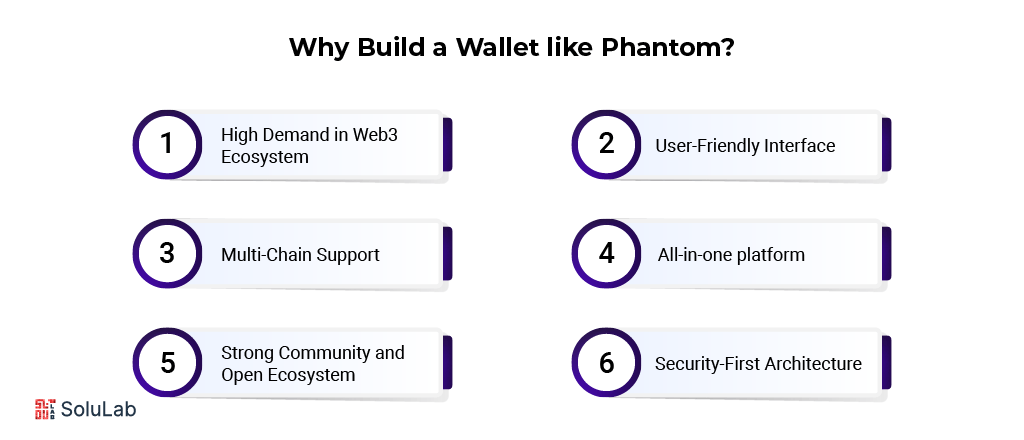
1. High demand in the Web3 space: Phantom’s user growth isn’t an accident. It reflects how many people need a wallet that doesn’t fight them.
2. Interface that converts: A clean, fast, intuitive UI isn’t a nice-to-have — it’s what separates wallets people try from wallets people keep.
3. Multi-chain from the start: Phantom covers Solana, Ethereum, and Polygon. Users don’t want to manage three wallets. Build for that.
4. Everything in one place: DeFi, NFTs, staking — all inside one wallet. That kind of depth keeps users inside the app instead of bouncing between tools.
5. Open by design: Phantom sits at the center of the Web3 experience — connected to DeFi apps, games, NFT platforms. That kind of reach compounds over time.
6. Security that users actually feel: Private key control and phishing protection aren’t just technical checkboxes. They’re what gives users confidence to put real money in.
Read Also: Build a dApps on Solana
Things To Consider When Creating A Wallet Like Phantom
A few things will make or break a wallet like Phantom. Not every detail matters equally — but these ones do.
- Security: Strong encryption and multi-factor authentication aren’t optional. Seed phrases, password protection, and phishing guards are the floor, not the ceiling. One breach can end a wallet’s reputation permanently.
- User experience (UX): Phantom’s design is deceptively simple. That simplicity took real work. If your wallet requires a tutorial to send tokens, you’ve already lost a large slice of potential users.
- Blockchain integration: Solana, Ethereum, or both — pick based on your audience, but build with multi-chain compatibility in mind from day one. Retrofitting it later is painful.
- Cross-platform support: Desktop and mobile, not one or the other. Users switch devices constantly. Meet them on both.
- Speed and transaction cost: Solana’s throughput and low fees are a big part of Phantom’s appeal. If your wallet runs slow or costs too much per transaction, users will notice immediately.
How Much Does It Cost to Build a Wallet Like Phantom?
There’s no single number, but you can get a working range. A Phantom-style wallet covering design, development, security, and basic marketing typically runs $50,000 to $150,000. The spread is wide because feature scope, team location, and timeline all pull the cost in different directions. Working with a dedicated crypto wallet development company can cut down the planning overhead considerably.
The main cost buckets to plan around:
- UI and UX design
- Blockchain integration for Solana, Ethereum, or other networks
- Security features like encryption, backup, and two-factor authentication
- Cross-platform support for iOS, Android, and web extensions
And beyond launch: ongoing maintenance, regular updates, and compliance with evolving regulatory requirements all add to the long-term cost picture. Budget for them upfront rather than treating them as surprises.

Conclusion
Building a wallet like Phantom is a real engineering challenge. You need solid knowledge of blockchain technology, tight security at every layer, and a design that doesn’t require users to figure things out on their own.
The team matters as much as the tech. Multi-network support, top-tier security, and a consistent experience across browser and mobile — none of that happens without people who’ve done it before.
Crypto wallet demand is real and growing. The wallets that win long-term are the ones that treat UX as a technical discipline, not an afterthought. Whether you’re building on Solana or a different chain, the details in both functionality and design are what actually separate a wallet users trust from one they delete.
SoluLab, a crypto wallet development company, can help you build a wallet like Phantom and answer the specific questions your project raises. Get in touch to talk through your requirements.
FAQs
Shipra Garg is a tech-focused content strategist and copywriter specializing in Web3, blockchain, and artificial intelligence. She has worked with startups and enterprise teams to craft high-conversion content that bridges deep tech with business impact. Her work translates complex innovations into clear, credible, and engaging narratives that drive growth and build trust in emerging tech markets.