Talk to an Expert

A Guide to Asset Tokenization

A Guide to Asset Tokenization

Investing in real estate, art, or other high-value assets often feels out of reach for everyday investors. Traditional methods involve high costs, middlemen, and limited liquidity, making asset ownership complex and restrictive.

Wanting to invest in a luxury apartment or a rare painting, but being held back by high prices and red tape. However, asset owners find it difficult to generate capital or extract value from their holdings without completely liquidating them. 

Asset tokenization is a game-changer that converts real-world assets into digital tokens on the blockchain. These tokens allow fractional ownership, increase liquidity, reduce transaction costs, and democratize access to previously illiquid markets. In this guide, we’ll break down what asset tokenization is, its benefits, use cases, and how you can get started.

Asset Tokenization (A Brief Introduction)

Tokenization is the transformative process of converting ownership and rights related to specific assets into a digital format. This method allows for the conversion of indivisible assets into tokenized representations.

To understand better, let’s take an example of an iconic painting, the Mona Lisa. To sell it traditionally, you’d need to find a buyer with the financial means to spend millions of dollars. This limits the pool of potential buyers significantly. However, through tokenization, we can fragment ownership of the painting, making it accessible to multiple individuals. Therefore, one person may own, for example, 1/25th of the painting or asset. This level of division is achievable only through tokenization, offering a modern solution compared to conventional methods. 

Read Our Blog: Top 10 Asset Tokenization Platforms in 2026

Type of Tokenized Assets
Type of Tokenized Assets 

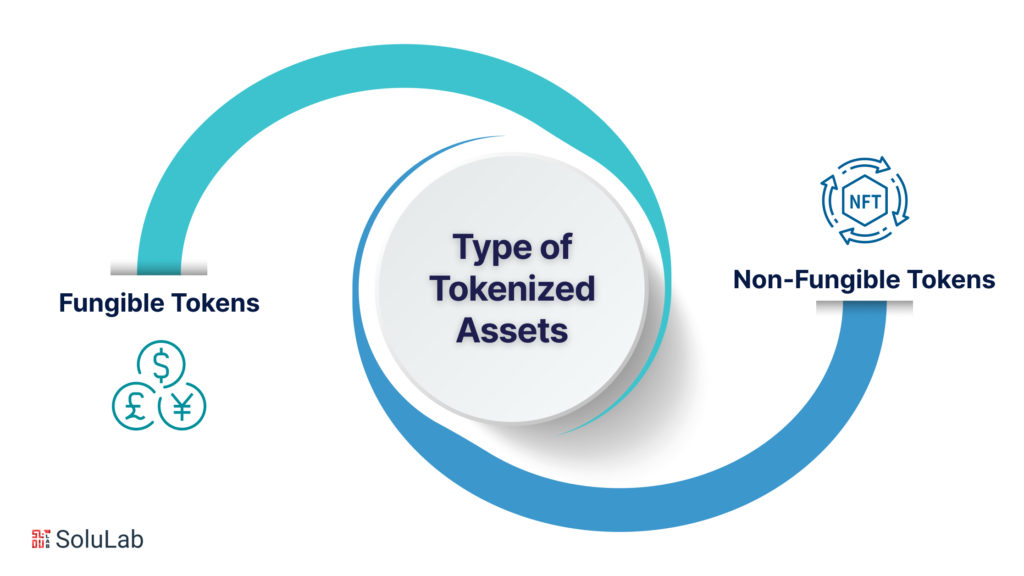
The tokenized assets can further broadly be categorized into two types: Fungible Tokens and Non-Fungible Tokens

Fungible Tokens 

Fungible tokens refer to an asset that can be exchanged for another identical asset of the same type. When a good or service is fungible, it means it can be substituted with another identical good or service without any distinction.

Non-Fungible Tokens

Non-fungible tokens signify that each token is unique and cannot be replaced by an identical token. These tokens possess distinct characteristics, making them individual and irreplaceable. This uniqueness imparts a higher intrinsic value to NFTs compared to fungible tokens.

What Real-World Assets Can Be Tokenized?

1. Commodities

Tokenization allows banks to trade commodities on the blockchain by generating digital tokens that represent ownership of the underlying commodity. These tokens can be traded on a blockchain network for faster, safer transactions.

The tokens can be exchanged for the underlying asset, usually stored commodities. Banks can improve commodities trading, lower transaction costs, and increase investor transparency.

2. Securities and Stocks

Digital tokens representing asset ownership allow banks to exchange stocks and securities on the blockchain. Tokens are usually backed by securities in custody and can be exchanged for the asset. Banks can speed securities trading, lower transaction costs, and increase investor transparency.

Fractional stock and private equity ownership allow new groups to pool resources for purchases, which is intriguing. Tokens allow banks to use present assets as collateral for future acquisitions, improving liquidity.

3. Currencies

Financial organizations create digital tokens backed by a reserve currency to represent real currency holdings. These “stablecoins” retain a stable value compared to their currency, such as the US dollar. Kaleido has built many institutional financial platforms.

The stablecoin’s one-to-one backing with the underlying currency is verified by third-party audits and verifications of the reserve currency. This makes fiat money transactions faster and more secure, and connects the regular banking system to cryptocurrencies.

4. Intellectual Property

Tokens can represent intellectual property like patents or copyrights. Trading these tokens on a blockchain platform makes intellectual property licensing and distribution more transparent and efficient.

Tokens with smart contract capability can automate royalty payments, licensing terms, and other contractual responsibilities. This helps financial institutions streamline intellectual property administration, save transaction costs, and increase owner liquidity.

5. Real Estate

Tokenizing real estate assets can boost liquidity for banks, as digital assets are easier to acquire, sell, and fractionalize. Buy smaller pieces of the property to lower entry barriers and make it more available to other investors. This allows banks to reach new consumers, including individuals who can’t afford or don’t want to acquire a whole property.

Eliminating intermediaries through real estate tokenization reduces transaction time and cost. These transactions can be audited or transparent. Digitizing physical places saves money. Management costs, including property maintenance, insurance, and legal fees, can be reduced.

6. Art & Collectibles

Tokenizing art entails digitizing it on a blockchain network. Like cryptocurrencies, this digital representation can be purchased, sold, or traded. The token can be used as loan collateral, increasing liquidity. Imagine all the new people who could possess a Picasso if they owned one millionth of it.

With art prices rising in some markets, this technology can generate a tamper-proof record of ownership and transaction history, prevent fraud, prohibit counterfeits, and confirm provenance.
CTA1

Asset Tokenization on Blockchain: Potential Benefits 
Asset Tokenization On Blockchain: Potential Benefits 

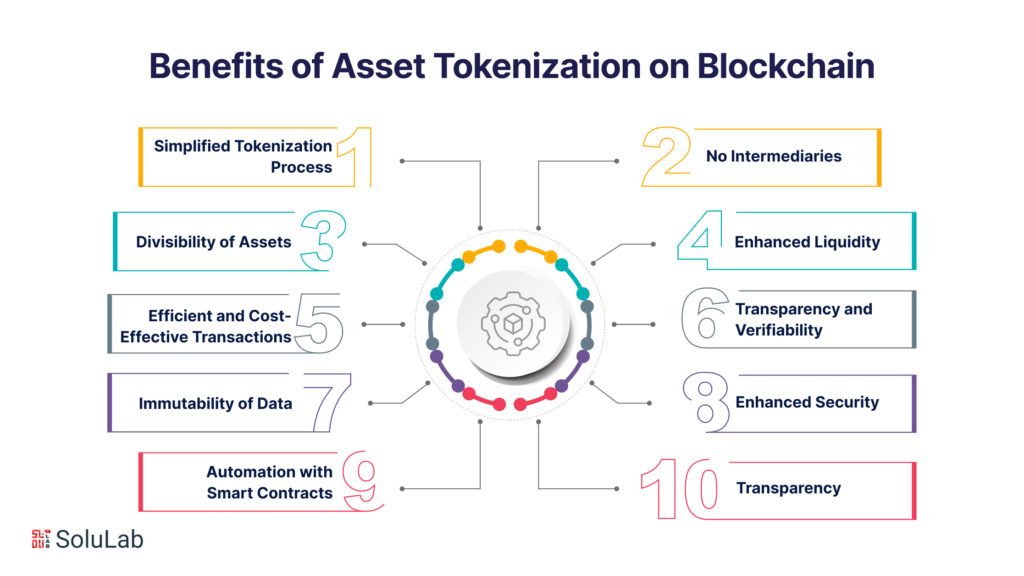
Tokenizing assets on the blockchain opens up significant growth and diversification opportunities in the market by bringing a plethora of new opportunities for businesses and individuals such as continuous operation, round-the-clock data accessibility, and immediate settlement possibilities.

  • Simplified Tokenization Process

In blockchain-based tokenization, the blockchain infrastructure replaces traditional banks, and cryptocurrency tokens replace digital dollars. While the mechanics change, the fundamental tokenization process remains similar to traditional banking, forex trading, or stock market tokenization.

  • No Intermediaries

Asset tokenization on the blockchain eliminates the intermediaries in the trading process. The distributed ledger system becomes a “source of truth” that ensures transaction integrity, securely stores digitized assets and facilitates transactions. Trust is primarily placed in the issuer and relevant regulatory bodies, simplifying and cost-reducing the process while enhancing security.

  • Divisibility of Assets

Tokenization can divide any asset into an unlimited number of virtual shares, each represented by a separate token. This feature enhances liquidity in markets where it was previously limited.

Consider real estate investments. Traditionally, buying or renting an entire building can be prohibitively expensive. However, using blockchain to divide a building into 100 tokens, each costing $2,500, reduces the investment threshold to $250. 

Similar divisibility applies to intellectual property, pharmaceutical development, space research, and even entire countries, enabling greater citizen involvement in political processes.

  • Enhanced Liquidity

Tokenizing assets broadens their accessibility, amplifying market liquidity by removing the traditional obstacles associated with illiquid investments, such as fine art or real estate. Tokenized assets can be seamlessly exchanged online, enabling investors to acquire fractional ownership in the underlying asset. In addition to increasing the liquidity of existing markets, this double effect opens up a wider range of investment opportunities to a wider range of investors.

  • Efficient and Cost-Effective Transactions

Crypto tokens eliminate the need for intermediaries and intermediaries, prevalent in traditional asset management processes. As a result, the value transfer process becomes more efficient and cost-effective by a reduction in transaction costs and processing time. Moreover, crypto tokens, residing on blockchain technology, facilitate 24/7 global trading, providing uninterrupted accessibility and flexibility.

  • Transparency and Verifiability

Crypto tokens’ residence on the blockchain ensures transparent provenance and transaction histories, cryptographically verifiable by users. Blockchain automatically records transactions, and its immutable and transparent nature guarantees the authenticity of each token’s historical data. These attributes endow crypto tokens with a level of trustworthiness rarely matched by other digital assets.

  • Immutability of Data

Data recorded on the blockchain cannot be altered, deleted, or tampered with by bribing officials or hacking systems. This inherent feature is due to blockchain architecture, which records information in blocks.

This immutability makes blockchains suitable for state registries, online banking systems, and corporate databases where data accuracy is paramount. It ensures the ability to trace the history of tokens or assets, deterring fraud, theft, errors, or corruption.

  • Enhanced Security

Blockchain Tokenization relies on cryptography and distributed registries. Cryptography safeguards open data by encrypting it with secret algorithms and keys. This enables secure storage of confidential or financial information while maintaining transparency.

These security measures enhance the safety of stored information in Token, including owner details and billing information.

  • Automation with Smart Contracts

Blockchain enables the automation of most workflow and bureaucratic procedures through smart contracts—autonomous algorithms that facilitate the exchange of assets like money, stocks, tokens, or real estate.

Smart contracts automate processes, eliminate intermediaries, accelerate transactions, reduce costs, and combat corruption. They operate based on predefined conditions, executing actions when certain criteria are met.

  • Transparency

Most blockchains are open-source software, allowing users and developers to inspect the code for vulnerabilities and functionality. This transparency ensures compliance with regulations, reduces fraud risk, and instills confidence in issuers and their assets.

Related: On-Chain vs. Off-Chain Asset Tokenization

How Does Asset Tokenization Profit the Asset Owners?

Asset tokenization brings real financial and operational benefits to asset owners. Here’s how:

  • Increased Liquidity: Owners can sell fractional shares of high-value assets, making it easier to access cash without selling the entire asset.
  • Wider Investor Reach: Digital tokens allow global investors to participate, expanding the potential buyer pool.
  • Lower Transaction Costs: Blockchain reduces the need for intermediaries, cutting fees and speeding up transactions.
  • Improved Transparency: Smart contracts ensure automated, secure, and traceable transactions, building trust with investors.
  • Enhanced Asset Utilization: Previously illiquid assets (like art or real estate) become monetizable, unlocking hidden value.

How Does Asset Tokenization Profit the Investors? 

  • Investors can easily diversify their portfolios by investing small amounts in tokenized assets, enhancing liquidity, and reducing paperwork hassles.
  • Tokenization enables quicker asset liquidity, eliminating long lock-up periods and allowing investors to access profits or make adjustments sooner.
  • Blockchain-based asset history ensures transparency, enabling investors to make informed decisions based on an asset’s true background.
  • Decentralized identity and blockchain technology provide secure, verifiable ownership and identity verification, meeting KYC/AML requirements and ensuring trust across various platforms.

Additional Features

In addition to the above benefits, tokenization offers a wide range of possibilities, including trading, storage, collateral usage, payment for goods and services, participation in loyalty programs, voting, and access to blockchain platforms.

How Does Asset Tokenization Work? 

The working of tokenization on the Blockchain network involves replacing sensitive information with an equivalent, non-sensitive placeholder known as a “token.” These tokens can be generated through several methods:

  • Using a mathematically reversible cryptographic function with a specific key.
  • Employing non-reversible functions, such as a hash function.
  • With indexing functions or generating a random number.

As a result, the token takes the place of sensitive information, while the actual sensitive data it represents is securely stored in a server referred to as a “token vault.” The token vault serves as the sole location where the original information can be mapped back to its corresponding token, ensuring the safeguarding of sensitive data. 

The Steps Involved in the Tokenization Process 
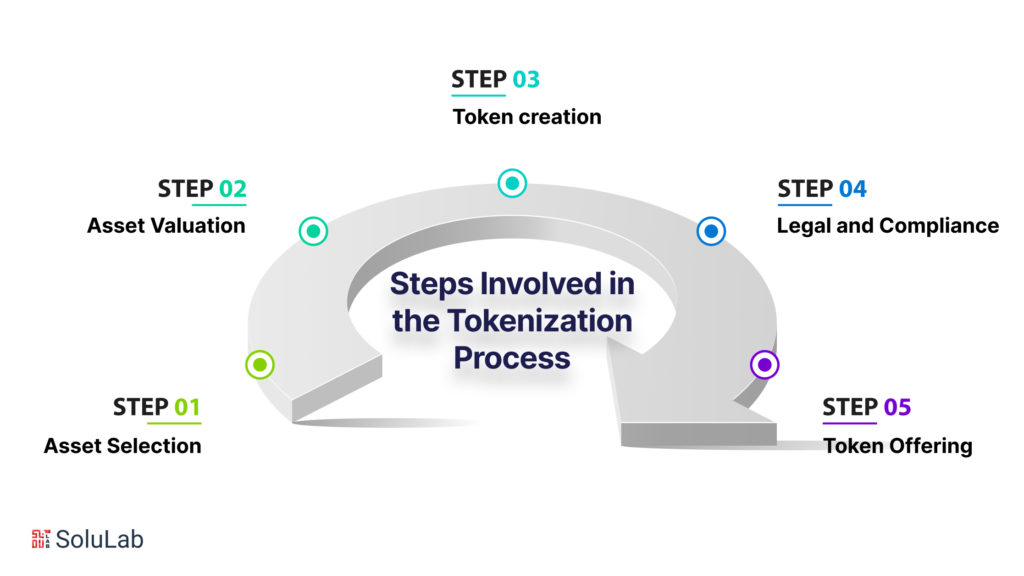
The steps involved in the Tokenization process are

1. Asset Selection- Select an asset, for example- a piece of art, intellectual property right, or house to tokenize. 

2. Asset Valuation- In this step, asset evaluation is done to determine its value, and parameters are set to understand the worth of the digital token 

3. Token Creation: After determining the value, the token is created using Blockchain technology. The token contains information related to the asset it represents such as ownership information, benefits, and rights.

4. Legal and Compliance– As per the jurisdiction, a token must fulfill the regulatory requirements and legal agreements. The process ensures that created tokens adhere to the applicable laws and regulations. 

5. Token Offering – The token created now can be made available for sale. The interested party who purchases the token will become the owner of the faction and the entire token as per the purchase agreement. 

Properties of Tokenized Real-World Assets
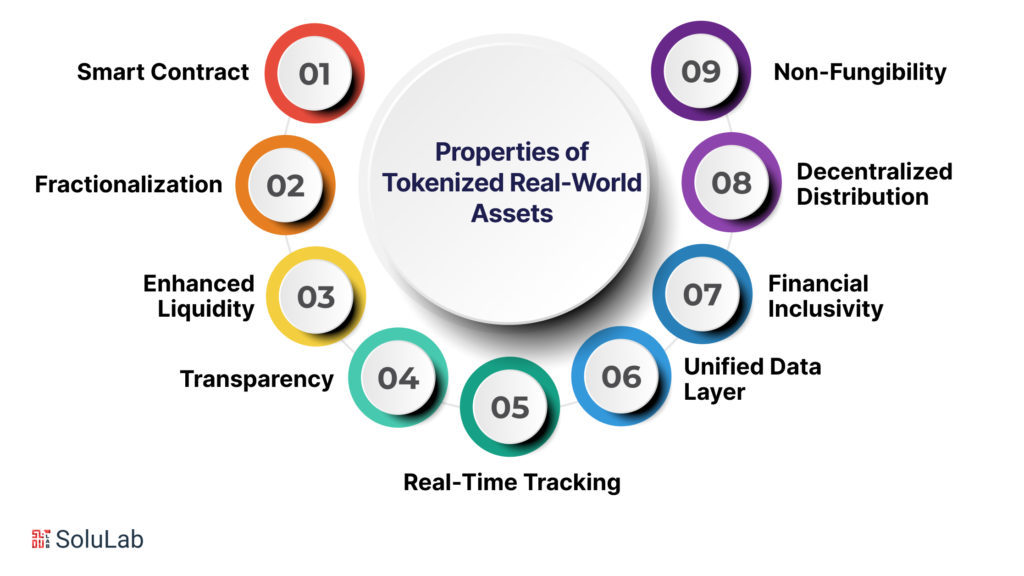
Properties of Tokenized Real-World Assets

  • Smart Contract 

The tokenization of real-world assets is achieved through the deployment of smart contracts. These self-executing contracts contain predefined instructions and automatically execute when specified conditions are met. This innovative approach promotes decentralization and eliminates the necessity for third-party intermediaries in transaction processes.

  • Fractionalization

Real-world assets can be subdivided into numerous digital tokens within the blockchain ecosystem. This fractionalization enhances liquidity and fosters financial inclusivity. For instance, a $1 million commercial building can be fragmented into one million digital tokens, each valued at just $1, thereby significantly reducing the investment threshold.

  • Enhanced Liquidity

Asset tokenization enhances liquidity by simplifying asset trading and transfers within a unified platform. Digital tokens can be freely and instantaneously exchanged in a peer-to-peer manner, obviating the need for intermediary financial institutions.

  • Transparency

Tokenized real-world assets are the real-world tokens present on a blockchain, which inherently offers transparency. Blockchain users can check the transaction records, trace the asset’s origins, scrutinize its complete history, and validate ownership.

  • Real-Time Tracking

As blockchains are transparent, they enable real-time tracking of tokenized assets, effectively deterring fraudulent activities. Central banks worldwide are adopting fiat currency in tokenized form, known as CBDC – “Central Bank Digital Currency”, that users can continuously monitor.

  • Unified Data Layer

Blockchain technology streamlines data management by providing a unified data layer. This facilitates more efficient data sharing and collaboration among multiple parties involved in asset management.

  • Financial Inclusivity 

Digital tokens can be issued by a wide range of entities, from small-sized businesses to big-scale industries, individuals, private companies, and non-governmental organizations, without the need for approval from traditional financial institutions. However, if these tokens are classified as securities, registration with regulatory bodies like the U.S. Securities and Exchange Commission may be required. Additionally, asset fractionalization lowers the entry barrier, promoting financial inclusivity.

  • Decentralized Distribution

Digital tokens can be easily distributed without reliance on third-party intermediaries. Token issuers have the flexibility to list their tokens on DEXs or can sell them autonomously.

  • Non-Fungibility

Non-fungible digital tokens (NFTs), which are unique and irreplaceable. Unlike fungible tokens like ETH, each NFT is distinct and non-replicable.

Industries Leveraging the Concept of Tokenization of Assets
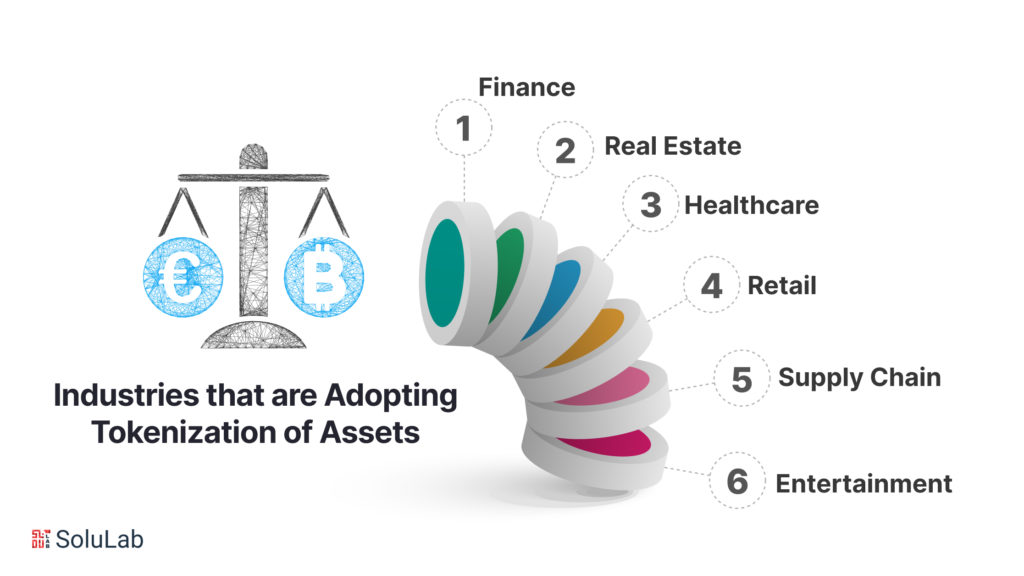
Industries that are Embracing the Concept of Tokenization of Assets

1. Finance: Blockchain technology, specifically payment tokenization, has changed finance operations. Tokenization has altered asset management by improving exchange services and data security, eliminating the need to store credit card data. In 2020, decentralized finance (DeFi) emerged, disrupting traditional institutional frameworks by offering a variety of financial goods and services. Decentralized Finance (DeFi), with lending protocols and yield-farming tokens, can alter global banking and lending regardless of local financial conditions.

2. Real Estate: Blockchain technology has enabled asset tokenization in the real estate business, reducing middlemen and enabling cost-effective buyer-seller platforms. Tokenization promotes diverse markets and prevents fraud. Tokenization includes describing properties as blockchain tokens. This strategy allows fractional ownership by dividing ownership into smaller fractions. Thus, tokenization facilitates secondary market property share transactions. This method increases liquidity and democratizes real estate investments, making them more accessible.

  Read Also: 9 Blockchain Real Estate Companies to Watch in 2026

3. Healthcare: The healthcare industry is considering asset tokenization to solve data security and supply chain management issues. Healthcare blockchain solutions use tokenization to replace sensitive patient data with non-sensitive representations. This empowers individuals and healthcare organizations by giving them personal data ownership. Pharmaceutical tokens are unique units of medication that use tamper-proof QR codes for authentication. This strategy increases supply chain transparency and reliability, reducing counterfeit pharmaceutical items. Thus, this step is vital to patient safety.

4. Retail: Tokenization has become a popular strategy in retail, enhancing user experiences and security. Businesses may offer safer, more convenient payment options with blockchain tokenization. Payment tokenization lets users trade without sharing credit card information, reducing data breaches and fraud. Businesses can transform consumer loyalty points and prizes into tokens, making them more transferable across stores and platforms. This strategy boosts customer loyalty and simplifies store loyalty program

5. Supply Chain: Tokenization has improved supply chain transparency, traceability, and operational efficiency. Blockchain technology lets companies tokenize commodities, transportation, and inventories. This lets stakeholders track these assets along the supply chain. Transparency helps prevent counterfeiting, theft, and fraud and ensures product authenticity. Tokenization streamlines payments and documentation, reducing paperwork and administrative overhead. Thus, supply chains are more agile and responsive, speeding delivery and lowering costs for businesses.

6. Entertainment: Blockchain tokenization is changing entertainment content development, distribution, and monetization. Music, film, and art producers can tokenize their digital assets. This empowers individuals by increasing their control over intellectual property and royalties. Blockchain technology might automate licensing, copyright, and revenue-sharing arrangements, ensuring artists fair compensation. Tokenization also allows fans and investors to support their favorite musicians and invest in their projects. Democratizing the entertainment industry may empower content creators and consumers.

Real-World Use Cases of Asset Tokenization
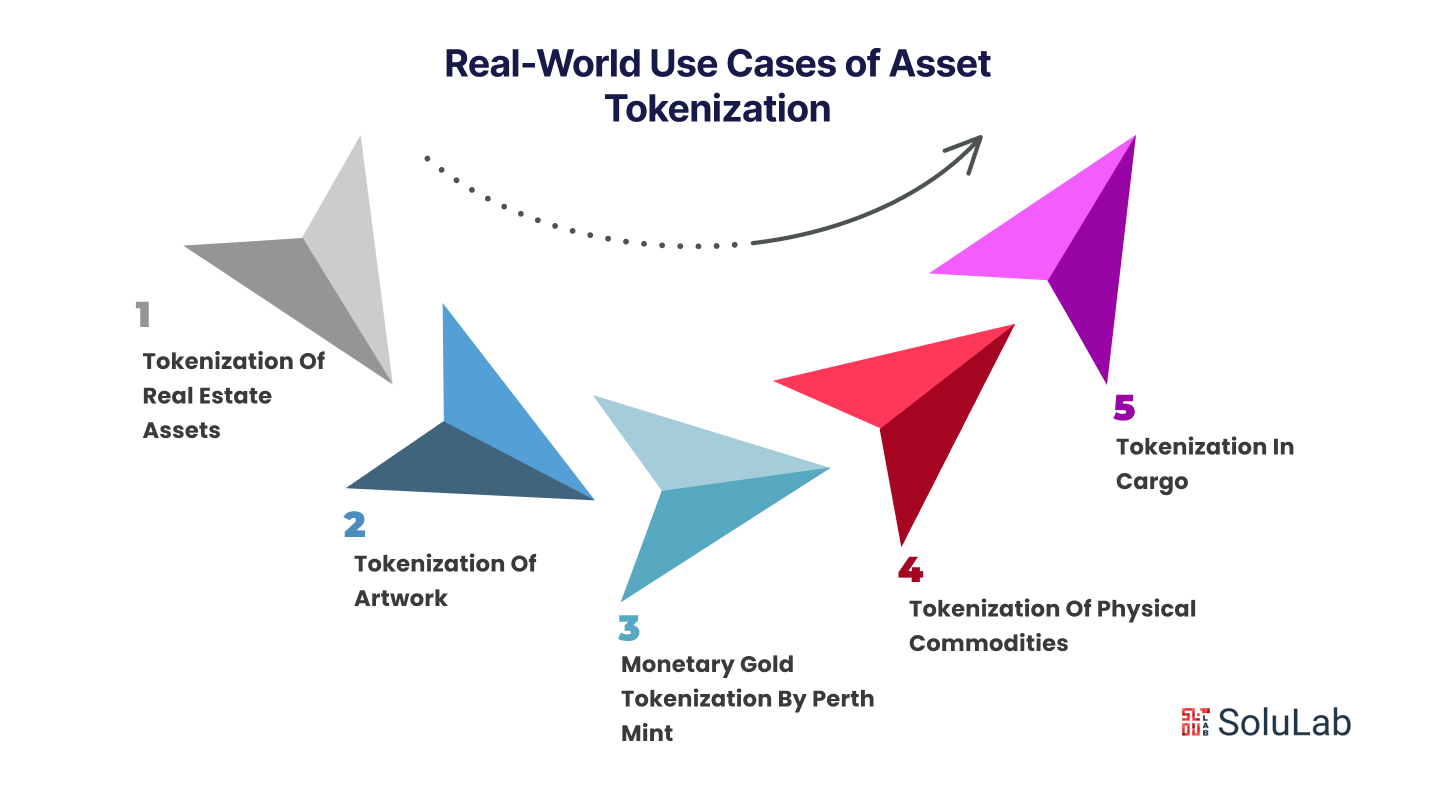
Real-World Use Cases of Asset Tokenization internal image

Tokenization is revolutionizing various industries by leveraging blockchain technology to transform real-world assets into digital tokens, thereby enhancing liquidity and accessibility. Here are some real-life use cases where tokenization is making a significant impact.

  • Tokenization of Real Estate Assets

In the realm of real estate tokenization entails breaking down traditionally illiquid property assets into fungible blockchain tokens. 

Elevated Returns, an asset management firm based in New York, demonstrated the potential of this approach by tokenizing the St. Regis Resort in Aspen, Colorado, worth $18 million on the Ethereum blockchain in 2018.

  • Tokenization of Artwork

Tokenization extends its influence to the world of art. Consider the scenario where a company holds ownership of a limited number of prints of an artwork by a renowned artist. These prints can be tokenized, allowing the public to redeem tokens for physical copies. If the value of tokens redeemed falls short of a certain threshold, token holders can retain fractional ownership based on the assessed value. 

TheArtToken (TAT) offers tokens representing partial ownership of Contemporary and post-war art, securely stored by the Swiss government. This approach simplifies the buying and selling of art fractions.

  • Monetary Gold Tokenization by Perth Mint

The Perth Mint (Australia) launched GoldPass, a digital platform that lets users buy, sell, and transfer digital gold certificates backed by physical gold stored in their vaults. Each digital certificate is fully backed by real gold, offering a modern way to trade the metal securely and efficiently.

This highlights how a gold tokenization development company can enable financial institutions and mints to digitize gold assets, making them accessible to everyday investors without physical handling.

Read Also: Gold Tokenization and How Does It Work?

  • Tokenization of Physical Commodities

Even in the realm of physical commodities, tokenization is making strides. Take the example of gold stored in a vault owned by ABC. ABC can tokenize ownership of a portion of the gold, maintaining an ownership registry with the vault owner, XYZ. Each token sold represents ownership of a corresponding amount of gold. Token holders can redeem their gold by proving ownership via a digital signature or certificate. 

JP Morgan, a financial services giant, has revealed plans to tokenize gold bars on their Quorum blockchain network. This showcases the potential for tokenization in the world of physical assets.

  • Tokenization in Cargo

In the logistics sector, tokenization addresses the inefficiencies associated with traditional proof of ownership, such as Bill of Lading (B/L) documents. 

CargoX introduces a solution through tokenization called Smart B/L, built on Ethereum. The Smart B/L system operates akin to tokenization. Carriers create a Smart B/L using their app and send it to exporters. Upon receiving payment from importers, exporters transfer ownership of the Smart B/L token. Importers, in turn, can claim ownership of the goods by presenting the Smart B/L token to the carrier. This innovative approach streamlines cargo logistics, reducing delays and simplifying ownership verification.

These real-world examples vividly illustrate how tokenization is enhancing liquidity, accessibility, and efficiency across various sectors.
CTA2

Conclusion

Asset tokenization is changing how we view ownership, trade, and investment. By converting real-world assets into digital tokens on the blockchain, it offers greater transparency, liquidity, and accessibility to investors across the globe.

Whether it’s real estate, art, or commodities, tokenization breaks down traditional barriers and opens up new opportunities for fractional ownership. As regulations evolve and technology matures, more businesses and individuals are likely to adopt this model.

For anyone looking to future-proof their investment strategy or business model, understanding asset tokenization isn’t just smart, it’s essential.

SoluLab, a top asset tokenization development company in the USA, provides the best services as per your business needs. Contact us today to discuss further.

FAQ

1. What is the future of asset tokenization?

Asset tokenization is set to revolutionize global finance by boosting liquidity, enabling fractional ownership, and making investments more accessible, transparent, and efficient.

2. What distinguishes cryptocurrencies from tokens? 

While tokens seek to facilitate the creation of decentralized applications (dApps), and other blockchain-based platforms, coins serve as the cornerstone for safe and decentralized networks. 

3. Which is the best cryptocurrency for tokenization?

The mantra OM in the realm of real-world asset tokenization arena is a layer 1 blockchain platform the other cryptocurrencies for tokenization are such as OriginTrail (TRAC), Pendle (PENDLE), Polymesh (POLYX), and TokenFi (TOKEN). 

4. What should businesses look for when choosing an asset tokenization development company?

Businesses should prioritize expertise in blockchain, regulatory compliance, security, and industry-specific solutions to ensure scalable, secure, and legally sound tokenization platforms.

5. How can asset tokenization be aided by SoluLab?

Consultation, creation, and deployment of tokenization of assets customized according to your company’s needs and preferences all come under SoluLab’s extensive services offered.
Top 10 Asset Tokenization Platforms in 2026

Asset Tokenization Platforms

Platforms for asset tokenization development have become crucial in 2026 for democratizing access to financial possibilities. Real estate, works of art, and even intellectual property, which were previously illiquid, may now be split into digital tokens, enabling anyone to hold portions of these assets. This concept of fractional ownership gives investors the freedom to diversify their holdings and get access to markets that were previously unavailable because of high entry barriers.

As the world continues to embrace the potential of blockchain technology, leading asset tokenization platforms have emerged as powerful tools that are revolutionizing the financial landscape. These platforms leverage the security and transparency of blockchain to transform traditional assets into digital tokens, enabling fractional ownership, liquidity, and enhanced accessibility.

In the history of financial markets, transparency and security have always been top priorities. Leading Asset tokenization platforms will use blockchain technology in 2026 to address these issues. These systems offer an immutable and auditable record of asset ownership and transfers by recording and validating transactions on a distributed ledger. This openness boosts investor trust, lessens fraudulent activity, and lessens the need for middlemen.

In this article, we will explore the top 10 asset tokenization development platforms that are making waves in 2026, facilitating a new era of decentralized finance.

Read Also: What Is Asset Tokenization?

What is the Process of Converting Real-World Assets into Digital Tokens?

Asset tokenization is revolutionizing the way we perceive and invest in real-world assets. By converting tangible assets into digital tokens, asset tokenization platforms are unlocking a multitude of benefits and opportunities for investors. But how exactly does this process work? Let’s delve into the steps involved in converting real-world assets into digital tokens.

  • Asset Selection and Evaluation: The first step in the process is selecting the asset to be tokenized. This can include a wide range of assets such as real estate properties, artwork, commodities, or intellectual property rights. The asset is carefully evaluated to determine its value, marketability, and legal compliance. Due diligence is crucial to ensure that the asset meets the necessary criteria for tokenization.
  • Legal and Regulatory Compliance: It is crucial to follow all applicable laws and regulations before beginning the tokenization process. This entails making sure all paperwork is in order, confirming ownership, and abiding by securities laws. Asset tokenization development systems actively collaborate with legal professionals to handle the complicated environment and guarantee legal compliance.
  • Asset Valuation and Fractionalization: A professional assessment or valuation approach are used to ascertain the asset’s worth. The amount of tokens that will represent fractional ownership of the asset is determined as a result of the valuation procedure. A larger spectrum of investors can access an asset thanks to fractionalization, which enables investors to buy a share of its value. The ownership rights and value of the underlying asset are represented by the tokens.
  • Smart Contract Creation and Token Issuance: Smart contracts, powered by blockchain technology, play a pivotal role in asset tokenization. These contracts are programmed with the terms and conditions of the tokenized asset, including ownership rights, dividend distribution, and transferability. The smart contract ensures that the tokenized asset operates within the predefined parameters and automates certain functions, such as dividend payments. Once the smart contract is created, the digital tokens representing the asset are issued and made available for sale or trade.
  • Investor Onboarding and Token Sale: Leading Asset tokenization platforms provide a user-friendly interface for investors to participate in the token sale. Investors can register, complete the necessary know-your-customer (KYC) and anti-money laundering (AML) procedures, and fund their accounts with the designated cryptocurrency or fiat currency. The tokens are then offered for sale, either through a private placement or a public offering, depending on the platform and regulatory requirements.

Read Our Blog Post: Importance Of Tokenization Of Assets

What are the Benefits of Asset Tokenization: Unlocking a New Era of Investment Opportunities?

Asset tokenization development, enabled by blockchain technology, has disrupted the traditional investment landscape, offering many benefits to investors and asset owners. Let’s explore the advantages that asset tokenization brings to the table:

  • Increased Liquidity and Fractional Ownership: One of the key benefits of asset tokenization is the increased liquidity it offers. By converting assets into digital tokens, fractional ownership becomes possible, allowing investors to purchase and trade smaller portions of valuable assets. Previously illiquid assets, such as real estate properties or fine art, can now be divided into tokens representing fractional ownership. This democratizes access to high-value assets, opening doors for a broader range of investors and facilitating more efficient and flexible transactions.
  • Enhanced Transparency and Reduced Barriers to Entry: Asset tokenization development platforms provide a transparent and auditable record of ownership and transactions on the blockchain. This level of transparency reduces information asymmetry and instills greater trust in the investment process. Investors can easily verify the authenticity, ownership history, and market value of tokenized assets. Additionally, asset tokenization development lowers the barriers to entry for traditionally exclusive or inaccessible assets. Previously, assets like rare collectibles or prime real estate were limited to wealthy individuals or institutional investors. Through tokenization, these assets become more accessible, allowing a wider audience to participate in investment opportunities that were once out of reach.
  • Diversification Opportunities and Optimized Portfolios: Asset tokenization development pave the way for portfolio diversification and optimization. Investors can now easily allocate their funds across various asset classes, reducing concentration risk and enhancing portfolio performance. Tokenized assets represent a wide range of sectors, such as real estate, commodities, or intellectual property, allowing investors to achieve diversification without significant capital requirements. Additionally, asset tokenization enables investors to customize their portfolios according to their risk appetite and investment goals. They can allocate funds across different asset types, geographies, or sectors, thereby achieving a more balanced and optimized investment strategy.
  • Efficient and Cost-Effective Transactions: Traditional investment transactions often involve multiple intermediaries, complex paperwork, and lengthy settlement periods. Asset tokenization platforms streamline this process by automating transactions through smart contracts. Smart contracts facilitate the execution of predefined conditions, such as dividend distribution or transfer of ownership, removing the need for intermediaries and reducing associated costs. Furthermore, blockchain technology enables faster settlement times, eliminating the need for lengthy verification processes. This efficiency and cost-effectiveness benefit investors and asset owners, creating a seamless investment experience.

Read Our Blog: Top 12 Real Estate Tokenization Companies in USA

What are the Regulatory Developments and Frameworks in 2026?

As the leading asset tokenization industry continues to evolve and gain traction, regulatory authorities worldwide are actively shaping the legal frameworks to ensure investor protection, market integrity, and compliance. In 2026, several key regulatory developments and frameworks are emerging, aiming to address the unique challenges and opportunities presented by asset tokenization. Let’s explore some of the notable trends and initiatives in this domain:

  • Enhanced Investor Protection: Regulators recognize the need to safeguard investors participating in tokenized asset markets. In 2026, we see an increased emphasis on enforcing robust investor protection measures. Authorities are imposing stricter requirements for asset tokenization platforms, including comprehensive disclosure of risks, transparent pricing mechanisms, and investor suitability assessments. Additionally, Know Your Customer (KYC) and Anti-Money Laundering (AML) procedures are being reinforced to mitigate the risk of fraudulent activities and enhance the overall security of the ecosystem.
  • Clearer Regulatory Definitions: Regulatory bodies are working to provide clearer definitions and classifications for tokenized assets. This clarity is essential to determine the regulatory treatment of different token types and their compliance requirements. For instance, regulatory authorities may distinguish between security tokens, utility tokens, and payment tokens, each subject to specific regulations and guidelines. Such distinctions aim to bring regulatory certainty and foster market transparency, enabling investors to make informed decisions and asset tokenization platforms to operate within defined boundaries.
  • Standardization and Interoperability: In 2026, regulatory bodies will focus on standardizing practices and promoting interoperability within the asset tokenization ecosystem. Standardization efforts aim to create uniform guidelines for token issuances, smart contract standards, and token trading practices. These standards facilitate cross-platform compatibility, ensuring smooth interoperability and liquidity across different asset tokenization platforms. By establishing common industry practices, regulatory bodies foster trust, reduce fragmentation, and enhance market efficiency.
  • Regulatory Sandboxes and Innovation Hubs: To encourage innovation while managing potential risks, regulatory authorities are increasingly establishing regulatory sandboxes and innovation hubs. These initiatives provide a controlled environment for asset tokenization platforms and startups to test new technologies and business models under regulatory supervision. Regulatory sandboxes enable platforms to experiment with innovative approaches, while regulators closely monitor their operations and assess their compliance with existing regulations. This collaborative approach between regulators and industry participants fosters innovation, allowing regulatory frameworks to evolve alongside technological advancements.
  • International Collaboration and Harmonization: Given the global nature of asset tokenization, regulatory authorities are actively collaborating and seeking harmonization at an international level. Recognizing the need for consistent regulatory approaches, regulators are engaging in cross-border discussions to share best practices, align regulatory frameworks, and address challenges associated with cross-jurisdictional transactions. These collaborative efforts aim to establish a cohesive global regulatory landscape for asset tokenization, promoting investor confidence, and enabling seamless international investment opportunities.

Check Out Our Blog: Tokenizing Real Estate Assets On Blockchain

How Did We Compile The List of Top Asset Tokenization Platforms in 2026?

Although choosing the best asset tokenization platforms was a challenging task, we have come up with great results by considering the following factors:

  • Years of experience in the market
  • Client testimonials
  • Quality of delivered products
  • Size of the team
  • Variety of industries the company has worked with
  • Expertise in understanding business and market development
  • Technology Stack

CTA 1

Here are the Top 10 Asset Tokenization Platforms in 2026.

1. SoluLab

At SoluLab, they specialize in the transformation of physical assets into digital tokens, aiming to enhance trading accessibility and security. Their expertise lies in tokenizing various assets such as real estate, works of art, precious metals, and stock certificates on the blockchain. By analyzing the unique business requirements, they determine the optimal token type, architecture, and technology stack for the asset tokenization solution. With a focus on safety, scalability, and legal compliance, SoluLab’s team combines their extensive industry experience with technological prowess to develop asset tokenization solutions.

The team at SoluLab provides comprehensive asset tokenization development services tailored to meet the specific needs of each company. Whether the objective is to tokenize assets for crowdfunding, fractional ownership, or enhancing liquidity, they offer a range of solutions. Their expertise ensures the development of secure and scalable platforms, enabling clients to leverage the benefits of asset tokenization.


$25-$49


50-249


2014


Los Angeles, CA, USA


Disney, Microsoft, Georgia Tech

2. tZERO

tZERO has emerged as a pioneer in the realm of digital securities. Founded in 2014, tZERO is a leading blockchain-based platform that is transforming traditional capital markets by digitizing and streamlining the process of issuing, trading, and settling securities. With its innovative approach, tZERO is revolutionizing the way investors and companies interact, creating new opportunities for liquidity and efficiency.

By leveraging the power of distributed ledger technology, tZERO provides a secure and transparent platform for the issuance and trading of digital securities.


$25-$49


51-100


2015


Utah, United States


Alliance Investments, Curzio Research

3. Polymath

Polymath is an expert in tokenizing securities, streamlining the creation and administration of security tokens complying with legal requirements. With a user-friendly interface and full compliance with Know Your Customer (KYC) and Anti-Money Laundering (AML) requirements, its platform allows issuers to tokenize assets.


$55-$90


11-50


2017


Saint George, Barbados


N/A

4. ADDX

ADDX provides a user-friendly and secure digital marketplace where investors can seamlessly access and trade a diverse range of alternative assets. With its innovative approach, ADDX is breaking down barriers and opening up new avenues for individuals to diversify their portfolios and participate in traditionally exclusive investment opportunities.

One of the key advantages offered by ADDX is its global reach. The platform enables investors from around the world to participate in alternative investments that were traditionally limited to a select few.


$25-$50


51-100


2017


Central Region, Singapore


Hamilton Lane, StashAway, Singtel, Fullerton Fund Management

5. Securitize

Securitize offers a comprehensive end-to-end platform for tokenizing securities. It streamlines the compliance process, ensuring that security tokens adhere to relevant regulations. Securitize also provides tools for investor management, facilitating the distribution of dividends and other benefits to token holders.


$55-$90


50-100


2017


California, USA


Whitehall Capital, Arca Labs

6. Bitbond

Bitbond is a financial technology company that has made significant strides in revolutionising the way small and medium-sized enterprises (SMEs) access financing. Established in 2013 and headquartered in Berlin, Germany, Bitbond operates as a peer-to-peer lending platform that utilises blockchain technology to facilitate transparent and efficient lending processes.


$55-$90


11-50


2013


Berlin, Germany


N/A

7. Tokensoft

Tokensoft offers a robust platform that enables companies to tokenize a wide range of assets, including securities, real estate, funds, and more. By leveraging blockchain technology, Tokensoft facilitates the seamless creation and issuance of digital assets, providing businesses with increased liquidity, fractional ownership, and access to a global investor base. Their platform supports both public and private blockchain networks, allowing for flexibility and scalability in asset tokenization.


$55-$99


11-50


2017


California, United States


N/A

8. Securrency

Securrency is a cutting-edge financial technology company that is spearheading innovation in the field of digital asset compliance and security. With its advanced platform and solutions, Securrency enables businesses to seamlessly issue, manage, and trade digital assets while ensuring compliance with regulatory frameworks. Founded with a mission to bridge traditional finance and blockchain technology, Securrency has emerged as a trusted leader in the digital asset space.


$25-$50


101-250


2015


Washington, United States


WisdomTree, State Street, US Bank

9. Algorand

Algorand offers a high-performance blockchain platform for asset tokenization development and decentralised applications. Its pure proof-of-stake consensus algorithm ensures scalability and security. Algorand’s robust architecture and focus on speed make it suitable for asset tokenization projects that require fast transaction processing.


$25-$50


51-100


2017


Massachusetts, USA


N/A

10. Hyperledger Fabric

Hyperledger Fabric is an open-source blockchain framework developed by the Linux Foundation. It provides a modular and scalable platform for enterprises to build and deploy permissioned blockchain networks. Hyperledger Fabric’s focuses on privacy to make it an excellent choice for organizations looking to tokenize assets within a controlled environment.


$25-$50


25-100


2015


California, United States


Fintract Global, NIRA Inc, OptimHire

Final words

The impact of leading asset tokenization platforms on the finance industry is significant and poised to shape the future of how assets are valued, traded, and accessed. The top 10 asset tokenization development platforms mentioned in this article have revolutionized finance by leveraging blockchain technology to provide enhanced liquidity, fractional ownership, and increased accessibility to a diverse range of assets.

These platforms have opened up new opportunities for investors, allowing them to participate in asset ownership that was previously restricted to large institutions or wealthy individuals. By tokenizing assets, fractional ownership becomes possible, enabling broader participation and democratizing investment opportunities.

In conclusion, leading asset tokenization platforms in 2026 have significantly transformed the financial landscape by introducing decentralized and transparent solutions. These platforms empower individuals and institutions to tokenize assets, unlocking new opportunities for fractional ownership, increased liquidity, and broader market accessibility. With continuous innovation and advancements, asset tokenization platforms are poised to reshape finance and drive the adoption of decentralized finance (DeFi) in the years to come.

At SoluLab, they specialize in transforming physical assets into digital tokens, enhancing their accessibility and security for trading purposes. The efficiency demonstrated by the development team at SoluLab necessitates the hiring of an asset tokenization development company in order to attain unparalleled work experience. The SoluLab team is also dedicated to delivering excellent real estate tokenization development services, enabling clients to unlock the complete potential of their real estate assets. They offer a range of services for real estate tokenization, making it easier to enter fractional ownership and enhance liquidity. Contact us today!

FAQs

1. What is asset tokenization development?

Asset tokenization development is the process of converting real-world assets, such as real estate, art, or securities, into digital tokens that can be stored and traded on a blockchain platform.

2. How do leading asset tokenization platforms revolutionize finance?

Asset tokenization development platforms revolutionize finance by providing enhanced liquidity, fractional ownership, and increased accessibility to a diverse range of assets. They enable the creation of digital tokens that represent ownership in real-world assets, allowing for efficient trading, increased market participation, and unlocking liquidity from traditionally illiquid assets.

3. What are the top 10 asset tokenization platforms in 2026?

The top 10 leading asset tokenization platforms in 2026 are Ethereum, Polymath, Stellar, Securitize, Tezos, Neo, Ravencoin, Algorand, Hyperledger Fabric, and Ontology.

4. What makes Ethereum a leading asset tokenization platform?

Ethereum is a leading asset tokenization platform due to its robust smart contract capabilities, vibrant ecosystem, and widely adopted ERC-20 token standards. It provides a foundation for developers to create and deploy decentralized applications (dApps) for asset tokenization.

What is Asset Tokenization?

What is Asset Tokenization?

Modern technology developments are continuing to transform established sectors. Asset tokenization is one such idea that has drawn a lot of attention. By utilizing the potential of blockchain technology, asset tokenization creates digital tokens out of both tangible and intangible assets. With these tokens representing ownership rights and value, investors may participate in fractional ownership, conduct smooth asset trades, and access new investment opportunities.

Transforming physical assets into digital tokens on a blockchain network is the essence of asset tokenization. Doing so eliminates the conventional obstacles related to asset ownership and investment, creating opportunities for people and companies.

One of its key benefits is the potential for an asset tokenization development platform to democratize investing. By making several smaller investments in different assets, fractional ownership enables people to diversify their portfolios. Tokenization also eliminates geographical limitations, allowing anybody to participate in investment possibilities. Markets previously closed off because of logistical or governmental restrictions can now be accessed.

What are the Key Characteristics of Tokenized Assets?

In banking and investing, a tokenization company —turning physical assets into digital tokens—has become a ground-breaking idea. Assets that have been tokenized have several distinctive qualities that set them apart from conventional assets and appeal to investors looking for increased liquidity, transparency, and accessibility. We will discuss the main traits of tokenized assets and how they are changing the investment environment.

  • Fractional Ownership

Tokenized assets enable fractional ownership, allowing investors to own a portion of an asset rather than the whole. Through tokenization companies, high-value assets previously out of reach for many individuals can now be divided into smaller units, opening doors to a wider pool of investors. Fractional ownership not only enhances accessibility but also enables portfolio diversification by investing in multiple assets with smaller investment amounts.

  • Divisibility

Tokenized assets can be divided into numerous smaller units, known as tokens. Unlike traditional assets, which have minimum investment requirements, tokenized assets provide flexibility in terms of investment size. Divisibility facilitates liquidity and enables investors to trade smaller units of assets, promoting market efficiency and reducing barriers to entry.

  • Enhanced Liquidity

Due to high transaction costs, protracted settlement times, and a small pool of purchasers, traditional assets like real estate or fine art sometimes have restricted liquidity. By establishing a secondary market for tokenized assets, tokenization company solves this problem by making it simpler for investors to acquire and sell tokens. By increasing liquidity, asset owners can realize greater value, while investors are given the chance to exit their positions more quickly.

Read Our Blog Post: Importance Of Tokenization Of Assets

  • Transparency

Tokenized assets must possess transparency as a core quality. The underlying blockchain technology records all ownership changes and transactions, producing a transparent and immutable ledger. Thanks to this openness, all parties are guaranteed access to current information, including past ownership records, transaction specifics, and smart contract conditions. Investors might examine the ownership history and legitimacy.

  • Programmability

Tokenized assets use smart contracts and programmable, autonomous agreements. Tokenized asset terms and conditions are automated and enforced via smart contracts. They allow token holders to receive dividends, royalties, or profits automatically and by predetermined regulations. By increasing efficiency and eliminating the need for middlemen, programmability lowers costs and streamlines the fulfillment of contractual commitments.

  • Global Accessibility

Because a particular location does not limit tokenized assets, everyone in the globe may engage in investing possibilities. Traditional assets frequently encounter logistical and regulatory challenges, limiting access to a select number of investors. On the other hand, tokenized assets are simple to sell on online marketplaces, enabling investors everywhere to compete on an even playing field.

  • Security and Ownership Rights

Tokenized assets offer secure digital representations of ownership rights in terms of security and ownership rights. Tokenization’s company underlying blockchain technology guarantees tamper-proof records and fraud prevention. Holders of tokens own special cryptographic keys that provide them ownership rights and permit safe transfers. As a result, middlemen no longer need to confirm ownership, which lowers costs and improves security.

What are the Types of Tokenization?

What are the Types of Tokenization?

The process of tokenizing, which involves turning physical assets into digital tokens, has created new opportunities for ownership and investment. Different forms of tokenization are tailored to certain asset classes and goals, giving investors various ways to participate in the digital economy. Fractional ownership, securitization, and real-world assets are the three main kinds of tokenization that will be covered in this topic.

1. Fractional Ownership

By dividing assets into smaller pieces through the tokenization company of fractional ownership, investors may own only a portion of an asset rather than the complete thing. High-value assets like real estate, fine art, or antiques are appropriate for this tokenization. Fractional ownership has the following benefits:

High entry cost barriers are removed by fractional ownership, allowing smaller investors to engage in profitable assets that were previously only accessible to well-off people or institutions.

Investors may diversify their portfolios and spread risk across several asset classes by purchasing a portion of many assets. This lessens exposure to a single asset and improves the stability of the entire portfolio.

2. Securitization

Illiquid assets, such as loans, mortgages, or receivables, are transformed into marketable securities known as asset-backed tokens through securitization. These tokens are often produced through a procedure known as tokenized securitization and reflect ownership in a pool of underlying assets. Securitization’s salient attributes include

Combining many assets into a single security makes dividing the risks across a larger group of investors possible. This diversification reduces the exposure to individual defaults or variations in asset performance. Securitization increases liquidity by turning illiquid assets into tradable tokens. On secondary markets, investors may purchase and sell these tokens, unlocking value from assets that would otherwise be difficult to monetize.

3. Real-World Assets

Tokenization company incorporates a variety of real-world assets in addition to conventional financial instruments. Real-world asset tokenization platforms transform physical assets into digital tokens, such as commodities, real estate, or intellectual property. Real-world asset tokenization highlights include:

In historically unliquid markets like real estate or commodities, tokenization company creates liquidity. Investors may trade fractions of these assets by breaking them into tokens, which increases market efficiency and lowers transaction costs.

Fractional ownership is made possible through real-world asset tokenization, allowing investors to own a section of a building or a commodity. Allowing more people to contribute through fractional ownership encourages financial inclusion and diversity.

CTA 1

How to Select Assets for Tokenization: A Strategic Approach

The practice of tokenizing, which involves turning physical assets into digital tokens, has become quite popular in the financial sector. To optimize the advantages of tokenization and ensure effective deployment, choosing the appropriate assets for tokenization necessitates a deliberate approach. In this, we will examine the essential elements to consider while choosing assets for tokenization.

  • Asset Type and Characteristics

Determining the kinds of assets appropriate for tokenization is the first stage in asset selection. Physical assets like real estate or commodities, financial instruments, intellectual property rights, and revenue sources can all be considered assets. Consider the asset’s special qualities, such as its price, market demand, and possibility for fractional ownership.

  • Market Demand and Liquidity

Evaluate the asset’s liquidity and the market demand. Highly liquid assets, like publicly traded stocks, can be tokenized to simplify trading and improve market efficiency. On the other hand, illiquid assets could need extra planning and tactics to guarantee liquidity in the secondary market. 

  • Ownership Rights and Legal Considerations

Examine any restrictions imposed by legislation or regulation, such as those relating to intellectual property or securities that may affect the tokenization process. Engage legal professionals to do due diligence and guarantee adherence to pertinent rules and regulations in the country where the asset is located.

Read Our Blog: Tokenizing Real Estate Assets On Blockchain

  • Value Proposition and Benefits

Consider the advantages of a tokenization company for the asset. Increased liquidity, fractional ownership, transparency, and accessibility are just a few benefits of tokenization. Consider how these advantages combine with the features of the asset and the preferences of possible investors. Consider whether asset class tokenization may unlock value, increase market efficiency, or provide new investment possibilities.

  • Technical Realisability

Determine if tokenizing the item is possible. Consider the underlying technologies necessary for tokenization, such as the platform’s scalability, smart contract functionality, and blockchain infrastructure. Make that the asset can be effectively split into digital tokens and that the tokenized version appropriately represents the original value.

  • Market and Industry Developments

Keep up with the tokenization-related market and industry developments. Keep track of the uptake and results of comparable tokenization efforts within the target asset class. Recognize the changing regulatory environment and any new best practices or standards in the asset tokenization industry. This information will aid decision-making and ensure compliance with market trends.

What Advantages Does Asset Tokenization Company Offer?

What Advantages Does Asset Tokenization Company Offer?

Asset tokenization, the transformation of physical assets into digital tokens on a blockchain, has emerged as a game-changing technology with several benefits. Traditional assets like real estate, works of art, commodities, and financial instruments may be made more accessible, effective, and safe by utilizing the potential of tokenization. We shall examine the main benefits that the asset tokenization platform provides in this.

  • Increased Liquidity

Liquidity is increased due to the asset tokenization platform. It establishes a secondary market where investors can conveniently purchase, sell, and exchange digital tokens representing a portion of ownership in various assets. Traditional assets frequently experience low liquidity, high transaction costs, and protracted settlement times. 

By removing these obstacles, tokenization opens up the market to more investors, enables the trading of assets in smaller units, and releases value. The capacity to sell tokens on digital platforms in a constantly active global market boosts market efficiency and makes transactions quicker and more affordable.

  • Fractional Ownership

The availability of fractional ownership is one of the most important benefits of asset tokenization. Tokenization allows investors to acquire high-value assets by dividing them into smaller pieces. 

A wider spectrum of people, including retail investors, may invest in often expensive assets because of fractional ownership. Because smaller sums of money may be spread across many assets, this creates chances for portfolio diversification, risk reduction, and democratization of investing.

  • Enhanced Accessibility

Asset tokenization platform makes formerly illiquid or exclusive assets available to a larger group of investors, which lowers entry barriers and increases investment opportunities. Because tokenization eliminates regional restrictions, investors worldwide may engage in international markets and have exposure to a wide range of asset types. This improved accessibility encourages financial inclusion, allows people to invest in things they support, and cultivates a more varied and inclusive investing environment.

Check Out Our Blog: What You Need to Know About Investing in Tokenized Real Estate

  • Enhanced Transparency

The foundation of the asset tokenization platform, blockchain technology, offers a transparent and unchangeable database of transactions. The blockchain maintains a complete audit history of all ownership changes, transactions, and contract conditions. This increases transparency. 

This openness fosters investor trust by giving investors immediate access to details about the asset’s ownership history, transaction logs, and smart contract rules. Investors may confirm the legitimacy of tokenized assets and acquire faith in the ecosystem’s integrity, lowering the risk of fraud and boosting market confidence.

  • Enhanced Security

By utilizing distributed ledger technology and cryptographic technologies, tokenization improves the security of assets. Tamper-proof records are ensured by blockchain, which also guards against unauthorized changes or fraudulent activity. 

Unique cryptographic keys are given to token holders, giving them ownership rights and allowing safe transfers. As a result, intermediaries are no longer required to confirm ownership, lowering counterparty risk and possible failure points. Blockchain’s decentralized structure improves data security by making it more challenging for malevolent parties to infiltrate the system.

  • Fractional Investment Opportunities

Asset tokenization platform makes it possible to make fractional investments in assets other than standard ones. It makes it possible for regular people to invest in sources of income, intellectual property, or special investment vehicles that were previously only available to institutions or high-net-worth individuals. 

Fractional investments in these unconventional asset groups offer the diversity and opportunity for lucrative returns. The investing landscape is widened through tokenization, opening up hitherto inaccessible markets to investors.

What is Early-Stage Investment Tokenization?

Early-stage investments are essential for promoting innovation and promoting economic expansion. However, these investments frequently encounter difficulties, including low liquidity, tough entrance requirements, and restricted access for small investors. Solving these issues, tokenization, and converting assets into digital tokens can transform early-stage investing. We will discuss tokenizing early-stage investments and how they may affect investors and entrepreneurs.

  • Increased Liquidity and Market Efficiency

Early-stage investments have historically been illiquid, which makes it difficult for investors to sell their holdings before an exit event like an initial public offering (IPO) or acquisition. Through the ability to exchange digital tokens that reflect ownership holdings, tokenization adds liquidity to these assets. 

Tokenization company increases flexibility and liquidity by establishing secondary markets for these tokens, enabling investors to purchase and sell their assets. Enhancing market efficiency and boosting investor trust in the asset class improved liquidity.

  • Global Investment Opportunities

Tokenization allows investors from all around the world to invest in early-stage enterprises despite territorial limitations. With conventional funding, geographical restrictions, legal impediments, and small investor networks may make it difficult to fund businesses in other nations. 

On the other side, tokenization uses blockchain technology to establish a worldwide investment market. Entrepreneurs now have access to a wider range of prospective financing sources because of the ease with which investors may access and invest in businesses from anywhere.

  • Additional Investor Protection

Early-stage investments become transparent and accountable thanks to tokenization. Blockchain technology maintains an immutable audit trail by recording all transactions and ownership changes. As a result of being able to check ownership records and follow the movement of tokens, investors become more trusting. 

Automatic compliance with investment terms is made possible by smart contracts, self-executing arrangements built into the blockchain that guarantees the protection of investors’ rights and interests. Tokenization company lowers the possibility of fraud and increases investor trust in the investing process.

CTA 2

Conclusion

In conclusion, the asset tokenization platform is a game-changing invention with the potential to change how we perceive and use conventional assets. Asset tokenization creates ownership rights represented by digital tokens using blockchain technology, which has many advantages and prospects for investors, businesses, and the whole financial ecosystem.

Asset tokenization makes Increased liquidity possible, making buying, selling, and exchanging assets on digital marketplaces simple. This liquidity increases market efficiency, creates more investment possibilities, and attracts more investors. 

Another major benefit of tokenization is fractional ownership, which makes formerly expensive and inaccessible assets more inexpensive and available to a wider variety of people. Investors can broaden their exposure to a range of asset types that were previously out of reach by diversifying their portfolios.

FAQs

1. What is an Asset tokenization platform? 

Asset tokenization is turning physical assets into digital tokens stored on blockchain technology, including real estate, works of art, commodities, and financial instruments. These tokens, which can be purchased, sold, and exchanged on digital platforms, reflect ownership rights or value in the underlying assets.

2. How exactly does asset tokenization operate?

There are various steps in the asset tokenization platform. The asset is first assessed, and ownership rights are confirmed. The asset is then split into digital tokens, each representing a portion of the real asset. These tokens’ blockchain records are transparent and unchangeable records of ownership and financial transactions. Investors may then buy these tokens to own a portion of the asset.

3. Is asset tokenization regulated?

Different jurisdictions have different regulatory environments for asset tokenization. It is crucial to abide by all applicable financial, anti-money laundering, and securities legislation. Engaging legal professionals with expertise in tokenization and blockchain can assist in navigating the regulatory environment and ensuring compliance.

4. How does the tokenization of assets affect liquidity?

By establishing alternative markets for often illiquid assets, asset tokenization greatly improves liquidity. Digital platforms simplify buying, selling, and trading digital tokens, allowing investors to liquidate their positions quickly. A wider range of investors may now participate, and the market becomes more efficient due to the additional liquidity.

Reimagine Your Asset Management With Blockchain And IoT

Technologies like Blockchain, AI and IoT are making the industry watch opportunities in a way which is incomparable to the traditional / existing methods. Blockchain and IoT have helped most of the industries to make all aspects to be interactive and to ensure maximum participation and involvement of the people involved in it.  With the ideal method to be communicated and secured, many industries are realizing the importance of blockchain systems and IoT to make their industries reach the perfect platform for their audience, customers or consumers. IoT has many features which make it the priority and the desired system to be adopted for interaction and communication. It includes smart asset management with blockchain and IoT.

IoT Smart Asset Management Solution Typically Comprises The Following:

  • Remote Asset Tracking
  • Asset Health/Condition Monitoring
  • Asset Workflow Automation
  • Predictive Asset Maintenance
  • Asset Lifecycle Management

These features could be the fastest pace in reaching the audience, low cost, widely spread all over the world, wide storage capability and obviously a machine could work more efficiently than a man could.

Now the industries which involve storage of assets and perishable goods. Hence, it is important to be more concerned for the capital as compared to the need of being careful in any other industry. Asset management of industries requires proper tracking as well as all the goods to be carried through different filters and customs in a secured way. This, in turn, requires a proper system for the security and tracking of the goods. 

Asset Management With Blockchain And IoT

Perhaps the only and the greatest challenge to blockchain and IoT implementation is the lack of understanding of the technology by businesses. However, early adopters of these technologies, are finding great value in implementing blockchain solutions. Smart asset management with blockchain and IoT is bound to bring massive benefits. Look at them!

  • Maintaining the consistency in the flow

While the processing of an asset to be stored properly or any information to be reached to its concerned users on time, everything needs to be tracked on time with proper specifications. These specifications may include GPS location and weather tracking. 

  • Providing asset management solution

There are many successful companies that have set up their own factories that contain numerous machines be it a bigger one or a small one. What is needed to be kept in mind is the usage of each machine. That means if the machine is over or underutilized and further process for its maintenance. Also tracking its life and up-gradation process and where is it kept and is the location suitable for the machine is also some bits of information that is needed to be maintained on a timely basis.

  • Managing the asset

In any business, there is a need to manage variety of assets. These assets could be human or non-human, moving or non-moving, on-premise or field asset. Depending on its type, an asset is maintained accordingly. Workers and staff, gas pipelines, cylinders, and other machines, rental cars and trucks are some examples of assets that are required. All these assets come with different challenges. 

  • Replacing the existing and traditional methods

Gone are the days spent with tiring traditional old-fashioned machines and the hardcore workforce and assets that are now outdated. Every industry that has an asset to be procured needs all the current and ni-fashion assets to be maintained. IoT and blockchain have got our back and has dubbed a system with all the transformation according to the rapidly dynamic environment. IoT has enabled the monitoring device to track the life cycle and maintenance of the assets and control its processes. This ultimately is offering far more advanced procedures and enhancements as compared to the traditional ones.

THREE Advantages Over Traditional Methods

Obviously, IoT and Blockchain bring about a change in the whole process of asset managing in the industries. It influences three main aspects; they are:

  • Automation

Before this technology coming to trend, it was the human who has to decide all the procedures manually. This ultimately created a demand for the expert for performing many of the functions. With new technology, it’s the automation that does all the work on its own without much help of human experts.  

  • Innovation

Using the machines and its progress and procedures in a smarter way will not only help in opening new boundaries for the machine to be tested for different tasks but will also help in connecting workers or human beings to the machine in order to make the tasks simpler and faster than ever before. Also, it will make the facing common challenges easily and readily.

  • Digital transformation   

As the digitalization has almost taken over the market and many of the industries, it is important to keep in pace with all the competitions in the way. Transforming digitally the work being done in the company is way easier now than it seems. With smart devices, it is easy to track the entire information about the current assets or assets that were in use previously.

Over To You – Reimagine Smart Asset Management With Blockchain And IoT

Asset management with Blockchain and IoT

It is not so far, the time when even the machines could talk to a human and would be able to work on the command given by the bosses. But before that, how about experimenting with our very own and helpful IoT and blockchain? Asset management was never given a priority till now. But soon the time will change. Organisations will spend efficiently without any discrepancies in the way of managing the assets. We all are aware of the responsibility that comes with purchasing the assets. But then, why to worry when we are also blessed with the rescuers on our command. Do let us know how Blockchain and IoT going to affect the asset management in your perspective!