Talk to an Expert

How Can AI Help Businesses Cut Costs in 2026?

AI For Cost Cutting in Businesses

Artificial Intelligence is not just an idea; it is shaping the world economy. AI is not just about automating a few tasks; it’s about innovation, data usage, and learning algorithms. This helps your business grow efficiently. 

Today, over 90% of business executives expect AI to play a major role in AI-powered cost optimization. In the coming months, AI cost-saving solutions are going to take a new turn. And the proof is visible: enterprises are already reporting 5% to 20% savings, sometimes even more.

But before you dive into this technology, one question comes up: how much does it really cost to implement AI, and how fast does it pay back? Let’s find out.

Why Businesses Are Turning to AI for Cost Reduction?

AI doesn’t just cut costs, it changes how you manage them. From MNCs to enterprises using AI cost-saving solutions to speed up work and decision-making. 

The major reason why AI in business works well is its ability to process massive data in seconds. Either e-commerce or manufacturing AI is playing its role quite efficiently. AI keeps learning predictive maintenance and supply chain management. Hence, in the near future, AI cost savings solutions for enterprises are going to evolve. 

Another big advantage? Prevention. Instead of waiting for a problem to happen, Artificial Intelligence spots early warning signs, saving repair, rework, and penalty costs. Think of it as a smart assistant that helps you act before expenses spiral.

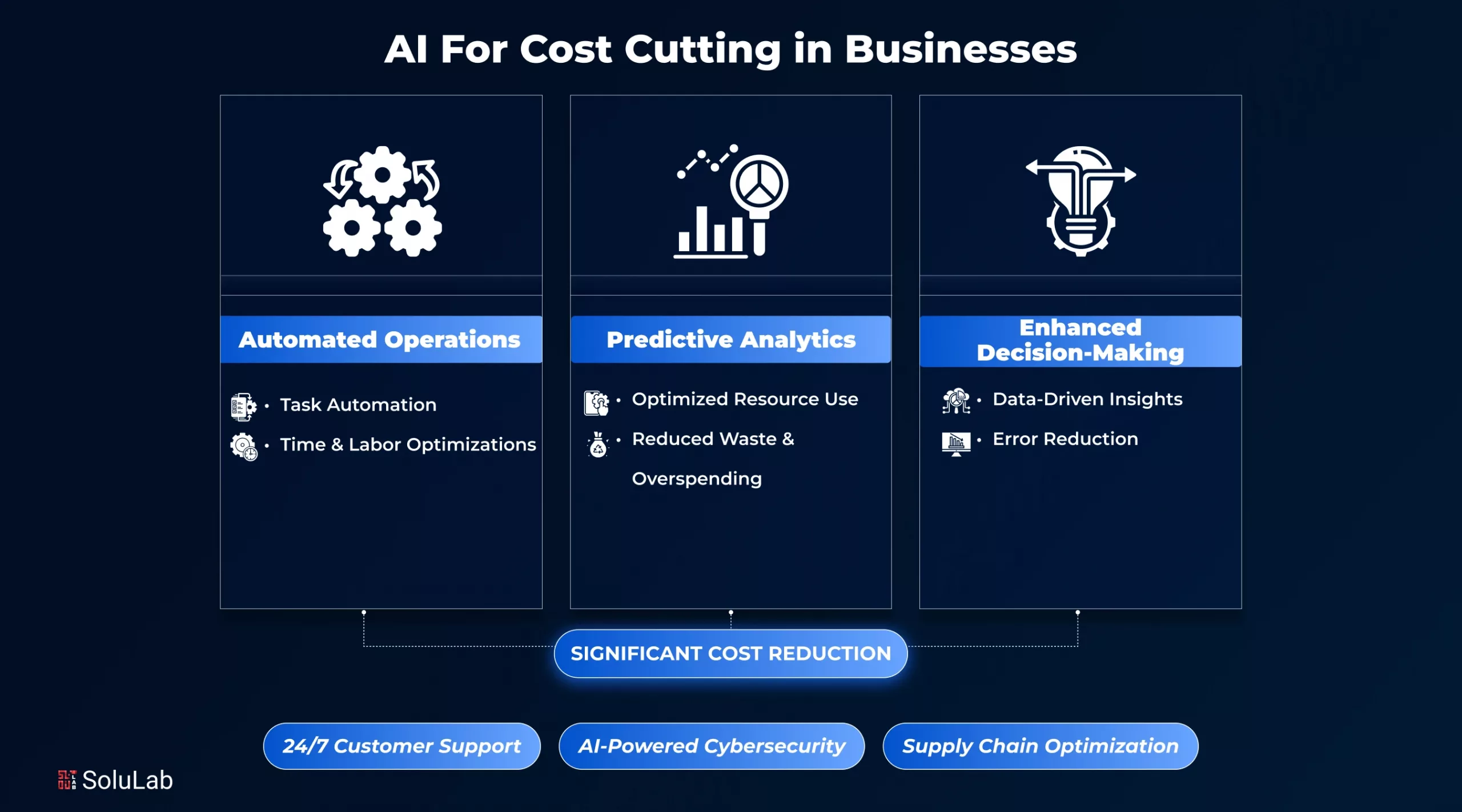
In short, AI cost reduction best practices focus on three things:

1. Automating repetitive work to save labor costs.

2. Predicting issues to avoid downtime and waste.

3. Using real-time data to make smarter financial decisions.

That’s why leading companies now see AI as a strategic investment, not just a technology upgrade.

CTA1

How Much Does It Cost to Implement AI in Your System?

Before expecting results, it’s important to understand the AI implementation cost. Prices can vary a lot depending on the size, complexity, and goals of your project.

  • Simple AI tools or APIs (like chatbots or analytics add-ons): $2,000 to $40,000
  • Custom enterprise AI systems (built for your business needs): $25,000 to $500,000+
  • Hybrid models (mix of both): ideal for most mid-sized companies looking for balance

Your industry also affects the cost. For example:

  • Healthcare and finance projects cost more due to strict data regulations and privacy requirements.
  • Retail, customer support, and logistics projects are faster and cheaper to deploy. However, they have large data sets to maintain, so upgrades are needed. 

Other key cost drivers include:

  • Data preparation: Cleaning and labeling data can consume up to 20 to 30% of the total cost.
  • Infrastructure: Cloud AI is flexible, but on-premises might be needed for compliance.
  • Talent: Hiring AI engineers or outsourcing impacts budgets heavily.
  • Maintenance: Retraining models and monitoring accuracy require ongoing investment.

Still, when you compare AI cost-benefit analysis, the numbers make sense. Most businesses see ROI of AI automation within 12–18 months, sometimes even faster.

For example, Deloitte found experienced adopters achieve an average 4.3% ROI in the first year, while Microsoft reports $3.70 return for every $1 spent on AI at scale. That’s proof that when planned right, AI pays for itself.

Which Business Areas Gain the Most Cost Savings from AI?
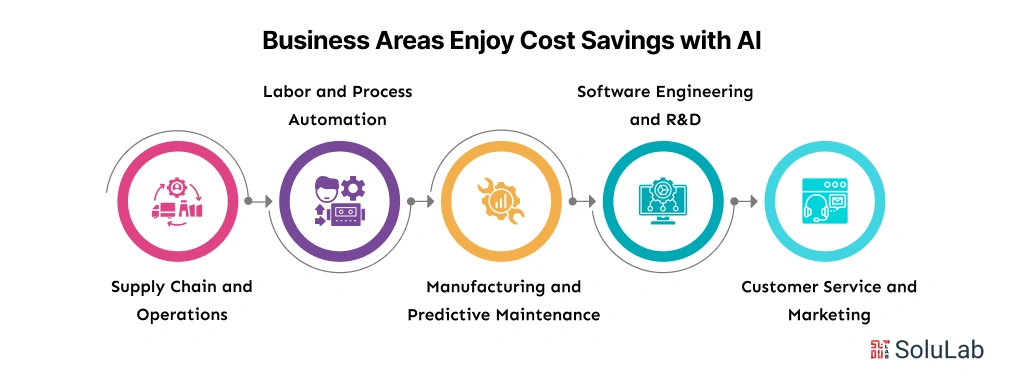
Business Areas Enjoy Cost Savings with AI

AI cost savings go beyond one industry and one department. Its impact is diverse from operations to finance and R&D. Let’s check where AI cost optimization is max. 

1. Supply Chain and Operations

Smart algorithms can reduce inventory waste, predict demand, and plan logistics better.

  • Predictive analytics can save 10-20% in logistics costs.
  • One global e-commerce company used AI to cut supply chain expenses by $500,000 annually.

2. Labor and Process Automation

AI-powered automation helps businesses save on labor by taking care of repetitive work.

For example, virtual assistants handling customer queries can cut support costs by 30–40%, while also improving customer satisfaction.

3. Manufacturing and Predictive Maintenance

AI-driven maintenance detects equipment faults before breakdowns.

  • Predictive maintenance can reduce repair costs by 30-40%.
  • One auto parts manufacturer saved $275,000 yearly using real-time AI monitoring.

4. Software Engineering and R&D

AI tools can write, test, and debug code faster, cutting human errors and development costs. However, human checking is needed, but it can improve the delivery speed and reduce the manpower. 

In R&D, AI scans large data sets to find promising ideas, helping teams bring new products to market up to 40% faster.

5. Customer Service and Marketing

AI chatbots and analytics reduce service center load. For instance, Australian insurer nib Group saved $22 million by automating 4 million customer interactions with AI.

When you add it all up, even a 10% cost drop or 5% revenue boost can create a six-figure impact in enterprise budgets.

Plan a Cost-Effective AI Implementation Service for Your Business
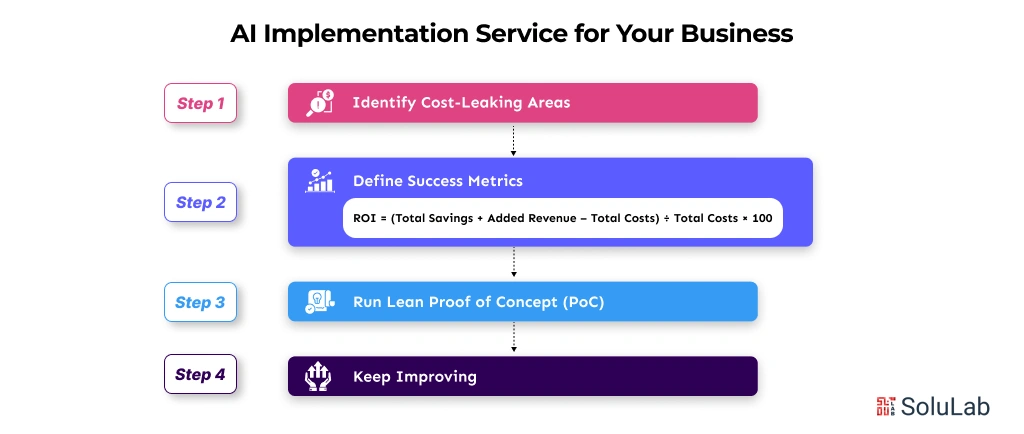
AI Implementation Service for Your Business

AI implementation services require expertise and, data-driven plan. Therefore, you can go for third-party AI development companies that provide maintenance and integrations. For now, let’s check the AI cost-effective implementation.

Step 1: Identify Cost-Leaking Areas

Start with your business audit. Ask: Where do we lose money or time most often? It might be in logistics delays, repetitive admin work, or manual data entry. Focus on areas with measurable KPIs like “cost per transaction” or “time per ticket.”

Step 2: Define Success Metrics

Without numbers, you can’t prove savings. Set clear goals: for example, “reduce support costs by 20%” or “save 1,000 labor hours per month.” This becomes your AI investment planning checklist before development begins.

Step 3: Run a Lean Proof of Concept (PoC)

Start small, one workflow, one use case. For example, automate refund approvals or ticket triaging. Once it delivers results, reuse the same AI components for other tasks. This keeps costs predictable and scalable.

A simple ROI formula to track:

ROI = (Total Savings + Added Revenue – Total Costs) ÷ Total Costs × 100

Example:
A chatbot automates 27,000 interactions in a quarter, saving $4 per case and earning $10,000 in extra sales.

Setup cost: $25,000. ROI = ((108,000 + 10,000 – 25,000) ÷ 25,000) × 100 = 372% ROI in three months.

Step 4: Keep Improving

AI is not a one-time project. Track performance monthly, refine models, and retrain as needed. Set feedback loops with your teams and ensure data quality stays high. This continuous improvement approach ensures sustainable AI cost savings solutions for enterprises.

CTA2

Conclusion 

Now you know how AI reduces costs for your business. There are different plans and strategies to cut your expenses; AI implementation solutions are the top-notch among them. So, if you are looking for AI cost savings solutions, SoluLab is here to offer them. 

SoluLab, a top AI development company, offers our future-ready AI solutions that can boost your business and reduce costs. We have been assisting organizations in using the most recent AI tools and technologies to accomplish exponential growth. 

If you set your goal to implement AI in your system, then contact us today and have a brief call with our consultant. 

FAQs

1. Can AI really think beyond automation and help my business make smarter money decisions?

Yes! AI goes beyond automation by identifying inefficiencies and predicting expenses, helping with AI for business cost optimization that supports smarter, data-driven financial decisions every day.

2. How do I know if AI is worth the investment for my company?

Do a simple AI cost-benefit analysis, compare your automation savings against implementation costs. If results show savings within 12-18 months, your AI investment is absolutely worth it.

3. What’s the best first step for companies new to AI?

Start small with one measurable AI use case. Test automation through AI implementation services or a short Proof of Concept (PoC) to see fast, low-risk cost savings.

4. Why should I choose SoluLab for my AI implementation?

SoluLab combines strategy, technology, and measurable results. Our experts design custom AI solutions that focus on ROI, scalability, and long-term savings for your business.
 

How Much Does It Cost to Build an AI App in 2026?

Cost to Build an AI App

In 2026, artificial intelligence isn’t just a trend, it’s a business necessity. Companies across industries like healthcare, fintech, logistics, and retail are using AI-powered apps to streamline operations, reduce costs, and stay competitive. 

According to Statista, the global AI software market is projected to hit $126 billion this year, while McKinsey notes that organizations adopting AI at scale can boost productivity by up to 40%. 

With this rapid adoption, a growing number of business leaders now ask, “How much does it cost to develop an AI app?”  

This blog gives you clear, actionable insights into every cost factor, whether you’re planning a simple chatbot or a full-scale AI personal assistant app. We’ll break down the real AI app development cost in 2026.

Why Invest in AI App Development in 2026?

AI is a growth factor in 2026; more than 80% of companies are expected to use AI solutions in some form, according to Gartner. From reducing manual work to making faster decisions, businesses are turning to AI implementation services and AI integration services to stay ahead.

But AI apps today are much more than just chatbots. Thanks to generative AI development services and falling AI personal assistant app development costs, companies can now build smart apps that understand language, predict user behavior, and automate operations, all in real-time.

Whether you’re in healthcare, finance, retail, or logistics, investing in AI app development helps your business improve efficiency, boost customer satisfaction, and cut costs.

Key Factors and Features That Affect the Cost of AI App Development

Costing Factors of AI App Development

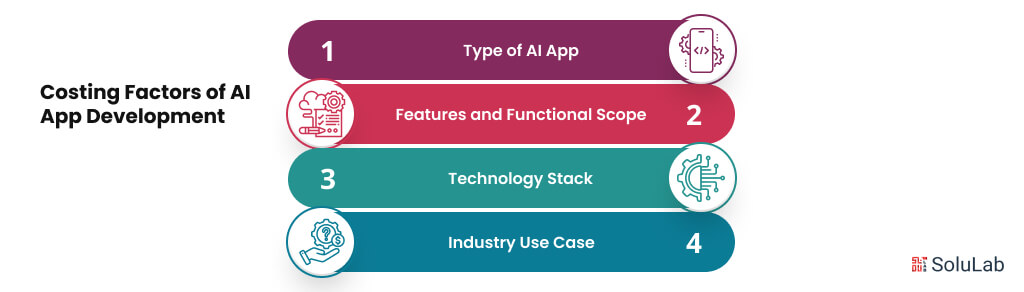
When you’re planning to build an AI-powered app, knowing what drives the cost is essential. As a B2B company, you’re likely focused on performance, compliance, and long-term ROI. Below are the main things that shape the total AI app development cost:

1. Type of AI App

The kind of app you want to build plays a big role in its cost.

  • Basic AI apps (like rule-based systems or recommendation engines) are cheaper and faster to build.
  • Moderate AI apps use advanced tools like Natural Language Processing (NLP) for voice, image recognition, or basic predictions.
  • Advanced AI apps involve adaptive systems, decision automation, or intelligent agents. These often require help from an expert AI agent development company.

2. Features and Functional Scope

The number and complexity of features directly influence your AI app’s cost. Common AI app features include:

  • AI-powered chatbot and virtual agents 
  • Voice or facial recognition
  • Behavioral analysis and user personalization
  • Integration with IoT or even blockchain systems

More features mean more time, testing, and budget.

3. Technology Stack

What tools and platforms you use matters a lot.

  • Using ready-made models (like OpenAI, Google Vertex AI) reduces costs.
  • Building your own models from scratch requires more budget.
  • Running on cloud services like AWS or Google Cloud adds cost unless optimized well.
  • Partnering with an experienced team that offers MLOps consulting services can help manage infrastructure and deployment costs smartly.

4. Industry Use Case

Different industries have different needs, and that affects pricing, too.

  • Sectors like finance and healthcare often need compliance, extra security, and data privacy, which increases the AI development cost.
  • Other sectors like retail, logistics, or education are generally faster to build for.

These factors raise the overall AI development cost but are necessary for safe deployment.

Read Also: How to Create an AI-Powered App like Doppl?

CTA1

AI App Development Cost Breakdown by Category

If you’re planning to build an AI-powered app in 2026, here’s a simple look at how much it might cost based on the type of solution you choose.

Type of AI App Estimated Cost Range (USD) Ideal For
Basic AI App $15,000 – $30,000 Simple apps with limited AI logic
NLP-based Chatbot $25,000 – $50,000 Customer service, lead generation
AI Personal Assistant App $35,000 – $60,000 Virtual assistants for tasks or scheduling
Predictive Analytics App $60,000 – $90,000 Forecasting, demand planning, trend analysis
Custom Generative AI Application $80,000 – $150,000+ Content generation, Gen-AI chat, simulations

These ranges depend on factors like:

  • Project complexity
  • Platform (iOS, Android, Web)
  • Number of third-party integrations
  • Advanced AI app features like Natural Language Processing (NLP), Predictive Analytics, or Generative AI

For enterprises, a high-quality AI application solution isn’t just about features, it’s about scale, security, and future-proofing. Choosing the right AI development company or partner can make a big difference in both cost and performance.

If you’re unsure where to start or how to estimate the cost for your project, it’s best to hire AI developers who specialize in enterprise-grade AI solutions.

AI App Development Lifecycle and Associated Costs

AI App development lifecycle

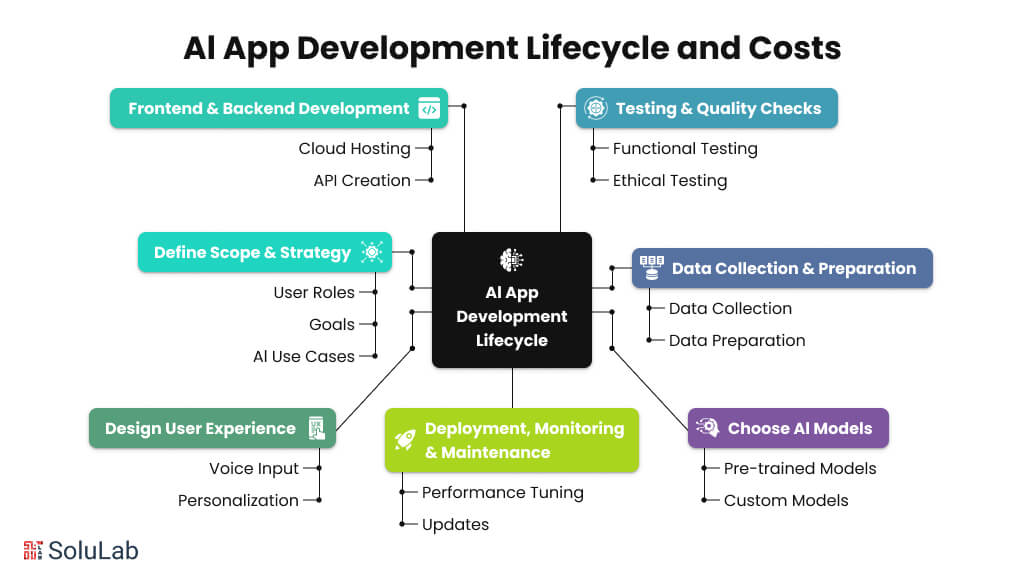
To understand the total AI app development cost clearly, it’s important to break it down step-by-step. Each phase in the development lifecycle impacts your budget and knowing where your money goes helps you plan smarter.

Here’s a breakdown of the key phases:

1. Define Scope & Strategy

Start by identifying user roles, goals, and the core AI use cases and applications. This ensures your app solves a real business problem and avoids unnecessary features.

2. Data Collection & Preparation

The heart of any artificial intelligence app is clean, labeled, structured data. This stage may require help from AI implementation services or in-house teams to collect and prepare the right training data.

3. Choose the Right AI Models

Decide between pre-trained models (like GPT, BERT) or building custom ones. This impacts speed, accuracy, and long-term cost. Custom training raises the AI development cost, but often brings better ROI.

4. Design the User Experience

Great AI apps feel natural to use. UX design focuses on intuitive flows based on how users think, not just how the tech works. At this point, AI app features like voice input, personalization, or recommendations are mapped.

5. Frontend & Backend Development

This is where your mobile app development company or internal team builds the actual app. They’ll connect the AI engine, create APIs, and host the app in a secure cloud environment. You’ll also need to handle security and data compliance. For companies seeking scalability and cost efficiency, nearshore backend development can provide the technical expertise needed to manage integrations, optimize performance, and ensure compliance with data protection standards.

6. Testing & Quality Checks

Apps go through functional and ethical testing to ensure they work and don’t create bias or risk. This helps reduce risks during deployment and can even lower long-term AI mobile app development costs.

7. Deployment, Monitoring & Maintenance

Once live, the app must be monitored, fine-tuned, and updated regularly. AI models learn over time, so performance tuning is ongoing. Many companies choose to partner with a trusted AI development company to handle updates and scale confidently.

At any stage, you can hire AI developers to speed up the process, reduce risk, and ensure high-quality output.

Read Blog: Cost To Build An App In Australia

Strategies to Reduce AI App Development Costs

Are you concerned that the cost of your AI development might exceed your budget? 

You’re not alone. Many businesses face the same challenge. But with the right approach, you can build a powerful AI app without overspending. Here’s how:

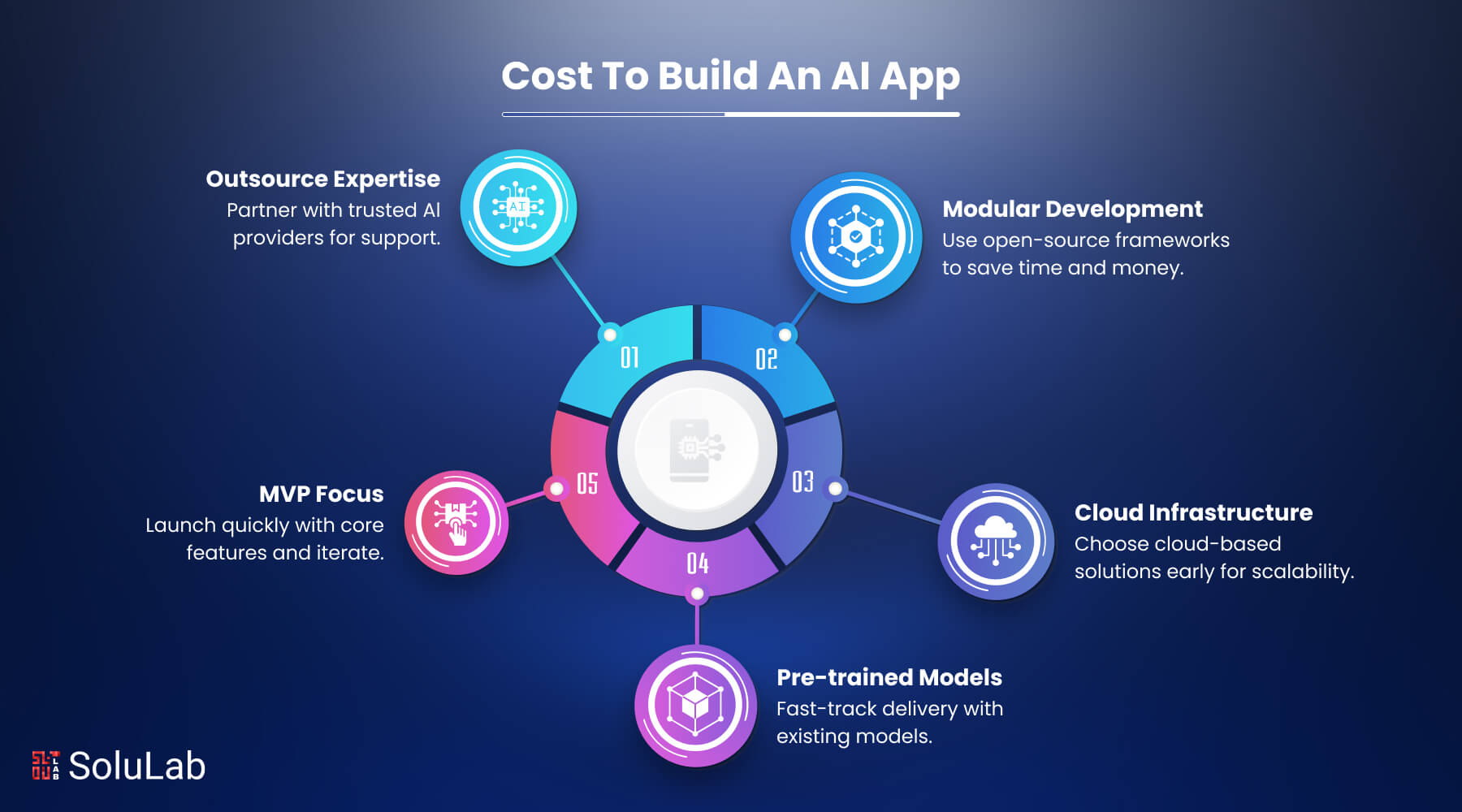
  • Utilize modular development and leverage open-source AI and ML frameworks. It saves both time and money.
  • Pick cloud-based infrastructure early and use MLOps consulting services to automate workflows.
  • Choose pre-trained models to fast-track delivery for most AI use cases and applications.
  • Focus on core MVP features first. Launch fast, then improve over time.
  • Outsource to a trusted AI application solutions provider with proven expertise.

Cutting costs doesn’t mean cutting value. It means making smart, scalable decisions that get your AI app to market faster and more efficiently.

CTA2

Conclusion

By now, you have a clear idea of what affects the AI app development cost. You’ve seen how features, app complexity, and industry use cases all play a role. Whether you’re building a Generative AI-powered chatbot, an AI personal assistant app, or a smart prediction tool, choosing the right mobile app development company is key to your success.

At SoluLab, we specialize in helping enterprises plan and build custom Artificial intelligence apps that are scalable, efficient, and built for real business impact. Our AI integration services are designed to support enterprise-grade apps from start to finish.

Contact us today to discuss your unique business idea, and we’ll power it with AI!

FAQs

1. How much does AI personal assistant app development cost today?

Building a personal assistant AI app like a smart scheduling or voice bot ranges between $50,000 and $150,000. The cost depends on how advanced your assistant is, simple apps are cheaper, but AI agents with NLP and voice capabilities need more development and testing.

2. Why does AI development cost vary so much across industries?

The AI development cost depends heavily on industry-specific use cases. For example, building AI for healthcare or finance often involves strict regulations and complex data, which means more time, security, and cost. In contrast, retail or HR apps may cost less due to simpler workflows.

3. Which Artificial intelligence apps are the most cost-effective to build?

Apps like chatbots, content recommenders, and image classifiers are the most budget-friendly Artificial intelligence apps. These use off-the-shelf models and are faster to build. More advanced tools like fraud detection or diagnostic engines require deeper AI expertise and bigger budgets.

4. How can I hire AI developers and manage the overall AI project cost?

To hire AI developers, work with an experienced AI development company that offers end-to-end support. Hiring a dedicated team ensures your project is scoped correctly, deadlines are met, and you’re not wasting budget on avoidable delays or poor architecture choices.