Talk to an Expert

Why Forward-Thinking CPAs Are Investing in AI-Driven Accounting Tools?

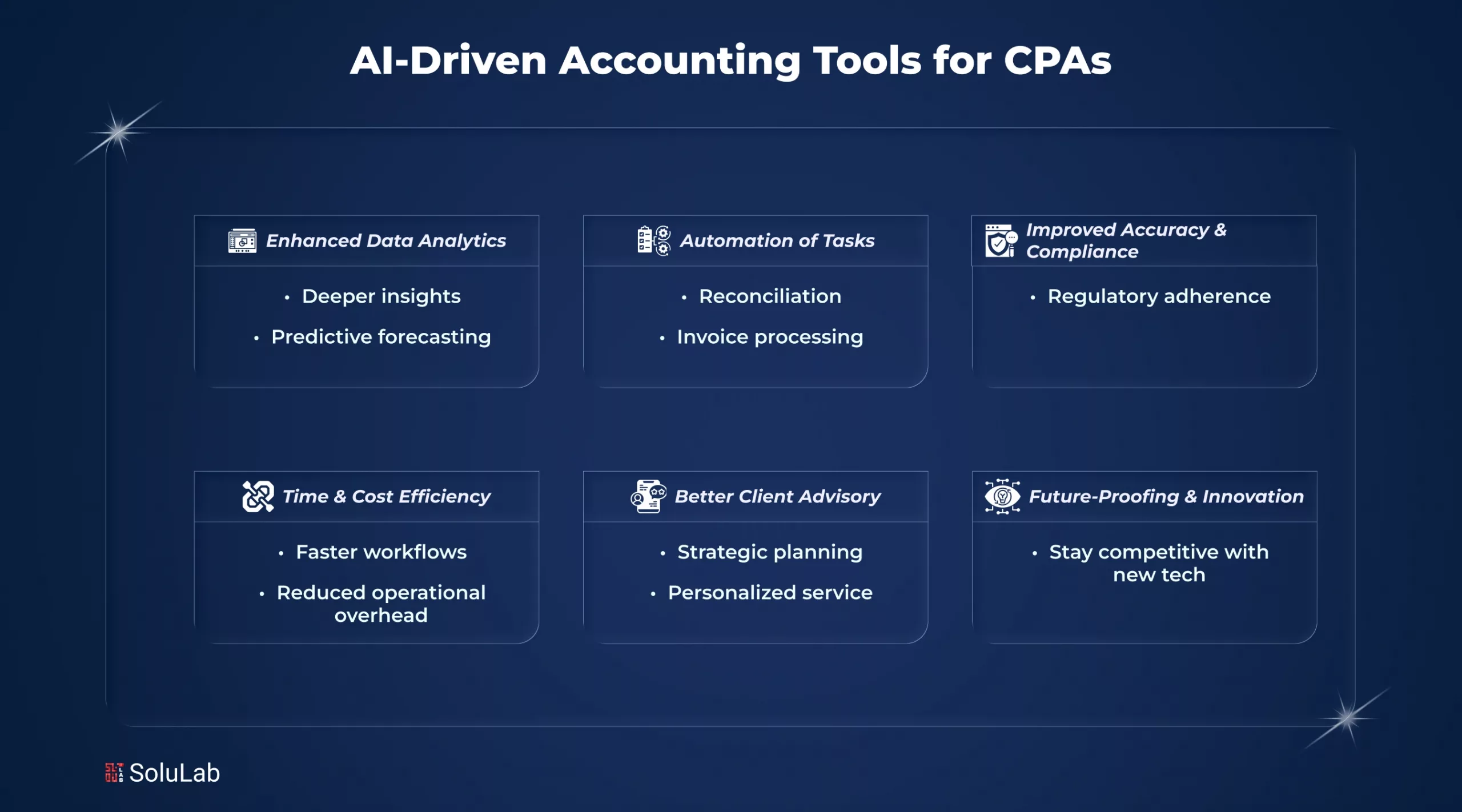
AI-Driven Accounting Tools for CPA

What if accountants could predict financial trends before they happen, automate tedious tasks, and make decisions backed by real-time data? That’s not a distant dream — it’s the reality AI is creating for today’s Certified Public Accountants (CPAs).

In an industry where accuracy, efficiency, and compliance are everything, AI-driven accounting tools are transforming how CPAs work. From automating bookkeeping to offering predictive insights for better financial planning, artificial intelligence is helping accountants move beyond manual data crunching into strategic advisory roles that add real business value.

The market is poised for growth, as the AI accounting market is projected to be worth approximately $6.7B in 2025 and could reach $67B by 2035.

Forward-thinking CPAs aren’t just adopting AI to keep up with technology, they’re using it to gain a competitive edge, reduce costs, and deliver smarter client outcomes. This guide will show why AI for accounting matters, where to start, and how to get results fast without overwhelming your team.

Why AI for CPAs Matters in 2025?

The accounting industry is entering a new phase where AI tools for accounting and AI-powered bookkeeping automation are necessities. Firms that integrate AI tools for accounting firms are seeing measurable ROI in efficiency, accuracy, and advisory value.

1. Efficiency and Scalability

AI automation cuts hours of manual bookkeeping, reconciliation, and tax prep. With AI in accounting and finance, firms handle more clients without expanding headcount, directly improving profit margins.

2. Accuracy and Compliance

AI bookkeeping tools minimize human error and ensure every transaction aligns with tax and audit standards. For CPA firms, this means stronger compliance and lower risk, key in maintaining long-term client trust.

3. Smarter Client Advisory

Beyond automation, AI for CPA firms enables real-time forecasting, expense analysis, and predictive cash flow management. This turns accountants into strategic advisors, not just service providers.

4. Competitive Advantage

Early adopters of AI-powered bookkeeping automation already lead the market. Firms using these tools report higher client retention and faster decision-making, positioning them as forward-thinking financial partners.

So, AI transforms CPA firms from reactive to proactive. It’s not about replacing people, it’s about scaling intelligence, service quality, and revenue potential. But first you need to understand what is right for you. 

Should You Build Custom AI Solution or Buy Off-the-Shelf?

When it comes to using AI for CPAs, you have two paths: use ready-made white label tools or build something custom. If your firm wants quick results, off-the-shelf AI tools for CPAs are usually the best starting point. These tools already handle common work like invoice coding, bank reconciliation, audit prep, and tax notes. They are fast to set up and your team can learn them without stress.

For firms with unique workflows or advanced needs, building a custom layer that integrates accounts payable automation AI helps manage multiple entities and complex reports efficiently.

The key is to keep it simple.

  • One workflow
  • One team
  • One goal
  • One month to test

This gives you a safe trial run where partners can see real results without overwhelming the staff. It also helps your firm learn how to use AI for CPA firms in a steady, confident way..

Top AI Use Cases for CPA Firms That Deliver Quick ROI

If you’re a CPA firm looking to make work faster, smarter, and more profitable, this is where AI in accounting shows real results. These are practical ways to cut costs, save time, and deliver better client service starting this quarter.
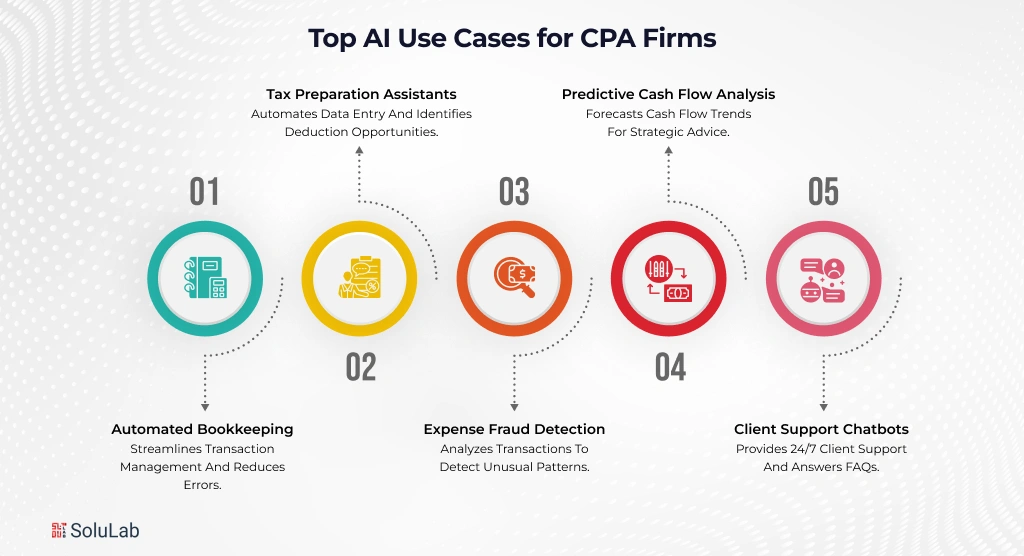
Top AI Use Cases for CPA Firms

1. Automated Bookkeeping

AI bookkeeping tools can now handle most of the repetitive work in bookkeeping like categorizing transactions, matching invoices, and reconciling accounts. This reduces manual errors and saves teams hours every week. For firms that manage multiple clients, automation can directly translate into more billable hours and faster turnaround time.

2. Tax Preparation Assistants

Preparing taxes can be one of the most time-consuming parts of accounting. With AI tax preparation tools, CPAs can automate data entry, detect missing forms, and even check for deduction opportunities. In 2025, top firms report up to 85% of repetitive tax work automated, freeing teams to focus on review and client strategy instead of routine paperwork.

Read Our Blog: Generative AI in the Tax Industry

3. Expense Fraud Detection

AI-powered fraud detection systems analyze transactions in real time, flagging unusual spending patterns or suspicious claims. This helps CPA firms protect clients from compliance issues while building trust. Even a small firm can use this to offer “AI-backed audit checks” as a premium service, a clear competitive edge.

4. Predictive Cash Flow Analysis

Machine learning tools can now predict cash flow trends weeks or even months ahead. For CPA firms, this means giving clients proactive advice like when to delay expenses or secure funding. Predictive insights help you move from being just an accountant to becoming a financial advisor clients rely on for strategic planning.

5. Client Support Chatbots

AI-powered chatbots are changing how firms handle client communication. They can answer FAQs, share document links, and schedule calls 24/7. This improves client satisfaction and saves your team from answering repetitive questions. The best part is that Chatbots can be integrated directly into your firm’s website or client portal within days.

Each of these AI use cases for CPA firms brings immediate returns, lower costs, faster turnaround, and happier clients. Firms that start with even one of these solutions often see ROI within the first 60–90 days.

How to Implement AI Solutions for CPAs?

Most CPA firms hear about AI for CPAs and think it’s complicated or takes months to get working but it doesn’t have to. A simple and proven process to help firms use AI integration for accounting firms in just a few weeks. It’s fast, secure, and designed to give you measurable ROI from day one. 
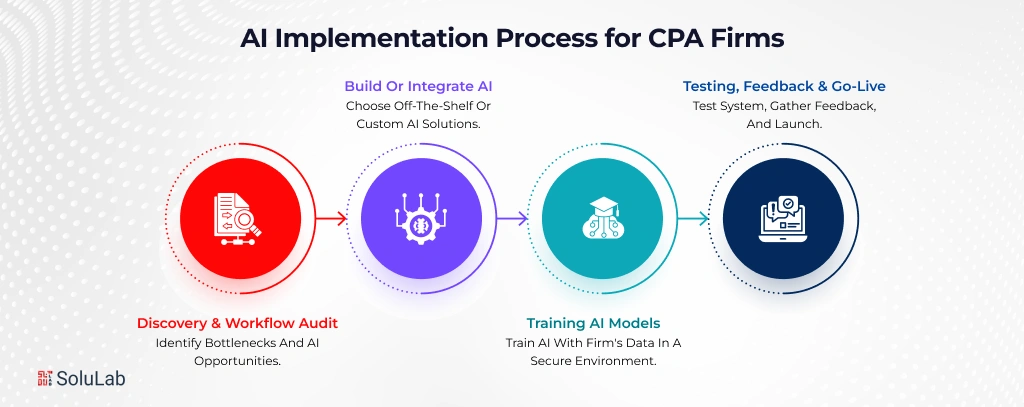
AI Implementation Process for CPA Firms

Step 1: Discovery & Workflow Audit

Every firm has its own way of working. That’s why its good to start with AI strategy consulting for workflow audit and understanding of how your team handles bookkeeping, audits, and tax operations.

Then map out every process and identify where AI applications can deliver quick wins. Common areas include:

  • Repetitive data entry
  • Manual reconciliations
  • Delays in financial reports
  • Tax compliance tracking

Once you know where the bottlenecks are, match each task with the best AI tools for CPAs or plan a custom AI solution if your needs are unique.

Step 2: Build or Integrate AI

Now you have to choose between off-the-shelf AI tools or a custom AI CPA system, whichever fits your goals and budget. Best Off-the-shelf tools work great for quick automations like:

  • Invoice scanning
  • Document sorting
  • Chatbots for client support

Custom-built AI systems are perfect if you want proprietary tools that learn from your client data and workflows. An experienced AI app development company can handle both, building from scratch or connecting existing tools to your systems. 

Step 3: Training the AI Models

Once tools are selected, train your AI in accounting and finance models with your firm’s real data. This is what makes your AI truly intelligent, it learns your processes, tone, and financial logic. Train each CPA AI model to:

  • Understand how your team categorizes transactions
  • Follow your firm’s reporting style
  • Learn from past client data for better predictions

Everything runs in a secure, encrypted environment, so your data is protected end-to-end.

Step 4: Testing, Feedback & Go-Live

Before launch, every system goes through a full testing and feedback cycle with your team. Test accuracy, run real scenarios, and fix edge cases. Once everything is stable, go live and train your team to use the new tools.

AI Security & Compliance to Follow for CPA Firms

When it comes to AI for CPA firms, security isn’t optional, it’s essential. Your clients trust you with their most private financial data. That’s why every AI system should follow strict data protection and compliance standards to keep your firm safe and audit-ready.

Core Security Practices

Don’t take shortcuts safely. Every system must include:

  • End-to-end encryption for all data transfers and storage
  • SOC 2 and ISO 27001 aligned frameworks for full compliance
  • Optional on-premise hosting for large CPA firms that prefer full data control
  • Continuous audit trails and access logs so every action is traceable

Compliance You Can Trust

Meet the highest standards required for AI in finance and accounting, including:

  • IRS Publication 4557 (Data Protection for Tax Professionals)
  • AICPA SOC compliance
  • GDPR for firms with international clients

An expert AI deployment company works as your AI security and compliance partner, making sure every automation layer remains safe, transparent, and aligned with your firm’s regulations. That’s why modern firms hire AI developers for helping them grow with confidence and compliance.

How CPA Firms Are Winning with AI in 2025?

Across the world, top accounting firms are already using AI tools for CPAs to save time, detect errors early, and grab new revenue opportunities. Here are three real stories showing how AI in accounting and finance is transforming the way firms work, win clients, and grow profits, all without increasing staff.

1: Cherry Bekaert LLP – AI Audit Cuts Time by 66%

Challenge:

Cherry Bekaert, a top CPA firm, spent weeks manually testing transactions and spotting fraud. Manual reviews were slow and missed key risks.

Solution:

They used MindBridge AI Auditor, an AI audit tool that checks 100% of transactions and flags unusual activity in real time.

Result:

  • 66% less sampling time
  • 35% faster audits
  • Detected fraud attempts within the first month
  • Full ROI in one year
  • Positioned as an AI leader in accounting

2: Ohio CPA Firm – AI Boosts Revenue 42%

Challenge:

A small Ohio CPA Firm spent 40% of staff time entering invoices manually, leading to slow operations and unhappy clients.

Solution:

They adopted Vic.ai, an AI accounting automation platform that handled invoice processing and approvals. The firm then used the saved time to offer AI-powered advisory services like cash flow forecasting and business insights.

Result:

  • 42% increase in advisory revenue
  • 75% faster invoice processing
  • 90% fewer data entry errors
  • ROI in 9 months
  • Moved from compliance work to strategic business advisory

3: Big Four Firm – Generative AI Saves 89,000 Hours

Challenge:

A big Four accounting firm spent hours preparing client briefs. Thousands of hours were lost to repetitive manual work.

Solution:

They built a custom Generative AI solution using Azure Cognitive Services and Large Language Models (LLMs) to auto-create proposals from data and past projects.

Result:

  • 89,000 staff hours saved yearly
  • Task time cut from 4 hours to under 7 minutes
  • Deployed to 40,000 employees
  • Improved proposal quality and speed
  • Became a model for AI in accounting firms

How Much Does AI for CPAs Cost in 2025?

Many firms think AI is too expensive, but that’s not true. The cost really depends on your firm’s size, the kind of work you do, and how deeply you want to use AI for accounting. Here’s a simple view of what to expect:

AI Solution Type Estimated Cost (USD) Best For
Off-the-Shelf AI Tools $50–$300/month Small firms or solo CPAs who want quick automation.
Custom AI Integration $2,000–$5,000 (one-time setup) Growing firms with 10–50 clients that want to connect AI with their existing software.
Full AI System Build $10,000–$25,000+ Established firms that need a complete AI accounting system across departments.

A CPA firm investing $5,000 in automation saved more than $20,000/year in manual work costs. That’s a full return in just 3 months and pure profit after that. So whether you start small with ready-made tools or go all in with a custom AI solution providers, you’ll see value fast.

cta

Conclusion

It’s no longer a question of if it’s about when and how fast you adopt AI for CPAs. Today, AI in accounting is a real tool that helps firms work smarter, not harder. CPA firms that use AI tools for CPAs are already seeing big improvements.

SoluLab, a renowned AI development company, holds much experience catering to the finance business needs with custom solutions. Backed by top notch technology, our solutions can offer you multiple benefits like:  

  • They complete client work faster.
  • They manage more clients with the same team.
  • They cut down on errors and improve accuracy.
  • They offer high-value advisory services that increase revenue.

It helps automate your daily tasks, boost client satisfaction, and free up your team to focus on strategy instead of data entry.

If you’re a firm owner, it’s the right time to explore AI for CPA firms. Contact us today!

FAQs

1. How do I calculate ROI and time savings from adopting AI tools in my practice?

Track time spent on manual tasks pre- and post-implementation, monitor reduction in errors, and calculate cost savings versus software investment. Most firms report ROI within 6–12 months and see staff hours freed up for billable advisory work.​

2. How do I choose between off-the-shelf and custom AI development for my firm’s needs?

Off-the-shelf solutions work best for standard workflow automation, while custom builds suit unique integrations and proprietary services. Agencies help by mapping requirements, comparing costs, and guiding pilot decisions for best-fit solutions.​

3. How can AI improve client communication, advisory services, and overall value delivery?

AI-powered chatbots, document summarization, and predictive analytics provide clients with faster responses, deeper insights, and more personalized advice, freeing accountants for strategic conversations.​

4. What ongoing support and updates should I expect after deploying AI solutions in my CPA firm?

Regular platform updates, cybersecurity monitoring, vendor-led training, and periodic workflow optimization are essential. At SoluLab, we offer post-launch support, troubleshooting, and best practices for continuous improvement.
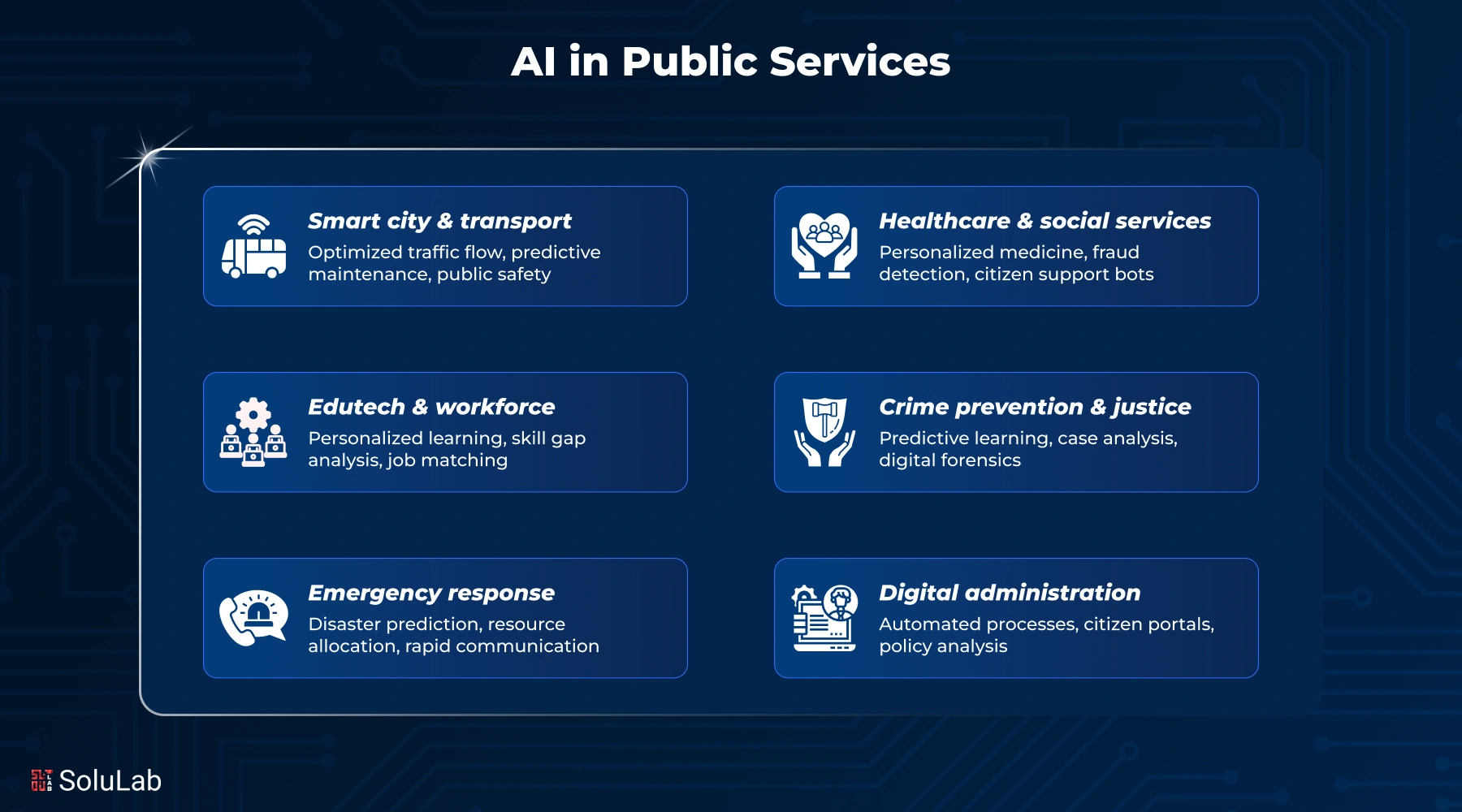
How Governments Are Using AI to Deliver Smarter Public Services?

AI in Public Service

Ever waited weeks for a government service that could have been done in minutes?

AI is changing that!

Governments around the world are now using Artificial Intelligence to deliver faster, smarter, and more personalized public services. AI is helping public institutions work efficiently while improving transparency and satisfaction. 

In 2025, the United Nations reported that over 60% of governments were adopting AI in various sectors, including healthcare, public safety, and taxation. The recent AI-related breakthroughs mark the beginning of a new industrial revolution. Therefore, governments are also focusing on sustainable AI adoption in the public sector. Let’s get into the details on AI in governance and public services!

Why Do Government and Public Services Need AI Solutions?

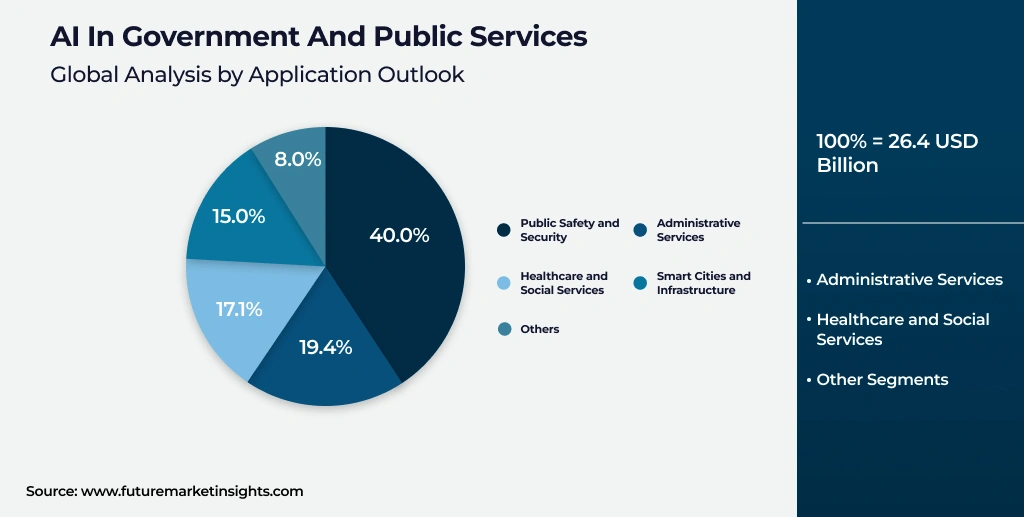
Governments handle large volumes of data and complex processes daily. Manual systems often slow service delivery and increase costs. AI in public sector services addresses these challenges by automating tasks, detecting fraud, and improving decision-making. It ensures transparency and reduces errors while enabling faster citizen support. The need for advanced AI solutions grows as populations demand efficiency and accountability from their leaders.

AI In Government And Public Services graph

Role of AI in Public Services

AI in public services often works silently in the background. Tax authorities use digital integration services for fraud detection and compliance checks. Municipalities rely on modern tools in local government to manage traffic flow with smart sensors. 

Public health agencies use predictive analytics to track outbreaks. Many citizens interact with such systems daily without realizing it.

Types of AI Used in Public Services To Serve People

Different AI models and solutions support governance, each serving a unique role in improving services. Some important ones are:

  • Machine Learning Models

Governments deploy Machine Learning models to study tax filings, detect unusual financial patterns, and identify possible fraud cases early. This AI-powered solution strengthens revenue systems, reduces tax evasion, and promotes fairness in financial governance.

  • Natural Language Processing

Natural Language Processing powers intelligent AI chatbots that respond to citizen queries, register complaints, and guide people on healthcare, pensions, or welfare benefits. These tools ensure faster resolutions, reduce waiting times, and create more inclusive citizen service experiences.

  • Computer Vision

Public safety departments leverage computer vision for facial recognition and video analytics to monitor crowded areas. This AI technology helps authorities prevent crime, manage emergencies, and improve urban safety without relying solely on traditional manual surveillance.

  • Robotic Process Automation

RPA automates routine tasks such as license renewals, application reviews, or form processing. By eliminating repetitive work, government staff can focus on policy-making and strategic initiatives. Along with direct citizen engagement, leading to faster and more efficient services.

  • Generative Tools in Public Service

Generative AI platforms assist officials by drafting policy notes, reports, or communication documents. This reduces manual paperwork, supports knowledge-sharing across departments, and gives officers more time to focus on decision-making and citizen-centric projects.

Each use case in government demonstrates how technology streamlines services and supports citizens.

Benefits of AI in Government and Public Sector

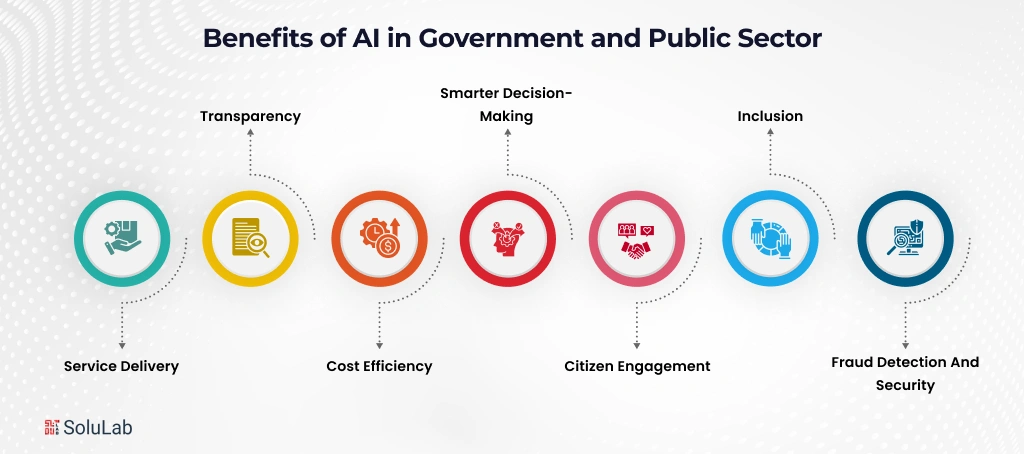
AI in government and public sector operations provides multiple benefits. It improves accuracy, reduces administrative costs, and enables faster decision-making. It also strengthens transparency and enhances citizen trust in governance.

Benefits of AI in Government and Public Sector

1. Service Delivery: AI chatbots reduce waiting time and improve efficiency. AI solutions streamline delivery for large citizen volumes.

2. Transparency: Open data portals reduce corruption in governance. Real-time information builds citizen trust in services.

3. Cost Efficiency: RPA cuts costs by automating repetitive tasks. Faster processing frees resources for key projects.

4. Smarter Decision-Making: Predictive analytics forecast healthcare and resource needs. Data-driven insights improve planning and crisis control.

5. Citizen Engagement: Mobile apps improve communication with state authorities. Feedback systems ensure policies reflect citizen needs.

6. Inclusion: Remote e-learning provides rural populations with equal access. Generative AI creates content for diverse communities.

7. Fraud Detection and Security: AI detects fraud in taxation and compliance. Computer vision strengthens public safety monitoring.

Global Examples of AI in Public Services

Countries worldwide are adopting digital solutions and AI to modernize governance. In September 2025, Albania made shocking headlines. The country took AI to the next level. They appointed the world’s first AI-generated minister for anti-corruption

Albania’s Prime Minister Edi Rama announced AI as the digital minister. This digital assistant is named “Diella” (Sun). This varied adoption reflects both local priorities and the benefits of technology in government services.

Here are some more examples that highlight the global momentum toward AI-powered governance.

How are Countries Adopting AI in Governance?

Countries are adopting modern AI tools in government and public sector services at different speeds, depending on readiness.

1. United States: The Social Security Administration uses technology to speed up claims processing. Federal agencies integrate systems for fraud detection and defense intelligence, supported by partnerships with development companies.

2. United Kingdom: Local councils implement digital traffic systems, reducing congestion and improving air quality. Public services rely on AI integration services to modernize healthcare and law enforcement.

3. China: Smart city projects use digital solutions to reduce traffic jams, monitor pollution, and improve urban planning. This creates more sustainable and livable cities for citizens.

4. Singapore: AI for healthcare services predicts hospital admission surges, helping authorities allocate resources effectively and ensuring patients receive timely, quality medical care when demand suddenly rises.

5. India: Municipal corporations deploy technology to manage waste collection routes efficiently. AI-powered app development collaborations with the government create agriculture advisory systems for farmers.

6. Estonia: Leads in digital governance, using advanced platforms for e-governance, secure judicial processes, and efficient public services, making government interactions faster, transparent, and citizen-friendly.

7. United Arab Emirates: AI for public services in Dubai, UAE utilizes chatbots, AI assistants, and digital platforms focused on citizen happiness, offering smoother, quicker, and more personalized government interactions daily.

8. Australia: Australia applies AI for disaster management, predictive healthcare, and smart transport systems, ensuring better preparedness, improved safety, and responsive governance for communities.

Not just these, each country adopts other strategies and implements them in their government to make things simple for people. Therefore, AI in public services is not just any myth; now it’s happening.

Ethical and Responsible Use of AI in Public Services

Digital governance cannot succeed without accountability and fairness. Decisions made through algorithms must remain unbiased, especially in welfare distribution, policing, or justice.

Key principles for implementing technology in the public sector include:

  • Data Privacy: Strong safeguards to protect citizen information.
  • Transparency: Clear communication about how digital government solutions make decisions.
  • Independent Audits: Regular checks to ensure compliance and fairness.
  • Explainable Models: Systems that allow officials and citizens to understand outcomes.
  • Human Oversight: Critical checks to avoid over-reliance on machines.

Trust in digital operations will grow only if these principles remain central. Responsible adoption ensures the benefits of modern governance are delivered fairly.

The Latest on AI in Governance and Public Services

Public services are entering a new phase where innovation meets scale. Governments are now investing in future-ready applications.

Emerging trends include:

1. Generative Tools in Public Service: Automating legal drafts, policy notes, and education materials to reduce administrative load.

2. Virtual Assistants: ChatGPT development solutions that enable personalized citizen interactions through chatbots and voice-based platforms.

3. Predictive Analytics: Early warnings for health crises, natural disasters, or economic risks.

4. Cross-Department Integration: A professional AI consulting company can help scale integration services across multiple ministries by exploring newer use cases.

5. AI-Powered Contract Management: Solutions like CRM for government contractors from Creatio use Generative, Predictive, and Agentic AI to automate RFP preparation, assess win probability, and forecast revenue, helping agencies and contractors streamline operations and make data-driven decisions.

According to McKinsey, efficiency gains from digital public services may save up to $1 trillion globally within five years. This highlights the growing role of modern government solutions in shaping the future of governance.

AI Development Company

Conclusion

From the above discussion, you might have understood the role of AI in public services and governance. No matter how AI has already become part of day-to-day life, using it ethically for people’s purposes is an ideal way. Platforms like InfuseNet highlight how businesses and governments can seamlessly integrate data, enhance decision-making, and drive secure, transparent growth.

If you are also looking to build AI models or want to integrate, SoluLab is here to assist you. We, at SoluLab, a top AI development company, build scalable, secure, and transparent solutions. From chatbots to high-level ML models, our expert team is here to help you. 

Contact us today to learn about AI integration and solutions that can bring your idea to life! 

FAQs

1. How does AI improve public services? 

Tools like AI in public services help automate routine work, spot fraud, and predict problems. Services become faster, cheaper, and more accurate. Staff can focus on complex cases while citizens get quicker, clearer responses.

2. What are the main risks of using AI in government? 

Key risks include biased decisions, weak data privacy, and over-reliance on automated systems. Poor audits can cause unfair outcomes. Strong safeguards, clear rules, and human oversight lower those risks and protect public trust.

3. Which countries lead in using AI for public services? 

Many countries use smart government tools. The United States, the United Kingdom, the UAE, Singapore, Estonia, China, and India show wide adoption. Each country focuses on local needs, from health to traffic and e-governance experiments.

4. How can SoluLab help a government adopt AI?

SoluLab builds secure, scalable, and transparent smart systems for governments. Services include chatbots, predictive models, and system integration. The team helps plan, test, and launch tools while keeping ethics and data privacy central.

5. How can citizens check if a government decision used AI? 

Citizens can ask for plain explanations, request audit reports, and check open data portals. Look for transparency statements and contact ombudsmen if needed. Clear public info and oversight make systems fair and understandable.

How AI Development Is Shaping the Future of Dubai’s Public Services?

AI in Dubai’s Public Sector

In recent years, Dubai has initiated strategic partnerships with tech giants and built new institutions to integrate AI in government and public sector operations to improve public services, governance, regulation, and planning.

By integrating AI across multiple sectors—healthcare, transportation, cybersecurity, education, and more. Dubai aims to become a global leader in AI by 2031. 

According to ESG News, AI is projected to add an impressive AED 335 billion (USD 91.28 billion) to the UAE’s economy by 2031, further highlighting its transformative power.

In this blog, we’ll explore Dubai’s AI journey, the strategic partnerships behind it, and how these advancements are changing the future of governance, business, and everyday life.

Overview of AI in Dubai

Dubai has positioned itself as a global leader in artificial intelligence (AI) adoption, aiming to become the world’s smartest city. With the launch of the AI in UAE Strategy 2031, Dubai integrates AI across public services, from transportation and healthcare to governance and security. 

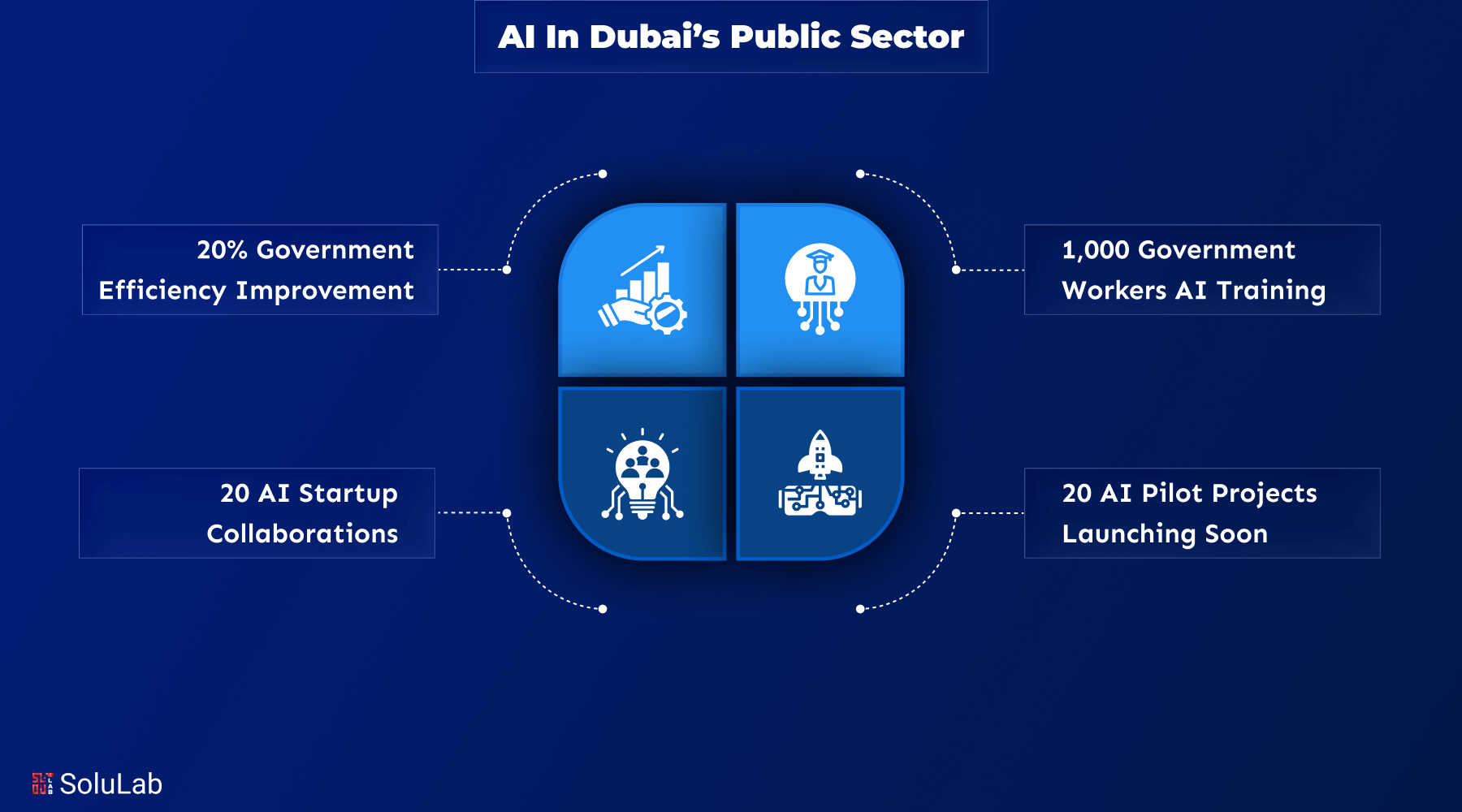
Dubai’s AI integration includes:

  • AI training for 1,000 government workers
  • 20 AI pilot projects that will be launched soon
  • Collaboration with 20 startups that specialize in AI
  • Increasing government efficiency by 20%

To achieve these objectives, Digital Dubai is collaborating closely with regional and international partners. Projects like the AI Lab, which is a joint venture with IBM, offer a testing ground for real-world smart governance applications.

CTA1

What Strategic Partnerships with Global Tech Giants are Being Formed?

Here are some Dubai AI transformation initiatives with global tech giants:

  • Silver Lake’s Investment in G42: Silver Lake invested about US$800 million in G42, enhancing the UAE’s AI-cloud and enabling G42 to scale AI infrastructure, cloud services, and the public sector.
  • Microsoft and G42 Partnership: Microsoft invested US$1.5 billion in G42, forming a collaboration to deploy over 200 AI-driven solutions across Abu Dhabi’s government services, automate all government processes, and build cloud infrastructure.
  • MGX AI Infrastructure: MGX, a UAE-based AI investment firm, co-invested with Silver Lake (and others) to acquire Altera (chip company), strengthen data centre infrastructure (like Khazna Data Centers), and build AI infrastructure foundations.
  • Space42 Initiative: Space42 (merger of Bayanat + Yahsat) has launched geospatial & Earth Observation (EO) partnerships (e.g., with EDGE’s FADA) to develop EO capabilities. Also, Map Africa MoU with Microsoft & Esri to improve mapping and public service planning.
  • IHC’s AI-Powered Governance: To improve governance, risk insights, and strategic decision-making entirely within the United Arab Emirates, IHC launched “Aiden Insight 2.0,” an on-premise AI Board Observer.  It was also introduced “SAIF,” an AI marketplace for developers worldwide.  

Key Benefits of AI Integration in Dubai’s Public Services

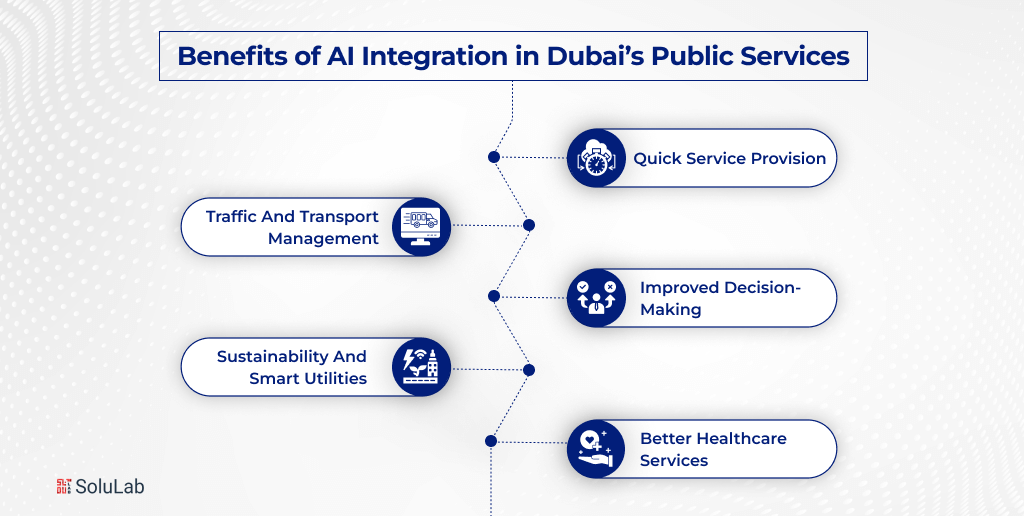
Benefits of AI Integration in Dubai’s Public Services

Dubai is moving towards smarter, faster, and more citizen-friendly governance through the use of AI in public services. Here are the key benefits:

  • Quick Service Provision: Using AI-based chatbots, virtual assistants, and robotic systems decreases the waiting time in government offices. Whether it is renewing licenses or paying bills, the residents can do things on the spot, which saves they time and energy.
  • Improved Decision-Making: AI can assist the authorities in forecasting future demands and issues due to a large-scale examination of data. This will enable better policymaking, allocation of resources, and better long-term planning of the growth of Dubai.
  • Better Healthcare Services: AI contributes to quicker illnesses, individualized care, and predictive health services. Hospitals also apply AI to care for patients remotely, decreasing hospital visits and maintaining timely care, and improving the overall health of the population.
  • Traffic and Transport Management: AI can be used to monitor traffic movement, minimize traffic congestion, and enhance the efficiency of public transport. Intelligent cameras and predictive intelligence assistance are used to control accidents and leave the Dubai roads much safer and easier for commuters.
  • Sustainability and Smart Utilities: AI is used to optimize the consumption of electricity and water based on the demand patterns. It helps Dubai bring in the vision of moving towards eco-friendliness by minimizing waste, boosting energy efficiency, and encouraging eco-friendly living around the city.

Top 7 AI Use Cases in Dubai’s Public Services

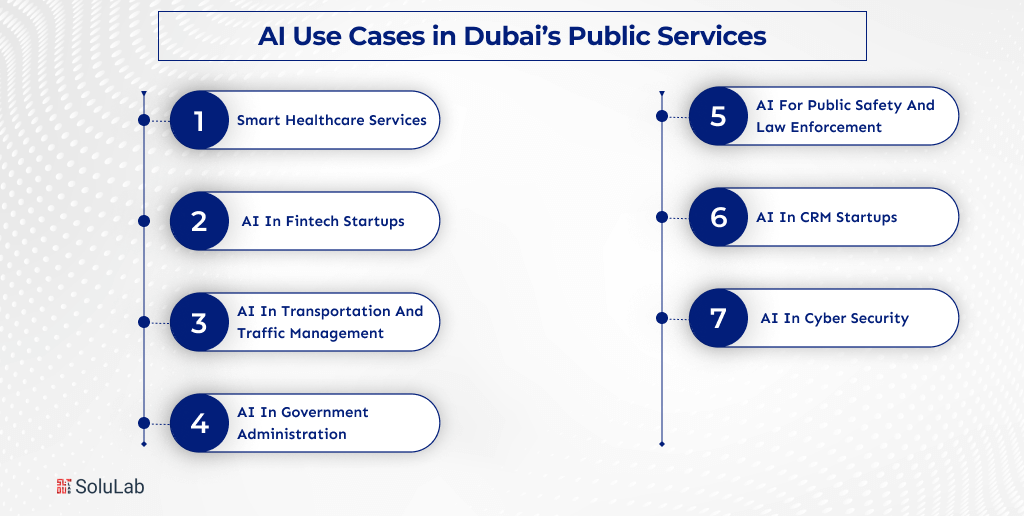
AI Use Cases in Dubai’s Public Services

Dubai is using artificial intelligence across industries to build smarter, faster, and more efficient services. From healthcare to traffic management, here are some use cases in government and the public sector:

1. Smart Healthcare Services

AI is transforming Dubai’s healthcare sector with predictive diagnostics, virtual consultations, and smart hospital systems. These reduce patient wait times, improve diagnosis accuracy, and enable personalized treatment plans, ensuring citizens receive world-class healthcare with maximum efficiency.

2. AI in Fintech Startups

Dubai’s fintech startups leverage AI for fraud detection, credit scoring, and personalized financial planning. With AI-powered algorithms, financial institutions can process huge datasets securely and make smarter decisions, enhancing customer trust while boosting financial inclusion.

3. AI in Transportation and Traffic Management

AI is optimizing Dubai’s transport network with real-time traffic monitoring, smart parking solutions, and predictive route planning. These systems reduce congestion, enhance commuter safety, and ensure smoother traffic flow, supporting the city’s vision of becoming a global smart mobility hub.

4. AI in Government Administration

Dubai uses AI chatbots, predictive analytics, and automated systems for administrative tasks. From faster service delivery to better policy-making, AI helps reduce bureaucratic delays, ensuring citizens experience more transparent, efficient, and responsive governance.

5. AI for Public Safety and Law Enforcement

AI-powered surveillance, predictive policing, and facial recognition tools are strengthening public safety in Dubai. These technologies help law enforcement monitor threats, prevent crimes, and ensure faster response times, creating a safer and more secure city environment.

6. AI in CRM Startups

AI-driven CRM startups in Dubai are enabling businesses to offer hyper-personalized customer experiences. Through predictive analytics and chatbots, companies can anticipate client needs, automate interactions, and build stronger relationships, helping brands stay ahead in competitive markets.

7. AI in Cyber Security

With rising digital threats, AI is vital for detecting cyberattacks, analyzing anomalies, and securing sensitive data. Dubai integrates AI in cybersecurity systems to proactively defend critical infrastructure, protecting citizens and businesses from potential breaches.

Read Also: How Founders and Businesses Can Leverage Digital Asset Treasury in UAE?

Future of Artificial Intelligence in Dubai

Dubai has the Universal Blueprint for Artificial Intelligence, targeting an AED 100 billion per year contribution to its economy. Dubai’s Roads & Transport Authority has launched its AI Strategy 2030. It includes 81 projects & initiatives across mobility, licensing, traffic, etc., showing how integral AI will be in service delivery.

More training programmes for government officials & civil servants, AI labs in universities, incubators, and incentives for research. This ensures that AI-in-government doesn’t rely only on external vendors but builds capacity internal to the public sector.

Expect growth in AI applications in public health (disease prediction, early warning systems), occupational health & safety (monitoring, prevention), environmental monitoring (air quality, emissions), disaster response, etc.

CTA2

Conclusion

Dubai is establishing a global standard in government and the public sector by developing partnerships across the world. The AI is improving efficiency, transparency, and citizen experience in healthcare and mobility, as well as governance and infrastructure.

Digital Quest, a travel business, partnered with SoluLab to develop an AI-powered chatbot using Generative AI. The chatbot enhanced customer engagement by offering real-time, personalized travel recommendations and hassle-free reservations. It also integrated user feedback and multi-language support, resulting in improved user experience and high ROI.

SoluLab, an AI development company, can help Dubai’s startups integrate AI. Whatever your industry is, we can help you add systems and reduce manual work. Get in touch with us today!

FAQs

1. What is the role of AI in the work of public services?

With AI development companies in the UAE, AI in public services enables automation, predictive analysis, and chatbots, as well as intelligent planning to enhance efficiency, cost reduction, and citizen experiences in the Dubai government.

2. What role does AI play in supporting the sustainability of the Dubai environment?

AI tracks the air quality, anticipates energy requirements, and controls water consumption and resources, enabling Dubai to align public services with the principles of sustainability.

3. Will AI take over human jobs in Dubai in the public sector?

Repetitive work will be automated by AI, but the main benefit will be to augment human work and allow employees to concentrate on strategic, creative, and citizen-centered work.

4. What is the role of AI in enhancing the smart city program in Dubai?

It is the AI that drives the IoT networks, AI-powered digital twins, and analytics to make Dubai’s infrastructure, energy, water, transport, and infrastructure operations more sustainable, considering the smart city vision of the city.