Attackers got faster. Defenders had to answer, and the answer turned out to be machines that learn. There is a lot to gain from putting artificial intelligence (AI) in cybersecurity workflows. It lets you build intelligent agents, some of them software, some of them sitting in hardware, that watch, learn, and then make a judgment call on a specific security problem without waiting for instructions. They pick out weak spots buried in messy code. They notice when a login pattern stops looking like the person it belongs to. And they catch strains of malicious software that a conventional tool would wave straight through.
The agents chew through enormous piles of data looking for patterns. What they learn feeds back into the defensive stack, which then judges whatever arrives next, including traffic nobody has ever catalogued before.
This is no longer a side experiment. Plenty of businesses now treat AI as load-bearing in the security plan rather than a nice extra bolted on at the end.
Why Does AI Matter For Cybersecurity?
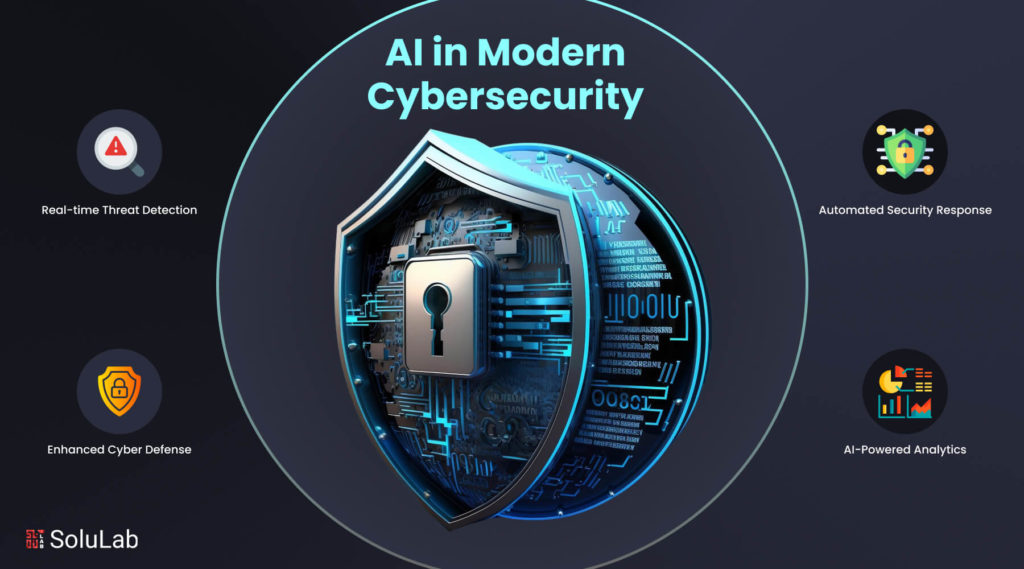
Four things explain the pull: sharper threat detection, responses that fire without a human clicking anything, a defense that reshapes itself as attacks change, and the sheer capacity to read data at a volume no analyst team can match. Al in Modern Cybersecurity tactics stop being optional the moment threats start mutating faster than your playbook gets updated. Strong defenses now depend on it.
Advanced Threat Detection
Detection gets more precise. Machine learning models read datasets that would take a human team weeks, then surface the odd shape inside them: a trend, an outlier, something that smells wrong. Because the work runs continuously instead of reactively, fresh risks show up early. Even the complicated, quiet attacks that nobody has named yet.
Behavioral Analytics
AI in Cybersecurity earns its keep in behavioral analytics, where the subject is not a file but a habit: how the network usually moves, how one user usually works. AI security systems learn that baseline first, then treat any drift away from it as a signal worth reading. That is how zero-day activity and the quiet insider get caught, because neither one trips a rule that somebody wrote in advance.
Automated Reaction to Events
Response is where the clock matters. A system that has learned from every prior incident can act on a new one in seconds, adjusting as fresh detail lands. Containment happens sooner. The window between breach and fix shrinks, and so does the damage that fits inside it.
Modular Security Protocols
Threats move. Your defenses have to move with them, and artificial intelligence (AI) is what makes that possible: models retrain, thresholds shift, rules get rewritten without anyone filing a ticket first. That ability to bend is what keeps strong Al for Cybersecurity protections standing after the first surprise.
Extensive Data Interpretation
Security work generates an absurd amount of exhaust. Network traffic, user activity, logs from systems half the company forgot were running. AI can hold all of it at once and read across it, which is the only way a pattern spread over three separate sources becomes visible at all. In connected, data-heavy workplaces, that capacity is table stakes rather than an upgrade.
Cut Down on False Positives
Ask an analyst what actually wears them down and the answer is the noise. Conventional tools fire on everything, the queue fills with nonsense, and somewhere in that nonsense sits a real intrusion nobody opens. Alert fatigue is a security vulnerability with a friendly name. AI shrinks the pile by reading context and learning what normal looks like here, in this environment, for this person, so a real danger and a false alarm stop looking identical.
Related: Evolution of AI in Cybersecurity
Constant Observation and Flexible Education
Monitoring runs without pause, and what it sees comes back in real time instead of in a Monday morning report. The systems revise themselves too: what counted as normal behavior last quarter gets rewritten as the environment shifts and as the model watches what people are really doing.
Is Cybersecurity Automation Safe?
Yes, with conditions. Automation in security carries the same shape of risk as any other powerful tool, and it works best when it is not left alone in the room. The gains are real. So is the need for a person who can overrule the machine. A defense that holds against the full spread of cyber threats comes from automated tooling and experienced practitioners working the same problem, not from either one running solo.
1. Quickness and Effectiveness
Speed is the obvious win. An automated system reads the data, spots the threat, and responds while a human analyst is still loading the first dashboard. Given how quickly attack techniques turn over, that gap decides the outcome more often than the tooling budget does.
2. Cut Down on Human Error
People get tired at 3 a.m. Automated systems do not. They follow the security procedure the same way on the hundredth run as on the first, which removes an entire class of small slips that quietly turn into openings.
3. 24×7 Observation And Reaction
Automated tools watch networks and systems around the clock, which turns monitoring from an after-the-fact investigation into a standing guard. Try keeping that up by hand across a sprawling, half-documented IT estate. The coverage gaps write themselves.
4. The Ability To Scale
Automation scales in a way headcount cannot. More data, more security jobs running at once, same system underneath. For enterprises carrying intricate infrastructure and heavy network traffic, that property matters more than any single detection feature.
5. Typical and Repeated Tasks
Hand the boring work to the machine. Triage, log sorting, the same lookup for the fiftieth time this week. Your security people then spend their hours on the intricate, strategic problems they were actually hired for, and they tend to be happier for it.
That said, a few things deserve a hard look:
6. Inaccurate Positive Results
Lean on automation too hard and the false positives multiply. Legitimate activity gets tagged as a possible threat, the queue swells, and alert fatigue sets in. Then the real danger arrives and lands in a list nobody trusts anymore.
7. Intelligent Opponents
Attackers are studying the same tools you bought. Some of them build assaults shaped specifically to slide past automated detection. Catching a sophisticated, focused campaign still comes down to a person who looks at the evidence and decides it does not add up.
8. Legal and Ethical Issues to Consider
Then there is the question of who answers for the machine. Automating security procedures raises legal and ethical problems the moment a system starts deciding things on its own. How much autonomy is appropriate, and where accountability lands when the call is wrong, remains an unsettled argument in this field.
Read Also: Agentic AI in Cybersecurity
How Can Artificial Intelligence Help Cybersecurity Professionals?
Security experts gain three concrete things from artificial intelligence (AI) in cybersecurity: recognition of data patterns too complicated to eyeball, guidance specific enough to act on, and problem-solving that runs without a handler. Decisions come easier. Incident response tightens up. Possible threats surface while they are still small enough to be boring.
Three mechanisms do most of that work:
1. Pattern Recognition
AI sorts and labels patterns in data that a person would struggle to hold in their head at all. Laid out that way, those patterns become something a security expert can actually interrogate.
2. Practical Suggestions
From those patterns, intelligent computer programs, also called intelligent agents, propose moves. Not abstractions. Steps somebody can take, which removes the worst part of any alert: staring at it and wondering what to do next.
3. Independent Mitigation
Some of these algorithms close the issue themselves, with no security expert in the loop at all.
None of this is a replacement pitch. The point is to make an already proficient team and a well-equipped facility harder to get past, by adding hands where there were none. Start with the first job in any defense: find the holes before an attacker finds them for you. AI raises the accuracy of source code scanning, which means fewer misses, and engineers catch security problems while the code is still theirs to fix rather than after it ships.
Danger response benefits too. Intelligent systems hand the security team the specifics and the threat intelligence sitting behind an alert instead of handing over the alert alone. With that context in front of them, people move faster and waste less of the incident arguing about what they are even looking at.
Al in Modern Cybersecurity changes the shape of how a business safeguards its systems and its data, and the distance from conventional technique is not subtle. Analysts get better at naming the problem. Risks get handled before they mature into serious incidents. Intelligent automation keeps the team a step ahead of attackers whose methods refuse to sit still, which is the whole argument for Al for Cybersecurity.
What Are The Benefits Of AI For Cybersecurity?
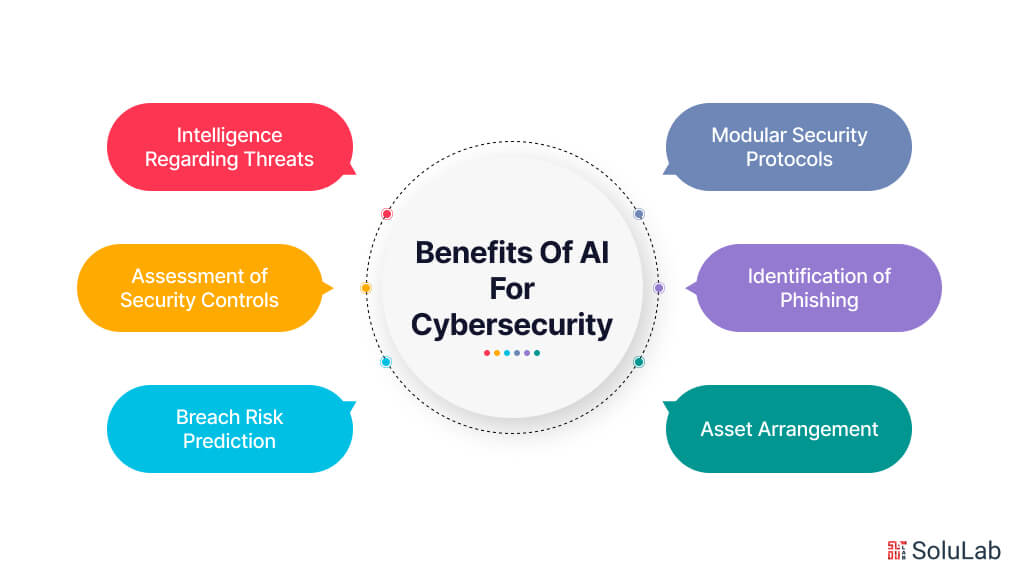
Real-time monitoring, automated incident response, behavioral analytics, better threat identification. That is the short list, and it explains why security budgets keep drifting this direction. The longer question is what changes for the people doing the work once AI security is wired in and pointed at a threat environment that never stops rearranging itself. Here is where human teams get sharper:
1. Modular Security Protocols
The models keep learning, so the protections keep changing. A static security measure defends you against last year’s attack. This does not have that problem.
2. Identification of Phishing
AI security reads a message the way a suspicious colleague would: the wording, the sender’s behavior, the small details that do not sit right. Machine learning picks up the trends running through phishing mail, and employees stop being the softest target for social engineering attacks.
3. Asset Arrangement
You cannot defend what you never counted. AI keeps an accurate, complete log of every device, user, and app touching your information systems, then sorts them by how much they matter to the company, so the administration reflects real priority instead of alphabetical order.
4. Intelligence regarding threats
Stay current on what is hitting your sector specifically, not just what is hitting the internet generally. Firms can then rank security measures by likelihood and possible impact rather than by whoever argued loudest in the meeting. That is what strategic decision-making looks like in practice.
5. Assessment of Security Controls
Measure the tools you already own. Which controls do real work, which ones are decoration, and where the gaps sit between them. That honest assessment usually improves a security posture more than the next purchase does.
6. Breach Risk Prediction
Feed in the IT asset inventory, the threat exposure, the measured efficacy of your existing controls, and AI can point at where a breach is most likely to open up. Being early is cheap. Resources go to the weak spot while it is still a weak spot and not an incident report with executives attached to it.
Companies that bring Al in Modern Cybersecurity into the fold come out more resilient, better defended, and considerably clearer when they have to explain risk to people who do not work in security.
Conclusion
Threats are not going to get simpler, and defenses built on fixed rules are already a step behind. That is the practical case for AI here: detection running in real time, response that does not wait for someone to wake up, security protocols that rewrite themselves as the attacks change. AI applications in cybersecurity have stopped being an experiment and started being infrastructure. Accuracy improves, speed improves, and the gap between noticing that something is wrong and shutting it down keeps narrowing. As attacks grow more layered, that gap is the whole game for any organization with digital assets worth taking.
SoluLab works at that intersection. Our teams build AI and cybersecurity together rather than bolting one onto the other after the fact, which is what it takes to actually harden a security posture instead of adding one more dashboard to the pile. Tell us what you are protecting and what keeps breaking. Partner with SoluLab an AI development company and see what your defenses look like with AI sitting behind them. Contact us today and we will walk through your environment with you.
FAQs
Shipra Garg is a tech-focused content strategist and copywriter specializing in Web3, blockchain, and artificial intelligence. She has worked with startups and enterprise teams to craft high-conversion content that bridges deep tech with business impact. Her work translates complex innovations into clear, credible, and engaging narratives that drive growth and build trust in emerging tech markets.