AI in accounting helps businesses to automate finance operations at scale. Helping teams reduce manual work and improve accuracy. But there’s more to accounting automation than just using AI; you also need to process large volumes of data, ensure compliance, detect risks early, and integrate AI with existing finance systems.
However, the right AI systems help you improve and automate core finance processes so your teams can focus on analysis, strategy, and decision-making. To automate finance effectively, companies need AI development solutions around their specific accounting processes, data structures, and compliance requirements.
In fact, the global AI in accounting market is projected to grow to over $67 billion by 2035. In this blog, you’ll learn the benefits of AI in accounting, key technologies, and more. Let’s get started:
Key Takeaways
- AI eliminates repetitive finance work such as data handling, reconciliation, and reporting, liberating accounting teams to do high-value and strategic work.
- AI has made businesses more accurate and eliminated more errors because it minimizes manual activities in bookkeeping, invoicing processes, and compliance.
- The benefit of AI-based analytics is that it offers real-time data to finance leaders to make quicker and more informed decisions and proactively manage risks.
- Growing businesses can use scalable AI solutions to manage the growing financial complexity without needing to add more accounting staff.
How is AI Changing the Accounting Industry?
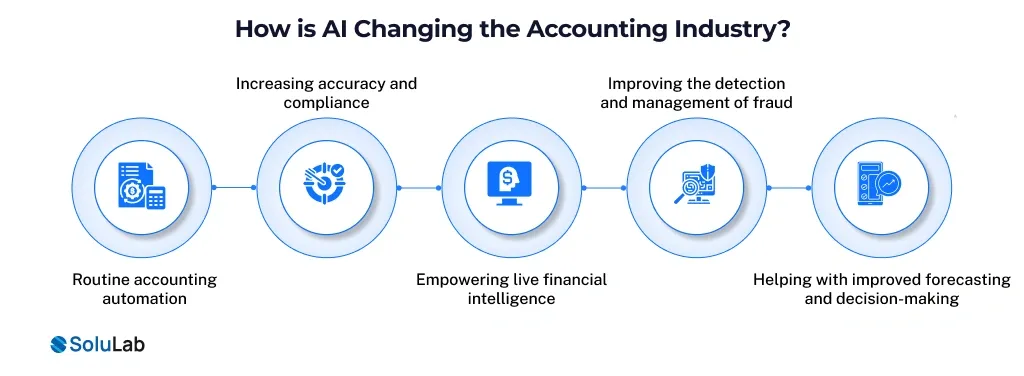
AI in accounting is improving the tasks of Finance Heads and audit teams by automating repetitive tasks. They can now focus on tasks that need their attention to grow their business further. Here’s a detailed explanation of how AI is changing the accounting industry.
Helping with improved forecasting and decision-making: Using historical and real-time data, AI predicts revenue, expenses, and cash flow to enable leaders to plan budgets and prepare reliable and data-driven decisions about their businesses
Routine accounting automation: Using AI, you can automate data entry, invoice processing, and reconciliations. This automation reduces manual tasks and human error. The best part about it is that accounting teams get to spend more time on valuable financial analysis.
Increasing accuracy and compliance: AI systems will continuously examine financial information to identify discrepancies, maintain regulatory compliance, and minimize the chances of reporting errors or auditing problems.
Empowering live financial intelligence: AI ensures that a business can monitor cash flow, costs, and performance at any point in time, instead of monthly reports, by offering real-time dashboards and predictive events.
Improving the detection and management of fraud: Machine learning programs detect suspicious transactions at an early stage, detect possible fraud, and enhance financial controls without necessarily having to review transactions manually.

Key Technologies in AI in Accounting
AI in accounting is the combination of intelligent technologies, which automate routine tasks, enhance accuracy, and transform financial information into real-time and decision-ready insights available to businesses.
- Machine Learning (ML): Machine learning assists accounting systems to learn based on historical financial records to automatically classify transactions, identify anomalies, become more accurate with time, and assist in smarter forecasting without direct human supervision.
- Natural Language Processing (NLP): Natural Language Processing allows accounting systems to interpret and compute unstructured data, such as invoices, emails, contracts, and receipts, which leads to faster document handling, searchability, and much less reliance on a human to interpret the data.
- Optical Character Recognition (OCR): OCR removes manual data entry by extracting formatted data on scanned invoices, bills, and receipts, which enhances speed, consistency, and accuracy in high-volume accounting operations.
- Robot Processing Automation (RPA): RPA automates the accounting activities based on rules, including data entry, reconciliation, and report creation, by recreating human behaviors across systems and assisting finance departments in doing strategic work.
- Predictive Analytics: Predictive analytics assists financial forecasting based on past and current financial data to predict cash flow, costs, and risk,s and therefore businesses can be able to make their data-driven financial decisions confidently.
Benefits of AI in the Accounting Industry
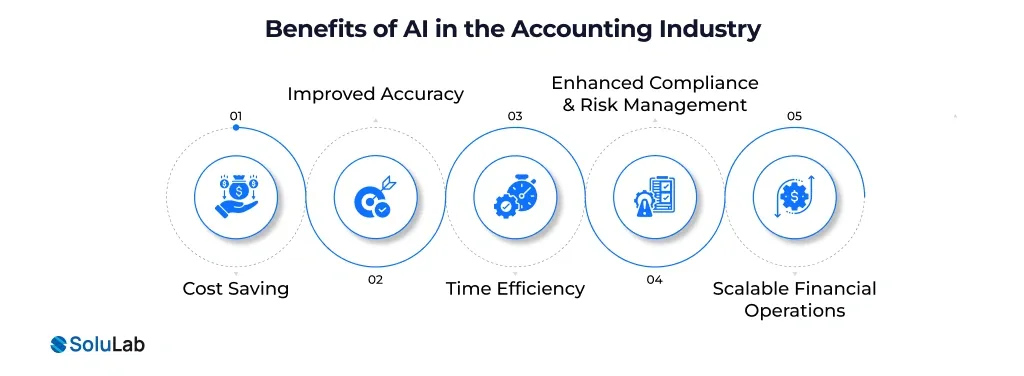
AI is changing the accounting sector through automation, lessening manual labor, and aiding companies with finances more precisely, more economically, and in larger amounts, without expanding the overheads of operations.
- Cost Saving: AI minimizes the use of manual data entry and repetition. The businesses save money on reducing the human resources, reducing rework due to error and increasing the accounting activities without necessarily recruiting numerous finance departments.
- Improved Accuracy: Artificial intelligence systems make uniform analysis of vast amounts of financial data. AI automation can reduce invoice processing time by up to 75% and achieve 95%+ accuracy in data extraction from financial documents.
- Time Efficiency: Mundane jobs such as invoice processing, reconciliation,,s and expense categorization are done in minutes. This liberates the finance departments to do more strategic analysis rather than time-consuming manual analysis.
- Enhanced Compliance & Risk Management: AI is also used to keep track of transactions against the established rules and regulations. It will assist businesses to be audit-ready and identify compliance risks at an early stage, as well as prevent the need to spend millions of dollars in penalties and regulatory challenges.
- Scalable Financial Operations: AI-based accounting systems can easily expand along with the business. Along with the doubling of transaction volumes or the addition of new markets, AI can cope with new complexity without affecting the speed or performance.
How Can AI be Used in Accounting?
AI accounting tools for CPAs are transforming accounting, making it more automated, more precise, and making financial decisions smarter to assist businesses in saving time, making fewer mistakes, and expanding the scope of financial work.
1. Automated Bookkeeping
AI automatically classifies transactions, reconciles bank statements, and updates ledgers in real time, which minimizes manual data entry, human errors, and delays in reconciling at the end of month.
2. Tax Filing & Compliance
Financial data, tax rules, and tax reports are analyzed by AI and presented accurately to assist businesses in remaining compliant, minimizing filing errors, and handling new regulations efficiently.
3. Internal & External Auditing
AI can process vast amounts of financial data to identify anomalies, inconsistencies, and possible fraud and conduct more efficient audits, more effective risk assessment, and enhance financial transparency.
4. Invoice Processing and Accounts Payable
AI uses OCR and machine learning to process invoice data, check vendor information, and automate approvals, which are much faster than normal processing time, and manage cash flow better.
5. Financial Forecasting and Planning
AI studies historical and real-time data to forecast the trends in cash flow, cost, and revenues, and enables the finance teams to make better decisions and strategize future business development.
Use Cases of AI in Accounting
AI is changing accounting through automation of repetitive tasks, human error reduction, and providing real-time insights- making finance teams work faster, comply and make more intelligent and data-driven business decisions.
1. Data Mining of Supporting Documents
AI analyzes data on invoices, receipts, bank statements, and contracts with the help of OCR and NLP. It minimizes the manual input and enhances the accuracy and reliability of data capture during high-volume accounting processes.
2. Fraud Detection
AI is applied to analyze mass data to detect abnormal behavior in real-time, duplicate transactions, or unusual behavior. This assists accounting departments and accounting services in identifying fraud at the initial stage and minimizing financial losses when there is no time to waste.
3. Data Analysis Risk Assessment Automatically
AI analyzes financial information, past and present, to determine trends of risks. It facilitates proactive decision-making through warning of compliance gaps, financial instability,y or operating risks more quickly and accurately.
4. Invoice and Expense Reconciling
AI compares invoices, purchase orders, and expense records. It accelerates the reconciliation process, minimizes discrepancies, decreases the length of the month-end close processes, and enhances financial accuracy in general.
5. Agent AI Disclosure Testing
Financial disclosure Agentic evaluates compliance with regulatory requirements, whether against the financial disclosures. It brings discrepancies, information gaps, and compliance risks to mind, assisting accounting team members to be accurate, transparent, and audit-ready.
Future of AI in the Accounting Industry
AI in the accounting profession is not just about automation. It is heading towards smart, self learning systems that facilitate quicker decisions, improved compliance, and real finance viewability.
- Major finance independent operations: With little human intervention, AI will deal with end-to-end finance processes, such as reconciliations, reporting, and cash flow forecasts, which reduces errors and liberates teams to work on strategic tasks.
- Real-time auditing: As compared to a regular audit, AI will be able to conduct continuous monitoring of the transactions, alert to anomalies immediately, and be used to ensure compliance, to ensure that businesses can identify risks on time and prevent expensive financial shocks.
- AI copilots for CFOs: AI-based copilot development will support CFOs in scenario planning, financial forecasting, and decision support by providing clear and actionable insights on complex data in response to real-time instructions.
- AI regulation and explainable models: The use of explainable AI models will enable companies to address regulatory demands since it will demonstrate how decisions are made, enhance transparency, trust and uptake of highly regulated accounting.

Conclusion
AI in accounting helps companies automate and scale back finance, minimize risk, and have up-to-date financial insight. AI and automated data extraction for fraud detection and agentic disclosure testing: AI will allow finance teams to work smarter and faster without compromising accuracy and compliance.
But the true worth is to develop the solutions which match in your workflows, your systems, and your regulatory requirements. It all depends on the appropriate AI development partner that counts.
SoluLab, an AI development company, has extensive experience in AI consulting and integration. With this expertise, it assists businesses in creating reliable, scalable automated accounting, which yields significant ROI and long-term cost-efficiency. Book a free discovery call today!
FAQs
Shipra Garg is a tech-focused content strategist and copywriter specializing in Web3, blockchain, and artificial intelligence. She has worked with startups and enterprise teams to craft high-conversion content that bridges deep tech with business impact. Her work translates complex innovations into clear, credible, and engaging narratives that drive growth and build trust in emerging tech markets.