AI keeps getting better at the messy, repetitive work that used to require a full customer-support team. Travel businesses noticed. They’re now using it to handle everything from booking confirmations to complaint routing, things that chew up staff hours without generating much value. Artificial Intelligence for travel goes further than automation, though. It generates genuinely personal experiences, where each suggestion is grounded in real data about what that specific traveler actually wants.
According to Statista, the global market for AI in travel hit $81.3 billion in 2022 and is on track to reach $423.7 billion by 2027, a compound annual growth rate of 35%. That’s not a slow build. Real-time customer service, smarter pricing, fraud prevention: travelers are already experiencing these changes whether they realize it or not. This post breaks down what AI in travel industry actually looks like today: the use cases, the benefits, and what’s likely to matter most in the next few years.

Importance of AI in Tourism
The use of artificial intelligence (AI) in tourism is changing how the industry actually operates. Not just marketing language, but operational reality. Efficiency is up, personalization is deeper, and the travel experience itself is measurably better for the people going through it. AI trip planning tools are quickly becoming something travelers expect, not a novelty. They pull together user preferences, historical booking behavior, live weather data, and local events to build itineraries that actually fit the person asking. The result is a trip that feels considered rather than generic.
Artificial intelligence travel agent systems have changed the booking process at a fundamental level. Tasks that used to require a human agent, finding flights, comparing hotels, managing approvals, confirming activities, are now handled automatically. Many businesses now rely on an online travel booking tool built with current AI capabilities to personalize trip planning and keep corporate travel within policy, without the back-and-forth that used to slow everything down. And travelers get immediate answers to their questions at any hour, not just during business hours.
There’s also a different kind of value: adaptability mid-trip. Trip planner AI applications don’t just help with the planning phase. They stay useful when things go sideways: a weather disruption, a sudden venue closure, a local event that makes the original route a bad idea. The system can read the situation and suggest alternatives on the spot. That kind of real-time adjustment used to require a local guide or a very patient travel agent. Trip planner AI handles it without drama.
For businesses inside the industry, AI in tourism means something different: a clear read on what customers actually think and do, not just what they say in a survey. Hotels, airlines, and tour operators can analyze real behavioral data to improve their offers and spot friction before it turns into a complaint. Predictive analytics helps them see shifts in demand before those shifts show up in the numbers. That’s the kind of early warning that matters in a competitive market.
Benefits of AI in Tourism Industry
AI isn’t a single tool for tourism companies. It works across multiple parts of the business at once, solving problems that used to require separate systems, separate teams, or just a lot of manual effort. Here’s where the real gains show up.
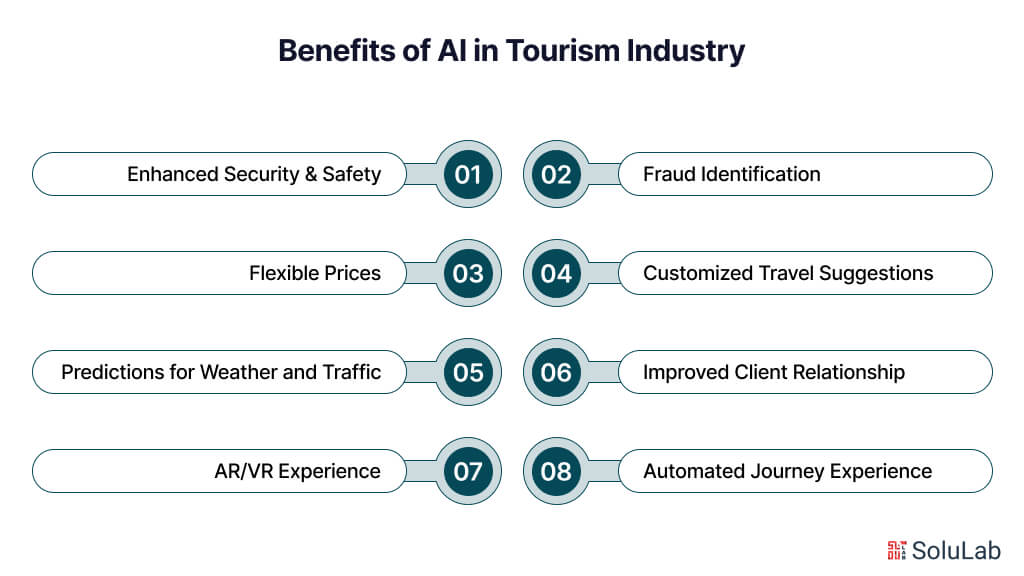
Enhanced Security & Safety
AI systems built around security can catch threats at tourism sites that a human guard would miss. Not because the human isn’t paying attention, but because the volume of data is simply too high. Real-time surveillance feeds, transaction records, and access logs all run in parallel. AI for travel has genuinely raised the bar on what’s possible here. Airport screening is the clearest example: automated facial recognition can verify a traveler’s identity in seconds, reducing both the risk of fraud and the queue length that makes everyone miserable.
Fraud Identification
Machine learning algorithms can read booking patterns fast enough to spot fraudulent transactions before they clear. For travelers and for businesses processing thousands of reservations a day, that matters. Predictive analytics takes it a step further: flagging suspicious behavior before someone actually makes a fraudulent booking or files a false insurance claim.
Flexible Prices
Dynamic pricing in travel is genuinely complex. Flight and hotel prices shift in real time based on dozens of variables: how far out the booking is, current occupancy, competitor rates, seasonal demand, even local events. AI is what makes this practical at scale. It pulls data from booking platforms, historical records, live market feeds, and traveler surveys, then runs algorithms to predict demand curves and set prices that balance revenue against occupancy. Without AI, you’d need a large team of analysts doing this manually. With it, the pricing model runs continuously.
Customized Travel Suggestions
Trip planner AI builds recommendations from actual behavior data: search history, social media activity, past trips. The suggestions it surfaces, destinations, accommodation types, itinerary options, are tied to what a specific traveler has shown they care about, not what’s generically popular. That alone can cut hours off the planning process.
Predictions for Weather and Traffic
Pairing AI with traditional forecasting methods gives travelers far more accurate, location-specific predictions for weather and traffic conditions. More importantly, it makes proactive risk management possible: rerouting transportation before a disruption hits, adjusting itineraries when a storm is developing, and keeping cancellations to a minimum. That’s not just convenient. For travelers on tight schedules, it’s the difference between a trip that works and one that falls apart.
Improved Client Relationship
AI is useful at every stage of a trip, not just the booking step. Before departure, it helps with planning. During travel, it surfaces relevant information and handles issues. After the trip, it collects feedback and feeds that back into future recommendations. AI in tourism does this through a combination of tailored suggestions, 24/7 multilingual concierge services, predictive analytics, and flexible itinerary management. The cumulative effect is a noticeably better client experience.
AR/VR Experience
Virtual tours let travelers actually feel what a destination is like before committing. Not a gallery of professional photos. A walkthrough of the actual place, its atmosphere, its scale.
VR travel brochures go well beyond static imagery. The 360-degree views, interactive elements, and immersive detail give travelers a real sense of what they’re choosing. And once they’re there, AR overlays can explain the history and cultural context of a place in a way that a printed guide simply can’t match.
Automated Journey Experience
AI takes the friction out of travel logistics. It handles real-time information delivery, manages the routine parts of trip coordination, and reduces how much mental energy a traveler has to spend on logistics. For businesses, the benefit is different but equally concrete: customer service inquiries, reservation management, and data analysis can all run with less human intervention. That frees up staff for work that actually needs a person involved. Operating costs drop. Resource allocation gets sharper.
Use Cases of AI in Travel Industry
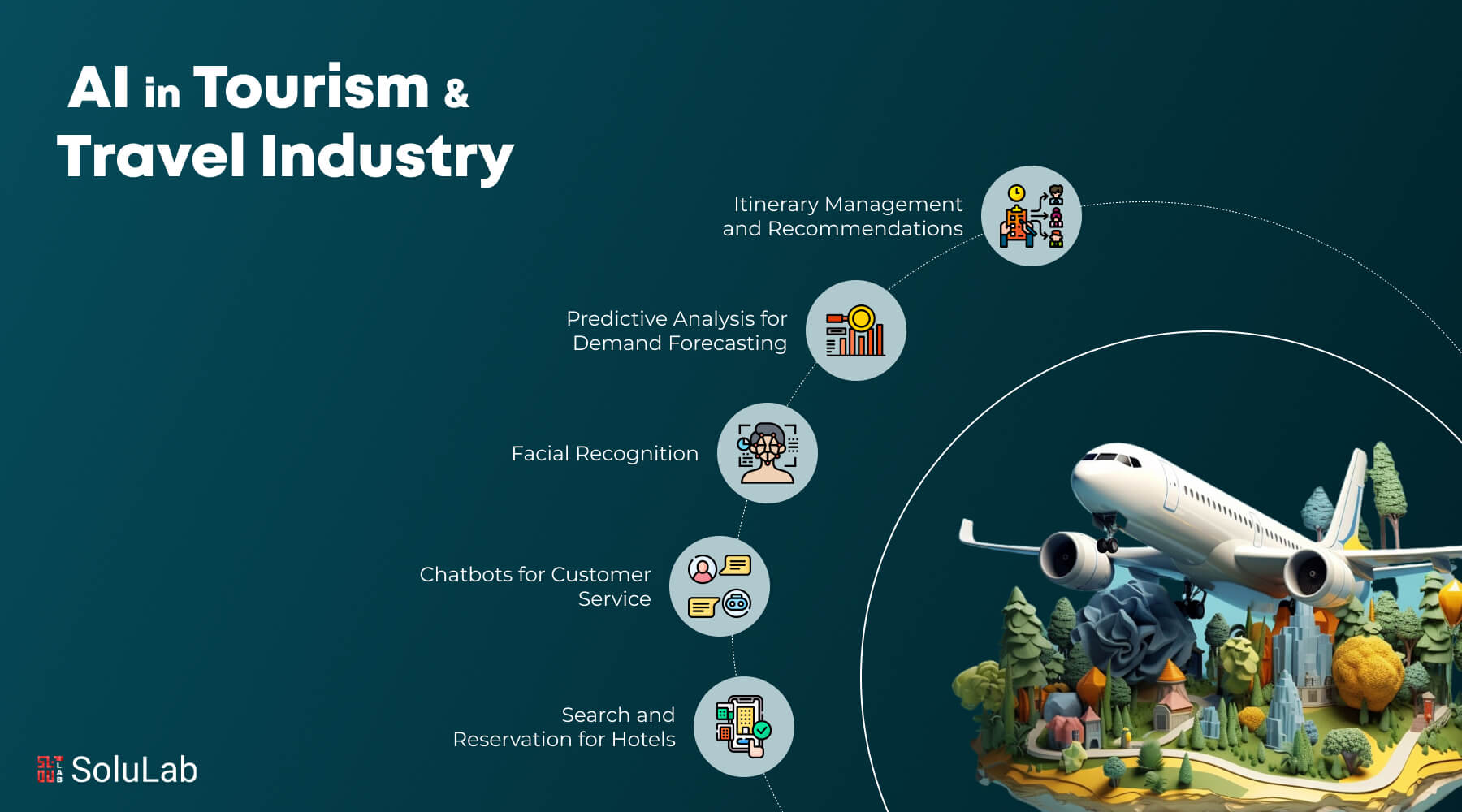
AI changes how the travel and tourism industry does its work across many different functions at once. Below are some of the AI use cases and applications that travel businesses are already putting to work to improve how trips are planned and delivered.
Search and Reservation for Hotels
AI in travel industry brings intelligent algorithms to hotel search and booking, making the process faster and the recommendations more relevant to each traveler’s actual preferences. The days of scrolling through hundreds of undifferentiated listings are fading.
Itinerary Management and Recommendations
AI-driven itinerary planning doesn’t just produce a schedule. It adapts that schedule to the individual traveler, suggesting routes and activities based on their stated interests and past choices. The planning gets smarter the more the person uses it.
Predictive Analytics for Demand Forecasting
Knowing demand before it peaks is a real operational advantage. AI-powered demand forecasting helps travel businesses allocate resources correctly, price appropriately, and respond to shifts in traveler behavior before those shifts become problems.
Facial Recognition
The practical impact of artificial intelligence for travel on identity verification is hard to overstate. Facial recognition speeds up check-in, reduces queues at border control, and enables more personalized experiences throughout a traveler’s journey, all while improving overall security.
ChatBots for Customer Service
Customer expectations in travel have shifted: people want answers now, not during business hours. AI chatbots in travel industry directly addresses this. They handle questions, provide trip-related information, and resolve issues around the clock, without putting the pressure of 24/7 availability on a human team.
AI Trends to Watch Out in 2025
AI is moving fast, and the travel industry sits in the middle of several converging shifts at once. These are the AI trends in travel industry in 2025 that are worth paying attention to.
1. Advancements in Explainable AI (XAI)
- XAI is becoming a serious research priority, focused on making AI decision-making legible to the people who depend on it.
- When organizations can actually trace how a model reached a decision, trust becomes easier to build, and accountability becomes possible.
- Healthcare, finance, and government are the most active sectors for XAI right now, since the stakes of opaque decisions in those fields are highest.
2. Increased Adoption of Edge AI
- Edge AI processes data at the point where it’s generated, cutting down on latency and reducing dependence on cloud connectivity.
- IoT devices, autonomous vehicles, and smart home systems are already running on edge AI for real-time decision-making.
- The next wave includes more capable edge-powered devices: systems that can analyze and act without waiting for a round-trip to the cloud.
3. Natural Language Processing (NLP) and Conversational AI
- NLP is getting better at understanding language the way humans actually use it, with ambiguity, context, and intent all factored in.
- Conversational AI is spreading into chatbots, virtual assistants, and customer service systems across most industries.
- Customer service, language translation, and text summarization are the areas seeing the most practical impact right now.
4. Development of Autonomous Systems
- Self-driving vehicles, autonomous drones, and industrial robots are all advancing. The underlying AI is maturing alongside them.
- These systems rely on AI and machine learning to read their environment and make moment-to-moment decisions without human input.
- Warehouses and factories are adopting autonomous systems for efficiency gains that are difficult to achieve with purely human-operated processes.
5. Quantum Computing and AI
- Quantum computing is starting to intersect with AI in ways that could change the field significantly.
- Faster processing of complex algorithms opens up new possibilities in cryptography, optimization problems, and machine learning at scale.
- One of the more interesting applications is enabling more sophisticated AI models, systems that can genuinely learn from experience rather than just pattern-match against training data.
6. Increased Use of Transfer Learning
- Transfer learning lets organizations reuse knowledge a model has already built up and apply it to a new task, rather than starting from scratch.
- That cuts development time and reduces the volume of training data needed to get a model working well.
- Image recognition, NLP, and recommendation systems are all benefiting from this approach.
7. Human-AI Collaboration
- As AI takes on more tasks, the question becomes how humans and AI systems work together, not whether they will.
- Human-AI collaboration gives organizations a way to get the most from both: human judgment where it matters, AI speed and processing power where volume is the constraint.
- Healthcare, finance, and manufacturing are all actively building out these hybrid workflows.
8. Cybersecurity Concerns and AI-powered Defenses
- Broader AI adoption means a broader attack surface. The security risks grow alongside the technology.
- AI-powered defenses are being built to match: machine learning algorithms that detect attack patterns early and respond faster than any human security team could.
- Better threat detection, stronger encryption, and faster incident response protocols are all part of this push.
Related: Generative AI in Cybersecurity
9. Development of Autonomous Retail
- Autonomous retail is the direction several major retail operators are moving, removing manual steps from checkout, inventory, and shelf management.
- Self-checkout kiosks are already common; AI-driven inventory management and smart shelves that optimize stock levels are the next layer.
- The practical benefits are lower operating costs, less waste, and a faster experience for shoppers.
10. Integration of AI into Healthcare
- AI is already changing how diseases get diagnosed and how treatment plans get personalized, with patient outcomes improving as a result.
- Medical imaging analysis, predictive analytics, and patient data management are the applications with the clearest track records so far.
- For healthcare providers, the combination of better care and lower costs is the core argument for continued AI investment.
11. Robotics Process Automation (RPA)
- RPA lets software robots handle the repetitive, rules-based tasks that eat up staff time without requiring much judgment.
- Robotics Process Automation will shift human attention toward work that actually requires it: the strategic decisions, the edge cases, the relationship-heavy tasks.
- Finance, healthcare, and manufacturing are all active users, but the application areas keep expanding.
12. Development of Emotional Intelligence in AI
- As AI shows up in more parts of daily life, the gap between what it can do and how well it reads human emotion has become obvious. That gap is closing.
- AI with better emotional intelligence produces more natural, less frustrating interactions. That matters a lot in customer-facing applications.
- Customer service, marketing, and education are the sectors pushing hardest on this right now.
13. Increased Use of Reinforcement Learning
- Reinforcement learning is gaining traction as a way to build AI systems that improve through trial and error rather than requiring a large labeled dataset to start with.
- Game-playing, robotics control, and recommendation systems have proven it out. More applications are following.
- The ability to adapt to genuinely new situations, not just variations on training examples, is what makes reinforcement learning worth the complexity.
14. Development of Explainable Reinforcement Learning
- Reinforcement learning can produce impressive results, but it often produces them through logic that no one can fully explain. That’s a problem in regulated industries.
- Explainable reinforcement learning research is working on making the decision process visible, so organizations can audit what their models are actually doing.
- Finance, healthcare, and manufacturing are the sectors with the most pressing need for this kind of transparency.
15. Growth of Low-Code/No-Code AI Development
- Low-code and no-code platforms are putting AI development within reach of people who aren’t engineers. That changes who builds AI tools and how fast they get built.
- Democratizing access to AI development means the ideas worth building aren’t limited to organizations with large technical teams.
- Customer service automation, marketing tools, and data analysis workflows are already being built on these platforms at scale.
Read Also: AI In Visa Applications and Approvals
Real-World AI Travel Examples
The travel industry has changed substantially in recent years, and Generative AI in travel industry is shaping where it goes next. Personalized recommendations, predictive maintenance, demand forecasting: these aren’t pilot programs anymore. They’re live. Here’s a look at some real-world AI travel examples:
1. Personalized Hotel Recommendations: Marriott and Hilton use AI chatbots in travel industry to give guests suggestions that match their actual patterns: preferred room types, dining habits, the kinds of activities they book. The personalization is built on real data about that guest, not generic popularity rankings.
2. Predictive Maintenance for Airplanes: Delta and American Airlines run AI across their sensor and maintenance data to catch potential mechanical issues before they ground a plane. The upside isn’t just safety. It’s fewer last-minute cancellations and the operational savings that come with planned maintenance versus emergency repairs.
3. Intelligent Travel Planning: Expedia and Booking.com have built AI into their booking engines to surface recommendations based on a user’s history and preferences. The output isn’t just a sorted list of options. It’s a set of suggestions tuned to what that particular traveler tends to choose.
4. Smart Airport Systems: Amsterdam Schiphol and Singapore Changi are using AI to move passengers through the airport faster. Check-in, baggage drop-off, security screening: each step has AI-powered support that cuts wait times and reduces the manual load on airport staff.
5. Virtual Assistants for Travelers: Amazon’s Alexa and Google Assistant are now standard in many hotel rooms and short-term rentals. Travelers use them for everything from setting wake-up alarms to booking restaurant tables and arranging activities, without picking up a phone or navigating a hotel website.
6. Predictive Demand Forecasting: Airbnb and Uber both use AI-powered analytics to predict when demand for their services will rise or fall. That prediction feeds directly into pricing and inventory decisions, so they’re not reacting to demand shifts after the fact.
7. Real-Time Language Translation: Apps like TripIt and TripCase give travelers live translation support that reduces how often language becomes a barrier. For anyone who’s tried to get directions or order food in a country where they don’t speak the language, the practical value is obvious.
8. Intelligent Traffic Management: Paris and London are running AI-powered systems that analyze live traffic data and predict congestion before it builds. Reduced travel times, lower emissions, better air quality: the benefits stack up when traffic moves more efficiently.
9. Virtual Reality Travel Experiences: Expedia and Airbnb are using virtual reality (VR) technology to let travelers explore hotels, destinations, and activities in detail before they arrive. Walking through a resort room virtually before booking it is a fundamentally different kind of confidence than scrolling through photos.
10. AI-Powered Travel Insurance: AXA and Allianz are using AI to analyze traveler behavior data, destination, mode of transport, planned activities, and generate insurance quotes that reflect the actual risk profile of that specific trip, not a generic category.
These real-world AI travel examples show the range of what AI is already doing in travel. The applications run from the visible, like chatbots and VR tours, to the invisible, like the pricing algorithms and maintenance schedules running quietly in the background. Together they’re changing what travelers experience and how travel companies operate.
Final Words
AI has moved from a nice-to-have in travel to something that touches nearly every part of the industry. Personalized recommendations, automated booking management, real-time logistics support: the technology is now deeply embedded in how trips get planned and delivered. But the implementation challenges are real. Data privacy, system integration complexity, the ongoing cost of maintenance and updates: these aren’t solved by purchasing an AI platform. They require deliberate architecture and continuous attention.
SoluLab works directly on these problems for travel businesses. Our AI development work prioritizes data privacy from the start, not as an afterthought, and our integration approach is built around the existing systems travel companies actually operate. We also stay engaged after go-live, because an AI system that isn’t maintained quickly falls behind what travelers expect. If you want to build something substantive with AI solutions, talk to us about what you’re trying to solve and where your current setup is falling short.
FAQs
Shipra Garg is a tech-focused content strategist and copywriter specializing in Web3, blockchain, and artificial intelligence. She has worked with startups and enterprise teams to craft high-conversion content that bridges deep tech with business impact. Her work translates complex innovations into clear, credible, and engaging narratives that drive growth and build trust in emerging tech markets.