AI isn’t slowing down in 2024. If anything, it’s burrowing deeper into the apps we open every morning, pulling whole industries along with it, and forcing regulators to finally write things down. Jobs in artificial intelligence now sit among the fastest-growing roles anywhere in the world, which nobody watching the last few years should find surprising. Scrappy startups use it. So do Fortune 500 giants, mostly to squeeze friction out of how they operate. And ordinary people are using it far more than they were a year ago, often without noticing.
So here we are at the start of 2024. The field keeps throwing up new advances, and each one pokes at how industries run, how products feel to use, and where we assumed the ceiling was.
This piece walks through the top artificial intelligence trends for 2024. Some are about users (personalization, for one). Some are about conscience, like the ethics of how models get built. And one is about the odd pairing of quantum computing and AI. Together, they’re the technologies and ideas most likely to decide how this year’s AI story gets told.
Let’s go.
Brief Overview of the Current State of AI Technology
Things move fast in artificial intelligence (AI). What was a novelty in spring is table stakes by autumn, and old assumptions get quietly retired. Before guessing where 2024 goes, it helps to take an honest look at where the technology actually stands right now: what’s been achieved, and what seems to be coming.
Not long ago, AI belonged to science fiction. Now it’s in your inbox. Machine learning algorithms, neural networks, and serious data analytics are behind new products in healthcare, finance, entertainment, education, and plenty of places in between. What these systems can do has grown enormously. Tasks people once called impossible are now weekday work.

Importance of Staying Updated on AI Trends
A field this restless doesn’t reward people who wait for the summary. Businesses, researchers, and hobbyists all have to keep up if they want to get real value out of AI in their own work. Why bother? Because knowing what’s current makes adoption easier, and it gives the people signing off on budgets enough context to decide sensibly whether, and how, an AI solution belongs in their operations.
There’s a second reason. AI keeps colliding with ethics, privacy, and its wider effect on society, which is exactly why responsible development matters. Tracking the trends isn’t only a competitive edge, then. It’s part of taking seriously the ethical questions that follow every step forward in artificial intelligence.
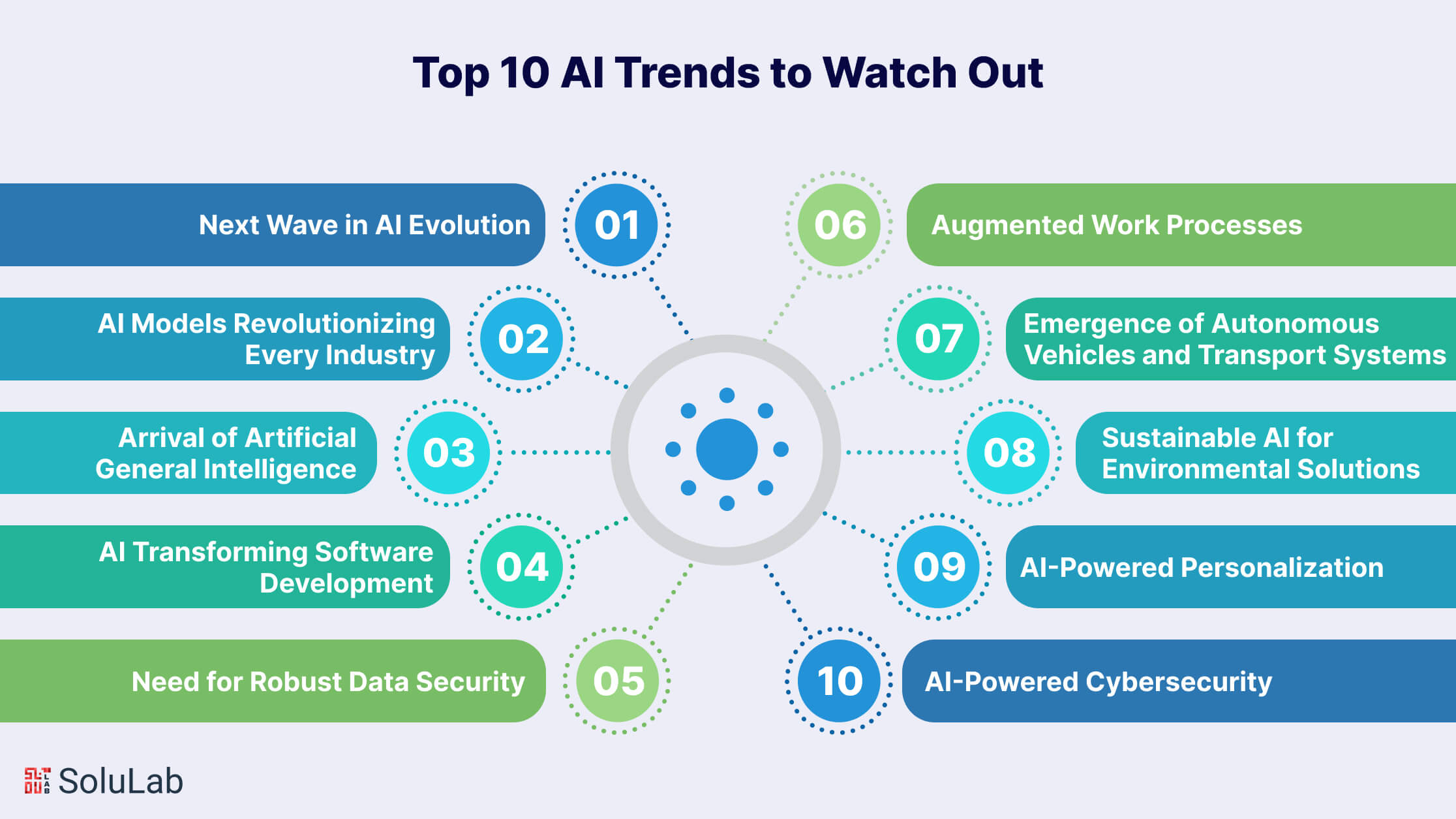
Top 10 AI Trends to Watch Out in 2024
1. The Next Wave in AI Evolution
Going into 2024, the landscape of Generative AI looks ready for a big jump, one that goes past what ChatGPT currently represents. A new generation, usually just called Gen AI, is expected to push well beyond the chatbots and image generators we’ve gotten used to.
Why does it top so many 2024 lists? It’s multimodal. Gen AI is expected to take in and make sense of text, voice, images, even music, and to produce several kinds of content at once. Picture writing an article and getting a fitting image alongside it. Or sketching a backdrop for a stage play while the scripts come out in multiple languages. That’s a different kind of creative tool, and a far richer experience for whoever is using it.
2. Tailored AI Models Revolutionizing Every Industry
Foundation models sit underneath the next wave of AI applications, and they’re expected to keep getting bigger and more capable. The catch is money. Training them is steep, which can make even early trial runs painful for a budget. Help is coming from the open-source community, where people are working on extensive language models (ELMs). Some teams are building trial versions of ambitious AI projects on smaller ELMs instead. Tuning one of these compact models to a particular business or industry costs a lot less. Even the makers of powerful closed models now sell bespoke generative pre-trained transformers (GPT).
The upshot? Companies are drifting toward personalized enterprise models. Which one they pick will come down to a trade-off between performance and privacy, and that trade-off is rarely comfortable. Among the top 10 artificial intelligence trends of 2024, expect the argument over open-source versus closed-source extensive language models to get louder.
3. The Arrival of Artificial General Intelligence (AGI)
2024 might be the year Artificial General Intelligence (AGI) becomes real: intelligence that can handle the cognitive tasks only humans manage today. Several organizations are openly working on technology that could outperform human intelligence. It isn’t finished. But if AGI arrives, it brings a level of power, and a set of capabilities, we haven’t had before.
The whole point is generality. An AGI has to cope with a wide spread of intellectual tasks, not one narrow job. If that works, it could add a great deal to the global economy, speed up scientific discovery, and move the line on what we think can be done.
4. AI Transforming Software Development in 2024
Software development is changing quickly, and AI is behind a good chunk of it, improving things for end users and for the developers themselves. You’ve probably felt it already. ChatGPT answering a detailed question, some other tool producing a striking visual, or a writing assistant helping you get a draft out the door.
Within the top 10 trends in artificial intelligence, this one could make 2024 a landmark year for the software industry. The shift is that AI now helps the people building the product, not only the people using it. GitHub is out in front here, giving developers AI help that cuts the grind out of writing code. Less time wrestling with syntax. More time building software solutions shaped around what customers actually need.
5. The Need for Robust Data Security
More AI means more data, and more data means more to protect. Simple as that. AI in cybersecurity has gone from nice-to-have to something teams can’t really do without. These tools can spot threats nobody has catalogued yet, find and patch weak points in real time, respond to risks before they turn into incidents, and handle a long list of other security jobs.
That’s why more businesses are buying AI-driven threat detection to guard customer records and confidential company information. Enterprises lean on it. So do individuals. In 2024 and after, AI’s part in securing data and IT infrastructure moves from helpful to mission-critical.
6. Augmented Work Processes
A big theme for 2024 is using AI to make everyday work better, not to replace the people doing it. Done well, AI stretches what a person can do: tasks finish faster, output goes up, and safety improves across all sorts of industries. Think summarizing content, doing research, drafting documents, writing code, even helping with medical diagnoses. AI can pitch in on every one.
What makes this trend interesting is specialization. Instead of one general helper, you get AIs or intelligent virtual assistants built for a particular field. A lawyer’s assistant. A doctor’s. A developer’s. Once they understand the domain, they stop being toys and start being assistants people rely on. That gives businesses a way into tailored AI solutions, and it fits neatly with the bigger push to improve how work gets done with AI applied where it counts. Of all the top AI trends for 2024, augmented work may be the one quietly doing the most for innovation and efficiency across sectors.
7. The Emergence of Autonomous Vehicles and Intelligent Transport Systems
Put AI inside cars and road networks and you get two things: autonomous vehicles and Intelligent Transport Systems (ITS). Self-driving vehicles pair advanced AI algorithms with sensors, and they’re shaking up the auto industry with better safety, better efficiency, and smarter traffic handling. ITS works at the level of the whole network. It uses AI to tie the pieces of a transport system together so everything runs more efficiently, which feeds directly into building smart cities. These systems chew through huge datasets from many sources to keep traffic moving, cut congestion, and support more sustainable ways of getting around. It’s a genuine change in how we think about, and use, transport.
It isn’t all smooth. Regulation, ethics, and cybersecurity all have to be sorted out before this goes mainstream. Still, the steady flow of AI-driven innovation is changing what transport looks like, pointing to a future where intelligent mobility sits at the center of networks that are safer, faster, and kinder to the environment.
8. Sustainable AI for Environmental Solutions
Then there’s Sustainable AI. The idea is to point artificial intelligence at the hard problems in energy conservation and environmental sustainability. With climate worries growing every year, AI is showing up with fresh answers on energy efficiency, smarter use of resources, and cutting pollution.
The use cases are wide. AI can balance how renewable energy gets distributed, track and shrink carbon footprints, and change waste management through smart sorting and recycling. Building AI into energy and environmental plans is a real step toward sustainable development. And it isn’t only good for the planet. It also opens new routes to business growth and new products.
Related: Geospatial AI
9. AI-Powered Personalization for Exceptional Customer Experiences
Personalization is one of the loudest AI stories of 2024, and for good reason. Recommendation engines have gotten very good at combing through massive datasets and picking out the fine detail of what customers like, how they behave, and what they need.
With that, a business can shape products, services, and interactions around the individual. You see it in the shows a streaming app lines up for you, in an online store that seems to know your taste, and in marketing that speaks to you instead of everyone. When personalization runs this deep, customers have a better time. They engage more, they stay loyal, and revenue tends to follow.
10. AI-Powered Cybersecurity for Seamless Experience
Last on the list, but hardly least: AI woven all the way through cybersecurity. Its advanced abilities are being used more and more to shore up digital defenses, with protection that anticipates attacks and adapts as they change. It works on several fronts at once. Machine learning algorithms sift enormous datasets, pick out patterns, and flag anomalies as they happen. That lets organizations harden their security posture, fix weak spots quickly, and defuse risks before they grow.
And AI in cybersecurity does more than classic threat detection. It covers predictive analysis, automated responses, and behavioral analysis that picks up activity that doesn’t look right. These systems find threats faster and more accurately, and they defend ahead of time, keeping a step in front of attackers. As threats get cleverer, AI-powered cybersecurity becomes a trend you can’t ignore: a sturdy shield against a constantly shifting set of cyber risks, and a way to keep digital systems intact.
Regulatory Landscape and Challenges
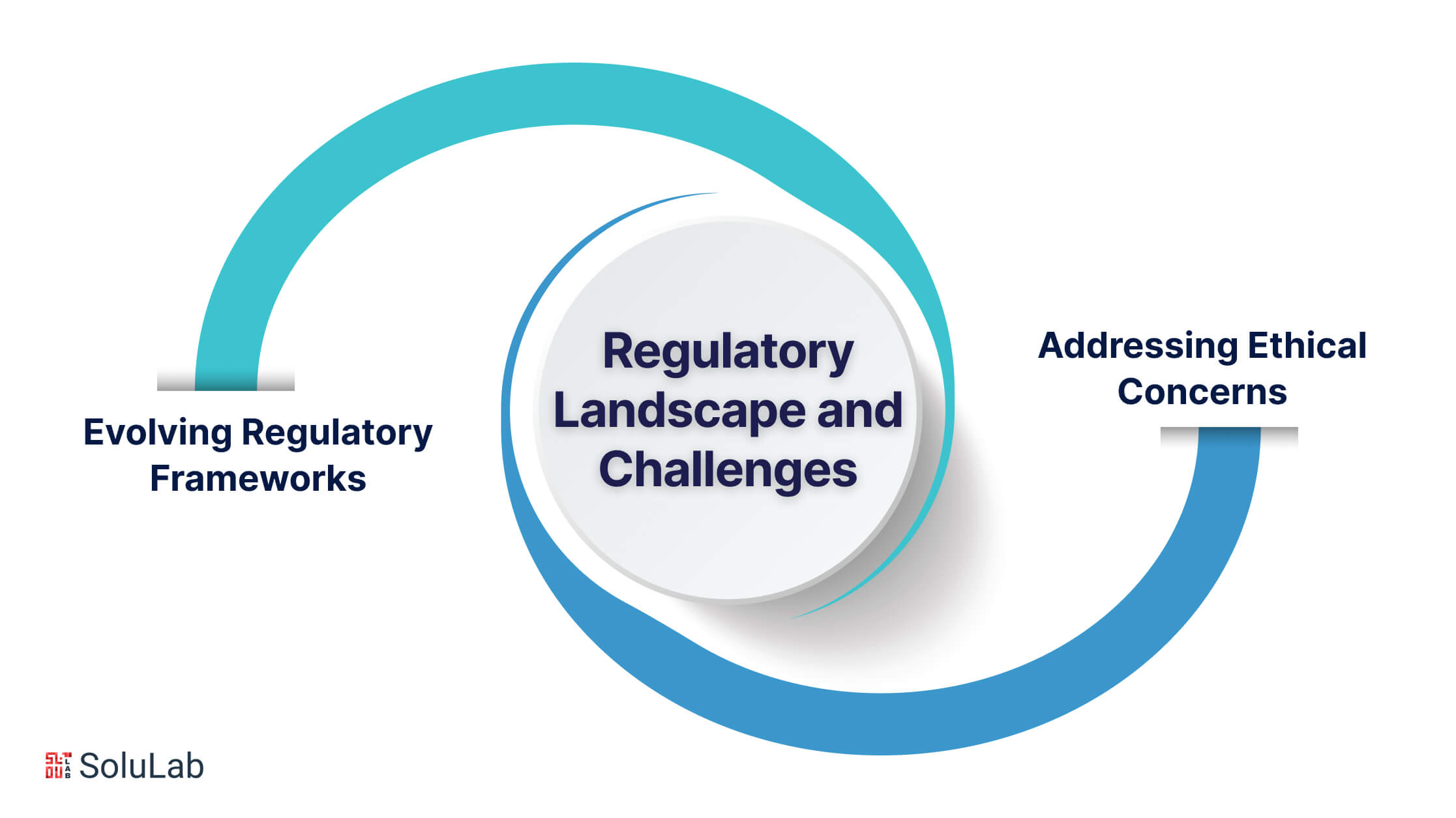
Regulation is racing to catch up with the technology, and in 2024 it’s changing a lot. Governments everywhere are writing AI policy, with the attention on ethics, data protection, and assessing risk. Countries are also talking to each other more this year, with bodies like the United Nations and the OECD hosting conversations aimed at shared AI standards. The goals: common ethical guidelines, answers to cross-border data governance problems, and more knowledge-sharing between nations. Ethics sits near the top of every agenda, with responsible development pursued through transparency, fairness, and accountability. Public awareness and education efforts are picking up, too, trying to close the gap between what the technology can do and what people understand about it. The hope is that AI settles into each sector without friction while the regulatory hurdles get worked through.
A. Evolving Regulatory Frameworks
1. Government Initiatives in AI Governance
Governments now see it plainly: AI keeps growing, and it needs strong rules around it. In 2024, countries are drafting policies and regulations so AI gets built and rolled out responsibly. The work in progress tries to hold two things at once, room to innovate and a line on ethics, so the technology can keep growing in a healthy way.
Where government bodies are putting their effort:
- Ethical Guidelines: Writing ethical frameworks for AI research and development that deal head-on with bias, transparency, and accountability.
- Data Protection: Drafting rules that protect user privacy and keep data use in AI applications responsible.
- Risk Assessment: Building methods to measure, and then reduce, the risks that come with advanced AI systems.
2. International Collaboration for AI Standards
AI doesn’t stop at borders, so more countries are working together on shared standards. The United Nations and the OECD are among the organizations bringing nations to the table so AI governance doesn’t splinter into a hundred different rulebooks. The joint work is meant to:
- Standardize Ethical Guidelines: Agree on ethical principles that everyone accepts, to steer AI development worldwide.
- Cross-Border Data Governance: Tackle the headaches of data moving between countries, so protection and privacy rules hold up internationally.
- Knowledge Sharing: Get nations swapping best practices and lessons learned so they can deal with problems together and share in what AI offers.
B. Addressing Ethical Concerns
1. Responsible AI Development
Talk about AI in 2024 and ethics comes up within minutes. Responsible development is how you earn trust from users and stakeholders, and without trust, adoption stalls. The main pieces:
- Explainability and Transparency: Adding ways to see how AI systems reach their answers, so certain algorithms feel less like a “black box.”
- Fairness and Bias Mitigation: Finding and correcting bias in AI models so results stay fair and even-handed for every group of users.
- Accountability Mechanisms: Setting up frameworks that make clear who is responsible when an AI system causes a problem or fails, so accountability is built into development and deployment.
2. Public Awareness and Education
The more AI shows up in daily life, the more people need to understand what it can do, and what it can’t. Governments and industry players are working on:
- Educational Programs: Running programs that teach the public about AI, what it could do for them, and the ethical questions that come with using it.
- Media and Communication Strategies: Putting accurate, easy-to-follow information about AI out through different media channels to clear up myths and misunderstandings.
- Community Engagement: Bringing communities into the conversation about AI, hearing a wide range of views, and making sure the technology fits what society values and expects.
As the rules keep shifting, all of this is about walking a fine line. Keep innovation alive. Guard against the risks and ethical problems that come with AI in 2024.

Final Words
Look across these ten trends and one thing stands out: 2024 is set up for some big changes in AI. Regulation is evolving, countries are cooperating, and there’s a firm commitment to building AI responsibly, which tells you ethics will steer a lot of what gets built. Personalized healthcare, autonomous industries, more immersive ways for people and computers to interact: the future is being shaped by advanced technology and careful governance moving together. If you want to get the most out of AI in this climate, you have to keep reading the trends. Stay informed, and the benefits of artificial intelligence can reach societies everywhere, not just the few who got there first.
Thinking about putting AI to work for you? SoluLab, an AI development company that has been pushing AI innovation forward, builds modern AI consulting services for a technology market that keeps moving. Our work spans many AI applications, from healthcare and business to education and more. If you’re ready to start building with AI, talk to us about solutions shaped around your specific needs. Visit our website or get in touch today, and let’s work out what AI can do for you.
FAQs
Shipra Garg is a tech-focused content strategist and copywriter specializing in Web3, blockchain, and artificial intelligence. She has worked with startups and enterprise teams to craft high-conversion content that bridges deep tech with business impact. Her work translates complex innovations into clear, credible, and engaging narratives that drive growth and build trust in emerging tech markets.