Maybe you write code for a living. Maybe you run a product team, or you just like watching where software is headed. Either way, something odd is happening to the craft. You type what you want an app to do, in ordinary English, and a few seconds later there is working code on the screen. That used to be a sci-fi pitch. Now it has a name: vibe coding.
This piece looks at why the approach feels so much more intuitive and creative than the old way, and how it is quietly rearranging who does what on a tech team, which tools they reach for, and how work moves from idea to release. Hacking on a prototype at 2 a.m.? Scaling a system that thousands of people depend on? Vibe coding is fast turning into the default route from “what if” to a running application.
So what actually makes it different?
What is Vibe Coding?
Vibe Coding is a way of doing software development where AI turns natural language prompts into code that runs. You stop wrestling with syntax. You say what you want, plainly, and the AI writes the implementation.
Andrej Karpathy coined the term “Vibe Coding” in February 2025, and it stuck because it named a real change in how people picture and build software. The machine brings precision. The human brings taste and intent. Put together, you get quicker prototypes, tidier workflows, and development cycles that waste less motion.
The process it encourages is looser and more conversational, with AI sitting in the middle of how apps and digital systems get made. Startups use it to get an MVP out the door. Enterprises use it to grow products they already have. In both camps, vibe coding software development and vibe coding AI tools are changing how much a team can ship and how often it tries something new.
How Vibe Coding Works?
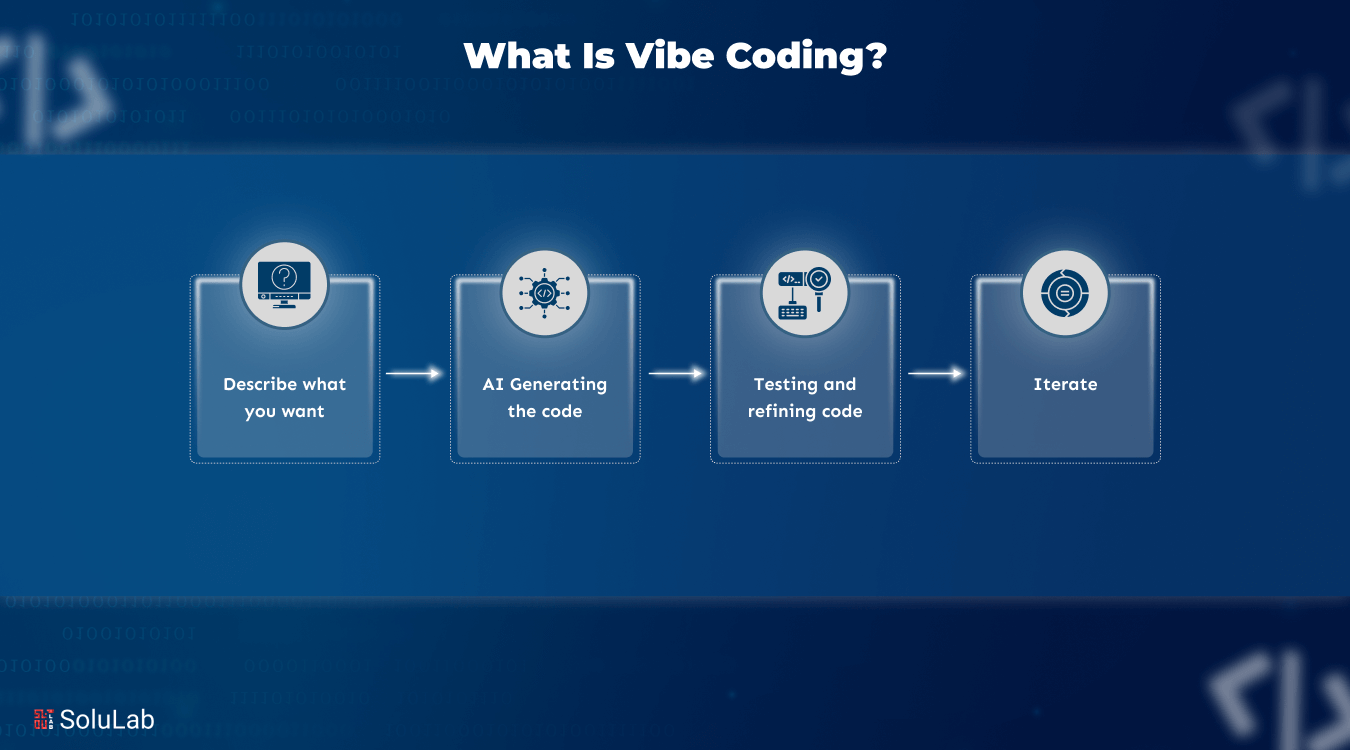
The pitch is simple: get more done without killing the creative part. It is a relaxed, intuitive, very collaborative way to build software. Strip it down and the loop looks like this:
1. Describe the Intent: You begin by saying, in plain English, what the software should do. Something like “create a user login form” or “build a dashboard for sales analytics.” That is the whole spec, at least to start.
2. AI Generates the Code: Large Language Models(LLMs) read those instructions and turn them into executable code, whether it belongs in the front end, the back end, or the database layer.
3. Real-Time Testing and Iteration: Tools such as Rocket.new and Replit vibe coding show you a live preview right away. You poke at it, spot what is off, adjust, and watch the change land in seconds.
4. AI Handles Routine Tasks: The AI automates repetitive work nobody enjoys: boilerplate, input validation, error handling. That leaves developers with the parts that need a brain, namely logic and the user experience.
5. Human-Centered Refinement: People are still in charge. Developers review what the AI wrote, untangle the hard problems, and keep the product pointed at what users and the business actually need. In practice, this review step is where most of the real judgment happens.
6. Quick Deployment: Once it is done, the code ships straight away through cloud-native tooling. No elaborate setup. No babysitting infrastructure.
Key Features of Vibe Coding Platforms
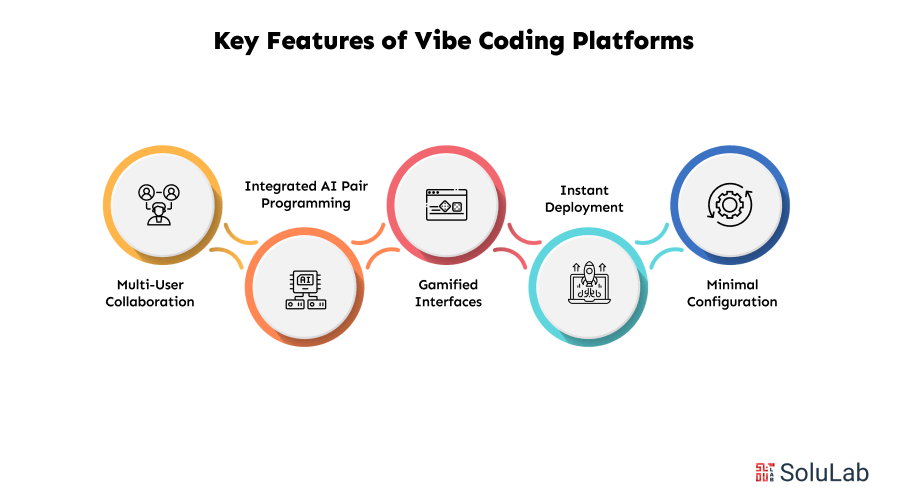
Software keeps getting more complicated, and teams need smarter help just to keep up. Vibe Coding AI answers that with AI agents that slot directly into the way developers already work. They cut manual effort. They speed things up. And they tend to nudge the code in a better direction. Here is what that looks like on the ground, because today’s vibe coding platforms are built around a handful of priorities:
- Multi-User Collaboration
Several developers can sit in the same codebase at once and watch each other’s edits appear live. Teamwork gets easier, bugs get squashed faster, and fewer messages go missing between people.
- Integrated AI Pair Programming
Think of the AI agent as a pair programmer who never gets tired. It offers suggestions, finishes your lines, and helps debug as you go. Work moves faster, and there are fewer slips of the human kind.
- Gamified Interfaces
Interactive, easy-to-read interfaces make coding more fun and less intimidating. That matters most when people are learning, or when the pace is frantic and attention is the scarce thing.
- Instant Deployment
Run it and preview it right there in the browser. Prototypes come together quickly, and every change gets checked the moment you make it.
- Minimal Configuration
No tangled setup, no afternoon lost to dependency management. You just start. That saves time for seasoned teams and makes the first step far less scary for beginners.
Replit Vibe coding is a good example: you write, test, and deploy inside the browser and get feedback instantly, without the usual tax of setup time and tooling headaches. Tools like this are a big part of where development is going.
The Impact of Vibe Coding AI on Modern Development
Vibe Coding AI changes how software gets built by putting intelligent agents inside the development process itself, not bolted on at the end. They behave like collaborators working alongside you in real time, streamlining workflows and lifting the quality of the code.
Smart autocompletion. Bugs caught before they bite. The upshot is that teams move faster and make better calls along the way. A scrappy startup and a big enterprise can both use it, since it grows with whatever you need.
- Autocomplete Code
The AI proposes snippets that fit the logic around them and the shape of your project. Less typing, and more of what you type is right. - Suggest Improvements
Vibe Coding AI pays attention to team feedback and shared activity, then tunes its suggestions to match. Over time, coding styles converge and working together gets smoother. - Detect Bugs Proactively
It spots trouble early. Risky patterns get flagged, and fixes are offered while you are still writing, not after something breaks. - Translate Ideas into Code
Describe the feature in plain words and the AI writes matching code. The distance between “here’s the idea” and “here’s the implementation” shrinks a lot.
Examples of Vibe Coding in Action
This is not a whiteboard idea anymore. Teams are already using vibe coding on real projects, mixing smart tools, live collaboration, and cloud environments to build with far less friction. A couple of vibe coding examples show how flexible it can be.
- Replit Hackathon
One fintech team put together a complete MVP in 36 hours with Replit vibe coding and AI code generation [SOURCE NEEDED]. Zero setup. Just quick, live collaboration.
- Shopify Sprint
Shopify reportedly used Vibe coding AI to turn ideas into code on the spot and had a working beta live in 10 days, roughly twice its usual pace [SOURCE NEEDED].
Why Should Businesses Invest in Vibe Coding Software Development?
Tech moves fast, and vibe coding software development is one of the few shifts that genuinely changes the math. Speed of typing is not the point. The point is getting from an idea to a real, working product in a fraction of the usual time, without letting quality slide.
AI-driven tools, live teamwork, and no setup pain: together they let a team move quickly and stay inventive while still shipping better work. If you are a startup building your first MVP, you get there sooner. A large company modernizing old systems gets room to breathe. Either way, you are better placed to react when the market moves, and here is why:
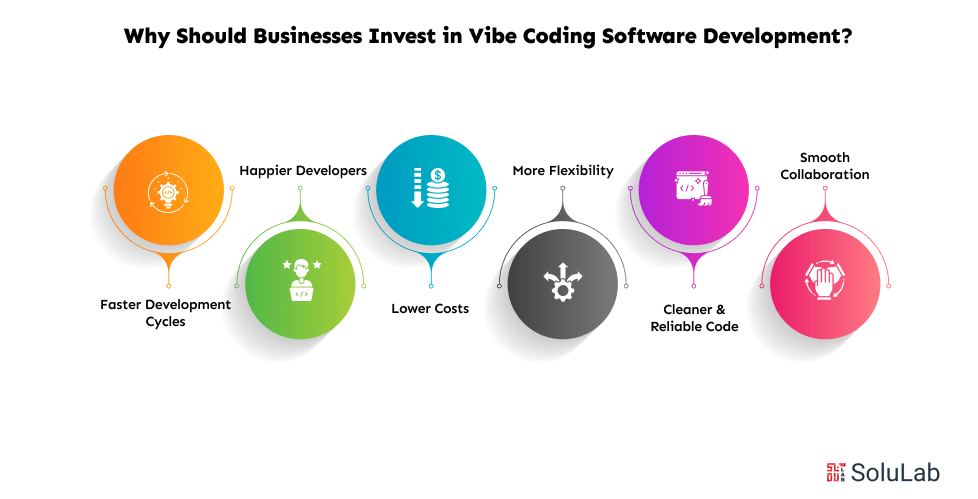
1. Faster Development Cycles
AI suggestions, instant feedback, and test environments that spin up on demand mean you build, adjust, and launch features much sooner. Days, often, instead of weeks. Less time staring at a build bar, more time making something worth using. You can push updates often, act on feedback while it is still fresh, and keep a step ahead of the competition.
2. Happier Developers
Coding becomes more intuitive and more visual. The repetitive grind, writing boilerplate, chasing the same bugs over and over, mostly falls away. Developers get to do the interesting part instead of drowning in chores. And people who enjoy their work tend to stay, which keeps hiring and onboarding costs down.
3. Lower Costs
Forget heavy infrastructure, never-ending local setups, and pricey server upkeep. Vibe coding platforms live in the cloud, bill as you go, and need next to no configuration. You pay for what you actually use. Scaling up does not mean a fight. And you skip the expensive DevOps overhead that used to exist purely to keep the lights on.
4. More Flexibility
Halfway through and the plan changes? Customers suddenly want a feature nobody scoped? With vibe coding you can respond almost immediately. Teams try things without betting big chunks of budget on each experiment. Agility is built in, which is exactly what you want when business conditions refuse to sit still.
5. Cleaner & Reliable Code
Because the AI integration actually understands context, the codebase stays tidy and consistent. Bugs get caught before deployment. Best practices get applied without someone nagging. Sometimes it even proposes smarter logic than you had in mind. The result is fewer fires in production and less pain maintaining things a year from now. Good code on day one pays off for users and for the product.
6. Smooth Collaboration
Same office or different continents, it hardly matters. Vibe coding platforms keep everyone working in sync, live, with no manual pushing and pulling of code. Updates show up for the whole team the instant they happen, so there is less waiting and fewer mix-ups. It feels like sharing a room even when you don’t.

Conclusion
Vibe Coding is where AI and human-led software development meet, and the meeting is a productive one. Faster typing was never the real prize. What changes is the whole lifecycle, from first idea to maintenance. Live collaboration, smart automation, and deployment without friction let teams build new things quickly and still hold a high bar for quality.
SoluLab’s experts build modern coding solutions shaped around what your business actually needs. Want AI inside your development stack? Need a team of Vibe-ready developers? You can hire full-stack developers or AI consultants who will help you speed up your digital transformation.
If your current development process feels slow, that is the place to start. Talk to SoluLab about building what comes next.
FAQs
Shipra Garg is a tech-focused content strategist and copywriter specializing in Web3, blockchain, and artificial intelligence. She has worked with startups and enterprise teams to craft high-conversion content that bridges deep tech with business impact. Her work translates complex innovations into clear, credible, and engaging narratives that drive growth and build trust in emerging tech markets.