Key Takeaways
- Cybersecurity is shifting from protection to trust design
- Blockchain removes reliance on centralized authorities
- Immutability ensures data integrity and auditability
- Decentralization reduces single-point failures
- Best suited for multi-party, high-trust environments
- Not a replacement, but a strong complement to existing security
- Adoption should be architecture-driven, not trend-driven
Cybersecurity used to be about keeping bad actors out.
Today, it is about assuming they are already inside.
That shift has changed everything. Firewalls, endpoint protection, and access controls still matter, but they are no longer enough. Most modern breaches do not happen because systems lack protection. They happen because systems are built on implicit trust.
A central database. A single identity provider. One layer that everything depends on.
When that layer breaks, everything breaks with it.
This is where blockchain development solutions enter the conversation, not as a replacement for cybersecurity tools, but as a way to rethink how trust is built into systems from the ground up.
Instead of asking “how do we protect this system,” blockchain pushes a different question:
What if the system did not require trust in the first place?
What Blockchain Actually Changes?
Most explanations of blockchain technology start with decentralization.
That is true, but incomplete.
The more important shift is this: blockchain removes the need for a central authority to validate truth.
In traditional systems, trust is delegated. A bank verifies transactions. A server validates credentials. A database confirms records.
In blockchain systems, validation is distributed across a network. Every participant has visibility. Every transaction is verified collectively.
This changes three things at a fundamental level:
- Data is no longer controlled by a single entity
- Records cannot be quietly altered after the fact
- Trust becomes verifiable, not assumed
It is less about “secure storage” and more about provable integrity.
That distinction is what makes blockchain relevant to cybersecurity, especially in environments where auditability and trust are non-negotiable.
How Blockchain Works in a Security Context?
At a structural level, blockchain is a chain of records, where each new record is mathematically linked to the previous one.
Each block contains:
- A set of transactions
- A cryptographic hash (a unique fingerprint)
- A reference to the previous block
This chaining creates a system where even a small change in one block breaks the entire sequence.
In practice, this means:
- You cannot alter past data without detection
- You cannot insert fraudulent records unnoticed
- You cannot rewrite history
On top of this, blockchain security uses public and private key cryptography.
Instead of usernames and passwords, users authenticate through cryptographic signatures. This significantly reduces common attack surfaces like credential theft.
Transactions are also validated by multiple nodes in the network. No single system gets to “decide” what is true.
That combination, distributed validation + cryptographic identity + immutability, is what gives blockchain its security strength.

Where Traditional Cybersecurity Models Fall Short?
Most enterprise security architectures still follow a familiar pattern:
- Protect the perimeter
- Authenticate the user
- Grant access to systems
It works, until it doesn’t.
The problem is not that these systems are poorly designed. The problem is that they are centralized by nature.
And centralization creates predictable weaknesses:
- A single breach can expose entire databases
- Insider access can bypass controls
- Credentials can be stolen or reused
- Logs can be altered or deleted
Even zero-trust models, while stronger, still depend heavily on centralized identity and access systems.
Blockchain integration does not eliminate all risks, but it changes where those risks sit.
Instead of concentrating trust in one place, it distributes it across the system.
That shift reduces the impact of any single failure, which is exactly where most cybersecurity incidents begin.
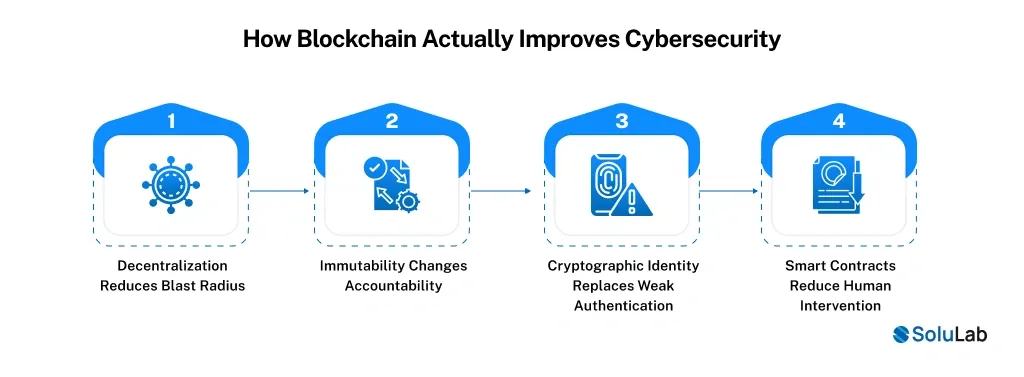
How Blockchain Actually Improves Cybersecurity?
Blockchain stack does not magically “secure everything.” What it does is change how systems behave under attack.
Instead of relying on barriers, it builds resistance into the structure itself.
- Decentralization reduces the blast radius
In a traditional setup, breaching one central system can expose everything. In a blockchain-based decentralized application, there is no single control point to compromise.
An attacker would need to manipulate a majority of the network, which is far more complex and expensive.
- Immutability changes accountability
Most systems allow data to be edited, overwritten, or deleted. That flexibility is useful, but also dangerous.
Blockchain removes that flexibility.
Once data is recorded, it stays. That creates a permanent audit trail, which is incredibly valuable in environments where traceability matters, like finance or compliance-heavy industries.
- Cryptographic identity replaces weak authentication
Passwords are still one of the biggest vulnerabilities in cybersecurity.
Blockchain replaces this with key-based authentication. Users sign transactions using private keys, making unauthorized access significantly harder.
- Smart contracts reduce human intervention
A surprising number of security failures come from human error.
Smart contracts automate decisions and enforce rules without manual involvement. If conditions are not met, actions simply do not execute.
That removes a layer of operational risk that traditional systems struggle with.
Taken together, blockchain does not just defend systems better. It limits how much damage can be done when something goes wrong.
Real-World Use Cases of Blockchain in Cybersecurity
The value of blockchain development use cases becomes clearer when you move from theory to application.
Across industries, it is already being used to solve very specific security problems.
- Identity management without central control
Centralized identity systems are a major target for attackers.
Blockchain enables self-sovereign identity, where users own and control their credentials. There is no central database to breach, and verification can happen without exposing sensitive data.
- Securing data in transit
Sensitive data moving between systems is always at risk of interception.
Blockchain adds an additional layer of encryption and validation, ensuring that data cannot be altered mid-transfer.
- Protecting software integrity
One overlooked attack vector is software tampering.
Blockchain can store hashes of legitimate software versions. When a file is downloaded or updated, its hash can be compared against the blockchain record to confirm authenticity.
- Strengthening IoT security
IoT development solutions often operate with weak security protocols.
Blockchain helps by enabling:
- Device authentication without central servers
- Tamper-proof activity logs
- Secure communication between devices
- Reinforcing DNS infrastructure
DNS attacks can redirect users to malicious environments without their knowledge. Blockchain-based DNS systems enable organizations to securely store and verify DNS records, making them significantly harder to manipulate.
This allows users and administrators to check DNS records with greater confidence while improving trust, transparency, and security in domain resolution systems.
- Reducing DDoS vulnerability
Distributed Denial of Service attacks exploit centralized infrastructure.
Blockchain-based systems distribute workload across nodes, making it much harder to overwhelm a single point.
These use cases show a clear pattern: blockchain is most effective where centralization itself is the vulnerability.

Understanding Blockchain Through the CIA Triad
Cybersecurity frameworks often come down to three pillars:
- Confidentiality
- Integrity
- Availability
Blockchain aligns with all three, but in slightly different ways than traditional systems.
- Confidentiality
Blockchain uses encryption and key-based access to protect data.
Only users with the correct private keys can access or interact with specific information. This reduces reliance on traditional access control systems.
However, this also introduces a new responsibility. If a private key is lost, access may be permanently lost.
- Integrity
This is where blockchain is strongest.
Because data cannot be altered after it is recorded, integrity is built into the system. Every change is visible, traceable, and verifiable.
For industries that rely on accurate records, this is a major advantage.
- Availability
Blockchain platforms do not rely on a single server.
Data is distributed across multiple nodes, which means the system can continue functioning even if parts of the network go down.
This makes blockchain inherently more resilient to outages and certain types of attacks.
Instead of protecting these three pillars externally, blockchain embeds them directly into how the system operates.
Advantages and Limitations: A More Balanced View
Blockchain consulting services offer strong advantages, but it is not a universal solution. Understanding both sides is important before adopting it.
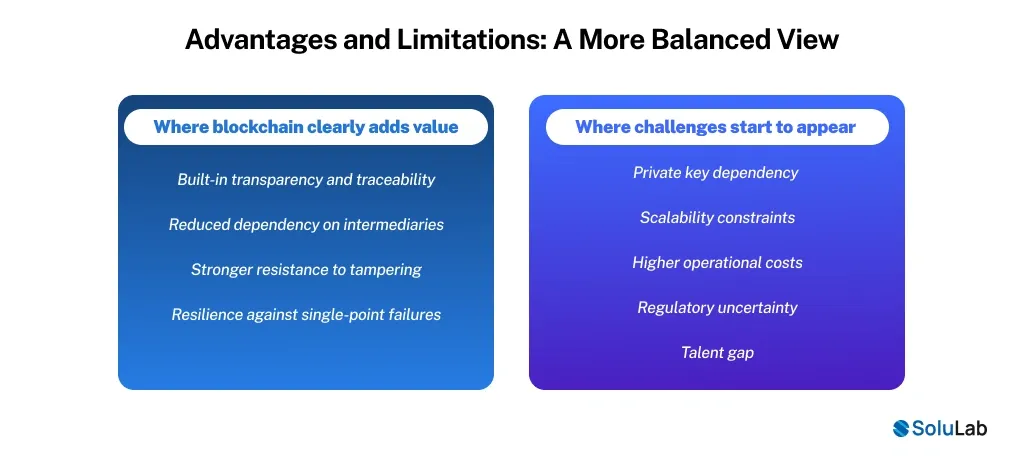
Where blockchain clearly adds value?
- Built-in transparency and traceability
Every transaction is recorded and can be audited. This is particularly useful in regulated industries. - Reduced dependency on intermediaries
Systems can operate without relying on central authorities, reducing both cost and risk. - Stronger resistance to tampering
Immutability makes unauthorized changes extremely difficult. - Resilience against single-point failures
Distributed architecture ensures that systems remain operational even during partial failures.
Where challenges start to appear?
- Private key dependency
Security depends heavily on key management. Losing keys can mean losing access permanently. - Scalability constraints
Blockchain networks can struggle with high transaction volumes compared to traditional systems. - Higher operational costs
Running and maintaining blockchain infrastructure can be resource-intensive. - Regulatory uncertainty
Global standards are still evolving, which creates ambiguity for enterprise adoption. - Talent gap
There is still a shortage of experienced blockchain developers and architects.
The takeaway is simple.
Blockchain is not a replacement for cybersecurity. It is a different approach to designing secure systems.
Used in the right context, it can significantly strengthen security posture. Used blindly, it can introduce unnecessary complexity.
Where Blockchain Is Already Working in Cybersecurity?
It is easy to list examples. It is more useful to understand why organizations are turning to blockchain app development in specific contexts.
Institutions like Barclays have explored blockchain in banking to secure transaction flows. The motivation is not just efficiency. It is about reducing fraud surfaces in systems where even minor manipulation can have a cascading financial impact.
In enterprise infrastructure, Cisco has looked at blockchain to secure IoT ecosystems. The challenge here is scale. Thousands of devices, each acting as a potential entry point. Blockchain introduces a way to authenticate devices and log activity without relying on a central controller.
In the cryptocurrency development, platforms like Coinbase operate in an environment where security is existential. Their use of cryptographic controls and layered protections reflects a broader pattern: when the asset itself is digital, security must be embedded at the protocol level.
Governments are also experimenting. The Australian Government has explored blockchain-backed systems for document integrity. The goal is simple: ensure that critical records cannot be altered without detection.
Even players like Philips Healthcare are using blockchain in healthcare to manage sensitive patient data, where both privacy and traceability are equally important.
Across these examples, a pattern emerges.
Blockchain is not being used everywhere. It is being used where trust, traceability, and tamper-resistance are non-negotiable.
The Future of Blockchain in Cybersecurity
Blockchain in cybersecurity is still evolving, but a few clear directions are emerging.
- Convergence with AI-driven security
Security systems are becoming more predictive. When combined, AI and blockchain can analyze tamper-proof data streams, making threat detection more reliable and harder to manipulate.
- Rise of decentralized identity
Identity systems are likely to move away from centralized providers. Users will increasingly control their own credentials with blockchain-based decentralized identity systems, reducing large-scale identity breaches.
- Privacy-first architectures
Technologies like zero-knowledge proofs are gaining traction. These allow verification without exposing underlying data, which is critical in privacy-sensitive industries.
- Zero-trust alignment
Blockchain fits naturally into zero-trust models. Instead of assuming trust, every interaction is verified, logged, and traceable.
- Regulatory maturity
Right now, regulation is fragmented. Over time, clearer frameworks will emerge, making it easier for enterprises to adopt blockchain without compliance ambiguity.
The important point is this.
Blockchain will not replace existing cybersecurity systems. It will sit alongside them, strengthening specific layers where traditional models struggle.

How Enterprises Should Think About Adoption?
One of the biggest mistakes organizations make is approaching blockchain development as a feature instead of a system decision.
The better approach is to ask:
- Where does trust currently sit in our architecture?
- What happens if that trust layer fails?
- Do we need immutability, or just access control?
Blockchain makes sense when:
- Multiple parties need to share and verify data
- Auditability is critical
- Centralized control creates risk
It does not make sense when:
- Speed is more important than traceability
- Systems are already tightly controlled and low-risk
- Complexity outweighs the benefit
From an implementation perspective, this is where experienced partners matter.
Teams that understand blockchain layers and both architecture and compliance can help design systems that are not just technically sound, but also deployable in real-world environments.
This is typically where firms like SoluLab position themselves, not as tool providers, but as infrastructure partners who can guide phased adoption aligned with business goals.
Conclusion
Cybersecurity is no longer just about defense. It is about designing systems that remain trustworthy even when things go wrong.
Partnering with a blockchain development company does not eliminate risk, but it redistributes it.
By removing central points of failure, enforcing data integrity, and embedding trust into system design, it offers a fundamentally different way to approach security.
For organizations operating in high-risk, high-trust environments, that shift is not optional anymore.
It is becoming necessary.
FAQs
Shipra Garg is a tech-focused content strategist and copywriter specializing in Web3, blockchain, and artificial intelligence. She has worked with startups and enterprise teams to craft high-conversion content that bridges deep tech with business impact. Her work translates complex innovations into clear, credible, and engaging narratives that drive growth and build trust in emerging tech markets.