


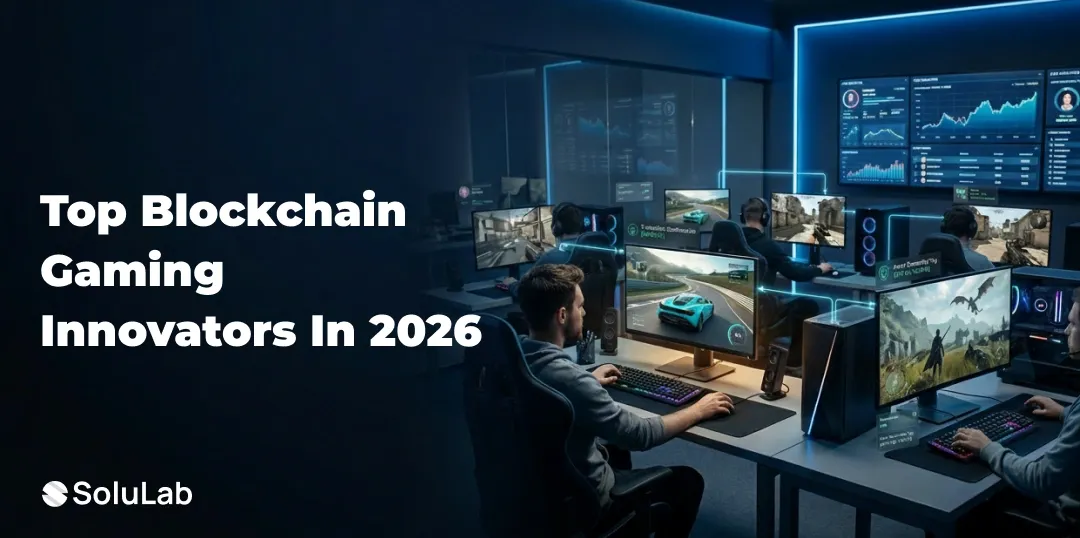
Blockchain gaming is no longer niche as it’s becoming a core part of the global gaming industry. By enabling transparent, verifiable transactions and true digital ownership, blockchain eliminates fraud risks and gives players real control over in-game assets. This shift has fueled massive demand for blockchain game development and Web3 gaming infrastructure.
In 2026, the industry is being shaped by companies building decentralized ecosystems, play-to-earn models, and immersive virtual economies. From NFT-based games to metaverse platforms and decentralized applications, these innovators are redefining how games are built, played, and monetized.
This blog explores the top 15 blockchain gaming companies leading this transformation—and what sets them apart.
Key Takeaways
- With expertise in AI, blockchain, and game development, SoluLab enables enterprises to launch secure, high-performance, and future-ready blockchain gaming platforms.
- Blockchain gaming is moving mainstream in 2026, driven by player-owned assets, transparent transactions, and decentralized economies.
- Play-to-earn (P2E), NFTs, and metaverse ecosystems are reshaping how games are built, monetized, and experienced.
- Leading companies are focusing on scalable Web3 gaming infrastructure, enabling faster, secure, and interoperable gaming platforms.
- True digital ownership and fraud prevention are key drivers behind the growing demand for blockchain game development.
- The rise of AI-powered game mechanics and smart contracts is enhancing gameplay, automation, and in-game economies.
- Companies like SoluLab are helping businesses build end-to-end blockchain gaming solutions, from NFT integration to scalable Web3 architectures.
Evaluation Criteria for Selecting Top Blockchain Gaming Companies
As gaming continues to evolve, blockchain technology has emerged as a game-changer, revolutionizing the gaming industry. With the growing number of blockchain gaming companies, it’s crucial to understand the key evaluation criteria for choosing the best among them. This blog explores the factors to consider when selecting a company that develops top blockchain games in 2026.
- Technology and Blockchain Integration: Evaluate how well the company integrates game blockchain technology into its gaming ecosystem. Look for robust blockchain infrastructure, smart contract development capabilities, decentralized asset ownership, and transparent and secure transaction mechanisms.
- Gaming Experience and Quality: Consider the overall gaming experience offered by the company. Assess the quality of graphics, gameplay, user interface, and responsiveness. Look for immersive and engaging gaming experiences that leverage game blockchain technology effectively.
- Game Diversity and Innovation: Examine the company’s portfolio of games. Look for various genres: action, strategy, role-playing, and more. Consider the level of innovation in terms of unique gameplay mechanics, creative storytelling, and novel features.
- Community and Player Engagement: Evaluate the company’s community and player engagement initiatives. Consider the company’s approach to fostering a vibrant and supportive gaming community.
- Blockchain Transparency and Security: Assess the transparency and security features provided by the company’s blockchain infrastructure. Look for open and auditable smart contracts, secure asset storage, and robust anti-cheat mechanisms. Consider the company’s commitment to ensuring fair play and protecting user data.
- Partnerships and Ecosystem: Examine the company’s partnerships and collaborations within the blockchain and gaming industries. Consider alliances with prominent game developers, blockchain platforms, and gaming influencers. Evaluate how these partnerships contribute to the overall ecosystem and growth potential.
- Scalability and Performance: Evaluate the company’s ability to handle a large user base and maintain smooth performance. Look for scalability solutions that enable high transaction throughput and low latency.
- Monetization and Token Economy: Assess the company’s monetization model and token economy. Look for fair and sustainable monetization mechanisms that value players and the company. Consider the utility and potential value appreciation of in-game tokens.
As gaming evolves, the way blockchain works is redefining how games are built, owned, and monetized. With a surge in Web3 gaming companies, choosing the right partner is no longer straightforward. Factors like scalability, security, NFT integration, and ecosystem support now play a critical role.
This blog breaks down the key criteria to evaluate and choose the best blockchain gaming company in 2026.

Comparison of Top Blockchain Development Companies Offering Custom Blockchain Game Solutions
The table below provides a side-by-side view of all 15 blockchain game company options covered in this guide, across the dimensions that matter most when making a selection: team size, location, pricing, and core specialization.
| Company | Founded | Employees | Location | Hourly Rate | Specialization | Strengths |
|---|---|---|---|---|---|---|
| Sky Mavis | 2018 | 350+ | Vietnam | N/A | Ronin blockchain, P2E ecosystems | Gaming-native L1, massive player base |
| Carbonated Games Inc. (MadWorld) | 2020 | 50+ | San Francisco, USA | $50–150/hr | Immersive Web3 games, P2E experiences | End-to-end Web3 integration, immersive VR/AR gameplay |
| SoluLab | 2014 | 250+ | Los Angeles, USA | $25–75/hr | Smart contract audit, DApps, blockchain games | Security-first, AI + Web3, US-based |
| Whimsy Games | 2016 | 100+ | Ukraine / USA | $25–50/hr | Unity-based P2E, Web3 game studios | Game-specialized team, fast delivery |
| ScienceSoft | 1989 | 750+ | Texas, USA | $50–99/hr | Blockchain integration, game backend security | Enterprise IT governance, ISO certified |
| Immutable X | 2018 | 600+ | Sydney, AU | Platform | L2 scaling, gas-free NFTs, Passport SDK | Best-in-class gaming infrastructure |
| Mythical Games | 2018 | 200+ | Los Angeles, USA | N/A | AAA on-chain economies, Mythical Platform | Mainstream reach, NFL partnership |
| Animoca Brands | 2014 | 400+ | Hong Kong | N/A | Publishing, The Sandbox, open metaverse | Ecosystem scale, 400+ portfolio co’s |
| Juego Studios | 2016 | 200+ | India / USA | $25–50/hr | Web3 games, NFT, metaverse experiences | Creative + technical combined delivery |
| Horizon Blockchain | 2018 | 100+ | Toronto, Canada | Platform | Sequence wallet SDK, Skyweaver | Seamless wallet UX, embedded Web3 |
| Unicsoft | 2015 | 150+ | USA / Ukraine | $25–75/hr | P2E, Unity builds, hybrid on/off-chain | Tokenomics-first methodology |
| Metlabs Blockchain | 2019 | 50+ | USA | $50–100/hr | Gaming, DeFi, NFT integration | Protocol-native, contract optimization |
| BR Softech | 2010 | 500+ | India / USA | $15–50/hr | NFT gaming, metaverse, real-money games | Decade of game dev maturity, low cost |
| Stepico | 2015 | 100+ | Ukraine | $25–50/hr | Mobile blockchain games, P2E | Mobile-first UX, iOS/Android specialist |
| RedDuck | 2018 | 50+ | USA / E. Europe | $50–100/hr | DApps, smart contracts, game protocols | Audit-first engineering, gas-optimized |
Here is a List of the Top 15 Blockchain Gaming Companies in 2026
Below is a deep-dive profile of each company covering their background, specialization, client work, and what makes them the right (or wrong) fit for specific types of blockchain game projects.

1. Sky Mavis
 $150 – $200 / hr
 350+
350+
 2018
2018
 Ho Chi Minh City, Vietnam
Sky Mavis proved that serious blockchain games cannot rely on generic chains. By building Ronin Network, they delivered near-zero fees and rapid finality, non-negotiables for real gaming UX. Mavis Market anchors the ecosystem, while Ronin Wallet removes onboarding friction. The result is a vertically integrated, gaming-first stack that now powers dozens of third-party titles, not just Axie, making Sky Mavis a clear blueprint for developers who want infrastructure that actually scales with players.
Best for: Gaming-specific Layer-1 blockchains and high-volume NFT ecosystems.
Why You Should Consider Them: Battle-tested infrastructure at consumer scale with a dedicated gaming community and an expanding multi-game ecosystem on Ronin.

2. Carbonated Games Inc.
$50 – $150 / hr
50+
2020
San Francisco, USA
Carbonated Games Inc. (MadWorld) differentiates itself by building immersive Web3 games that blend VR/AR with dynamic NFTs, play-to-earn economies, and decentralized multiplayer worlds. With deep Unity and Unreal expertise across Ethereum L2s, Solana, and Immutable X, they onboard non-crypto players seamlessly, focusing on player ownership, viral growth, and games proven to scale with real trading volume.
Best for: Immersive Web3 P2E games, VR metaverses, and NFT-driven interactive experiences.
Why You Should Consider Them: Pioneering immersive gameplay with robust Web3 tech stacks, rapid prototyping, and a portfolio of high-engagement titles at scalable pricing.

3. Solulab
$25 – $75 / hr
250+
2014
Los Angeles, California, USA
SoluLab’s edge comes from combining security-first thinking with product-grade engineering. Every engagement begins with threat modeling and smart contract audits before any real value is exposed. We’ve shipped production systems across Ethereum, Solana, Polygon, BNB Chain, and Hyperledger, spanning ownership, staking, in-game economies, and cross-chain flows. Add AI + Web3 integration and payment-native design, and clients aren’t just launching, they’re future-proofing from day one.
Best for: Security-first DApp and blockchain game development with smart contract auditing, AI integration, and scalable platform engineering
Why You Should Consider Them: The rare combination of enterprise-grade security practices, full-stack blockchain engineering, and a US-based delivery model with a proven client roster across industries

4. Whimsy Games
$25 – $50 / hr
100 +
2016
Ukraine (+ US presence)
Whimsy Games is a pure-play blockchain gaming studio, where every engineer and designer thinks in game mechanics first, not just smart contracts. They build across Ethereum, Polygon, and Solana, with deep Unity expertise layered directly with on-chain logic. NFT assets, wallets, and in-game economies are designed from day one, avoiding the costly retrofitting most studios regret later. For teams serious about Web3 gaming, their approach is pragmatic, focused, and built to ship.
Best for: Unity-based P2E game development and custom blockchain game solutions for indie and mid-market studios.
Why You Should Consider Them: Specialized focus on Web3 gaming means no generalist overhead, as every hour billed directly advances your blockchain game’s core mechanics and on-chain economy.

5. ScienceSoft
$50 – $99 / hr
750 +
1989
McKinney, Texas, USA
ScienceSoft brings a rare combination to blockchain gaming: enterprise-grade governance applied to game infrastructure. Their blockchain development services blend smart contracts, private chains, node ops, and security audits with real consultancy-level delivery discipline. For studios with regulatory or data-security pressure, compliance is built into the architecture, not added later. Their real strength is backend resilience: servers, wallets, and chain interactions that hold up under scale.
Best for: Enterprise blockchain integration, game backend security, and compliance-ready blockchain gaming infrastructure
Why You Should Consider Them: Decades of enterprise IT experience combined with modern blockchain capabilities, which is ideal for gaming companies operating in regulated markets or requiring SOC 2/ISO-grade security

6. Immutable X
$350 – $500 / hr
600 +
2018
Sydney, Australia
Immutable X removes the two biggest blockers in blockchain gaming: gas fees and onboarding friction. Its ZK-rollups enable near-zero-cost NFT transactions, while Passport replaces seed phrases with simple social logins. Studios also plug into a shared marketplace, liquidity layer, and cross-game order book by default. For builders, its SDKs, APIs, and Unity/Unreal plugins are among the most production-ready available.
Best for: Gas-free NFT infrastructure, Layer-2 scaling, and player onboarding SDKs for blockchain game developers.
Why You Should Consider Them: Best-in-class infrastructure for studios that want to focus on game design rather than blockchain plumbing. Immutable handles the chain complexity.
7. Mythical Games
$250 – $500 / hr
200 +
2018
Los Angeles, California, USA
Mythical Games wins because they design games first and layer blockchain second. Their Mythical Platform works as white-label infrastructure, letting publishers launch player-owned economies without rebuilding chain rails. NFL Rivals proved that mainstream users will engage when crypto friction disappears. Add AI-driven economy balancing, and you’re looking at the playbook studios should study before launching any serious Web3 gaming product.
Best for: AAA blockchain game production and white-label player-owned economy platforms for publishers and game studios.
Why You Should Consider Them: Proven ability to bring blockchain mechanics to mainstream gaming audiences, backed by major brand partnerships and a purpose-built publishing platform.

8. Animoca Brands
$350 – $500 / hr
400+
2014
Hong Kong
Animoca isn’t just a developer, they’re a publisher, accelerator, and strategic advisor rolled into one, rare among top blockchain game companies. Their open metaverse thesis drives every title and investment. Studios get not just development muscle, but a token strategy, go-to-market support, and ecosystem integration. Their Web3 solutions span gaming, music, sports, and culture.
Best for: Web3 game publishing, ecosystem investment, open metaverse development, and token economy advisory.
Why You Should Consider Them: Unmatched ecosystem depth by Partnering with Animoca means access to their entire portfolio network, investor relationships, and proven open-metaverse playbook.

9. Juego Studios
$25 – $50 / hr
200 +
2016
Bangalore, India (+ USA offices)
Juego Studios delivers end-to-end game development from concept art and 3D modeling to smart contracts, backend, and live ops, blending high-quality visuals with robust on-chain mechanics. Using Unity, Unreal, Ethereum, BNB Chain, and Polygon, they avoid the trap of style outpacing blockchain. For founders seeking blockchain game developers with both technical and artistic depth, Juego offers a rare, complete solution.
Best for: Full-cycle Web3 game development combining AAA visual production with smart contract engineering and live ops support
Why You Should Consider Them: Rare blend of high-quality game art production and deep blockchain technical expertise: one studio can carry both the creative vision and the on-chain architecture

10. Horizon’s Sequence
$150 – $200 / hr
100+
2018
Toronto, Canada
Horizon’s Sequence platform solves one of blockchain gaming’s toughest problems: making wallets feel like a seamless app feature. Their SDK integrates with social login, session keys, and gasless relayers, while Skyweaver proves it works in the wild. Developers can tap marketplace APIs and NFT indexing, cutting the infrastructure load. For teams seeking a Web3 development partner in the US or Canada, Horizon delivers battle-tested tooling.
Best for: Embedded wallet infrastructure, gasless relayer networks, and Web3 game SDK tooling
Why You Should Consider Them: Best choice for game studios that want seamless player UX. Sequence abstracts blockchain complexity so developers can focus on gameplay, not crypto UX
11. Unicsoft
$25 – $75 / hr
150+
2015
USA / Ukraine
Unicsoft puts tokenomics and smart contract design at the core, not as an afterthought. Their Unity expertise ensures mobile and PC games run smoothly, while on-chain layers across Ethereum, BSC, and Solana handle asset ownership, rewards, and staking reliably. They excel at hybrid games mixing on-chain security with off-chain performance and also help clients build CFTC-compliant Web3 wallets within broader game economies.
Best for: Unity-based P2E blockchain games with hybrid on/off-chain architecture and tokenomics design
Why You Should Consider Them: Structured delivery methodology, strong Unity engineering, and flexible engagement models make them a reliable partner for early-stage and growth-stage blockchain game studios

12. Metlabs
$50 – $100 / hr
50+
2015
New Delhi, India
Metlabs brings an unusually protocol-native mindset – their engineers have hands-on experience with low-level contract optimization, cross-chain bridging, and on-chain randomness systems (VRF) that are critical for fair, trustless game mechanics. Their DeFi integration capabilities mean game economies can connect to lending, yield, and liquidity protocols, unlocking financial composability that traditional games simply cannot offer.
Best for: Protocol-level blockchain engineering for gaming, DeFi integration, cross-chain bridges, and on-chain randomness systems.
Why You Should Consider Them: Pure blockchain focus means every engineer is blockchain-native with no generalist overhead, and deep expertise in the contract patterns and protocol integrations that make game economies trustworthy.

13. BR SofTech
$15 – $50 / hr
500 +
2010
Jaipur, India (+ USA office)
With over a decade in game development, BR Softech brings disciplined delivery where many newer blockchain studios falter. Their expertise spans Ethereum, Polygon, BNB Chain, and Solana, covering card games, RPGs, casino, and metaverse experiences. For budget-conscious teams, their offshore-hybrid model offers the most accessible entry among established firms. Solutions include asset tokenization, wallet integration, staking, and live-ops dashboards.
Best for: Cost-effective blockchain game development for startups and mid-market teams, including NFT gaming, metaverse, and real-money game mechanics.
Why You Should Consider Them: Over 10 years of game development maturity combined with modern blockchain capabilities, accessible pricing without sacrificing delivery experience.

14. Stepico
$25 – $50 / hr
100+
2015
Lviv, Ukraine
Stepico makes blockchain seamless for mobile players like NFTs, wallets, and rewards feel like native game features, not crypto add-ons. They specialize in Unity for iOS and Android, integrating Ethereum L2s and BNB Chain. For studios looking to hire blockchain developers with mobile-first expertise, Stepico delivers engineers who balance blockchain complexity with UX constraints. Their session management and gas-optimization work solves issues desktop-first studios often miss.
Best for: Mobile-first blockchain game development with P2E mechanics, NFT integration, and seamless wallet UX for iOS and Android.
Why You Should Consider Them: Rare combination of mobile game development maturity and blockchain integration depth, which is ideal for teams targeting smartphone audiences with blockchain game mechanics.

15. RedDuck
$50 – $100 / hr
50+
2018
USA / Eastern Europe
RedDuck builds blockchain games from the contract layer up, creating gas-optimized, airtight smart contracts for fair, transparent mechanics. Their DApp architecture ensures smooth, reliable frontend-chain interaction, avoiding latency and common early-game pitfalls. Often called in to fix contract vulnerabilities or scalability limits, they combine audit-first discipline with hands-on experience across top blockchain games, making them a trusted protocol-layer partner.
Best for: Audit-first smart contract engineering and DApp architecture for blockchain games demanding protocol-layer precision.
Why You Should Consider Them: The contract-first engineering philosophy ensures game mechanics are trustless, gas-efficient, and exploit-resistant, which is critical for games where real economic value is at stake.
Which Blockchain Development Company Should You Choose for your use case?
With so many capable firms in the field of top blockchain games and companies, the decision comes down to four core variables: your project stage, your target chain, your budget, and the UX priority of your players.
If you are a startup building your first P2E game and need to minimize the cost to build a blockchain game while still hitting quality thresholds, agencies like SoluLab, Juego Studios, and BR Softech offer accessible pricing with proven delivery. Their offshore-hybrid models let you stretch seed capital further without compromising on technical depth.
If your priority is production-grade infrastructure for a high-transaction game, think tens of thousands of daily players transacting NFTs with Immutable X and Horizon Blockchain Games offer the best-in-class platform and SDK layer. These are the top Web3 Platforms your engineering team integrates with, rather than the development firms you commission custom work from.
If you need enterprise-grade security, compliance, and scale, particularly if your game touches real financial value or operates in a regulated market, SoluLab and ScienceSoft bring the audit rigor, ISO certifications, and governance frameworks that larger organizations require. Their blockchain development services go beyond code delivery into architecture review, threat modeling, and ongoing security monitoring.
If you are a major publisher or IP holder exploring blockchain game development company USA options for a flagship title, Mythical Games and Animoca Brands offer publishing-level partnerships that combine technical build capability with market access, token strategy, and ecosystem distribution.
In any scenario, ask each candidate firm the same set of questions:
- What on-chain games have you shipped?
- Can you show us your smart contract audit reports?
- How do you approach gas optimization for mobile users?
- What is your process when a contract needs to be upgraded post-launch?
The answers will quickly separate experienced blockchain game developers and platform providers from generalist shops claiming Web3 expertise.
Where SoluLab Can Be the Best Fit for Your Requirements?
SoluLab occupies a distinctive position in the landscape of Web3 game development company USA options: they are large enough to staff complex, multi-chain engagements with senior engineers but structured enough that clients receive direct senior attention rather than being handed to junior teams.
Here is where SoluLab consistently outperforms alternatives as a blockchain software development company:
1. Security-critical launches:
If your game will carry real economic value, like token treasuries, NFT assets with market prices, or staking pools, SoluLab’s smart contract audit-first process identifies critical vulnerabilities before mainnet. Most dev shops treat audits as a final checkbox; SoluLab embeds them in sprint reviews.
2. AI-enhanced game mechanics:
SoluLab’s AI native practice means they can integrate machine learning directly into game economies like dynamic difficulty, fraud detection, NPC behavior, and predictive analytics for in-game market balancing. Their understanding of AI in Web3 contexts positions them ahead of pure blockchain studios.
3. Cross-industry enterprise clients:
If your game is backed by a brand, sports league, or enterprise with compliance requirements, SoluLab’s track record with Fortune 500 clients gives them fluency in procurement processes, NDAs, security reviews, and enterprise IT integration.
4. Multi-chain architecture:
SoluLab has shipped on Ethereum, Solana, Polygon, BNB Chain, Avalanche, and Hyperledger. If your blockchain game ecosystems require cross-chain asset bridges or multi-chain deployment strategies, they have the breadth.
5. US-based engagement management:
For clients who require US-timezone responsiveness, contract structures, and US-based points of contact, SoluLab’s Los Angeles headquarters satisfies procurement and legal requirements that offshore-only firms cannot.
Whether you want to launch web3 app experiences for gaming, need to hire blockchain developers with deep smart contract expertise, or are ready to architect your full game economy, SoluLab offers a discovery call process that maps your requirements to a realistic scope, timeline, and budget before any commitment is made.
As a US blockchain game developer and platform partner, SoluLab also helps clients navigate the evolving regulatory landscape, including token classification, DAO governance structures, and the technical requirements to ensure compliant player-economy design from day one.
Conclusion
The blockchain gaming space has matured rapidly. The top blockchain games and companies profiled in this guide are no longer building on speculation; they are shipping live products with real economics, verifiable ownership, and growing player bases. The decentralized web3 ecosystem infrastructure layer has also advanced: gas costs have collapsed, wallet UX has improved dramatically, and developer tooling now rivals traditional game engines in maturity.
For any studio, publisher, or investor entering this space, the choice of a blockchain game development company USA partner or global provider will determine more than your launch. The timeline will define the security, scalability, and long-term upgradeability of your entire game economy. The cost to build a blockchain game is real, but the cost of getting the architecture wrong is far higher.
Across the 15 companies covered here, from infrastructure giants like Immutable and Sky Mavis to full-service blockchain software development company providers like SoluLab, the right choice depends on your specific stage, chain preference, compliance requirements, and audience. Use the comparison table and individual profiles to build a shortlist, then run a structured RFP or discovery conversation with your top two or three candidates.
The momentum behind blockchain game ecosystems is only accelerating. Studios that lock in strong technical foundations now, with the right blockchain consulting services partner, you will be positioned to capture the next wave of mainstream adoption as Web3 gaming crosses into the hundreds of millions of players.
FAQs
Bhavya is driving growth through data-backed demand generation for AI and Web3 solutions. With 9+ years in digital marketing, he has spearheaded initiatives that led to a 40% increase in qualified inbound leads. Bhavya shares insights on marketing ROI and scaling a digital presence via AI workflows. He is open to connecting with startups and enterprise teams to help them overcome their challenges.


![Kalshi vs Polymarket vs Augur vs Manifold: Prediction Market Platforms Comparison [2026 Guide]](https://www.solulab.com/wp-content/uploads/2026/08/Kalshi-vs-Polymarket-vs-Augur-vs-Manifold.webp)