Talk to an Expert

How Go Supercharges Blockchain Development for High-Scale Enterprises?

Golang Blockchain for Enterprises

Several industries, from tech to healthcare, are adopting blockchain to secure user data. However, building a reliable blockchain is a significant task; multiple programming languages can be used. Golang is also one of the options for blockchain development. 

Go is known for its simple and high-performance blockchain framework. Ethereum’s Geth client, to Hyperledger Fabric and Tendermint, adopted this method to build enhanced blockchain technology. This blog’s primary focus is to provide you with a detailed overview of blockchain development using Go. 

What Is a Blockchain Built with Go?

A blockchain built with Go is a distributed system that records transactions in secure blocks linked together.

Go offers concurrency, fast execution, and easy deployment, making it suitable for enterprise blockchain solutions and lightweight blockchain prototypes. Unlike other high-level programming languages, Go compiles into a single binary. This makes deployment simple across multiple platforms. This aids startups’ blockchain app development and provides enhanced solutions.

Why Go Is a Preferred Language for Blockchain Development?

Go’s architecture makes it ideal for large-scale blockchain programming.

  • Concurrency support: Thousands of Goroutines run in parallel, handling blockchain transactions efficiently.
  • Garbage collection: Automatic memory management keeps blockchain nodes stable under heavy load.
  • Cross-platform support: Go compiles to machine code and runs on different OSs without modification.

These features of Golang shape the speed, security, and scalability.

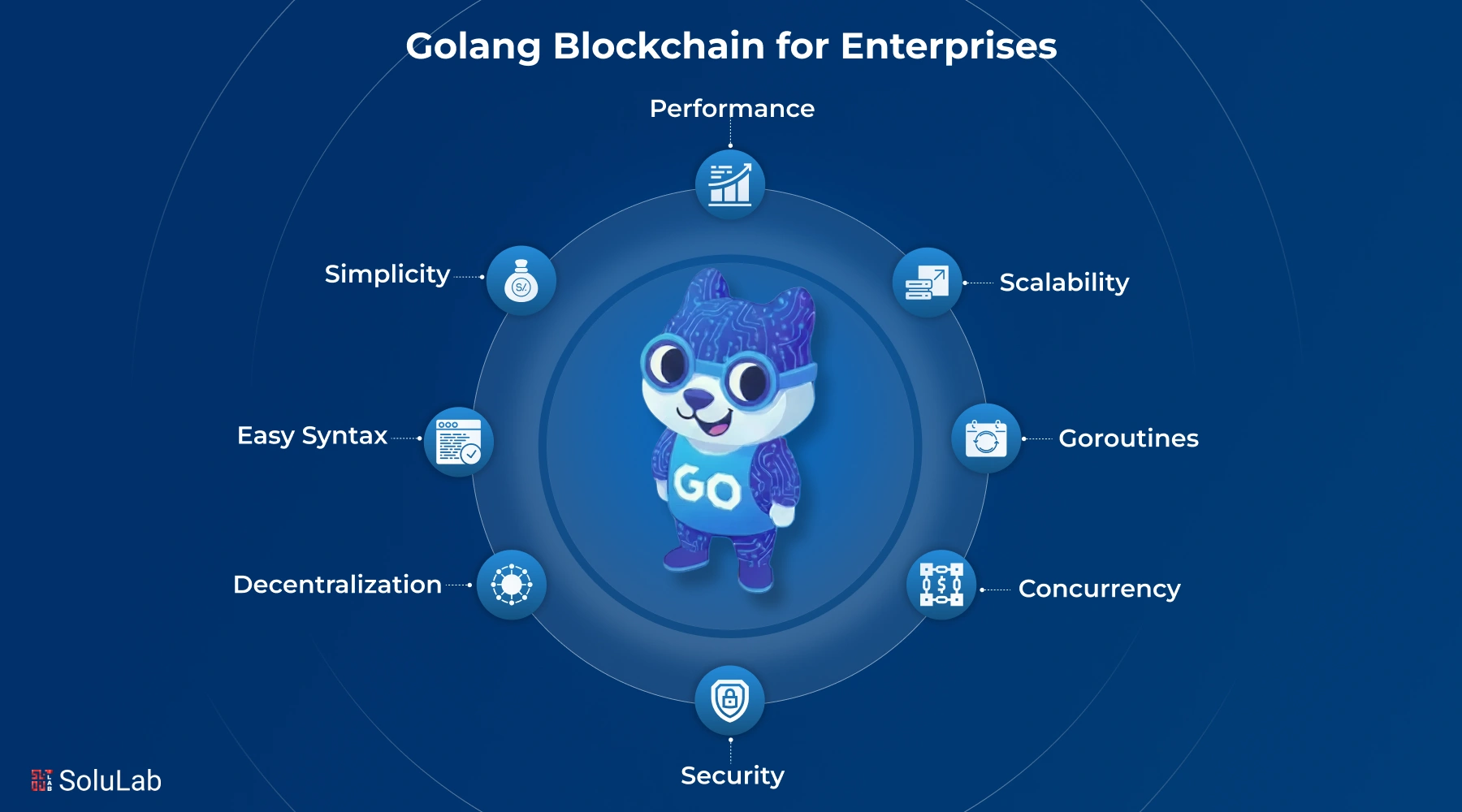
Core Features of Blockchain Development With Go
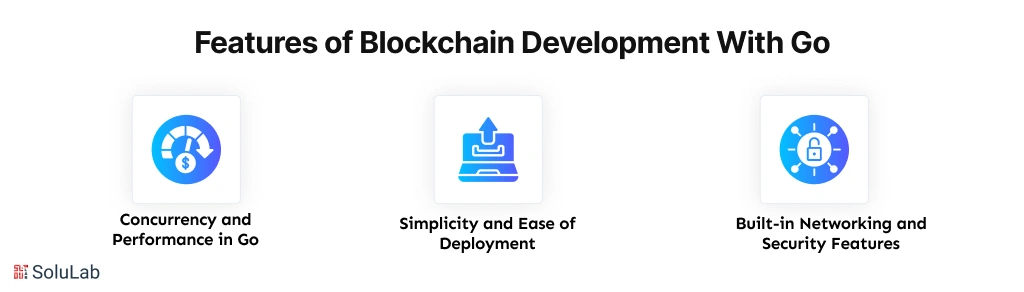
Features of Blockchain Development With Go

As said, Go simplifies blockchain development. Let’s check what they are and how they are enhancing blockchain technology on platforms. 

1. Concurrency and Performance in Go

Concurrency is essential for blockchains, which must process multiple transactions across distributed networks. Go’s lightweight Goroutines enable developers to manage thousands of parallel processes efficiently. This makes Go an excellent choice for high-volume transaction environments where speed and responsiveness are critical. Unlike heavier languages, Go’s performance closely rivals C, offering blockchain developers both power and flexibility.

2. Simplicity and Ease of Deployment

Blockchain systems often face challenges with setup and maintenance. Go addresses this with its simple syntax and compilation process. Applications can be compiled into single, platform-independent binaries, making deployment faster and easier. This is particularly useful in blockchain app development for startups, where teams require rapid testing, iteration, and scaling without complex installation hurdles.

3. Built-in Networking and Security Features

Networking is at the heart of blockchain frameworks, and Go’s standard library provides robust tools for secure communication. Peer-to-peer networking, encryption, and cryptographic hashing can be implemented with fewer external dependencies. These features of Golang reduce risks, simplify development, and make Go a trusted choice for enterprise-grade blockchain development.
CTA1

How Go Compares with Other Programming Languages?

There are several programming languages other than Golang. Here is how they are different from Go. 

  • Go vs. Python in Blockchain Development

Python is widely used for blockchain prototypes, but it lacks Go’s raw performance. Go offers a compiled environment, giving it a speed advantage critical for production-grade systems. While Python remains useful for learning and experimentation, Go ensures scalability and efficiency in enterprise blockchain solutions.

  • Go vs. Java for Enterprise Systems

Java has long been a popular choice in enterprise IT systems, but it often requires more resources than Go. Go’s lightweight nature makes it faster and less memory-intensive, reducing infrastructure costs. As a result, organizations moving towards enterprise-grade blockchain development increasingly adopt Go for long-term efficiency and scalability.

  • Go vs. Rust and C++

Rust and C++ are powerful languages that also focus on performance and safety. However, they have steeper learning curves and more complex syntax. Go achieves similar results with cleaner code, making it easier for developers to implement blockchain app development with Go without excessive overhead.

Go vs. Other Programming Languages

Criteria Go Python Java Rust / C++
Performance High (compiled, fast execution) Moderate (interpreted) Good but heavier Very High
Scalability Excellent for large blockchain networks Limited for production-grade systems Strong but resource-intensive Excellent
Learning Curve Easy & clean syntax Easy Moderate Hard / Complex
Resource Usage Low, lightweight Higher memory usage Higher CPU & memory Efficient but complex to optimize
Best Use Case Enterprise blockchain, nodes, validators Prototyping & experimentation Legacy enterprise systems High-performance blockchain engines
Key Advantage Speed + simplicity Flexibility Ecosystem maturity Maximum control & safety

Blockchain Business Benefits of Choosing Go

For enterprises, how is Go going to help attract users? Let’s check the business benefits as follows. 

  • Faster Time-to-Market

One of the strongest benefits of Go is its ability to accelerate development cycles. Startups and enterprises can build and deploy blockchain applications faster due to Go’s simplicity. This shorter time-to-market is a critical advantage in industries where innovation speed defines competitiveness.

  • Scalability and Long-Term Growth

Go is designed to handle growth effortlessly. Whether it is a small pilot project or a global enterprise blockchain solution, Go-based frameworks can scale as needed. This scalability ensures long-term value for businesses investing in blockchain app development with Go.

  • Proven Track Record in Enterprise Systems

Go powers well-known frameworks such as Hyperledger Fabric, Tendermint, and Geth. These platforms demonstrate Go’s reliability in real-world, enterprise-grade systems. Businesses choosing Go benefit not only from its technical strengths but also from its proven adoption in blockchain use cases for enterprises worldwide.

Step-by-Step Process of Go Blockchain Development
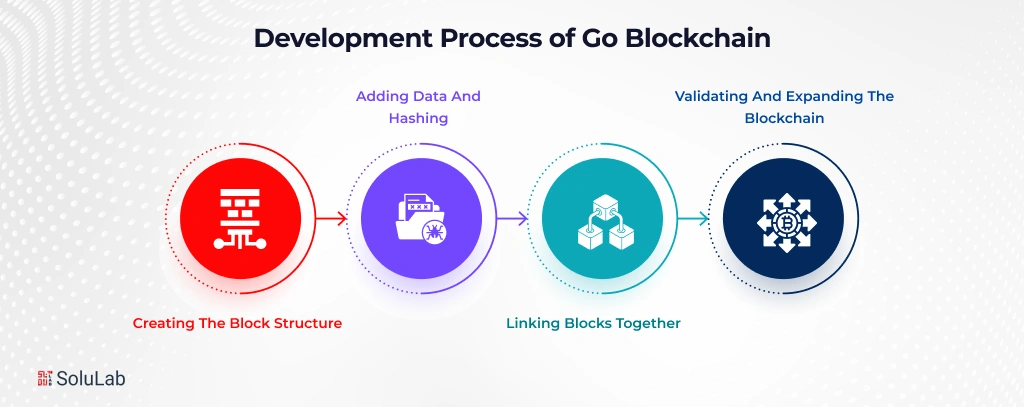
Development Process of Go Blockchain

We already know GO benefits; it’s time to know the step-by-step process of blockchain development with Go. To save time and price, you can partner with blockchain development companies, which can provide support and also integrations if needed. 

  • Creating the Block Structure

The first step in how to build a blockchain with Go is defining the structure of a block. Each block contains data, a timestamp, and a cryptographic hash linking it to the previous block. This ensures data security and immutability.

  • Adding Data and Hashing

Once the block is created, transaction data is added. The data is secured using cryptographic hashing, which ensures that even the smallest change alters the block’s identity. This immutability builds trust across the blockchain network.

  • Linking Blocks Together

Blocks are chained by referencing the hash of the previous block. This linking creates a tamper-proof ledger, where altering one block requires changing every subsequent block. Go’s efficiency ensures this process runs smoothly, even under heavy workloads.

  • Validating and Expanding the Blockchain

After building the chain, validation is essential to confirm integrity. Developers can expand the blockchain with features like peer-to-peer networking, consensus algorithms, and smart contract support, laying the groundwork for enterprise-grade blockchain development.

Note: The total process might take at least 8 weeks based on the features you want to incorporate. 

Industries That Benefit Most from Go-Based Blockchains

You might be wondering, blockchain is adopted in several industries, but can building with Go bring any change? Let’s get to know that.

1. Financial Services and Payments

The finance sector increasingly depends on Go-powered blockchain development for finance because of its speed, reliability, and high security. Ethereum’s Geth client, written in Go, is widely used by banks and crypto platforms. Binance also built its blockchain using Go, enabling fast trades and low-cost transactions.

2. Supply Chain and Logistics

Blockchain in supply chain is becoming more efficient and trustworthy thanks to Go-based frameworks like the Cosmos SDK. Companies such as Suning in retail and Krafton in gaming have used these systems to track goods, verify origins, and reduce fraud.

3. Healthcare and Data Security

Blockchain in healthcare is rapidly advancing as providers adopt Go-supported frameworks like Hyperledger Fabric to secure and streamline medical data. These systems allow quick access, safe sharing, and compliance with strict privacy rules, making data handling more reliable.

4. Startups and Innovation Hubs

Startups choose Go for blockchain apps because of its simplicity and speed. Development firms and tech ventures use Go with Cosmos SDK to launch new blockchain solutions quickly, test ideas, and scale without heavy costs.

Future Directions and Potential Integrations in Go and Blockchain

Golang is proving its credibility in blockchain development. As the technology increases, there are many possibilities for enhancement. Let’s check some expected changes. 

1. Cross-Chain Interoperability: Go-based blockchain frameworks are making it easier for different blockchains to talk to each other. This helps businesses share data and assets smoothly across networks.

2. Integration with Artificial Intelligence: When Go blockchains meet AI, contracts get smarter and systems more predictive. Industries like finance and healthcare can use this for faster, data-driven decisions.

3. Growing Adoption in Enterprises: Tools like Hyperledger Fabric highlight Go’s stability. More companies are now trusting Go for secure, scalable, and efficient blockchain solutions.

4. Research on Scalability Enhancements: Developers are working on Go blockchains that can handle millions of transactions quickly. This could make Go a strong base for future large-scale blockchain systems.
CTA2

Conclusion

Golang in blockchain development is enhancing the platform’s working that makes the company reliable and scalable. If you are also looking to build a blockchain with Go, then SoluLab is here to assist you. We at SoluLab, a top blockchain development company in the USA, deliver secure, scalable, and ROI-driven solutions that solve real business challenges. 

Our expert team implemented an efficient crypto-based payment system using OBOT tokens. This is to enhance financial interactions within the OBORTECH SmartHub ecosystem. For more information, consult us today

FAQs

1. What industries benefit most from Go blockchain development? 

Financial services, supply chain, healthcare, and startups gain efficiency, transparency, and secure data management. Go’s speed and scalability allow enterprises to process transactions faster and manage complex distributed systems reliably.

2. How long does it take to build a blockchain with Go? 

A production-ready Go blockchain typically requires 6–12 weeks, depending on features, consensus mechanisms, integrations, and testing. Partnering with us for experienced developers can optimize timelines while ensuring robust enterprise-grade implementation.

3. What makes Go better than other programming languages for blockchain? 

Go offers concurrency, fast execution, cross-platform support, and simpler syntax. Unlike Python or Java, it handles high-volume transactions efficiently, reduces infrastructure costs, and scales easily for enterprise blockchain solutions.

4. How can SoluLab help businesses build a blockchain with Go? 

SoluLab delivers enterprise-grade Go blockchain solutions, combining technical expertise and strategic insight. We design secure, scalable, and efficient systems, tailored to business needs, ensuring ROI, transparency, and seamless integration into existing workflows.

5. Can Go blockchain integrate with AI or IoT for smarter business solutions? 

Yes, Go blockchains can integrate AI for predictive insights and IoT for real-time data tracking. This enables automated decision-making, improved operational efficiency, and more intelligent, data-driven enterprise workflows.

 

Top 10 Enterprise Blockchain Development Companies in USA in 2025

The rise of blockchain technology is being seen in every phase of industries-from banking to supply chain to healthcare. Various organizations use blockchain to enhance operational efficiency, security, and new business opportunities. 

As more businesses embrace blockchain to enhance transparency, cut costs, and optimize processes, the U.S. is a hotbed for innovation. Indeed, the enterprise blockchain development market worldwide will expand from $408 million in 2024 to over $1.25 billion by 2031 at a consistent rate of 17.8% CAGR. This growth signifies the increased adoption of decentralized technology in making operations smarter and secure.

Finding the right enterprise blockchain development company is one of the critical steps forward on this journey. From building custom smart contracts to integrating blockchain with existing enterprise systems, the top firms in the U.S. help businesses unlock new levels of efficiency and trust.

In this blog, we’ve curated a list of the top 10 companies in the USA that are shaping the future of enterprise blockchain in 2025. So, let’s get started!

Why You Should Choose an Enterprise Blockchain Development Company?

When it comes to bringing blockchain into an enterprise setup, working with people who’ve done it before makes all the difference. It’s not just about writing code — it’s about solving real business problems using the right tools and methods. A solid enterprise blockchain consulting team helps you avoid unnecessary trial and error and gets things moving in the right direction from day one.

  • Expertise

Blockchain technology might sound straightforward on the surface, but once you start working with it, the complexity shows up quickly, especially in enterprise environments. A specialized team brings actual hands-on experience to the table. They’ve built for different industries, dealt with different compliance needs, and can offer clear guidance instead of guesswork. That kind of depth only comes from doing this a lot — and doing it well.

  • Customization

Every business runs differently, and your blockchain solution should reflect that. A reliable enterprise blockchain consulting company in the USA won’t try to push a generic solution. They’ll listen first to your processes, your pain points, and your long-term goals — and then design something that fits you, not just technically but operationally too. That personal approach can save you a lot of money and frustration in the long run.

  • Security

Security isn’t something you can bolt on later—it has to be baked in from the beginning. Enterprise blockchain understands what’s at stake. They know how to set up access control, manage encryption properly, and ensure the system is protected at every level. Whether you’re handling financial data, internal IP, or customer information, they know how to keep it safe without slowing things down.

  • Scalability

Your business won’t look the same in two years — and neither should your tech. One of the biggest benefits of working with the right team is that they build systems designed to grow with you. Whether that means adding more users, expanding to other markets, or integrating with new tools, your blockchain setup should scale smoothly without having to start over.

  • Support & Maintenance

Launching the project is just one part of the journey. A professional team won’t vanish after the deployment — they’ll stick around to help you tune performance, fix problems, and keep everything updated. That ongoing support is what turns a decent system into a dependable one over time.

How Enterprise Blockchain Development Services Transform Your Business?

Blockchain isn’t just a flashy upgrade—it’s quickly becoming a backbone technology for businesses that want to modernize how they operate. When thoughtfully developed and integrated, it can streamline operations, build trust, and cut through inefficiencies that weigh companies down. Here’s how working with a blockchain development team can genuinely impact your organization:

  • Transparent Data
    Blockchain creates a tamper-proof record of every transaction. That means everyone involved can see the same version of events, reducing confusion, delays, and the finger-pointing that can slow progress.
  • Less Paperwork
    With automated processes like smart contracts handling repetitive tasks, things like approvals, payments, and documentation happen faster and with fewer errors.
  • Cost Saving
    Getting rid of middlemen and overlapping systems helps cut costs. It reduces the need for manual checks and brings down expenses linked to admin-heavy workflows.
  • Security
    With encryption, permissioned access, and built-in tracking, sensitive data is far better protected than in traditional systems. It also helps tick the boxes for compliance without added effort.
  • Stronger Business Relations
    When everyone, from suppliers to partners, can view real-time data and updates, it makes collaboration easier and more transparent. That trust can strengthen long-term partnerships.

Hence, the real enterprise blockchain benefits come from better coordination, stronger security, and systems that scale with your business, rather than hold it back.

Top 10 Enterprise Blockchain Development Companies in the USA in 2025

solulab

1. SoluLab

SoluLab is one of those companies that consistently delivers when it comes to practical blockchain solutions. They focus less on the buzzwords and more on solving real business problems with secure, scalable tech. Whether it’s building out smart contracts or architecting a full-blown blockchain application, they take the time to understand the client’s business and deliver something that works, not just in theory, but in the real world.

What makes them easy to work with is their flexible engagement approach. They’re transparent with pricing, responsive in communication, and genuinely invested in long-term outcomes. Companies from industries like healthcare, fintech, and logistics keep coming back because they know SoluLab doesn’t just build — they partner.


$25 – $49


50-249


Goldman Sachs, Walt Disney, Mercedes-Benz


USA

ConsenSys

2. ConsenSys

If you’ve spent any time in the Ethereum space, you’ve probably heard of ConsenSys. They’ve been there since the early days, helping shape how enterprises use blockchain, especially when it comes to building on Ethereum. What sets them apart is the depth of their product ecosystem. From private Ethereum variants to tools for DeFi and compliance, they offer everything under one roof.

They’re not just a tech company either — they’re thought leaders who actively help shape global blockchain standards. Big firms looking to deploy scalable blockchain systems often find ConsenSys at the top of their list for a reason: they bring serious experience and a strong track record.


$96 – $120/ hr


500+


JPMorgan Chase, Microsoft, Procter & Gamble


USA

IBM

3. IBM

IBM doesn’t need much of an introduction, and its blockchain division lives up to that reputation. What they’ve done really well is apply structure and scale to blockchain, especially in industries where trust and traceability are non-negotiable. If you’re looking to build a permissioned blockchain system backed by global infrastructure, IBM tends to be a safe, strategic choice.

They also do a great job of integrating blockchain with existing enterprise systems, which is a big plus for organizations that don’t want to start from scratch. Their blockchain team handles everything from early consulting to long-term governance, which makes the whole experience smoother for large organizations.


$54 – $86 / hr


10,000+


Walmart, Nestlé, Maersk


USA

Altoros

4. Altoros

Altoros isn’t just about building blockchain platforms — they’re about making technology actually work for people. They’ve got a sharp focus on making blockchain solutions easy to use and easy to integrate into the bigger business picture. It’s not just about writing code; they pay attention to what the client wants to achieve and build something practical around that.

Their team’s worked with all kinds of industries — from automotive to public services — and they handled projects that go well beyond the blockchain buzz. Think of custom systems that actually plug into the way businesses already operate. If you’re looking for people who can take your idea and make it not just functional, but useful, they’re worth talking to.


$50 – $99 / hr


250 – 500


Siemens, Toyota, The Weather Channel


USA

Unicsoft

5. Unicsoft

Unicsoft is a team known for delivering blockchain solutions that are practical, scalable, and tailored to business needs. With experience across blockchain, AI, and digital transformation projects, they’re particularly strong at aligning technical innovation with real-world business goals. They focus on building products that are secure, user-friendly, and market-ready, whether it’s tokenization platforms, smart contract solutions, or blockchain-based marketplaces.

Their team is a great fit for startups and enterprises alike who want a reliable development partner that can bring structure, transparency, and speed to blockchain projects. Unicsoft’s experience across industries like fintech, healthcare, and supply chain management speaks to their versatility and depth.


$50-$99/ hr


50 – 249


Siemens, RBC Royal Bank, Dentsu


UK

HashCash Consultants

6. HashCash Consultants

HashCash is one of those firms that’s been around long enough to understand the rhythm of enterprise tech, especially in the blockchain space. They focus heavily on helping businesses rethink how they handle things like payments, supply chain, and digital identity. The cool part is they’re not trying to reinvent your business — they’re just making your existing systems faster, more secure, and more transparent using blockchain.

They’re often the first call for companies that want enterprise blockchain consulting without the fluff. Their strength lies in simplifying complexity and rolling out real, working systems that start delivering value fast. If you’re exploring blockchain for enterprises, HashCash brings both the strategy and the hands-on development to make it happen.


$50-$100/ hr


100 – 250


Emirates, Airbus, SBI


USA

ChainSafe Systems

7. ChainSafe Systems

ChainSafe is a bit more on the developer-heavy side, but that’s part of the appeal. They’re not your typical corporate-style firm — they’re builders at heart. If you’ve got a technically challenging blockchain idea and need people who are knee-deep in Web3 protocols and infrastructure, ChainSafe’s your crew.

They’ve worked with everything from decentralized storage systems to Ethereum clients, but they’re also quietly doing some solid work on the enterprise side. As an enterprise blockchain consulting company in the USA, they bring in the kind of deep tech expertise that helps large businesses tackle next-gen problems — whether that’s cross-chain interoperability or building secure internal blockchain tools.


$70 – $120/ hr


80 – 200


Ethereum Foundation, UNICEF, Web3 Foundation


USA

Deqode

8. Deqode (formerly Techracers)

Deqode is the kind of company that just “gets it” when you’re trying to apply blockchain in real-world business settings. They don’t come in with a one-size-fits-all playbook. Instead, they sit with you, figure out your goals, and build tech that fits — whether you’re exploring digital assets, secure data sharing, or streamlining cross-border operations.

What people like about Deqode is their mix of technical strength and business practicality. You don’t have to educate them about industry constraints — they’ve already been there. For companies exploring enterprise blockchain consulting, it’s a no-fluff, all-action experience that makes moving forward feel simple.


$40 – $70/ hr


150 – 250


Shell, Emirates, Airtel


USA

ChromaWay

9. ChromaWay

ChromaWay takes a fresh approach to blockchain — one that’s focused on building real systems that people and institutions can actually use. They’re not the loudest in the room, but they’ve been quietly working with governments and financial institutions, helping them modernize critical infrastructure without throwing everything away.

They’re especially good when the job involves sensitive data, complex systems, or regulatory guardrails. If you’re looking to explore blockchain for enterprises in areas like real estate, finance, or public records, ChromaWay offers both the tech and the strategic clarity to help you move the needle.


$60 – $110/ hr


100 – 200


Swedish Land Registry, Inter-American Development Bank


USA

Intellectsoft

10. Intellectsoft

Intellectsoft isn’t just another software firm jumping on the blockchain trend. They’ve got roots in enterprise IT, which means they understand what it takes to implement secure, scalable solutions without disrupting your core business operations. Their team asks the right questions, digs deep, and then delivers software that fits into your bigger digital strategy.

They’re a solid choice for companies that want more than just development — they want a long-term enterprise blockchain consulting company in the USA that knows how to balance innovation with stability. From blockchain modules to full-scale dApps, they focus on doing the work that makes your business run smoother.


$45 – $85/ hr


200 – 500


NHS, Universal Pictures, Jaguar


USA

Enterprise Blockchain Development Company

Conclusion

Finding the right blockchain development company isn’t just a technical decision, it’s a strategic one. These firms bring more than just development skills; they bring a clear understanding of how to build systems that fit into real business environments, support long-term goals, and evolve with changing needs.

Each of these companies brings a distinct strength to the table, but they all share one commonality: a focus on developing blockchain solutions that function effectively in practice. Whether you’re looking for a top development partner or an enterprise blockchain consulting company USA businesses trust, the right choice can turn blockchain into a powerful tool for efficiency, security, and growth, not just an experiment, but a long-term advantage.

As we discussed, choosing a reliable partner is crucial for success, and SoluLab stands out as a top enterprise blockchain development company. With deep expertise, a focus on customization, and a commitment to security and scalability, SoluLab helps businesses build solutions that are built to last. Their approach ensures your blockchain initiatives align seamlessly with your long-term goals.

If you are planning to launch your own blockchain solution, partnering with an experienced team can make all the difference. SoluLab, as a top enterprise blockchain development company, brings the expertise, customization, security, and scalability needed to turn your vision into reality.

FAQs

1. What should I look for when choosing an enterprise blockchain development company?

Start with experience and not just in blockchain, but in working with businesses similar to yours. Look for a team that asks the right questions, offers tailored solutions, and shows they understand the practical side of implementing blockchain in a business setting. Strong communication, long-term support, and a clear delivery process are equally important.

2. How do enterprise blockchain solutions differ from regular blockchain projects?

Enterprise solutions are built for scale, security, and integration. Unlike public or experimental projects, enterprise systems need to work with existing infrastructure, comply with regulations, and handle real workloads. These systems are designed with long-term maintenance and adaptability in mind, not just fast deployment.

3. Is blockchain really necessary for my business?

It depends on what you’re trying to solve. If your business relies on secure transactions, shared data across multiple stakeholders, or transparency in operations, blockchain might offer real value. But it’s not a one-size-fits-all solution; a good consulting partner will help you figure out whether it makes sense for your specific use case.

4. How long does it take to build an enterprise blockchain application?

Timelines vary based on project complexity, but a typical enterprise blockchain solution can take anywhere from 3 to 9 months. This includes planning, development, testing, deployment, and training. The more prepared you are with your goals and internal processes, the smoother and quicker the build tends to be.

5. Will the development company provide support after launch?

Yes, if you choose the right team. Post-launch support is essential for updates, performance checks, troubleshooting, and scaling. Most enterprise blockchain consulting companies offer ongoing maintenance packages or retainers to ensure your system stays aligned with your business as it grows.