
In 2026, three of the world’s most critical blockchain infrastructure projects run on Go: Ethereum’s Geth client, Hyperledger Fabric, and the Cosmos SDK. That’s not a coincidence, it’s the result of Go offering something no other language does at enterprise scale: the combination of C-level performance, Python-level simplicity, and first-class concurrency built for distributed systems from the ground up.
Golang for blockchain companies has moved from an interesting option to the de facto standard for enterprise-grade infrastructure. This article explains why, with real performance benchmarks, honest architecture trade-offs, compliance considerations, and what it actually costs to build a production Golang Blockchain technology system in 2026, so your team can make an informed decision before committing to a stack.
Whether you’re evaluating Golang Blockchain Solutions for a new platform, upgrading an existing system, or trying to understand the impact of Golang Blockchain Development on your business operations, this guide covers everything decision-makers and technical leads need to know.
Why Go Is the Enterprise Standard for Blockchain?
Go’s architecture makes it ideal for large-scale blockchain programming.
- Concurrency support: Thousands of Goroutines run in parallel, handling blockchain transactions efficiently.
- Garbage collection: Automatic memory management keeps blockchain nodes stable under heavy load.
- Cross-platform support: Go compiles to machine code and runs on different operating systems without modification.
These three properties, taken together, explain the Features of Golang that no competitor language replicates at the same cost. But for enterprise buyers, three additional advantages matter even more than raw technical specs:
Go vs Rust vs Java vs Solidity:Enterprise-Grade Blockchain Development Comparison (2026)
Enterprises aren’t choosing between Go and Python. The real decisions are Go vs Rust for node infrastructure, Go vs Java for Hyperledger deployments, and Go vs Solidity for chaincode. Here’s the comparison that actually matters for enterprise teams evaluating blockchain programming with Go:
| Criteria | Go | Rust | Java (Hyperledger Besu) | Solidity (EVM) |
|---|---|---|---|---|
| Smart contract / chaincode | Hyperledger Fabric chaincode | Solana programs, NEAR contracts | Ethereum via Besu | Ethereum, EVM-compatible chains |
| Node / validator development | Best in class (Geth, Cosmos) | Strong (Lighthouse, Solana) | Resource-heavy (Besu, Fabric peer) | Not applicable |
| Enterprise deployment | Single binary, zero dependencies | Complex build toolchain | JVM ecosystem, familiar to IT | Not applicable |
| Security audit complexity | Low — static typing, explicit errors | High — complex ownership model | Moderate — mature tooling | High — EVM attack surface |
| Developer hiring pool | Large and growing | Scarce, premium rates | Largest enterprise pool | Niche, Web3-specific |
| Learning curve for blockchain | Low — clean syntax, fast ramp | Steep — ownership/borrow checker | Moderate — familiar patterns | Specialized — EVM-specific concepts |
| Throughput at L1 | ~10,000 TPS (Tendermint/Go) | ~65,000 TPS (Solana/Rust) | ~3,000 TPS (Besu) | ~30 TPS (Ethereum L1) |
| Best use case | Enterprise networks, validators, nodes | Max-performance L1, systems code | Legacy enterprise integration | Public Ethereum smart contracts |
Go wins on deployment simplicity, audit-friendliness, and developer availability for most enterprise permissioned blockchain deployments. Rust wins only when maximum raw throughput is the primary constraint.
Why Go Is a Preferred Language for Blockchain Development?
Go’s architecture makes it ideal for large-scale blockchain programming.
- Concurrency support: Thousands of Goroutines run in parallel, handling blockchain transactions efficiently.
- Garbage collection: Automatic memory management keeps blockchain nodes stable under heavy load.
- Cross-platform support: Go compiles to machine code and runs on different OSs without modification.
These features of Golang shape the speed, security, and scalability.
Core Features of Blockchain Development With Go
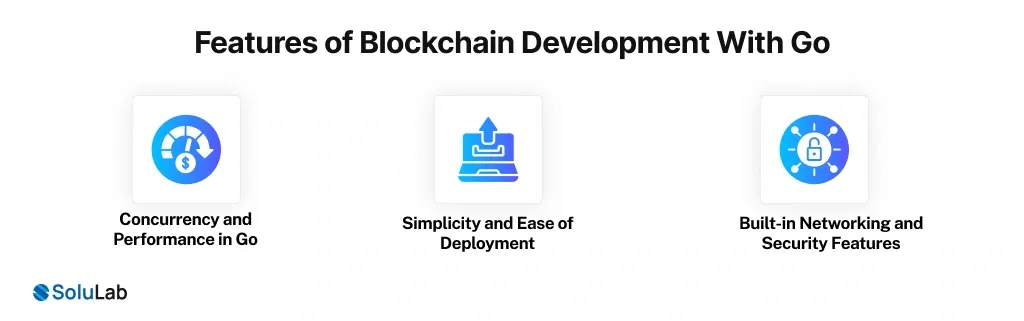
As said, Go simplifies blockchain development. Let’s check what they are and how they are enhancing blockchain technology on platforms.
1. Concurrency and Performance in Go
Concurrency is essential for blockchains, which must process multiple transactions across distributed networks. Go’s lightweight Goroutines enable developers to manage thousands of parallel processes efficiently. This makes Go an excellent choice for high-volume transaction environments where speed and responsiveness are critical. Unlike heavier languages, Go’s performance closely rivals C, offering blockchain developers both power and flexibility.
2. Simplicity and Ease of Deployment
Blockchain systems often face challenges with setup and maintenance. Go addresses this with its simple syntax and compilation process. Applications can be compiled into single, platform-independent binaries, making deployment faster and easier. This is particularly useful in blockchain app development for startups, where teams require rapid testing, iteration, and scaling without complex installation hurdles.
3. Built-in Networking and Security Features
Networking is at the heart of blockchain frameworks, and Go’s standard library provides robust tools for secure communication. Peer-to-peer networking, encryption, and cryptographic hashing can be implemented with fewer external dependencies. These features of Golang reduce risks, simplify development, and make Go a trusted choice for enterprise-grade blockchain development.
How Go Compares with Other Programming Languages?
There are several programming languages other than Golang. Here is how they are different from Go.
Go vs. Python in Blockchain Development
Python is widely used for blockchain prototypes, but it lacks Go’s raw performance. Go offers a compiled environment, giving it a speed advantage critical for production-grade systems. While Python remains useful for learning and experimentation, Go ensures scalability and efficiency in enterprise blockchain solutions.
Go vs. Java for Enterprise Systems
Java has long been a popular choice in enterprise IT systems, but it often requires more resources than Go. Go’s lightweight nature makes it faster and less memory-intensive, reducing infrastructure costs. As a result, organizations moving towards enterprise-grade blockchain development increasingly adopt Go for long-term efficiency and scalability.
Go vs. Rust and C++
Rust and C++ are powerful languages that also focus on performance and safety. However, they have steeper learning curves and more complex syntax. Go achieves similar results with cleaner code, making it easier for developers to implement blockchain app development with Go without excessive overhead.
Go vs. Other Programming Languages
| Criteria | Go | Python | Java | Rust / C++ |
|---|---|---|---|---|
| Performance | High (compiled, fast execution) | Moderate (interpreted) | Good but heavier | Very High |
| Scalability | Excellent for large blockchain networks | Limited for production-grade systems | Strong but resource-intensive | Excellent |
| Learning Curve | Easy & clean syntax | Easy | Moderate | Hard / Complex |
| Resource Usage | Low, lightweight | Higher memory usage | Higher CPU & memory | Efficient but complex to optimize |
| Best Use Case | Enterprise blockchain, nodes, validators | Prototyping & experimentation | Legacy enterprise systems | High-performance blockchain engines |
| Key Advantage | Speed + simplicity | Flexibility | Ecosystem maturity | Maximum control & safety |
Go (Golang) Blockchain Performance Benchmarks for Enterprise-Grade Systems in 2026
Most articles describe Golang Blockchain Solutions in abstract terms. Here are the actual production numbers:
| Framework | TPS | Hardware | Notes |
| Tendermint / CometBFT (Go) | ~10,000 | 4-validator testnet | 1MB blocks, standard hardware |
| Hyperledger Fabric — Go chaincode | ~3,500 | 4-org, RAFT ordering | 8-core CPU, 32GB RAM per peer |
| Hyperledger Fabric — Java chaincode | ~2,100 | Same hardware | 67% lower TPS than Go chaincode |
| Ethereum L1 (Geth / Go) | ~30 | Mainnet | 12-second block time |
Infrastructure cost implication: A Hyperledger Fabric network with Go chaincode on three AWS c5.2xlarge instances (~$600/month) sustains ~2,000 TPS at under 500ms latency. Equivalent Java chaincode requires c5.4xlarge instances (~$1,200/month) to match the same throughput — roughly doubling infrastructure spend.
Building Secure Enterprise Blockchain Systems with Golang
Enterprise decision-makers evaluating Go frameworks for In House blockchain development need to understand two things: how production systems are structured and whether they’ll survive a compliance review.
1. Architecture: The Three Layers That Matter
Every production Golang-based blockchain system separates concerns across three layers. Validator/ordering nodes run consensus logic (Tendermint BFT or RAFT) and are the performance-critical path. Full peer nodes execute chaincode and serve read queries. Thin SDK clients handle application-layer transaction submission via gRPC – the Fabric Gateway SDK (Go) is the current enterprise standard pattern here.
Go chaincode on Hyperledger Fabric follows the contract API pattern: explicit state reads, atomic state writes, and an error return on every operation. No silent failures in financial logic. This structure is what makes blockchain app development with Go audit-ready by default, not after the fact.
2. Security and Compliance Properties
Three compliance advantages make Go the default choice for regulated enterprise deployments:
- FIPS 140-2 compliance: Go’s standard crypto library includes FIPS 140-2 compliant implementations, a hard requirement for federal healthcare and financial services deployments
- No reentrancy attacks: Fabric’s execute-order-validate model makes reentrancy architecturally impossible in Go chaincode, eliminating the most common smart contract exploit class entirely
- Explicit error handling for HIPAA: Go’s error return pattern prevents silent failures in PHI access logging, a common HIPAA audit finding in exception-based languages. This makes blockchain app development with Golang significantly easier to approve in healthcare procurement
These properties collectively reduce external audit scope, shorten audit timelines, and lower the compliance risk that kills enterprise blockchain pilots before production. When enterprises choose to Build Enterprise Blockchain Platforms on Go, they’re choosing a stack their security team can actually sign off on.
Why Enterprise Should Build Blockchain Systems with Golang?
For enterprises, how is Go going to help attract users? Let’s check the business benefits as follows.
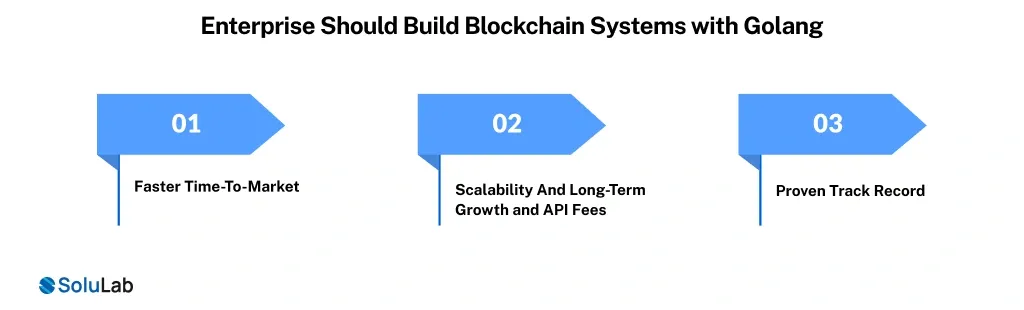
1. Faster Time-To-Market
- Go’s simple syntax and single binary compilation accelerate development cycles for both enterprise teams and blockchain app development for startups.
- DevOps teams report 40–60% faster CI/CD pipeline execution compared to Java-based blockchain deployments and Go chaincode containers start in ~120ms vs ~2,800ms for Java (JVM warmup).
- That’s a 23x startup time advantage that compounds across every deployment cycle.
2. Scalability And Long-Term Growth
- Go-based frameworks scale from small pilots to global enterprise blockchain solutions without architectural rewrites.
- At 20-node enterprise network scale, Go’s memory efficiency vs Java represents $180,000–$400,000 in annual cloud infrastructure savings depending on provider and region.
3. Proven Track Record
- Go powers Hyperledger Fabric, Tendermint, and Geth. As of 2026: Fabric v3.x powers global consortium networks in trade finance, healthcare, and government; Geth v1.14 processes every Ethereum transaction; Cosmos SDK v0.52 powers 50+ sovereign chains with combined TVL exceeding $8B.
- The Impact of Golang Blockchain Development at this scale is what makes Blockchain Solutions Built with Golang the default enterprise infrastructure choice, not marketing, but production track record.
Blockchain Business Benefits of Choosing Go
For enterprises, how is Go going to help attract users? Let’s check the business benefits as follows.
Faster Time-to-Market
One of the strongest benefits of Go is its ability to accelerate development cycles. Startups and enterprises can build and deploy blockchain applications faster due to Go’s simplicity. This shorter time-to-market is a critical advantage in industries where innovation speed defines competitiveness.
Scalability and Long-Term Growth
Go is designed to handle growth effortlessly. Whether it is a small pilot project or a global enterprise blockchain solution, Go-based frameworks can scale as needed. This scalability ensures long-term value for businesses investing in blockchain app development with Go.
Proven Track Record in Enterprise Systems
Go powers well-known frameworks such as Hyperledger Fabric, Tendermint, and Geth. These platforms demonstrate Go’s reliability in real-world, enterprise-grade systems. Businesses choosing Go benefit not only from its technical strengths but also from its proven adoption in blockchain use cases for enterprises worldwide.
Step-by-Step Process of Go Blockchain Development
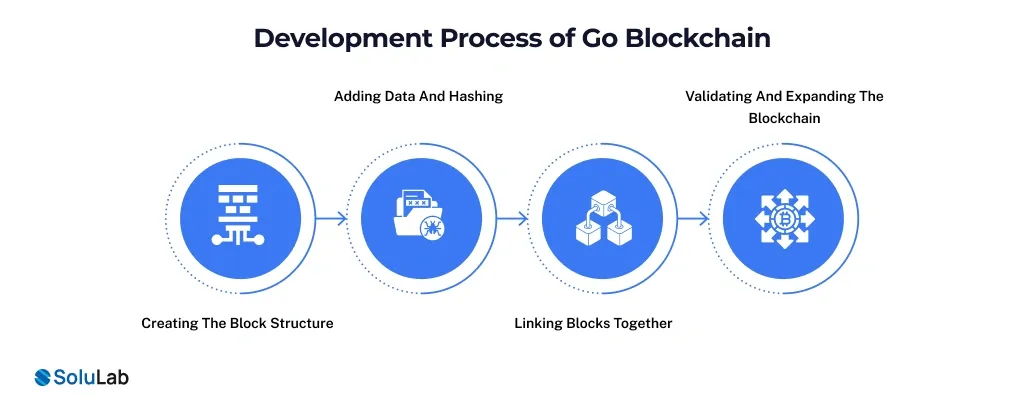
We already know GO benefits; it’s time to know the step-by-step process of blockchain development with Go. To save time and price, you can partner with blockchain development companies, which can provide support and also integrations if needed.
Creating the Block Structure
The first step in how to build a blockchain with Go is defining the structure of a block. Each block contains data, a timestamp, and a cryptographic hash linking it to the previous block. This ensures data security and immutability.
Adding Data and Hashing
Once the block is created, transaction data is added. The data is secured using cryptographic hashing, which ensures that even the smallest change alters the block’s identity. This immutability builds trust across the blockchain network.
Linking Blocks Together
Blocks are chained by referencing the hash of the previous block. This linking creates a tamper-proof ledger, where altering one block requires changing every subsequent block. Go’s efficiency ensures this process runs smoothly, even under heavy workloads.
Validating and Expanding the Blockchain
After building the chain, validation is essential to confirm integrity. Developers can expand the blockchain with features like peer-to-peer networking, consensus algorithms, and smart contract support, laying the groundwork for enterprise-grade blockchain development.
Note: The total process might take at least 8 weeks based on the features you want to incorporate.
Industries That Benefit Most from Golang-Based Blockchain Development
These Blockchain Use Cases for Enterprises demonstrate Go’s real-world viability across sectors:
1. Financial Services
The finance sector depends on Go-powered blockchain development for speed, reliability, and security. Binance’s BNB Chain, written entirely in Go processes 1.4M+ daily transactions at sub-second finality. This is among the most visible Blockchain Solutions Built with Golang in a live financial infrastructure.
2. Supply Chain and Logistics
Go-based frameworks like Cosmos SDK enable tracking goods, verifying origins, and reducing fraud. Maersk’s TradeLens platform used Hyperledger Fabric Go chaincode to coordinate 800+ logistics partners, proving that Golang blockchain development company teams can build supply chain systems at genuine enterprise data volumes.
3. Healthcare and Data Security
Hyperledger Fabric secures and streamlines medical data with privacy controls. Change Healthcare’s Fabric network, built on Go chaincode, processes over 15 billion medical transactions annually, the most cited production example of HIPAA-compliant Golang-based blockchain systems in healthcare.
4. Startups and Innovation Hubs
Blockchain app development for startups benefits from Go’s simplicity and fast hiring pool. Go’s developer talent pool is 10x larger than Solidity’s, meaning a startup can hire generalists. Go engineers and ramp them on blockchain concepts rather than hunting for scarce Web3 specialists. The advantages of blockchain in Golang for startups are operational, not just technical.
How Much Does Go Blockchain Development Cost in 2026?
Blockchain development cost is rarely published honestly. Here are transparent ranges for Go-based enterprise deployments:
| Project Type | Cost Range | Timeline |
| Hyperledger Fabric pilot (2-org, Go chaincode) | $45K–$90K | 8–14 weeks |
| Full enterprise Fabric network (4–8 orgs) | $150K–$400K | 20–32 weeks |
| Custom Cosmos SDK appchain | $80K–$150K | 24–40 weeks |
| Custom Go Layer 1 blockchain | $150K–$1.2M+ | 40–80 weeks |
| Dedicated Go blockchain team | $5K–$30K/month | Rolling |
The most important cost variable isn’t the headline rate, it’s audit scope. Add $20K–$80K for regulated industry compliance requirements. When evaluating a Golang blockchain development company or deciding to Hire blockchain developers, prioritize verified production deployment history over cost per hour.
A vendor with a post-launch exploit history will cost far more in remediation than any rate premium you saved upfront. Most enterprise teams who need to How to Hire Blockchain Developers for Your Next Project find that combining a specialist blockchain development company for the initial build with in-house maintenance after launch is the most cost-effective 3-year model.
When Golang Fits Blockchain App Development for Startups and Enterprises?
Go is the right choice when:
You’re building on Hyperledger Fabric or Cosmos SDK; you need validator node infrastructure; your team is backend engineers who can ramp on blockchain programming with Go in 4–8 weeks. You’re in a regulated industry where auditability matters, or you’re doing blockchain app development for startups and need to hire from a broad talent pool.
Go may not be the right choice when:
You need maximum raw throughput above 10,000 TPS at L1 (Rust wins here). You’re deploying to public Ethereum (Solidity is the only option, Go doesn’t compile to EVM bytecode), or your team is deeply Java-native and integrating with legacy Java enterprise systems, where Hyperledger Besu reduces friction.
Understanding this honestly before you, How to build blockchain with Go is what separates an architecture decision from a technology bet.
Ready to Build Enterprise Blockchain Platforms on Go? Talk to a SoluLab architect, no commitment, just clarity on whether Go is the right stack for your use case and get a custom quote in 8 hours.→ Get Architecture Review
What’s Actually Changing for Builders in Golang for Blockchain Technology?
Four specific developments in the Golang Blockchain technology ecosystem are affecting architecture decisions right now:
1. Go 1.22–1.24 runtime improvements
Profile-guided optimization (PGO) delivers 2–7% throughput gains in validator workloads. Improved arena allocators reduce GC pressure in high-throughput transaction processing, relevant at 5,000+ TPS.
2. Hyperledger Fabric 3.x
RAFT is now the standard ordering service. The Fabric Gateway SDK (Go) replaces the legacy peer CLI, as enterprise applications should migrate to better connection pooling. External chaincode builders now allow Go chaincode to run outside Docker in Kubernetes-native deployments, reducing operational overhead.
3. Cosmos SDK v0.52
New modular app-wiring reduces appchain scaffolding time by 30–40% for standard enterprise use cases. IBC v2 enables more efficient cross-chain interoperability for enterprises needing to connect private chains to public DeFi liquidity.
4. AI agent integration
The most significant emerging pattern is autonomous AI agents operating on Go blockchain infrastructure. Fetch.ai’s framework runs on a Cosmos SDK Go chain, enabling AI agents to execute on-chain transactions with cryptographically verifiable audit trails. The Impact of Golang Blockchain Development on enterprise AI integration is just beginning and Blockchain Solutions Built with Golang is increasingly the infrastructure layer that enterprise AI agents operate on.
Future Directions and Potential Integrations in Go and Blockchain
Golang is proving its credibility in blockchain development. As the technology increases, there are many possibilities for enhancement. Let’s check some expected changes.
1. Cross-Chain Interoperability: Go-based blockchain frameworks are making it easier for different blockchains to talk to each other. This helps businesses share data and assets smoothly across networks.
2. Integration with Artificial Intelligence: When Go blockchains meet AI, contracts get smarter and systems more predictive. Industries like finance and healthcare can use this for faster, data-driven decisions.
3. Growing Adoption in Enterprises: Tools like Hyperledger Fabric highlight Go’s stability. More companies are now trusting Go for secure, scalable, and efficient blockchain solutions.
4. Research on Scalability Enhancements: Developers are working on Go blockchains that can handle millions of transactions quickly. This could make Go a strong base for future large-scale blockchain systems.
Conclusion
Go’s dominance in enterprise blockchain infrastructure isn’t theoretical. Geth, Hyperledger Fabric, and the Cosmos SDK collectively secure hundreds of billions in on-chain value, all written in Go. That track record exists because Go delivers the rarest combination in systems engineering: C-level performance, a Java-sized hiring pool, deployment simplicity that rivals scripting languages, and an auditability profile that compliance teams can approve.
For enterprises making a blockchain stack decision in 2026, Golang for blockchain development means building on infrastructure that the Golang blockchain development company ecosystem has stress-tested under real financial conditions for over a decade.
SoluLab is a leading blockchain development company with 250+ in-house engineers who have shipped production Golang Blockchain Solutions across enterprise blockchain solutions in finance, healthcare, logistics, and government. From Hyperledger Fabric chaincode to custom Cosmos SDK appchains, we handle the full build cycle with zero post-launch exploits across 150+ shipped projects, and you can be the next.
FAQs
Shipra Garg is a tech-focused content strategist and copywriter specializing in Web3, blockchain, and artificial intelligence. She has worked with startups and enterprise teams to craft high-conversion content that bridges deep tech with business impact. Her work translates complex innovations into clear, credible, and engaging narratives that drive growth and build trust in emerging tech markets.