Today, every business leader is asking where IoT actually creates real value and looking for real use cases that save money, grow revenue, and improve operations today. That’s why looking at the top IoT use cases for 2026 is so important.
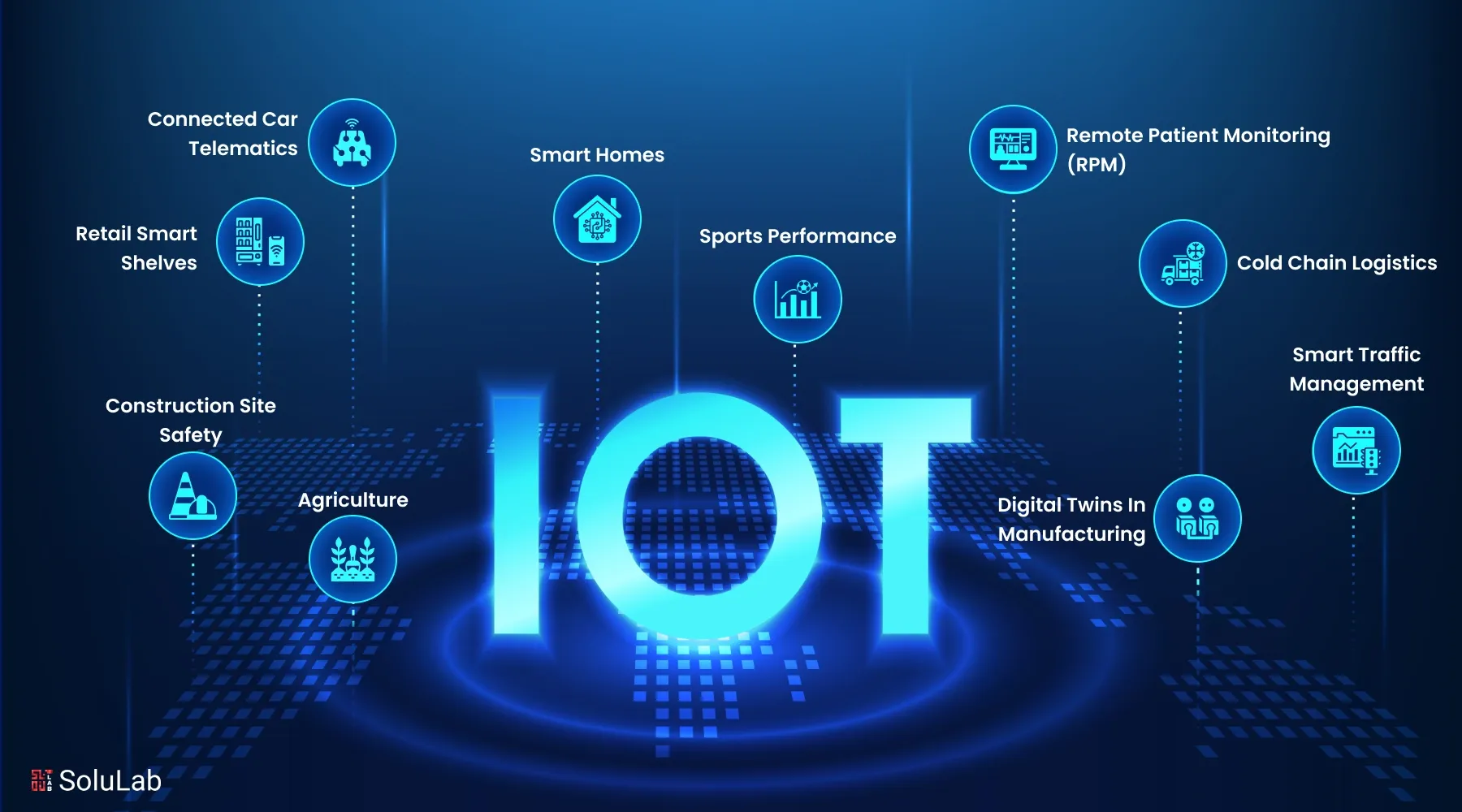
You can see IoT working everywhere, from sensor-based sports analytics, digital twins in factories, and smart energy grids, to cold-chain tracking, smart homes, and predictive pipeline monitoring. One thing is clear: businesses that choose the right IoT solutions are moving ahead fast.
This article gives you a clear picture of the IoT landscape. In this, we’ll walk through 12 powerful IoT use cases, explained in simple words with real industry examples.
Key Takeaways
- IoT in 2026 is a strategic growth driver, not just a connectivity upgrade, helping enterprises improve efficiency and decision-making.
- The success of IoT initiatives depends on choosing use cases aligned with business goals, not just deploying more devices.
- Real-time data from connected devices enables proactive operations, reducing downtime, waste, and operational risk.
- Enterprises that integrate IoT with AI, analytics, and cloud platforms gain long-term scalability and competitive advantage.
IoT Development Market Trends 2026
The IoT market has become the digital backbone of almost every industry today. What used to be future tech is now core infrastructure across healthcare, manufacturing, agriculture, smart cities, retail, transportation, and even real estate.
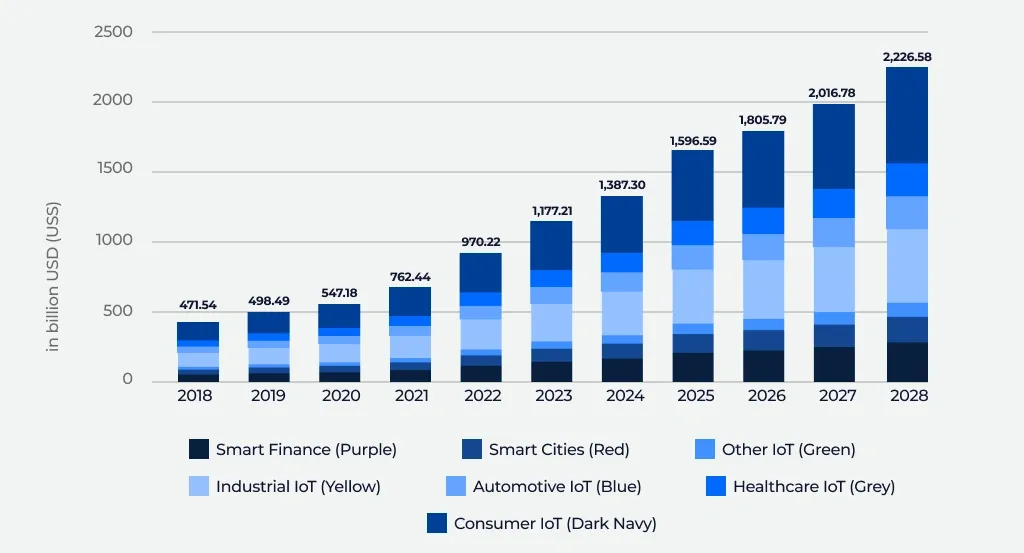
The global IoT market touched $1.06T in 2025 and is set to reach $5.34T by 2035, growing fast at 16.8% CAGR. Today, there are 19.8B IoT devices, and this number will hit 40.6B by 2034.
Here is how IoT is needed in the market –
- In healthcare, connected wearables and remote-care tools cut hospital readmissions by up to 38%. The market hit $44.21B (2023) and is growing at 21.2% CAGR.
- In manufacturing, predictive maintenance and real-time monitoring will push IIoT to $53.8B by 2025, creating $1.4T–$3.3T in value.
- Smart farming solutions deliver 20–30% higher yields and 50% water savings through data-driven irrigation and crop insights.
- Smart cities & buildings reduce traffic by 25% and energy use by 15%, improving safety and utility efficiency.
- In retail, smart shelves and RFID tracking cut stockouts by 30%, with strong growth at 28.4% CAGR.
- Connected mobility is rising fast, 79% of new cars in 2024 included built-in telematics, growing to 521M vehicles by 2029.
- Telecom operators now earn beyond data plans by powering smart homes, connected devices, and automation. This space will hit $1.149T by 2034.
- Mining, oil & gas use real-time monitoring for safety and leak detection; a single undetected leak can cost $100M+.
Top 12 IoT Use Cases You Should Know
IoT technology is changing how businesses work across industries. From smart homes and digital twins to healthcare and sports analytics, these 12 use cases demonstrate how connected devices can enhance efficiency, inform better decisions, and create new opportunities.
1. Smart Homes & Connected Living
Today, homes are no longer just living spaces; they’re connected ecosystems. Residents now expect:
- Lighting that adjusts automatically with presence, time, and mood
- Climate control that learns behavior and saves energy
- Smart access combining locks, video intercoms, and visitor management
- Real-time security alerts for motion, smoke, or break-ins
For businesses, this goes beyond individual homes. Smart buildings, multi-family housing, co-living spaces, senior living, and commercial complexes use IoT. It seamlessly links lights, locks, cameras, and appliances. Smart home platforms are long-term wins, once your IoT solution controls core systems, user loyalty skyrockets, and churn drops.
2. Sports Performance Analytics
Sports today all about data. From amateurs to elite athletes, coaches and players are using IoT in wearables to track performance far beyond what simple video review can show. There are systems like:
- Bats, rackets, sticks, and clubs with accelerometers, gyroscopes, and pressure sensors measuring swing speed, acceleration, and point of impact.
- Smart insoles and shoes track balance, ground contact time, and gait.
- Compression gear monitors heart rate, strain, and recovery in real time.
IOT in Sports technology helps track player load, workload spikes, and movement patterns, helping coaches design hyper-personalized training plans that match each athlete’s body and performance goals.
3. Remote Patient Monitoring (RPM)
Remote care is essential. Using IoT in healthcare, hospitals, clinics, and digital health providers now deploy wearables and in-home devices that continuously track:
- Heart rate, blood pressure, oxygen levels
- Blood glucose and sleep patterns
- Activity levels and medication impact
With this real-time data, care teams can detect health issues early, intervene before emergencies, track treatment effectiveness, and even prioritize patients who need immediate attention.
When done right, it reduces re-admissions, cuts costs, and improves patient experience, especially for chronic conditions like diabetes, cardiac problems, and respiratory illnesses.
Case study: We developed Medicgraph, a platform that provides accurate ECG analytics, streamlined patient data management, and comprehensive reporting, empowering medical staff to deliver truly patient-centered care.
4. Cold Chain Logistics
For pharmaceuticals, vaccines, fresh produce, and specialty chemicals, even a small temperature spike at the wrong moment can ruin shipments and damage customer trust. IoT in supply chain management solves this by connecting sensors across the entire value chain, giving full visibility and control in real time.
Key solutions include:
- Attaching temperature and humidity sensors to pallets, containers, or individual packages
- Streaming data instantly over cellular or LPWAN networks
- Triggering alerts if thresholds are breached at warehouses, hubs, vehicles, or last-mile delivery
- Maintaining audit trails for compliance and claims
5. Smart Traffic Management
Cities struggle with congestion, and building more roads isn’t enough. IoT in smart city projects uses cameras, sensors, and connected vehicles to monitor traffic in real time and adjust systems dynamically, making everyday commuting smoother.
Core capabilities:
- Adaptive traffic signals that adjust green times based on real flow
- Priority signaling for ambulances, fire trucks, and public transport
- Real-time rerouting suggestions for drivers and ride-hailing fleets
- Analytics on congestion hotspots for better long-term planning
When implemented well, commuters barely notice IoT as they just enjoy shorter travel times, fewer bottlenecks, and safer intersections.
6. Digital Twins in Manufacturing
In manufacturing, IoT is more than just adding sensors to machines; it’s about creating a live, data-rich digital copy of your entire production line. These digital twins connect machine data, line performance, and quality metrics into a smart virtual model.
Read More: How Can Digital Twin Services in 2026 Transform Your Real-World Assets?
This is where IoT use cases in manufacturing and industrial IoT solutions really shine. With a mature digital twin IoT implementation, manufacturers can:
- Predict equipment failures and schedule maintenance before breakdowns happen.
- Simulate process changes in the virtual model before touching the actual line.
- Optimize line speeds, batch sizes, and energy usage efficiently.
- Spot bottlenecks and quality issues across multiple plants in real time.
Case study: We built Gearnetics, an advanced IoT fleet monitoring solution for up to 10,000 vehicles, showing how digital twins can optimize operations, reduce hardware costs, and improve efficiency.
7. Connected Car Telematics
Vehicles today are rolling computers, generating data on engine health, driving patterns, and safety events. IoT applications in smart vehicles are crucial for OEMs, insurers, mobility services, and fleet operators, forming the backbone of IoT in the automotive industry.
Typical use cases include:
- Real-time telematics: location, speed, driving behavior, and safety events
- Predictive maintenance using engine diagnostics and component health
- Over-the-air software updates for infotainment, safety systems, and performance tweaks
- Usage-based insurance models and driver scoring
As autonomous and assisted driving expand, the volume and value of vehicle data grows making robust, secure, and scalable IoT systems essential for businesses in automotive, mobility, and insurance sectors.
8. Retail Smart Shelves
Retail stores lose money when shelves go empty, stock is wrong, or online and in-store experiences don’t match. Smart shelves fix this by using sensors, RFID, computer vision, and edge computing to show what is happening in the store in real time. This is a big part of IoT in retail stores and IoT in inventory management for brands that want smoother operations.
Smart shelves help retailers:
- Detect low stock with weight sensors or RFID
- Connect shelves with warehouse systems for fast restocking
- Track how customers move in the store with heatmaps
- Change prices and digital signs based on demand and stock
9. Smart Grid Optimization
Energy companies today must keep power reliable, affordable, and clean while managing solar, wind, and battery resources. Smart grids leverage large-scale IoT sensors to monitor and control power flow in real time. While commonly seen in utilities, these solutions are also critical for factories, data centers, campuses, and smart buildings.
Key features include:
- Smart meters in homes and buildings
- Sensors on transformers and power lines
- Systems that detect and automatically fix faults
- Demand-response programs reward customers for shifting usage
We developed an energy monitoring and analytics platform for Kadi Energy, helping them achieve smarter grids, better efficiency, and measurable cost savings.
10. Pipeline Leak Detection
Oil and gas pipelines run across huge distances, and even a small leak can turn into a multi-million-dollar disaster. This is why leak detection is one of the most important IoT oil and gas use cases and a key part of the IoT in the oil & gas industry.
Companies place pressure, flow, acoustic, and fiber-optic sensors along the pipeline. These systems:
- Spot tiny changes in pressure or flow
- Find the exact point of a possible leak
- Trigger automatic shutoff valves
- Give data for audits, reports, and compliance
With high financial and environmental risk, leak detection is a no-regret investment for any energy company.
11. Construction Site Safety
Construction sites change every day and carry high safety risks. IoT helps site managers see real-time activity and create safer, more controlled environments. This is a significant aspect of IoT in construction and the construction industry.
Popular solutions include:
- Wearables that detect falls, dangerous gases, or entry into unsafe zones
- GPS trackers on heavy machines to prevent collisions
- Sensors for dust, noise, heat, and humidity
- Smart access control and attendance tracking
This approach leads to fewer accidents, improved compliance, and stronger trust from insurers and clients, showing how IoT transforms safety and efficiency in construction projects.
12. Precision Agriculture
Food demand is rising, water is limited, and the weather is becoming harder to predict. Traditional farming simply can’t keep up. That’s why data-driven farming, powered by IoT in agriculture and smart farming solutions, is becoming one of the strongest ROI models in the entire industry.
Modern farms rely on a mix of connected IoT tools to make smarter, data-driven decisions every day. Here are some common IoT patterns in modern agriculture:
- Soil sensors track moisture, temperature, and nutrients in real time.
- Connected weather stations provide hyperlocal forecasts for each field.
- Drones and satellite imagery detecting crop stress before it’s visible.
- Automated irrigation systems deliver water exactly when and where it’s needed.
Case study: We built AgroPro, an agriculture app that analyzes soil across 35+ parameters, processes 2 million data points daily, and visualizes results in real time, empowering farmers to act quickly and efficiently.
Why IoT Integration Matters for Every Industry?
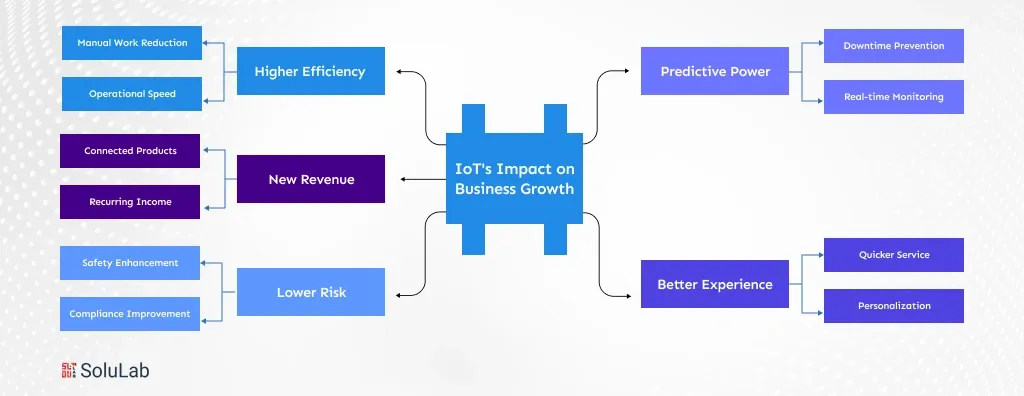
When you look across different IoT use cases, one thing becomes clear: the business value stays the same, no matter the industry. Whether it’s IoT fleet management use cases, IoT in telecom, or IoT in property management, companies everywhere see similar benefits when they use smart, connected systems.
Here’s how IoT development companies help businesses grow:
- Higher efficiency: IoT cuts manual work, removes delays, and keeps daily operations running fast and smoothly.
- Predictive power: IoT spots problems early so teams prevent downtime instead of reacting late.
- New revenue: Connected products create steady, recurring income instead of one-time sales.
- Better experience: IoT helps brands deliver quicker, more personal service across retail, hotels, healthcare, and transport.
- Lower risk: Real-time monitoring boosts safety, improves tracking, and helps companies stay fully compliant.
The smartest companies don’t do IoT in random pieces. They build a full roadmap mixing quick wins with long-term bets, so every IoT project adds to a bigger transformation plan.
Conclusion
Today, every business that wants to scale must understand where IoT fits into its growth strategy. Companies that act now will build smarter operations, cut costs, and unlock new revenue streams before competitors even begin.
Over the next 3–5 years, the real winners will be those who choose the right IoT opportunities, implement them with strong fundamentals, and continuously improve as their data grows. Most industries are already moving toward connected systems; delaying means falling behind.
If you want to build these systems the right way, with clean architecture, real-time data workflows, and enterprise-grade execution, partnering with a reliable IoT development company is key. At SoluLab, our team helps businesses design and deploy scalable IoT solutions with confidence, so you can build smarter today and scale fearlessly tomorrow. Contact us today to get started!
FAQs
Industries like manufacturing, logistics, energy, healthcare, and retail get the fastest returns from Web3 in IoT solutions. This is because use cases such as predictive maintenance, fleet tracking, cold-chain monitoring, and smart retail shelves start saving money almost immediately. These projects reduce breakdowns, cut fuel waste, prevent product loss, and improve daily operations, so businesses see quick and clear ROI.
Pick a problem that hurts your business today and is easy to measure like downtime, spoilage, fuel usage, or slow service. These areas already cost you money, and even a small improvement creates a real financial impact. Start with a small, focused IoT pilot that collects the missing data and shows early results. This helps you learn fast and scale confidently.
Strong IoT security must be built from day one. This includes secure provisioning, encryption, identity and access control, network segmentation, and safe update systems. If you work in a regulated industry like healthcare, energy, or finance, your IoT setup should match your existing security and compliance frameworks. The goal is simple: protect your data, protect your customers, protect your business.
IoT does not replace your systems; it upgrades them. Most companies connect IoT data directly into tools they already use, like ERP, CRM, MES, or analytics platforms. With clean APIs and integration layers, IoT becomes another powerful real-time data source that makes your entire stack smarter without forcing a full rebuild.
Usually, no. Most businesses get better results by mixing proven cloud IoT services, edge devices, and custom modules built for their real workflow. A good development partner will guide you on when to build, when to configure, and when to integrate existing solutions. This keeps your costs low, speeds up launch time, and lets you focus on results.