
Key Takeaways
- The Problem: Startups and early blockchain projects can’t easily reach capital through the usual channels. Traditional funding is slow, tied to geography, and gatekept by institutions that pass on most early-stage ideas.
- The Solution: Initial Coin Offerings (ICOs) flip that script. Projects sell tokens directly to a global pool of buyers, cut out the middlemen, lower the cost of raising money, and let people invest in real time from anywhere, all on decentralized blockchain rails.
- How SoluLab Can Help: SoluLab is a trusted ICO development company. We handle the whole build, smart contracts, token development, whitepaper drafting, and the ICO platform itself, so you launch something secure, compliant, and genuinely appealing to investors.
ICOs changed how blockchain startups get funded, full stop. Instead of chasing banks or VCs, a project sells digital tokens and raises money directly from the people who want to use its product. J.R. Willet ran the first one back in 2013, MasterCoin, and what started as an experiment is now a real fundraising category in crypto.
By 2023, DeFi projects alone made up almost 36% of all ICO launches. The global market had already blown past $3.2 billion by 2025, pushed along by AI-driven blockchain platforms and tokenized real-world assets. Now that regulators in 2026 are giving clearer signals, more businesses are turning to ICO development solutions to raise money faster, pull in investors from more countries, and build out bigger Web3 platforms.
This piece breaks down what ICO development actually gets you as a crypto business today.
What is an Initial Coin Offering?
So what is it, exactly? An Initial Coin Offering (ICO) is a way for startups to raise money by issuing digital tokens straight to investors, no bank in the middle. People often describe it as ICO vs IPO, and the comparison holds up: it lets crypto projects fund blockchain platforms, decentralized apps, and Web3 products without ever walking into a conventional financial institution.
Here’s the mechanic: investors buy the newly minted tokens using Bitcoin, Ethereum, or similar crypto. What that token actually gets you varies. Sometimes it’s platform utility. Sometimes it’s a governance vote. Sometimes it’s just upside tied to the project doing well. This model now underpins DeFi platforms, gaming projects, tokenized assets, and AI-powered blockchain solutions.
Compliance matters more than it used to. Most serious token offerings now build around frameworks like Regulation D exemptions and KYC/AML checks, partly to satisfy regulators and partly because investors simply trust a compliant project more. And ICOs have raised real money for real startups, no question. But the bar has moved. Investors now want to see actual utility, clean tokenomics, and a business that can survive past the raise.
What is the Purpose of an ICO?
Newcomers ask this a lot: what’s the point of an ICO beyond just grabbing cash?
The honest answer has layers.
At the most basic level, an ICO funds product development, selling tokens to early believers before anything actually ships. But that’s really just the starting point:
- Community Building: Token holders have skin in the game, so they promote and actually use the product. That’s your early user base, built in.
- Decentralized Ownership: Tokens aren’t equity, but they can carry utility, governance rights, or access, giving holders a genuine stake in what gets built.
- Market Validation: A raise that goes well is a signal. Other investors notice, and partnerships tend to follow.
- Liquidity for Early Backers: Once listed, tokens trade on exchanges. Try getting that kind of liquidity out of early-stage equity.
By 2026 the purpose has widened again: cross-chain interoperability funding, DAO treasury building, protocol-level upgrades. Projects working in the Decentralized Web3 Ecosystem now lean on ICOs as their main way to bootstrap.
How ICO Funding Works for ICO Projects and Token Launches?
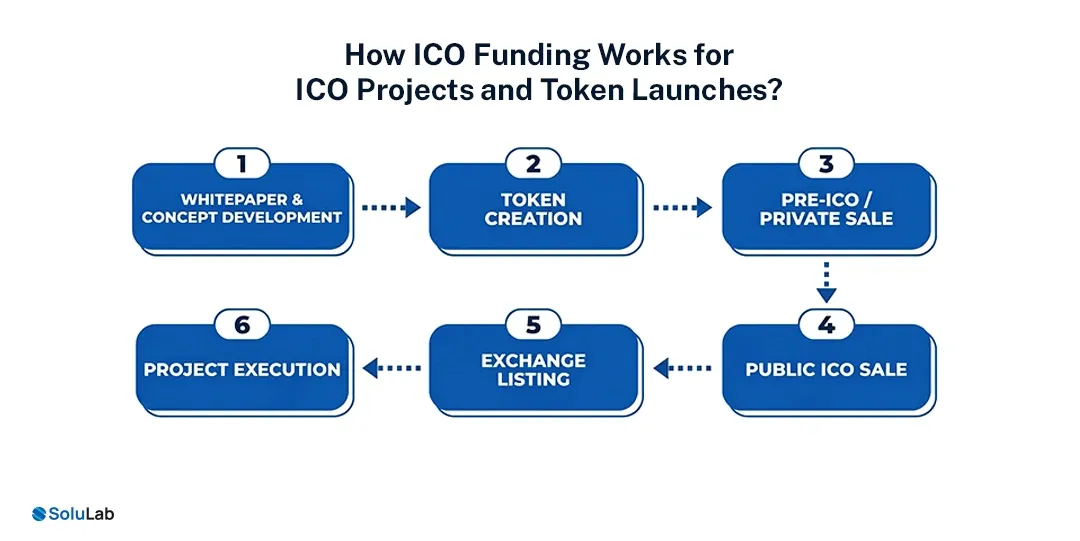
Before you invest a dollar or launch a token, you need to know how the money actually moves. Here’s the typical sequence.
1. Whitepaper & Concept Development:
The team writes a whitepaper covering the project’s goals, tokenomics, roadmap, and where the funds will actually go. Investors treat this as their main due-diligence document, so it needs to hold up under scrutiny.
2. Token Creation:
Next, the project deploys a smart contract, usually on Ethereum, BNB Chain, or Solana, that locks in the total supply, how tokens get distributed, and the vesting schedule. This is what ICO token development services actually do.
3. Pre-ICO / Private Sale:
Before anything goes public, strategic investors and partners get first access at a discount. It’s a way to test appetite and bank some early capital before the wider market even sees the offer.
4. Public ICO Sale:
Then it goes live. Retail and institutional buyers alike can purchase tokens with crypto or fiat on an ICO crowdfunding platform, and smart contracts handle distribution automatically, no manual bottleneck.
5. Exchange Listing:
After the raise closes, tokens get listed on centralized or decentralized exchanges. That’s what gives them liquidity and lets the market actually price them.
6. Project Execution:
And then the real work starts: building the thing the whitepaper promised.
Having experienced ICO Consultants at every stage genuinely raises your odds of a clean launch. Blockchain development services matter here too, they’re the ones who keep the underlying infrastructure secure and able to scale.
Curious how an ICO differs from an STO? This ICO vs. STO comparison covers it.

Five Successful ICO Projects Highlighting the Advantages of ICO Development
The biggest ICOs to date have moved billions of dollars and touched millions of people. The space has already produced plenty of winners, and there’s still room for more. Here are five of the token releases that made the biggest mark:
Ethereum: One of the earliest ICOs on record, and arguably the one that mattered most. Ethereum went beyond just being digital money like Bitcoin before it. Its smart contracts became the foundation developers use to build decentralized apps.
IOTA: IOTA aimed its ICO squarely at the Internet of Things, pairing blockchain with a decentralized transaction ledger that offered a scalable, fee-free environment.
Stratis: A software platform built for companies to develop, test, and deploy programs across multiple languages, without ever setting up or managing their own development environment. The ICO itself raised close to 1,000 BTC, worth $675,000 at the time. Today that same stack is worth over $8 million.
EOS: EOS pulled in more than $185 million in just the first five days of its ICO, still one of the biggest raises anyone’s seen. Its white paper positions the network as a real competitor to Ethereum, and the team backs that up with a broad range of blockchain-compatible business solutions.
NEO (formerly Antshares/NXT): Ran two separate rounds of token sales, with backing tied to Microsoft and the Chinese government, and launched at 3 cents a coin. Between October 2015 and January 2018, that price climbed to $180M. Per its own white paper, NEO counts among the largest ROI coin offerings out there.
Why the 2026 ICO Launch Process Favors Early Backers?
Early access and high ROI potential have always been the pitch for ICO investors. But 2026 adds a more mature layer of advantages on top of that:
1. Regulated Entry Points:
The EU has MiCA now. The UAE and parts of Asia have their own clearer frameworks too. Investors can jump into an ICO today with a legal picture that simply didn’t exist a few years back.
2. Tokenized Real-World Assets:
More ICOs in 2026 are built around tokenization development solutions, launching tokens backed by real estate, commodities, or revenue-sharing arrangements. The result: digital investments that are more secure, more transparent, and tied to something actually useful.
3. DAO Governance Rights:
Plenty of ICO tokens now carry governance voting rights inside decentralized autonomous organizations DAOs. Buy in, and you get an actual vote on where the project goes next.
4. Cross-Chain Liquidity:
Multi-chain infrastructure has grown up. ICO tokens now move across several blockchain networks, which means far better liquidity for the people actually holding them.
5. Transparent On-Chain Audits:
Smart contract audits paired with on-chain treasury tracking is close to standard practice now. Investors can see more than they ever could before.
If you’re an investor scoping out top Web3 platforms, ICOs are still one of the highest-upside entry points around, provided you actually do the diligence work first.
Advantages of ICO Development in the ICO Launch and Funding Process
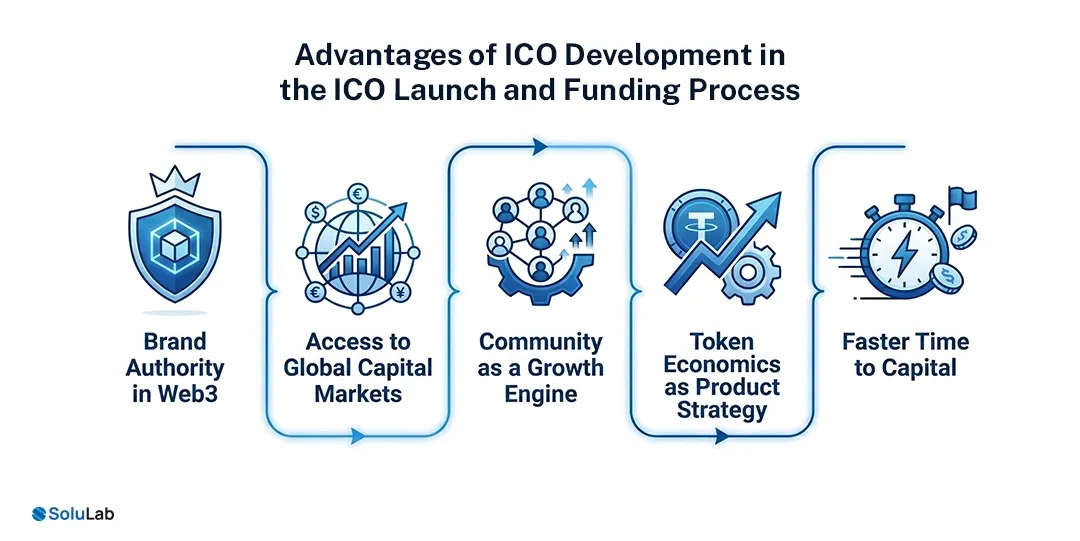
ICO development pays off in more than just the money raised. Launch one, and you pick up a wider set of strategic benefits along the way:
Brand Authority in Web3:
Launching a well-structured ICO tells the market you’re a serious player, not a side project. It signals real technical depth, a clear product vision, and genuine commitment to your community, and those three things pull in both investors and talent.
Access to Global Capital Markets:
Venture capital still clusters in a handful of cities. ICO launch services skip that bottleneck entirely, letting you raise from investors in 100+ countries at once. No conventional fundraise touches that kind of reach.
Community as a Growth Engine:
Token holders turn into evangelists, and that’s not an accident. Give people a financial stake in your success and they’ll promote, refer, and advocate for you without being asked. Your customer acquisition cost drops as a direct result.
Token Economics as Product Strategy:
Good tokenomics does double duty as product strategy. Staking rewards, governance participation, utility discounts, these are behavioral incentives, and they keep your community showing up long after the raise itself is over.
Faster Time to Capital:
A traditional Series A can eat 6 to 18 months of your life. An ICO, run by the right team, can go from concept to capital in 8 to 16 weeks. Web3 development company in USA partners like SoluLab build entire practices around exactly that kind of speed.
Cost to Develop an ICO Platform in 2026 Across the ICO Launch Process
Founders search one question more than almost any other: what does it actually cost to develop an ICO platform? It depends on scope, obviously, but here’s a realistic breakdown for 2026:
| Component | Estimated Cost Range (USD) |
|---|---|
| Smart Contract Development | $5,000 – $20,000 |
| ICO Platform Frontend & Dashboard | $8,000 – $25,000 |
| KYC/AML Integration | $3,000 – $10,000 |
| Token Creation & Security Audit | $5,000 – $15,000 |
| Whitepaper & Legal Documentation | $3,000 – $12,000 |
| Marketing & Community Setup | $5,000 – $30,000 |
| Total Estimated Cost Range | $29,000 – $112,000+ |
That spread exists because a basic ICO crowdfunding platform and a full multi-chain build with staking, vesting dashboards, and DAO governance are simply not the same project.
Go with a white-label ICO platform, the kind SoluLab offers, and you can cut time-to-market by 40 to 60% while staying closer to the lower end of that range.
Step-by-Step Guide for ICO Platform Development Launch
Knowing what the launch process actually looks like helps you plan for real timelines, not wishful ones. Here’s the step-by-step sequence leading ICO development solutions are running in 2026:
Step 1: Concept Validation & Market Research
Nail down your core value proposition first. Figure out who your target investors actually are, size up the competition, and settle on a token utility model, all before a single line of code gets written.
Step 2: Legal & Regulatory Assessment
Bring in blockchain consultants to pin down whether you’re dealing with a utility token or a security token, and decide which jurisdictions you’re actually targeting. That single decision shapes your whole KYC/AML strategy and how the whitepaper gets structured.
Step 3: Whitepaper Development
Write the whitepaper. Cover the problem, the solution, your tech stack, tokenomics, the team, the roadmap, and exactly where the funds go. This is the single document investors will scrutinize hardest.
Step 4: Token & Smart Contract Development
Bring in ICO token development services to code, test, and audit the token smart contract. Skip the audit at your own risk: one exploit is enough to wipe out investor confidence overnight.
Step 5: ICO Platform Development
Build or deploy your crypto launchpad solution, complete with the investor dashboard, wallet integration, a working token purchase flow, and progress tracking that updates in real time.
Step 6: Pre-ICO Marketing & Community Building
Get your Telegram, Discord, and social channels live. Put out content that actually says something. Run a private sale or a whitelist to build momentum before the public even gets a look.
Step 7: Public ICO Launch
Now open it to the public. Watch the smart contract activity closely, answer investor questions as they come in, and keep an eye on milestones in real time.
Step 8: Exchange Listing & Post-ICO Roadmap Execution
List your token on top decentralized exchanges, then get to work on the actual roadmap. Trust erodes fast if you don’t.
Specific Considerations for ICO Projects and Investors
Regulatory clarity has genuinely improved between 2025 and 2026. The EU’s Markets in Crypto-Assets (MiCA) regulation, in full effect since early 2025, gives ICO projects across member states an actual compliance framework to follow.
In the US, SEC and CFTC guidance is still shifting, which is exactly why working with qualified ICO Consultants before launch matters more than ever. Projects that partner with top ICO development companies are simply better positioned to move through this without legal exposure.
No one can promise you won’t run into fraud when investing in an ICO. That risk is real. But a few precautions cut it down a lot:
- Check whether the developers can actually explain what they’re building. The whitepapers behind successful ICOs tend to state simple, clear goals, not vague promises.
- Demand transparency, full stop. Any company running an ICO should be willing to show you everything.
- Read the legal terms line by line. Traditional regulators aren’t fully in the picture here, so confirming legitimacy falls on you, the investor.
- Keep ICO funds in an escrow wallet. It needs multiple access keys just to open, which makes it a real barrier against scams.
- That multi-key requirement is precisely what makes fraud so much harder to pull off.
- Some ICOs only accept other cryptocurrencies, so you might need to buy additional coins just to participate.
Choosing the Right ICO Development Company to Launch a Successful ICO
Hundreds of firms claim they do ICO development. Picking the right one is one of the biggest calls a founder will make on this whole journey.
Here’s what actually matters when you’re evaluating one:
Technical Depth
Look for a track record: real smart contract deployments, real security audits, real multi-blockchain platform work. Ask to see the case studies and the audit reports, not just the pitch deck.
End-to-End Capabilities
The strongest providers cover everything: token creation, platform development, legal guidance, marketing, exchange listing support. Split that work across five different vendors and you’ve just created a coordination problem for yourself.
Regulatory Experience
The ICO Consultants on staff need to actually know the SEC, MiCA, DFSA, and VARA frameworks cold. Build a technically flawless token and violate securities law anyway, and you’ve still failed.
Post-ICO Support
The relationship shouldn’t end the moment tokens are delivered. A good development company sticks around for smart contract maintenance, community management tools, and help executing the roadmap.
Transparent Pricing
Reputable providers give you clear, scope-based pricing up front. Watch out for anyone who quotes a vague “starting from” number without breaking down what’s actually included.
If your team is also exploring cryptocurrency development services as part of a bigger Web3 push, working with one provider that covers both ICO and DApp development tends to produce a much more coherent result than juggling two.
How Can an ICO Development Company Like SoluLab Support Your ICO Launch?
ICOs still work as a fundraising mechanism, that much hasn’t changed. What has changed is the bar: more regulatory scrutiny, more cautious investors, and a real need for stronger due diligence, secure token design, and compliant execution. Buyers today want transparency, audited smart contracts, and clear utility, not a speculative story.
That’s the gap SoluLab works in. We help startups and enterprises launch ICOs that are secure, compliant, and built to scale, from token development and smart contract engineering through to fully customized white-label platforms with multi-blockchain support. The goal is straightforward: get you the most out of your raise while keeping technical and regulatory risk as low as possible.
First ICO or an upgrade to an existing platform, it doesn’t matter. SoluLab’s blockchain engineers deliver end-to-end ICO development built to last, not just to launch.
Conclusion
An ICO gives startups and blockchain projects a real way to raise capital without traditional intermediaries standing in the way, and it builds a global user base from day one in the process. It’s never really just about the money. Done right, an ICO gets you to market faster, grows your community organically, and validates whether your project’s utility actually holds up in the wider crypto world.
Get the tokenomics right, follow security best practices, and stay aware of the regulatory picture, and an ICO aligns what builders want with what users want. That’s long-term value, not a short-term flip. Teams that actually prioritize transparency, compliance, and technical rigor will find ICOs still a flexible, effective way to launch and grow ambitious blockchain projects. The ones that skip those steps usually find out why they mattered, the hard way.
Got a question about your own ICO plans? We’re around, just ask.
FAQs
Shipra Garg is a tech-focused content strategist and copywriter specializing in Web3, blockchain, and artificial intelligence. She has worked with startups and enterprise teams to craft high-conversion content that bridges deep tech with business impact. Her work translates complex innovations into clear, credible, and engaging narratives that drive growth and build trust in emerging tech markets.