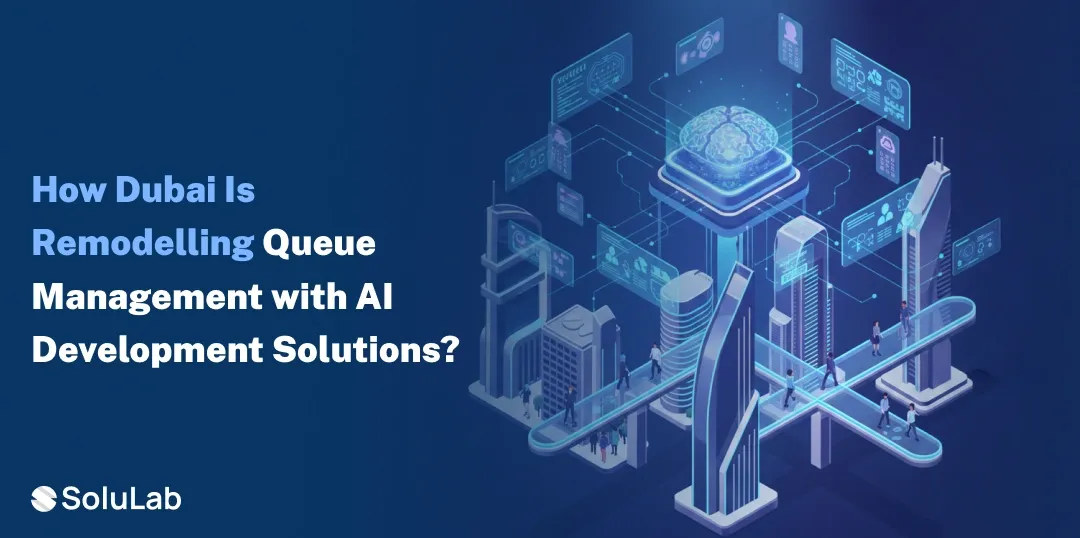
Dubai’s service economy runs on speed, scale, and experience. With 99% internet penetration in the UAE as of early 2025, customers expect services to be fast, intelligent, and predictable across government offices, hospitals, banks, airports, and retail environments. Traditional queue systems struggle to keep pace with these expectations.
This is where an AI development service for queue management system becomes essential. By combining data, machine learning, and real-time automation, organizations can move from manual queue handling to intelligent queue management that adapts dynamically to demand, behavior, and service complexity.
Why Traditional Queue Systems Fail in Dubai’s Service Economy?
Traditional queue systems were designed for low complexity environments. Dubai’s service ecosystem operates at a very different scale, with fluctuating demand, multilingual users, and high expectations for speed and fairness.
Static, rule-based queues struggle when demand spikes during holidays, tourism seasons, or large public events. They also lack the intelligence required to adapt in real time.
- Traditional token-based queues rely on first-come-first-serve logic, which fails during peak periods and creates visible congestion and dissatisfaction.
- Static systems cannot predict rush hours, resulting in up to 30–40% longer average wait times during unplanned demand surges.
- Manual staff allocation often leads to overstaffing during low demand and counter shortages during high-volume service windows.
- Lack of personalization treats all customers equally, ignoring appointments, urgency, or premium service requirements.
These limitations make legacy systems incompatible with Dubai’s smart service vision.
What Makes an AI-Powered Queue System Fundamentally Different?
An AI-powered queue management system replaces static rules with learning-based decision engines. Instead of reacting to queues after they form, AI systems predict, optimize, and continuously improve service flow.
What fundamentally changes with AI in queue management systems:
- AI models analyze historical and real-time data to predict customer arrivals, reducing uncertainty by up to 35% in high-volume locations.
- Intelligent routing dynamically assigns customers to counters based on service complexity, language preference, and staff availability.
- Real-time wait-time predictions update continuously, improving accuracy by 25–40% compared to static estimations.
- AI-driven prioritization ensures fairness while automatically handling VIPs, elderly users, emergency cases, and appointments.
This intelligence layer transforms queue management from a control mechanism into a service optimization engine. For better implementation strategy, an AI consulting company like SoluLab can guide the best roadmap with flawless execution.
Core Architecture Behind an AI-Driven Queue Management Platform
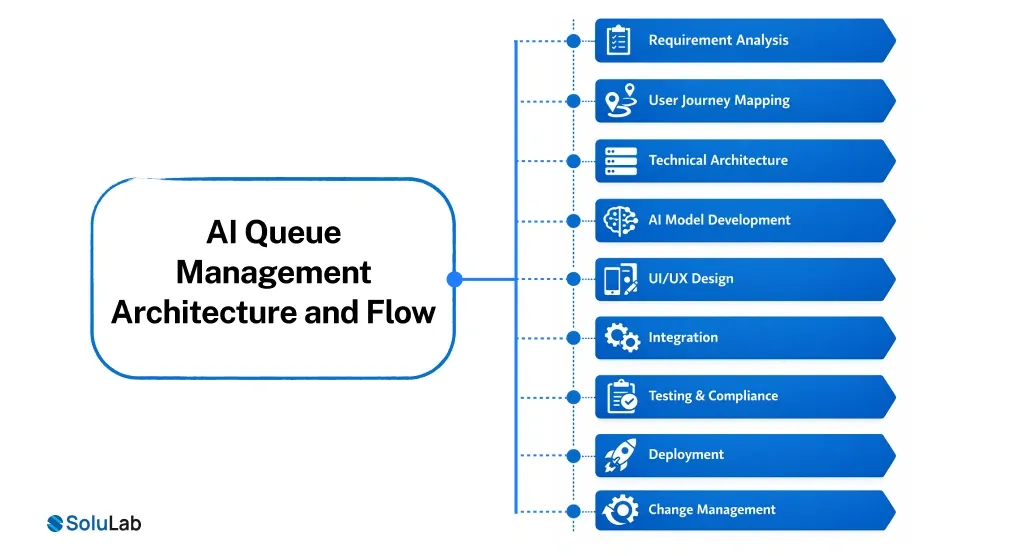
A robust architecture is essential to ensure stability, scale, and compliance across all UAE locations. Modern intelligent queue management platforms are built using modular, cloud-ready designs that support rapid expansion without performance loss.
A modern AI queue management architecture includes:
- Microservices architecture where ticketing, routing, identity, notifications, reporting, and analytics run independently for faster scaling.
- An AI and machine learning engine that powers crowd forecasting, routing intelligence, sentiment detection, and facial recognition workflows.
- Event-driven processing where queue state changes and counter availability propagate instantly using real-time event streams.
- Multilingual customer displays and staff dashboards with native Arabic and English support as a baseline requirement.
This architecture allows organizations to operate across multiple branches without system degradation.
1. AI Model Development Layer
Artificial Intelligence is the layer that elevates queue systems from automation to decision intelligence. According to IBM’s UAE research, 77% of UAE business leaders report measurable efficiency gains from AI adoption, driven by learning-based operational decisions.
Core AI models used in AI queue management optimization include:
- Crowd forecasting models that predict rush hours, long weekends, tourist season spikes, and public holiday surges with high accuracy.
- Computer vision models enabling facial recognition check-in, occupancy analysis, and anonymous queue movement tracking.
- AI for sentiment analysis detects frustration patterns using facial cues and behavioral signals to trigger proactive interventions.
- Service time prediction models that dynamically adjust routing and staffing recommendations based on expected service duration.
These models continuously learn from real operational data, improving performance over time.
2. Compliance, Personalization, and User Experience in Dubai
Compliance and user experience are inseparable in Dubai. Queue systems handle personal data, behavioral insights, and sometimes biometric information, making regulatory alignment mandatory.
Critical compliance and UX requirements include:
- Full alignment with UAE PDPL, Dubai Data Law, and sector-specific regulations such as DHA, MOHAP, and CBUAE standards.
- Privacy-by-design architecture with encrypted data storage, role-based access control, and comprehensive audit trails.
- Transparent consent mechanisms when using facial recognition or advanced behavioral analytics technologies.
- Personalization logic that improves service quality without violating fairness or data protection principles.
User experience must also reflect Dubai’s cultural and linguistic diversity.
3. UI and UX Engineering for UAE Users
User interfaces must be instantly usable by residents, tourists, and frontline staff. Simplicity, clarity, and inclusivity drive adoption.
Key UI and UX design considerations include:
- Mandatory Arabic and English service flows across kiosks, mobile apps, signage, and staff dashboards for accessibility compliance.
- Optional Hindi, Urdu, and Filipino interfaces based on branch demographics to improve adoption and reduce service friction.
- Mobile-first experiences including QR-based check-in, virtual queues, WhatsApp notifications, and remote wait-time tracking.
- Clear visual cues and instructions that reduce confusion and lower staff dependency during peak operational hours.
Well-designed UX directly reduces perceived wait times by up to 20%.

Cost, ROI, and Scaling AI Queue Systems Across the UAE
The cost of building an AI application like queue management in Dubai depends on intelligence depth, scale, and regulatory requirements. Thinking in layers provides more clarity than focusing on a single number.
Primary cost drivers include:
- AI model complexity, where crowd forecasting, sentiment analysis, and facial recognition significantly increase development effort.
- Number of branches, as multi-city deployments across Dubai, Abu Dhabi, and Sharjah require centralized intelligence with local customization.
- Enterprise integrations with CRM, ERP, HIS, banking systems, UAE Pass, DubaiNow, POS tools, and WhatsApp workflows.
- Compliance and cybersecurity requirements that add encryption, governance, monitoring, and audit configurations.
Hosting and infrastructure choices also affect total cost. Data residency is a non-negotiable requirement in the UAE. Common hosting approaches include:
- AWS UAE region deployments for scalable, high-availability enterprise workloads.
- Azure UAE region infrastructure for organizations already aligned with Microsoft ecosystems.
- G42 cloud environments for government and regulated industries requiring strict data sovereignty.
Compared to global regions, UAE-hosted infrastructure has a higher baseline cost but ensures regulatory compliance and trust.
Real-World Use Cases of AI Queue Management Across Dubai’s Key Sectors
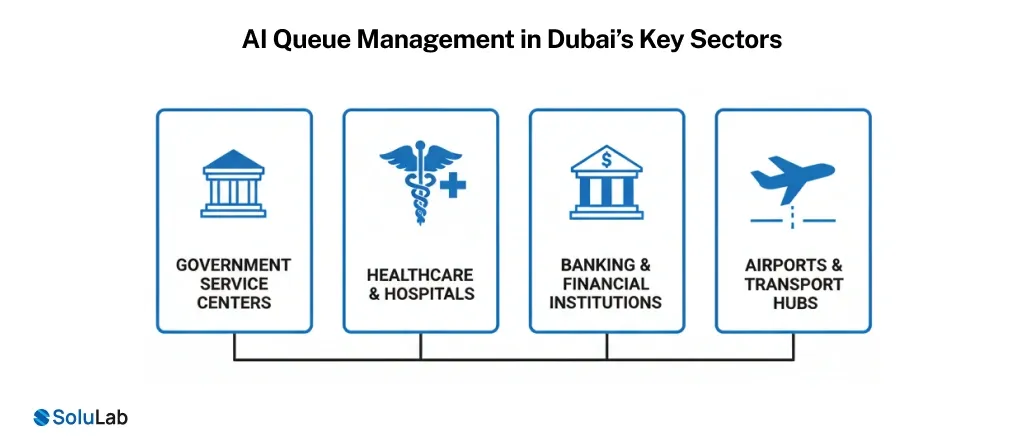
AI-powered queue systems are no longer conceptual in Dubai. They are actively reshaping how high-footfall sectors operate by reducing friction, improving predictability, and enabling real-time decision-making. With the UAE’s digital maturity and service expectations, AI queue management has become a practical tool for operational resilience rather than a future investment.
Below is a more detailed, sector-wise breakdown that reflects how AI-powered queue management systems in Dubai are delivering measurable outcomes.
1. Government Service Centers
AI in Dubai public service handles thousands of daily visitors across licensing, immigration, utilities, and citizen service centres. Demand fluctuates heavily based on deadlines, policy changes, and public holidays.
- AI-driven crowd forecasting models predict daily and hourly visitor volumes using historical data, public calendars, and seasonal demand patterns.
- Intelligent routing automatically balances workload across counters, reducing counter idle time while preventing visible queue congestion.
- Priority logic ensures elderly citizens, people of determination, and appointment holders are served fairly without manual intervention.
- Real-time wait-time prediction improves transparency, reducing perceived wait time dissatisfaction by over 30% in large centers.
As a result, many government entities report 30-45% reductions in average waiting times while maintaining auditability and fairness.
2. Healthcare and Hospitals
Hospitals face some of the most complex queue scenarios, involving appointments, walk-ins, diagnostics, and emergency triage. Traditional queue systems often fail to account for urgency and service variability. AI in healthcare acts as a problem solver:
- Patient flow orchestration across OPD visits, diagnostics, pharmacy, and emergency services using predictive service-time models.
- AI-based triage that dynamically prioritizes cases based on urgency, symptoms, and real-time capacity constraints.
- Reduced overcrowding in waiting areas through virtual queues, SMS, and WhatsApp notifications.
- Improved staff utilization by predicting peak patient inflow, often reducing bottlenecks by 25–35%.
These systems directly improve patient experience while supporting compliance with DHA and MOHAP operational standards.
3. Banking and Financial Institutions
Banks in Dubai operate in a premium, trust-driven environment where long waits directly affect customer loyalty. Walk-ins, appointments, and relationship-managed clients must be handled simultaneously. AI solutions for banking and finance sector become crucial for-
- Separating appointment-based customers from walk-ins using predictive queue segmentation logic.
- Prioritizing high-value and relationship-managed clients without compromising fairness or transparency.
- Predicting service complexity based on transaction type, reducing unnecessary counter switching.
- Delivering real-time notifications and accurate wait estimates through mobile-first channels.
Banks using intelligent queue management often see higher service throughput and improved customer satisfaction scores without increasing staff count.
4. Airports and Transport Hubs
Dubai’s airports and transport hubs experience extreme demand volatility due to tourism, global events, and seasonal travel peaks. Managing queues efficiently is critical for safety and throughput.
- Predictive crowd management using flight schedules, arrival patterns, and real-time passenger flow data.
- Dynamic counter and lane allocation at check-in, security, immigration, and boarding checkpoints.
- Computer vision-based occupancy analysis to identify congestion before queues visibly form.
- Faster response to disruptions such as delayed flights or sudden passenger surges.
These capabilities help reduce congestion during peak hours and improve overall passenger movement efficiency. And there are other areas like the Retail industry, entertainment, and more.
Futuristic Innovations Towards AI in Queue Management in Dubai
The next phase of AI in queue management systems goes beyond efficiency into anticipatory service design. Systems will increasingly predict demand days in advance and influence staffing, scheduling, and facility planning.
Emerging innovations shaping the future include:
- Hyper-personalized queue experiences driven by integrated customer profiles, loyalty data, and service history insights.
- Deeper AI integration with smart city infrastructure in Dubai, including transport data, event schedules, and tourism analytics.
- Voice-enabled kiosks and conversational interfaces powered by natural language processing for hands-free interaction.
- Explainable AI models that improve trust by clearly communicating why prioritization and routing decisions occur.
These innovations position AI-powered queue systems as core components of intelligent service ecosystems.

Conclusion
As discussed throughout the blog, queue transformation in Dubai works best when AI strengthens predictability, compliance, and service intelligence without disrupting existing operations. AI-powered queue management systems are no longer operational add-ons. They are becoming core infrastructure for government, healthcare, banking, aviation, and high-footfall enterprises that must deliver speed, fairness, and consistency at scale.
This is where the right implementation partner makes the difference. SoluLab, a leading AI development company in Dubai, specializes in building enterprise-grade AI-powered queue management systems, designed around local compliance, multilingual user experience, and scalable architecture that supports long-term growth.
If you are planning to build or upgrade an AI system in Dubai, now is the right time to move from static workflows to intelligent service orchestration. Contact our experts to improve customer experience across the UAE!
FAQs
Absolutely. Arabic and English support is mandatory, and many systems also include Hindi, Urdu, and Filipino interfaces based on branch demographics. Multilingual UX significantly improves adoption and reduces service friction in the UAE.
The cost depends on AI model complexity, number of branches, integrations, compliance needs, and hosting choices. Basic AI systems start at $10k (AED 36725.00), while enterprise, multi-branch solutions with advanced AI can reach six figures.
Core systems typically take 3 to 6 months to develop and deploy. Advanced features like computer vision, sentiment analysis, and large-scale integrations may extend timelines based on scope and regulatory requirements.
Most organizations see measurable ROI within 6–12 weeks, driven by reduced wait times, better staff utilization, lower operational bottlenecks, and improved customer satisfaction across high-volume service locations.
Yes. Modern platforms integrate seamlessly with CRM, ERP, HIS, banking systems, appointment platforms, WhatsApp, UAE Pass, and DubaiNow using secure APIs and middleware.