Artificial Intelligence, the world just can’t get enough of it. With next-gen models like GPT-5 setting new benchmarks, AI innovations are evolving every day to simplify human work and enhance efficiency. But building such advanced, data-driven Generative AI models requires much more than just algorithms; it demands a structured approach, robust infrastructure, and vast datasets.
In this blog, we’ll explore how to build your own Generative AI model, the key requirements behind it, and how these AI-powered applications are transforming the way businesses operate today.
Understanding the Basics of Generative AI Model Development
Generative AI model development goes far beyond writing code or training algorithms — it’s about teaching machines to create. From text and images to speech and data insights, Generative AI learns patterns from massive datasets to produce outputs that are human-like. The process starts with identifying a real-world problem, gathering high-quality training data, and choosing the right neural network architecture.
By understanding these foundational principles, developers can build scalable, creative, and business-ready Generative AI solutions that not only automate tasks but also innovate new ways of communication and productivity.
What Makes GPT-5 Different from Traditional AI Models?
GPT-5 represents the next leap in Generative AI evolution. Unlike traditional AI models designed for specific, rule-based tasks, GPT-5 is built to understand, learn, and create across multiple domains. It can generate human-like text, summarize complex information, translate languages, and even write code, all with remarkable context awareness.
| Aspect | Traditional AI Models | Generative AI (GPT-5) |
| Purpose | Designed for specific, rule-based tasks | Learns to generate content across multiple domains |
| Learning Approach | Uses predefined logic and limited datasets | Trains on massive datasets with billions of parameters |
| Output Type | Predictable, fixed responses | Creative, context-aware, and human-like outputs |
| Adaptability | Performs well in narrow use cases | Adapts to diverse tasks such as writing, coding, and translation |
| Data Understanding | Focuses on structured data analysis | Understands patterns, tone, and context from unstructured data |
| Human Interaction | Limited conversational ability | Feels natural and human-like in conversations |
Step-by-Step Process of Building a Generative AI Model
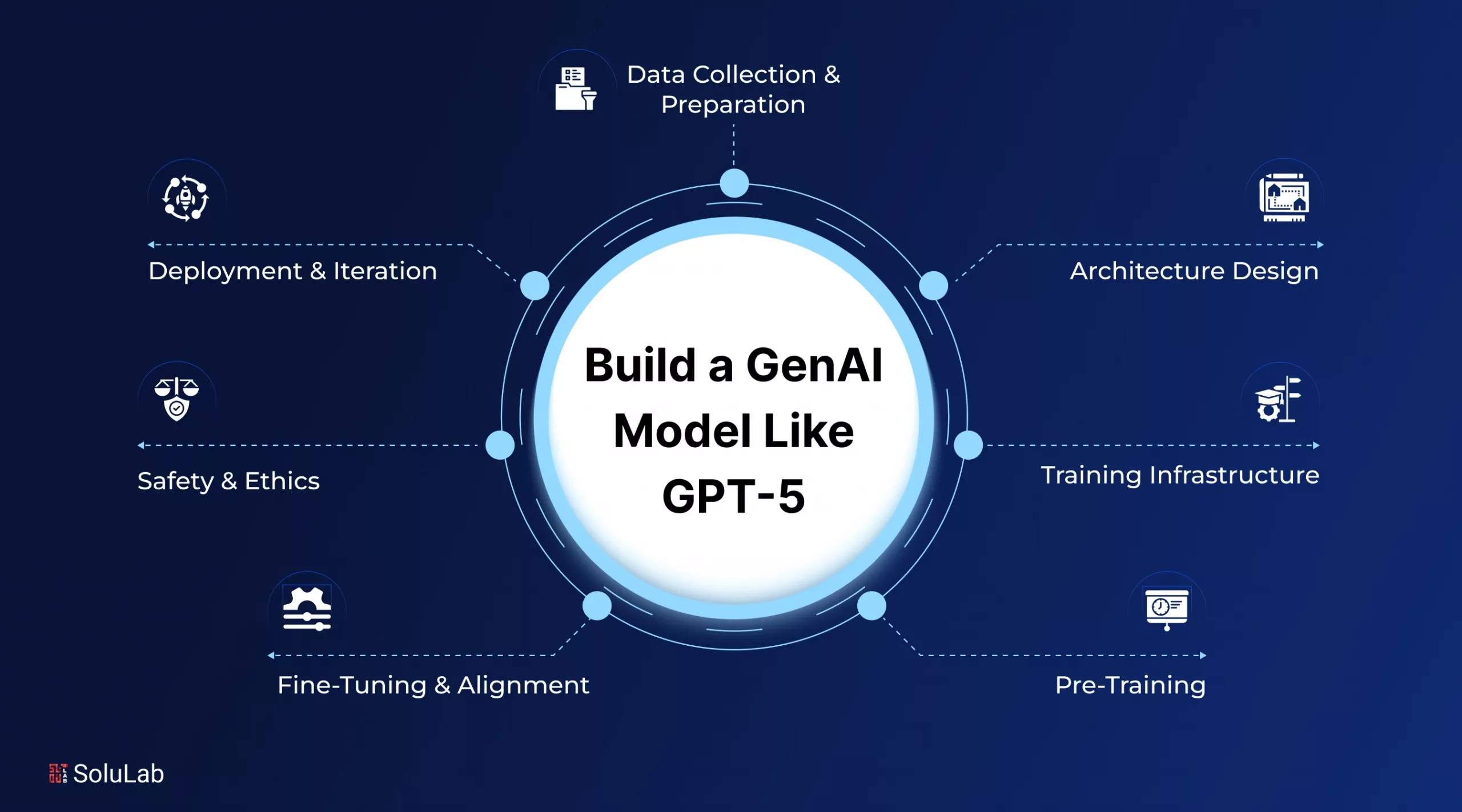
Building a generative AI model requires a structured approach. Each step ensures the model can create meaningful, realistic outputs and scale effectively in real-world applications.
Step 1: Identifying the Problem
Start by clarifying the type of generative AI you need. Are you generating text, images, audio, or code? Decide on the objective—writing human-like text, creating images from prompts, or generating music. A clear goal ensures the data collection and model design are focused on achieving the desired outputs.
Step 2: Collecting and Preparing Data
Gather large, diverse, and high-quality datasets related to your task. Clean the data to remove noise, duplicates, or inconsistencies. For text, perform tokenization and normalization; for images, consider resizing, cropping, or augmenting. Always split data into training, validation, and test sets. Good data is the foundation of realistic and creative generation.
Step 3: Choosing the Right Framework
Frameworks provide the structure for building generative AI. PyTorch and TensorFlow are widely used for deep learning, while Hugging Face and OpenAI libraries simplify working with pretrained generative models. Choose tools based on scalability, community support, and task complexity. The right framework speeds up experimentation and fine-tuning.
Step 4: Designing the Model Architecture
Decide on the model type for your generative task. Transformers like GPT, BERT, or diffusion models are popular for text and image generation. Define layers, attention mechanisms, and other hyperparameters. For simple tasks, smaller models may suffice; for complex tasks, larger architectures capture better context and creativity. A well-designed model architecture is key to generating coherent and high-quality outputs.
Step 5: Training and Fine-Tuning
Training teaches the model to generate realistic outputs. Use algorithms like gradient descent and optimization techniques to adjust weights. Fine-tune pretrained models on your domain-specific data for better performance. Training large generative AI models often requires GPUs or cloud resources. Monitor for overfitting and adjust learning rates as needed.
Step 6: Testing and Evaluation
Evaluate your generative AI model using metrics suited to your task. For text, use BLEU, ROUGE, or human evaluation; for images, consider FID or IS scores. Testing ensures the model produces high-quality and meaningful outputs across unseen data. Iteratively refine the model based on results to achieve the best generative performance.
Why Should Businesses Invest in Generative AI Models Like GPT-5?
Generative AI, like GPT-5, is transforming the way businesses operate, innovate, and engage with customers. Here’s why investing in such AI models makes strategic sense:
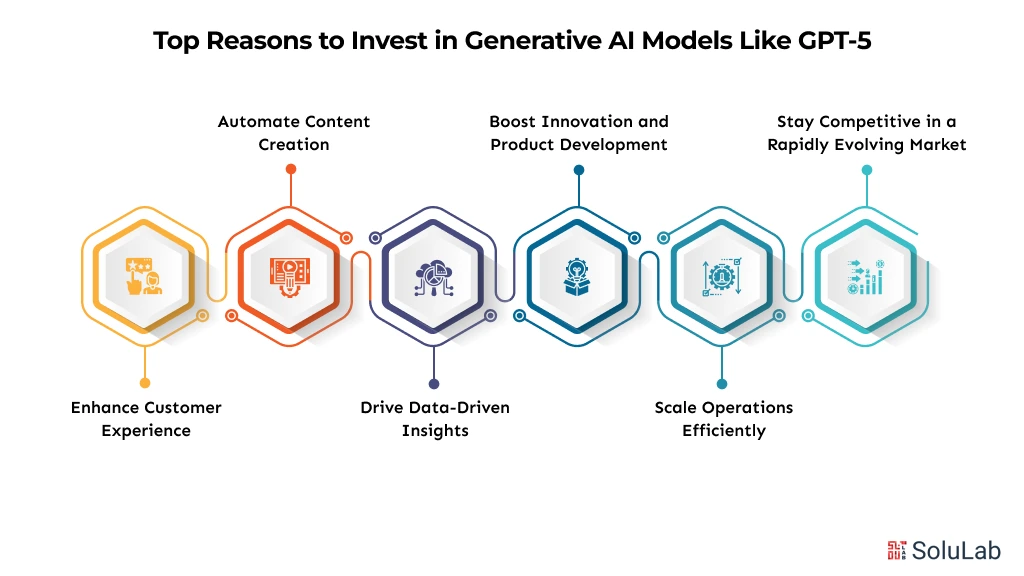
Enhance Customer Experience
GPT-5 can generate human-like responses, personalized recommendations, and conversational interactions at scale. Businesses can use it to power chatbots, virtual assistants, and support systems, providing faster, more accurate, and 24/7 customer service.
Automate Content Creation
From marketing copy and blogs to social media posts and product descriptions, GPT-5 can generate high-quality content quickly. This reduces dependency on manual writing, speeds up campaigns, and ensures consistent brand messaging.
Drive Data-Driven Insights
Generative AI can analyze large datasets and produce summaries, reports, and actionable insights. Businesses can make smarter decisions faster, spot trends, and forecast market behavior with improved accuracy.
Boost Innovation and Product Development
AI models like GPT-5 can assist in brainstorming ideas, designing prototypes, or generating code snippets. This accelerates R&D cycles, allowing companies to innovate without being limited by human bandwidth.
Scale Operations Efficiently
Generative AI can handle repetitive, time-consuming tasks such as drafting emails, generating documentation, or producing creative assets. This frees up human resources for high-value work and reduces operational costs.
Stay Competitive in a Rapidly Evolving Market
Early adopters of GPT-5 and other generative AI technologies gain a competitive edge by offering smarter services, faster turnaround, and personalized experiences. Businesses that leverage AI are better positioned to lead in their industry.
Future of AI Models and Generative AI
The future of AI is evolving rapidly, with generative AI at the forefront of innovation. Businesses and developers are witnessing transformative possibilities that extend beyond automation into creativity, problem-solving, and decision-making.
1. Smarter, Context-Aware Models
AI models will become more intelligent, understanding context, intent, and nuance in human communication. This will enable highly personalized interactions and precise predictions across industries.
2. Seamless Multi-Modal Capabilities
Future generative AI will integrate text, images, audio, and video, creating immersive and interactive experiences, from realistic virtual assistants to AI-generated media.
3. Democratization and Accessibility
Cloud-based AI platforms and open-source models will make advanced generative AI accessible to startups and businesses of all sizes, lowering barriers to adoption.
4. Ethical and Responsible AI Development
As AI grows more powerful, emphasis on fairness, transparency, and safety will shape development. Responsible AI practices will ensure models are reliable, unbiased, and aligned with human values.

Conclusion
Building a Generative AI model like GPT-5 might look complex, but with the correct development partner, this will enhance your growth. From identifying problems to deploying and monitoring, each step needs careful observation and a framework.
SoluLab, a top Generative AI development company, specializes in developing advanced AI solutions tailored to your business needs. Whether you want to build a custom generative AI model like GPT-5, integrate AI into your applications, or optimize operations with intelligent automation, our team provides end-to-end support from model design and training to deployment and scaling.
Partnering with SoluLab ensures your AI initiatives are efficient, innovative, and ready for the future!
FAQs
With over 3 years of experience, I specialize in breaking down complex Web3 and crypto concepts into clear, actionable content. From deep-dive technical explainers to project documentation, I help brands educate and engage their audience through well-researched, developer-friendly writing.