Put artificial intelligence and the virtual reality metaverse together and you get something bigger than either one: the Metaverse. It’s a shared virtual space that many people inhabit at once, and it’s no longer just a sci-fi idea. Pieces of it are already here. What makes it work, increasingly, is AI woven right into the fabric of those worlds, a pairing people have started calling “Metaverse AI.” Done well, it could change how we meet, hang out, work, and spend time online.
The Rise of the Metaverse and AI
Science fiction usually paints the Metaverse as a web of connected virtual worlds. You step inside and do almost anything: play, learn, shop, socialize. The tools for building those immersive spaces keep getting more sophisticated. And that’s exactly where AI development services come in, making these worlds work better and feel more real.
Artificial Intelligence (AI) has already reshaped industry after industry. The Metaverse is next. Because AI can learn, adapt, and make smart decisions, it adds a living layer of interaction to virtual spaces. Without it, you have a simulation. With it, you have a world that notices you, responds, and keeps you coming back.
Synergy between AI and Metaverse
Someone has to build these worlds. That job usually falls to specialized Metaverse developers, who design the digital spaces people explore and interact in. But the environment alone is only half the job. The interesting part starts when AI and Metaverse development meet.
Read Also: Metaverse Use Cases and Benefits
Picture walking into a busy virtual city. The characters around you are AI-driven, and they react to what you do and say, instantly. A shopkeeper suggests products that actually suit your taste. An AI companion tags along on your quest and helps when you’re stuck. How far can that go? About as far as our imagination and the state of AI development allow.
Enhancing User Experience with Metaverse AI
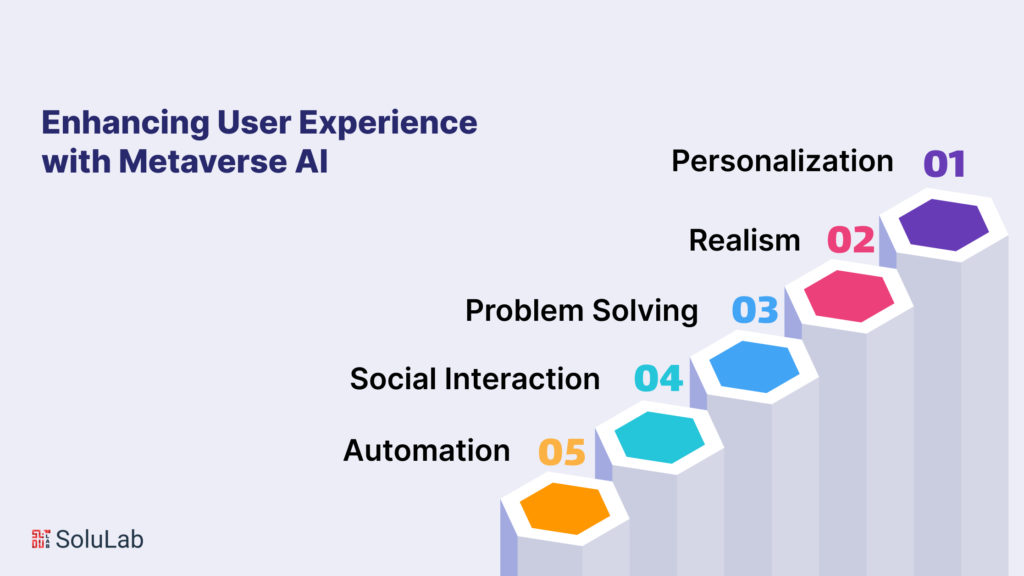
So what does AI actually change for the person inside the Metaverse? Five things stand out:
Personalization: AI watches how you behave, what you like, and who you interact with, then serves up content and recommendations that fit. That might be a nudge toward a virtual event you’d enjoy. Or it might be an avatar that picks up your real-life mannerisms.
Realism: AI can mimic human behavior and reactions convincingly. The world feels more believable, and you sink into it more. That matters most in educational simulations, training scenarios, and virtual events.
Problem Solving: AI can build puzzles, mysteries, and branching stories that react to your choices. The challenge shifts as you go, so the problem you’re solving evolves with every decision you make.
Social Interaction: AI characters can hold real conversations and interactions, which builds a feeling of connection and community inside the Metaverse. Over time, these companions could become a regular part of someone’s digital life, offering company and support.
Automation: Plenty of work in a virtual world is routine. Running virtual economies. Organizing events. Moderating interactions. AI can take that on, leaving people free to spend their time on the parts they actually care about.

Building the Future: AI and Metaverse Developers
Metaverse AI needs two kinds of people working in step. Metaverse developers build the virtual environments, design the interactive pieces, and make sure the whole thing feels smooth to use. AI experts, on the other side, write the algorithms, models, and systems that drive the intelligent interactions inside those worlds.
Get the hiring wrong and the project stalls. Bringing on strong Metaverse developers and top AI developers is what makes these projects succeed. Metaverse work demands a rare mix of skills: a deep grasp of virtual environments, user experience design, and emerging tech. AI developers need their own depth, in machine learning, natural language processing, computer vision, and related fields.
AI and Metaverse Applications: Unlocking the Potential of Immersive Technologies
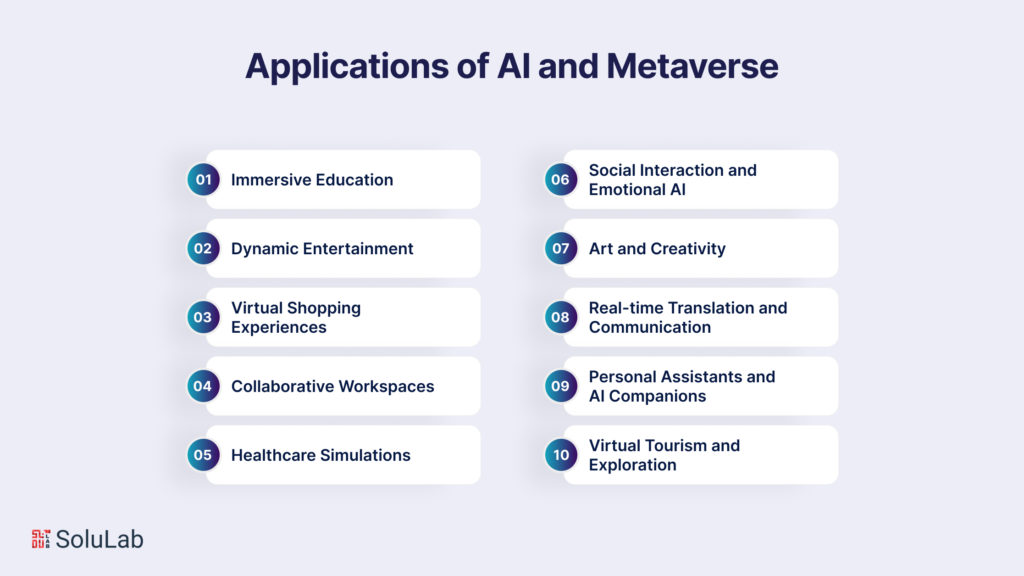
Where Artificial Intelligence (AI) meets the Metaverse, the list of possibilities gets long fast. As the tech matures and our digital lives get more immersive, AI in the Metaverse is starting to change things in field after field. Below are ten applications worth knowing, and what each one means for how we interact, learn, work, and have fun.
Read Our Blog: Top 10 Metaverse Development Companies in 2024
1. Immersive Education:
Classrooms are changing. AI-powered virtual classrooms in the Metaverse shape lessons around each student: their needs, their pace, their level. Imagine an AI tutor that walks a student through a hard subject, answers questions on the spot, and adjusts the next lesson based on how the last one went. These spaces also offer interactive simulations and visuals, so students can explore historical events, scientific phenomena, and abstract ideas in a way no textbook can match.
2. Dynamic Entertainment:
Games feel different when the characters think. AI-driven non-player characters (NPCs) adapt to how you play, which makes game worlds more lifelike and much harder to predict. They can show emotion, make their own decisions, and even learn from you. The result is gameplay that shifts and pulls you in, rather than the same script every time.
3. Virtual Shopping Experiences:
In Metaverse marketplaces, AI looks at your preferences, past purchases, and browsing habits. From that, you get AI shopkeepers who recommend things you’d actually want and lead you around virtual storefronts. An AI fashion advisor can show you clothing that matches your style, size, and taste. Shopping gets more personal.
4. Collaborative Workspaces:
Distance stops mattering. The Metaverse works as a hub for remote teams, and AI keeps virtual meetings running smoothly, with transcription and translation that get rid of language barriers. AI assistants can handle routine tasks, manage calendars, and surface useful insights in the middle of a meeting. People get more done, and communication gets simpler.
Read Also: Top 10 AI Development Companies in 2024
5. Healthcare Simulations:
Medical training has always had a problem: practice on real patients carries real risk. AI-driven healthcare simulations in the Metaverse give students and professionals immersive places to train instead. The AI patient avatars show realistic symptoms, reactions, and medical histories, so learners can practice diagnosing and treating with nothing at stake. People learn faster, build clinical skill, and get used to making evidence-based decisions.
6. Social Interaction and Emotional AI:
AI avatars and characters can show emotion and carry on meaningful exchanges. That lets them act as digital friends, confidants, or even therapy tools, offering support and company. Emotional AI reads a user’s mood and adjusts, offering comfort, entertainment, or advice depending on what the moment calls for. It adds real emotional depth to virtual experiences.
7. Art and Creativity:
AI tools in the Metaverse give human creativity more range. AI-generated art, music, and environments spark new kinds of expression. Collaborative tools let artists work live with virtual brushes, palettes, and sculpting tools, and the art itself can become interactive. 3D creation is getting easier too, with tools like Hyper3D AI 3D model generator helping creators turn flat images into detailed 3D assets for immersive digital worlds.
8. Real-time Translation and Communication:
People in the Metaverse speak many languages. AI translation handles that live, translating conversations as they happen so users can talk properly with anyone, no language barrier in the way.
Check Out Our Press Release: SoluLab Bridging the Gap Between Technology And Innovation
9. Personal Assistants and AI Companions:
Think of a personal assistant that moves through the Metaverse for you. It handles tasks, books events, and fetches information. That kind of convenience means your attention goes to the experiences that matter, not the busywork.
10. Virtual Tourism and Exploration:
An AI tour guide can take you through immersive virtual trips. Along the way, it shares history, cultural context, and good stories, so exploring a virtual destination feels richer than just looking around.
Opportunities for Integration of AI into the Metaverse
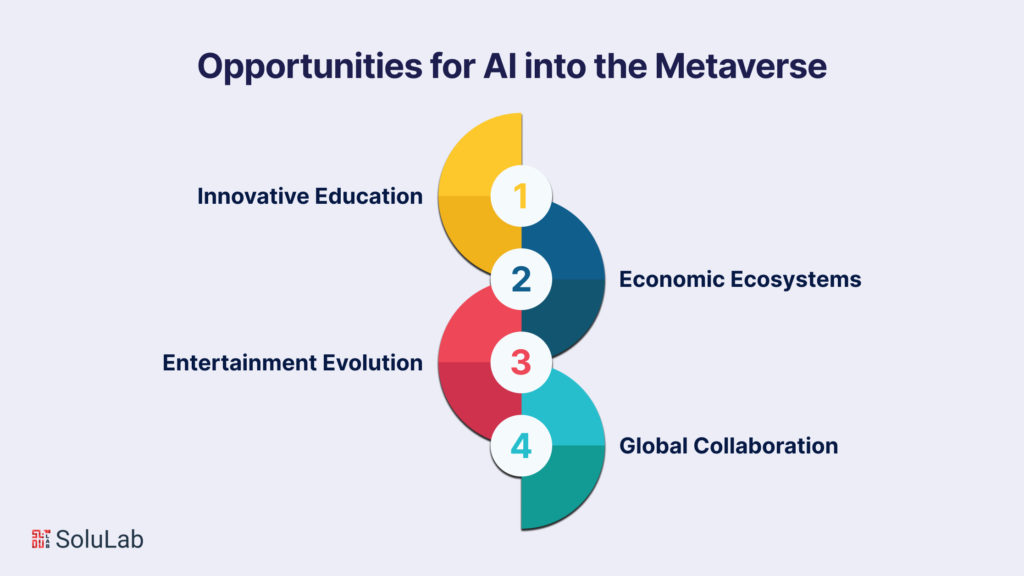
Like any young technology, AI in the Metaverse opens up some clear opportunities:
Innovative Education: Metaverse spaces powered by AI can teach through immersion, recreating historical events, scientific phenomena, and cultural encounters in ways we simply haven’t had before.
Read Also: Everything You Need to Know About Metaverse NFT Marketplace Development
Economic Ecosystems: AI can run virtual economies where users buy and sell virtual goods and services. That creates room for new business models and new entrepreneurs.
Entertainment Evolution: Entirely new kinds of entertainment become possible: interactive storylines driven by AI, game worlds that shift as you play, and media tuned to each person.
Global Collaboration: Borders matter less in a virtual room. The Metaverse can host collaboration across the globe, and AI translation and communication tools make cross-cultural conversations far easier.
The Road Ahead: Metaverse AI as a Catalyst for Change
AI keeps improving, and Metaverse development keeps moving forward alongside it. Together, they make Metaverse AI a very promising idea. It could change how we use digital spaces, how we learn, how we work, and how we socialize. Education and entertainment are the obvious first places it will show up, and the effect on an increasingly digital world could be a good one.
None of that happens on its own. It takes the best Metaverse developers and top AI developers, working together to build virtual spaces that are immersive, intelligent, and engaging, and that deliver real value across many industries.
Read Also: 5 Ways To Develop A Metaverse Digital Real Estate
Shaping Tomorrow with Metaverse Developers and Top AI Developers
Something real is underway where the Metaverse and AI overlap, and it could change the digital world as we know it. Looking at how AI fits into virtual worlds, the room for new ideas is huge. The partnership between Metaverse developers and top AI developers is what turns that room into something people can use, and it could reshape how we interact, create, and engage.
Metaverse developers are the architects. They know how to build immersive digital environments, and they understand design principles, user experience, and the technical details that hold it all up. Metaverse AI is built on their foundation. Their vision and skill are what make these virtual spaces feel alive and full of possibility.
Read Our Blog: Top 15 Metaverse Startups to Watch out in 2024
But a beautiful world with nothing thinking inside it is still a set. That’s where top AI developers come in. They bring the algorithms, models, and new ideas that give the Metaverse intelligence and responsiveness. With their AI development work, we can build characters, experiences, and interactions that reflect what people hope for and adjust to what they do, like, and need.
If you want the full value of Metaverse AI, you need the best Metaverse developers and top AI developers on the team. Simple as that. These are the people shaping where technology and human experience go next. And their work isn’t just writing code. It’s building something creative, new, and capable of real change.
The choices made now matter. If we want Metaverse spaces that grab people, inspire them, and give them real capability, we have to invest in the people behind the scenes: the Metaverse developers and AI developers who imagine, build, and ship what comes next.
Conclusion
Technology never sits still, and the meeting of AI and the Metaverse is a turning point in how we use the digital world. The road ahead will have its share of problems, breakthroughs, and unknowns. Still, with skilled Metaverse developers and top AI Developers leading the work, there’s good reason to expect virtual worlds that reflect what we want from them, and AI interactions that stretch what we think is possible.
Maybe you want to explore the Metaverse. Maybe you want to build virtual adventures, rethink education, or reinvent entertainment. Either way, the people you bring on decide the outcome. Hire strong Metaverse developers to build the worlds you have in mind, and bring in top AI developers to make those worlds smart. Together, they can build a future where technology fits naturally into human experience. Metaverse AI is ready to be explored and used, by whoever has the nerve to build something out of the ordinary.
SoluLab, a trusted provider of Metaverse development services and Artificial Intelligence solutions, helps clients turn their Metaverse ideas into working products. Using modern tools and advanced technologies, our Metaverse developers build solutions shaped around each project’s needs. We’re committed to agile development and to results that move the business forward, and that’s what sets SoluLab apart in AI development.
Need intelligent chatbots, predictive analytics, or machine learning algorithms? SoluLab’s experienced AI developers build custom solutions that fit your industry’s specific requirements. If you’re ready to start, get in touch with SoluLab and see what’s possible across Metaverse and AI development.
FAQs
Shipra Garg is a tech-focused content strategist and copywriter specializing in Web3, blockchain, and artificial intelligence. She has worked with startups and enterprise teams to craft high-conversion content that bridges deep tech with business impact. Her work translates complex innovations into clear, credible, and engaging narratives that drive growth and build trust in emerging tech markets.