Generative AI is everywhere now. It reads through enormous training datasets, runs natural language processing over them, and uses neural networks and deep learning to produce content that did not exist a moment earlier.
Most people met this technology through a content model like ChatGPT. That is the shallow end. What generative AI already does, and where it is heading, runs well past a chat box.
This piece covers what generative AI can actually do, how it got here, and why it caught on so fast. We will also look at who is winning right now, and what users should reasonably expect next.
What is Generative AI?
Generative AI is the corner of artificial intelligence (AI) concerned with algorithms and models that produce fresh data resembling human-made work. Traditional AI systems follow predefined rules for one narrow task. generative AI models learns from huge datasets and then makes something new: images, text, music, video. No human hand on each individual output. That is what makes it useful for creative work, and for problems where the answer is not simply a lookup.
Underneath sit generative models, a specific family of machine learning techniques. They study the patterns and structure of input data, then produce new data that is statistically close to the training examples. Three names come up most often: Generative Adversarial Networks (GANs), Variational Autoencoders (VAEs), and Autoregressive Models.
Generative Adversarial Networks (GANs): Ian Goodfellow and his team introduced GANs in 2014. Two neural networks, a generator and a discriminator, play against each other. The generator makes synthetic data. The discriminator tries to tell real from fake. Every round, the generator gets a little better at fooling it, and the output grows more convincing. GANs turned out to be remarkably good at high-quality images, at art, and at synthesizing human faces that hold up to a second look.
Read Also: Top 10 Generative AI Development Companies
Why is Generative AI Becoming More Popular Now?
Two things happened at once. Neural networking algorithms got better, and both the models and the compute to run them got easier to reach. Google laid the foundation in 2017 when it announced the Transformer neural network design. Transformers made it possible to build higher-quality language models with more tunable characteristics, and to train them far more efficiently. Predictive text tools and early AI chatbots appeared around that point and began to mature.
Transformers alone did not make the economics work. Processing generative AI queries ate power resources that most businesses did not own and could not get near. From 2022, computational power and the AI platform infrastructure layer caught up with what generative AI tools actually demanded, and more firms could finally build on top of it. The bigger shift: today’s generative AI developers can serve their models to many more users without the cost curve going vertical.
New approaches such as diffusion models arrived alongside, lowering the entry bar for generative AI research. Less energy, less money, and suddenly the field includes both established tech companies and a long tail of generative AI startups. Open-source releases and public APIs keep widening access, and new applications show up faster than anyone can catalogue them.

Leaders in the Generative AI Landscape
OpenAI sits at the front of the pack, with a market capitalization of roughly $30 billion. The tight Microsoft partnership, its newest GPT-4 model, the sheer reach of ChatGPT, and steady progress on other kinds of content production all point the same way: continued expansion, funded partly by outside money.
Amazon and IBM are pushing hard too, but Microsoft and Google are the two you cannot miss right now. Microsoft currently holds an edge over Google on content production, AI assistance, cybersecurity, and coding support tools.
Google has been doing this work longer than almost anyone. Its shipping has been slow, yes. But the time spent on extensive testing and AI ethics suggests the tools will land strong when they finally land.
Use Cases of Generative AI Landscape
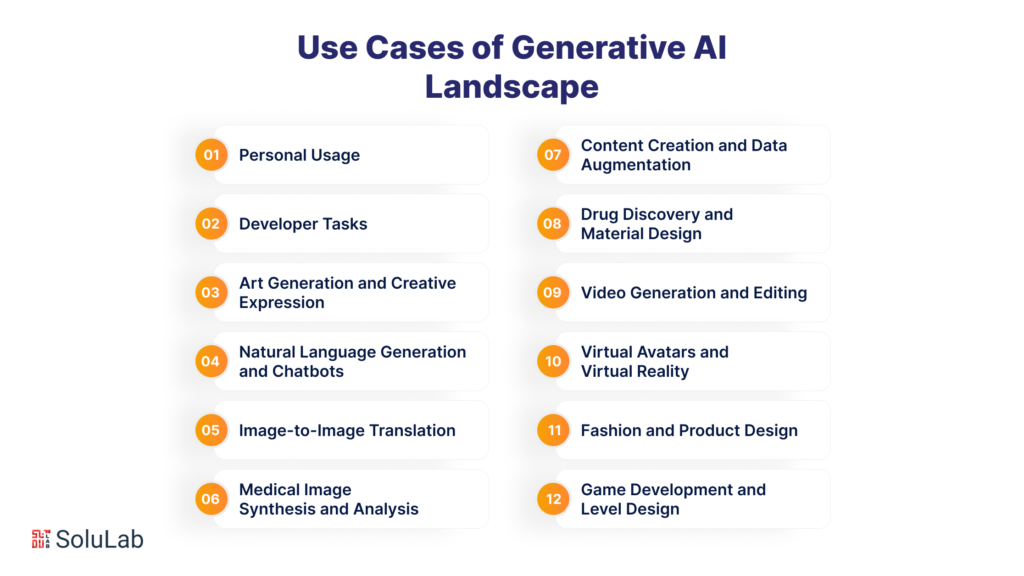
The application list is long and genuinely varied, spanning industries that have almost nothing else in common. Here are the ones worth knowing:
- Personal Usage: Casual users mostly want text. Q&A, trip and event planning, open-ended conversation, quick research.
- Developer Tasks: Forecasting the next chunk of code, working through a problem, documenting code nobody wants to document, automating the repetitive jobs.
- Art Generation and Creative Expression: Art is where this technology got loud first. Artists now work alongside algorithms, mixing their own instincts with machine intelligence. Generative models like GANs produce paintings, sculpture, and other visual forms that pull real audiences worldwide.
- Natural Language Generation and Chatbots: Language models, the GPT-3 based ones included, write human-sounding articles, stories, and working code snippets. They also drive chatbots that hold an actual conversation instead of matching keywords, and hand users help shaped to their situation.
Read Also: Top 25 Generative AI Use Cases
- Image-to-Image Translation: Feed a model a sketch, get a realistic image back. Feed it a satellite photo, get a map. Architects, urban planners, and fashion teams doing style transfer all lean on this.
- Medical Image Synthesis and Analysis: Healthcare has a chronic shortage of labeled scans, which is exactly where generative AI earns its place in medical image synthesis. Synthetic images pad out thin training data, which sharpens analysis and supports diagnosis.
- Content Creation and Data Augmentation: Writers, marketers, and content teams get real mileage here. Models draft blog posts, marketing material, and social content. An essay humanizer lets you humanize AI text so the result reads authentic and keeps a reader moving rather than sounding machine-stamped. The same models generate synthetic data to widen training sets, which lifts performance elsewhere.
- Drug Discovery and Material Design: Generative AI is changing drug discovery by proposing molecular structures with the properties you asked for, which can compress the front end of drug development. Material design works the same way: describe the characteristics you need, get candidate materials.
- Video Generation and Editing: Video came next. Models build convincing clips from thin input, rework existing footage in all sorts of ways, and yes, produce deep fake videos for entertainment and special effects.
- Virtual Avatars and Virtual Reality: Realistic avatars for virtual reality (VR) and augmented reality (AR) come straight out of generative models. They are what makes a virtual space feel inhabited instead of empty.
- Fashion and Product Design: In the fashion and product design industries, generative AI throws out design options faster than any studio can sketch them. Clothing silhouettes, accessories, even automotive bodies.
- Game Development and Level Design: Studios use it for procedural content: levels, terrain, characters. The payoff is a world that does not feel hand-placed and finite.
Read Our Blog: From Theory to Reality: Real-World Applications of Generative AI and GPT
Generative AI Applications Across Industries
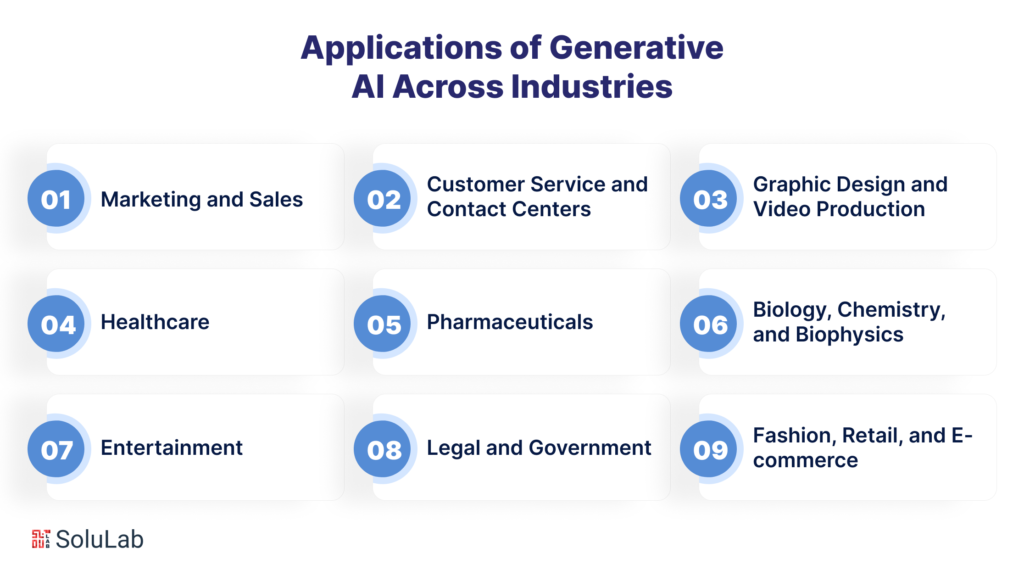
Plenty of industries and departments have already worked this into daily operations. Here is where it is landing hardest:
- Marketing and Sales
Marketing teams were early to this. Language models draft blog posts, social media content, and product descriptions written for one buyer instead of all of them at once. Predictive customer analytics does the other half of the job: segment the audience, aim the campaign, watch conversion and engagement move.
- Customer Service and Contact Centers
Generative AI powers intelligent chatbots and virtual assistants now understand and answer customer queries in real time. Support arrives instantly, queues shrink, and human agents get handed the cases that genuinely need a human. Contact center managers tend to notice this on the cost line first.
- Graphic Design and Video Production
Design and video production changed fast. Designers pull dozens of directions, logos, and branding options out of a model before lunch. Generative AI also improves instructional video production, so a small team can turn out tutorials and training material that look visually consistent without a week of manual editing.
- Healthcare
Generative AI in healthcare handles medical image synthesis and analysis. Synthetic scans feed research, improve diagnostic accuracy, and give trainee clinicians more cases to learn from. On the drug side, models propose molecular structures with target properties and shorten the early search.
- Pharmaceuticals
Pharmaceutical companies run generative AI across enormous datasets to identify candidate compounds, predict drug interactions, and simulate molecular structures. Fewer dead ends, cheaper research cycles, a shorter pipeline. That is the whole pitch, and it is a good one.
- Biology, Chemistry, and Biophysics
In biology, chemistry, and biophysics, generative models help predict protein folding, propose structures for drug design, and simulate biological processes that are painful to model any other way. What that could do for drug development, and for how we understand biological systems, is hard to overstate.
- Entertainment
The entertainment industry uses generative AI for content, personalization, and recommendation. Streaming platforms read your viewing habits and decide what to put in front of you next. Games get interactive storytelling and worlds that assemble themselves as you move through them.
- Legal and Government
Legal and government work means reading mountains of text, so the fit is obvious. Generative AI handles document analysis, contract generation, and natural language processing. Chatbots take the first client conversation and answer the routine questions. Everything downstream, legal research and decision-making included, moves quicker.
- Fashion, Retail, and E-commerce
Generative AI transforms retail industries and fashion by suggesting new clothing styles, accessories, and even store layouts. Recommendation engines put the right product in front of the right shopper, which is where cross-selling and upselling actually happen. E-commerce gets virtual try-on, so customers see the thing on themselves before they commit.
The list keeps growing. Competition between the tech giants and the startups chasing them is brutal, and that rivalry is the main reason progress has not slowed. Expect it to keep reshaping how work gets done and how people deal with the software in front of them.
Generative AI: The Future Landscape
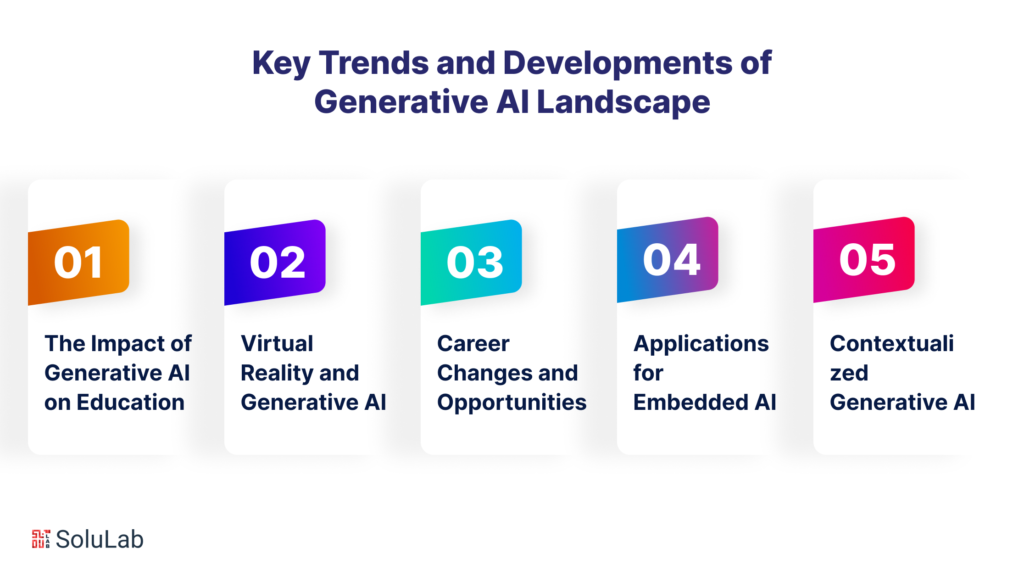
Generative AI has already shown it can produce realistic content, push creative work into new shapes, and reorganize whole industries. What comes next is the interesting part. Below are the trends most likely to drive the field forward.
- The Impact of Generative AI on Education
Teachers and parents are worried, and not without reason. Students hand homework to ChatGPT and get essays back. These huge language models do not “know” the answer to an educational task; their training taught them to anticipate a plausible sequence of text, which for a lot of school work turns out to be close enough to pass. That can hollow out learning. It can also do the opposite, if institutions treat AI as an assistive tool for students and instructors rather than a threat to be banned.
Classroom technology has always forced teaching to adapt. Overhead projectors, anyone? Generative AI will demand the same shift in pedagogical approach. Virtual learning is the most intriguing front here: AI games and AI storytelling tools already exist, giving instructors both support and a genuinely new way to get material to land with pupils.
Copying remains the open problem. Teachers can reach for one of the many free AI content plagiarism checker built recently to push back on students outsourcing assignments to ChatGPT and its relatives. They are not perfect. They do give a usable read on what share of a submission was machine-written, and they will sharpen as the pressure on schools grows.
- Virtual Reality and Generative AI
Video and 3D models are the fastest-moving model types right now. Games and entertainment will benefit, obviously. The bigger question is what these models do for virtual reality (VR) and augmented reality (AR), the metaverse included. As they improve, generative techniques will build experiences detailed enough that a virtual space stops feeling like a demo.
- Career Changes and Opportunities
Some jobs get augmented. Some eventually get replaced. The ordinary working professional who is willing to pivot and build on existing abilities as demands shift does not need to panic. Take writers: plenty now focus on SEO writing, material built to perform in search results. That is exactly the kind of output generative AI models produces well through algorithmic training.
So writers will need the strategic skills a model does not have: editorial planning, judgment, quality assurance over the content, and a working relationship with organizations that value human creativity and real research as massive language models get stronger. The upside is real too. Notes, emails, and the small administrative sludge all get faster. Meeting documentation gets simpler with an AI meeting note taker that captures and organizes the key discussion points on its own. Clear that off someone’s plate and they spend the recovered hours on higher-value strategic work.
- Applications for Embedded AI
Microsoft and other large tech firms are testing AI assistants that steer how users search the web. Several of the top generative AI businesses, Cohere and Glean among them, already sell AI-driven enterprise search. As those features and functionalities grow, expect companies to build enterprise search into their own websites and software so customers and staff can find things without filing a ticket.
- Contextualized Generative AI
Most models available today carry language limits and time limits. Demand is global, so providers will have to make their tools accept inputs and return outputs that work across multiple languages and cultural settings, not one.
People also want answers that are current. ChatGPT is the best-known content creation and big language model on the market right now, but it could fall behind rivals such as Bard that connect to the internet and answer from up-to-date information. ChatGPT, by comparison, is working from data that stops in September 2021.

Bottom Line: The Generative AI Landscape
Generative AI moves quickly, and the shape of the field changes every few months. The core stays the same: algorithms and models that produce new content, whether that is an image, a paragraph, a track, or a video. As the technology matures, it is quietly rewriting how entire industries operate.
A handful of use cases have separated from the rest. art generation and content creation. Medical image synthesis. Drug discovery. Graphic design and video production teams now hand the tedious work to a model and keep the judgment for themselves, which is the collaboration people actually wanted. Chatbots in customer service answer faster and more personally than a queue ever did. Entertainment gets lifelike virtual avatars and storytelling that responds to its audience.
Competition is fierce. Google, Facebook, and OpenAI spend heavily on research and development and keep pushing the ceiling higher. Startups keep appearing with narrow solutions aimed at one industry’s specific problem. Academic labs feed the whole thing, with papers at the major AI conferences setting the pace.
Expect realism and creative range to keep improving. Output will sit closer to human work, which opens doors in virtual reality, gaming, and artistic expression. Ethics will get louder as that happens: mitigating bias, keeping decisions transparent, protecting privacy. And as generative models get wired into other AI technologies, the combinations should open real ground in healthcare, education, and how people interact with computers.
The honest summary is that nobody has the full map yet. The applications are broad, the competition is unrelenting, and the teams that take the ethics seriously while still shipping quickly are the ones worth watching.
SoluLab builds generative AI systems for a living. The team offers Generative AI development services shaped around the industry and business model in front of them rather than a template. Its AI developers work with current Generative AI technology, software, and tools to build something specific to each client: tightening operations, cleaning up processes, improving what users actually experience. If you want ChatGPT, DALL-E, Midjurney, or similar put to work on your problem, you can hire Generative AI programmers from SoluLab.
Talk to SoluLab and find out what that looks like for your business, with custom content built to hold its own in a crowded market.
FAQs
Shipra Garg is a tech-focused content strategist and copywriter specializing in Web3, blockchain, and artificial intelligence. She has worked with startups and enterprise teams to craft high-conversion content that bridges deep tech with business impact. Her work translates complex innovations into clear, credible, and engaging narratives that drive growth and build trust in emerging tech markets.