

- AI Development
- AI App Development
- AI Consulting
- AI Software Development
- ChatBot Development
- Enterprise AI ChatBot
- AI Chatbot Development
- LLM Development
- Machine Learning Development
- AI Copilot Development
- MLOps Consulting Services
- AI Agent Development
- Deep Learning Development
- AI Deployment Services
- Deep Learning Consulting
- AI Token Development
- AI Development Company
- AI Development Company in Saudi Arabia
- AI Integration Services
Do you know tools like ChatGPT and Google Gemini can do tasks like write emails, summarize meeting notes, or even help customers with their problems? But guess what? Sometimes, AI needs to do more than just one job for everyone. It has to learn to help people with specific problems.
When businesses face problems, general AI (or horizontal AI) isn’t always good enough. Businesses need smart AI that understands their unique needs. For example, a restaurant has different needs than a clothing store. So, they need AI that knows their work inside out! The global vertical AI market will be worth around USD 115.4 billion. From USD 12.9 billion in 2024 to USD 34 billion by 2034, rising at a CAGR of 24.5% from 2025 to 2034.
This is where Vertical AI comes in, Vertical AI is made just for specific jobs, like helping restaurants, shops, or even construction sites. Moreover, it’s similar to how special apps like Shopify work for stores, and Procure for builders. These tools show us how powerful it is to have something made just for your job.
This article helps you understand what is vertical AI, its features, real-world use cases, and future trends.
What Are Vertical AI Agents?
Vertical AI is a smart AI agent that can do specific tasks all by itself. These are called Vertical AI agents. They are tools that can handle work without human intervention. They might change how businesses work even more than when companies started using cloud software a long time ago.
Back then, cloud software made it easy for AI agents and Customer Service companies to use programs without buying and setting up lots of computers. But Vertical AI agents can do something even bigger. They won’t just help as software does; they can do work humans usually do or work alongside people to get things done faster.
Here’s something interesting: companies usually spend a lot more money on employees than they do on software. Before, if a business wanted to earn more money, they had to hire more people. But now, Vertical AI agents can do jobs that needed whole teams before. As a result, companies save on software, and one of their biggest expenses paying employees.
Why Vertical AI Agents Are Unique?
Unlike regular software, vertical AI agents are like super-smart helpers made just for specific tasks. They focus on solving one problem well. For example:
- MCH: Consider it as a robot that takes over testing apps and websites so humans don’t have to.
- Gig.ml: It’s like a helper that answers tons of customer questions every day for companies like Zepto.
- Sweet Spot: Imagine an AI that checks government contracts and saves people hours of manual work.
These AI agents make work faster and easier for businesses. Moreover, they help companies do more with fewer people!
1. Startups, Not Giants, Lead the Charge
Big companies sometimes have a hard time being the best in very specific areas. For example, Google didn’t compete with payroll tools like Gusto because payroll is tricky and needs special knowledge. Moreover, smaller companies that focus on one thing often do better in these areas.
This gives startups a big chance to shine! When founders notice tasks that are boring and happen over and over again, they can create smart AI tools to do those jobs. History shows us that when new tech comes along, the people who try it early often win. The same is true for these smart AI helpers.
2. Disrupting the Workforce
These tools are changing how people work, too. Before, when companies wanted to earn more money, they usually had to hire more people. But now, these AI tools let companies grow a lot without needing so many workers.
For example, Rippling puts all HR tools in one place. This makes work easier and means fewer systems are needed. Moreover, a tool like Salient helps with phone calls for things like collecting payments. Instead of needing a big team, the AI does the job!
3. What Founders Should Focus On
For people starting new companies, success means finding slow and boring jobs that can be made faster with AI. Here are a few ideas:
- Medical billing: Dentists spend a lot of time on billing, but AI can do it for them.
- Job hiring tests: AI can help pick the right people for jobs by checking their skills.
These jobs might sound simple, but fixing them with AI can make a huge difference! Smart AI tools are becoming super important for businesses. They mix automation (doing things automatically) with special skills to help companies work faster and save money. These tools are like SaaS (software-as-a-service) but might become even more powerful!
As this idea grows, the companies that will do the best are the ones that find the biggest problems and solve them in amazing ways. This isn’t just a small improvement—it’s a whole new way to think about what software can do!
Why Vertical AI Agents Could Be 10 Times Bigger Than SaaS?
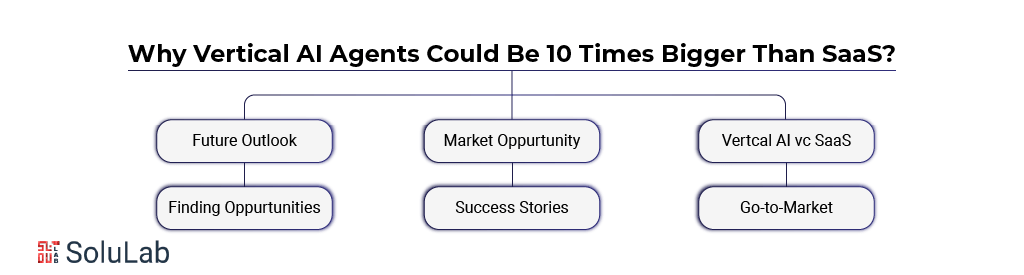
Here are some reasons why AI agents could be 10 times bigger than SaaS:
1. Market Opportunity
AI is like the SaaS (software as a service) boom in the 2000s, but it could grow even bigger! Suppose every big SaaS company has its own AI partner. These AI buddies, called vertical AI agents, could create companies worth over $300 billion!
Once, OpenAI was the king of this space, but now other AI tools have come and improved every month. As a result, the ecosystem is growing with lots of opportunities.
2. Vertical AI > SaaS
AI doesn’t just replace software; it also saves money on hiring people. Did you know companies spend way more on employees than software like SaaS AI agents? With AI, smaller companies can work smarter and need fewer employees. Moreover, AI keeps getting better every three months!
These smart vertical AI agents can even take over full teams and complete big tasks by themselves. That’s powerful!
3. Go-to-Market
Selling AI to teams that it might replace can be tricky. Teams might resist because they feel threatened. Instead, it’s smarter to talk directly to decision-makers, like CEOs, who won’t feel worried about automation.
4. Finding Opportunities
Look for boring, repetitive tasks that no one enjoys doing—there’s a goldmine of AI opportunities here! For example, one founder noticed how much time his mom, a dentist, spent on processing claims. He realized AI could handle that, and here’s how ideas come and are executed.
These “butter-passing jobs” (small, boring tasks) are perfect for AI. That’s where big opportunities are hiding!
5. Success Stories
- MTIC: Automates testing software so humans don’t have to.
- Cap.AI: Made a super-smart chatbot to help developers, reducing the need for big support teams.
- Salient: Uses AI to call people about auto loans and already works with big banks.
6. Future Outlook
AI tools are helping leaders manage even bigger teams by making information easier to handle. The usual limits on how large a company can grow might not matter anymore with AI helping out!
Just like SaaS stays focused on specific jobs, vertical AI agents are expected to specialize, too. So, the future of AI looks both exciting and focused!
Features of Vertical AI Agents
Here are some features of vertical AI agents you should know:
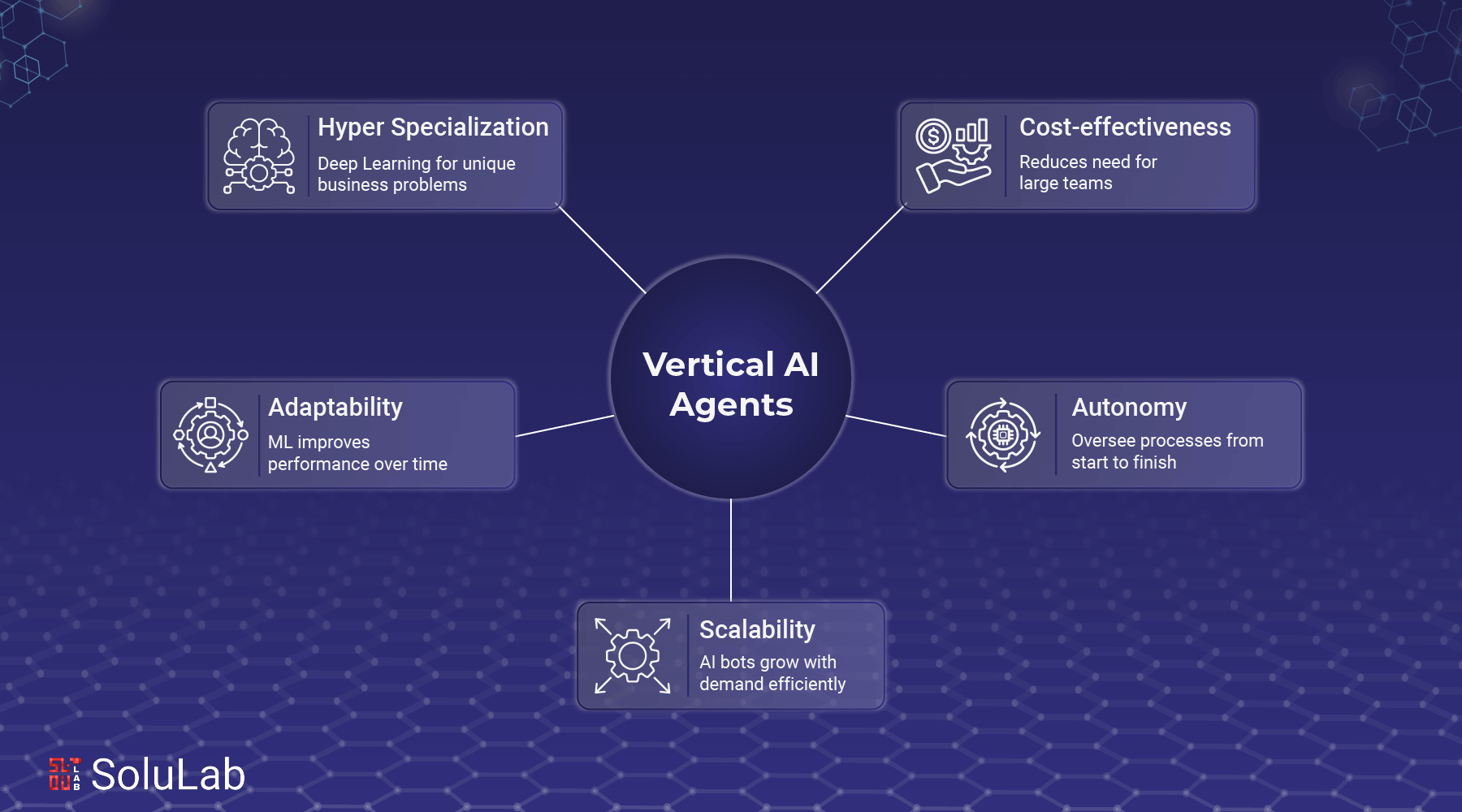
- Hyper-Specialization: Use deep learning to solve difficult problems unique to your business that general AI can’t handle as accurately.
- Autonomy: It means being able to oversee whole processes from start to finish.
- Adaptability: Machine learning should be used to keep improving performance.
- Cost-effectiveness: Cuts down on the need for big teams, significantly lowering payroll costs.
- Scalability: It has been improved because AI bots can grow with demand without adding as many employees. Startups can grow a lot with smaller teams.
- Increase competitiveness: Make businesses more competitive by giving them advanced, custom solutions that help them make better decisions and run their operations more efficiently.

Real-World Use Cases of Vertical AI Agents
AI agents are like super-smart helpers that can make big changes in different industries. They handle tough tasks and work faster than humans. Let’s see how they are making things better in different areas.
1. Healthcare
AI can help doctors take care of patients in new ways. For example, special AI systems, called Vertical AI, can look at X-rays or MRIs and find problems that even doctors might miss. This makes it easier to figure out what’s wrong and choose the right treatment.
Moreover, these AI agents in Healthcare helpers can talk to patients online, give early advice, and even set up doctor appointments. By doing all this, AI gives doctors more time to focus on important things and helps patients feel better sooner.
2. Finance
In money-related jobs, AI can find sneaky tricks like fraud faster than humans can. It watches transactions and spots anything strange, like magic eyes for money!
As well, it helps with tasks like deciding who gets loans by checking tons of information, such as credit histories. AI in finance can also read long, boring contracts to find mistakes or risks, helping businesses follow the rules and stay safe.
3. Manufacturing
In factories, an AI Agent for Manufacturing is like a super mechanic. It keeps machines in good shape by checking how they’re doing and fixing problems before they break. This saves time and money.
Moreover, AI can plan production schedules so everything runs smoothly, like making sure all the puzzle pieces fit. It even helps move things through the supply chain faster, so people get what they need quicker.
4. Retail
Shopping becomes smarter with AI! It can restock shelves, figure out what people want to buy, and suggest cool products based on your past purchases.
In addition, AI agents in Retail and E-commerce can run customer service chats, answer questions, and even stop fraud from happening in stores or online. It’s like having a shop assistant who never takes a break.
5. Software Development
AI helps programmers by spotting mistakes in code and suggesting fixes. It can even write some parts of the code itself!
For example, AI can test software to make sure everything works perfectly. This means developers can focus on creating exciting new things instead of spending hours fixing bugs.
6. Agriculture
On farms, AI is like a robot farmer. It checks if plants are healthy, predicts the weather, and waters crops just right. Furthermore, it helps with jobs like planting, harvesting, and keeping bugs away. AI even tracks how much food is being grown and tells farmers the best way to manage their crops and supplies.
Opportunities and Challenges for Vertical AI Founders
Vertical AI agents can do amazing things! They help businesses save money by automating tricky tasks that humans usually do. This means companies can grow without needing to hire lots of people. However, history shows us that when new technologies come around, the first people to use them often get the biggest rewards. Vertical AI agents are like that too. Many industries haven’t used them much yet, so founders who spot boring, repetitive jobs and create AI agents to handle them can succeed faster.
Challenges of Starting a Vertical AI Company
But starting a company like this isn’t easy. To create these smart AI tools, founders need to understand the industry they’re working in. They also need to get the best data to teach their AI how to work properly. Moreover, it’s super important for AI builders to team up with people who know the industry well. Plus, things like fairness in the AI’s decisions and keeping people’s information private are important too.
Even with these challenges, the chances to do great things are huge! Big companies sometimes don’t do well in small, specialized markets because they lack specific skills. This is where smaller, quicker startups can shine and become leaders.
Future Trends in Vertical AI Agents
In the future, Vertical AI agents will grow fast. These are special kinds of artificial intelligence that help industries like healthcare, finance, and manufacturing. Vertical AI uses smart technology to help solve problems in specific industries. These agents can do things like automate tasks, help make decisions, and create custom solutions for each industry. Many businesses now use AI because it can make work faster and easier. Moreover, these AI agents help businesses with things like managing customers and improving how they work, making them more productive.
- Increased Personalisation: Vertical AI agents are getting better at creating solutions that fit the needs of each business. This helps businesses improve their work and stand out in a crowded market.
- Integration with IoT: Vertical AI is now working with the Internet of Things (IoT). This means businesses can get real-time information from smart devices, which helps them make better decisions and work faster.
- Advancements in Natural Language Processing: Vertical AI is also getting better at understanding human language using Natural Language Processing. This helps businesses talk to customers more easily, making the customer experience much better.
- Multi-model Capabilities: Consider a robot that can understand everything—what you say, what you show, and even what you write! That’s what multimodal models AI does. It combines different kinds of information, like words, pictures, and sounds, into one super-smart system. For example, in hospitals, this type of AI can read patient files (text), look at X-rays (visual), and listen to what patients say (audio). This helps doctors make better decisions quickly.
Moreover, this amazing ability can help many industries. As businesses need tools that can handle all kinds of data at the same time, these special AI systems will become even more useful in the future.
- Integration Ecosystem
Think of this as all your gadgets working together perfectly. For vertical AI to do its best work, it needs to connect smoothly with different apps, tools, and platforms that industries already use. This connection is called an integration ecosystem.
For example, in banking, AI can connect with tools that check rules (compliance) and customer management systems. This makes work faster and simpler. When everything works together, businesses can use their data better and get more out of AI systems.
- Automation and Cost Efficiency
Imagine if robots could do all the boring chores while humans focus on fun and creative stuff. That’s the future with vertical AI! By 2030, experts believe this AI will handle many tasks that people do today, and it’ll do them much faster and cheaper.
As a result, businesses will save a lot of money. People can then use their energy to solve tough problems and take care of customers, while the AI takes care of the repetitive tasks.
Expert Insights and Predictions
Jose E. Puente, CEO of Reality Border, says, “In the next five to ten years, Vertical AI agents will be super important for many industries. They will quickly adapt to solve tough problems.” He adds that businesses need to keep learning about these changes to get the most out of AI.

Conclusion
Vertical AI agents are not just new software tools—they’re a big change in how software works! Just like SaaS (Software-as-a-Service) made it easier to use software without buying and installing it, AI agents are taking it even further. They can help or even replace people in doing certain tasks.
As more businesses start using Vertical AI, it will change how industries work. Old ways of doing things will improve, and new ideas will set the bar higher. Entrepreneurs who can find specific problems and create smart solutions for them will lead the future of business technology!
SoluLab helped AI-Build, a construction tech company, utilize generative AI and machine learning for advanced product development in the CAD space. Their goal was to automate design processes, improve productivity, and enhance accuracy. The challenge was creating a system that could generate optimized designs while reducing manual tasks and ensuring scalability. SoluLab’s an AI Development Company expertise enabled AI integration, improving efficiency and performance. SoluLab has a team of experts ready to solve your business queries—contact us today!
FAQs
1. What is an example of vertical AI?
Vertical AI examples include healthcare-specific AI diagnosing diseases or retail-focused AI for inventory management.
2. What is vertical integration in AI?
Vertical integration in AI refers to combining AI technology with specialized solutions tailored to specific industries, ensuring functionality across workflows.
3. What is a vertical LLM agent?
A vertical LLM agent is a building private LLM model trained to handle specific industry tasks, such as legal document review or medical report generation.
4. What is a vertical software solution?
A vertical software solution caters to the unique needs of a particular industry, like Shopify for retail.
5. What is the difference between vertical and horizontal AI?
Vertical AI is industry-specific, solving tailored challenges, while horizontal AI offers general-purpose solutions for broad use cases.

