

- AI Development
- AI App Development
- AI Consulting
- AI Software Development
- ChatBot Development
- Enterprise AI ChatBot
- AI Chatbot Development
- LLM Development
- Machine Learning Development
- AI Copilot Development
- MLOps Consulting Services
- AI Agent Development
- Deep Learning Development
- AI Deployment Services
- Deep Learning Consulting
- AI Token Development
- AI Development Company
- AI Development Company in Saudi Arabia
- AI Integration Services
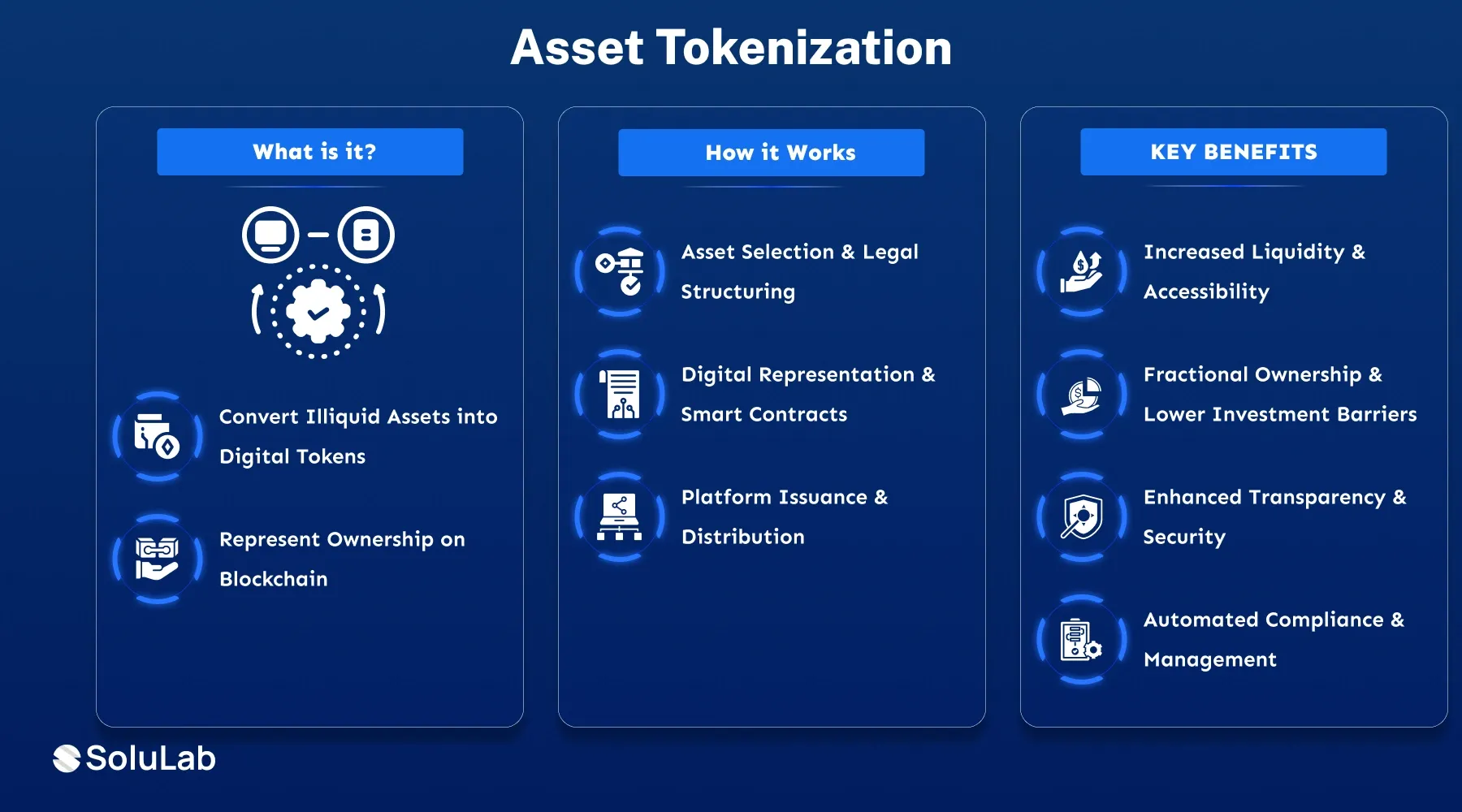
Asset tokenization started as a blockchain experiment. By 2025, it has become a measurable market with real capital, real assets, and real institutions involved.
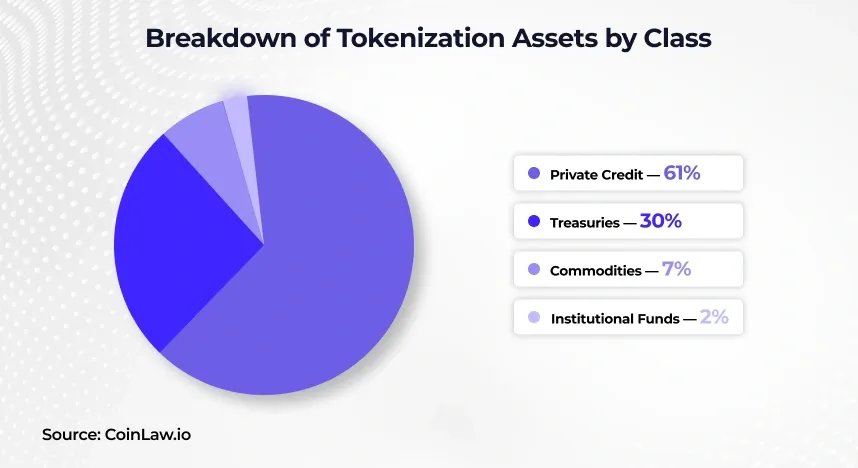
Today, the on-chain value of tokenized real-world assets (RWAs) has already crossed $50 billion. Led by tokenized U.S. treasuries, funds, gold, and real estate. Major asset managers, global banks, and sovereign-linked entities are actively running live tokenization programs. As per Coin Law, the asset tokenization market could reach $1 trillion by 2030, depending on regulatory adoption and institutional participation.
This shift raises important questions for enterprises, banks, and asset owners. What assets can realistically be tokenized? How do compliance, custody, and blockchain architecture come together? And what does it actually take to build and operate an enterprise-grade asset tokenization platform? You can get answers to all these questions in the following sections.
Key Takeaways
- Enterprises can understand the full asset tokenization landscape and can plan correctly, reduce trial-and-error, and optimize budget allocation from the start.
- You gain a clear view of how real-world asset tokenization is evolving across regions, industries, and regulations through 2030.
- By the end of the guide, you will know what type of tokenization fits your assets and how to build or launch the right platform with confidence.
What is Asset Tokenization? Know What Enterprises
Asset tokenization is the process of converting ownership or economic rights of a real-world asset into digital tokens on a blockchain. Each token represents a defined share, right, or claim linked to the underlying asset.
For example, a commercial property or a gold reserve can be divided into thousands of blockchain-based tokens. Investors can buy, hold, or transfer these tokens without handling the physical asset.
1. Market Demand for Tokenized Asset
The demand for tokenized assets comes from problems with the way traditional finance works. Investors want easy access, issuers want things to run smoothly, and regulators want things to be clear.
Real estate, gold, private equity, and bonds are examples of high-value assets that are hard to sell and have high entry barriers. Tokenization solves this by allowing partial ownership and faster settlement.
- The global tokenization market is growing quickly in 2025, and its total value is thought to be over $1.2 trillion.
- The market could reach $5.2 trillion by 2029, thanks to a compound annual growth rate (CAGR) of more than 43%.
- Tokenized U.S. Treasuries and money-market funds have also become more popular, with an on-chain value of almost $7.5 billion in 2025, a growth rate of almost 80% in just one year. Analysts say that in aggressive growth scenarios, this segment alone could grow to more than $1 trillion as more people start using it.
- In 2025, the Real-World Asset (RWA) tokenization market was worth about $24 billion.
This is more than three times the growth that has happened in the last three years, mostly because more institutions are getting involved and regulations are getting better.
Key demand drivers
- Search for yield and diversification
- Faster settlement cycles
- Cross-border capital access
- Demand for transparent ownership records
RWA tokenization is no longer theoretical. It is responding to active investor and issuer needs.
2. Asset vs RW
| Aspect | Asset Tokenization | RWA Tokenization |
| Definition | A broad concept of converting any asset into digital tokens on a blockchain | A focused subset of asset tokenization that deals strictly with real-world, off-chain assets |
| Asset Scope | Includes digital-native assets, utility tokens, in-game assets, and some virtual items | Limited to tangible or legally enforceable real-world assets like real estate, commodities, bonds, and funds |
| Legal Complexity | Often lighter, especially for digital or utility-based assets | High legal complexity due to ownership rights, securities laws, and jurisdictional rules |
| Regulatory Exposure | May not always fall under financial regulations | Almost always subject to securities, commodities, or property regulations |
| Custody Requirement | Custody may be optional or purely digital | Mandatory custody, escrow, or vaulting of underlying assets |
| Proof of Ownership | Ownership is defined primarily on-chain | Ownership must be enforceable both on-chain and off-chain through legal agreements |
| Compliance Design | Basic compliance or none in some cases | Embedded KYC, AML, transfer restrictions, and audit mechanisms are required |
| Enterprise Adoption | Common in startups, Web3 products, and digital platforms | Primarily adopted by banks, enterprises, asset managers, and institutional platforms |
| Risk Profile | Lower regulatory and operational risk | Higher operational, legal, and compliance risk if not designed correctly |
| Typical Use Cases | Loyalty tokens, utility tokens, digital collectibles | Real estate tokenization, gold tokenization, bond and fund tokenization |
How Asset Tokenization is Reshaping the Modern Economy?
Tokenization of assets is not only making trading easier. It is slowly changing how money moves, how ownership is set up, and how markets grow across borders. Tokenization is changing many parts of the global economy at once by turning real-world value into digital units that can be programmed.
Here are the most important ways that asset tokenization is changing the economy today.
1. Liquidity Is Expanding Beyond Traditional Market Limits
Historically, many valuable assets were locked behind high capital requirements and long holding periods. Asset tokenization removes these structural barriers.
Tokenized assets can be divided into smaller units and traded digitally, which increases participation and transaction frequency.
Economic impact:
- Illiquid assets such as real estate and private equity become tradable
- Capital can be deployed and rebalanced faster
- Price discovery improves through increased market activity
This shift is particularly visible in real estate RWA tokenization and commodities tokenization, where liquidity was previously limited.
2. Capital Access Is Becoming More Inclusive and Global
Tokenization allows assets to reach investors beyond geographic and institutional boundaries. Instead of relying on local markets or closed investor networks, asset owners can access global capital pools.
What changes at a macro level:
- Cross-border investment becomes simpler and faster
- Smaller investors gain access to institutional-grade assets
- Asset owners reduce dependence on traditional intermediaries
For emerging markets and asset-heavy enterprises, this creates new funding pathways that were previously unavailable.
3. Settlement and Transaction Cycles Are Shrinking
Traditional financial systems rely on layered clearing, reconciliation, and settlement processes. These introduce delays, costs, and counterparty risk.
Blockchain asset tokenization replaces these steps with smart contracts that execute transactions automatically.
System-level benefits:
- Near-instant settlement instead of T+2 or longer cycles
- Reduced counterparty and reconciliation risk
- Lower operational and administrative overhead
This efficiency has direct implications for tokenization in banking and tokenization in finance.
4. Ownership Is Becoming Programmable and Transparent
Tokenization introduces programmable ownership. Rights, restrictions, and revenue flows can be embedded directly into tokens.
This shifts ownership from static legal records to dynamic, rule-based systems.
What programmable ownership enables:
- Automated dividend and interest distribution
- Embedded compliance and transfer restrictions
- Real-time visibility into ownership and asset history
For regulators and enterprises alike, this improves transparency and reduces disputes.
5. Enterprises Are Rethinking Asset Utilization
Many enterprises sit on valuable but underutilized assets. Tokenization enables these assets to generate liquidity without being sold outright.
Examples include:
- Tokenized real estate portfolios for balance-sheet optimization
- Tokenized receivables to unlock working capital
- Tokenized intellectual property for recurring revenue
This changes how companies think about capital efficiency and asset monetization.
6. Financial Infrastructure Is Gradually Becoming Modular
Tokenization does not replace traditional finance overnight. Instead, it introduces modular layers that can integrate with existing systems.
Economic implications:
- Banks and financial institutions adopt hybrid models
- Legacy assets coexist with blockchain-based rails
- Innovation happens without systemic disruption
This gradual integration is why RWA tokenization is gaining institutional acceptance.
7. New Asset Classes Are Entering the Investment Universe
Tokenization is enabling markets for assets that were previously difficult to price, verify, or trade.
Emerging tokenized asset categories include:
- Carbon credits and sustainability assets
- Infrastructure and renewable energy projects
- Art, collectibles, and niche commodities
These new markets diversify investment opportunities while supporting long-term economic themes like sustainability.
8. Regulation Is Becoming Part of Product Design
As asset tokenization matures, regulation is no longer treated as an external constraint. It is being built into platform architecture and token logic.
This shift results in:
- Better investor protection
- Higher institutional participation
- Reduced systemic risk
Jurisdictions that embrace this approach are positioning themselves as global tokenization hubs.
Key Economic Takeaway
Asset tokenization is reshaping the modern economy by making assets more liquid, ownership more transparent, and capital more mobile. It does not disrupt value creation. It modernizes how value moves.
For enterprises, banks, and investment firms, tokenization is becoming a structural advantage rather than a speculative trend.
Types of Assets That Can Be Tokenized Across Multiple Enterprises
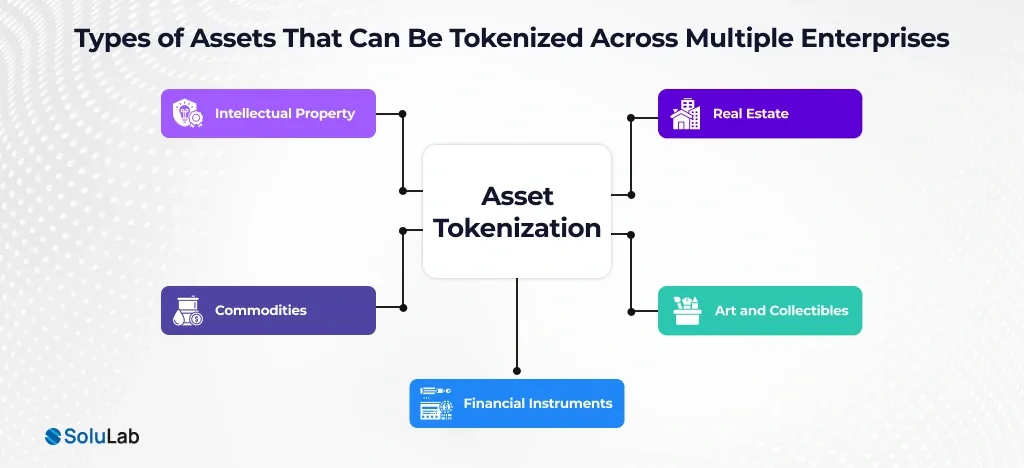
There isn’t just one way to tokenize Real-World Assets (RWA). There are differences in how assets are owned, valued, regulated, and traded. Because of this, RWA tokenization platforms are usually built around different types of assets, each with its own legal, technical, and financial issues.
Businesses can choose the best token structure, custody model, and compliance framework for their tokenized asset by knowing these categories.
These are the main types of RWA tokenization that businesses and banks are using right now.
1. Financial Assets Tokenization
Financial asset tokenization focuses on instruments that already exist within regulated financial markets. These assets have well-defined cash flows, valuation models, and investor expectations.
This category is often the entry point for banks, asset managers, and private equity firms.
Common financial RWAs include:
- Equity tokenization for private companies and pre-IPO shares
- Bond tokenization, including corporate bonds and government securities
- Fund tokenization for private equity, hedge funds, and venture funds
- Invoice and receivables tokenization for working capital financing
- Tokenized money market instruments and treasuries
Why the Financial category works well for tokenization:
- Existing legal frameworks can be adapted to blockchain rails
- Smart contracts automate dividends, interest, and redemptions
- Faster settlement reduces counterparty and clearing risk
- Fractional access expands the investor base without changing asset fundamentals
Financial RWA tokenization is primarily compliance-driven and institutional in nature.
2. Commodities and Natural Resources Tokenization
Commodities are among the most mature and widely adopted RWA categories for tokenization. These assets are tangible, globally traded, and supported by standardized valuation methods.
Tokenization introduces liquidity and transparency without disrupting physical custody.
Tokenized commodity examples include:
- Gold tokenization backed by vaulted reserves
- Silver, copper, and industrial metal tokenization
- Diamond tokenization with provenance and certification tracking
- Oil and gas production rights tokenization
- Agricultural commodity output tokenization
Key characteristics of this category:
- Tokens are backed by verifiable physical reserves
- Custody and proof-of-reserves are critical platform components
- Investors gain exposure without handling physical delivery
- Producers unlock liquidity without selling inventory outright
Commodities tokenization is especially attractive for institutional investors seeking asset-backed exposure with on-chain transparency.
3. Real Estate RWA Tokenization
Real estate tokenization focuses on transforming property ownership into digital, tradable units. This category addresses one of the most illiquid and capital-intensive asset classes. Real estate tokenization continues to expand, with the current market valued at around $20 billion.
Tokenization enables shared ownership and faster capital movement without changing property usage.
Assets commonly tokenized include:
- Residential rental properties
- Commercial real estate such as offices and retail spaces
- Hospitality assets like hotels and resorts
- Industrial warehouses and logistics hubs
- Land and development projects
Why real estate is ideal for RWA tokenization:
- High asset value makes fractional ownership practical
- Rental income can be distributed via smart contracts
- Secondary trading improves exit flexibility for investors
- Global investors can participate without local intermediaries
Real estate RWA tokenization platforms must integrate legal entities, property management, and compliance controls into the asset lifecycle.
Emerging fractional investing in real estate:
Real Estate Investment Trusts (REIT) tokenization converts REIT tokens into blockchain-based digital tokens, improving liquidity and access through secondary trading and fractional ownership.
However, tokenized REITs must comply with securities regulations, making compliance-first platform design essential.
4. Infrastructure and Energy Asset Tokenization
Infrastructure and energy assets are long-term, yield-generating assets traditionally accessible only to large institutions. Tokenization opens these assets to broader participation while maintaining governance.
Examples in this category include:
- Renewable energy projects such as solar and wind farms
- Power generation and grid infrastructure
- Transportation infrastructure like roads, ports, and rail assets
- Utility and water management projects
Tokenization benefits for this category:
- Long-term revenue streams can be tokenized into predictable yields
- Project financing becomes more flexible and transparent
- Investors gain exposure to stable, non-correlated assets
- Sustainability-linked assets align with ESG investment mandates
This category often appeals to infrastructure funds, government-linked entities, and impact investors.
5. Intellectual Property and Revenue-Generating Rights
Intellectual property tokenization focuses on assets that generate ongoing income rather than physical ownership. These assets benefit from programmability and transparent revenue distribution.
Common IP-based RWAs include:
- Music and film royalties
- Software licensing rights
- Patents and trademarks
- Brand licensing agreements
- Media and content revenue streams
Why IP works well with tokenization:
- Smart contracts automate royalty distribution
- Ownership and usage rights are clearly defined on-chain
- Creators access capital without selling full ownership
- Investors gain exposure to performance-based returns
This category blends legal enforceability with programmable revenue logic.
6. Alternative and Emerging RWA Categories
New asset classes are emerging as tokenization infrastructure matures. These assets were previously difficult to trade or verify at scale.
Examples include:
- Carbon credits and sustainability certificates
- Renewable energy credits
- Art and high-value collectibles
- Rare assets with limited secondary markets
Why enterprises explore this category:
- Blockchain provides transparency and traceability
- Tokenization improves market confidence
- Fractional access increases participation
- ESG and sustainability reporting becomes auditable
These RWAs require careful validation, oracle integration, and compliance design.
7. Why Categorization Matters for RWA Tokenization Platforms?
Each RWA category demands a different approach to:
- Legal structuring and compliance
- Custody and asset verification
- Token standards and smart contract logic
- Investor onboarding and transfer rules
Enterprises building or adopting an RWA tokenization platform must align the platform architecture with the asset category, not the other way around.
This alignment is what separates scalable, compliant tokenization platforms from short-lived pilots.
Fun Fact:
Stablecoins have increasingly become a foundational component of tokenized markets as real-world assets move on-chain.
By late 2025, the global stablecoin market neared a $300 billion capitalization, reflecting significant growth in adoption across payments, settlement, and digital asset transactions
How Does Asset Tokenization Work in 2026?
Asset tokenization follows a structured process that connects a real-world asset with blockchain technology in a legally enforceable way in 2026. To understand this clearly, consider the example of gold tokenization.
- First, the physical gold is identified and verified. The gold is stored in a secure, audited vault managed by a regulated custodian.
- Each unit of gold is weighed, certified, and recorded. This step ensures that every digital token is backed by a real, measurable asset.
- Next, the legal structure is defined. Ownership rights, redemption terms, and investor eligibility are established based on the jurisdiction.
- This ensures the tokenized gold complies with commodity and financial regulations.
- Once the legal and custody layers are in place, digital tokens are created on a blockchain. Each token represents a fixed quantity of gold, such as one gram.
- Smart contracts define how tokens can be issued, transferred, or redeemed.
- Investors then purchase these tokens through a compliant asset tokenization platform. Transactions are recorded on the blockchain, providing transparency and traceability.
- Token holders can trade their gold-backed tokens, use them as collateral, or redeem them for physical gold where permitted.
In this way, blockchain asset tokenization transforms physical gold into a liquid, digital investment without moving the underlying asset.
Technology Stack Behind Asset Tokenization
The success of any asset tokenization initiative depends on the strength of its underlying technology stack. Unlike simple digital assets, real-world asset tokenization must bridge physical assets, legal systems, and blockchain infrastructure in a secure and scalable way.
An enterprise-ready asset tokenization platform is typically built as a layered system. Each layer has a specific responsibility, from asset representation to compliance enforcement and transaction execution. This modular approach allows businesses to scale, adapt to regulations, and integrate with existing financial systems.
At the core of this stack is blockchain technology, supported by smart contracts, custody systems, identity frameworks, and external data providers.
1. Blockchain Architecture for Asset Tokenization
Blockchain architecture defines how tokenized assets are created, managed, and transferred across the platform. For asset tokenization, architecture must prioritize security, compliance, scalability, and interoperability.
Most asset tokenization platforms follow a multi-layered architecture:
- Blockchain Layer
This is the foundation where tokens are issued and transactions are recorded. It provides immutability, transparency, and auditability for tokenized assets.
- Smart Contract Layer
Smart contracts define token logic, ownership rules, transfer restrictions, and automated actions such as dividend distribution or redemption. In blockchain asset tokenization, smart contracts also enforce compliance conditions.
- Compliance and Identity Layer
KYC, AML, and investor eligibility checks are integrated either on-chain or through secure off-chain systems. Only approved wallets are allowed to hold or transfer certain tokenized assets.
- Custody and Asset Management Layer
This layer connects digital tokens to the underlying real-world asset. It includes vaults, escrow accounts, custodians, and proof-of-reserves mechanisms.
- Application Layer
Dashboards, investor portals, admin panels, and reporting tools sit here. This is where enterprises and investors interact with the asset tokenization platform.
This architecture ensures that digital asset tokenization remains legally enforceable while benefiting from blockchain efficiency.
2. Blockchain Protocols for Real-World Asset Tokenization
Choosing the right blockchain protocol is critical for any RWA tokenization platform. Different protocols offer different trade-offs in terms of decentralization, cost, speed, and regulatory compatibility.
For real-world asset tokenization, enterprises usually prefer protocols that support smart contracts, permissioned access, and compliance controls.
Commonly used blockchain protocols include:
- Ethereum
Widely used for asset tokenization due to its mature ecosystem and smart contract capabilities. It supports standards like ERC-20, ERC-721, and ERC-1155, making it suitable for fungible and non-fungible tokenized assets.
- Permissioned Ethereum Networks
Enterprise implementations often use private or consortium Ethereum networks to control access while retaining compatibility with public chains.
- Polygon and Layer-2 Networks
Used to reduce transaction costs and improve scalability while remaining compatible with Ethereum standards. These are popular for real estate tokenization platforms and fund tokenization.
- Hyperledger Fabric
A permissioned blockchain suited for enterprises that require strict access control, data privacy, and regulatory oversight. Often used in tokenization for banking and financial institutions.
- Other Enterprise-Focused Chains
Protocols like Avalanche subnets or private chains are used where performance and compliance customization are required.
In practice, many modern asset tokenization platforms adopt a hybrid or multi-chain approach, allowing assets to be issued on secure permissioned networks while enabling controlled interoperability with public blockchains.
Asset Tokenization Economics, Legal and Regulatory Considerations
Asset tokenization is not only a technical decision. It is an economic and regulatory one. Enterprises evaluating tokenization must understand how value is created, where costs arise, and how legal obligations shape platform design.
Assets that were previously locked for long durations can now be fractionalized and traded, allowing issuers to recycle capital faster and investors to manage risk more dynamically.
However, these economic benefits materialize only when tokenization is aligned with legal enforceability and regulatory compliance. Without this alignment, tokenized assets risk becoming unusable or restricted.
1. Economic considerations, enterprises must evaluate
From an economic perspective, tokenization improves capital efficiency by increasing liquidity and reducing operational friction.
- Liquidity premium vs. structuring cost
Tokenization can improve liquidity, but legal structuring, custody, and compliance add upfront costs.
- Operational savings
Automation through smart contracts reduces 30% of settlement, reconciliation, and reporting costs over time.
- Investor reach and pricing efficiency
Fractional ownership can expand demand, which may improve price discovery for certain assets.
- Ongoing platform costs
Custody, audits, compliance monitoring, and infrastructure maintenance are recurring economic factors.
Enterprises that treat tokenization as a long-term infrastructure investment, rather than a short-term fundraising tool, tend to see sustainable returns.
2. Regulatory Landscape for Asset Tokenization
Regulation is the defining constraint for real-world asset tokenization. Jurisdictions differ significantly in how they classify and govern tokenized assets, especially when tokens represent ownership, income rights, or financial instruments.
Below is a high-level, factual overview of how major regions approach asset and RWA tokenization.
2.1 United States
The United States has a strict substance-over-form regulatory approach. This means that the economic reality of a token determines whether it is regulated as a security.
- According to the SEC, most RWA tokens are securities and must follow the rules for registering or getting an exemption.
- Most of the time, accredited investors take part, and private placements under Regulation D are still the most common way to issue securities.
- Tokenized U.S. Treasuries and money market funds have grown quickly, with on-chain values in the tens of billions of dollars under regulated pilots.
This setting strongly favors RWA tokenization platforms that are institutional-grade, compliance-heavy, and have a legal-first design.
2.2. European Union
The European Union has a layered system for regulating asset tokenization that combines traditional securities law with laws that are specific to cryptocurrencies.
- MiFID II still applies to security tokens, which means that all of the rules about disclosure, custody, and protecting investors still apply.
- MiCA makes things clearer for crypto-assets, but it doesn’t include tokenized securities, which are still subject to current financial rules.
- Switzerland is not part of the EU, but its DLT Act legally recognizes tokenized securities, which allows for live institutional issuance.
The EU backs institutional tokenization, but it is still not fully united because different countries have different rules about it.
2.3 United Arab Emirates (UAE)
The UAE has positioned itself as one of the world’s most progressive jurisdictions for real-world asset tokenization.
- VARA and ADGM have published dedicated digital asset frameworks enabling licensed tokenization of real estate, funds, and commodities.
- Dubai has witnessed real estate tokenization pilots selling properties worth millions of dirhams within minutes of launch.
- Regulators actively engage with platforms, accelerating licensing timelines and reducing uncertainty for compliant tokenization projects.
This proactive stance makes the UAE a preferred hub for real estate and commodities RWA tokenization.
2.4 Singapore
The UAE has made itself one of the most forward-thinking places in the world for tokenizing real-world assets.
- ADGM and VARA have both released specific digital asset frameworks that make it possible to legally tokenize real estate, funds, and goods.
- Dubai has seen real estate tokenization pilots sell properties worth millions of dirhams in just a few minutes after they started.
- Regulators work closely with platforms to speed up the licensing process and make it easier for compliant tokenization projects to know what to expect.
This proactive approach makes the UAE a popular place for RWA tokenization of real estate and goods.
2.5 United Kingdom
The UK is taking a cautious but structured approach toward asset and RWA tokenization.
- Tokenized securities fall under the Financial Services and Markets Act, with no separate crypto exemption for RWAs.
- The FCA has launched digital securities sandbox programs to test tokenized bonds and settlement infrastructure.
- Regulatory focus remains on wholesale and institutional markets rather than broad retail participation at this stage.
The UK favors gradual infrastructure modernization over rapid retail-facing tokenization.
2.6 Australia
Australia is still in an early but increasingly active phase of exploring asset tokenization frameworks.
- Regulatory sandboxes have enabled pilot projects involving tokenized funds, carbon credits, and settlement experiments.
- Legal classification of tokenized assets remains under review, particularly regarding securities and managed investment schemes.
- Most activity is institution-led, with banks and infrastructure providers testing controlled, non-public issuance models.
Australia’s tokenization ecosystem is evolving, but large-scale commercial deployment is still emerging.
3. Strategic takeaway for enterprises
Jurisdiction selection directly impacts token structure, investor access, custody design, and compliance cost.
Enterprises building RWA tokenization platforms must treat regulation as a core architectural input, not a downstream constraint.
In practice, the UAE and Singapore favor controlled innovation, while the US prioritizes investor protection through exemptions.
4. Token Standards Explained: ERC-20, ERC-721, ERC-1155, and Others
Token standards define how digital tokens behave on a blockchain. In asset and RWA tokenization, the choice of token standard directly affects compliance, transferability, scalability, and investor experience.
Each standard serves a different purpose. Selecting the wrong one can limit liquidity, create compliance gaps, or increase operational complexity. Below is a practical comparison of the most commonly used token standards in blockchain asset tokenization.
| Token Standard | Token Type | Best Used For | Key Characteristics | Typical RWA Use Cases |
| ERC-20 | Fungible | Divisible, identical assets | All tokens hold equal value, highly liquid, widely supported by wallets and exchanges | Gold tokenization, fund tokenization, bond tokenization, stable-value assets |
| ERC-721 | Non-Fungible (NFT) | Unique, one-of-one assets | Each token is unique, strong provenance tracking, low divisibility | Art tokenization, unique real estate assets, collectibles |
| ERC-1155 | Hybrid (Fungible + NFT) | Mixed asset portfolios | Supports multiple token types in one contract, lower gas costs, operational flexibility | Real estate portfolios, commodity baskets, platform-level tokenization |
| ERC-1400 | Security Token | Regulated financial assets | Built-in compliance features, transfer restrictions, investor eligibility controls | Equity tokenization, regulated bond issuance, private securities |
| ERC-3643 (T-REX) | Permissioned Security Token | Institutional RWA platforms | Identity-based transfers, modular compliance, regulator-friendly architecture | Institutional RWA tokenization platforms, banking use cases |
| Custom / Permissioned Standards | Controlled Tokens | Private enterprise deployments | Restricted access, customizable logic, limited public interoperability | Banking, internal asset digitization, consortium-based platforms |
Note: For enterprises, this distinction directly determines licensing, custody design, and long-term platform scalability.
4.1 How Enterprises Should Choose a Token Standard
- Fungible assets such as commodities, funds, and bonds typically use ERC-20 or security-focused variants.
- Unique assets like individual properties or artworks align better with ERC-721.
- Multi-asset platforms benefit from ERC-1155 due to operational efficiency.
- Regulated RWAs almost always require ERC-1400 or ERC-3643 to embed compliance at protocol level.
In real-world asset tokenization, standards are often combined with off-chain compliance systems, custody frameworks, and legal agreements to ensure enforceability.
Tokenization Across Industries: Key Use Cases
An enterprise-grade Asset Tokenization Platform for precious metals, enabling fractional ownership of gold and silver fully backed by physical vault reserves. The objective was to modernize commodities investing using Blockchain Asset Tokenization while maintaining the trust, transparency, and regulatory discipline expected in traditional markets.
Digitizing Gold & Silver Through a Real-World Asset Tokenization Platform
The platform allows investors to buy, hold, trade, and redeem tokenized gold and silver without handling physical assets. Each token represents a defined gram or ounce of metal, verified through audited proof-of-reserves and real-time price tracking. The solution was designed for global access, institutional compliance, and long-term scalability.
Read More: How Silver Tokenization Platform Development Paves the Future of RWAs?
Industry Requirement
Precious metals are widely trusted but operationally inefficient. Traditional gold and silver investing suffers from high entry barriers, limited liquidity, slow settlement, and opaque custody models.
The industry needed a real world asset tokenization solution that could:
- Enable fractional ownership without compromising asset backing
- Offer transparent proof of physical reserves
- Support 24/7 global trading and liquidity
- Comply with KYC/AML and jurisdictional regulations
- Bridge traditional commodities with digital asset infrastructure
This made RWA Tokenization the most practical path forward for modern commodities platforms.
Solution Delivered
The tokenization development partner delivered a secure and compliant RWA Tokenization Platform tailored for gold and silver.
Key capabilities included:
- Smart Token Issuance & Fractionalization
Tokens were minted to represent precise metal quantities, enabling low-ticket investments and broader participation.
- Vault Integration with Proof-of-Reserves
Licensed custodians were integrated to ensure every token remained 1:1 backed by physical gold or silver, with audit visibility for users.
- 24/7 Digital Trading Infrastructure
Tokenized metals could be traded globally, without physical movement, improving liquidity and settlement speed.
- Multi-Chain Wallet & Exchange Connectivity
The platform supported multiple blockchain networks, external wallets, and exchange integrations, unlocking DeFi liquidity paths.
- Redemption and Conversion Flows
Investors could redeem tokens for physical metal or fiat currency, aligning digital ownership with real-world expectations.
- Business-Ready Dashboards & Analytics
Admin and investor dashboards provided insights into reserves, trading volume, redemptions, and compliance metrics.
This approach combined Digital Asset Tokenization with institutional-grade controls.
Results Achieved
The platform delivered measurable business and operational outcomes:
- 100% verifiable gold and silver backing with transparent audits
- Fully compliant token issuance with embedded KYC/AML controls
- Always-on global trading access for precious-metal investors
- Strong trust signals through proof-of-reserves and redemption options
- Scalable foundation for expanding into other commodities tokenization
How to Get Started With Asset Tokenization Platform Development?
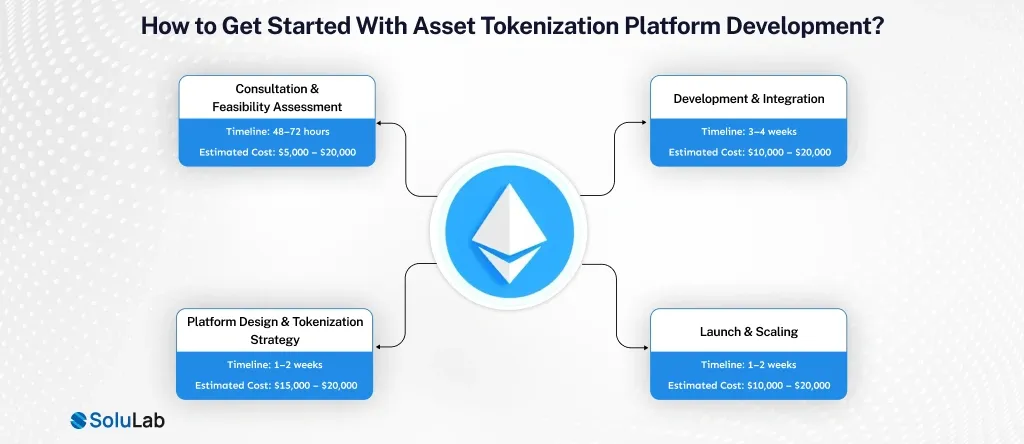
Getting started with asset tokenization requires a structured, compliance-first approach. Enterprises typically begin by evaluating asset suitability, regulatory exposure, and the right technology model. Whether you are a bank, asset manager, or enterprise asset owner, the goal is to build a secure Asset Tokenization Platform that aligns with legal requirements while delivering liquidity and operational efficiency.
Most organizations engage Asset Tokenization Services providers to reduce risk, shorten timelines, and ensure enterprise-grade execution.
Below is a simplified, practical rollout model used in Asset Tokenization Platform Development projects.
Phase 1: Consultation & Feasibility Assessment
This phase focuses on identifying the asset type, jurisdiction, compliance needs, and business goals. The outcome is a clear roadmap for Real World Asset Tokenization and platform architecture.
Timeline: 48–72 hours
Estimated Cost: $5,000 – $20,000
Phase 2: Platform Design & Tokenization Strategy
Token standards, custody models, compliance workflows, and blockchain selection are finalized. This phase defines how the RWA tokenization platform will operate end to end.
Timeline: 1–2 weeks
Estimated Cost: $15,000 – $20,000
Phase 3: Development & Integration
Smart contracts, compliance modules, wallets, and dashboards are built. Enterprises may choose full custom development or a white label tokenization platform to accelerate launch.
Timeline: 3–4 weeks
Estimated Cost: $10,000 – $20,000
Phase 4: Launch & Scaling
Assets are tokenized, investors onboarded, and secondary trading enabled. Ongoing support ensures regulatory alignment and platform scalability.
Timeline: 1–2 weeks
Estimated Cost: $10,000 – $20,000
This structured approach minimizes risk while enabling faster, compliant tokenization at enterprise scale.
How Tokenized Assets Will Shape Global Markets by 2030?
By 2030, asset tokenization and real world asset tokenization are expected to move from early adoption to core financial infrastructure. Also, Business Research company predicted that the market is expected to grow to $5,254.63 billion as of 2029.
As blockchain matures and regulation stabilizes, RWA Tokenization Platforms will reshape how assets are issued, traded, and managed across global markets.
1. Rise of Tokenized Commodities Exchanges
Tokenized gold, silver, oil, copper, and agricultural assets will increasingly trade on regulated digital exchanges. Commodities tokenization improves liquidity, enables fractional ownership, and reduces settlement cycles from days to near real-time. Analysts project tokenized commodities to represent a multi-trillion-dollar market by 2030.
Read Also: How Does Copper Tokenization Benefit Modern Businesses?
2. Interoperable Tokenized Finance
Cross-chain infrastructure will allow tokenized assets to move across blockchains, banks, and marketplaces. This interoperability will integrate blockchain asset tokenization directly into lending, collateral, and settlement systems, especially for tokenization in banking and tokenization in finance.
3. Enterprise AI + Tokenization Twins
AI will become the intelligence layer of asset tokenization platforms. Enterprises will use AI to monitor tokenized assets in real time, optimize pricing, manage risk, and automate compliance. This fusion turns Digital Asset Tokenization into a data-driven, self-optimizing system.
4. ESG and Green Tokenization
Green tokenization will accelerate the adoption of tokenized carbon credits, renewable energy certificates, and ESG-linked infrastructure. Blockchain enables auditable impact tracking, while tokenization makes sustainable assets investable at scale.
5. Country-Led Tokenization Hubs
Jurisdictions like the UAE, Singapore, and Switzerland will lead RWA tokenization through clear regulations and enterprise-friendly frameworks.
Conclsuion
Asset tokenization is moving from experimentation to execution. As this guide explains, it is reshaping how assets are owned, financed, and traded by improving liquidity, transparency, and capital efficiency across industries. If you are thinking of an asset tokenization development company to partner with and build a world-class platform, then SoluLab is here to assist you.
At SoluLab, we turn your ideas into production-ready asset tokenization platforms. Our team delivers secure, compliant, and scalable real estate tokenization solutions tailored to your asset class, jurisdiction, and business goals.
With SoluLab, you can:
- Reduce operational and settlement costs by up to 40% through smart contracts
- Achieve 2x faster capital efficiency via fractionalization and secondary liquidity
- Launch compliant platforms with enterprise-grade security and governance
If you are planning to tokenize assets or build an RWA tokenization platform, connect with us to get started confidently.
FAQs
1. What types of businesses should consider asset tokenization right now?
Asset tokenization is ideal for real estate firms, private equity funds, commodity traders, family offices, and fintech startups looking to unlock liquidity, automate ownership, and scale globally. Enterprises with illiquid assets benefit the most from tokenization adoption.
2. How do I know if my asset is suitable for tokenization?
Suitability depends on asset value, ownership structure, regulatory environment, revenue model, and market demand. A feasibility assessment helps determine technical, legal, and financial viability before implementation.
3. How much does it cost to build an asset tokenization platform?
Costs typically range based on features, jurisdiction, compliance requirements, and asset type. Enterprise-grade platforms usually start from five-figure budgets, while full-stack deployments require larger investment.
4. What is the expected asset tokenization development ROI timeline?
ROI depends on asset class, market demand, and monetization strategy. Most platforms see commercial outcomes within 6–18 months when combined with a proper liquidity strategy.
5. Do I need smart contracts to tokenize assets?
Yes. Smart contracts automate issuance, compliance rules, ownership tracking, and transactions. They ensure trust without intermediaries.
6. How do I start an asset tokenization project?
The first step is a feasibility and compliance assessment. This determines the ideal structure, technology stack, and regulatory path. If you are not aware, then contact SoluLab. It’s simple, just visit the site and fill in your details. Our team will get in touch with you within 24 to 48 hours, based on the region.

