Talk to an Expert

How Much Does It Cost To Build An App In Australia?

Cost To Build An App In Australia

Mobile apps are not just a fancy or technological thing for any company. They are essential for brand growth. Whether for startup companies or well-established organizations, mobile apps play a crucial role in interacting with customers. 

If you are an entrepreneur looking to develop an app in Australia, it is essential to thoroughly review the following details. With the right partners and planning team, you can launch a mobile app at a lower cost. Australia offers plenty of cost-effective routes to make an enhanced app for your company.

A Simple Overview of App Development Costs in Australia

Based on the types of mobile apps, the development costs vary. However, any startup company doesn’t go for a complex mobile app. Hence, based on the requirement and company goal, entrepreneurs must choose an effective model and set their budget. Check the following details to gain cost insights on developing a mobile app in Australia.

App Type Estimated Cost (AUD) Development Timeline Ideal For
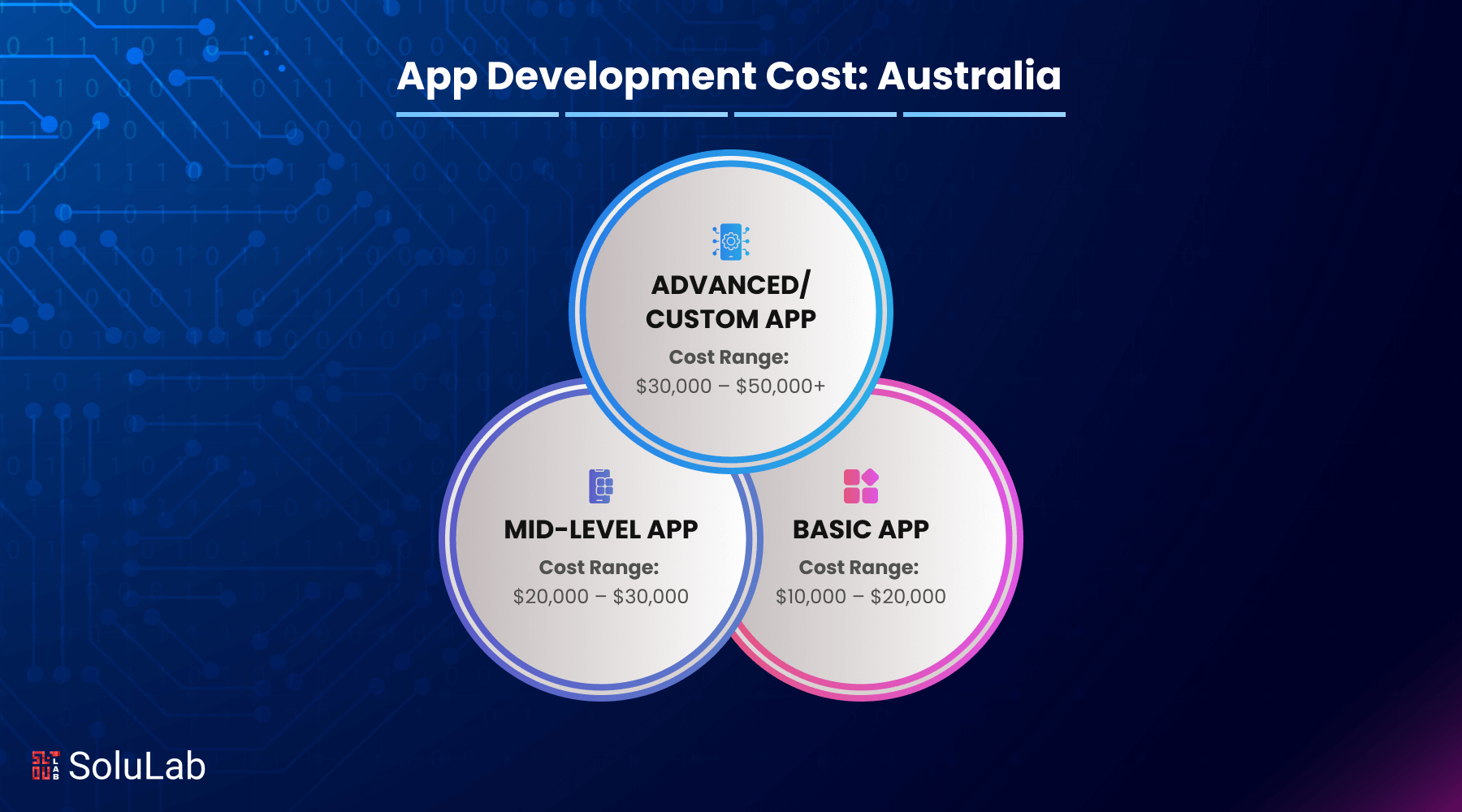
Basic App $10,000 – $20,000 4 – 6 weeks Startups, MVPs, simple utilities
Mid-Level App $20,000 – $30,000 8 – 12 weeks SMEs, booking apps, ecommerce platforms
Advanced/Custom App $30,000 – $50,000+ 12 – 20 weeks (depends) Enterprises, AI-driven apps, real-time systems

Factors That Influence Mobile App Costs in Australia

Multiple factors affect the cost of mobile app development in Australia. The most impactful ones include:

  • Internal vs. external development
  • App platforms (iOS, Android, both)
  • Complexity and features
  • Back-end and front-end requirements
  • Third-party integrations
  • Design quality
  • Marketing and post-launch support

Let’s explore each in detail.

1. Internal vs. External Development

Hiring a Perth or Melbourne-based agency may seem more expensive initially, but it saves you from long-term issues like delays, bugs, and team overheads. Agencies offer:

  • Expertise in tools and tech stacks
  • Faster turnaround times
  • Flexibility and resource scalability

Outsourcing also removes HR costs like sick leave, insurance, and overtime. Many Australian businesses still outsource, even if they have an internal team, just to access advanced skills and reduce development time.

CTA-1

2. Choosing a Platform: iOS, Android, or Both?

Here’s how platform selection affects development:

  • iOS apps cost more upfront but offer less fragmentation and reach affluent users in Australia, Japan, and the U.S.
  • Android apps require more testing due to device variety, but are ideal for global markets.
  • Cross-platform apps (built using Flutter or React Native) save money and time by targeting both iOS and Android users with a single codebase.

Around 40% of Australian apps are cross-platform to reduce costs and expand market reach.

How App Features and Functions Impact Cost?

The average cost to build an app in Australia increases as adding extra functionality can quickly inflate your budget. Even features like push notifications or chat systems can cost thousands.

Common Features Development Complexity
User Login & Profiles Medium
Payment Gateway High (due to security)
Real-Time Tracking High
Push Notifications Medium
In-app Purchases Medium

Third-Party Integrations

Want social logins, Google Maps, or payment APIs? That’s extra time and cost. While these services improve functionality, they often include:

  • Monthly subscriptions
  • Usage-based billing
  • Additional testing and security compliance

But done right, third-party services can save development time and boost user experience.

Developer Accounts & Fees

You’ll also need to factor in developer program costs:

  • Google Play Developer Account: One-time fee of $25.
  • Apple Developer Account: Annual fee of $99.

These accounts give access to the app stores, testing tools, and support.

Marketing

An amazing app is useless if no one knows about it. Here’s what marketing might include:

  • Social Media Campaigns
  • Google Ads & SEO
  • Influencer or PR outreach
  • Outdoor/TV ads for large-scale launches

Marketing budget varies depending on strategy and target market. But it’s a must to drive user acquisition and retention.

Detailed App Development Timeline (With Milestones)

Building a mobile app is a step-by-step journey and also requires a skilled team and expertise. Here’s what the typical process looks like:

Stage Timeframe Activities
Discovery & Planning 1 – 2 weeks Market research, feature prioritization, tech stack selection
Wireframing & Prototyping 1.5 – 3 weeks UI/UX mockups, interactive user flows, initial feedback loop
Core Development (MVP) 6 – 8 weeks Backend & frontend development, API integrations, core functionality build
Testing & QA 2 – 3 weeks Functional, performance, and cross-device testing
Launch Preparation 1 – 1.5 weeks Final bug fixes, deployment, App Store/Play Store submission, ASO
Post-Launch Iterations Ongoing (1st 2–4 weeks critical) User feedback implementation, performance tracking, feature updates

On average, a standard app takes around 4 to 8 months to launch fully, while complex apps may require up to a year.

App Maintenance Costs in Australia

Mobile app development is not the end; its maintenance requires funds too. The constant updating of software and adding new features consumes a lot of money, too. 

Post-Launch App Maintenance Costs

Developing an app is just the start. Ongoing maintenance ensures your app remains stable, secure, and user-friendly. Expect to spend 15%–20% of the initial development cost annually on updates, security patches, and minor feature upgrades.

Maintenance Task Frequency Estimated Cost (AUD)
OS & SDK Updates Quarterly $2,000 – $5,000/year
Bug Fixes & Security Monthly $500 – $1,500/month
New Features & Enhancements As Needed $10,000 – $50,000 per update
Server & Hosting Costs Ongoing $100 – $1,000/month

Proactive maintenance helps retain users and supports app store rankings.

Read More: Asset Tokenization Regulations for Australia

Local Development Agencies vs Offshore Comparison

Many companies are now looking for offshore companies for lower costs for mobile app development. This is mainly due to the Australian expenses and offshore companies’ offers on post-launch support and compliance. The following table provides a detailed comparison. 

Factor Local (Australia) Offshore (India/Ukraine)
Cost AUD 100 – 250/hour AUD 25 – 75/hour
Communication Real-time, culturally aligned May face time-zone or language gaps
Quality Assurance High standards, regulation-compliant Varies by agency
Data Security Strong under Australian law Depends on jurisdiction

Cost of Integrating Emerging Technologies into App Development in Australia

Modern apps are more than just code and UI — they’re powered by intelligent technologies that enhance performance, security, automation, and user experience. Whether it’s blockchain for secure transactions, AI for automation, or NFTs for digital ownership, the right tech stack can future-proof your app.

Technology Use Case Estimated Cost (AUD) Estimated Timeline
Blockchain Secure transactions, smart contracts, tokenization $20,000 – $60,000 4 – 8 weeks
Artificial Intelligence (AI) Predictive analytics, automation, personalization $15,000 – $45,000 3 – 6 weeks
Generative AI (GenAI) Content generation, chatbots, image/text AI $25,000 – $75,000 5 – 8 weeks
NFT Integration Asset tokenization, digital collectibles $20,000 – $50,000 4 – 6 weeks
IoT (Internet of Things) Smart devices integration, real-time monitoring $18,000 – $50,000 5 – 7 weeks
AR/VR Immersive experiences, 3D product views $30,000 – $85,000 6 – 10 weeks
Voice Assistants / NLP Voice search, AI chat interfaces $15,000 – $40,000 3 – 5 weeks

Integrating one or more of these technologies doesn’t always mean skyrocketing your budget. At SoluLab, we offer modular integration options that align with your goals, timelines, and business model—whether you’re a startup or an enterprise. 

Smart Ways to Reduce Development Costs

App development doesn’t have to break the bank. Try these cost-cutting strategies:

  • Define Clear Requirements Early: Poor planning leads to scope creep and extra costs. Create detailed specs from day one.
  • Use Agile Methodologies: Frameworks like Scrum or Kanban help break down work into sprints. Faster delivery, fewer errors, and lower costs.
  • Go Hybrid or Cross-Platform: Use a single codebase to build apps for both platforms. Saves time and ensures a unified user experience.
  • Leverage Third-Party Services: Integrate tested solutions instead of building from scratch. Think payment APIs, login auth, cloud hosting, etc.
  • Build an MVP First: Start with a Minimum Viable Product (MVP). Launch fast, gather feedback, and iterate later with fewer risks.
  • Apply for R&D Tax Incentives: In Australia, R&D incentives help tech companies reclaim a portion of development costs, especially for innovative features.
  • Outsourcing to Experts: Outsourcing to experienced app developers in Australia offers better tech stacks and reduced risk. It’s often cheaper than building an in-house team.

How Do Apps Make Money in Australia?

Once your app is live, it’s time to think about monetization. Go for several types of advertising to increase the user reach, which helps in raising funds. Here are common models:

Model How It Works
Advertising Free app with in-app ads (e.g., banners, videos)
Subscription Recurring monthly/yearly payment (e.g., Netflix)
Freemium Free app + premium upgrades (e.g. Evernote)
In-App Purchases Virtual goods or features (e.g., Candy Crush)

Choose the model that best fits your audience and content strategy.

CTA-2

Final Thoughts

Every company that is going to stand in Australia should plan the budget and the clever execution of mobile apps. As discussed above, AUD 10,000 to over AUD 50,000 is required based on the mobile app type. As the features and functions increase, the cost also increases.

If your business is ready to go for app design, then SoluLab, the top mobile app development company, is here to support you in every step. SoluLab focuses on developing native and cross-platform mobile app solutions. Our skilled mobile app development team aids in seamlessly integrating device management tools and platforms. 

Contact us to start building your dream mobile app. Let’s reach every mobile user!

FAQs

1. What is the average cost to build a mobile app in Australia?

The average cost to build a mobile app in Australia ranges from AUD 10K to AUD 50K+. Based on the type of mobile app, goal, features, and development complexity, the price varies.

2. Can I build a mobile app for under AUD 100,000 in Australia? 

Yes. A basic or mid-level app with essential features can be built for AUD 10,000 to 30,000, especially if cross-platform development or outsourcing to cost-effective local teams is used.

3. What is the most cost-efficient way to launch an app? 

Start with a Minimum Viable Product (MVP) using cross-platform development tools like Flutter. Use agile methods, integrate third-party services, and focus on essential features to launch quickly and refine later.

4. How long does it take to build an app in Australia?

Development time can range from 4 weeks to 4 months or more, depending on the app’s complexity, number of features, and development approach.

5. Can I get a fixed quote from SoluLab before starting?

Absolutely. We offer a free consultation and project analysis to understand your app goals. Based on that, we provide a detailed proposal with a fixed or milestone-based pricing model—no hidden costs.
 

Mobile App Development Costs 2026: Cost Breakdown

Mobile App Development-Budget Breakdown

Beginning from the early 90s and continuing till date, mobile app development costs have evolved significantly becoming essential for business growth. Numerous companies have transitioned to the digital realm, using apps to compete. The question of the hour is “What is the Cost of Mobile App Development?” There is an app for everything these days, making it easier for consumers and businesses to buy. What is the real deal with mobile app development, and how much does it cost? All these questions never have a single answer to them.

We have cracked the code to make it easier for many who seek to understand. This blog will provide you with a breakdown of every factor, step, and component involved in app development, which will empower you to estimate the precise cost of your app. The global mobile application market size was valued at USD 252.89 billion in 2023 and is projected to grow at a compound annual growth rate (CAGR) of 14.3% from 2025 to 2030.

Cost of Mobile App Development in 2026

Whenever a client heads to a mobile app development for a consultation on their app idea, they often find themselves in the dark about the whole development process and the costs involved. Even if they have laid out their requirements and functions it may not be enough for the estimation of price. The initial cost is given by the agency but that’s not entirely how it works. App development is a much more complex journey and is the key factor for understanding the expense it may hold with appropriate research.

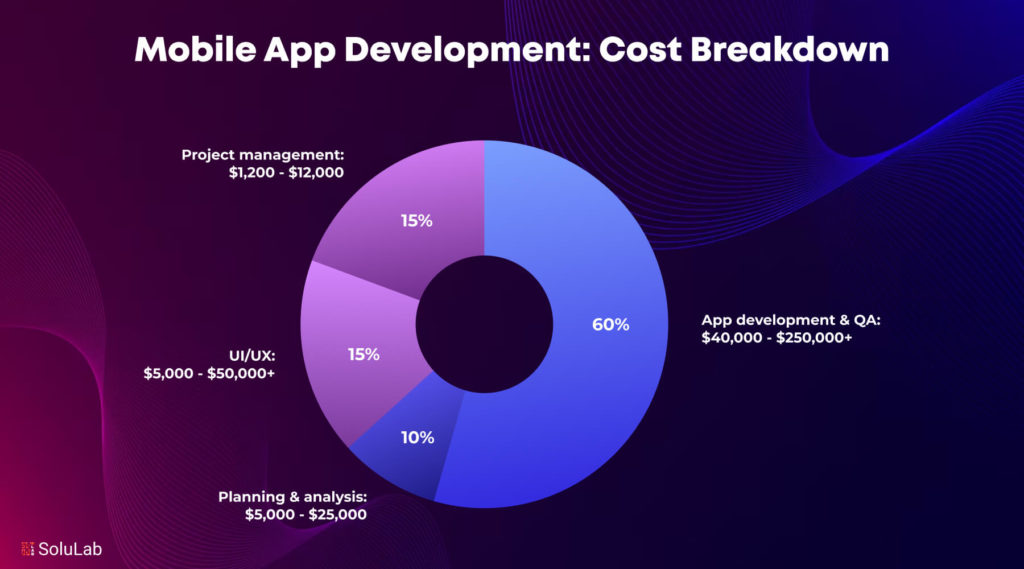
The Breakdown of mobile app development cost is based on complexity for finding out the estimate of how much it may cost:

Application Type Cost
Basic Application– Games, Social Media, Clocks, and Simple Utilities  Project Management- $1,000-$3,000

UI/UX- $3,000-$5,000

Planning and Analysis- $2,000-$4,000

Development- $6,000-$12,000

Testing- $1,000-$3,000

Mid-Level Applications– E-commerce, Chat, and Food Delivery Apps Prjoect Management- $3,000-$6000

UI/UX- $5,000-$10,000

Planning and Analysis- $4,000-$8,000

Development- $12,000-$25,000

Testing- $3,000-$6,000

Complex Applications– Enterprises, Logistics, gaming, and health applications.  Prjoect Management- $6,000-$10,000

UI/UX- $10,000-$20,000

Planning and Analysis- $8,000-$15,000

Development- $25,000-$50,000

Testing- $6,000-$10,000

The expense of creating an app boils down to these five key factors as well:

  • Functionalities: What tasks are supposed to be performed by the app and the needs it will need to meet for users? 
  • Complexity of Features: Be it a high or a basic app, or a to-do list, feature complexity affects the development cost and intricacy. 
  • Maintenance: Planning for ongoing technical support after the app is launched to make sure it is running smoothly and ensure its potential enhancements. 
  • Third-Party Integrations: Integrating external services like location services and payment options can impact the overall cost of developing an app. 

Instead, you can even simply do things with a mobile app development cost calculator to have an estimate of the expenses accurately.

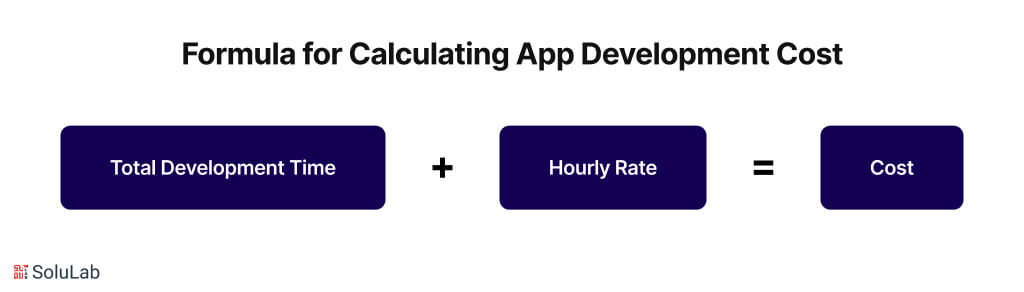
Formula for Calculating App Development Cost

Factors Affecting the Costs of a Mobile App Development?

The ultimate cost of developing a mobile app and an Android app hinges on various aspects like app complexity, included features, and the developer’s location. Let’s have a look at the factors influencing the expenses of mobile app development step by step:

1. Mobile App Complexity

Developing a simple app ranges from $5,000-$50,000. These apps provide fundamental user features like login systems, user profiles, dashboards, and basic administration capabilities. Whereas for a medium-complex app, the cost falls between $50,000- $120,000. These apps not only provide an array of features but also incorporate user privacy settings, payment getaways, audio-video streaming, and more. For example, domino’s UI/UX strategy boosted conversion by23%. On the other hand, complex apps can cost about $100,000-$300,000 and beyond. These apps make use of technologies like AR/VR, AI, and Machine Learning.

2. App Features and Functions

The mobile app development cost estimate of crafting an app mostly depends on the features and functions you include for your app. The initial cost of mobile app development for your desired app type escalates as you add more features. It’s better to focus on the crucial features of the first version of your app. This approach makes sure that the user experience is made accessible at a reasonable price. By choosing a Minimum Viable Product (MVP) with a basic feature set you can save both time and money.  Here is a breakdown of the cost and time required for basic features:

Features Functions Required Time Average Expense
Login Login with Social Handles

Email Login

Option of 

Password Recovery

Logout Options

30-42 Hours $500-$1,000
Completing Profile Adding Formal Information

Photo Opting 

Location Services

30-40 Hours $900-$1,000
Messaging Active/Inactive Visibility
Typing StatusSending Files and MediaDelivered and Read Update
170-180 Hours $3,000-$5,000
Notifications Push Notificnats and Reminders for users 25-32 Hours  $1,000-$1,200
User Management  Delete/Block User

Edit User

Block Options

66-69 Hours $3,500-$4,000

3. Category of Apps

The mobile app development cost is also dependent on the category it falls into. Category is defined with various changes like user base, features, security, and other requirements. All these differences result in varying development costs for an app. Here are most of the popular categories for mobile app development:

  • E-Commerce: Applications like Amazon are highly renowned because of their extensive features which allow them to function in real-time, handling a large number of users and maintaining strong security measures. 
  • Social Media Apps: These apps involve third-party integrations for utilizing hardware functions like cameras and audio recorders. They are designed to be highly scaleable for supporting the number of users.
  • Custom Apps: Even the simplest on-demand apps comprise three versions- for users, for individuals, and for the business.
  • Hardware-Dependent Apps: All of the apps using IoT technology are made hardware-independent to indulge in functions like extracting data and sending commands for required actions.

4. Animations and Designs

The other major factor affecting the cost of developing an app development mobile is the design. To ensure the engagement of users with the app, you would require a strong focus on the designs for the app. When the designs are the talk, you have two choices Custom UI and Standard UI. The customized UI is more complex in design and implementation making it pricier while Standard UI is a reasonable option. The main components included in mobile app design development are as follows:

  • Animation: Animations are used widely amongst designers to enhance the user experience and engagement for apps, majorly in social media and gaming fields.
  • Wireframing: Developers mostly use wireframing tools like Photoshop to create a more user-friendly layout of an app.

5. Platform

When you are willing to get an app for your business, you have to choose a platform for it that will help estimate the cost behind it. Choosing the platform solely relies on your audience, you can go for iOS, android, web apps, and cross-platform applications. If you have a startup with a limited budget, going for a single platform is advised. These are the most common application development platforms: 

  • Native: iOS apps are developed using a C objective, while Android apps are built using Java and Kotlin.
  • Web Apps: Progressive web apps and any other web app variant are more cost-effective in comparison to native apps. These apps range from $15,000 to $50,000.
  • Cross-Platform: The apps that are developed for both iOS and Android simultaneously are a cost-effective trend. For example, flutter offers reduced development efforts. 
  • Hybrid: These apps combine the features from both web apps and native platforms. They can easily be installed like native apps but will function within a web view component.

6. Maintenance

The expenses are not limited till the development of the apps, goes beyond it. Businesses have to constantly update their apps to adapt to the changing market trends, new models, and operating versions. Here is the breakdown of factors that require expenses even after the app is developed: 

  • Bug Fixes: Every app has bugs, some of which surface only when the app is launched. Therefore it is crucial to monitor and resolve these bugs as soon as they come.
  • Changes in Designs: App designs get outdated and can potentially lose the appeal for users. To keep the app designs fresh it is important to retain as per user interests. 

Read Also: How Much Does It Cost to Build an AI App in 2026?

Major Mobile Apps and Their Cost of Development 

Most Known Mobile Apps

Here are some of the most known apps that have been reshaped and transformed with time as per user experiences, and recently are dominating the app market. The details of each app are provided below which will help you with insights into how the cost of developing a mobile app may depend on the functions, complexity, and design needs of all kinds of apps

  • Snapchat

Snapchat boasts more than 300 million active users daily and has reshaped the dynamics of social media apps. This highly-used platform is at the forefront of introducing augmented reality features using filters and lenses for users. In addition, this app allows users to share messages along with media that can vanish in up to 10 seconds. The average cost of developing Snapchat for a single platform is $45,000-$100,000 and goes up to $200,000 for both platforms.

  • WhatsApp 

A messaging app that enables users to chat, make instant video and audio calls and send videos, photos, and more. The typical cost to develop a messaging app like Whatsapp mostly varies from $30,000-$70,000.

  • Uber

Uber stands out as the most liked ride and sharing app that links users to drivers for a safe and comfortable ride to their destination. With the help of this app, users can swiftly find a ride instantly or for a scheduled time. The typical cost for developing a similar app ranges from $30,000-$100,000. 

  • Netflix

Netflix has emerged as the top media streaming platform globally. This allows users to stream shows and movies whenever they feel like. The average cost for developing an app like Netflix starts from $25,000-$200,000.

These were some estimations of how much it would cost to create apps similar to the globally used leading ones. 

Read Blog: Cost To Build An App In Australia

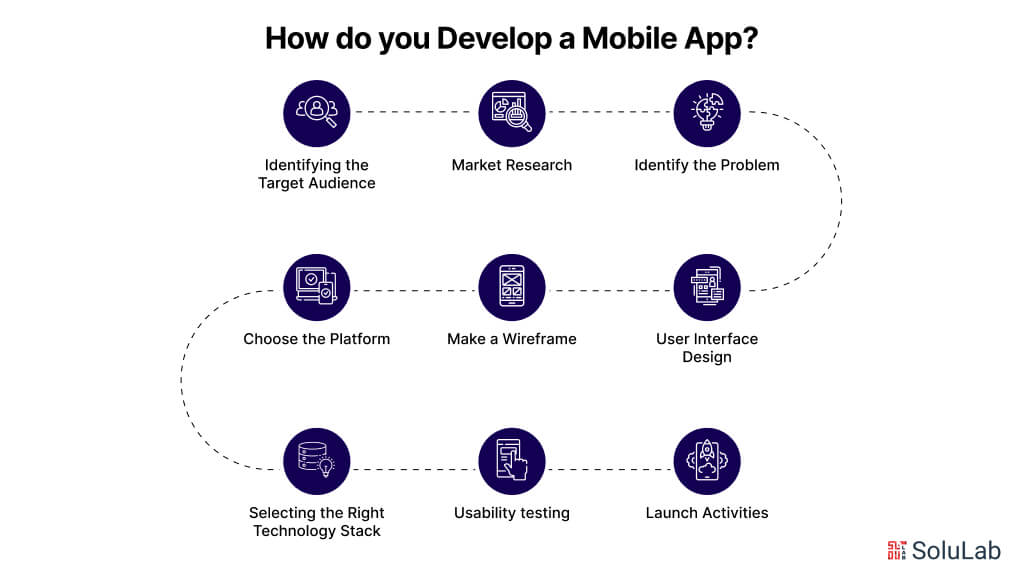
How do you Develop a Mobile App?

How Do You Develop a Mobile App

The process of developing mobile apps is methodical and encompasses many steps, from concept to implementation and maintenance. It involves strict planning, designing, development, testing, and marketing for the satisfaction of the user’s needs and to make a difference in crowded markets. Here is a comprehensive guide on how to develop mobile apps

1. Research and ideation

The development of a mobile app begins with idea generation and in-depth research. This step includes:

  • Identifying the Target Audience: It involves understanding who the audience is so that more personalized work can be put into the features and layout of the app for the end-user.
  • Market Research: It involves looking at existing apps to identify an opportunity or opening in the market. All the various competitors need to be studied with their pros and cons.
  • Identify the Problem: Clearly state the problem that your software is to solve. This will ensure there is no relevance and guide the development process.

2. Planning

The step after confirming the idea is planning:

  • Describe App Features: List down the primary features to be included in your application. Prioritize them by technical feasibility and user requirements.
  • Choose the Platform: Whether you want to develop for Android, iOS, or both, this will have an impact on programming languages, design, and development tools.
  • Make a Wireframe: The wireframe or prototype of an application will let you see what the UI and layout look like. This helps in understanding user flow and in visualizing what issues might come up down the track.
  •  Designing User Experience (UX): The software should be user-friendly and intuitive. Consider the usability, accessibility, and navigation of apps.
  • User Interface Design: The designing of the font, color schemes, and icons for the application. It has to be attractive to the target audience but at the same time in light of the brand identity.

Read Blog: Mobile App Development for Businesses

3. Development

With a ready design, development commences:

  • Selecting the Right Technology Stack: From among the host of development tools, choose suitable frameworks and programming languages for the Application. In the case of Android, it would be Java or Kotlin; for iOS, it would be Swift or Objective-C.
  • Frontend Development: Build the User Interface of an application with the designs produced earlier. This involves putting features into practice and making sure that various devices are responsive.

4. Testing

Testing is essential to ensure that the program works properly and is bug-free:

  • Functional Testing: Check that all features work as expected. This is meant to test user interactions, data processing, and the performance of applications.
  • Usability testing: Engage real users to find out usability issues. This would enhance the software before its release into the market.
  • Performance testing: The app performance under different scenarios has to be tested—across various network speeds and device types.

5. Implementation

Once testing is done, the application is good to go to market:

  • App Store Guidelines: Avoid getting rejected. The software must adhere to all the guidelines of their respective app stores (Play Store, Apple Software Store).
  • Launch Strategy: Whether your app requires a press release or influencing people before launching the app, comes under marketing plans that should be all set before its launch. Press releases, collaborations with influencers, and social media marketing are some examples.
  • Apply: Once you add an app to selected app stores with screenshots, synopsis, and marketing materials, you are good to go.

How can Apps Make Money?

There is not a single way to use apps to make money. But how exactly does that work, how are apps making money even the free ones?

Apps are monetized through various means, meaning that developers can still benefit even if they distribute their apps for free. In-app ads are likely the most common form, where dedicated developers are paid based on impressions gleaned from app users. These can take the form of interstitial ads—an ad that takes over the whole screen on a device at natural transition points in an app—rewarded video ads, where a person views a video ad in exchange for an in-app reward, or a banner ad, which is smaller and appears at the top or the bottom of an app screen.

In this business model, users of subscription-based apps pay a regular price to access premium features or content. The model is applied when the service-to-be provided is supposed to generate a continuous income stream, as long as users consent to the payment of recurrent fees to be able to continue using the application or service. For mobile app developers, other ways in which apps can be monetized are with affiliate marketing and sponsorships. Developers can team up with brands that are promoting products or services in their app with affiliate links and also with an increase in affiliate sales percentage, inducing a commission for sales generated by them through their referrals. This works very well for applications that have real ardent user bases associated with specific companies.

Mobile app development services

The Final Word

Developing mobile applications is a procedural process for Mobile App Development Company, involving various conceptualization steps, implementation, and maintenance processes. This whole process involves lean planning, designing, development, testing, and marketing, specifically aimed at ensuring that the app satisfies the users and that it makes a difference in the thronged market. If you hire an App developer, you can map out a winning app with such steps, and this will enable them to make big from the variety of monetization strategies of monetization ranging from IAPs to subscriptions, sponsorships, freemium, and in-app advertising. The app is considered to be current and competitive for a long period, thanks to its continuous development based on users’ feedback and the general development of technology.

In such a situation, you are supposed to look to collaborate with a reputable mobile app development company of the likes of SoluLab. With strategy, design, development, and marketing expertise, Solulab can help bring app ideas to life and maximize revenue.

FAQs

1. Which phases are most important in the development of a mobile app?

The important phases in the creation of mobile apps are ideation and research, planning, design, development, testing, deployment, and maintenance.

2. How can apps generate revenue?

There are so many methods of monetization that the app uses to generate revenue, such as in-app advertisement, freemium models, in-app sales, subscription, and sponsorship models, among others.

3. What is the freemium model?

The freemium model involves the free downloading of software but charges a fee for additional premium features or content. This provides attraction to more users and probably raises the conversion speed of premium features.

4. Why is testing important in mobile application development?

Testing is important to make sure that the software works perfectly, is bug-free, and offers a flawless user experience. Performance testing, usability, and functionality are all part of it.

5. Why is SoluLab a trustworthy provider of mobile app development services?

SoluLab has successfully designed applications for numerous startups and big corporations around the world. Specifically in cross-platform development and custom application design, helping businesses reap the maximum revenue.