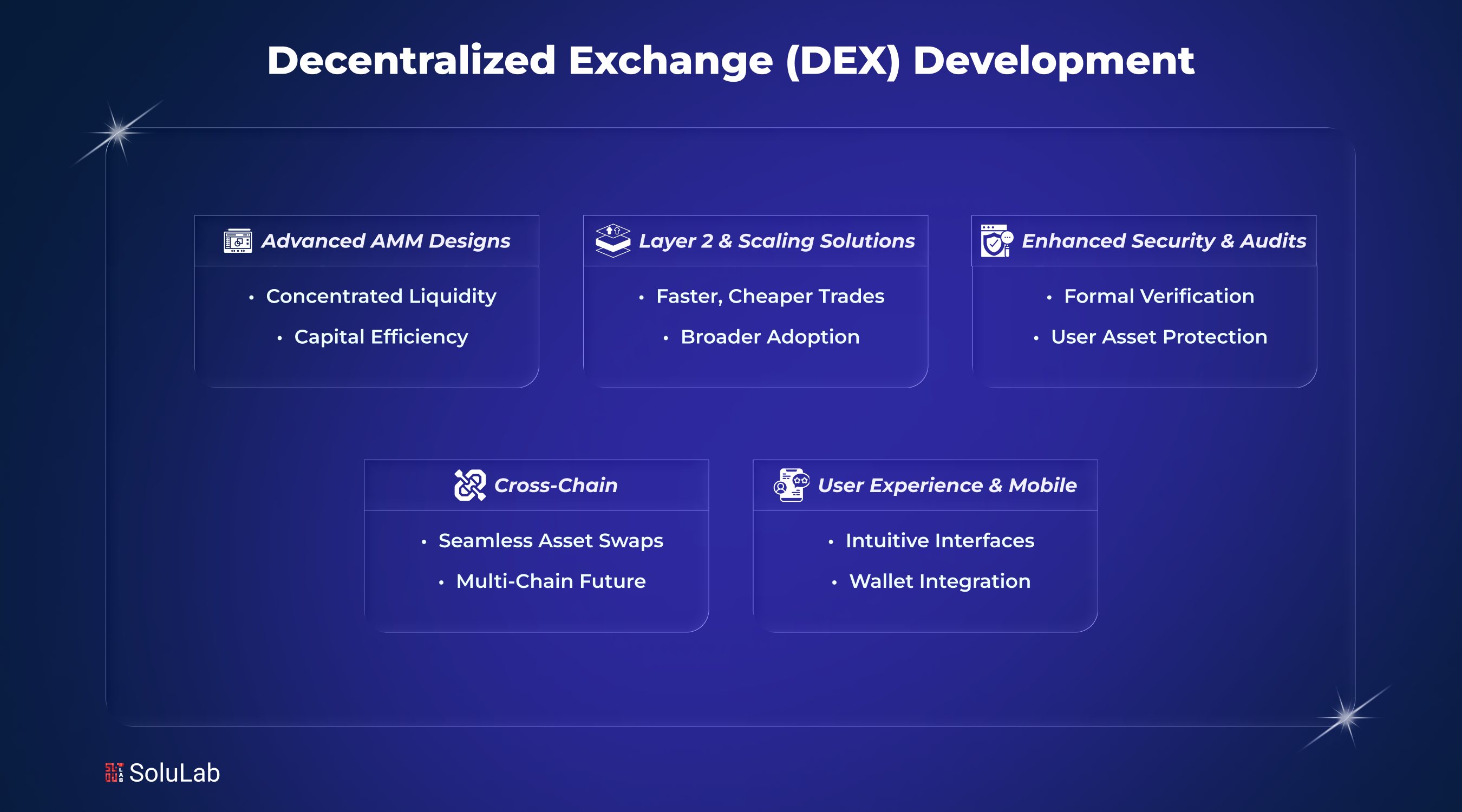
Talk to an Expert

Decentralized Exchange Development – A Complete Guide 

Decentralized Exchange Development

In today’s fast-moving digital economy, businesses must stay ahead of innovation. Decentralized Exchanges (DEXs) are reshaping the global cryptocurrency market. They are traded, without a middleman, without central control, and with full security. 

The average daily trading volume across some major DEXs ranges between $1-2 billion, depending on volatility.

For startups and established businesses alike, building a DEX opens new opportunities. However, developing the decentralized platform with advanced features isn’t an easy task. In this guide, we’ll walk you through defining your DEX model, estimating cost, building the platform, and preparing for future trends.

What Is a Decentralized Exchange (DEX)?

A DEX lets people trade crypto directly via smart contracts, without a middleman or custodied funds. Modern DEXs use AMMs like Uniswap, with liquidity pools replacing traditional order books, driving billions in weekly trading and 60%+ of DEX spot volume.

DEXs offer control, transparency, and global access, but face challenges like impermanent loss and front-running. For traders, it’s freedom; for founders, it’s a chance to own infrastructure in the $1.5T+ DeFi market.

Key Features a DEX Should Have in 2025?

The decentralized exchange (DEX) space is evolving rapidly, driven by growing demand for trustless trading, regulatory considerations, and innovative blockchain technology. To remain competitive and future-proof, a DEX in 2025 should integrate the following must-have features:
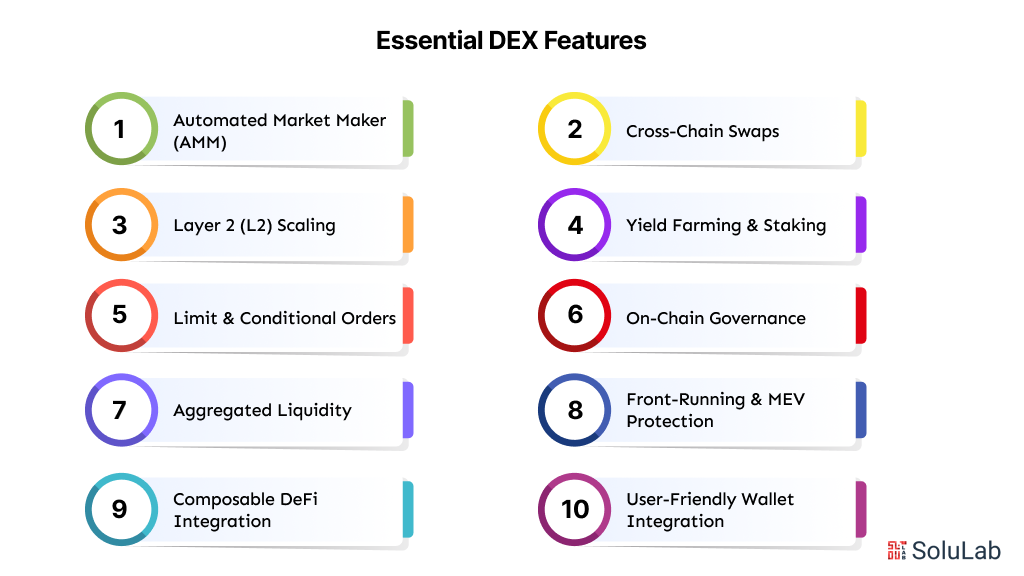
Essential DEX Features

1. Automated Market Maker (AMM)

Uses liquidity pools instead of order books, letting users trade instantly while liquidity providers earn fees. It eliminates the need to wait for buyers or sellers, creating continuous liquidity.

2. Cross-Chain Swaps 

Enables trading tokens across different blockchains without needing bridges or intermediaries. This opens access to a wider market and more diverse assets in one platform.

3. Layer 2 (L2) Scaling 

Speeds up transactions and lowers fees using rollups or sidechains, making trading efficient for everyone. It ensures high-volume trades remain fast and affordable, even during network congestion.

4. Yield Farming & Staking 

Users can lock tokens to earn rewards, incentivizing liquidity and increasing platform engagement. This encourages long-term participation and rewards users for supporting the platform.

5. Limit & Conditional Orders 

Advanced trading options that let users set specific prices or conditions for trades. It gives traders more control and the ability to execute strategies automatically.

6. On-Chain Governance 

Token holders vote on platform decisions, ensuring the community helps shape its future. This creates a decentralized decision-making process that aligns incentives with users.

7. Aggregated Liquidity 

Pulls liquidity from multiple DEXs, giving users better prices and less slippage. It reduces trading costs and improves execution quality for all users.

8. Front-Running & MEV Protection 

Mechanisms to prevent bots or miners from exploiting transaction order for unfair profit. This protects users from losing value due to transaction manipulation.

9. Composable DeFi Integration 

Connects seamlessly with lending, borrowing, and other DeFi protocols for broader financial services. Users can combine multiple DeFi strategies without leaving the DEX ecosystem.

10. User-Friendly Wallet Integration 

Supports multiple wallets with simple onboarding, so even beginners can trade easily. It lowers barriers to entry and ensures smooth access for both new and experienced traders.
DeFi DEX Development

Why Your Business Should Consider Developing a Decentralized Exchange (DEX)?

If you’re a startup or a business thinking about entering the crypto space, building your own DEX can be a game-changer. Here’s why creating a decentralized exchange makes total sense in today’s digital economy.

  • Full Control Over Your Platform

When you develop your own DEX, you don’t rely on third parties. You control everything, from how fees are structured to the tokens you list. This gives your business full independence and flexibility to grow exactly the way you want.

  • Unmatched Security and Trust

Unlike centralized exchanges, your DEX never holds user funds. Each user connects with their private wallet, keeping sensitive data and assets safe. This builds strong trust with your audience. People care deeply about security these days.

  • Expand Globally Without Restrictions

With a DEX, geographical borders don’t matter. Anyone with an internet connection can use your platform. No lengthy KYC procedures, no paperwork, just easy and instant access to trading.

As per Coinlaw, DEX trading volume rose by 37% in 2025, with an average monthly volume of ~$412 billion.
  • Stand Out With Innovation

Building a DEX positions your business as a true innovator. You can offer advanced features like yield farming, staking, or cross-chain swaps. This makes your platform attractive to both crypto newbies and seasoned traders.

  • Create New Revenue Streams

Earn a steady income from trading fees, listing fees, and liquidity incentives. As more users trade or stake assets, your business grows without extra effort. It’s a scalable way to tap into the booming decentralized finance (DeFi) market.

  • Future-Proof Your Business

The DeFi space is booming, and regulations around centralized exchanges are tightening. A DEX keeps your operations decentralized, helping you stay ahead of compliance risks. Plus, integrating features like decentralized governance makes your platform more appealing long-term.

How Does a Decentralized Exchange Work?

A Decentralized Exchange (DEX) allows users to trade cryptocurrencies directly and securely, with smart contracts automating transactions — no middlemen, no delays, and no custody of user funds.
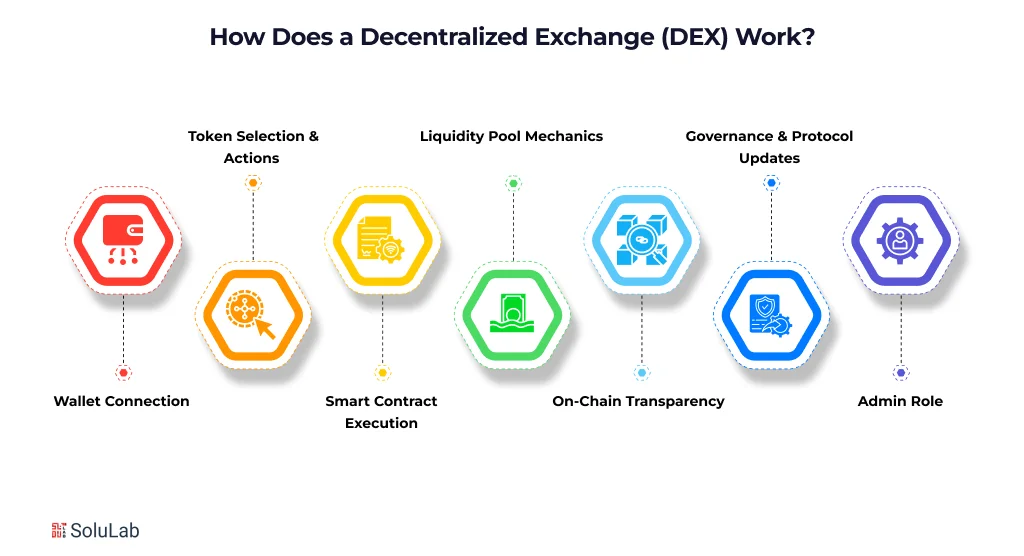
How Does a Decentralized Exchange (DEX) Work_

1. Wallet Connection 

Users link wallets like MetaMask or Trust Wallet. This ensures full control over private keys and funds, while enabling global access without accounts or KYC.

2. Token Selection & Actions 

Traders can swap tokens, provide liquidity, stake, or participate in yield farming. Modern DEXs also offer cross-chain swaps and Layer 2 scaling, enabling faster, cheaper trades and access to multiple blockchain ecosystems.

3. Smart Contract Execution 

Once a trade is initiated, smart contracts calculate outputs, apply slippage limits, deduct fees, and update liquidity pools automatically. This ensures trustless execution and prevents human error.

4. Liquidity Pool Mechanics 

Users deposit tokens into pools, earning a proportional share of trading fees or incentive rewards. AMM formulas (like x*y = k) automatically balance token ratios and maintain continuous liquidity.

5. On-Chain Transparency 

Every trade and liquidity change is recorded on-chain, fully auditable and immutable, letting users and developers monitor activity and verify fairness.

6. Governance & Protocol Updates 

Admins or dev teams can deploy upgrades, but critical changes are controlled by token holders through on-chain governance. This ensures that the community approves fee changes, token listings, or new features.

7. Admin Role

Admins manage the platform but never control user funds, ensuring trust and fairness. This makes your DEX reliable, fast, and user-friendly.

How to Develop a Decentralized Exchange?

Developing a DEX for your business doesn’t have to be complicated. But in-house building can be complicated. So, hire a blockchain developer to make your work simple and efficient. Here’s a simple and clear step-by-step process to help you understand what goes into building a solid, reliable platform.
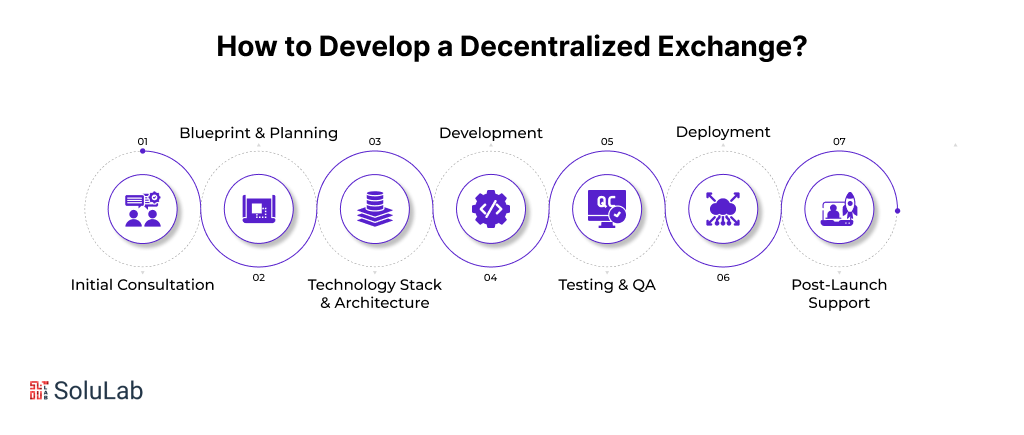
How to Develop a Decentralized Exchange

1. Initial Consultation

First, discuss your business goals and target audience with the third party. Understand what kind of DEX model suits your strategy: AMM, Order Book, or Hybrid. This helps clarify the approach and scope.

2. Blueprint & Planning

Create a detailed project plan and execution roadmap along with your partner. Define features, platform flow, trading logic, and key integrations. Set clear timelines and budgets as per your choice.

3. Technology Stack & Architecture

Choose the right blockchain (Ethereum, BSC, Polygon). If you are not aware, then know the details from your developing partner. Decide on platform designs, database, and smart contract language (Solidity). Plan system architecture for scalability and security. 

4. Development

Build the user interface, smart contracts, wallet integrations, and liquidity pool setup. Focus on clean, well-documented code so that in the future, when updates or changes are needed, this can help.

5. Testing & QA

Cross-check the functional tests, load tests, and security audits to ensure accuracy. Ensure every feature works under real conditions.

6. Deployment

Deploy smart contracts to the mainnet of the blockchain. Start with a soft launch or beta version. Gather early feedback and fix issues.

7. Post-Launch Support

Provide continuous support with regular updates, bug fixes, and security patches. Monitor system performance and user issues.

Cost & Timeframe of DEX Development

If you’re wondering how much it takes to develop a Decentralized Exchange (DEX), the answer depends on the type of platform you want to build.

1. A basic DEX with essential features like token swaps and wallet connections can cost $10,000 – $20,000. This usually takes around 1 to 2 months to develop.

2. A custom or advanced DEX with features like Automated Market Maker (AMM), staking, yield farming, and cross-chain support can cost $25,000 – $70,000 or more. Development time in this case stretches from 3 to 5 months, sometimes longer.

3. An AI-powered DEX is a new model in 2025 that includes AI-driven trading insights, predictive analytics, and automated liquidity balancing. These platforms can cost $100,000 – $200,000+ and take 5 to 7 months to build.

4. A white-label DEX uses a ready-made framework with customizable branding. It’s faster to deploy and costs around $15,000 – $45,000, usually taking just 1 to 2 months.

Why Such a Difference in DEX Development Costs?

Factor Impact on Cost & Time
Advanced Features AMMs, staking, yield farming, and governance require complex smart contracts and specialized logic.
Multi-Chain Integration Supporting Ethereum, BNB Chain, Solana, etc., adds extra development effort and more testing cycles.
Custom Reward Mechanisms Designing incentives like liquidity mining or AI-driven rewards requires additional coding and tuning.
Security Audits Professional audits and penetration testing increase costs but ensure trust and safety.
UI/UX Design A polished, scalable interface with advanced dashboards takes more design and development time.
Rigorous Testing Stress tests, bug fixes, and cross-chain validations extend the timeline but ensure smooth operations.

While a basic DEX is quicker and cheaper, investing in advanced features, multi-chain compatibility, and security pays off in the long run by reducing risks and building user trust.

Which DEX Models Fit Your Business?

When building a Decentralized Exchange (DEX), the model you choose determines user experience, liquidity depth, and technical complexity. Each approach has its strengths, from speed and simplicity to advanced trading power.
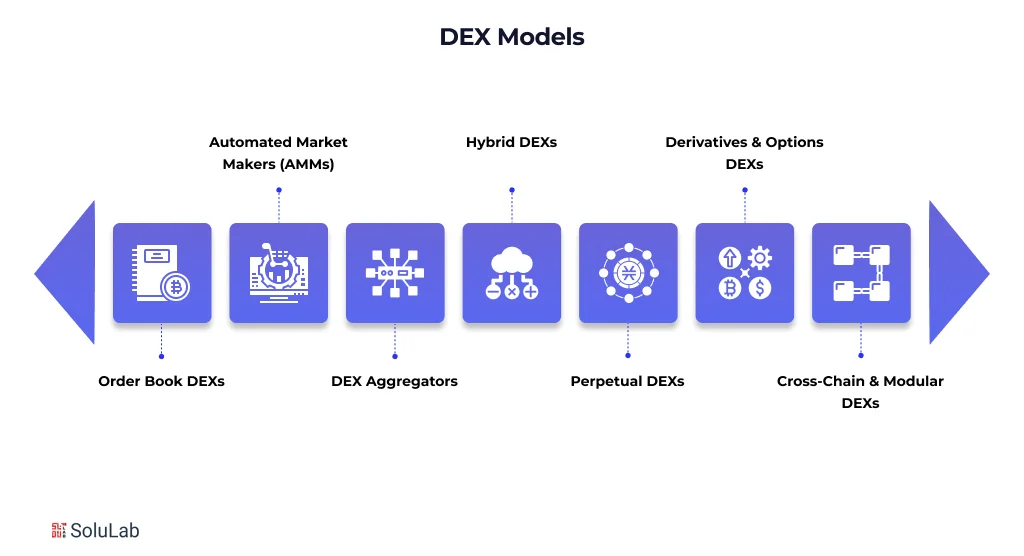
DEX Models

1. Order Book DEXs

  • Works like centralized exchanges: buy and sell orders are matched directly.
  • Best for pro traders who want features like limit orders, stop-loss, and margin trading.

2. Automated Market Makers (AMMs)

  • Use liquidity pools and formulas (e.g., x*y = k) instead of direct order matching.
  • Simple, instant swaps, popularized by Uniswap, PancakeSwap.
  • Great for beginner-friendly DEXs, but faces issues like impermanent loss and MEV risks.

3. DEX Aggregators

  • Pull liquidity from multiple DEXs (e.g., 1inch, Matcha), giving users the best available price in one place. 
  • Ideal if your platform focuses on efficiency and arbitrage-proof trading.
  • Requires advanced routing algorithms and cross-chain liquidity integration.

4. Hybrid DEXs

  • Combine order books for pros and AMM pools for casual traders.
  • Attracts both retail users and institutional traders.
  • More complex to build, but it provides a balanced trading ecosystem.

5. Perpetual DEXs 

  • Offer perpetual futures contracts, where traders speculate with leverage (5x, 10x, or higher) without expiry dates.
  • Platforms like dYdX and GMX popularized this model.
  • By 2025, perp DEXs are among the fastest-growing segments, handling billions in daily derivatives volume, rivaling CEXs.
  • Great if your business wants to capture advanced traders looking for leverage and futures.

6. Derivatives & Options DEXs 

  • Go beyond spot and perpetuals by offering options, structured products, and synthetic assets.
  • Riskier but opens doors to institutional DeFi and sophisticated financial instruments.

7. Cross-Chain & Modular DEXs 

  • Built on Layer 2s, cross-chain bridges, and modular rollups.
    Let users swap tokens across multiple chains in one transaction.
  • This model is becoming essential as liquidity is no longer confined to one chain.

Future of Decentralized Exchanges

The future of Decentralized Exchanges (DEXs) is multi-chain, faster, and more intelligent. As regulations tighten on centralized exchanges and users demand privacy, security, and control, DEXs are becoming the default entry point into DeFi. Here’s where the space is headed:

  • Cross-Chain & Omnichain Trading

Users no longer need to be tied to one blockchain. With cross-chain DEXs and omnichain liquidity protocols (like LayerZero, THORChain, and Wormhole), traders can swap assets across Ethereum, BNB Chain, Solana, Polygon, and even Bitcoin layers, all in a single transaction. This creates deeper liquidity and a unified trading experience.

  • Layer 2 Scaling & Gasless Transactions

Solutions like zk-Rollups, Optimistic Rollups, and Validium are now mainstream. Many DEXs in 2025 also support account abstraction and gasless swaps, meaning users can pay fees in any token. This reduces friction for both retail and institutional traders.

  • Decentralized Governance 2.0

Governance has matured beyond simple token voting. New models use delegated governance, quadratic voting, and reputation-based DAOs, making governance more resistant to whale control. This ensures fairer, more community-driven decision-making.

More than 9.7 million unique wallets interacted with DEXs by mid-2025, up from ~6.8 million last year.
  • AI-Powered Trading Assistance

AI tools are being integrated directly into DEX dashboards. They analyze on-chain flows, liquidity movements, MEV patterns, and sentiment data to provide real-time trading insights. This lowers the learning curve for beginners and gives pros a competitive edge.

  • MEV Protection & Fair Ordering

Front-running and MEV (Miner Extractable Value) are used to eat into user profits. In 2025, intent-based trading systems like UniswapX and CoW Swap batch transactions, aggregate liquidity across venues, and execute trades fairly, ensuring best execution without slippage abuse.

  • NFT & RWAs Integration

DEXs are expanding beyond fungible tokens. NFT marketplaces, fractionalized assets, and tokenized Real-World Assets (RWAs) are being swapped on DEX rails, turning them into universal asset exchanges.

  • Composability & Modular DEXs

Instead of monolithic platforms, new DEXs are built as modular protocols where builders can plug in their own liquidity modules, fee models, or settlement layers. This creates ecosystems where projects build on top of DEX infrastructure, not just trade on it.
Decentralized Exchange Development Company

Conclusion

As of above, you might have understood the growing opportunities and how DEX plays a key role. If you’re ready to step into the future of finance, building your own Decentralized Exchange is the way forward. 

At SoluLab, a top decentralized exchange development company, we built a secure, fast, and easy-to-use platform. Our solutions are gas-optimized and built for real-world use, ensuring your business stays ahead of the curve. We focus on intuitive interfaces, strong security, and seamless scalability so your users enjoy a smooth experience.

Whether you’re a startup or an established business, we help turn your DEX vision into reality. Contact us now!

FAQs

1. Do I really need a Decentralized Exchange for my business?

Yes, if you’re planning to enter the crypto space or want to offer financial services without depending on third parties. A DEX gives you full control, enhances security, reduces compliance risks, and attracts users who value privacy.

2. Can I integrate my existing business model with a DEX easily?

Absolutely! A DEX can work alongside your current digital services or stand alone as a new revenue stream. It’s flexible, you can customize features like token swaps, staking, or cross-chain compatibility to suit your business goals.

3. Will my customers need technical knowledge to use the DEX?

No, not at all. We focus on building a user-friendly interface that works smoothly on mobile, tablet, and desktop. Users just connect their wallets, pick tokens, and trade in a few clicks.

4. Is developing a DEX an expensive and complicated process?

It depends on your goals. A basic DEX with essential features costs between $10K-$70K+ and takes 4-12 weeks. The cost varies based on complexity, security audits, and integrations, but investing upfront saves future headaches.

5. Can a DEX survive without active admin control over users’ funds?

In a DEX, admins don’t control user funds directly. Instead, smart contracts handle everything automatically. Your business provides the platform, earns from fees and listings, and ensures smooth operation. This creates trust because users remain in full control of their assets, no middleman needed.
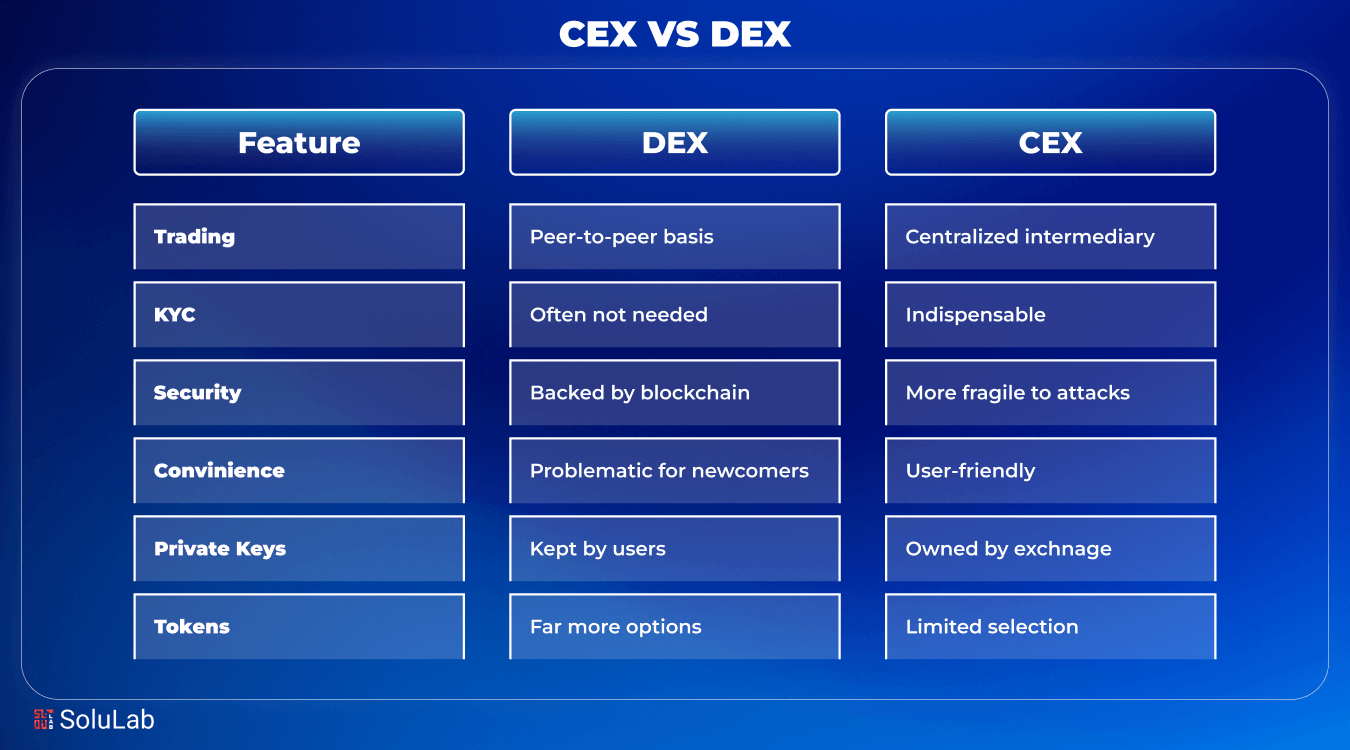
CEX vs. DEX: Which Crypto Exchange is Right for You?

CEX VS DEX (2)

The global crypto market now serves over 560 million users, and that number is growing fast. With more institutions and enterprises exploring digital assets, one key decision stands out: should you build on a centralized exchange (CEX) or a decentralized exchange (DEX)?

Choosing between CEX vs DEX  isn’t just a technical decision. It affects how you manage compliance, user experience, custody of assets, liquidity, and scalability. For businesses building crypto platforms, understanding the real-world pros and cons of each model is critical.

Whether you’re launching a DeFi project, a fintech app, or an enterprise-grade crypto solution, this guide breaks down DEX vs CEX from a business-focused angle. You’ll get clarity on features, use cases, costs, and long-term strategies.

Why Build a Centralized Exchange (CEX)?

Centralized Exchange (CEX) development gives your business full control over security, user experience, and regulatory compliance. This type of crypto exchange is ideal for enterprises looking for fast transactions, strong liquidity, and smooth onboarding for users, especially when dealing with fiat currencies.

Benefits of a CEX

  • Faster transactions thanks to a well-optimized backend
  • Built-in tools for KYC/AML compliance, helping you stay legally compliant worldwide
  • Easier liquidity management, allowing you to offer tight spreads and competitive pricing
  • Fiat on/off ramps that make it easier for users to deposit or withdraw local currencies
  • Better UX control compared to Decentralized Exchanges (DEX)

Things to Consider Before Building a CEX

  • Since everything is stored in one place, there’s a single point of failure, which can raise security concerns
  • You’ll be responsible for handling all regulatory and licensing requirements
  • It uses a custodial model, which means your users must trust your platform to store their funds securely

A CEX is often the preferred choice for enterprises that want to launch quickly, integrate with banks, or offer a wide range of crypto-fiat services. However, it’s important to have strong security and compliance frameworks in place.

What is a Decentralized Exchange (DEX)?

A Decentralized Exchange (DEX) is a type of crypto exchange that allows users to trade digital assets directly, without any middlemen like banks or centralized companies. These exchanges are built on blockchain technology and powered by smart contracts, which means trades happen automatically, securely, and transparently.

Popular examples include Uniswap, PancakeSwap, and Curve. Users can swap tokens instantly through liquidity pools, with no sign-up, approval, or central control. This makes DEXs open, fast, and permissionless.

For enterprises, launching a DEX platform means giving users complete control over their assets, enhancing privacy, and minimizing regulatory dependencies. Partnering with a reliable Decentralized Exchange development company ensures your DEX is secure, scalable, and tailored to long-term business goals.

Benefits of a DEX

  • Users have full control over their assets at all times, with no need to rely on third-party custodians.
  • Trades on a DEX can’t be blocked, reversed, or tampered with, making the platform censorship-resistant.
  • Privacy is stronger, as KYC requirements are minimal or completely optional depending on your business model.
  • Anyone with a crypto wallet can access the platform, giving you immediate global reach.
  • Operational costs are lower due to reduced transaction fees and the removal of unnecessary intermediaries.

Things to Consider Before Building a CEX

  • The UI/UX can be challenging for non-technical users
  • Liquidity may be limited for newer tokens
  • No centralized support, users are responsible for their own wallets
  • Fiat integration is complex and often not supported
  • Risk of smart contract bugs or attacks if not built properly

If your focus is user privacy, global access, and decentralized control, building a DEX can set your platform apart. A leading Blockchain development company helps you create a secure and scalable DEX tailored to your enterprise needs.

CEX vs DEX: A Clear Comparison for Businesses

Choosing between a CEX vs DEX is more than just a tech decision; it’s a strategic move that affects compliance, user trust, scalability, and revenue.

Feature Business Impact
Custody of Assets CEXs hold user funds (centralized custody), while DEXs give users full control (non-custodial).
Liquidity Generally higher on centralized exchanges, making them better for high-volume trading.
KYC & AML CEXs fully support compliance, making them ideal for regulated industries.
Privacy DEXs offer better user privacy due to fewer onboarding requirements.
Speed & Fees CEXs are faster with lower latency. Some DEXs may charge higher gas fees depending on the network.
Development Complexity Easier to build and manage on a CEX. Decentralized exchange development may require complex smart contracts.
Smart Contract Risk Present mostly in DEXs due to their on-chain nature. Smart contract audits are critical.

For any enterprise, the decision between centralized vs. decentralized crypto exchanges should depend on:

  • Your regulatory compliance needs
  • The level of control you require
  • Your user base and market
  • How much security and transparency matter to your brand

Check Out Our Blog Post: How to Build Your Own DEX Like Aster

What Do Users Prefer in 2025?

The market in 2025 is split but growing fast. Most of the daily crypto trading volume (over 72%) still happens on centralized exchanges (CEXs). They’re easier to use, offer higher liquidity, and are trusted in regulated markets. But decentralized exchanges (DEXs) are catching up, especially in DeFi, Web3, and privacy-focused sectors.

As per Chainalysis, DEX trading volumes rose by 23% year-over-year in 2024, and 35% of that came from institutional wallets. This shows strong demand for decentralized platforms, especially in regions where users value control and transparency.

Today, many DeFi development companies are building hybrid exchanges or cross-chain DEXs. These platforms let users enjoy decentralization while still offering the liquidity and speed of CEXs. This mix is becoming the preferred approach for enterprises and startups launching in global markets.

When Should You Choose CEX or DEX?

Choosing between a centralized or decentralized exchange depends on your business goals and target audience. Here’s a quick guide:

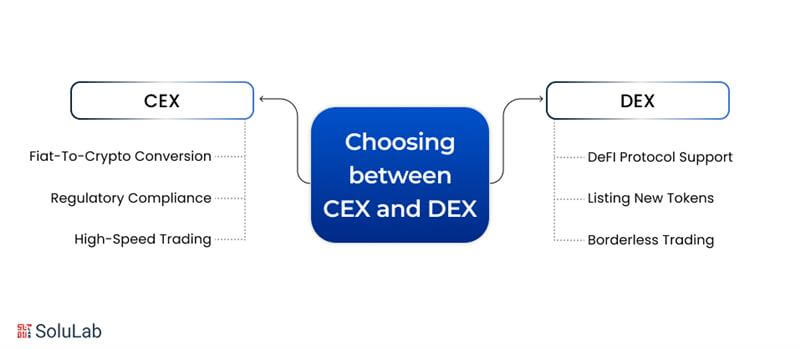
Choosing between CEX and DEX

You should choose a CEX (Centralized Exchange) if:

  • You need fiat-to-crypto conversion for users
  • You operate in a regulated market and require compliance tools
  • You want to support high-speed, high-volume trading

You should choose a DEX (Decentralized Exchange) if:

  • You are building or launching DeFi protocols
  • You want to list new or experimental tokens
  • You aim for non-custodial, borderless trading

A Blockchain development company can help you evaluate these options and design the right exchange architecture for your business goals. If you are interested in building your exchange?

Can You Combine CEX and DEX?

Yes, and many businesses are doing exactly that. A hybrid crypto exchange brings together the best of both worlds: the speed and easy user experience of a Centralized Exchange (CEX) and the security and transparency of a Decentralized Exchange (DEX).

These platforms often use smart contracts to handle settlements while keeping order books centralized. This setup improves liquidity, speeds up trading, and still maintains a level of trustless execution.

Projects like Serum and Injective follow this hybrid model. If you’re planning to build a hybrid platform, it’s also possible to integrate a Crypto Trading Bot that can operate across both CEX vs DEX models to maximize trading efficiency.

What to Know Before Building Your Own Exchange

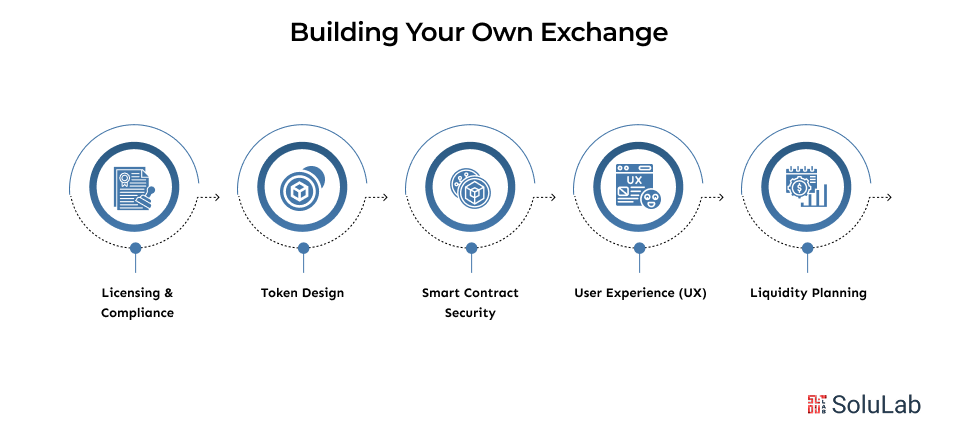
Building Your Own Exchange

Before you build a crypto exchange, here are key things every business should consider:

  • Licensing & Compliance: Make sure you meet all regulatory requirements in your target regions.
  • Token Design: Define your tokenomics early; this affects how users trade and engage on your platform.
  • Smart Contract Security: Always get smart contracts fully audited to avoid hacks or exploits.
  • User Experience (UX): Design intuitive user flows to help users trade easily, especially on mobile.
  • Liquidity Planning: Without liquidity, even the best exchanges fail. Plan how you’ll source or incentivize liquidity.

Partnering with a trusted Cryptocurrency Development Company ensures your platform is secure, compliant, and ready to scale.

Cost to Build a Centralized or Decentralized Exchange

The cost of building a crypto exchange depends on the type, Centralized (CEX) or Decentralized (DEX), and the features you need.

Exchange Type Estimated Cost Range Key Cost Factors
Centralized Exchange (CEX) $120,000 – $350,000 Margin trading, KYC/AML compliance, fiat ramps, backend infrastructure
Decentralized Exchange (DEX) $80,000 – $250,000 Smart contract development, UI/UX for on-chain trading, security audits, tokenomics
  • A CEX requires more backend systems and centralized control features.
  • A DEX may look simpler, but it needs strong smart contracts and liquidity mechanisms for success.

Working with an experienced white label exchange development company helps reduce risk, manage costs better, and ensure your platform is compliant and scalable from day one.

How SoluLab Helps Enterprises Build CEX and DEX Platforms?

At SoluLab, we build both Centralized Exchanges (CEX) and Decentralized Exchanges (DEX) tailored to enterprise needs.

  • For CEX platforms, we deliver secure fiat integration, high-performance trading engines, and intuitive admin dashboards.
  • For DEX platforms, we build with automated market makers (AMMs), liquidity pools, and DAO-based governance.
  • We also support hybrid exchange models that offer the best of both worlds.

As a leading cryptocurrency exchange development company in the USA, we combine our experience in DeFi, smart contracts, and AI integration to help enterprises launch faster, scale securely, and stay future-ready.

DEX Development Services

Conclusion

There’s no one-size-fits-all answer in the CEX vs DEX crypto conversation. The best choice depends on your business goals, customer expectations, regulatory requirements, and long-term growth plans.

Whether you want full control with a Centralized Exchange, or transparency and self-custody with a Decentralized Exchange, success comes down to building the right foundation. With a trusted Decentralized Exchange development Partner, your company can confidently launch in the competitive world of Crypto Exchanges and stay ahead.

Let’s help you build it right. Contact us to get started!

FAQs

1. How does DEX vs CEX affect enterprise-level trading or investing?

For businesses, CEXs provide smoother onboarding, regulatory compliance, and deep liquidity. But DEXs offer security, transparency, and lower counterparty risk, making them ideal for DeFi-native firms.

2. What should I know about CEX vs DEX crypto platforms before building one?

CEX platforms need user KYC, support, and backend management. DEX platforms rely more on smart contracts, wallet integration, and on-chain liquidity. Your platform’s vision should guide this decision.

3. What are the top decentralized crypto exchange businesses are using in 2025?

Some of the leading DEXs include Uniswap, PancakeSwap, dYdX, and Curve. These platforms are open-source and serve as benchmarks for enterprises planning to build similar infrastructure.

4. Why are crypto exchanges important for blockchain businesses? 

They form the core infrastructure of the crypto economy, enabling token liquidity, fundraising (through IEOs/IDOs), and user onboarding. A reliable exchange boosts brand trust and transaction volume.

5. Which is a better crypto exchange for startups: CEX or DEX?

It depends on your audience and market. If you’re targeting retail users and require regulatory ease, go with a CEX. If you’re DeFi-focused, looking for transparency and low-cost operations, a DEX may be better.

6. How do I choose the right Crypto Exchange development company?

Look for a team with proven experience in exchange architecture, smart contract development, security audits, and regulatory readiness. SoluLab builds both CEX and DEX platforms from scratch with custom features for enterprises.

How Much Does DEX Development Cost in 2026?

DEX Development - Cost Breakdown

Decentralized exchanges are quickly becoming the go-to option in the DeFi space, enabling users to trade digital assets directly while maintaining full control and transparency. By the end of January 2026, platforms like these were handling over $140 billion in trades per week, with more than $24 billion locked into them, according to DefiLlama. That kind of activity shows how far they’ve come and how much trust users are putting into them.

What’s driving that shift? It’s simple—people want more control over their money. They want privacy, freedom, and the ability to manage their assets without relying on someone else. That’s exactly what DEXs offer, which makes them super appealing to both users and businesses trying to build something in the blockchain space.

Building a DEX isn’t as simple as flipping a switch. It takes careful planning, the right tech, and a solid understanding of what users expect. Costs can vary widely depending on the platform’s complexity and the features you want to offer. In this blog, we’ll explore what goes into launching a DEX and break down the factors that influence the overall decentralized exchange development cost.

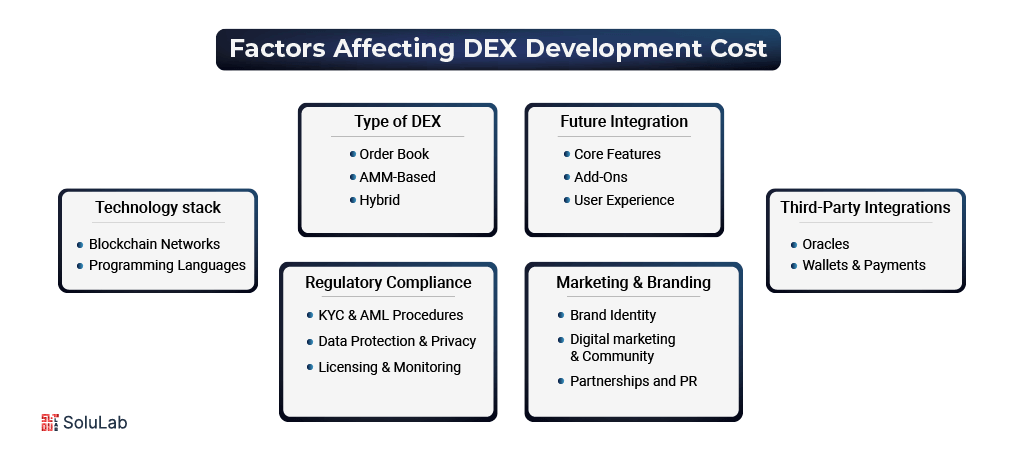
Factors Affecting DEX Development Cost

Factors Affecting DEX Development Cost

If you’re planning to launch your decentralized crypto exchange, the first thing to understand is that there’s no fixed price tag. The total cost depends on several moving parts, from the tech you use to the features you include, and even how you handle regulations and marketing. Let’s go through the most important factors that shape your budget:

Technology Stack

The kind of tech you use plays a huge role in both the performance and cost of your DEX. Since everything here runs on code, with no centralized party involved, it’s important to choose tools that are fast, secure, and scalable.

  • Blockchain Networks: Ethereum is still a go-to for many developers, thanks to its mature ecosystem. But if you’re looking for faster transactions with lower fees, you might want to consider alternatives like Solana or Binance Smart Chain. These networks are gaining traction and can help you avoid the congestion and high gas costs that Ethereum is known for.
  • Programming Languages: Solidity (for Ethereum) and Rust (for Solana) are among the most commonly used. Other languages like Go and Python also have their place, depending on your architecture. Keep in mind, skilled blockchain developers are in short supply, especially those who really know the ins and outs of these languages. This scarcity often pushes up development costs.

If you’re using a more advanced tech stack, you can expect this stage to cost somewhere between $5,000 to $7,000. It’s a smart idea to work with a decentralized exchange (DEX) development company in the USA that understands how to balance performance with cost-efficiency.

Type of Decentralized Exchange

The type of DEX you decide to build has a direct impact on complexity—and by extension, your budget.

  • Order Book DEX: This is the most traditional type, similar to what centralized exchanges use. Buyers and sellers place orders, and a matching engine pairs them. It’s reliable but takes some serious backend logic and algorithmic muscle.
  • AMM-Based DEX: This one works differently—trades are made against liquidity pools instead of waiting for someone to take the other side of the trade. It simplifies the trading process for users but requires robust smart contracts and careful incentives for liquidity providers.
  • Hybrid DEX: If you want the speed of a centralized platform and the control of a decentralized one, a hybrid setup might be your best bet. But be prepared—this combination demands extra layers of architecture and typically costs more to build.

Depending on the approach, you’re looking at $2,500 to $3,500 just to set up the core exchange mechanism. An experienced DEX developer can help you choose the right model based on your target audience and use case.

Feature Integration

Adding features is where the project takes shape—and where the costs start to stack up. Beyond the basics like wallet connectivity and token swaps, there are some advanced tools and user options you might want to include:

Must-have Features:

  • Wallet Integration
  • Trade Execution
  • Liquidity Pools
  • Token Swapping
  • DeFi Staking
  • Smart Contract Automation
  • Cross-Chain Interoperability
  • Custom Token Launchpad
  • Order Matching
  • Basic Analytics
  • Token Diversity

Add-ons That Boost Engagement:

  • Cross-Chain Swaps
  • NFT Trading Support
  • Fiat On-Ramp Integration
  • Real-Time Analytics
  • Social Trading Tools
  • Multi-language Support
  • Gamification Mechanics
  • Loyalty Programs
  • Governance Token System
  • Mobile App Support
  • Gas Fee Optimization

The more interactive and user-friendly your platform, the more likely you are to stand out as one of the best decentralized exchange options out there. But keep in mind—more features mean more time, more testing, and a bigger bill. On average, you can expect this phase to cost $3,500 to $4,500, depending on your final scope.

Third-Party Integrations

To deliver a smooth and reliable user experience, you’ll need to plug in several external tools and APIs. While these boost the platform’s capabilities, they do come with added costs.

Common Integrations Include:

  • Oracle Services: Tools like Chainlink help keep asset prices accurate by pulling data from external sources.
  • Wallet Support: MetaMask, Trust Wallet, Exodus, and others are essential for enabling crypto storage and access.
  • Payment Gateways: Services like BitPay and Coinbase make it easier for users to deposit or withdraw funds.
  • Analytics Tools: Platforms like Dune Analytics help track user behavior, platform performance, and more.

For third-party integrations, budget around $1,500 to $2,500. Partnering with a decentralized crypto exchange provider who already has experience integrating these tools can make this part easier and more efficient.

Regulatory Compliance

Even though DEXs operate without a central authority, they’re not exempt from government oversight. Different countries have different rules, and if you want to operate legally, you’ll need to comply.

Here are a few key areas to plan for:

  • KYC and AML Procedures
  • Data Protection and Privacy Rules
  • MSB Licensing (in some regions)
  • Tax Reporting and Documentation
  • Sanctions and Restricted Address Monitoring
  • General Consumer Protection

The legal and compliance part of the build usually adds $1,500 to $2,500 to your budget, depending on where your users are located and how strict the local laws are.

Marketing and Branding

Launching a DEX is one thing—getting people to actually use it is another. Without a clear strategy for branding, user acquisition, and education, it’s easy for a great platform to get lost in the noise.

What this might include:

  • A strong brand identity (name, logo, positioning)
  • Digital marketing (SEO, PPC, influencer campaigns)
  • Community building on platforms like Telegram, Discord, and X
  • Partnerships and ecosystem integrations
  • Public relations and media exposure

Hiring a capable marketing team or agency will be critical in shaping how your exchange is perceived. It’s a long-term investment, but a necessary one to build credibility and trust. Every decision you make—from blockchain choice to UI features—affects the final cost of your DEX. If you’re working with a trusted partner from day one, it becomes a lot easier to make smart trade-offs without compromising on quality.

If you’re still exploring your options, working with a decentralized exchange (dex) development company in the USA that’s already helped others succeed is a great way to start on the right foot.

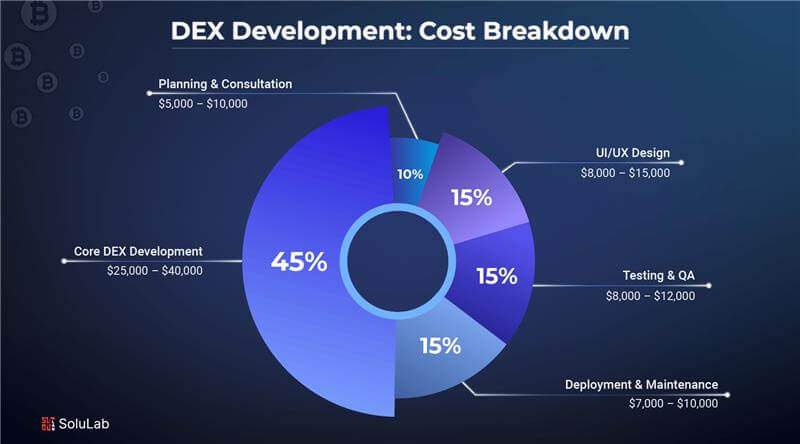
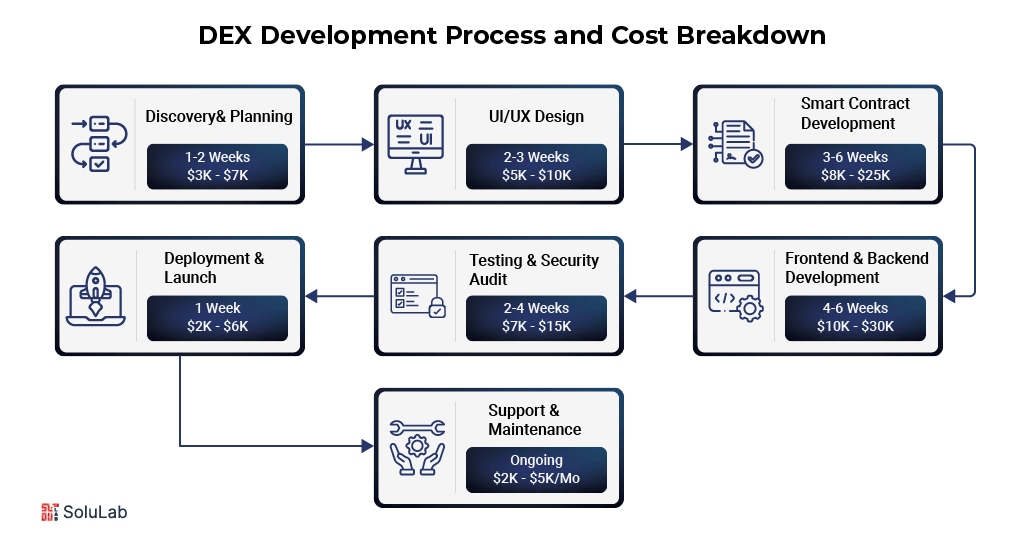
Development Process and Cost Breakdown for a Decentralized Exchange

DEX Development Process and Cost Breakdown

Building a decentralized exchange isn’t something that happens overnight. It involves multiple stages, from initial research to final deployment, each with its own set of tasks, timelines, and costs.

It’s not just about hiring a few developers and writing some code. A solid decentralized exchange goes through several well-defined phases before it’s ready to go live.

Let’s walk through what the process of having DEX development services looks like, step by step.

1. Discovery and Planning

This is where everything begins. Before a single line of code is written, you need to define what kind of DEX you want to build. Will it be an AMM-based model like Uniswap? Or something more complex with a built-in order book?

You’ll also want to research your target users, look at competitors, choose your blockchain (Ethereum, Solana, Polygon, etc.), and figure out your key features. This phase often involves meetings, brainstorming sessions, and a few whiteboard scribbles that eventually shape your product vision.

  • Timeframe: 1–2 weeks
  • Estimated Cost: $3,000–$7,000

2. UI/UX Design

Once the concept is clear, it’s time to sketch out what your platform will look like. A good DEX should be intuitive, even for people who aren’t tech-savvy. Designers create wireframes and clickable prototypes so you can visualize the user journey before any code is written.

Expect back-and-forth discussions here—this is the phase where your product starts to feel real.

  • Timeframe: 2–3 weeks
  • Estimated Cost: $5,000–$10,000

3. Smart Contract Development

This is the technical heart of your exchange. Smart contracts handle everything – token swaps, liquidity provision, fee distribution, staking logic, and more. These need to be built from scratch (or forked and modified from existing codebases), tested thoroughly, and optimized to minimize gas usage and potential exploits.

This step requires experienced remote blockchain developers. If you’re working with a reliable DEX development services provider, they’ll walk you through best practices and likely recommend getting contracts audited by a third party.

  • Timeframe: 3–6 weeks
  • Estimated Cost: $8,000–$25,000+

4. Frontend and Backend Development

Now it’s time to connect everything and bring your platform to life. Frontend developers turn your design into a working web application, while backend devs handle database interactions, server logic, and admin panels.

Wallet integrations, charts, transaction tracking, notifications—this is where all the “magic” that users interact with gets built.

  • Timeframe: 4–6 weeks
  • Estimated Cost: $10,000–$30,000

5. Testing and Security Audit

Before going live, every feature and function needs to be tested—not just once, but thoroughly. Smart contracts are reviewed line by line. The frontend is tested for bugs, responsiveness, and usability.

Third-party auditors are often brought in at this stage to ensure the smart contracts are secure. This step might seem like a slowdown, but skipping it could cost you a lot more if there’s a vulnerability after launch.

  • Timeframe: 2–4 weeks
  • Estimated Cost: $7,000–$15,000+

6. Deployment and Launch

Once everything is greenlit, it’s time to deploy. This includes launching the smart contracts on the mainnet, making your site publicly available, and setting up connections with price oracles, block explorers, and liquidity pools.

You’ll also need to make sure users can easily connect their wallets and that your interface is intuitive on both desktop and mobile.

  • Timeframe: 1 week
  • Estimated Cost: $2,000–$6,000

7. Post-Launch Support and Maintenance

Even after your platform is live, the work isn’t over. Bugs pop up, users request new features, and as the market evolves, so should your DEX. That’s why ongoing support is critical, especially if you’re dealing with real money and high trade volumes.

Most teams allocate a monthly budget for updates, feature rollouts, and security monitoring.

Estimated Cost: $2,000–$5,000 per month

Tips on How to Reduce Your DEX Development Costs

Developing a decentralized crypto exchange can require substantial capital investment, especially when aiming to build a secure, scalable, and feature-rich platform. However, there are effective strategies to optimize your development process and manage expenses without compromising on quality or performance. Below are several best practices that can help reduce your overall DEX cost while ensuring your project remains competitive.

1. Begin with a Minimum Viable Product (MVP)

One of the most effective ways to control initial development costs is by launching a Minimum Viable Product (MVP). This approach allows you to release a basic version of the exchange with essential functionalities such as wallet integration and token swaps. By launching with core features first, you can test market viability and user engagement before allocating additional resources for advanced capabilities.

2. Choose the Right Blockchain Network

The selection of a blockchain network significantly impacts the Decentralized Exchange Development cost. For instance, Ethereum, while robust and widely adopted, incurs higher gas fees and longer processing times. Alternative networks such as Solana and Binance Smart Chain offer improved scalability and lower transaction costs, making them suitable choices for cost-sensitive projects.

3. Use Open-Source Frameworks

Utilizing existing open-source frameworks can greatly reduce development time and expenditure. Projects like Uniswap and PancakeSwap provide open-source code that can be adapted to meet your specific requirements. With proper customization and security audits, these frameworks can serve as a reliable foundation for your platform.

4. Work with Skilled and Specialized Developers

While opting for lower-cost developers might appear budget-friendly, it often leads to increased expenses due to revisions, inefficiencies, or security vulnerabilities. Hiring experienced developers—especially those with direct expertise in decentralized crypto exchange development—ensures higher code quality, reduced errors, and better long-term value.

5. Automate Operational Workflows

Wherever feasible, automate platform functionalities such as trade execution, liquidity pool management, and reward distribution. Automation reduces the need for manual intervention and enhances operational efficiency, resulting in lower long-term maintenance costs.

6. Consider White-Label Solutions

White-label DEX platforms can provide a fast and cost-effective route to market. These pre-built solutions allow businesses to deploy their exchange with minimal technical overhead, while still offering flexibility for customization. They are especially beneficial for startups aiming to validate their concept before investing in a custom build.

7. Prioritize Feature Development

It is advisable to focus on mission-critical features during the initial build. While it may be tempting to integrate a wide range of advanced tools, such as NFT trading modules or gamified rewards systems, these should be implemented only when user demand justifies the investment. Strategic feature planning ensures optimal use of resources.

Dex development company

The Bottom Line

The cost of developing a decentralized exchange depends on a wide range of variables, each shaping the final budget in significant ways. From the selection of blockchain networks and smart contract complexity to third-party integrations and compliance obligations, every component adds to the overall scope. Hidden costs such as security audits, infrastructure maintenance, and user support are often underestimated but crucial for long-term success. A well-structured approach that prioritizes core functionalities while allowing room for future scalability is essential for launching a sustainable DEX platform.

SoluLab offers comprehensive support for organizations looking to enter the decentralized exchange space. As a trusted DEX development company, SoluLab delivers secure, high-performance platforms tailored to specific project goals. With a focus on smart contract development, DeFi protocol integration, and regulatory best practices, the team ensures that each platform is built to scale with confidence and integrity.

FAQs

1. Is it possible to launch a DEX with a small team?

Yes, it is. Many early-stage decentralized exchanges have been built by small teams, especially when starting with a minimal feature set. What matters most is having people who understand blockchain development well and are clear on the product’s direction. As long as the technical foundation is solid, the team can grow over time based on needs.

2. Do I need my token to launch a DEX?

Not necessarily. Some DEXs launch without their token and focus purely on facilitating token swaps and liquidity. That said, having a native token can open up more opportunities, like rewarding liquidity providers, enabling governance, or supporting staking features—but it’s something that can be added later if needed.

3. Can I integrate a DEX into an existing crypto platform?

Yes, integration is possible and quite common. If there’s already a wallet, portfolio tracker, or decentralized finance dashboard in place, a DEX module can be added to expand functionality. The integration work will depend on your current architecture and how flexible it is with new components.

4. What kind of support does a DEX need after it goes live?

Once a DEX is launched, support becomes just as important as the development itself. That includes routine maintenance, handling user queries, upgrading smart contracts, and keeping up with changes in wallet standards or blockchain protocols. Many teams also stay active in their community channels to help guide users and gather feedback.

5. How competitive is the DEX space right now?

It’s a growing space, but there’s still room for innovation. While big names dominate certain chains, many users are looking for platforms that are easier to use, offer better token options, or support specific communities. A clear value proposition and good user experience can still help a new DEX stand out.