
Talk to an Expert

External Opportunities And Threat For Blockchain Start-ups Going Into 2019


The year 2017 proved to be huge for the ICOs (Initial Coin Offerings). And from these ICOs the blockchain start-ups have managed to raise a whopping amount of $1.3 billion in the year 2018 which as compared to the mainstream VC is more than the triple amount generated.

These ICOs allow the investors to become the part of the company. What differentiate these ICOs from others is the use of cryptocurrencies like bitcoin and ether in it instead of the cash. In recent years it has been observed that the blockchain start-ups have shown a lot of growth with most of it through the non-financial market segments.

As per experts, blockchain can help create better public services. According to an IBM study it is predicted that more than 90 percent of the government organisations are planning to incorporate blockchain-powered platforms in their work in the upcoming years.

Therefore, the upcoming year 2019 is definitely going to create a mark of its own for the blockchain start-ups. There are many trends that will impact these blockchain start-ups.

Upcoming blockchain regulations

From the past many years with the help of regulators both blockchain- based solutions and the blockchain- based infrastructure were largely unsupervised which had both positive as well as negative impact for the blockchain start-ups. As with the help of these unregulated environment the blockchain starts-ups had the freedom to innovate which results in for a number of solutions for both the financial and non-financial segments.

Well on the other hand due to this unregulated environment the bigger organisations such as banks and other institutes avoid staking claims in the blockchain environment.

In the year 2017, it was observed that many countries opted different aspects to regulate in the blockchain start-ups. Example- In Japan bitcoin was made part of the legal tender by the authorities while in China cryptocurrency markets were ruffled with the ban on virtual currency. Trends like this are expected to continue in the year 2019 as well.

Read more -: Enterprise blockchain development with hyperledger fabric and composer

War against Crypto volatility

As the market of cryptocurrencies is still emerging volatility has come up as the complicated issue which many businesses are facing. Due to the intrepid nature of the industry it is seen that the transactions lead to changing values which causes drop in the coin value.

However, to overcome this problem CanYo.io is launched which is a cryptocurrency-based online marketplace which protects both the buyer as well as the seller from losing the values when a cryptocurrency transaction is conducted.

ICOs will still fuel a large number of blockchain start-ups

Buying and selling of bitcoin is the traditional method for the crypto investors to make money. But as the crypto markets are becoming extremely volatile in the recent years ICOs has come up as the perfect investing platform for the investors who are looking to turn the profit into cryptocurrency.

ICOs became more and more popular and this increased popularity is the reason that many countries are opting regulate blockchain-related platforms. ICOs offer these blockchain start-ups quick and easy access to cash which is the main advantage of using the ICOs.

It has been observed that the value of the ICOs is continuously rising. In the year 2017 it was recorded $103 million in April which in the month of May rose to $232 million, $462 million was recorded in the month of June and a whopping $574 million was recorded for the month of July.

With these increasing numbers analysts predict that this trend will more increase in the upcoming years with the increase in the blockchain uses.

Read more –  Cost of ICO launch

Foray into non-financial industries

The main moto for The blockchain development was as a transactional platform for the cryptocurrencies but with its several advantages it is also being used in non- financial industries which means that blockchain start-ups can operate in other fields also where trust and security are the base.

Slow reception in some market segments

The strength of the blockchain is its weakness as well that is it allows transactions to be stored in public ledger. As with this public ledger the concern of privacy will emerge for the confidential transactions. This has led to slowing of the incorporation of the blockchain in some industrial segments.

The solution coming up for dealing with this problem is the development of the private blockchain networks where the members can only be added with the help of invitations and several other policies and norms.

Scalability issues

Scalability has come up as another big issue for the blockchain start-ups. Due to this the Bitcoin got splitted into two crypto coins recently due to disagreement among the stakeholders on how to scale. The traceability feature of blockchain works as it stores each transaction complete details on the storage nodes which led to increment in the block sizes and also the time to validate individual transactions.

This led to slowing of blockchain transaction as t was lowered to only seven transaction per second which is way too low for an industry where thousand of transactions are taking place every second.

The cryptocurrency networks such as Bitcoin and Ethereum are constantly working to increase these transaction volumes.

The blockchain industry is still developing potential and has a long way to go but will provide many opportunities for development of innovative blockchain start-ups in the upcoming years.

How Blockchain Can Help Create Better Public Services

Blockchain began as a publicly accessible shared ledger that formed the basis of cryptocurrency surge witnessed worldwide. Does this technology play any role in creating better public services or improving the way public sectors work?

Well, it wasn’t long before the idea of an incorruptible ledger caught the fancy of entrepreneurs worldwide. This resulted in the integration of blockchain technology into several industrial sectors. Startups sprang up worldwide that dealt with this new technology and helped create solutions that could improve the efficiency of services.

In a similar fashion, the government officials of many countries have also began to take notice. Government agencies which require speed, efficiency, and security at the helm are pushing for the infusion of blockchain into their systems. Mature institutions need to recognize opportunities where implementation is possible. Pilot projects can be used to cautiously roll out this tech. The main advantage that governments have to gain is trust – in an open system such as this, the citizens can hope to have more faith in their institutions.

Blockchain Solutions For Public Sectors In Improving Public Services

Every country has its own unique needs and it’s worthwhile to see how they adapt this blockchain solutions for public sector  into their day to day operations.

Countries such as India, Canada, China and Brazil have begun trials and pilots to test how the open ledger can be applied to day to day applications in their offices.

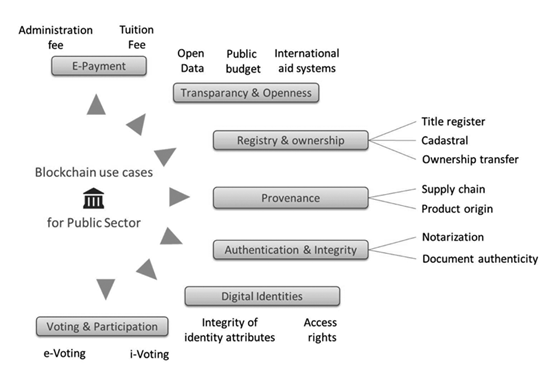
Given below are some issues in public sectors that can be catered to with blockchain.

Blockchain country data

MAINTENANCE OF DIGITAL ASSETS AND DATA

One of the key roles played by any government is to maintain confidential data about its citizens. It is supposed to store information such as birth and death certificates, property deeds, and criminal data amongst other assets. All of this is supposedly kept at secure locations at the regional and national level. The data must be secured from forgery and unauthorized alteration. This is easier said than done in the current scenario which is heavily reliant on the physical proof. The records exist on pieces of paper which can be toyed around with. Moreover any editing requires the person to not only be physically present but also go through a lot of bureaucracy.

Blockchain can help sidestep all the issues that currently plague the system. It can help store all data on public ledgers that can be shared with all necessary institutions. Since these stored blocks of information cannot be edited without verification they’ll remain virtually tamper proof.

DIGITIZATION OF PROPERTY OWNERSHIP

As is the case with identification data, property details such as ownership, transfer, and registries are mostly stored on paper or centralized libraries. Maintaining the vast records of all land under a government and all exchanges that occur on a day to day basis can be a mammoth task. In addition to the huge volume, this process is also prone to inadvertent errors and manipulation. To transfer the ownership rights of a property from one person to another, one must go through several government agencies who take ages to get any work done.

Instead of paper based deeds and titles, permanent registries can be created for each property using blockchain. This will ease the verification process vastly decreasing the time and costs involved. All meddling agencies can be eliminated and the process can become more personalized and streamlined.

VOTING

Elections stand to be the most defining moment for any functioning democracy. Not only do these large scale events take time, they also consume a lot of resources and money. A lot of care needs to be taken to ensure that the votes are not manhandled, miscounted, or forged. Huge sums of money are spent on preparing ballots, electronic voting machines, and necessary man force. Even this cannot guarantee an election that is completely free of rigging.

Blockchain can help digitize the whole process. Votes can be likened to any other online transaction conducted across a secure space free of threats. These votes once audited into the registry will not remain prone to alteration. Moreover, voting will also be easily conducted in remote areas allowing greater participation.

CREATION OF A DATA REPOSITORY

Every agency collects their data separately and stores it in different locations. Sometimes, this data needs to be shared with other government agencies. According to a study, the officials of one Scandinavian country spent over half their days collecting data on criminals from different agencies. All the time wasted on this can be better utilized if a central repository can be created to store all data in one location.

A block containing data can be created and stored on the blockchain ledger. This block will remain encrypted and available only to a private network of computers to avoid data leakage. With blockchain, government institutions and public services will no longer need to lobby for information. They can simply check it in the central data silo.

blockchain for public services

Closing thoughts on blockchain for public services

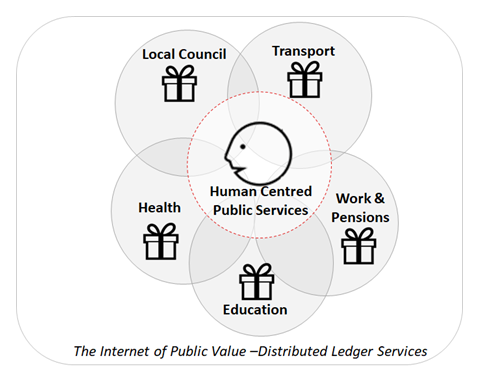
While these changes seem plausible, they remain a distant possibility unless officials decide to take the plunge. With careful planning and investments, governments can increase transparency and fluency of the public services they offer. This eventually benefits the end users, that is, the citizens.