Talk to an Expert

Why Forward-Thinking CPAs Are Investing in AI-Driven Accounting Tools?

AI-Driven Accounting Tools for CPA

What if accountants could predict financial trends before they happen, automate tedious tasks, and make decisions backed by real-time data? That’s not a distant dream — it’s the reality AI is creating for today’s Certified Public Accountants (CPAs).

In an industry where accuracy, efficiency, and compliance are everything, AI-driven accounting tools are transforming how CPAs work. From automating bookkeeping to offering predictive insights for better financial planning, artificial intelligence is helping accountants move beyond manual data crunching into strategic advisory roles that add real business value.

The market is poised for growth, as the AI accounting market is projected to be worth approximately $6.7B in 2025 and could reach $67B by 2035.

Forward-thinking CPAs aren’t just adopting AI to keep up with technology, they’re using it to gain a competitive edge, reduce costs, and deliver smarter client outcomes. This guide will show why AI for accounting matters, where to start, and how to get results fast without overwhelming your team.

Why AI for CPAs Matters in 2025?

The accounting industry is entering a new phase where AI tools for accounting and AI-powered bookkeeping automation are necessities. Firms that integrate AI tools for accounting firms are seeing measurable ROI in efficiency, accuracy, and advisory value.

1. Efficiency and Scalability

AI automation cuts hours of manual bookkeeping, reconciliation, and tax prep. With AI in accounting and finance, firms handle more clients without expanding headcount, directly improving profit margins.

2. Accuracy and Compliance

AI bookkeeping tools minimize human error and ensure every transaction aligns with tax and audit standards. For CPA firms, this means stronger compliance and lower risk, key in maintaining long-term client trust.

3. Smarter Client Advisory

Beyond automation, AI for CPA firms enables real-time forecasting, expense analysis, and predictive cash flow management. This turns accountants into strategic advisors, not just service providers.

4. Competitive Advantage

Early adopters of AI-powered bookkeeping automation already lead the market. Firms using these tools report higher client retention and faster decision-making, positioning them as forward-thinking financial partners.

So, AI transforms CPA firms from reactive to proactive. It’s not about replacing people, it’s about scaling intelligence, service quality, and revenue potential. But first you need to understand what is right for you. 

Should You Build Custom AI Solution or Buy Off-the-Shelf?

When it comes to using AI for CPAs, you have two paths: use ready-made white label tools or build something custom. If your firm wants quick results, off-the-shelf AI tools for CPAs are usually the best starting point. These tools already handle common work like invoice coding, bank reconciliation, audit prep, and tax notes. They are fast to set up and your team can learn them without stress.

For firms with unique workflows or advanced needs, building a custom layer that integrates accounts payable automation AI helps manage multiple entities and complex reports efficiently.

The key is to keep it simple.

  • One workflow
  • One team
  • One goal
  • One month to test

This gives you a safe trial run where partners can see real results without overwhelming the staff. It also helps your firm learn how to use AI for CPA firms in a steady, confident way..

Top AI Use Cases for CPA Firms That Deliver Quick ROI

If you’re a CPA firm looking to make work faster, smarter, and more profitable, this is where AI in accounting shows real results. These are practical ways to cut costs, save time, and deliver better client service starting this quarter.
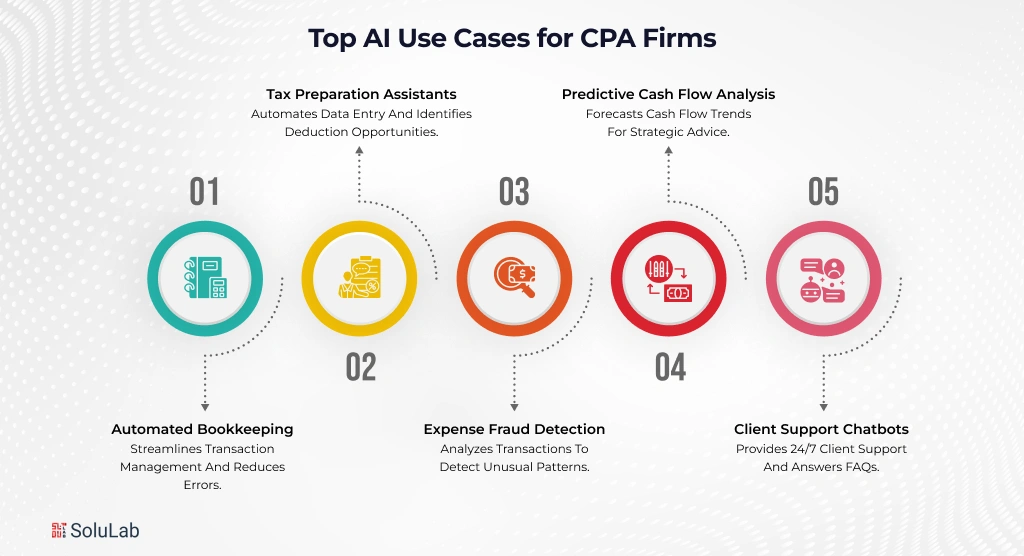
Top AI Use Cases for CPA Firms

1. Automated Bookkeeping

AI bookkeeping tools can now handle most of the repetitive work in bookkeeping like categorizing transactions, matching invoices, and reconciling accounts. This reduces manual errors and saves teams hours every week. For firms that manage multiple clients, automation can directly translate into more billable hours and faster turnaround time.

2. Tax Preparation Assistants

Preparing taxes can be one of the most time-consuming parts of accounting. With AI tax preparation tools, CPAs can automate data entry, detect missing forms, and even check for deduction opportunities. In 2025, top firms report up to 85% of repetitive tax work automated, freeing teams to focus on review and client strategy instead of routine paperwork.

Read Our Blog: Generative AI in the Tax Industry

3. Expense Fraud Detection

AI-powered fraud detection systems analyze transactions in real time, flagging unusual spending patterns or suspicious claims. This helps CPA firms protect clients from compliance issues while building trust. Even a small firm can use this to offer “AI-backed audit checks” as a premium service, a clear competitive edge.

4. Predictive Cash Flow Analysis

Machine learning tools can now predict cash flow trends weeks or even months ahead. For CPA firms, this means giving clients proactive advice like when to delay expenses or secure funding. Predictive insights help you move from being just an accountant to becoming a financial advisor clients rely on for strategic planning.

5. Client Support Chatbots

AI-powered chatbots are changing how firms handle client communication. They can answer FAQs, share document links, and schedule calls 24/7. This improves client satisfaction and saves your team from answering repetitive questions. The best part is that Chatbots can be integrated directly into your firm’s website or client portal within days.

Each of these AI use cases for CPA firms brings immediate returns, lower costs, faster turnaround, and happier clients. Firms that start with even one of these solutions often see ROI within the first 60–90 days.

How to Implement AI Solutions for CPAs?

Most CPA firms hear about AI for CPAs and think it’s complicated or takes months to get working but it doesn’t have to. A simple and proven process to help firms use AI integration for accounting firms in just a few weeks. It’s fast, secure, and designed to give you measurable ROI from day one. 
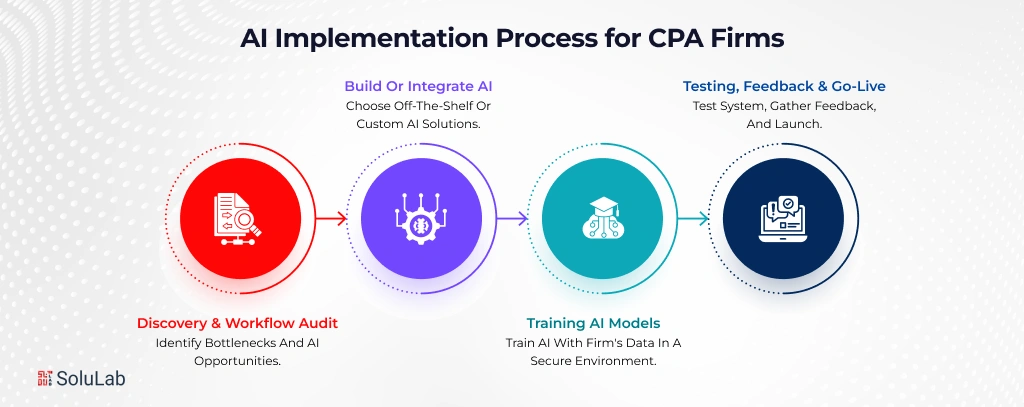
AI Implementation Process for CPA Firms

Step 1: Discovery & Workflow Audit

Every firm has its own way of working. That’s why its good to start with AI strategy consulting for workflow audit and understanding of how your team handles bookkeeping, audits, and tax operations.

Then map out every process and identify where AI applications can deliver quick wins. Common areas include:

  • Repetitive data entry
  • Manual reconciliations
  • Delays in financial reports
  • Tax compliance tracking

Once you know where the bottlenecks are, match each task with the best AI tools for CPAs or plan a custom AI solution if your needs are unique.

Step 2: Build or Integrate AI

Now you have to choose between off-the-shelf AI tools or a custom AI CPA system, whichever fits your goals and budget. Best Off-the-shelf tools work great for quick automations like:

  • Invoice scanning
  • Document sorting
  • Chatbots for client support

Custom-built AI systems are perfect if you want proprietary tools that learn from your client data and workflows. An experienced AI app development company can handle both, building from scratch or connecting existing tools to your systems. 

Step 3: Training the AI Models

Once tools are selected, train your AI in accounting and finance models with your firm’s real data. This is what makes your AI truly intelligent, it learns your processes, tone, and financial logic. Train each CPA AI model to:

  • Understand how your team categorizes transactions
  • Follow your firm’s reporting style
  • Learn from past client data for better predictions

Everything runs in a secure, encrypted environment, so your data is protected end-to-end.

Step 4: Testing, Feedback & Go-Live

Before launch, every system goes through a full testing and feedback cycle with your team. Test accuracy, run real scenarios, and fix edge cases. Once everything is stable, go live and train your team to use the new tools.

AI Security & Compliance to Follow for CPA Firms

When it comes to AI for CPA firms, security isn’t optional, it’s essential. Your clients trust you with their most private financial data. That’s why every AI system should follow strict data protection and compliance standards to keep your firm safe and audit-ready.

Core Security Practices

Don’t take shortcuts safely. Every system must include:

  • End-to-end encryption for all data transfers and storage
  • SOC 2 and ISO 27001 aligned frameworks for full compliance
  • Optional on-premise hosting for large CPA firms that prefer full data control
  • Continuous audit trails and access logs so every action is traceable

Compliance You Can Trust

Meet the highest standards required for AI in finance and accounting, including:

  • IRS Publication 4557 (Data Protection for Tax Professionals)
  • AICPA SOC compliance
  • GDPR for firms with international clients

An expert AI deployment company works as your AI security and compliance partner, making sure every automation layer remains safe, transparent, and aligned with your firm’s regulations. That’s why modern firms hire AI developers for helping them grow with confidence and compliance.

How CPA Firms Are Winning with AI in 2025?

Across the world, top accounting firms are already using AI tools for CPAs to save time, detect errors early, and grab new revenue opportunities. Here are three real stories showing how AI in accounting and finance is transforming the way firms work, win clients, and grow profits, all without increasing staff.

1: Cherry Bekaert LLP – AI Audit Cuts Time by 66%

Challenge:

Cherry Bekaert, a top CPA firm, spent weeks manually testing transactions and spotting fraud. Manual reviews were slow and missed key risks.

Solution:

They used MindBridge AI Auditor, an AI audit tool that checks 100% of transactions and flags unusual activity in real time.

Result:

  • 66% less sampling time
  • 35% faster audits
  • Detected fraud attempts within the first month
  • Full ROI in one year
  • Positioned as an AI leader in accounting

2: Ohio CPA Firm – AI Boosts Revenue 42%

Challenge:

A small Ohio CPA Firm spent 40% of staff time entering invoices manually, leading to slow operations and unhappy clients.

Solution:

They adopted Vic.ai, an AI accounting automation platform that handled invoice processing and approvals. The firm then used the saved time to offer AI-powered advisory services like cash flow forecasting and business insights.

Result:

  • 42% increase in advisory revenue
  • 75% faster invoice processing
  • 90% fewer data entry errors
  • ROI in 9 months
  • Moved from compliance work to strategic business advisory

3: Big Four Firm – Generative AI Saves 89,000 Hours

Challenge:

A big Four accounting firm spent hours preparing client briefs. Thousands of hours were lost to repetitive manual work.

Solution:

They built a custom Generative AI solution using Azure Cognitive Services and Large Language Models (LLMs) to auto-create proposals from data and past projects.

Result:

  • 89,000 staff hours saved yearly
  • Task time cut from 4 hours to under 7 minutes
  • Deployed to 40,000 employees
  • Improved proposal quality and speed
  • Became a model for AI in accounting firms

How Much Does AI for CPAs Cost in 2025?

Many firms think AI is too expensive, but that’s not true. The cost really depends on your firm’s size, the kind of work you do, and how deeply you want to use AI for accounting. Here’s a simple view of what to expect:

AI Solution Type Estimated Cost (USD) Best For
Off-the-Shelf AI Tools $50–$300/month Small firms or solo CPAs who want quick automation.
Custom AI Integration $2,000–$5,000 (one-time setup) Growing firms with 10–50 clients that want to connect AI with their existing software.
Full AI System Build $10,000–$25,000+ Established firms that need a complete AI accounting system across departments.

A CPA firm investing $5,000 in automation saved more than $20,000/year in manual work costs. That’s a full return in just 3 months and pure profit after that. So whether you start small with ready-made tools or go all in with a custom AI solution providers, you’ll see value fast.

cta

Conclusion

It’s no longer a question of if it’s about when and how fast you adopt AI for CPAs. Today, AI in accounting is a real tool that helps firms work smarter, not harder. CPA firms that use AI tools for CPAs are already seeing big improvements.

SoluLab, a renowned AI development company, holds much experience catering to the finance business needs with custom solutions. Backed by top notch technology, our solutions can offer you multiple benefits like:  

  • They complete client work faster.
  • They manage more clients with the same team.
  • They cut down on errors and improve accuracy.
  • They offer high-value advisory services that increase revenue.

It helps automate your daily tasks, boost client satisfaction, and free up your team to focus on strategy instead of data entry.

If you’re a firm owner, it’s the right time to explore AI for CPA firms. Contact us today!

FAQs

1. How do I calculate ROI and time savings from adopting AI tools in my practice?

Track time spent on manual tasks pre- and post-implementation, monitor reduction in errors, and calculate cost savings versus software investment. Most firms report ROI within 6–12 months and see staff hours freed up for billable advisory work.​

2. How do I choose between off-the-shelf and custom AI development for my firm’s needs?

Off-the-shelf solutions work best for standard workflow automation, while custom builds suit unique integrations and proprietary services. Agencies help by mapping requirements, comparing costs, and guiding pilot decisions for best-fit solutions.​

3. How can AI improve client communication, advisory services, and overall value delivery?

AI-powered chatbots, document summarization, and predictive analytics provide clients with faster responses, deeper insights, and more personalized advice, freeing accountants for strategic conversations.​

4. What ongoing support and updates should I expect after deploying AI solutions in my CPA firm?

Regular platform updates, cybersecurity monitoring, vendor-led training, and periodic workflow optimization are essential. At SoluLab, we offer post-launch support, troubleshooting, and best practices for continuous improvement.
How AI in Accounting is Changing the Industry?

AI in accounting

Artificial Intelligence (AI) is lately having a higher hand in all fields, and AI use in accounting is no exception. AI is helping people work with higher efficiency leaving fewer chances for errors that might take place manually. AI is a computer science software of accounting and artificial intelligence with human intelligence for better experiences in reasoning, learning, and decision-making. The rise of AI is transforming the traditional methods for getting things done. With the growing dynamics, it has become rather important for professionals to work smarter, more accurately, and faster in financial operations with the help of AI. 

How is AI Used in Accounting?

The main use of AI in Accounting is for processing and data entry. ai for accountants

can take a lot of time to wrap up with the data management and processing which AI would do in much less time and with zero error rate. All this data is gathered from invoices, receipts, statements, and taxes. artificial intelligence accounting can be done using optical character recognition (OCR) and natural language processing (NlP) to extract and process the data accurately. Regarding this data, it becomes easy for AI to generate reports.

Another AI application in accounting is done with audit and compliance. Auditing is where the records are verified and examined as per laws and regulations. AI is also transforming how firms operate on a day-to-day basis through the use of accounting practice management software like Cone. Earlier auditors used a sampling technique but now machine learning can analyze data, detect errors and frauds, and even provide recommendations. 

One more way how to use AI in accounting is even for advisory and consulting because analyzing the data, gathering the information, and having a better sense of accuracy for future scenarios, artificial intelligence in accounting helps with providing the best pieces of advice and consulting for clients and stakeholders. AI is not a threat to accountants but a power to enhance capabilities. Companies that use AI-driven accounting processes can see a 20% reduction in manual errors.

Benefits Of AI in Accounting

There exists numerous benefits of ai in accounting and by leveraging these capabilities of ai accounting you can create improved experiences. 

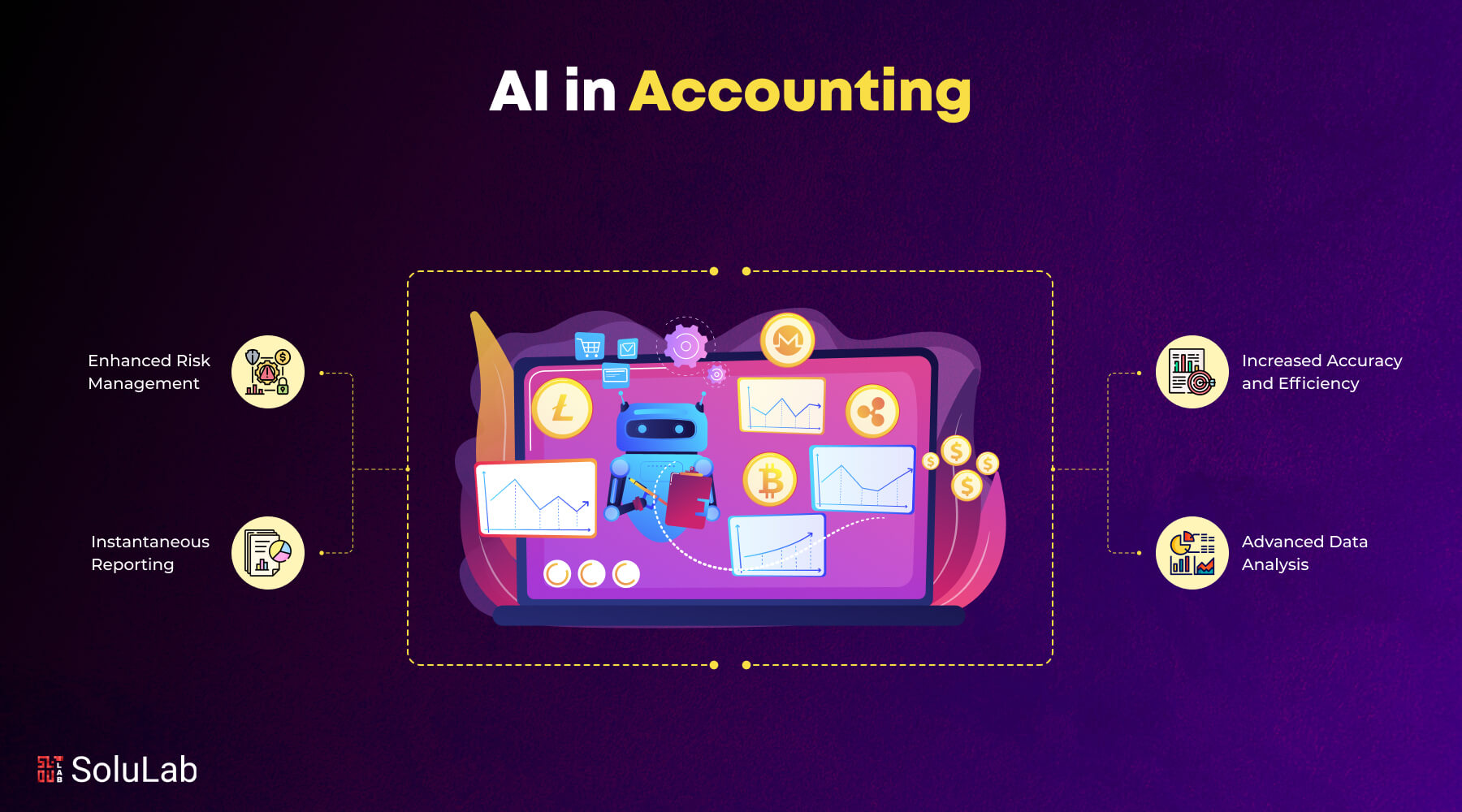
  • Increased Accuracy and Efficiency

Specifically, artificial Intelligence accounting is useful in managing and efficiently handling certain trivial exercises that could easily consume a lot of an accountant’s time. Some of the best examples that can be classified under AI for accounting include data entry jobs, invoicing as well and bank reconciliation. The tasks mentioned above can be easily automated with the help of AI technologies and can save accountants time for more serious and important tasks, including client support and analysis of the business’s potential developments. 

CTA1

  • Insights and Advanced Data Analysis

While financial data is replete with information, it is at times hard to come up with significant conclusions. With the help of Big data, accountants can acquire a detailed understanding of a business’s financial potential by using AI in accounting software to search for trends that are not detectable near-sightedly. Also suitable when it comes to taxes and credits.

  • Enhanced Risk Management and Fraud Detection 

Fraud is then defined as the unauthorized use of an organization’s resources whereby the gains accrued by the perpetrators are impressively remarkable to threaten the financial stability of an organization. Financial transactions might be constantly closely supervised by systems. AI in the accounting industry can detect suspicious behavior that does not correspond to a normative model. This means identifying payments that do not look right, issues with vendor invoices, or almost certainly, questionable payroll issues.

  •  Instantaneous Reporting and Determination

In the case of traditional accounting systems, there are always some forms of deferring when processing data and reporting, whereas AI for accounting enhances the speed of data processing and collection, hence the ability to real-time data of financial aspects. This bestows companies the power to act appropriately by having proper current financial information, AI applications in accounting are like knowing you could generate reports at the snap of your fingers or arrive at cash flow information within the blink of an eye.

Challenges of AI In Accounting

Challenges of AI In Accounting

AI in accounting has numerous benefits, but there are some challenges you may face by indulging AI in the accounting industry

  • Security and Privacy Concerns 

AI in accounting for your data analysis and management you are putting sensitive data at risk which becomes a potential challenge. So protecting data from unauthorized access, cyber threats, and breaches is extremely important to maintaining a security measure. These measures will help with safeguarding financial data and information against cyber threats. 

  • Ethical Considerations

Artificial intelligence accounting learns from the data in which they are trained which they then use to gain knowledge. This data may be prejudiced, which the AI system may reflect making the results prejudiced too. For instance, a training set that employed discrimination in the selection process may lead to discrimination in the employment of persons. Societal norms need to be incorporated into the systems that are being developed or trained to be AI systems.

  • Cost of the Integration 

AI solutions may be expensive; this is especially so where they are still innovative and have not been adopted and fully matured in the market. As much as Cube Intelligence is entering a growth marketplace with large potential, AI applications in accounting have many barriers that may limit its business activities in the beginning, which may include the capital outlay for recruiting people, buying an AI system, and possibly improving its IT systems. For this reason, businesses have to devise a clear and rational plan on how AI use in accounting will work and how the ROI of such an investment will be maximized. 

  • Preserving Expertise and Professional Judgment

Entirely, AI is good for data and automatism; nevertheless, it can never replace humans and their thinking, including in accounting. The debate around Will AI replace accountants continues, but ethical dilemmas, ethical decisions, and other detailed accounting situations still require the knowledge and experience of humans. AI depends on the abilities of the accountant to assess the AI outputs and to identify issues, risks, and limitations of accounting and artificial intelligence while ensuring that such technologies work in parallel with accountants and do not eliminate professional judgment.

  • Transparency and Explainability in AI Decisions

Some types of accounting and artificial intelligence can present a challenge because they have uninterpretable decision-making processes or various issues. By the same token, accountants need to understand how the systems come to the conclusions they make to uphold the concepts of decision-making transparency and accuracy. With the use of XAI approaches, one can build trust and offer supervision where needed with AI decision explanations.

Read Blog: Top 10 AI Development Companies in Finance

Leveraging AI and Machine Learning In Accounting

With ML and AI, the accounting field is seeing total disruption. They are some of the most powerful tools that can significantly alter the course of handling, analyzing as well as utilizing financial data. By adopting AI & ML as accounting and AI technologies, accounting professionals will be able to step into this new world of higher accuracy, effectiveness, and, sophisticated decision-making.

  • Automating Tasks That Repeat

The use of AI and ML to at least assist in automating operations that consume much of the accountants’ time is one of the biggest severities. Accounts payable, bank reconciliations, data entry, and invoice processing are some of the tasks that can be considered quite time-consuming, but they can be easily solved with the help of artificial intelligence for accounting technologies. From this, accountants can provide more time for higher-value operations such as financial analysis, client support, and analysis research. Imagine having the ability of AI where bills can be automatically read, compared with business rules, and then routed to the right person for approval. This would in effect, have a positive impact of increasing efficiency by using most of the available time productively for using AI in accounting and finance

  • Better Data Analysis and More In-Depth Understanding

That is the actual strength of AI and ML, the benefits of AI in accounting are its capability to analyze huge amounts of data and derive patterns, and trends for businesses where they can make use of it and something that can help them make sound decisions about their company and understand possible risks in the environment or opportunities they can take They help a company or business have an overview of how financially sound they are. Picture the benefit of being able to identify potential ways of cutting operational costs by employing ML algorithms or the prospects of estimating future revenues when the program analyses the prior sales and trends of the market, accounting and AI allow accountants to work not only as record-keepers but also as strategists on companies’ sides.

  • Fraud Identification and Risk Control

It is established that fraudulent activity has a severe negative impact on an organization’s financial stability, AI in accounting software and ML have the potential to create strong fraud detection systems. These programs can monitor financial operations during a certain period and indicate those as being rather suspicious. This means the ability to identify wrong, strange, or rather suspicious payments, vendor billing anomalies, or potential payroll discrepancies. He pointed out that, through the process of analyzing historical data and learning from previous fraudulent behaviors, such systems can become better developed at the identification of abnormalities. This brings quick action and minimizes the amount of lost money.

  • Predictive Analytics and Businesses that Are Future-Proof

So, it is possible to draw powerful predictive analytics leveraging AI and ML in this regard, AI accounting may show a forecast picture of future financial results, cash flow, and probable risks taking into account past data and adding the market trends. Such knowledge allows firms to forecast their revenues and expenses and make decisions and investments that will be profitable in the given conditions. It is suggested to apply AI for accounting to predict changes in customer needs regarding the seasons or to detect potential economic crises and, therefore, to prepare for measures concerning costs.

Related: AI in Finance

  • Better Customer Service and Tailored Guidance

As it is observed, while accountants are more engaged with their clients, AI performs many administrative tasks. This translates into better identification of the gap in clients’ needs, personalized advice on fiscal matters, and the ability to deal with difficult fiscal circumstances. Other applications of AI can also be applied to develop clients’ online working environment that provides secure access to their financial information and documents, which will enhance their interactions and improve the level of engagement. The capacity to offer an excellent service to the client will be one of the main strategies through which the organizations operating in the accounting market will compete.

How is AI Changing the Industry?

The impact of AI in accounting and finance is not only enabling accountants to work fast and smart but also opening possibilities for them to focus more on high-value activities that need more human interference, empathy, creativity, and relationship-building. Accountants can upskill themselves with AI applications in accounting and adapt to the changing environment at the workplace for thriving results. 

The complete word of data entry can be easily handled by AI in accounting software which has reduced manual effort, time, and the risk of possible errors. OCR allows AI to extract only the exact and right information from relevant documents and then make an input. AI systems can integrate with payment gateways to process a real-time database. 

Intelligent Financial Analysis is the key competency of AI in accounting and finance because no decision can be made without keeping a day-to-day financial track of clients and stakeholders. It is easier for AI to keep track of changed patterns, and vast data numbers to give relevant recommendations. AI also looks after security and compliance related to accounting and financial procedures by identifying possible risks associated with businesses and plans of clients as well as in financial bookkeeping. AI in accounting is cost-efficient With the growth of business, complexities grow too, but AI can notice them before and this helps in managing the costs and prevents losses.  

Related: AI Use Cases and Applications 

Future of AI In Accounting

With the growth of AI in the accounting industry the question will ai replace human accountants sure crosses our mind. But that’s too early to think AI for sure is a very powerful tool but will never be able to fulfill all the manual functions as well, it can never be a substitute for humans and their intelligence. What AI will continue with in the future is the completion of repetitive tasks which may be time-consuming and error-prone for humans. AI will always stand out in keeping large databases, recommending improvement by possessing profound knowledge of the history of clients and stakeholders. 

It is easier for AI to keep up with the market trends and formulate policies for existing and new clients giving better experiences. The future of AI will be more of a right hand for the accounts but never a replacement. Streamlining workflow has been made easier with AI leaving more free space for working on strategic tasks requiring human intelligence. The future will witness the transformation of accounting practices alongside human intelligence. 

CTA2

Conclusion

AI in accounting is changing the industry by automating routine tasks, reducing human error, and offering data-driven insights for smarter financial decisions. From real-time reporting to predictive analytics, AI tools enhance efficiency, compliance, and accuracy. 

Businesses gain faster access to critical financial data, while accountants can focus from manual entries to strategic advisory roles. With AI continuously upgrading, the future of accounting will be proactive, transparent, and cost-effective. Digital Quest, a travel business, partnered with SoluLab to develop an AI-powered chatbot using Generative AI. 

The chatbot enhanced customer engagement by offering real-time, personalized travel recommendations and hassle-free reservations. It also integrated user feedback and multi-language support, resulting in improved user experience and high ROI.

SoluLab, an AI development company can help you in automate your startup or business and reduce manual tasks. Contact us today to discuss further.

FAQs

1. What is the use of AI in accounting and finance?

From summarizing contacts to keeping track of previous and recent activities and recommending more possibilities to existing customers according to the database of each AI works well for data numbers, vast information, forming policies, running investigations, and keeping audit checks.

2. Can AI for accountants be a potential threat?

Not a big threat, but with its ability to do repetitive and tedious tasks such as data entry AI can raise concerns about job displacement. 

3. Can AI reduce costs in Accounting?

AI can reduce the manual need for analyzing and recording data resulting in fewer errors. It can also streamline accounting workflow and store data in the cloud or other digital platforms if required. 

4. Can Artificial Intelligence be the future of Accounting?

A report given by ICAEW says 88% of accounting professionals believe AI will improve their working lives in the coming three years, this report makes it easier to understand how useful AI in accounting can be and continue to be. 

5. How are the processes of AI in accounting complemented by SoluLab?

The implementation of AI from SoluLab brings more power to your accounting company. Protecting data is our main concern and analyze the process to automate it, develop new AI-based products, and use existing AI tools. To ensure that employees are optimally using AI, our company even provides training for the same. When you engage SoluLab, you will be opening the door to the accounting of the future.