Talk to an Expert

How Is AI Healthcare in the UAE Elevating Medical Efficiency?

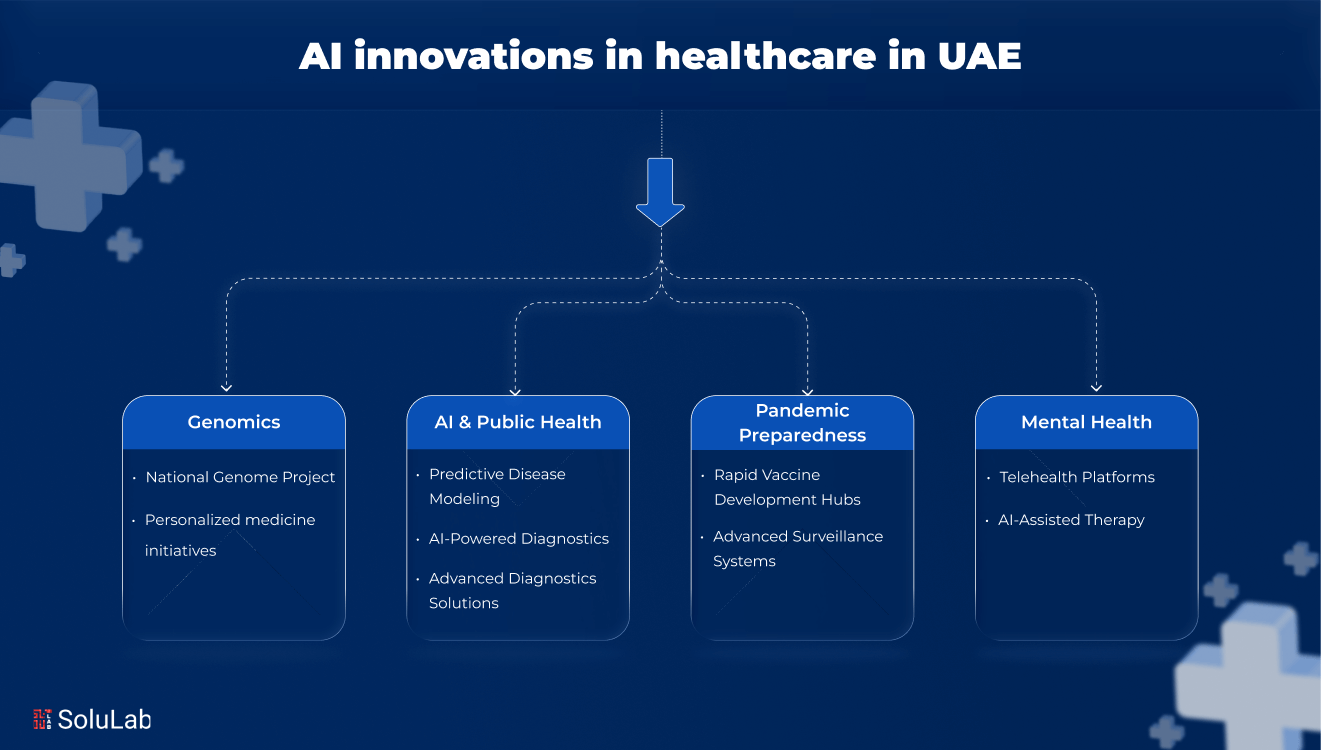
AI innovations in healthcare in UAE

Artificial intelligence isn’t just entering hospitals; it’s taking on real roles in surgeries, diagnostics, hospital operations, and even virtual patient care. In the UAE, this isn’t a concept for tomorrow. It’s already in motion. With a national AI strategy and major investments in digital health, the country is fast becoming a global hub for AI innovations in healthcare.

From AI-powered genomic analysis that predicts diseases early to generative AI in healthcare creating personalized treatment plans, the UAE is redefining modern medicine. It’s all about faster diagnoses, smarter systems, and better outcomes.

So how exactly is AI transforming care in the UAE? What does it mean for patients, doctors, and hospitals? And who’s behind these AI-based healthcare applications? Let’s dive in and find out.

What Makes The UAE a Global Leader In Adopting AI in Healthcare So Quickly?

Because the UAE doesn’t wait for change, it builds it!

While many countries are still drafting AI roadmaps, the UAE has already rolled out a national AI strategy, invested billions into digital health, and made AI a central pillar of its healthcare vision. The leadership is clear: smarter tech means better care.

Add to that a diverse population, world-class infrastructure, and a government that moves fast, and you’ve got the perfect testing ground for AI-based healthcare applications. Whether it’s AI in diagnostics, hospital management, or personalized medicine, the UAE is turning ambition into real, working systems and doing it at record speed.

CTA1

Game-Changing Medical Innovations for Healthcare in the UAE

From AI-driven diagnostics to culturally tuned mental health tools, the UAE is embracing healthcare innovation at every level. These breakthroughs are not just futuristic ideas; they are real solutions transforming how care is delivered, personalized, and experienced across the country.

Genomics–Powered Personalization

  • AI-Powered Polygenic Risk Scoring: Uses machine learning and genetic markers to predict a person’s lifetime risk for complex diseases like diabetes, cancer, and heart conditions.
  • Personalized Drug Response Algorithms: AI evaluates genetic variants to predict how patients will respond to medications, reducing trial-and-error and adverse drug reactions.
  • Nutrigenomics Platforms: AI-driven systems that combine DNA analysis with lifestyle data to deliver custom diet and fitness plans.
  • Cancer Genomics Decision Tools: AI models trained on tumor genomics help oncologists personalize treatments by targeting mutation-specific therapies.

 AI-Driven Public Health

  • AI Epidemiological Forecasting Models: Predicts potential disease outbreaks by analyzing large-scale data sources like travel, climate, and human behavior, helping governments act early.
  • AI-Powered Environmental Health Sensors: Tracks real-time air, water, and soil quality using IoT and AI to flag emerging public health threats.

Pandemic Preparedness

  • Wastewater Surveillance with AI Analytics: Analyzes viral and bacterial loads in sewage systems to detect outbreaks before they reach hospitals.
  • AI-Enhanced Pathogen Genome Tracking: Uses AI to monitor mutations in viruses (like SARS-CoV-2) during pandemics, enabling rapid vaccine updates and targeted interventions.

Culturally-Tuned AI for Mental Health

  • Multilingual Mental Health Chatbots: AI chatbots are designed with cultural awareness, supporting users in different languages and respecting regional values and communication styles.
  • AI-Curated VR Therapy for PTSD and Phobias: Combines virtual reality with adaptive AI to deliver immersive therapy sessions that adjust in real time to a user’s emotional and cultural needs.

Read More: AI In Dubai’s Public Services

How AI in Healthcare is Improving Lives in the UAE?

How AI in Healthcare is Improving Lives in UAE

Medical innovation sounds big and technical, but what does it do for people like you and me? In the UAE, the benefits of AI and genomics are already making care faster, smarter, and more personalized. Here’s how:

1. Know Your Health Risks Early

Knowing your risk of diabetes, heart disease, or cancer years in advance, based on your DNA, is now possible. That’s already achievable in the UAE thanks to AI-powered genetic testing. It gives you a chance to make changes early and avoid long-term health issues.

2. Get Medications That Work for You

Ever tried a medicine that didn’t help or worse, made you feel worse? AI in UAE healthcare is now assisting doctors to match medications to your genetic makeup. That means fewer side effects, faster recovery, and no more wasted time on trial and error.

3. Care That Feels Personal

Whether you’re Emirati, Indian, Filipino, or British, healthcare in the UAE is becoming more culturally aware. AI chatbots and wellness apps now speak your language, understand your lifestyle, and tailor recommendations that feel relevant to you.

4. Safer, Smarter Cities

AI-powered sensors in cities like Dubai and Abu Dhabi track air quality and potential health hazards in real time. That means faster alerts about pollution spikes, water safety, or potential outbreaks before they reach your doorstep.

5. Better Outbreak Preparedness

The UAE learned from COVID-19. Today, AI monitors sewage systems, tracks virus mutations, and predicts where illness might spread next. This helps keep communities ahead of the curve so you’re not caught off guard.

6. Smarter Hospitals and Surgery

AI is streamlining hospital operations in the UAE, from smart facility design and patient flow to inventory management and supply tracking. AI-powered robots are also assisting with care tasks, improving efficiency and easing staff workloads.

7. Mental Health That Understands You

Mental health support in the UAE is becoming more accessible and culturally respectful. AI-powered chatbots and VR therapy tools can now recognize emotional distress, offer guidance in your preferred language, and respond in a way that feels human, not robotic.

Read Also: How Founders and Businesses Can Leverage Digital Asset Treasury in UAE?

Ethics and AI Regulations in Healthcare

Let’s be real, AI doesn’t come without ethical baggage. But the UAE isn’t ignoring it. The country is actively shaping frameworks to ensure AI is not only powerful but also responsible.

  • Protecting Patient Data in a Connected World: As healthcare data travels across borders, privacy becomes a global concern. The UAE is drafting policies that ensure medical data used in AI systems stays secure, anonymized, and ethically sourced without slowing down collaboration or innovation.
  • Building Bias-Free AI for a Diverse Population: AI in healthcare must work for everyone, not just the demographic it was trained on. In the UAE, systems are being audited and stress-tested for fairness to prevent discrimination based on race, gender, language, or socioeconomic background.
  • Who’s Responsible When AI Gets It Wrong: If an AI tool makes the wrong call on a diagnosis, who’s liable: the developer, the doctor, or the hospital? The UAE is addressing these grey areas by working on legal frameworks to define accountability as AI becomes more involved in clinical decision-making.

Artificial Intelligence at Every Step of the Patient Journey

AI isn’t just used in high-tech labs or emergency rooms. In the UAE, it’s becoming part of the patient journey from the very first symptom search to long-term recovery.

1. Smarter Symptom Checks and Triage

Many clinics now offer smart digital assistants that help patients assess symptoms and recommend next steps. These tools reduce unnecessary ER visits and connect patients to the right care faster.

2. AI as Your Doctor’s Second Brain

Doctors are using AI to double-check diagnoses, analyze scans, and personalize treatment plans based on real-time data and global research. It’s not replacing physicians; it’s making them faster, more accurate, and better informed.

3. Keeping Tabs on Recovery After You Leave the Hospital

From wearables to mobile apps, AI tracks recovery and alerts doctors if something’s off. This is a game-changer for managing chronic conditions like diabetes, heart disease, or post-surgical recovery, especially in remote areas or busy urban centers.

How SoluLab Can Help Build the Future of Healthcare in the UAE?

All these breakthroughs, like personalized medicine, AI-powered hospitals, and mental health chatbots, don’t happen on their own. They need expert hands to design, build, and scale them. That’s where SoluLab can assist.

As a leading AI development company in the UAE, SoluLab helps healthcare providers, hospitals, startups, and government projects turn ambitious ideas into real, working solutions. Whether you’re looking to develop:

  • AI-based healthcare applications
  • Custom generative AI tools for diagnostics or triage
  • AI-powered patient engagement platforms or hospital management systems
  • Robotics-integrated systems for elderly care or surgery support
  • Or even a multilingual AI chatbot tuned for cultural sensitivity in the UAE

SoluLab has the technical depth, domain expertise, and UAE-specific healthcare experience to make it happen.

CTA2

Conclusion

The UAE isn’t just adopting AI in healthcare; it’s actively shaping what the future of medicine looks like. From genomics-powered personalization to AI-driven public health strategies, pandemic readiness, mental health support, and smart hospital infrastructure, the country is building a system that’s faster, smarter, and more human-centered.

By blending advanced technology with cultural sensitivity and real-world needs, the UAE is proving that healthcare innovation isn’t just about machines, it’s about people. And in that vision, AI is becoming not just a tool, but a trusted partner in care.

Get in touch with SoluLab today and start building AI solutions that will shape the future of healthcare in the UAE!

FAQs

1. How is AI improving medical efficiency in the UAE?

AI streamlines hospital operations, automates administrative tasks, assists in accurate diagnostics, predicts patient outcomes, and optimizes resource management, reducing delays and costs.

2. What are the benefits of AI in UAE hospitals?

Key benefits include faster and accurate diagnosis, improved patient outcomes, optimized resource allocation, reduced human error, and better decision-making for doctors and management.

3. Can AI assist doctors without replacing them?

Absolutely. AI acts as a support system, providing insights, diagnostics, and predictive analytics, while doctors make the final clinical decisions, ensuring human oversight.

4. How is AI helping with patient monitoring in the UAE?

AI-powered wearables and remote monitoring systems track vital signs in real time, alerting doctors to potential issues and allowing proactive care, reducing hospital readmissions.

5. How can SoluLab help implement AI in healthcare?

SoluLab builds custom AI solutions tailored for healthcare providers in the UAE. From predictive analytics and smart diagnostics to workflow automation, SoluLab delivers scalable, secure, and patient-centric AI applications that elevate efficiency and improve outcomes.
 

From Cancer to COVID: How AI Agents in Healthcare Are Saving Lives in 2025

AI Agents in Healthcare - Tackling Cancer and COVID

In 2025, artificial intelligence (AI) is doing more than assisting doctors, it’s changing how healthcare works. From hospitals to health tech startups, everyone is now exploring how to use AI agents in healthcare to make care faster, smarter, and more personal.

A recent study by McKinsey estimates that AI in healthcare can save $360 billion annually in the U.S. alone by improving efficiency and accuracy. Global spending on AI-powered health-tech is expected to cross $187 billion by 2030, which is a signal that this isn’t just hype; it’s the future.

If you’re a hospital, health-tech startup, or research institute exploring AI, this guide will show you why it’s worth investing in AI agent healthcare solutions and how your business can benefit.

What Are AI Agents in Healthcare?

AI agents are smart software programs that can understand information, make decisions, and take actions, all without human help. In healthcare, they act like digital assistants or analysts. They go through huge amounts of medical data like lab reports, scans, and patient histories to help doctors make faster, more accurate decisions.

These systems are at the heart of how AI agents work in healthcare. They don’t just follow rules, they learn from data and get better over time.

Types of AI Agents in Healthcare

Different types of AI agents are used in hospitals and health tech platforms, depending on the need:

  • Reactive agents – best for AI chatbots in healthcare or symptom checkers.
  • Goal-based agents – help suggest treatment plans based on medical goals.
  • Utility-based agents – used in complex areas like surgical planning or drug testing.

How Do They Help in Real Life?

Thanks to improvements in AI applications in healthcare, these tools now do much more than basic tasks. They can think, adapt, and even talk to patients through voice or chat interfaces.

  • They help in real-time diagnosis and triage.
  • They reduce doctors’ workload by automating reports.
  • They spot patterns that humans may miss in scans or blood tests.

More hospitals and companies are now exploring AI in healthcare as a long-term solution. Whether it’s for robotic surgery, remote consultations, or clinical trials, these tools are becoming the brains behind modern healthcare systems.

Read Also: AI Healthcare in the UAE

How Is AI Used to Predict, Detect, and Treat New Diseases?

Emerging diseases like COVID-19 proved that healthcare needs faster, smarter solutions. This is where AI agents for healthcare truly stand out.

These AI systems help medical teams act faster by analyzing health data, predicting risks, and suggesting treatments in real time. They’re especially useful when dealing with unknown or fast-spreading diseases.

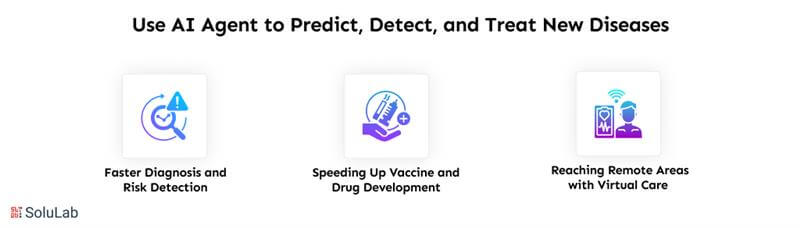
1. Faster Diagnosis and Risk Detection

AI tools analyze patient data and medical scans to catch problems early.

  • AI agent healthcare solutions scan CTs and MRIs to spot early signs of infection
  • AI models identify high-risk patients using real-time health records
  • Predictive tools help hospitals plan ahead during outbreaks

2. Speeding Up Vaccine and Drug Development

AI helped researchers save time during the COVID-19 crisis.

  • AI models found possible vaccine targets faster than manual methods
  • It helped repurpose existing drugs to fight new viruses
  • AI simulations tested how viruses mutate and spread

3. Reaching Remote Areas with Virtual Care

The implementation of AI agents in virtual healthcare helps reach underserved regions.

  • Smart devices collect health data and offer real-time guidance
  • AI assistants do risk assessments from mobile apps
  • Doctors can remotely monitor symptoms and suggest next steps

These AI applications in healthcare are not just an innovation, they’re a necessity. For B2B healthcare providers, AI offers scalable, cost-effective ways to prepare for what’s next.

If you’re building tools for disease control or virtual care, it’s time to invest in AI agent healthcare solutions that are ready for real-world impact.

Can AI Agents Help Find Cures for Cancer, HIV/AIDS, and COVID-19?

Yes and it’s already happening. Today, Healthcare AI agents are helping researchers, hospitals, and biotech firms move faster in finding treatments and potential cures. These agents process massive datasets, simulate results, and improve decision-making across medical research.

Use AI Agent to Predict, Detect, and Treat New Diseases

1. Cancer Treatment & Drug Discovery

AI is helping scientists find new ways to fight cancer faster and more accurately.

  • Simulates how different molecules interact with cancer cells
  • Helps design personalized treatments using patient-specific data
  • Speeds up drug discovery by months or even years

2. HIV/AIDS Prediction & Prevention

Using AI to better target and prevent the spread of HIV/AIDS.

  • Identifies high-risk groups faster than traditional methods
  • Recommends preventive care (e.g., PrEP) using data models
  • Supports screening and detection in remote regions

3. Long COVID Research

AI agents help track and treat the ongoing effects of COVID-19.

  • Analyze patient history to predict long-term risks
  • Personalize rehab and recovery plans
  • Support resource allocation in public health planning

These are real-world agentic AI use cases in healthcare that are reshaping what’s possible in medical science, not years from now, but today!

How Are AI Agents Revolutionizing Oncology?

Cancer is one of the biggest health challenges in the world and every second matters when it comes to diagnosis and treatment. This is where AI agents in healthcare are making a big difference. They help doctors find cancer early, suggest the right treatments, and even assist in developing new medicines.

Here’s how they’re helping:

  • MIT’s Sybil AI model can predict the risk of lung cancer up to 6 years in advance, just by reading CT scans.
  • Autonomous AI tools can scan biopsy and pathology slides to detect tumor grades, which helps doctors decide how to treat each patient.
  • Generative AI is now creating custom cancer drugs in just a few weeks, a process that used to take years.

These tools are fast, smart, and highly accurate. This kind of work is possible only because of the integration of AI agents in healthcare systems that support doctors, labs, and hospitals.

If you’re in the business of cancer diagnostics, treatment planning, or oncology research, now is the time to adopt AI. It’s not just innovation, it’s a real competitive advantage.

Read Also: How Businesses in Every Industry Are Benefiting from AI Agents?

What Are the Broader Applications of AI Agents in Healthcare?

AI agents are not limited to cancer or diagnostics, they’re being used across healthcare systems to make operations smoother, faster, and smarter. These AI applications in healthcare are helping hospitals and health-tech companies cut costs, save time, and serve patients better.

1. Remote Diagnostics with Chatbots

AI-powered chatbots in healthcare are being used for symptom checking, appointment scheduling, and follow-up care, especially in virtual care setups.

  • Reduces doctor-patient wait time
  • Supports telemedicine growth
  • Helps patients get quick answers without staff overload

2. Smarter Resource Allocation

During health emergencies, AI agents for healthcare help predict ICU demand, staff shortage, or equipment needs in advance.

  • Prevents last-minute overloading
  • Helps hospital admins plan better
  • Saves critical care time

3. AI Tools for Doctors & Staff

AI assistant tools automate routine tasks like documentation and report writing, freeing up time for actual care.

  • Cuts down paperwork
  • Boosts doctor efficiency
  • Lowers burnout rates

Companies that hire AI developers to build such tools often see higher efficiency and lower operational costs. These solutions are especially powerful when paired with Healthcare AI agents to create a connected care ecosystem.

What’s the Future of AI Agents in Healthcare?

The future of AI agents in healthcare is fast-moving and full of potential, especially for hospitals, labs, and health tech companies looking to innovate.

Here’s what’s coming next:

  • Multimodal AI agents that can understand both medical images (like X-rays or CT scans) and patient records or doctor’s notes. This allows for faster, more accurate decision-making.
  • Responsible AI and strong governance frameworks that ensure patient safety, data privacy, and compliance with regulations are especially important for enterprise adoption.
  • Open-source agentic systems designed for low-resource hospitals and clinics. These tools will make smart healthcare more accessible and affordable, especially in developing regions.

The most exciting shift? AI agent healthcare solutions are now being built directly into wearables, smart health monitors, and digital hospital systems. These tools can automatically track vital signs, flag early warnings, and even support clinical staff, all without adding extra workload.

Why Should Your Company Invest in AI Healthcare Solutions?

If you’re a hospital, research lab, or health-tech company, now is the time to explore AI in healthcare.

Here’s why it matters:

  • It helps improve patient care and clinical outcomes.
  • It reduces errors in diagnosis and treatment.
  • It speeds up research and drug development.
  • It saves time by automating repetitive tasks.

Partnering with an experienced AI development company gives you access to custom, compliant, and scalable solutions that actually work in real clinical settings.

AI Agents Deveopment Company

Conclusion

The future of healthcare is becoming smarter, faster, and more personalized. From cancer diagnosis to COVID-19 care to HIV prevention, AI agents in healthcare are helping doctors make better decisions and improve patient outcomes.

Whether you run a hospital, health-tech startup, research lab, or digital platform, this is the right time to invest in AI-powered healthcare solutions. The technology is ready, the demand is growing, and the impact is real. 

If you’re looking to build, scale, or integrate AI into your healthcare product, SoluLab, a leading AI agent development company in the USA, is here to help. We specialize in custom AI development designed for real-world medical challenges.

Contact us to build the future of healthcare!

FAQs

1. What are the benefits of using AI agents in healthcare?

AI agents help healthcare providers work faster and smarter. They improve diagnosis accuracy, speed up decision-making, reduce manual work, and offer personalized treatments. These benefits lead to better outcomes for patients and lower operational costs for hospitals or clinics. 

2. What are some real agentic AI use cases in healthcare?

Agentic AI is being used in cancer diagnosis, patient triage, health monitoring apps, and hospital automation. For example, AI can detect cancer earlier through imaging or help hospitals allocate ICU beds based on real-time data. These agentic AI use cases in healthcare are growing quickly and offer great ROI for B2B adopters.

3. How do AI agents work in healthcare? 

AI agents in healthcare collect data (like images, symptoms, or patient history), analyze it using algorithms, and then suggest or take action, like flagging a diagnosis or recommending a drug. That’s the core of how AI agents work in healthcare, whether it’s through automation, prediction, or recommendation.

4. What can AI agents be used for in healthcare?

AI agents for healthcare are used in disease prediction, patient communication, medication management, diagnostics, and even surgery assistance. Their job is to assist both doctors and patients, making care faster and more reliable.

5. What are some common AI applications in healthcare?

AI is used in radiology, cancer treatment, predictive analytics, medical imaging, and chatbot-based consultations. These AI applications in healthcare help providers reduce costs and improve accuracy while scaling services for more patients.

6. How is the implementation of AI agents in virtual healthcare improving care?

The implementation of AI agents in virtual healthcare has helped reach remote areas, automate basic care, and provide 24/7 assistance through apps and chatbots. This improves accessibility, especially in under-resourced locations.