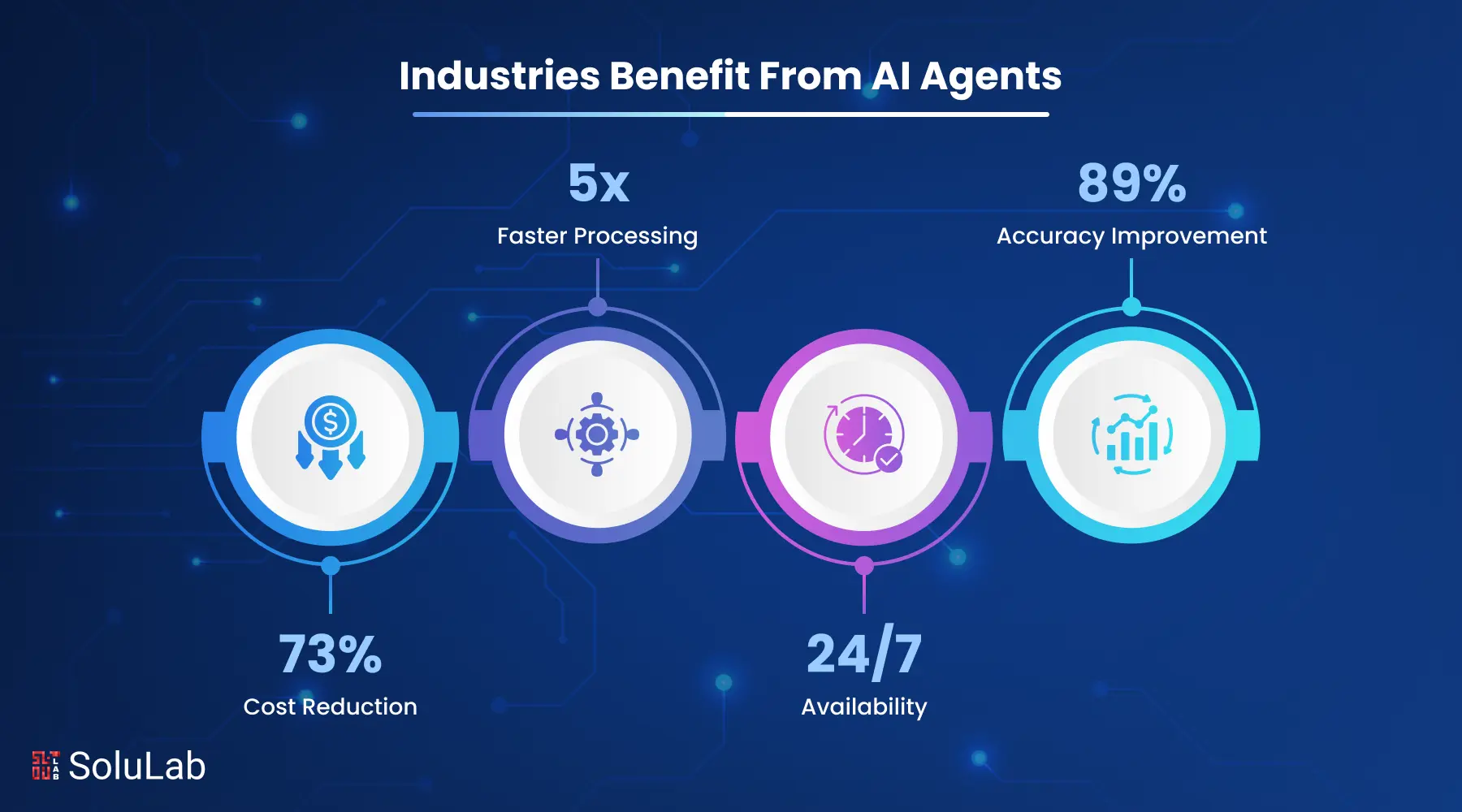
Customer queries. Inventory counts. Data that nobody has time to read. Running a business now means holding all of it at once, and the old playbook of “add another person to the queue” stopped working a while ago. Your team burns hours on work a script could do. Decisions stall because the numbers live in five places. Output slips, quietly, and nobody can point at the exact reason. This is the gap AI agents for business were built to close: automating the repetitive layer, surfacing what is happening right now, and giving people back the hours they need for work that actually moves something.
Chatbots handling support. Routing logic that reworks a delivery schedule mid-shift. Campaign tweaks that happen without anyone opening a dashboard. AI agent applications are quietly rewriting how whole industries run their day. Healthcare, finance, education, retail: in each of them, AI agents for business operations have stopped looking like an experiment and started looking like infrastructure.
So this piece walks through where AI agents are actually being used, industry by industry, with the real deployments behind each one.
Key Components of AI Agents
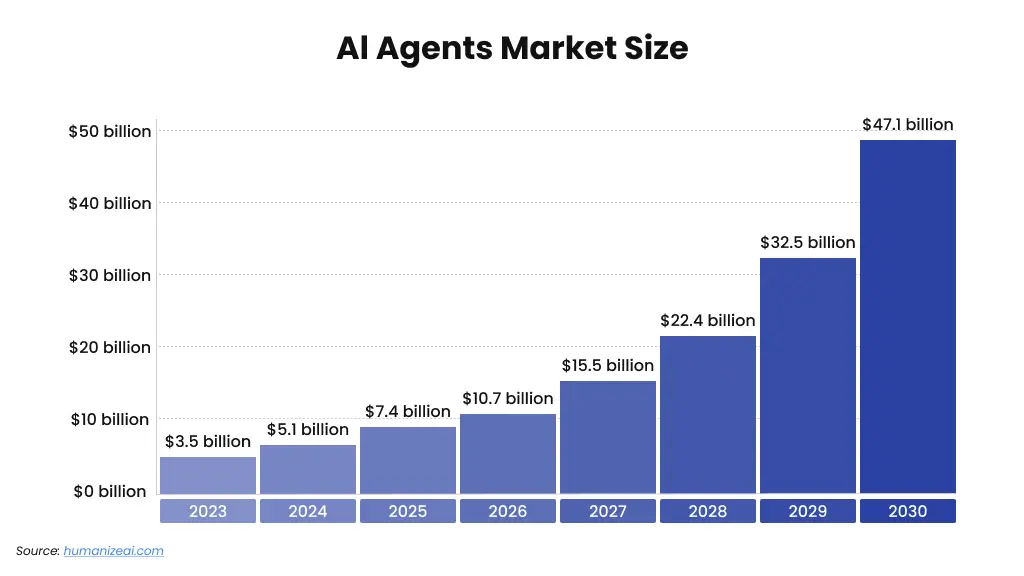
An agent watches, chooses, and then acts. That loop is the whole thing, and a handful of components make it possible. For scale, the AI agent market sat at roughly $3.52 billion in 2023, and forecasts put it at $47.10 billion by the close of 2030.
Here are the main pieces. What matters is not any one of them on its own, but how they hand off to each other.
- Perception: the agent’s way of taking in the world. Cameras, microphones, sensors, a plain API feed of order data. Whatever the agent later decides, it decides on top of this. Bad inputs, bad agent.
- Making decisions: the core of it. The agent reads what it just took in, weighs the options open to it, and picks. Sometimes that is a rulebook doing exactly what a rulebook does. Sometimes the call is messy enough that you need a machine learning model to make it, and the logic stops being something a person can read line by line.
- Action: the decision has to land somewhere. A robot arm moves. A message goes out. A thermostat drops two degrees. Without this step you have an opinion, not an agent.
Benefits of AI Agents for Modern Businesses
Teams that put agents to work tend to notice the change in how their week feels before they notice it in a report. Here is what AI agents for businesses actually buy you:
1. Enhance Employee Efficiency: the repetitive work goes to the agent, and your people get their attention back for the thinking and building parts of the job. Fewer slips, better use of the day, and departments that stop tripping over the same manual steps every week.
2. Improve Operations: the AI agents for automation tie doing, watching, and correcting into one loop. Work moves, the system notices where it is stalling, and it adjusts. Output climbs without a single new hire on the payroll.
3. Reduce Preservation: agents do not sleep. Running around the clock means less spent on labor hours, fewer errors that cost money to undo, and less waste generally. The saving compounds, and quality holds.
4. Competitive Advantage: being early here is its own advantage. Faster calls, sharper forecasts. Companies running AI agents keep pulling ahead of the ones still routing everything through a manual process.
5. Enhanced Customer Service: support agents that hold context answer people right away, in a way that fits the person asking. Reply times drop. Queues shrink. And the customer comes away feeling like somebody was actually paying attention.
6. Bring in Data-Driven Insights: agents chew through volumes of data live and pull out the patterns, the trends, the things worth acting on. Leaders end up deciding from evidence instead of instinct.
10 Real-Life AI Agent Examples Across Industries
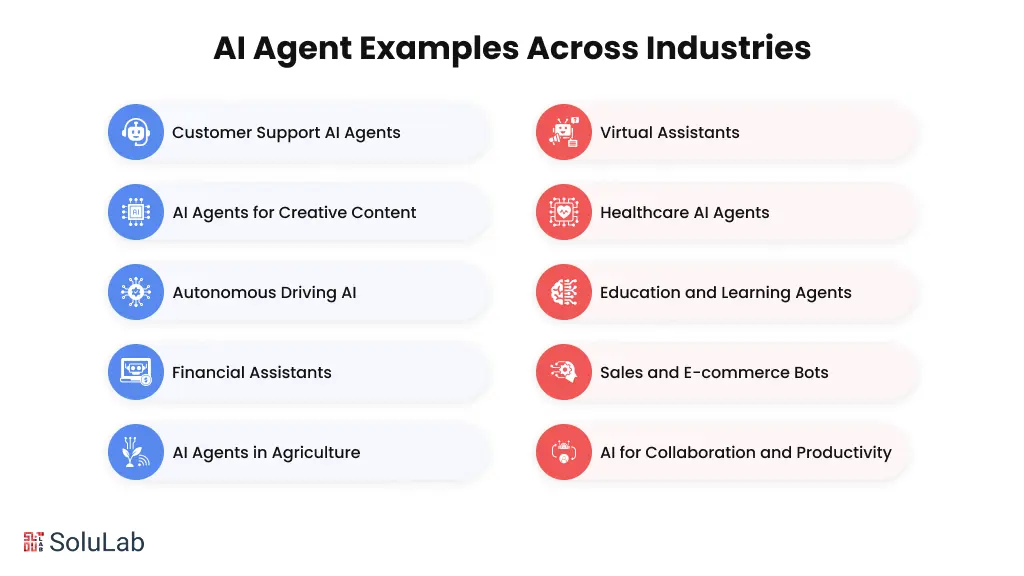
Abstractions only take you so far. The AI agent use cases in business below are the ones already running in production, across ten very different sectors. We have grouped the types of AI agents with the companies using them. Take them one at a time:
1. Customer Support AI Agents
Customer support AI agents changed the shape of the support desk. Queries get answered the moment they arrive, at 2 PM or 2 AM, and the wait that used to define the experience mostly disappears. The routine stuff the agent closes on its own. Anything genuinely thorny it hands to a person, with the context attached, so nobody starts the conversation from scratch. Satisfaction scores tend to follow.
Real-World Examples:
- HDFC Bank, EVA (Electronic Virtual Assistant): EVA fields banking questions as they come in, at a volume measured in millions of interactions, which takes serious pressure off the call center floor.
- Swiggy, Swiggy Genie Chatbot: this AI chatbot handles order tracking, delivery problems, and refund requests. Tickets get answered faster and fewer of them reach a human at all.
2. Virtual Assistants
Alexa and Siri are the agents most people already live with, even if they never call them that. They run on natural language processing: you say a thing out loud, the assistant works out what you meant, and something happens. Lights go off. A reminder gets set. The gap between wanting something done and it being done shrinks to one sentence.
Real-World Examples:
- Amazon Alexa: the workhorse of the smart home. Lights, appliances, reminders, and an order placed without anyone picking up a phone.
- Apple Siri: texts, weather, calendar invites, directions, all by voice, across iPhone, iPad, and Mac.
3. AI Agents for Creative Content
Writers, marketers, and designers now work alongside agents, and the output volume shows it. Blog drafts. Ad copy. Product descriptions. Social captions that used to eat a Thursday afternoon. The tools do not replace the judgment, but they clear the blank page, which is usually the expensive part.
- Jasper AI- a writing assistant that marketing teams and content shops lean on for posts, ad copy, and email. It runs on GPT-based models, so it picks up context and tone rather than just filling a template, which is what makes scaling output survivable.
- Writesonic- built for SEO articles, product descriptions, landing pages, even AI art prompts. The interface is forgiving and the template library is wide, which is why startups and small agencies reach for it first.
4. Healthcare AI Agents
Healthcare AI agents are changing patient care from both ends: faster diagnosis on one side, remote consultations on the other. Doctors get help instead of another form to fill in. And in places where there simply are not enough specialists, an agent is often the difference between care and no care at all.
Real-World Examples:
- Babylon Health AI: runs AI-driven consultations, reading symptoms against medical history to triage and guide patients on the spot.
- PathAI: supports pathologists with image analysis, catching diseases like cancer more accurately and in less time.
5. Autonomous Driving AI
A car that reads the road, decides, and steers itself is the perception-decision-action loop running at highway speed. Autonomous driving agents lean on dense sensor arrays, machine learning, and data arriving continuously, because safety here is not a feature, it is the entire bar you have to clear.
- Real-World Examples:
Tesla Autopilot: Tesla’s driver-assist stack handles lane keeping, adaptive cruise control, and automatic lane changes, with Full Self-Driving (FSD) aimed at full autonomy. - NVIDIA DRIVE: a scalable AI platform that automakers worldwide build their autonomous systems on, pulling sensor fusion, deep learning, and HD mapping into decisions made in real time.
6. Education and Learning Agents
Classrooms move at one speed. Students do not. That mismatch is exactly what learning agents fix: feedback the second a student answers, hard ideas broken down as many times as it takes, and a pace that bends to the learner rather than the timetable.
- Duolingo Bots
Duolingo runs AI-powered bots that act out real conversations, so you can fumble through a language without anyone watching. The bots read what you type and meet you at your level. - Socratic by Google
Point it at a homework problem and it explains the thing, step by step, and pulls in resources across math, science, and history rather than just handing over the answer.
7. Financial Assistants
Money management used to mean a spreadsheet you opened once a quarter and felt bad about. AI financial assistants track spending as it happens, read the habits behind it, and tell you where the budget is leaking while you can still do something about it. Individuals and finance teams both.
Real-World Examples:
- Plaid AI: lets apps connect securely to bank accounts and turns raw transactions into insight through categorization and predictive analytics.
- Cleo AI: a chat-style assistant for budgeting and expense tracking that will also roast your spending a little, which is oddly effective.
8. Sales and E-commerce Bots
Lead generation through product recommendations, the whole front end of selling is now partly automated. Picking the right tool is where most teams stall, and working through the best AI agents is a decent way to compare enrichment accuracy, orchestration, and what you actually get back for the spend. The payoff is not only saved hours. Personalization gets sharper, conversion rates move, and the buying journey stops feeling like a form.
Real-World Examples:
- ChatGPT Plugins for Shopify: shopping by conversation. Customer questions get answered and orders get managed inside the chat window.
- HubSpot AI: email suggestions, lead scoring, and follow-ups that fire on their own, so reps spend their day on the deals worth chasing.
9. AI Agents in Agriculture
Farming runs on decisions made with incomplete information, and agents are closing that gap. Precision farming, crop monitoring, planting calls backed by data instead of a hunch. Yield goes up, waste comes down, and water, fertilizer, and land all get used with a bit more care.
Real-World Examples:
- IBM Watson for Agriculture: pulls weather data, IoT sensors, and satellite imagery together into guidance a farmer can act on for crop planning and heading off disease.
- FarmBot: an open-source robotic farming rig that plants, waters, and watches soil health on its own. Small-scale growing, automated, down to the centimetre.
10. AI for Collaboration and Productivity
Most of the friction inside a team is coordination, not work. Agents take the routine pieces of that off everyone’s plate: chasing updates, routing requests, drafting the thing nobody wants to start. From standups to documentation, the shape of the working day keeps shifting.
Real-Life Examples:
- Slack Workflow AI: runs daily standups, moves approvals along, and sends tasks to whoever should own them. Less nudging, fewer dropped threads.
- Notion AI: writes, summarizes, and throws out ideas when a page is stuck, which speeds up documentation and planning without pulling anyone into another tool.
Future Outlook for AI Agents Across Industries
Work that used to cost hours of human attention is steadily moving over to these systems. In healthcare, that means catching disease earlier and watching patients through the night, when nobody is on the ward to notice a change.
Finance gets fraud caught faster and investment advice that reads more than one signal. Retail and e-commerce get personal shopping assistants and stock counts that are accurate right now, not as of last night’s sync. On the factory floor, agents will flag the bearing about to fail before it takes the line down.
Schools get tutors that sit with one student at a time. Logistics, HR, real estate, legal: name a field and something is already being piloted there. The AI development companies are not coming for the people. They are coming for the parts of the job nobody wanted. Expect them to settle into the background, doing steady work you stop noticing, which is usually the sign that a technology has actually arrived.
Conclusion
Demand keeps rising, the systems underneath keep aging, and the gap between those two things is where most businesses are currently stuck. Artificial intelligence and intelligent agents close it with decisions made in the moment, work that runs itself, and workflows that stop breaking at the handoffs.
Sitting this one out has a cost. Your competitors are already cutting spend and lifting output with it. Put an agent in artificial intelligence to work on the specific problems your industry actually has. Healthcare or retail, the framing that holds up best is this: they are less like tools and more like teammates, and they do not get tired.
SoluLab, a leading AI agent development company in the USA, builds and wires these agents into the systems you already run. Got manual work you want off your team’s plate? Contact us today and let’s talk through it.
FAQS
Shipra Garg is a tech-focused content strategist and copywriter specializing in Web3, blockchain, and artificial intelligence. She has worked with startups and enterprise teams to craft high-conversion content that bridges deep tech with business impact. Her work translates complex innovations into clear, credible, and engaging narratives that drive growth and build trust in emerging tech markets.