Apple first showed Vision Pro at its June 2023 developer conference, and demand has climbed sharply since the headset went on sale in February 2024. Apple is expected to ship 350,000 Vision Pro units in year one, according to Statistica. That number alone tells you there is room for fresh Apple Vision Pro app ideas, and that those apps could change how whole sectors work. The growth is not supposed to slow down, either: forecasts put shipments at 12.61 million units by 2028.
Projections that steep say something. People want this device, and it is already changing how consumers interact with Extended Reality (XR) technology. Where it is heading? Toward a big say in what immersive experiences look like over the next few years. For companies that plan ahead, building for Apple Vision Pro opens a lot of doors, from better accessibility to completely new ways of engaging customers.
This post looks at the strategic upside of app development for Apple Vision Pro, written for businesses that want to lead in immersive tech rather than follow. We cover app ideas, real use cases, and what it takes to build an app like the ones Apple Vision Pro runs. Plenty of opportunity here, if you know where to look.
What is Apple Vision Pro and How Does It Work?
Apple unveiled Vision Pro at the Worldwide Developers Conference on June 5, 2023, and began selling it in the United States on February 2, 2024. It is the company’s move into mixed reality. Apple calls it a “spatial computer,” and the label fits: it blends digital content with the physical world around you without much fuss. Eye tracking, speech recognition, and motion gestures make using it feel interactive rather than passive. It is also Apple’s first big step into a brand-new product category since the Apple Watch arrived in 2015.
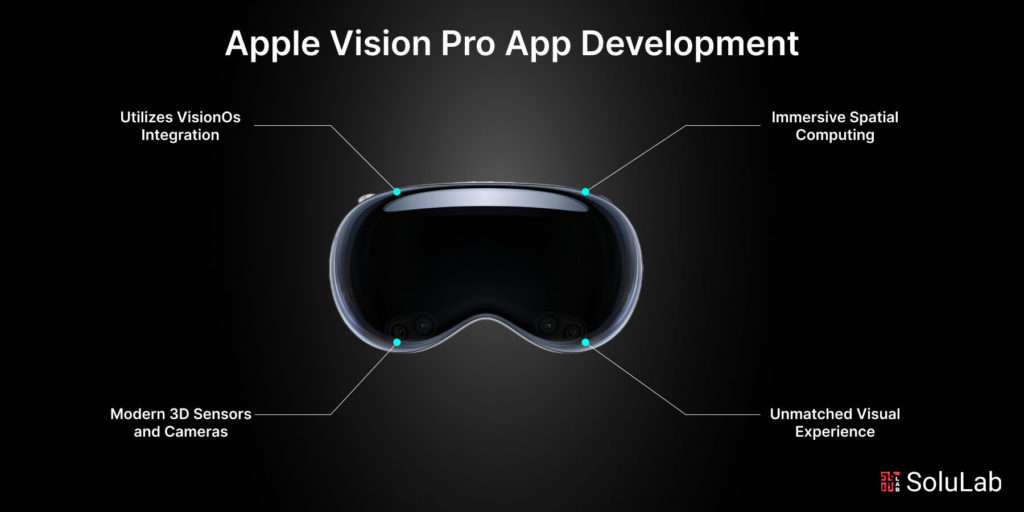
Under the hood is visionOS, which makes built-in apps like Apple TV, Photos, and Safari simple to use. Want something else? The App Store makes third-party apps easy to find and install. The laminated glass front houses advanced 3D cameras and synchronized sensors, which is what makes it such a strong interface for spatial computing. You move through the whole virtual space with your hands, your voice, and your eyes. No controller needed.
Benefits of Developing an Apple Vision Pro App
Building for Apple Vision Pro comes with real advantages, mostly because the platform lets virtual and physical worlds sit together in a way few devices manage. Here is a quick look at them.
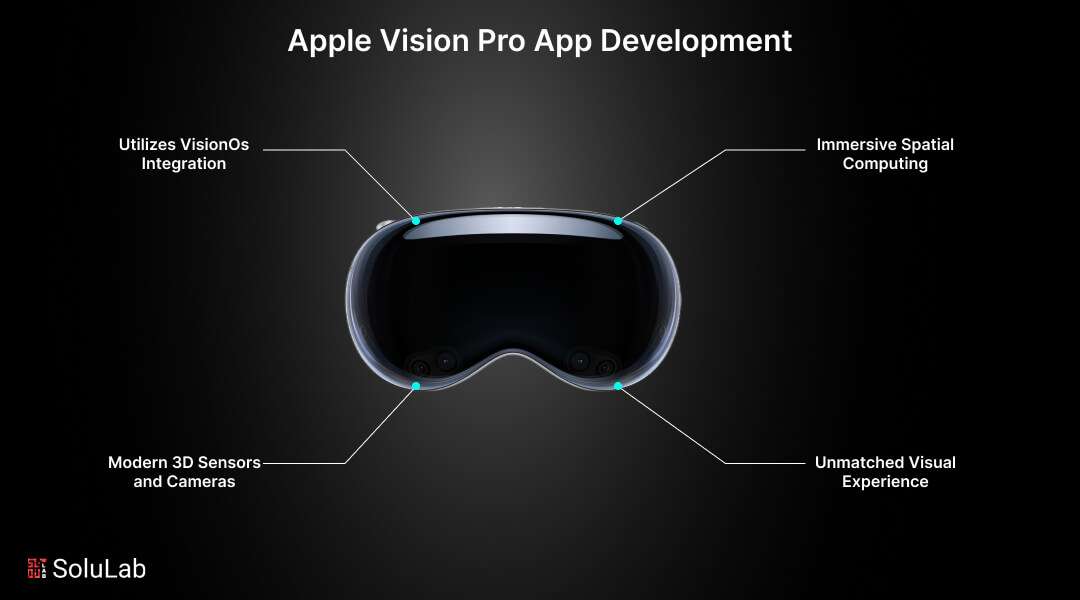
Immersive Spatial Computing
On Vision Pro, spatial computing means apps and content live inside the real world instead of behind a flat screen. Virtual and physical objects share the same space. The result goes well past a conventional interface. You interact with digital material as if it were physically sitting in front of you, and that is a very different feeling from tapping glass.
Utilizes visionOS Integration
visionOS is the operating system that holds this together, and it is built for active, hands-on use. Its inputs are natural and flexible: voice commands, eye movement, hand gestures. Users get around the virtual space easily, and the experience is better for it. Because these inputs are all connected, people can interact with the headset in several different ways and pick whichever feels most convenient in the moment.
Unmatched Visual Experience
Visually, Vision Pro is in a class of its own. Put it on and you are surrounded by imagery driven by very current technology. Dynamic color rendering, high-resolution displays, and tuned graphics combine into something genuinely striking, and they raise the bar for what visual quality on a headset should be.
Modern 3D Sensors and Cameras
Precision comes from the hardware. Synchronized sensors and advanced 3D cameras give Vision Pro a sharp sense of space. The device sees your surroundings smoothly and accurately, which deepens immersion. It also makes it easy to interact with virtual objects placed in the real world.
Use Cases of Apple Vision Pro Apps
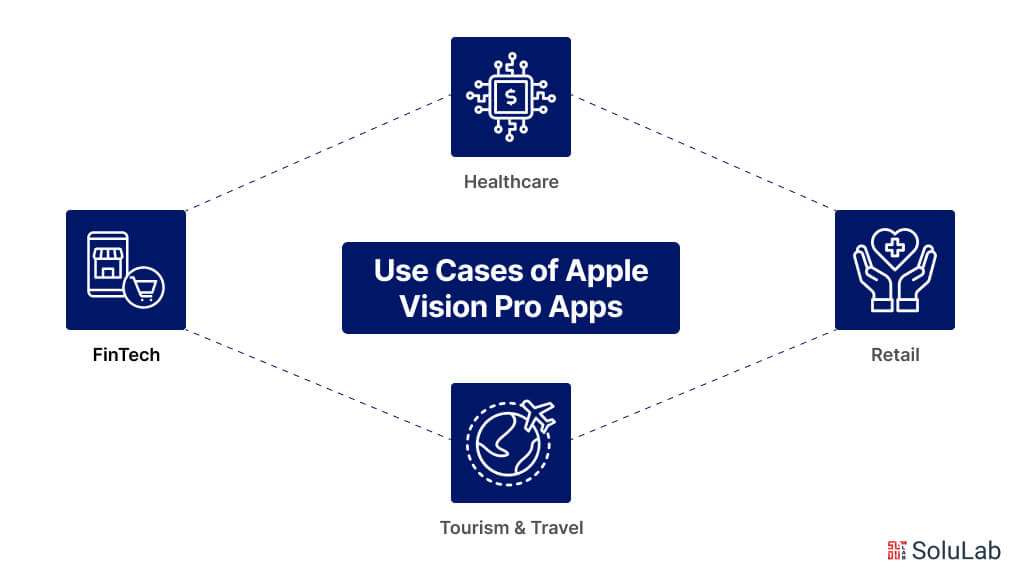
Enterprise apps for Vision Pro are making things possible in healthcare and education that simply were not before. Below are some of the most popular Apple Vision Pro use cases, and how these apps are changing one sector after another.
Healthcare
Medical training is an obvious fit. A Vision Pro app can show clinicians 3D anatomy, walk them through surgical techniques, or run full medical simulations. Patients benefit too: augmented reality apps that visualize anatomy, treatment steps, or medication guidance can help people actually understand what is going on with their own health.
Training scenarios can be repeated as often as needed, and nobody gets hurt. That makes Vision Pro a strong tool for helping medical professionals build advanced skills. AR headsets like this one produce simulations that are realistic and absorbing, which is exactly what medical education needs. Students can practice surgery, diagnose disease, and explore anatomy, gaining hands-on experience with zero risk to a real patient.
Related: Artificial Intelligence in Healthcare: Future Outlook
Retail
eCommerce brands can borrow Vision Pro’s game-like dynamics to give shoppers something better than scrolling through flat product photos. Bring augmented reality into the store experience and customers can try on clothes, accessories, or makeup virtually before they buy. Online shopping gets a lot less like guesswork.
Virtual try-ons for apparel and accessories. AR previews of furniture and home décor. Better ways to discover products. Put together, Vision Pro hands retailers a shopping experience that is lively and hard to ignore.
Tourism & Travel
Vision Pro’s high-definition environments let people visit places virtually and soak up all kinds of travel content. You get around with your hands, eyes, and voice while the app lays navigation details over the view, pointing out landmarks, interesting bits of history, or useful directions. AR in travel and tourism can also sharpen virtual tours by recognizing sites or artifacts on the spot and pulling up information about them.
Then there is the audio. The headset builds a spatial sound field, so noises seem to come from real positions around you. It sounds like a small thing. It is not. The whole experience feels more real, and watching and listening both become more natural and more absorbing.
Education
Hard subjects get easier to care about when you can see them. Vision Pro apps can bring real-time 3D models, historical simulations, and virtual dissections into a lesson, lifting learners’ interest in material that usually loses them. And because the AR content sits right inside the student’s real surroundings, interacting with simulations and 3D models feels natural, which can change what a classroom experience looks like.
It can give students a realistic view of a topic plus practical, hands-on instruction. Stargazing is a nice example. One app lets anyone, beginner or expert, look up and have stars, planets, constellations, and satellites identified automatically.
FinTech
In FinTech, Vision Pro pairs face recognition with augmented reality, and the combination changes what using a financial app feels like. Biometric verification keeps things secure while AR visuals make the data easier to read. Users can get into banking services, complete secure transactions, and work with their financial information without friction.
It is a good illustration of the device’s range. Security, usability, and engagement in financial interactions can all improve at once, and that could reshape FinTech experiences entirely.
Related: Top 10 Fintech Software Development Companies in 2024
Creative Apple Vision Pro App Concepts for Businesses
From AR fitness coaches to lifelike medical simulations, Vision Pro apps are already changing what users expect across many sectors. So which ideas are worth building? Here are some of the strongest Apple Vision Pro app ideas for businesses.
Architectural Visualization Tool
An architectural visualization tool is one of the best-liked concepts, and for good reason: it overhauls how architects and designers work. Professionals can view and manipulate 3D models inside real-world settings with very little effort. Planning and visualization happen in real time, not after a render queue.
Placing digital models into their designs gives architects better spatial awareness and speeds up the design process. It also gives them a lively space to experiment with new ideas in architecture and design. And there is a business angle. A tool like this can open up new sources of income for the professionals who use it.
Virtual Interior Design Studio
A virtual interior design studio built for Vision Pro changes how people make decisions about their homes. Using the headset’s spatial computing, users arrange and inspect furniture and décor right inside the room they actually live in.
They can try out design elements in real time, which helps them land on choices that look good and are properly thought through. Customers get an interactive way to customize and preview their living spaces, and the traditional design process looks very different as a result. Clients end up happier and more engaged. The buying experience improves, too.
Personalized Augmented Shopping Experience App
A personalized augmented shopping app could transform online shopping on Vision Pro. With virtual try-ons, users place clothing and jewelry on themselves in real time and get a realistic look before they commit to buying.
It closes the gap between browsing virtually and picking real fashion items. Shopping gets better for the customer, and the business earns more, riding the growing appetite for online shopping that is personal and genuinely engaging.
Medical Training Simulator
A medical training simulator uses what Vision Pro does well to build a realistic, immersive teaching environment for clinicians. Advanced spatial computing lets it recreate complicated medical procedures, so practitioners can sharpen their skills in a virtual setting that looks and behaves like the real thing.
It makes medical professionals more capable. It also brings in new revenue for the institutions that teach them. With the medical field asking for better, more inventive training resources, this concept is a strong option for healthcare businesses.
Interactive Learning Program
An interactive learning platform is another Vision Pro concept that could reshape education. It uses spatial computing to give students interactive courses and simulations, making the learning environment active and hard to tune out.
Hands-on, immersive lessons do a lot for personalized, active learning. Students engage more and understand more. Schools and training providers get better tailored learning and higher engagement in one move. As demand grows for learning that is dynamic and actually holds attention, institutions that want to stay ahead of competitors will find this concept hard to skip.
Augmented Reality Cooking Assistant App
An AR cooking assistant on Vision Pro makes preparing food simpler and more fun. It projects recipe steps and cooking tips straight onto the kitchen counter, with visual cues that guide the cook through every stage.
Because it is hands-free, it changes how people cook: steps get simpler, confidence goes up, and precision in the kitchen improves. By pairing augmented reality with traditional cooking, the app reinvents how cooking is taught and can become a go-to tool for home chefs. It also taps into the culinary instruction market, which means more confident customers on one side and new income for businesses on the other.
Features & Navigation Panels for the Apple Vision Pro App
Beyond the mixed-reality experience itself, the Vision Pro app offers a set of immersive features and navigation panels that are easy to pick up. Here is how they break down.
Navigation Panels
Navigation in the Apple Vision Pro app is split across a set of panels: a Control Center panel, Home View, Apps View, People View, and Environments View.
Home View Navigation
Everything starts in Home View. It works as a central hub, and the tab bar lets users jump between Apps, People, and Environments.
Apps View
All your apps sit in the Compatible Apps folder. Open several at once and arrange them around your desk however you like.
People View
People View is where you message friends, family, and coworkers, look up contact details, and start FaceTime calls.
Environments View
This one swaps out your surroundings for realistic 3D settings. Pick a scene, then use the Digital Crown to adjust its lighting, music, and how immersive it feels.
Control Center
Control Center shows the time, your battery level, and a few other essentials. It is also your shortcut to Home View and Notification Center.
Features of the General Platform
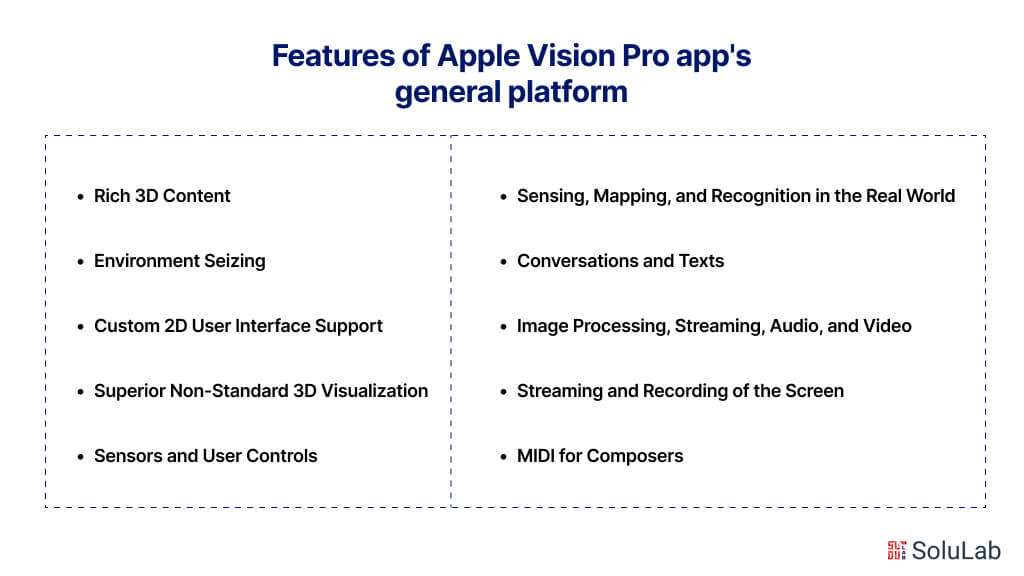
At the platform level, a Vision Pro app can draw on the following:
- Rich 3D Content: RealityKit gives you 3D windows, advanced features such as animation and physics simulation, and straightforward tools for building 3D scenes. It is how an app goes from decent to impressive.
- Complete Environment Seizing: Spaces lets users focus on a single app, with full-screen mode and immersion control for AR apps through the Digital Crown, so they can dial the level of immersion up or down.
- Custom 2D User Interface Support: visionOS still offers familiar 2D windows with standard UI controls, and those windows can show static 3D objects and realistic depth effects for a better user experience.
- Superior Non-Standard 3D Visualization: The Metal framework lets developers build complex 3D visuals, run calculations on the GPU, and apply advanced rendering effects.
- Sensors and User Controls: Your eyes point and your hands act. That pairing is what makes interaction on Vision Pro feel natural. It also connects to other input devices and supports typing through virtual keyboards and dictation.
- Sensing, Mapping, and Recognition in the Real World: ARKit handles flat-surface detection, shape recognition, and environment meshing, blending virtual and physical elements smoothly so AR experiences hold together.
- Conversations and Texts: With CallKit and Message UI, users can handle calls and messages, and developers get room to integrate those features and customize the UI.
- Image Processing, Streaming, Audio, and Video: Spatial audio, strong image processing, and a wide set of video features give Vision Pro users a full multimedia experience.
- Streaming and Recording of the Screen: ReplayKit supports screen recording and streaming, though some visionOS features may need more investigation before you rely on them.
- MIDI for Composers: Core MIDI support lets apps talk to MIDI devices, which is what musicians and music fans need.
Final Words
Apple Vision Pro gives businesses a rare opening into a fast-growing market for immersive experiences. Its advanced augmented reality (AR) capabilities make room for apps that deliver far more engagement and usefulness than users are used to. SoluLab, as a top AR app development company, works with clients to build apps in the style of Apple Vision Pro. Our specialists use modern technologies such as AR to create solutions that look great and pull people in. We take a user-centered, agile approach, so each app matches what the client is trying to achieve, with advanced features like smooth visual comprehension, AR simulations, and interactive 3D models built in.
Our developers know visionOS well, and we keep a close eye on new technology so we can adopt it early. If you want to take your business further, talk to our team. We can plan a path toward innovation and quality together and keep your projects ahead of where the technology is going. The first step is simple: contact SoluLab’s team to learn more about Apple Vision Pro app concepts.
FAQs
Shipra Garg is a tech-focused content strategist and copywriter specializing in Web3, blockchain, and artificial intelligence. She has worked with startups and enterprise teams to craft high-conversion content that bridges deep tech with business impact. Her work translates complex innovations into clear, credible, and engaging narratives that drive growth and build trust in emerging tech markets.