Mobile phones are no longer just communication devices. Now, they’ve become our health trackers, shopping assistants, and personal advisors.
AI in mobile phones brings undeniable benefits such as personalization, efficiency, security, and productivity. At the same time, it introduces challenges, privacy concerns, data dependency, and over-reliance on technology.
Personalization is one of the clearest wins: personalized onboarding alone can lift Day-7 app retention by up to 20 percentage points (Userpilot, 2026 App Retention Benchmarks), and AI features overall are now a genuine satisfaction driver rather than a novelty, scoring 85/100 in their first year measured by the American Customer Satisfaction Index, nearly matching core functions like calling and texting (ACSI, 2026 Telecommunications, Cell Phone, and Smartwatch Study), and AI-driven camera enhancements boosted user satisfaction by around 30%. In this blog, we’ll break down:
How AI is improving mobile experiences. The advantages we can’t ignore. By the end, you’ll know what you can do using AI mobile phones and more. Let’s get started!

How AI In Mobile Devices Enhances Efficiency and User Satisfaction?
Artificial Intelligence (AI) in mobile devices is transforming everyday experiences by making smartphones smarter, faster, and more personalized, enhancing efficiency, reducing effort, and boosting overall user satisfaction.
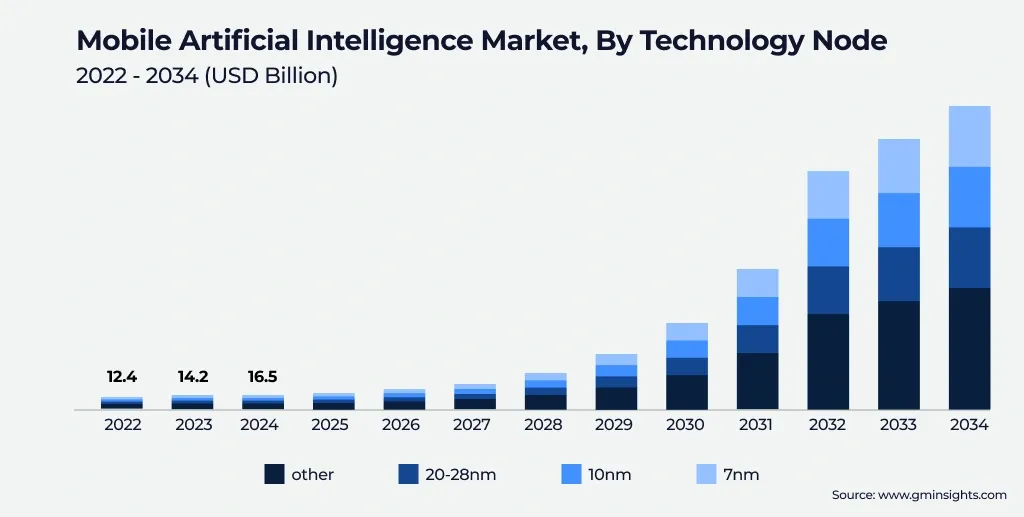
The global mobile AI market was valued at USD 25.53 billion in 2025 and is projected to reach USD 258.13 billion by 2034, growing at a CAGR of 29.32% (Fortune Business Insights, 2026).
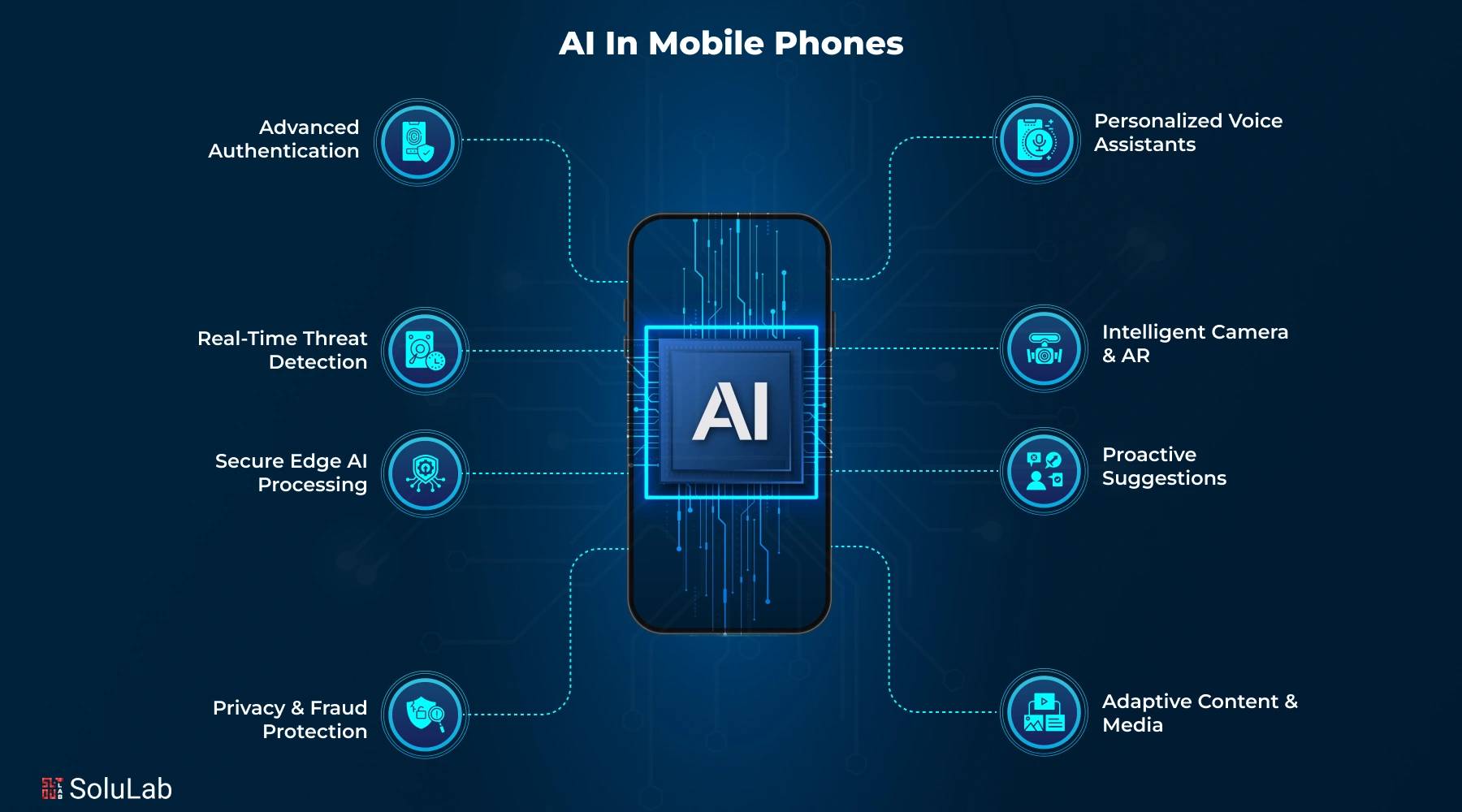
- Smarter Virtual Assistants: AI-powered personal assistants like Siri, Google Assistant, and Alexa help users set reminders, answer queries, and perform tasks hands-free, saving time and effort.
- Personalized Recommendations: From music playlists to shopping suggestions, this type of AI-driven personalization is also used in ad servers, which analyze user interactions to deliver optimized, real-time ads, similar to how AI in mobile phones improves user engagement and experience.
- Improved Battery Management: AI optimizes power usage by predicting app activity and adjusting performance, ensuring longer battery life without compromising on speed.
- Enhanced Security: With AI-driven facial recognition and fingerprint scanning, mobile devices offer faster, safer, and more reliable security for users.
- Camera Intelligence: AI improves mobile photography by automatically adjusting lighting, detecting scenes, and enhancing image quality, helping users capture professional-level photos.
- Predictive Typing & Voice Recognition: AI-powered keyboards and voice recognition reduce typing errors, suggest words, and understand speech better, making communication faster and easier.
Benefits of AI Integration In Mobile Phones
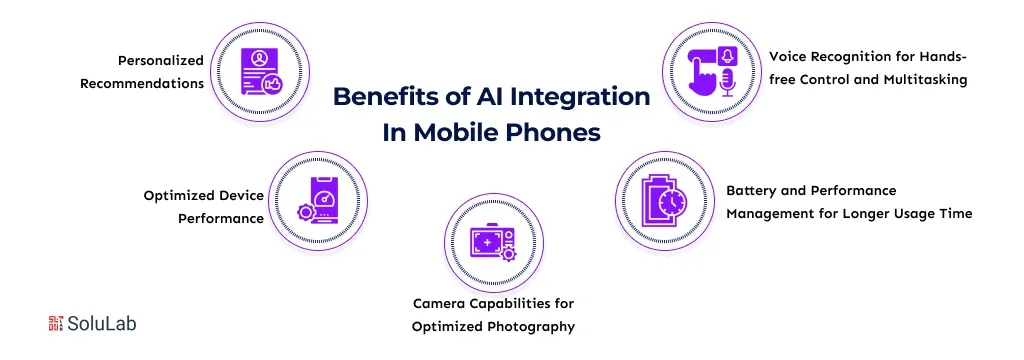
The benefits above show up as concrete daily wins rather than abstract capability. Personalization means the phone surfaces the apps, content, and settings you actually reach for, so less time is spent hunting. Performance management keeps multitasking smooth and stretches battery life by predicting which background processes matter. On the creative side, AI photography features like scene recognition and real-time editing let non-experts capture professional-looking shots, and voice control turns calling, texting, and searching into hands-free tasks that support accessibility. Rather than a separate feature list, treat these as the payoff of the assistants, camera, battery, and security systems already described.
Use Cases of AI in Mobile Devices
AI is now being used in every industry. Here are a few industry-specific AI use cases:
1. Healthcare: AI-powered apps track vitals, monitor chronic conditions, and provide early diagnosis. Mobile devices use AI for virtual health consultations, making medical support accessible anytime, anywhere.
2. Retail & E-commerce: AI in shopping apps enables personalized product recommendations, smart search, and virtual try-ons. It improves customer experience by predicting buying behavior and tailoring offers in real time.
3. Finance & Banking: Mobile banking apps use AI for fraud detection, personalized financial advice, and customer support via chatbots. It ensures secure transactions and smarter financial management for users.
4. Education: AI-driven learning apps offer personalized lessons, adaptive quizzes, and instant feedback. Students benefit from interactive learning experiences, and making education more engaging and effective.
5. Entertainment & Media: Streaming apps apply AI to recommend movies, songs, and shows based on user preferences. It enhances user engagement while reducing content overload.
6. Travel & Hospitality: AI chatbots assist with bookings, itinerary planning, and language translation. Mobile apps use AI to provide real-time recommendations for hotels, restaurants, and attractions.
7. Academic Assistance: AI-powered mobile apps support students with research guidance, content organization, grammar enhancement, and essay writing assistance, helping them complete assignments more efficiently and improve their writing quality.
Real World Examples of AI in Mobile Phones
Mobile phones are no longer just communication tools; they embed advanced AI agents in smartphones to enhance photography, resource management, and personalization; combined with AI + 5G + Edge Computing, they provide smarter, faster user experiences.
1. Google Pixel: AI-Driven Photography Excellence
Google’s recent Pixel models use features like Magic Editor, Auto Frame, Add Me, Best Take, and Zoom Enhance to improve photos (adjust framing, remove unwanted objects, combine multiple shots). Additionally, AI Agents in smartphones appear in Pixel devices via Camera Coach, an assistant that gives suggestions on lighting, angle, etc., helping users take better photos
2. Apple iPhones: Personalized User Experience with Siri and Face ID
Apple’s Neural Engine powers Face ID (secure facial recognition) and also enables on-device AI processing. With the new Apple Intelligence, Siri now offers richer personalization, including onscreen awareness so it can act on screen content, plus cross-app actions like pulling up flights or playing podcasts from messages.
3. Huawei Mate Series: AI-Powered Resource Management and Photography
The Huawei Mate 10 introduced a dedicated NPU (Neural Processing Unit) for on-device AI, enabling smart battery management, real-time scene/object recognition, and AI-bokeh effects using the Kirin chip. Huawei’s Mate line pioneered on-device AI photography, and its current flagship, the Mate 80 series (Mate 80, Mate 80 Pro, Mate 80 Pro+, and Mate 80 RS, unveiled in 2026), carries that forward with Master AI, which automatically detects the scene and subject, spanning categories like scenery, food, and pets, and adjusts color, contrast, and exposure accordingly, plus AI Composition, which offers real-time framing guidance (Huawei, Mate 80 Pro product pages, 2026). Huawei has not published an updated scene-count figure for this generation the way it did for the 2018-era Mate 20 (over 1,500 scenarios), so that older number should not be reused.
Future Potential of AI in Mobile Technology
Artificial Intelligence (AI) is changing the future of mobile technology, driving innovation across industries. From smarter health tracking to gaming, AI is getting improved and redefining how we use smartphones daily.
- AI-Driven Health Features: AI-powered apps and sensors can detect health issues early, track fitness goals, and monitor vitals like heart rate or oxygen levels, turning smartphones into portable health assistants.
- Smartphone Integration with IoT Ecosystems: AI enables smooth communication between smartphones and IoT devices like smart homes, cars, and wearables, creating interconnected ecosystems where devices “talk” and adapt to user habits effortlessly.
- Improved Mobile Gaming Experiences: AI enhances gaming with real-time graphics optimization, adaptive difficulty levels, and personalized in-game recommendations, offering gamers a richer, more immersive experience tailored to their skills.
- Integration with 5G Networks: AI combined with 5G will enable ultra-fast, low-latency mobile services This will power AR/VR apps, cloud gaming, and real-time data processing like never before.
Sentiments Among Smartphone Users With AI
Users of smartphones are adopting AI features more and more because they notice how these advancements improve security, ease everyday life, encourage creativity, and facilitate interactions, particularly through voice assistants that shape digital convenience.
1. Enhanced Convenience: Reminders, navigation, and intelligent recommendations are all made easier by AI-powered solutions. Users may use their smartphones more quickly, easily, and individually because of their efficiency.
2. Putting Faith in AI-Enhanced Security: Confidence is increased by features like fraud alerts, fingerprint scanning, and facial recognition. Knowing that their gadgets have clever measures in place to secure sensitive data makes users feel safer.
3. Improvement in Creativity: AI tools enable innovation in anything from photo editing to content creation. Users take an interest in discovering new concepts and effortlessly generating products of expert quality.
4. Increasing Use of Voice Assistants: Alexa, Google Assistant, and Siri are now commonplace. In daily life, users depend on them for hands-free convenience, fast responses, and multitasking.
Conclusion
The through-line across every section above is that AI has shifted the phone from a tool you operate to one that anticipates you, and that shift is what raises both convenience and security at the same time. The open question for most organizations is not whether to adopt these features but how to integrate them without compromising user data
Digital Quest, a travel business, partnered with SoluLab to develop an AI-powered chatbot using Generative AI.
The chatbot enhanced customer engagement by offering real-time, personalized travel recommendations and hassle-free reservations. It also integrated user feedback and multi-language support, resulting in improved user experience and high ROI.
SoluLab, an AI app development company, can help you integrate AI into your Apps from scratch. Get in touch with us today.
FAQs
Shipra Garg is a tech-focused content strategist and copywriter specializing in Web3, blockchain, and artificial intelligence. She has worked with startups and enterprise teams to craft high-conversion content that bridges deep tech with business impact. Her work translates complex innovations into clear, credible, and engaging narratives that drive growth and build trust in emerging tech markets.