Key Takeaways
- Autonomous shopping assistants read preferences, behavior, and what someone actually bought last time, then recommend accordingly.
- Discovery gets shorter. Thousands of SKUs collapse into a shortlist the shopper can actually work with.
- Comparison stops being homework: price, features, reviews, ratings, all lined up in one view.
- Competition in eCommerce keeps tightening, and shopping agents are turning into the tool that carries personalization.
For years, buying something online meant doing the work yourself. Search. Compare. Second-guess. Retail and ecommerce ran on manual steps, and personalization was mostly a promise nobody kept.
Intent was the blind spot. Businesses could see clicks but not reasons, so opportunities slipped, carts sat abandoned, and the experience broke apart the moment a shopper switched channels.
That gap is what AI agent development closes. Data gets analyzed, decisions get automated, interactions get personal. And the three steps that matter most, discovery, evaluation, purchase, are being rebuilt around agents.
What Does “AI Agents in Ecommerce and Retail” Actually Mean?
AI agents for ecommerce and retail are software systems that go past assisting. They read data, decide, and then act on their own inside shopping workflows.
You rarely see them. They sit across systems, wired into product catalogs, customer data, inventory, and checkout, quietly improving how shopping runs for the business and the buyer at the same time.
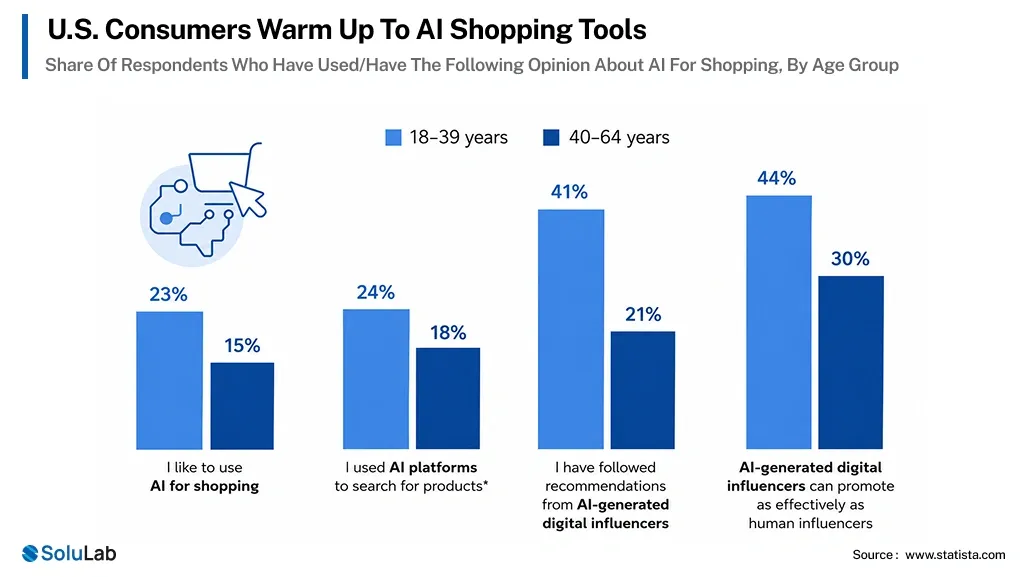
Recent data from Statista Consumer Insights puts it plainly: roughly one in five Americans used an AI platform to search for products while shopping over the past twelve months.
So what can an agent actually do?
- Work out what a customer is really after
- Put the most relevant products in front of them
- Shift pricing or promotions while the session is live
- Fire off actions like cart recovery or a restock request
How Are AI Agents Integrated Across Ecommerce and Retail Systems?
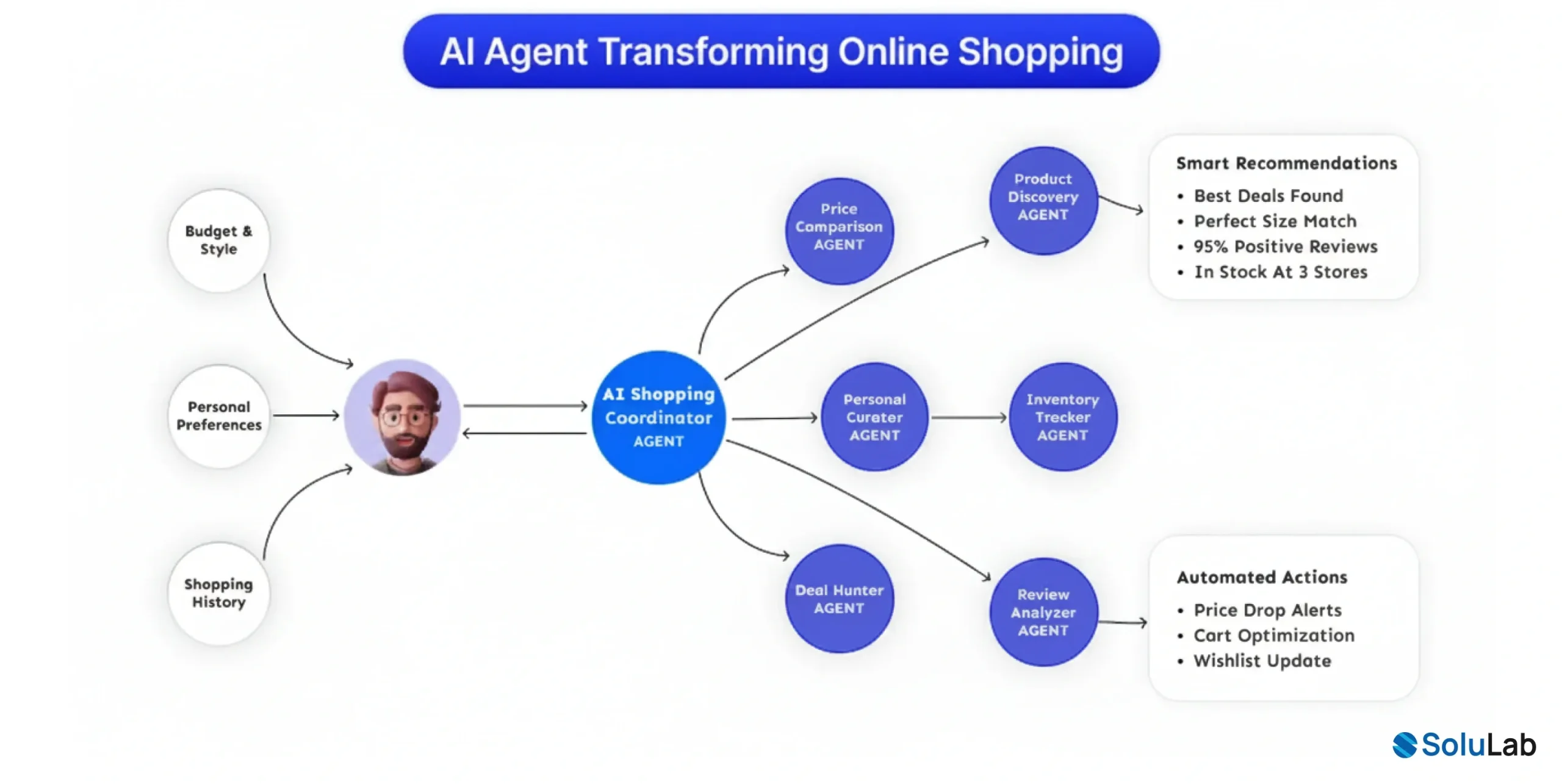
AI agent systems go deep rather than sitting on top. They tie data to workflows, automate the decisions and the operations behind them, and make personalized shopping work at a scale humans cannot staff for.
Shopping assistants hook straight into core business systems, which is what makes real-time data flow and intelligent automation possible across the whole journey.
1. Product Catalogs and Merchandising Systems
Agents built for ecommerce stores connect to the product database itself, then manage, update, and tune listings on the fly using live signals and generative output.
- Product data stays in sync, live
- Tagging and categorization happen automatically
- Copy and descriptions get generated
2. Customer Data and Behavior Tracking
Online shopping agents read interactions alongside historical data, build a profile out of both, and use it to personalize across every channel a shopper touches.
- Tracks browsing and purchase patterns
- Builds customer profiles in real time
- Makes hyper-personalized recommendations possible
3. Checkout, Payments, and Order Systems
AI retail assistant sit inside the transaction layer, where friction costs the most. Less drag, better conversion, a tighter final mile.
- Checkout flows tuned on the fly
- Upsells and bundles driven by the model
- Transactions that finish fast
4. Inventory and Supply Chain Systems
On the back end, shopping agents forecast demand, hold stock at sane levels, and keep fulfillment from turning into guesswork.
- Predicts demand from historical data
- Updates stock levels in real time
- Tightens supply chain operations

How Do AI Agents Enhance the End-to-End Shopping Experience?
AI agent orchestration is rewriting the shopping journey end to end. It links the data, reads intent early, automates the calls in between, and the result is a path from first look to paid order that feels quicker and far more relevant.
1. Product discovery becomes intent-driven
Keywords were always a crude proxy. AI-powered discovery reads search patterns and context together to figure out what a shopper actually wants, and surfaces matching products on the spot.
2. Personalized recommendations across channels
One unified customer profile feeds the site, the app, the email, even the in-store screen. Same person, same context, same recommendations, which is exactly why engagement and conversion move.
3. Faster decision-making for users
Too many options is its own kind of failure. Curated picks, side-by-side comparisons, and live detail cut the overload so people buy with confidence instead of closing the tab.
4. Reduced friction from search to checkout
Retail-side shopping agents simplify navigation, take over repetitive steps, and stay present through checkout, so the buying path holds together instead of falling apart at payment.
Read More: Agentic AI for Retail Merchandising
How Should Businesses Approach AI Agent Integration in Ecommerce and Retail?
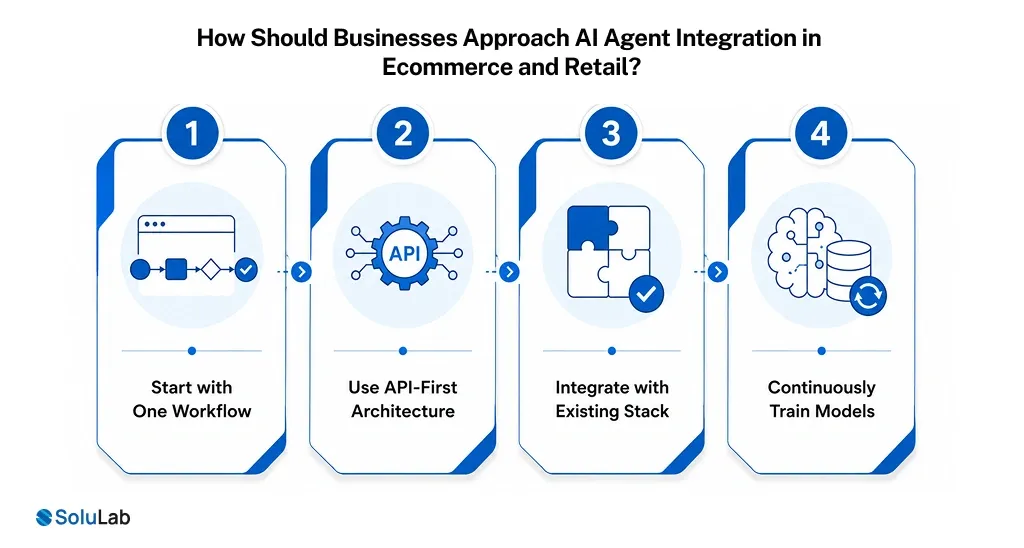
Rolling AI into e-commerce and retail needs structure, not enthusiasm. Tie the technology to a business goal, keep the integration clean, measure the outcome, then improve it, on both the customer side and the operational side.
1. Start with One Workflow
Pick one use case. Product recommendations, say, or customer support. A narrow scope ships sooner, keeps complexity down, and shows your team how agents behave once real customers are involved rather than test data.
2. Use API-First Architecture
Build the strategy on APIs. Systems talk to each other cleanly, integrations land faster, and upgrading a piece later does not mean tearing into the ecommerce or retail infrastructure you already depend on.
3. Integrate with Existing Stack
Do not rip and replace. Connect agents to the CRM, the inventory system, the payment layer you already run. Continuity stays intact, costs stay lower, and capability grows without a rebuild nobody budgeted for.
4. Continuously Train Models
An agent is only as current as its last update. Feed it customer interactions, sales numbers, behavioral signals on a schedule, or recommendations drift out of step with what the market and your users are doing now.
Real-World Use Cases of AI Agents in Online Shopping
AI agents in ecommerce and retail are producing results right now, not in a pilot deck. They automate decisions, personalize interactions, and tighten operations across customer journeys, supply chains, and the workflows that actually generate revenue.
1. Personalized Product Recommendations
Browsing behavior, purchase history, and whatever the shopper is doing this minute all feed the same model. Discovery improves, engagement climbs, and conversions follow because people are shown what they were probably going to buy anyway.
2. AI-Driven Cart Abandonment Recovery
Someone walks away with three items in the cart. The agent notices and follows up by email, chat, or push, and the message is personalized rather than a generic nudge. That is how abandoned sales come back and checkout completion goes up.
3. Pricing Optimization
Demand, competitor prices, stock levels: all three watched constantly, with prices adjusted in real time. You stay competitive without giving away margin, and you react the moment conditions shift.
4. Intelligent Inventory Management
Historical data plus trend signals give a demand forecast worth acting on. Stock levels get set against it, which cuts both overstocking and stockouts, keeps products available, and trims what you pay to store the rest.
5. Conversational Commerce
Search, compare, and buy through chat or voice. The agent reads intent, answers questions on the spot, and walks the customer through the purchase. Shopping starts to feel like a conversation instead of a form.
6. Fraud Detection and Risk Monitoring
Transactions get watched as they happen, and odd patterns get flagged or blocked before money moves. Both sides are protected, and trust in the storefront holds.
What Challenges Do Businesses Face When Implementing AI Agents?
On paper, agents in ecommerce and retail look straightforward. Adoption is where it gets messy. Technical debt, operational habits, and scattered data all push back, and each one has to be dealt with before integration holds up and scales.
1. Data Silos
Customer records here, product data there, transactions somewhere else entirely. An agent cannot see a whole picture that does not exist, and both personalization and decision accuracy suffer for it.
Solution: Bring it together with a centralized data platform, APIs, or a data lake so information can move.
2. Integration Complexity
Wiring agents into your ecommerce platform, CRM, and backend takes real engineering hours, and it takes more of them when none of those systems were ever built with AI-first workflows in mind.
Solution: Go API-first, add a middleware layer, and keep the integration modular so deployment stays manageable.
3. System Compatibility
Legacy infrastructure often cannot carry modern models or real-time processing at all. Bottlenecks show up, and automation stops short of what you planned.
Solution: Upgrade the pieces that matter, or lean on cloud AI services that integrate without a full replacement.
4. Privacy Concerns
Agents run on customer data, which puts security, compliance, and trust squarely on the table, especially under GDPR and the privacy rules still being written.
Solution: Put real data governance, encryption, and compliance frameworks behind it so usage stays secure and responsible AI.
How AI Agents Create Personalized Shopping Experiences That Drive More Sales?
Shoppers now assume a brand knows their preferences, sees what they need next, and recommends it without being asked. AI is what makes that assumption survivable: behavior gets read, and every step of the journey gets tailored around it.
1. Personalized Product Recommendations
Browsing history, past purchases, stated preferences. The model reads all three and puts forward products that match an individual, not a segment.
- Relevant products for every shopper
- Better discovery experience
- More conversion potential
2. Customer Journey Customization
Page content, promotions, and recommendations shift while the session is still running, based on what the shopper is doing.
- Offers and promotions that fit
- Shopping experiences built per person
- More engagement
3. Smarter Search and Product Discovery
With eCommerce AI agent development, intelligent search and a conversational assistant get shoppers to the right product in far fewer steps.
- Search in plain language
- Faster discovery
- Less effort asked of the customer
4. Predictive Shopping Experiences
Intent shows up in the data before it shows up in a cart. Reading it early lets you recommend at the moment it lands instead of a week later.
- Anticipates customer preferences
- Recommends before being asked
- More repeat purchases
5. Personalized Cross-Selling and Upselling
Complementary items and higher-value alternatives get suggested off actual interests and buying patterns, not a static rule someone wrote in 2019.
- Add-ons that make sense
- Higher average order value
- More room to sell
6. Real-Time Customer Engagement
Shopping assistants answer immediately and stay useful the whole way through the purchase, not just at the top of the funnel.
- Help the moment it is needed
- Support that does not vary by channel
- Happier customers
Future of AI Agents in Shopping in Ecommerce and Retail
Where is this heading? Toward shopping that runs itself, reads intent, and fits the individual:
1. AI as Core Infrastructure
The add-on phase is ending. Agents are becoming an operational layer inside ecommerce and retail systems, carrying automation, personalization, and scale for the whole business rather than one feature of it.
2. Conversational and Voice Commerce Growth
Buying gets more like talking. Through conversational AI and voice, a shopper describes what they want and the agent handles discovery, comparison, and checkout from there.
3. Predictive and Proactive Commerce
Reaction gives way to anticipation. Agents will see the need forming and act on it, suggesting a product, replenishing a staple, or dropping an offer at the moment it will land.
How Can SoluLab Help Integrate AI Agents into Your Ecommerce Business?
SoluLab is an AI native firm. We put agents into ecommerce systems so automation, personalization, and better decisions run across the customer journey, daily operations, and the backend workflows nobody sees but everyone feels.
- AI shopping agent development
- Conversational AI and chatbot solutions
- AI-powered search and discovery systems
- Ecommerce platform API integration
- CRM and ERP system integration
- Payment gateway and checkout integration
- Product catalog and PIM integration
- Data pipeline and middleware integration
- Cloud and microservices architecture setup
- Third-party tool and marketplace integration

Conclusion
Shopping built on AI is quicker, more personal, and connected across systems that used to sit apart. That is the whole shift for ecommerce and retail.
Discovery, checkout, and whatever happens after the order: friction drops at each one, and decisions get easier to make.
If you’re ready to build this out or push it further, SoluLab, an AI development company, can design, integrate, and deploy tailored AI-driven solutions.
FAQs
Neha is a curious content writer with a knack for breaking down complex technologies into meaningful, reader-friendly insights. With experience in blockchain, digital assets, and enterprise tech, she focuses on creating content that informs, connects, and supports strategic decision-making.