Tree-based businesses handle massive value across the world, but the work on the ground often looks outdated as a lot of tracking still happens on paper, in spreadsheets, or in tools that were never meant to work together. That gap is exactly where problems slip in, as illegal wood trade continues to thrive, money leaks into the shadows, and forests keep disappearing at scale.
Even well-run agro-forestry companies feel this pain, as fraud and weak visibility add to the damage, quietly costing the agriculture sector billions over time. Buyers, regulators, and global partners don’t rely on verbal promises or basic paperwork anymore, because those can be changed, missed, or easily faked. Because of this, Blockchain in agriculture is growing fast, with the blockchain market projected to reach $95.26B by 2035.
This is where Blockchain Applications in Forestry become practical. By keeping shared, tamper-resistant records for trees, raw materials, and finished products, blockchain fills gaps that older systems simply can’t. This is what modern, global green supply chains actually need to grow without friction.
How Blockchain Technology in Agriculture Brings Trust Back to Agro-Forestry?
Tree-based industries move huge money around the world, but the way things run on the ground hasn’t changed much. Old systems like Paper files, spreadsheets, emails, and systems that don’t connect but still dominate day-to-day work. Because of that, a big part of the global wood trade, which is around 15–30%, ends up illegal, creating a $23B black market and wiping out close to 10 million hectares of forest every year. Even serious agro-forestry businesses find it hard to clearly prove where material came from or whether it actually meets sustainability rules.
When people talk about blockchain development in agro-forestry, it’s not really about new tech, it’s about fixing trust problems that already exist. Traditional setups depend on slow data movement, manual checks, and middle players, which means records can be changed, and certifications are hard to verify. That’s why buyers often pause, deals take longer, and prices get pushed down. When trust is missing, premium markets usually stay out of reach, even for good operators doing the right thing.
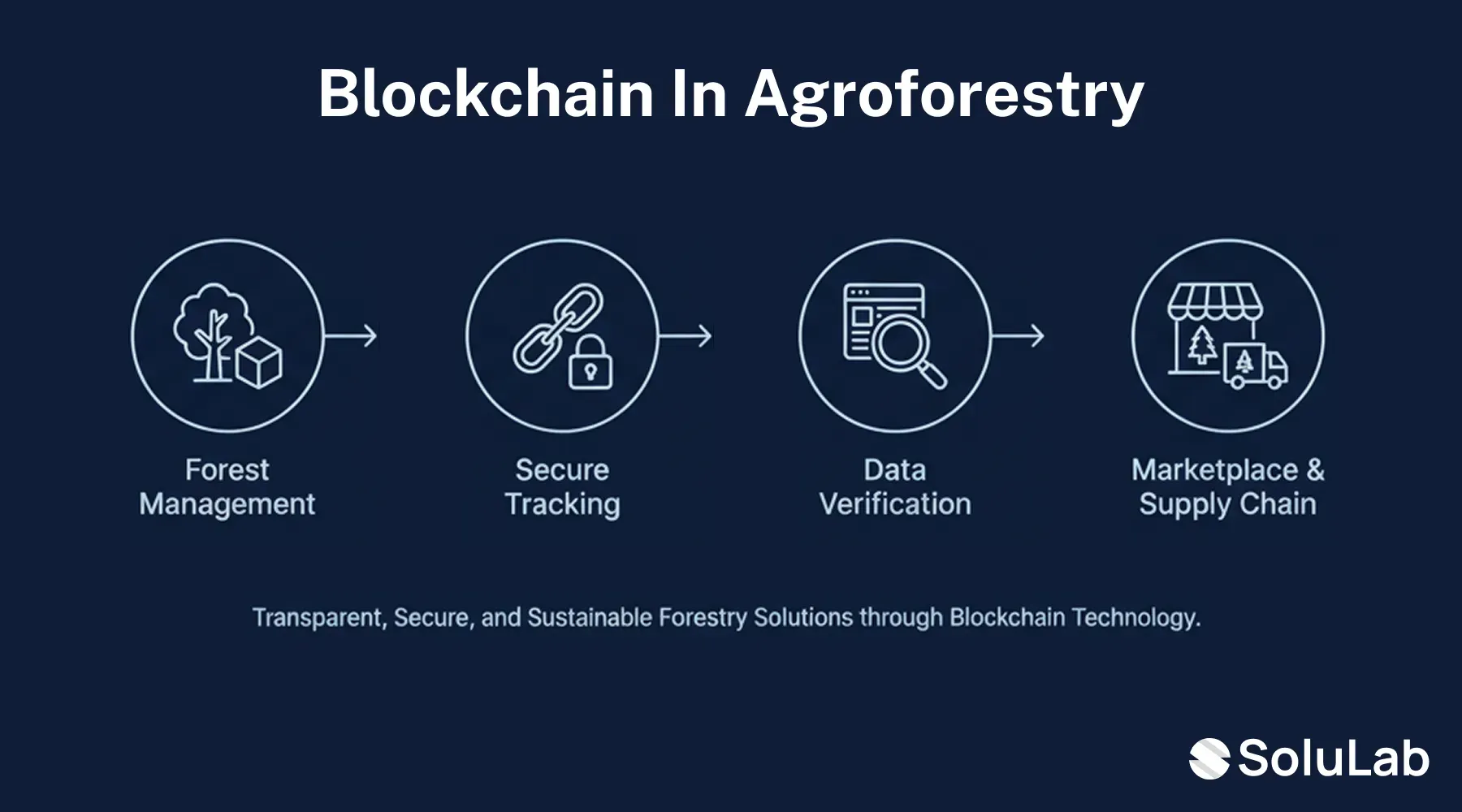
Blockchain changes this by putting everyone on the same page. Instead of each party keeping its own files, blockchain applications in agriculture keep key events in one shared record, like when a tree is planted, how it’s managed, when it’s harvested, and how it moves through processing and transport. The data follows the product, not the paperwork. Sustainability data travels with the asset, which makes verification easier for buyers, auditors, and regulators without endless back-and-forth.
Once this information is on-chain, it can’t be quietly changed later, and that’s the real shift. From a business angle, this lets agro-forestry companies prove sustainability rather than just talk about it. As it cuts disputes, reduces fraud, builds buyer confidence, and helps verified products command better pricing in export markets.
This is already happening in practice. Platforms like IBM Food Trust, Open Forest Protocol, Treejer, GainForest, and Veridium use blockchain to track trees, measure environmental impact, and link real forestry assets to digital records. At the end, the goal is to hold up when money, audits, and regulations are involved by using Blockchain.
Key Problems in Tree-Based Industries Solved by Blockchain Applications in Forestry
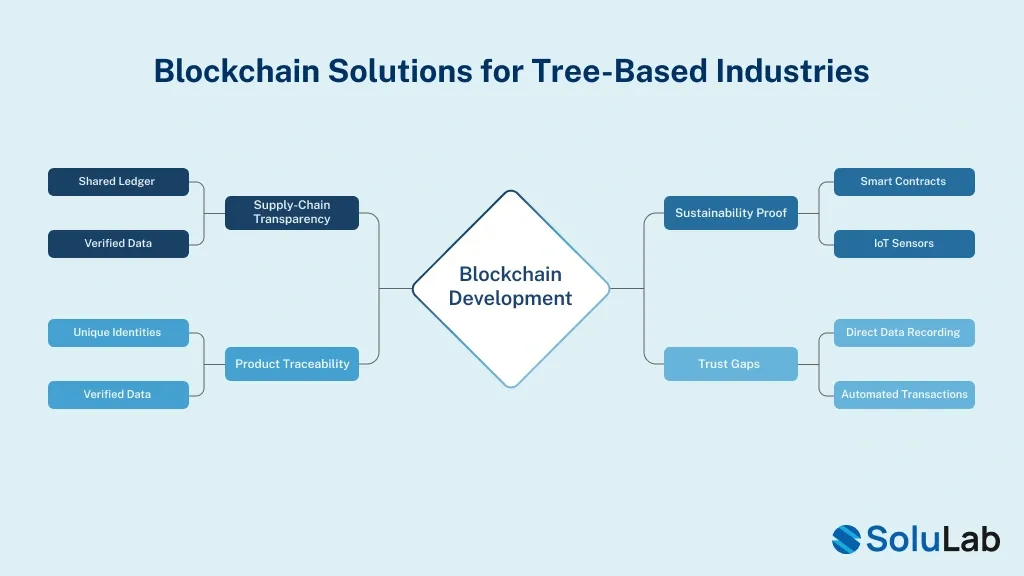
Tree-based industries like forestry, agro-forestry, timber, furniture, paper, and plantation products all face the same core issue, like a lack of trust, visibility, and proof at scale. This is exactly where blockchain development creates real business value. So, let’s break it down clearly.
1. Lack of Supply-Chain Transparency
The real issue starts very simply: most businesses don’t actually know where their wood or tree-based products come from. A buyer in Europe might receive timber from Southeast Asia, the paperwork looks clean, and everything seems approved, but there are still big gaps, like
- Was the permit real
- Did the forest owner truly approve it
- Was the wood taken from the forest mentioned in the documents
In practice, there’s no easy way to check this. Physically visiting sites doesn’t scale, especially when supply chains cross countries and continents. This is where blockchain-based supply chain systems make sense. Instead of relying on trust and paperwork, every step gets recorded on a shared ledger, like forest owner, logger, transporter, processor, distributor, retailer, all writing data that’s time-stamped and permanent. Once it’s there, it can’t be changed later.
The same logic applies to agriculture. When a farmer records crop or harvest data on-chain, it becomes verifiable and traceable from day one. By the time the product reaches a buyer or consumer, its entire journey is visible on chain. A good real-world example is Shan Liang Taste, which connects farmers, processors, distributors, and retailers through a single blockchain system where every transaction can be checked, not just claimed.
2. No Verifiable Sustainability Proof
Sustainability is another area where the problem isn’t intent, it’s proof. Many companies say they follow sustainable forestry or farming practices, but claims are easy to fake and hard to back up on paper. Traditional audits happen once or twice a year, which costs a lot, and only show a moment in time. What happens between audits, like illegal cutting, chemical misuse, and labor issues, often goes unseen.
With blockchain development, sustainability proof becomes continuous instead of occasional. Smart contracts and IoT sensors can collect data automatically and store it on-chain as transaction happens. Things like tree growth, carbon capture, soil health, air quality, and even fire risk can be tracked without any manual reporting. The data is always there, updated, and verifiable.
Smart contracts also enforce rules directly. If harvesting follows approved plans, payments go through. If rules are broken, payments stop. Trust moves from people to code. VeriTree on Cardano is a strong example, as they track reforestation using on-ground sensors and store growth and carbon data on-chain, so donors and businesses see real proof, not marketing slides.
3. Fragmented Product Traceability
Today, traceability is fragmented across emails, PDFs, spreadsheets, and phone calls. For Example, imagine a furniture manufacturer sourcing wood from multiple suppliers:
- One claims FSC certification
- Another claims sustainable harvesting
- Another claims community impact
Verifying this means chasing documents and waiting weeks or months, and Blockchain technology unifies traceability into one system. Each tree-based product or batch gets a unique on-chain identity, as it moves through the supply chain, every handler adds verified data like Origin, Harvest date, Certifications, Transport details, and Processing data.
All parties see the same version of the truth. In agriculture, this works the same way, for example, a batch of coffee beans can have Farm location, Harvest date, Weather conditions, Processing method, and Storage details, all recorded on blockchain.
4. Trust Gaps Between Producers and Buyers
Trust is where most of the money leaks. Farmers and forest owners rarely sell directly because buyers can’t check quality or sustainability claims on their own. So middlemen step in. Each layer takes a cut, pays the producer less, and makes the supply chain harder to see.
Blockchain changes how this works. Producers can write real information on-chain like harvest quality, sustainability data, certifications, and labor standards. Buyers don’t need to trust anyone. They can check the data themselves, straight from the source.
Once terms are agreed, smart contracts take over. Quality and delivery are verified on-chain, and payment is released automatically. No chasing invoices or disputes. AgriDigital proved this works at scale. It ran the first blockchain-based grain payment and now processes over $360M a year, serving 1,300+ users and moving 1.6 million metric tons of grain.
How Blockchain Use Cases Are Fixing Trust and Traceability in Tree-Based Supply Chains?
Tree-based industries struggle with one core problem, which is trust at scale. Buyers want proof, regulators want data, and brands want to show sustainability, but most forestry and agro systems still rely on paperwork, spreadsheets, and manual audits.
This is where blockchain development becomes a real business advantage, as Blockchain creates a single, shared source of truth for the entire supply chain from planting to final product.
1. Tokenizing Trees and Forestry Products on Blockchain
A token is just a digital record on a blockchain that represents something real. In agro-forestry, that something can be a tree, a group of trees, a log, a batch of harvested wood or even a carbon or biodiversity credit. When you tokenize a tree, you are creating a digital twin of that tree on a blockchain.
Here’s how it works in real life. The moment a tree is planted, a token is created on a blockchain platform. That token stores key data such as:
- GPS location
- Tree species
- Planting date
- Expected harvest timeline
- Sustainability certifications
- Compliance data like FSC, EUDR, carbon programs etc.
As the tree grows, new data is added. Sensors, satellite images, or field reports update the token with growth, health, and environmental data and every update is permanent and tamper-proof. When the tree is harvested responsibly, the token does not disappear. Instead, it evolves.
- A standing tree token becomes log tokens.
- One tree can become multiple logs.
- Each log stays linked to the original tree.
By the time wood reaches a furniture brand or construction company, they are not guessing where it came from. They can verify everything, like forest, location, compliance, and sustainability, directly on the blockchain.
This is not a theory, as Blockchain platforms already track soy, coffee, and timber globally. In 2025, tools like FSC Trace and ForestGuard are actively using blockchain to meet EU deforestation rules and reduce fraud in cross-border trade, and even startups like Forest Protocol are implementing this.
So, tokenization can lower fraud risk, speed up audits, ease compliance, and higher buyer trust. So don’t wait for the right time.
2. Role of NFTs in Representing Tree-Based Assets
NFTs are often misunderstood but in reality, they are perfect for forestry. As an NFT represents something unique, and no two trees are the same. In blockchain development for agro-forestry, NFTs are used to represent:
- Individual high-value trees
- Forest sections
- Timber lots
- Reforestation zones
- Verified impact assets
This is because an NFT can store satellite images, survey reports, timber quality data, legal permits, and environmental assessments
Owning the NFT means owning the digital rights and proof linked to the real-world asset. For example, the Sproutly, VeriTree with Cardano initiative has already tokenized over 1 million trees. Each NFT is tied to exact GPS coordinates, planting photos, and verification data. This completely removes greenwashing.
For enterprises, NFTs become Proof of sourcing, impact, ESG reporting, and Proof for customers. This is where NFTs stop being art and start being infrastructure.
3. Soulbound Tokens as Proof of Ownership, Impact, and Compliance
Now we move to the trust layer. Soulbound Tokens (SBTs) are blockchain tokens that cannot be sold or transferred as they stay permanently linked to a wallet or identity. In forestry and agriculture, this is extremely powerful as Soulbound tokens are used as proof, not products. For example:
- Proof that a forest owner followed sustainable harvesting for 12 months
- Proof that a farmer met FSC or EUDR standards
- Proof of participation in carbon or biodiversity programs
Once verified, the blockchain issues a soulbound token, and that token becomes a permanent reputation badge. This helps business as:
- Buyers can instantly check a producer’s blockchain history.
- Banks can assess risk without paperwork.
- Markets can offer better prices to compliant producers.
For small farmers, this is a game-changer because they don’t need expensive middlemen or certificates as their blockchain record speaks for them. Some ecosystems like the treegens already use SBTs to unlock better loan terms, auto-apply price premiums, and qualify suppliers for enterprise contracts. This is programmable trust, built directly into blockchain systems.
4. Building On-Chain Products for Agro-Forestry Ecosystems
This is where a SoluLab, as a blockchain development agency, creates the most value, as we feel that the real opportunity is not just tracking data but building full-on-chain ecosystems. A modern agro-forestry blockchain platform includes:
- Producer onboarding dashboards
- IoT and satellite data integration
- Smart contracts for compliance
- NFTs for assets and inventory
- Soulbound tokens for reputation
- On-chain marketplaces for trade
- Automated pricing based on sustainability metrics
Here’s what that looks like in practice:
- A farmer records daily operations on blockchain.
- Sensors measure soil, water, and carbon data.
- Smart contracts verify compliance automatically.
- Harvests are tokenized and sold directly to buyers.
And the buyers get full traceability, instant verification, automated certifications, and direct sourcing without brokers, which replaces slow, opaque supply chains with real-time, trust-based systems. Platforms like Agrotoken and ForestGuard already show how open-source blockchain tools can connect small producers directly to global buyers while staying compliant with regulations.
How VeriTree Used Blockchain in Sustainable Forest Management to Build Real Verification?
VeriTree is a clear example of how blockchain development for agro-forestry industries creates real business value. It solved one core problem that most tree-based projects face by proving that trees were actually planted and maintained.
Before blockchain, verification relied on manual field audits. These audits were expensive, slow, and still unreliable, and to solve this, VeriTree replaced this model with a blockchain-based verification system. VeriTree built a mobile app used during plantations. For every tree, the system records like Tree count, GPS location, Time and date, Photos, and Environmental data
The app works offline and syncs data to the Cardano blockchain once connected, and creates immutable proof that cannot be altered or disputed. To go further, VeriTree added IoT sensors to track tree growth, carbon capture, forest health, and fire risks.
VeriTree’s blockchain system has already delivered:
- 12+ million trees verified on-chain
- 18,000+ tons of CO₂ measured and reported
- 2,500+ jobs created
- Large-scale deployments with enterprise partners
Each contributor also receives an NFT tied to exact tree locations, turning impact into a verifiable digital asset, not a marketing claim. For companies considering blockchain, VeriTree proves one thing: when built correctly, blockchain becomes infrastructure not just a hype.
How Blockchain in Sustainable Forest Management Drives Profits?
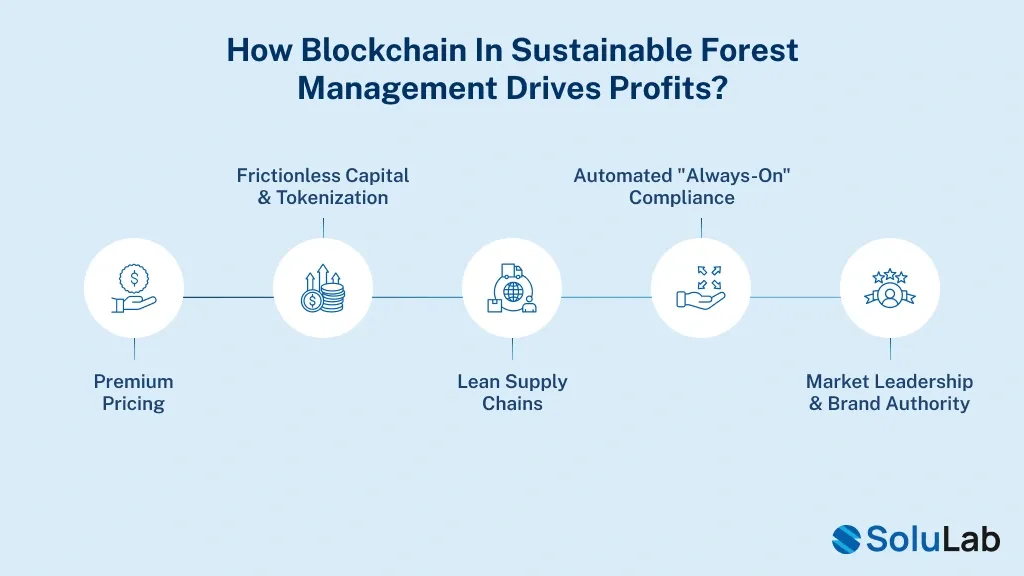
For agro-forestry and tree-based businesses, blockchain development is not about buzzwords. It is about better margins, lower risk, and stronger trust in the market. When done right, it fixes real operational gaps and helps serious operators scale with confidence. Here’s how it plays out in practice.
Sustainability Becomes a Pricing Advantage
Sustainability only matters when buyers can trust it. Blockchain makes that possible by locking origin data and harvesting practices on-chain, which cannot be changed later. As a result, verified sustainable timber and forestry products often sell for 15–25% higher prices, simply because buyers trust data more than claims. What used to be a cost now starts driving revenue.
New Revenue Paths Through Tokenization
This part is really interesting because tokenization makes things possible that didn’t work before. You can break forestry assets into tiny pieces, track carbon credits clearly, and let investors take part in reforestation projects without friction. Using blockchain this way creates real, scalable revenue streams that bring in long-term capital, not just short-term hype.
Lower Supply Chain Costs and Faster Settlement
Agro-forestry supply chains can be slow and packed with middlemen, which pushes costs up. Blockchain systems cut out those layers by letting everyone deal directly and safely. Platforms like AgriDigital show that it works like payments get faster, disputes drop, fees go down, producers earn more, and buyers get quicker, clearer transactions.
Automated Regulatory Compliance
Compliance is where many forestry and agriculture businesses feel the most pressure. With smart contracts, compliance checks happen automatically at the transaction level. Products cannot move without valid certifications, and exports cannot proceed without approved sustainability data, which makes compliance real-time, auditable, and far less risky from a legal standpoint.
Stronger Brand Trust and Clear Market Positioning
Big buyers today don’t trust claims alone, and paperwork is no longer enough. With blockchain, agro-forestry businesses can show real traceability, ethical sourcing, and sustainability directly on-chain, as things actually happen. This kind of open visibility builds stronger brand trust over time, and it clearly separates serious operators from competitors still relying on static documents and a manual report process.
Why Blockchain in Agriculture and Forestry is the Future of Sustainable Practices?
Blockchain is finally moving out of the testing phase and is actually being used. Lots of ESG-focused companies are now using this to work so their sustainability efforts are real and easy to check.
1. Integration with AI and IoT
Farms and forests are full of sensors that send info straight to the blockchain. AI looks at the data, guesses what might happen, and can even trigger smart contracts by itself. It’s way faster, cuts out a lot of manual work, and saves money in the process.
2. Decentralized Governance
Instead of having one central authority, blockchain lets everyone, like communities, governments, investors, NGOs, and all decisions get recorded on-chain. It makes things more trustworthy and open, which really matters since ESG investments are now over $30 trillion.
3. Carbon Credit Markets
The carbon market is growing really fast because of blockchain tokenization. Planting trees now produces verifiable carbon credits you can trade, instead of claims no one can check. This makes sustainability something you can actually measure and use as a real business asset.
4. Supply Chain Consolidation
Supply chains are messy and slow. With blockchain, forests, processors, manufacturers, and buyers are all connected, so tracking that once took weeks now happens in seconds. It builds trust, keeps things compliant, and makes reaching global markets way easier.
How to Get Started With Blockchain Development in Forestry?
Blockchain isn’t some far off tech, as it’s already being used in agro-forestry today. I’ve seen small farms, plantations, and even forest product businesses try it out, and the results can be surprisingly simple and practical if you know where to start.
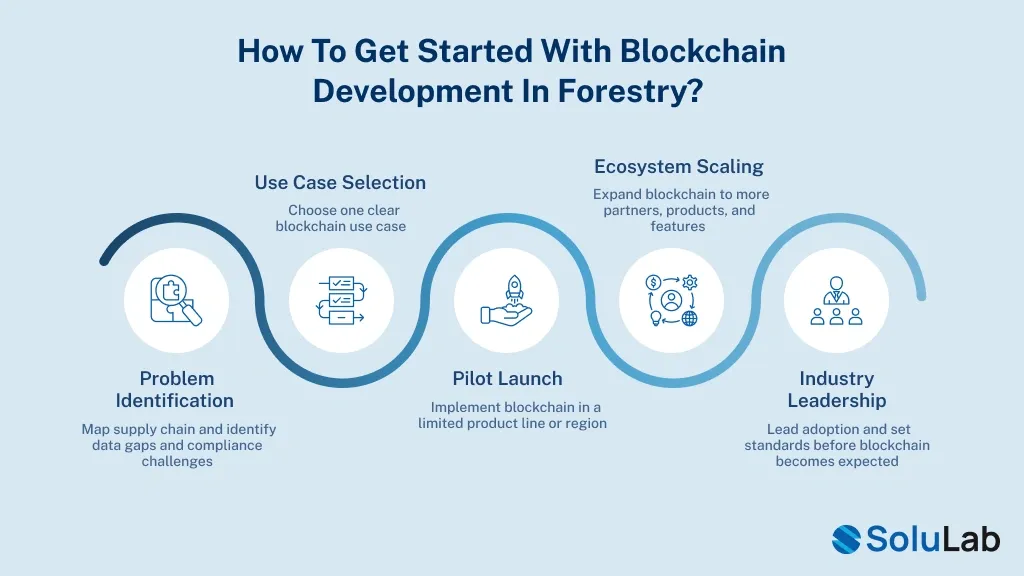
Phase 1: Identify the Real Problem
Take a good look at your supply chain like where the data getting lost and why audits take forever. We even worked on a project where tracing organic certifications across a few regions took weeks and it was super messy. That’s exactly where we implemented blockchain which made data reliable, quick, and easy to share.
Phase 2: Choose One Clear Blockchain Use Case
It’s tempting to try to do everything at once, but please don’t. Try to Pick one thing that will make a difference for example tracking products, verifying sustainability, or supply chain transparency. In one pilot we ran, just focusing on a single crop line and it taught us more than trying to do it for everything.
Phase 3: Start With a Pilot
Try blockchain in one region or one product first. Keep an eye on efficiency, trust, and ROI. In our experience, pilots always show small gaps you didn’t notice before, that’s actually a huge benefit. Some platforms started this way and it’s the safest way to test without wasting money.
Phase 4: Scale Into an On-Chain Ecosystem
Once your pilot works, then add more partners, products, and features like NFTs, on-chain tracking, or Soulbound Tokens. Some companies which started with a single fruit usually end up tracking the entire orchard ecosystem. Small tests can turn into full solutions once you scale smartly.
Phase 5: Lead Before It Becomes Standard
Being early gives you an edge, so the companies that adopt blockchain first set the standards and let others follow. If you start now, you shape how the industry will run in the future.
Conclusion
Blockchain technology in agro-forestry is becoming the foundation for how tree-based industries manage traceability, sustainability proof, and trust. By using blockchain, businesses can track trees and products end to end, and this level of transparency was not possible before, but now it is already changing how buyers, regulators, and partners make decisions.
Right now, the edge sits with teams that move early. Companies that are already investing in blockchain development for tree-based industries are opening the door to new on-chain products that others will struggle to catch up with later. As a blockchain development agency, we help agro-forestry businesses move from ideas to real systems that work in the field. If you want to lead in sustainable, verifiable, and future-ready operations, it starts with the right blockchain strategy and the right team to build it.
FAQs
Blockchain solves trust issues that traditional systems can’t. It creates an immutable, shared record where all parties can verify in real time, and industries benefit the most because origin, sustainability, certification and everything is on-chain. It also reduces disputes and simplifies audit, which makes operations smoother and more trustworthy.
A basic supply chain system costs around $50k–$70k. A full tokenized ecosystem with NFTs, on-chain products, and partner integrations would cost around $120k. Usually, the ROI comes from reduced intermediaries, premium pricing, and lower audit costs, usually within 12–24 months.
They can copy the technology, but not your first-mover advantage. As early adoption builds trust, investor confidence, and brand credibility, which give you market share while competitors are catching up. It also lets you experiment and refine your solutions before others enter the market.
Blockchain locks data in form of transaction but doesn’t verify it. So you have to manually do it by Using IoT sensors, field audits, and third-party validation to ensure all entries are correct. Once the data is verified, it’s permanent and tamper-proof. This approach strengthens compliance and reassures customers and regulators.
Absolutely. Blockchain lets small producers build verifiable reputations and access markets directly, removing intermediaries. Some Platforms like VeriTree shows that individuals and small organizations can meaningfully join tokenized ecosystems and contribute to real-world impact. It also opens opportunities for many micro-investments, carbon credits, and premium product pricing in the market
Yes, SoluLab can design and implement systems liker supply chain tracking, tokenized trees, NFTs, and on-chain products. We handle everything, from planning and architecture to deployment and integration, ensuring your green ecosystem runs securely and efficiently