The crypto fundraising landscape has fundamentally shifted. In 2026, capital isn’t spread thin across thousands of projects; it’s concentrated into fewer, higher-quality rounds. According to recent data, crypto fundraising reached over $25.5 billion in the 12 months ending March 2026, but deal volume fell 46%.
The message is clear: more money is available, but only the strongest projects backed by reliable, compliant infrastructure are capturing it. Investors today aren’t just chasing ideas or tokenomics. They demand platforms that are fast, compliant, and operationally sound. Projects that don’t meet these standards aren’t just left behind; they don’t get funded at all.
That’s the context in which SoluLab’s AI-powered white-label crypto launchpad development sits. This guide breaks down what every modern launchpad needs in 2026, backed by real-world case studies and practical economics, so you can build a platform that serious investors and founders will trust.
Key Takeaways
- The Problem: As founders, we’re not competing for credibility, not just ideas. In 2026, capital only moves toward platforms that are fast, compliant, and operationally de-risked, and everything else gets filtered out before the pitch even lands.
- The Solution: Winning launchpads are built like financial infrastructure, as AI-led vetting, automated compliance, secure contracts, and precise investor targeting are the baseline for getting funded.
- How SoluLab Helps: SoluLab builds white-label AI-powered launchpads that investors trust from day one. We handle architecture, compliance, security, and scale, so you can focus on closing quality deals, not fighting infrastructure.

Why AI Is No Longer Optional in Launchpad Development?
Building a crypto launchpad from scratch is expensive, slow, and increasingly regulated, as security audits alone can cost six figures. KYC/AML compliance demands specialists who understand both blockchain architecture and evolving fintech law. So, working with an experienced AI-powered blockchain development company is the fastest way to avoid these pitfalls
And that’s before accounting for ongoing patches, chain updates, and regulatory changes. In crypto launchpad platform development, the winners aren’t competing on design; they win because they are compliant by default, operationally efficient, and continuously monitored. Regulations have moved from future risk language to immediate operational requirements:
- EU: MiCA (Markets in Crypto-Assets Regulation) is now fully in force, with a key transitional deadline of July 1, 2026, for many crypto-asset service providers (CASPs). Earlier windows for some categories have already closed.
- US: The regulatory environment is more fragmented but increasingly clearer, with sharper distinctions emerging between securities-like tokens and digital commodities.
- Asia: Singapore, Hong Kong, and the UAE continue to evolve jurisdiction-specific licensing requirements.
Manual compliance in this environment is not a viable strategy. AI-based solutions automate identity verification, AML screening, real-time fraud detection, and regulatory monitoring, reducing cost and risk simultaneously.
Measurable benefits for founders include:
- Faster onboarding: Risk-based KYC verification in minutes, not days
- Lower operational costs: Reduced manual review load and compliance staffing
- Better user retention: Frictionless verification keeps qualified investors engaged
- Continuous monitoring: Automated alerts for transaction anomalies and regulatory changes
- Stronger auditability: Detailed, jurisdiction-specific audit trails generated automatically
Note: AI handles the volume and consistency of compliance tasks. Human oversight remains essential for complex cases and regulatory relationships. Platforms built on AI-based blockchain launchpad solutions deliver all of the above without proportionally growing the team.
Core AI Features Every Modern Launchpad Must Include in 2026
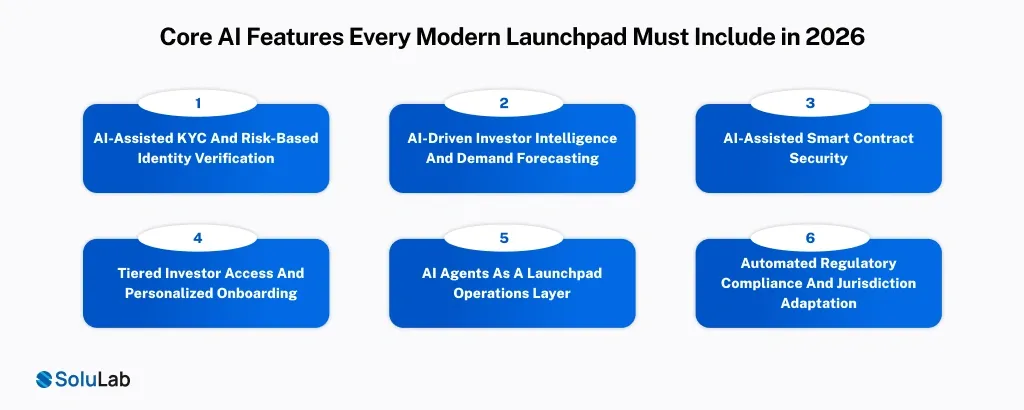
1. AI-Assisted KYC and Risk-Based Identity Verification
KYC remains one of the biggest operational bottlenecks in crypto launchpads. Conventional solutions are slow, error-prone, and increasingly non-compliant with 2026 standards. Modern platforms use AI to automate the full verification process while maintaining the human fallback that regulators expect.
How AI-driven KYC works:
- Document Processing: OCR and machine learning extract and authenticate data from passports, driver’s licenses, and national IDs, automatically flagging forged or mismatched documents.
- Biometric Verification: Facial recognition and liveness detection confirm the user is present and not a deepfake or pre-recorded video.
- Sanctions & Risk Screening: Real-time comparison against global AML, OFAC, EU, and PEP watchlists.
- Behavioral Anomaly Detection: Ongoing checks identify unusual patterns, such as high transaction amounts, rapid account setups, or suspicious wallet activity, that could indicate fraud or money laundering.
This is how AI is used in crypto launchpads at the compliance layer, not just automation, but continuous risk management. Regulators expect platforms to maintain ongoing vigilance, not just a checkbox at sign-up.
It helps reduce onboarding time, lower regulatory exposure, and adopt a compliance posture that satisfies MiCA, US AML rules, and APAC requirements without building separate workflows for each.
2. AI-Driven Investor Intelligence and Demand Forecasting
In a market where capital concentrates into fewer, larger rounds, getting investor targeting right is a competitive advantage. AI-powered fundraising analytics helps launchpad operators and founders improve project quality and allocation efficiency, not guarantee outcomes, but significantly improve the odds.
Key capabilities:
- Historical Launch Analysis: Pattern recognition across past token sales, identifying timing, pricing, and participation characteristics associated with successful raises.
- Community Sentiment Analysis: Real-time monitoring of Twitter, Telegram, and Discord to gauge genuine interest and detect manufactured hype.
- Investor Profiling and Segmentation: Classification of likely participation based on wallet history, portfolio size, and demonstrated risk appetite.
- Dynamic Token Pricing: Pricing recommendations that adjust to real demand signals and market conditions.
- Optimal Launch Timing: Data-backed suggestions for launch dates and windows based on market conditions and investor activity cycles.
The right framing here is operational: AI-powered demand forecasting improves decision quality for founders and reduces failed launches for operators. It doesn’t replace judgment, but it makes judgment better-informed.
3. AI-Assisted Smart Contract Security
Every AI white-label crypto launchpad must treat smart contract security as non-negotiable. Smart contract failures have caused billions in losses. Manual audits are valuable but expensive, time-consuming, and finite. AI assists with vulnerability detection, risk triage, code review support, and continuous post-launch monitoring, making platforms more secure without replacing the need for professional audits.
Key capabilities:
- Automated Vulnerability Detection: Identifies common attack vectors, including reentrancy, integer overflows, and unauthorized access patterns.
- Risk Triage and Prioritization: Flags critical vulnerabilities immediately and logs lower-priority items for review.
- Audit Documentation: Generates reports suitable for compliance and investor disclosure.
- Ongoing Post-Launch Surveillance: Monitors live contract activity for suspicious behavior, reducing exploitation risk after go-live.
This is important as AI-assisted smart contract auditing is a supplement to professional smart contract audits, not a replacement. Platforms that communicate these points clearly build more investor trust, not less.

4. Tiered Investor Access and Personalized Onboarding
In 2026, segmented onboarding, dynamic dashboards, and tailored communications are standard platform expectations, not premium add-ons. Investors across all tiers expect to see information that’s relevant to their portfolio and participation level.
How it works:
- Investor Profiling: AI analyzes wallet activity, past investments, and portfolio behavior to classify investors accurately.
- Tier-Based Access: Distinct workflows and allocation structures for institutional, fund-level, and retail participants.
- Personalized Dashboards: Each investor sees data relevant to their tier, holdings, and risk profile.
- Automated Communications: Targeted notifications, project recommendations, and allocation alerts based on individual activity.
The business value is conversion, retention, and allocation efficiency. Investors who find a platform easy to navigate and relevant to their needs participate more frequently and refer others.
5. AI Agents as a Launchpad Operations Layer
One of the fastest-growing AI use cases in crypto fundraising platforms is the agent-based operations layer, which lies on top of launchpad workflows, helping with onboarding, project scoring, investor support, and post-launch monitoring. They don’t replace the platform; they make it run with less manual intervention.
Agents can assist with:
- Investor Onboarding and KYC: Real-time identity and wallet verification with anomaly flagging.
- Fundraising Optimization: Token sale success modeling, tokenomics simulation, and launch timing analysis.
- Smart Contract Review Support: Automated vulnerability scanning and risk scoring.
- Multi-Chain Operations: Supporting Solana, TON, BNB Chain, Ethereum, Sui, Aptos, and others with chain-specific logic.
The practical value for operators: fewer manual interventions, faster response to issues, and consistent process execution across dozens of simultaneous projects.
6. Automated Regulatory Compliance and Jurisdiction Adaptation
Compliance is now one of the highest-value features a launchpad can offer, especially for projects targeting EU markets under MiCA or operating across multiple jurisdictions. AI enables platforms to adapt workflows automatically as regulations change, rather than requiring expensive manual updates.
Key capabilities:
- Regulatory Monitoring: Continuous scanning of updates from SEC, MiCA, MAS (Singapore), SFC (Hong Kong), UAE VARA, and other bodies.
- Jurisdiction-Based Workflow Automation: Automatically adjusts KYC requirements, disclosures, approvals, and documentation per target market.
- White Paper and Disclosure Generation: Produces compliant documentation with appropriate risk warnings per jurisdiction.
- Non-Compliance Flagging: Identifies projects that don’t meet current regulatory requirements before they go live.
- Approval Logs and Audit Trails: Generates complete compliance records for regulatory review or investor due diligence.
These are among the most impactful AI use cases in crypto fundraising platforms available today. And for operators running projects across multiple geographies, this is the feature that determines whether scaling is feasible without proportionally growing the compliance team.
Read Also: Why White-Label Crypto Exchange Development Makes Sense for UAE Banks?
How an AI-Integrated Launchpad Works: The Full Lifecycle
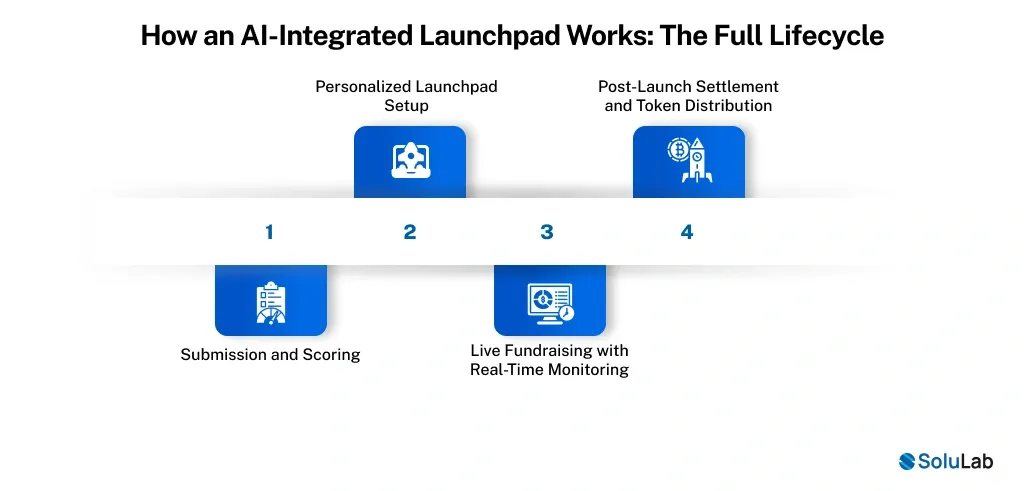
A well-built AI-powered launchpad follows a clear operational lifecycle:
1. Submission and Scoring:
A founder submits a project. AI processes team credentials, whitepapers, smart contracts, tokenomics, financial history, and marketing signals. Multi-layered vetting produces a risk score and a recommendation like “approve,” “request changes,” or “reject” within hours rather than weeks.
2. Personalized Launchpad Setup:
Approved projects receive a customized launchpad page. AI recommends investor tier structures based on historical success data, optimizes token pricing to balance fundraising targets with investor returns and market stability, and proposes a phased marketing timeline. For projects without existing smart contracts, AI-assisted contract generation creates standard, audited templates based on token supply, vesting schedules, and launch requirements.
3. Live Fundraising with Real-Time Monitoring:
During the live raise, AI manages investor onboarding (KYC, wallet verification, and sanctions screening), automates allocation management to prevent overbooking or tier violations, and monitors for fraud and anomalous activity in real time. If participation patterns suggest the raise is at risk of missing targets, AI surfaces recommendations for timeline adjustments or targeted outreach.
4. Post-Launch Settlement and Token Distribution:
After the raise closes, AI automates accounting, allocation settlement, and vesting schedule implementation. Multi-chain token distribution across Ethereum, Polygon, Arbitrum, and others is coordinated through smart contracts. Ongoing monitoring tracks vesting milestones and secondary market performance, with automated investor communications throughout.
Why Founders Should Invest in an AI-Powered Launchpad?
1. Revenue Model
An AI-powered crypto launchpad platform development project supports multiple income streams
- Platform Fees: Typically 1–3% of each token sale
- KYC/AML Verification Fees: $5–$20 per verified user
- Premium Tools: Analytics dashboards, investor matching, smart contract review reports
- Launchpad-as-a-Service: Licensing your platform infrastructure to other projects
- Token Staking: Investors stake their platform token, generating recurring fee revenue
Illustrative economics: For a mid-sized launchpad handling 20–30 projects annually, each raising $2–$5M in the current market environment where fewer but larger rounds are the norm:
| Revenue Stream | Estimated Annual Range |
| Platform Fees (1–3%) | $1.2M–$4.5M |
| KYC/AML Fees | $50K–$200K |
| Premium Features | $100K–$300K |
| Potential Total | $1.35M–$5M |
Actual figures depend heavily on compliance depth, chain support, audit scope, and market conditions. These should be treated as illustrative, not guaranteed.
2. Network Effects
AI launchpads grow stronger with scale, as this is the network flywheel that separates mature AI token launchpads from one-off platforms. More investors make the platform a preferred destination for new projects. More historical data improves AI predictions, fundraising advice, and investor recommendations. This creates a self-reinforcing cycle that makes the platform increasingly defensible over time.
3. Built-In Compliance Advantage
In a market where MiCA deadlines are live, and US regulatory clarity is improving, an AI-powered crypto launchpad solution with built-in compliance has a structural advantage. Serious founders choose launchpads that reduce their regulatory risk. AI-native approach for compliance is no longer a differentiator; it’s a prerequisite.
Read Also: AI in White-Label Crypto Launchpads
Real Case Studies
1. Virtuals Protocol
Type: AI Agent Launchpad | Tokenization and Co-Ownership
Virtuals Protocol manages thousands of AI agents using a bonding curve model with VIRTUAL tokens. Liquidity pools are created on Uniswap once funding goals are met. Its significance in 2026 is that the year the tokenized agent model itself turns AI infrastructure into a participatory Web3 economy where co-owners and users share in revenue and value.
2. Vvaifu.fun
Type: No-Code AI Agent Launchpad | Solana
vvaifu.fun simplifies the creation of AI agents like trading bots, NFT assistants, and similar tools using templates that require no deep technical background. Agents are tokenized via SPL tokens and monetized through subscriptions or usage fees. Its relevance in 2026 is the launchpad-as-a-service model: enabling fast AI-powered launches with built-in tokenomics and staking mechanics.
3. ai16z / Eliza Framework
Type: AI-Focused Multi-Chain Launchpad
Ranked among the top AI agent platforms by market cap, ai16z supports agent-to-agent interactions, multi-chain deployments, and LP staking using the AI16Z token, and it represents where AI agents in crypto infrastructure are heading at scale. In 2026, its significance is the infrastructure model: complex, multi-modal AI agents deployed on-chain with governance and value tied directly to token economics. This is the architecture that AI-native on-chain infrastructure is moving toward.
Why SoluLab Might Be the Right White-Label Crypto Launchpad Partner?
Launchpads don’t fail because of ideas; they fail because of weak infrastructure. In 2026, trust, compliance, and execution speed decide who gets funded and who gets ignored.
SoluLab builds white-label crypto launchpad development like financial infrastructure, with compliance, security, AI-led vetting, and investor targeting embedded from day one, so you are credible to investors before the first deal goes live.
If you want a partner that thinks like an operator, builds for scale, and helps you win in a capital-concentrated market, SoluLab is built for that role.
Conclusion
The 2026 launchpad market rewards platforms that combine AI capabilities with operational compliance, selective fundraising standards, and infrastructure built for scale. Capital is concentrating on fewer, better-supported projects, which means the platforms that host those projects need to earn trust through reliability, not just features.
Building a crypto launchpad development platform with AI integration is a sound business decision: it reduces costs, accelerates time to market, and positions your platform as a regulation-ready fundraising infrastructure that both founders and investors can rely on.
SoluLab, a trusted AI-led development provider, delivers end-to-end AI crypto launchpad development services, from predictive fundraising analytics and automated KYC/AML to smart contract review support, multi-chain deployment, and white-label crypto launchpad services tailored to your jurisdiction and stack.
The goal is to create a platform that is built for the 2026 market and is defensible well beyond it.
FAQs
Shipra Garg is a tech-focused content strategist and copywriter specializing in Web3, blockchain, and artificial intelligence. She has worked with startups and enterprise teams to craft high-conversion content that bridges deep tech with business impact. Her work translates complex innovations into clear, credible, and engaging narratives that drive growth and build trust in emerging tech markets.