According to Statista, the AI market is expected to reach $244.22 billion by the end of 2025. Moreover, it is projected to grow at a compound annual growth rate (CAGR) of 27% from 2025 to 2031, reaching a total volume of $1.01 trillion by 2031.
And this is crucial for businesses to adopt AI in their workflow to stay competitive. But many companies don’t know how to use AI wisely. Additionally few businesses outsource by hiring AI development companies. But choosing the wrong AI partner can lead to wasted budgets, security risks, and solutions that never scale.
Many companies rush into outsourcing AI development solutions without asking the right questions around data ownership, technical expertise, timelines, and long-term support. AI models that look good in demos but fail in real-world use.
Before you hand over your data and business-critical processes to an external team, you need clarity. This blog covers the top 10 questions you must ask before outsourcing AI development so you can reduce risk, protect your IP, and choose a partner who delivers real business impact.
Key Takeaways
- Outsourcing AI development is most effective when the vendors are viewed as long-term partners, rather than service providers.
- The right questions should be asked at the beginning of the project to prevent cost overruns, ambiguous ownership, and implementation failures.
- Never rely on hype or experimentation to determine AI use cases, but always on real business problems.
- The keys to successful outsourcing of AI are clear communication, transparency, and measurable success metrics.
Why Businesses Outsource AI Development Partners?
According to global research, 78% of global companies are using AI in their daily operations. With the rise of AI adoption, numerous businesses come to the realization that it is costly, time-consuming, and risky to build everything in-house, and outsourcing AI development is a smarter, more scalable, and future-proofed decision.
- Efficiency in costs and shortened time-to-market: Outsourcing removes massive hiring, training, and infrastructure expenditures. Ready-to-deploy workflows and established tech stacks allow businesses to launch custom AI solutions more quickly and enable them to remain competitive without lengthy development times.
- Technical AI skills: The AI skills include niche skills such as machine learning, NLP, and data engineering. By outsourcing, you can gain access to highly skilled AI experts who have already solved a similar issue, eliminating trial-and-error and resulting in a better solution.
- Concentrate on business core processes: Through AI development outsourcing, external companies can devote internal resources to strategy, growth, and customer experience, and internal companies can develop and integrate complex models, test them, and continue optimizing them.
How to Choose the Right AI Development Partner?
Selecting the appropriate company to develop AI is not about empty boasting. It is also about locating a partner that knows AI solutions for your business, data facts, and can provide scalable AI solutions.
1. Know their AI knowledge and applications: Determine whether they have created actual AI applications, such as chatbots, predictive models, or automation applications. Relevant industry experience implies that they are more aware of the challenges, data complexity, and practical application.
2. Consider business knowledge, not only technical skills: A successful AI company does not inquire about the model, but rather asks about your problem. They are required to map business objectives to the use cases in AI, whereby the solution needs to bring quantifiable ROI, rather than technical elegance.
3. Check data processing and security measures: AI runs on data. Maintain high data privacy, compliance, and security standards used by the company. This is essential when it comes to customer, financial, or enterprise-sensitive data.
4. Measure scalability and supportability: AI isn’t a one-time project. Ask them about how they update their models, how they monitor their performance, and how they can scale to be able to serve your business when it grows. The issue of long-term support is better than quick deployment.
5. Revise communication and transparency: Well-defined schedules, frequent communication, and transparent viability meetings are indicators of a trustworthy partner. Effective communication prevents unforeseen situations and keeps your AI project on track.
Top 10 Questions to Ask Before Outsourcing AI Development
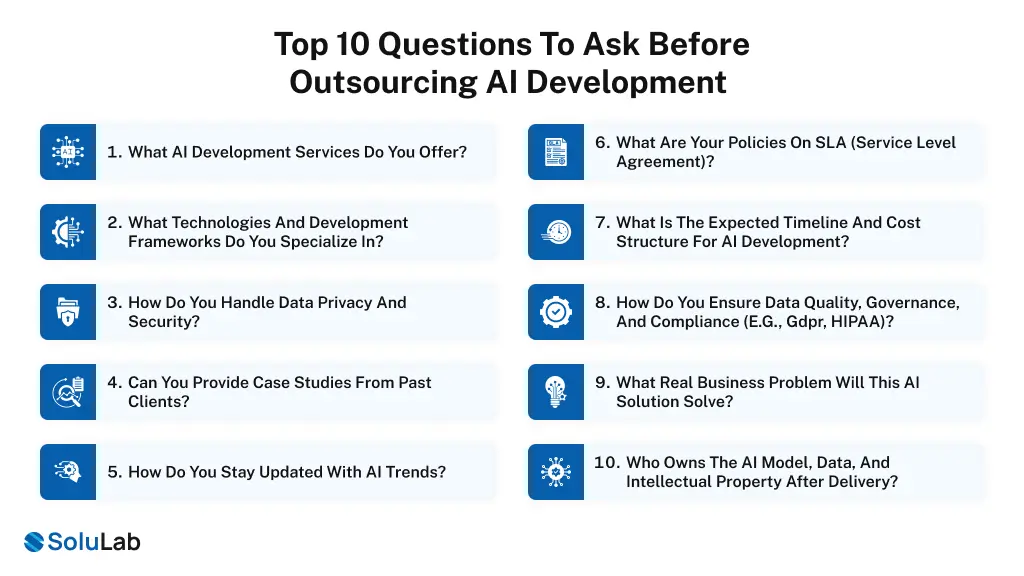
The appropriate development partner can help you maximize this development by increasing efficiency, stimulating innovation, and providing your company with a competitive advantage. Here are the top 10 questions you should ask before outsourcing to AI development companies:
1. What AI Development Services Do You Offer?
Before outsourcing AI development, it is important to have a superior understanding of what AI development services the company itself provides. Enquire about the services, such as AI strategy, data engineering, model development, integration, deployment, and continuous support that they offer. Other vendors simply develop models, and others assist in the operation of AI in your existing systems.
Another thing is to ensure that they are usable with technologies that are applicable to your application: machine learning, generative AI, NLP, or computer vision. Such transparency will prevent lapses, concealed expenses, and coordination problems in the future. One of the benefits of having a full-service AI partner will guarantee a seamless implementation process, accelerate the time-to-value, and allow scalability over the long term.
2. What Technologies And Development Frameworks Do You Specialize In?
The performance, scalability, and success of an AI partner depend directly on the technologies and structures that an AI partner works with. Before outsourcing, you must have a clear understanding of whether their tech stack is in line with your product objectives and current systems.
The following are some of the main points that you should take into account:
- AI frameworks: Inquire about their proactive development of established frameworks such as TensorFlow, PyTorch, or Scikit-learn to use real-world applications.
- Cloud knowledge: Place experience with AWS, Google Cloud, or Azure to handle secure, scalable deployments.
- Integration compatibility: Check that their stack is compatible with your existing software and databases.
- Scalability: ensure that the frameworks can help the business grow without significant re-development.
- Preparedness in the future: Determine whether they are continuing to be current with changing AI tools and best practices.
Final takeaway: A proper tech stack will lower risk, accelerate development, and future-proof your AI solution.
3. How Do You Handle Data Privacy And Security?
The privacy of data and its security cannot be compromised when outsourcing the development of AI. Inquire about the way that the vendor gathers, stores, handles and destroys your data throughout the AI lifecycle. Determine their adherence to international practices such as GDPR, ISO 27001, or SOC 2, and access control and encryption management.
Another thing is to determine the owner of the data and trained models. An effective AI consulting partner must become open, active, ve and ready to sign NDAs and data protection contracts to protect your business and customer information.
4. Can You Provide Case Studies From Past Clients?
Case studies demonstrate that an AI development partner can really perform rather than just discuss what he or she can do. Find actual cases that describe the issue in business, the AI application, and the quantifiable results obtained.
Monitor other projects like yours in terms of industry, scale of data, or application. Good case studies are also expected to mention challenges thatwere experienced and their solutions. This is a reassurance that the company has a great problem-solving strategy, technical expertise, and reliability.
5. How Do You Stay Updated With AI Trends?
An AI development outsource company should be a proactive follow-up to the trends in the industry via research articles, product launches, conferences, and individual experimentation. Inquire whether their team has a regular upskilling, internal POC, or AI community contribution.
This is to make sure that they are not merely obeying hype, but implementing practical, tried and tested AI progress that is in line with actual business requirements and market trends.
6. What Are Your Policies On SLA (Service Level Agreement)?
There is a clear definition of SLAs regarding response time, problems are solved, and the performance level of the model and the level of availability of the support. A powerful AI vendor will provide transparent SLAs that will deal with downtime, maintenance, security, and the process of escalation. This secures your business, makes everyone accountable, and provides clear expectations during the lifecycle of AI development.
7. What Is The Expected Timeline And Cost Structure For Ai Development?
Before outsourcing AI development, have a clear understanding of the timeline and cost structure to be incurred. There is no usual schedule in an AI project since data preparation, model training, testing, and iterations are time-consuming. Request a stage-by-stage breakdown- discovery, development, validation, deployment, and after-sales support. Do not use vague estimates on costs.
Explain how AI app development costs, by the milestone, or hourly, and what it involves, such as data preparation, model retraining, integrations, and maintenance. Verify also fringe costs such as infrastructure, third-party APIs, or scaling considerations. A clear schedule and cost framework will assist in making better budgets and avoiding scope creep in the future.
8. How Do You Ensure Data Quality, Governance, And Compliance (E.G., Gdpr, HIPAA)?
Requesting the vendor during the outsourcing of AI development about the quality of data, its governance, and compliance with regulations at the very beginning of the project. They ought to be explicit on the data collection and data validation process, as well as data cleaning and version control. Determine whether they observe robust data governance models, role-based access, and safe storage schemes.
To be compliant, ensure that they are familiar with the regulations, such as GDPR or HIPAA, and consent management, data anonymization, and audit trails. Inquire about cross-border data transfers and breach response plans, also. A trusted AI integration service provider does not consider data protection as an additional task.
9. What Real Business Problem Will This AI Solution Solve?
Prior to outsourcing AI development, understand what the actual business issue is that you want to resolve. Don’t start with “we need AI.” Begin with inefficiencies, expenditures, delays, or revenue losses. Inquire on whether AI will take over a repetitive activity, enhance decision-making, minimize errors, or enhance the customer experience. Precisely state quantifiable results such as time savings, cost savings, or accuracy increase.
This transparency assists the vendors in the development of the appropriate solution rather than overengineering models. When the problem is clear, you do not spend money on nothing, you do not have unrealistic expectations, and AI projects that seem to be successful, yet they do not make a real difference to the business.
10. Who Owns The Ai Model, Data, And Intellectual Property After Delivery?
The ownership of the AI model, training data, and intellectual property should be decided before outsourcing AI development through a clear definition of who owns the model after delivery. Several vendors repurpose structure, already trained models, or anonymised data, which may obstruct ownership. You are to be sure whether the final model, source code, datasets, and derivatives are owned by your business or licensed.
Outline rights too, with future modifications, commercial use, and resale. This is also quite relevant when the AI solution turns into a core product or competitive advantage. Ensure to record the terms of ownership in the contract always, so that you are not faced with a legal issue and vendor lock-ins, or scaling and monetising your AI solution in the future.
Common Mistakes to Avoid When Outsourcing AI Development
Developing AI may be time and cost-efficient when outsourced, but any small errors may ruin the outcomes unnoticed. These are some of the pitfalls to be avoided, and with them, you can create scalable and reliable AI solutions that will do you a favor.
- Making decisions that favor affordability: Being at the lowest possible price causes weak models, poor architecture, and rework. Consider established AI experience, expertise in the specified area, and quality of delivery, not hourly prices.
- Ignoring data readiness: AI is only as good as your data. Data of bad quality, format, and quantity can freeze projects, escalate expenses, and restrict the originality of the model.
- Lack of long-term AI strategy: The approach to AI as a single project brings about integration and scaling difficulties. These are the steps that can be followed to make sure that those AI solutions meet your business objectives and expand alongside your product.
Conclusion
Outsourcing AI development may speed up innovation, but only if you choose the appropriate partner and ask the right questions upfront. From data ownership and security to scalability, competence, and long-term support, every decision has an impact on the success of any AI endeavor.
Skipping these questions can result in hidden expenses, regulatory issues, or solutions that fail to provide true business benefit. Clarifying expectations early reduces confusion and strengthens collaborations.
AI outsourcing should be viewed as a strategic investment rather than a short-term initiative. The better your questions, the more confident, scalable, and forward-thinking your AI solution will be.
SoluLab, an AI development company, provides AI integration services and consulting as well. Book a free discovery call today!