Key Takeaways
- In 2026, generative AI stopped being a lab experiment. It is plumbing now: automation, smarter workflows, personalization at scale, and business operations that assume an AI layer by default.
- Agentic workflows, multimodal models, domain-specific LLMs, and retrieval-augmented (RAG) systems are quietly rewiring how companies decide things, ship work, talk to customers, and keep operations tight.
- The firms that pick their spots, one clear problem instead of a broad “AI everywhere” push, scale faster, spend less, produce content quicker, and get answers closer to real time.
Here is what defines generative AI in 2026. Agentic workflows that act instead of just answering. Multimodal models as the default way you talk to a system. Cheaper inference, which pushes generation out to the edge. Open-weight models that have all but caught up to the frontier. And regulation with teeth, replacing the polite voluntary guidelines of a few years back. Each trend below gets a plain explanation, a real example running today, and one honest note on how it should change what you decide to build this year.
Generative AI writes text, makes images, produces audio, generates code, and creates video. It learns patterns from huge training sets and then makes something new. That last part matters. A classifier labels what already exists. A generative model produces output that was not there before.

Understanding Generative AI
Generative AI is the branch that produces original text, images, audio, code, and video by learning patterns from large training sets. Classic AI mostly sorts or predicts what you feed it. Generative models build something new instead, leaning on transformer-based neural networks to keep the output coherent and aware of its context. Tools like OpenAI’s ChatGPT and DALL-E are what dragged all of this out of research labs and into everyday use.
PwC’s “Sizing the Prize” analysis put a big number on it. AI, and this is all AI, not generative AI on its own, could add USD 15.7 trillion to the global economy by 2030. A figure like that pulls demand toward legacy modernization tools, the kind that bolt AI onto systems companies already run.
The reach is wide already. Marketers use it to automate campaigns and crank out creative. Writers use it to draft. Clinicians use it to explore diagnostic angles they might otherwise miss. But using it well is a different skill from using it at all. You have to know where it helps, where it breaks, and what it does to the people on the other end.
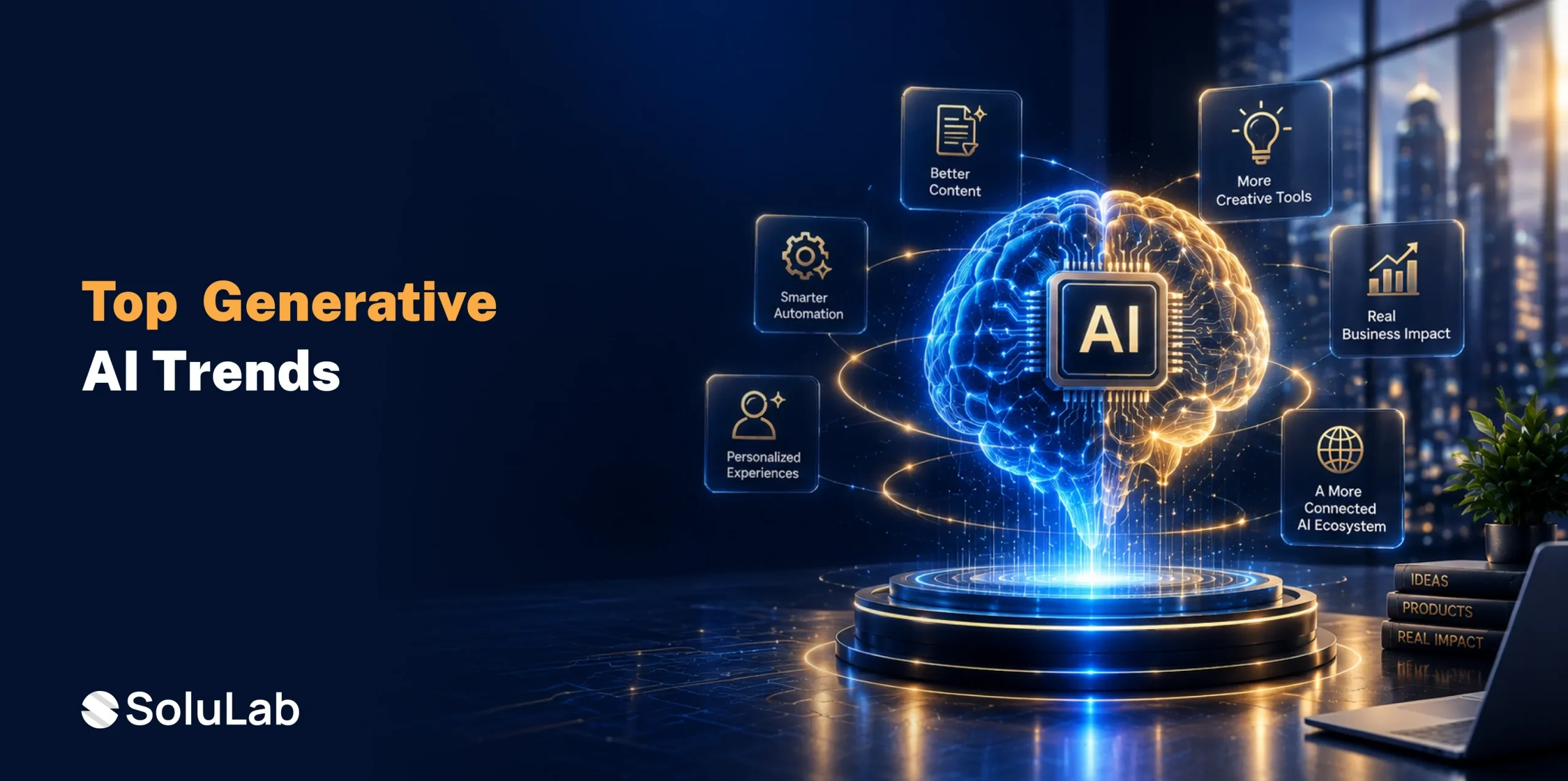
Top Generative AI Trends For 2026
In 2026, generative AI has crossed from promising to measurable. And the companies actually seeing a return share a pattern: a clear roadmap, people who know what they are doing, and one priority domain instead of an AI-everywhere spray. Keep that framing in mind. Here are the trends driving the shift this year.
1. AI for Creativity
Image generation was the early proof point. DALL-E turning a one-line prompt into finished artwork felt like magic in the beginning. The quality has moved a long way since. OpenAI’s GPT Image 2, out in April 2026, was the first mainstream image model that plans its own layout, can search the web for reference when it needs to, and checks its own work before handing you a result. And it no longer stops at still pictures. These tools now stretch into real-time animation, music, and audio. One catch worth naming: as the visuals get this convincing, an AI image detector becomes the thing that tells you whether an image was generated or quietly altered by AI in the first place.
Expect this corner of the field to keep expanding. Musicians, songwriters, visual artists, sound designers, hobbyists tinkering on a weekend, all of them get a bigger creative toolkit out of it, and most are only starting to figure out what they can do with it.
Coca-Cola teamed up with Dall-E on a platform called “Create Real Magic,” built to sharpen marketing campaigns with AI. It is a telling example. Grab attention, yes, but do it by letting people play with genuinely new generative tools rather than pushing another static ad at them.
2. GenAI for Hyper-Personalization
Hyper-personalization has become one of the sharpest edges of generative AI across a lot of industries. Take Pharmaceutical and Life Sciences. Drug launches live or die on the campaign around them, and there, getting personal is not a nice-to-have. It is the whole game.
Commercial pharma teams talk to healthcare professionals (HCPs) one on one when they introduce a new drug. That means real homework: understanding the HCP’s field and lining the drug up against their specialty.
Generative AI lets those teams build individualized material for every single HCP, at a scale no human team could match by hand. Feed it enough data and it shapes the message and the supporting content to what one specific person actually cares about. The payoff is communication that lands, which is the whole point of GenAI in the healthcare industry.
This does not stop at pharma. E-commerce and entertainment run the same playbook. The algorithms chew through mountains of behavioral data, guess what you want next, and bend the experience toward it. Done right, you barely notice it happening. You just notice things feel oddly on point.
3. Conversational AI
This is where generative models showed up in production most visibly of all.
Generative AI makes it possible to actually talk to a machine in plain language. Models like GPT run on advanced natural language processing and machine learning, so they read context, answer coherently and on-topic, and shape the conversation around your history and what you seem to prefer.
GenAI pushes Conversational AI further: more intuitive, more interactive, and able to carry messy, tangled interactions without falling over.
4. How Is Generative AI Being Used in Scientific Research?
Generative AI (Gen AI) is changing how research papers get summarized, and nowhere more than in medicine and pharma. Pulling the key points out of a dense, jargon-heavy document is faster and, frankly, more accurate than it used to be.
The engine here is large language models (LLMs), which squeezes a long paper down to a tight, readable summary. Researchers, practitioners, industry folks: they get the findings, the methods, the implications in a fraction of the time, without reading every page start to finish.
That is a real dent in the literature-review slog. Less time buried in PDFs, more time deciding what to do next. Decisions come faster and better informed, new treatments and drugs move along quicker, and the through-line lands where it should: better care and better outcomes for patients.
5. Human in the Generative AI Loop
Human-in-the-Loop (HITL) became a real trend in 2026, and the reason is simple. As generative systems got more capable, they also got harder to trust blind. Putting people back into the training process turned into the way to keep those systems aligned with ethics, cultural nuance, and whatever the job on the ground actually demands.
This does two things at once. It makes the output more accurate and more dependable. And it builds a working relationship, human judgment steering where the AI goes rather than watching from the sidelines.
Teams that lean on HITL get the speed and inventiveness of generative AI without losing the wheel. They keep control of what comes out, which is exactly what you need when the demands vary and the details matter.
6. Multimodal Generative AI
The field is shifting away from one-trick models toward multimodal ones. Text, image, audio, video, all handled inside a single system.
Earlier models cleared the path. CLIP for text-to-image, Wave2Vec for speech-to-text. What is different now is the ambition: models that move between jobs without friction, from natural language processing (NLP) to computer vision, and increasingly into video too, the way Google’s Lumiere does.
This wave covers both camps. Proprietary systems like OpenAI’s GPT-4V and open-source ones like LLaVa. The goal is the same on either side: apps that feel more natural and bend to what you are doing, so you can, say, get a visual walkthrough alongside a spoken instruction instead of one or the other.
And there is a quieter benefit. When multimodal models take in a wider mix of inputs, they simply understand the situation better, which means sharper output. That stretches what AI is good for across a lot of different fields.
7. Opensource Wave in Generative AI
What can GenAI actually do? Make intricate art. Compose music. Help design drugs. Mimic a human voice. That range is why it draws so much enthusiasm and so much scrutiny at the same time.
Open-source projects carry a lot of this progress. They open the door to more people, pull in contributors from all sorts of backgrounds, spark new ideas, and catch biases early while a model is still being built.
Work in the open and you get a more inclusive kind of building. Knowledge gets shared, resources get shared, and when something is off, a bias or a plain bug, more eyes catch it and fix it sooner.
There is also the trust angle. Open-source GenAI keeps the process transparent, which builds confidence and keeps ethics in the room instead of as an afterthought.
So open source is not a passing fad here. It is load-bearing, part of how generative AI grows without cracking. The usual names show the point: TensorFlow and TensorFlow Models, PyTorch, Hugging Face’s Transformers, GPT-Neo and GPT-J, Stable Diffusion, and plenty more.
8. What Regulations Now Apply to Generative AI?
The push toward regulatory compliance in Generative AI keeps building, and the EU’s proposed Artificial Intelligence Act is a big part of why. As multimodal AI gets easier for anyone to reach, worries about privacy and bias have gotten louder, and rules are the response.
The flip side is real too. No clear rules can actually slow adoption down. Businesses hesitate to put money in when they fear a future regulation might make today’s investment obsolete overnight, or worse, illegal.
Look at the United States, the biggest hub for AI work, and the rules are still a moving target. Agencies and developers have set some standards and made ethics pledges, sure. But one framework that ties it all together? Not yet.
Pharma is one place where GenAI is already tackling the compliance side head-on. It turns out compliant-ready material for drug launches, promotions, and HCP outreach, automating document creation against strict industry standards. That means faster, cleaner prep for market entry and for staying compliant after. Fewer errors, less exposure to regulatory violations, and a real assist to the regulatory affairs teams who own the paperwork.
9. What Is Bring Your Own AI (BYOAI)
Bring Your Own AI (BYOAI) means plugging your own preferred or custom AI models into platforms, systems, or services you already use. The appeal is fit: more customization, more efficiency, and models tuned to exactly what you are trying to do. Real-world examples are still thin on the ground, but the shape is clear. In healthcare, providers are running algorithms they built or adapted themselves to read patient data, forecast disease outcomes, and shape treatment plans, an early look at what BYOAI can do in that setting. And even when nobody calls it BYOAI, the pattern is there: banks like JPMorgan Chase have built their own artificial intelligence (AI) systems, one of them called Index GPT, to sharpen risk management and customer service.
10. AI-Augmented Apps and Services
A lot of the generative AI trends in 2026 lead straight to AI-augmented apps and services. It is a genuine shift in how software helps people, across all kinds of work. The idea is straightforward: fold advanced AI into everyday tools and platforms so the experience feels tailored and, well, smart.
These augmented tools rewrite what efficiency and personalization look like. Think writing software that picks up your voice and adapts to it, or health apps that hand you treatment suggestions shaped around your own situation rather than a generic checklist.

Conclusion
Run through the top Generative AI trends for 2026 and one thing is hard to miss: what is coming is genuinely impressive. But it arrives with baggage. Ethics questions. A real need for regulation that has caught up. Getting those right is not optional. It is the price of building and shipping Generative AI solutions responsibly.
Here is the part people skip. Getting value out of these trends is not about chasing every new model that drops. It is about matching the right technique to an actual business problem, then building the data and governance underneath it so you can run the thing safely. That is where a partner who has done it before earns their keep. SoluLab’s team can scope it, build it, and wire GenAI into the systems you already run, so the jump from experiment to production is something you can measure instead of something you hope for.
FAQs
Shipra Garg is a tech-focused content strategist and copywriter specializing in Web3, blockchain, and artificial intelligence. She has worked with startups and enterprise teams to craft high-conversion content that bridges deep tech with business impact. Her work translates complex innovations into clear, credible, and engaging narratives that drive growth and build trust in emerging tech markets.