Talk to an Expert

How Can Blockchain Enable Green Real Estate Platforms in the UAE?

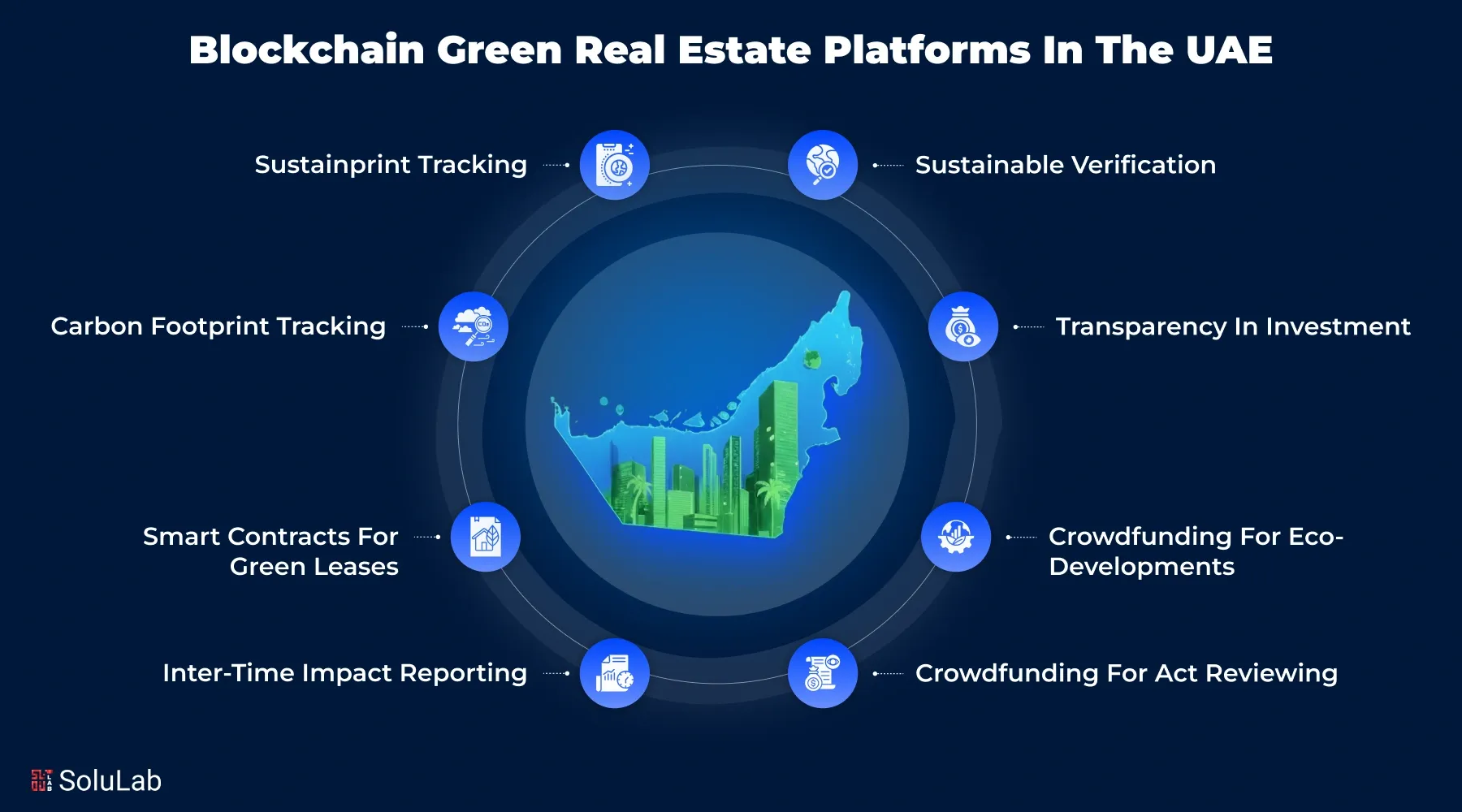
Blockchain Green Real Estate Platforms in the UAE

Dubai’s real estate market is shifting from bold architecture to measurable sustainability. UAE strategies: UAE Vision 2021, the Energy Strategy 2050, and Dubai Clean Energy Strategy 2050 are directing towards green real estate growth. 

Also, landmark projects like Masdar City and The Sustainable City demonstrate how blockchain plays a key role in sustainable real estate enhancement. 

UAE climate-forward development looks like: energy-efficient design, extensive water recycling, and integrated renewable systems. With blockchain technology support UAE is trying to reduce emissions and build sustainable real estate.  

Key Takeaways

  • Through green real estate, you can reduce its environmental footprint, especially in a sector responsible for nearly 40% of global CO₂ emissions.
  • Blockchain technology strengthens sustainable real estate in the UAE by providing verifiable data to get certificates like LEED and Estidama. 

Dubai’s Green Real Estate Market Is Entering Its Next Phase

Dubai is shifting from basic green initiatives to data-driven, digitally monitored, and finance-ready sustainability models. This new phase is powered by technologies like AI-based energy optimization, IoT-driven real-time monitoring, blockchain for water management, and Web3-enabled ESG verification, ensuring every sustainability claim is backed by transparent, tamper-proof data.

  • Market evolution emphasizes continuous performance data rather than single-point green features on buildings.
  • Investors now reward verified operational savings and transparent ESG reporting when pricing assets and risk.
  • Green buildings are becoming essential because the real estate sector is responsible for nearly 40% of global CO₂ emissions. Of this footprint, 70% comes from building operations, and 30% comes from construction activity.
  • The UAE aims for net-zero emissions by 2050, increasing pressure on developers and investors to adopt sustainable practices.
  • Developers who embed monitoring and measurement early gain certification advantages and faster project approvals.

CTA1

Why Is Blockchain Becoming a Must-Have for Green Real Estate Platforms?

Blockchain combines immutable records, real-time data flows, and programmable rules, a strong match for sustainability needs. And Dubai is not an exception to using blockchain and AI for futuristic growth. With this integration in the green real estate sector verification, automation of tasks, and compliance quickens.

  • Buildings with verified green credentials command 7-10% higher rental premiums.
  • Verified performance also reduces insurance premiums by 5–15% for compliant buildings.
  • Increase the installed clean energy capacity from 14.2 GW to 19.8 GW by 2030
  • Efficient blockchain-enabled systems can reduce operational energy costs by 20–30%.

 Below are the concrete benefits written as solution-focused statements for business readers.

Ensures transparent tracking of sustainable real estate materials and provenance

Blockchain in supply chain events is immutable; developers can prove origin, certifications, and recycled content.

  • Verifiable material origin reduces greenwashing and supports certification audits quickly and reliably for regulators worldwide.
  • Immutable supplier records speed up procurement approvals and lower disputes between contractors and buyers.
  • On-chain provenance enables faster, clearer claims for recycled or low-carbon construction materials.

Makes compliance and certification straightforward with verifiable evidence

Certifications like LEED and Estidama require proof. Therefore, blockchain integration comes into the picture: to store audit trails and performance data for easy verification.

  • On-chain documentation simplifies audits and reduces the administrative time required for certification submission and review.
  • Automated evidence pulls lower manual reconciliation and provides assessors with clean, tamper-proof files.
  • Continuous performance logs demonstrate compliance over time, improving certification renewal outcomes and investor confidence.

Automates payments and approvals to reduce project delays

Smart contracts execute payments, incentives, and warranty releases automatically when predefined performance or delivery milestones are met.

  • Smart contracts reduce payment disputes and accelerate cash flow for real estate contractors and suppliers working on green measures.
  • Milestone-based automated disbursements improve trust among stakeholders and shorten project timelines substantially.
  • Programmable incentives align subcontractors with sustainability real estate outcomes, improving delivery quality and schedule adherence.

Enables verified carbon accounting and blockchain carbon credits

Immutable energy and emissions records permit credible carbon accounting and creation of tradable, verifiable carbon credits.

  • On-chain emissions ledgers create trusted data for carbon credit minting, sale, and retirement processes.
  • Verified carbon credits open new revenue lines and funding options for developers and building owners.
  • Transparent carbon accounting supports investor due diligence and strengthens environmental claims for assets.

Strengthens investor trust through tamper-proof sustainability performance

Investors need credible, auditable data. Blockchain solutions deliver a single source of truth for operational performance and ESG metrics.

  • Tamper-proof performance data reduces perceived investment risk and supports better pricing for green assets.
  • Clear audit trails make underwriting simpler and shorten investment committee review cycles.
  • Transparent metrics help asset managers report reliably to stakeholders and regulatory requirements.

Applications of Blockchain in Sustainable Real Estate Development, UAE 
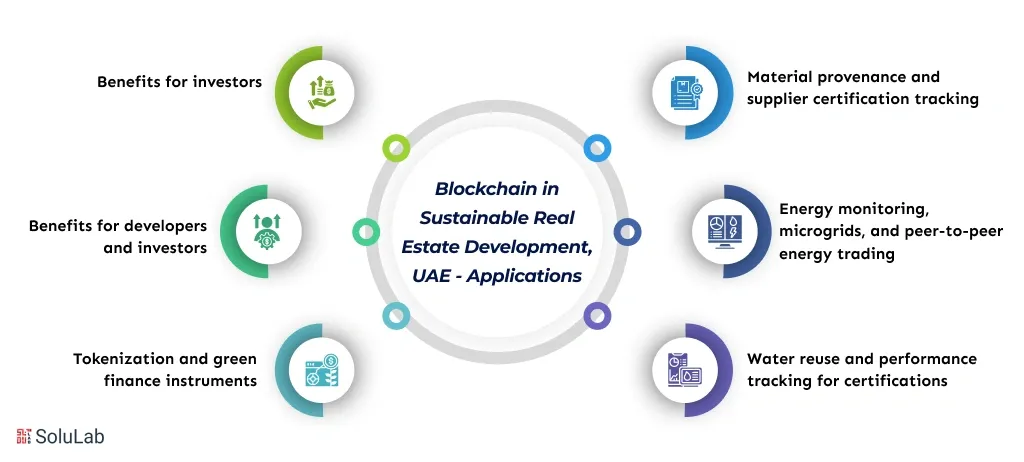
Blockchain in Sustainable Real Estate Development, UAE - Applications

Blockchain trends can be woven into multiple use cases across design, construction, operations, and finance. Each application drives business outcomes and supports Dubai’s sustainable real estate development targets. Luxury under a safe environment is the main action in the UAE’s Net Zero Emission 2050. 

1. Material provenance and supplier certification tracking

Record every supply event on-chain from quarry to site, enabling verifiable material claims and faster approvals.

  • Traceable supply chains reduce procurement friction and help validate low-carbon or recycled material claims instantly.
  • On-chain supplier ratings encourage sustainable sourcing through market visibility and accountability.
  • Integration with certification bodies speeds acceptance of innovative eco-materials in projects.
  • Material transparency matters because 30% of real estate emissions come from construction.

2. Energy monitoring, microgrids, and peer-to-peer energy trading

Combine smart meters with blockchain to record production, consumption, and enable direct trading of surplus renewable energy.

  • Real-time energy data on-chain enables automated billing, settlement, and renewable energy tracking.
  • Microgrid settlements reduce system losses and let owners monetize excess solar generation reliably.
  • P2P trading supports local resilience and creates tangible returns from embedded renewables.

3. Water reuse and performance tracking for certifications

Log greywater and rainwater recycling performance to prove water efficiency gains and support Estidama or local regulations.

  • On-chain water performance evidence simplifies the demonstration of targeted freshwater reductions during certification.
  • Reliable water data supports operational optimization and tenant engagement programs for conservation.
  • Measured savings improve asset valuation and unlock water-focused green financing instruments.

4. Tokenization and green finance instruments

Fractional ownership and tokenized green assets expand investor pools and enable new funding for sustainable development.

  • Tokenized assets increase liquidity for green projects and diversify capital sources for developers.
  • Blockchain-enabled green bonds or sukuk can deliver automated interest and environmental reporting.
  • Fractional ownership attracts smaller investors into high-quality, certified sustainable real estate.

5. Benefits for developers and investors

Blockchain reduces barriers to green building delivery and improves margins through automation and better capital access.

  • Verified operational savings of 20–30% increase long-term competitiveness.
  • Buildings with verified credentials achieve 7–10% higher rental premiums.
  • On-chain data improves financing access due to transparent sustainability performance metrics.

6. Benefits for investors

Investors gain clearer signals on risk, verified sustainability returns, and optional liquidity from tokenized instruments.

  • 10 to 15% operational savings increase the predictability of cash flows and support stronger valuation models.
  • Transparent ESG records reduce compliance risk and simplify reporting to limited partners or institutions.
  • Tokenization creates exit options and fractional exposure to high-quality green assets. 

Implementation Roadmap of Blockchain in Green Real Estate in Dubai

Adopt a phased, pragmatic roadmap that aligns policy, certification needs, and operational targets. Start small, prove value, then scale.

Pilot and data foundation

Deploy smart meters, integrate building management systems, and record baseline data on a permissioned chain.

  • Pilots show measurable energy and water savings and validate smart contract workflows before wider rollout.
  • Establish data governance, privacy controls, and stakeholder access rules to ensure regulatory compliance.
  • Use pilot results to refine KPI definitions used for certifications and investor reporting.

Green certification and finance integration

Connect on-chain performance to certification processes and green finance instruments like green sukuk or bonds.

  • Link verified performance to finance triggers and automate reporting for lenders and rating agencies.
  • Enable tokenization pilots for fractional investment and test secondary market liquidity options.
  • Scale supplier onboarding to include provenance data for major building materials across projects.

Sustainable real estate ecosystem scale and marketplace

Open access to a broader set of developers, auditors, and investors to create network effects and liquidity.

  • Create standardized on-chain data models and APIs for seamless integration across PropTech platforms.
  • Launch a marketplace for verified carbon credits, green certificates, and tokenized assets to attract global capital.
  • Embed automated compliance and reporting as standard operating procedure across new developments.

Future of Blockchain-Powered Green Real Estate Development in Dubai

The long-term outcome is a resilient real estate ecosystem where sustainability is measurable, financeable, and valuable. Buildings will be judged by continuous performance, not claims. 

Companies that combine design excellence with verified operational data will command premiums and easier financing. Investors will favor assets with immutable sustainability proofs. Dubai, with clear national targets and leading projects, is well-positioned to lead this transition.

  • Verified performance will become the baseline for asset valuation and investor decision-making across the UAE.
  • Blockchain carbon credits and tokenized assets will unlock new capital and monetize sustainability outcomes.
  • Early adopters will gain regulatory headroom, faster certification, and stronger market positioning.
  • AI-powered green real estate will take a new shape in the coming days. 

Conclusion

Dubai’s real estate sector is entering a new era where sustainability is no longer optional. As mentioned above, blockchain supporting green real estate is adding a long list of benefits to businesses. Tokenization, carbon credits, and real-time ESG reporting will only accelerate the UAE’s moves towards its Net Zero 2050 target.

At SoluLab, we help in developing blockchain platforms for material provenance, smart contracts, certification automation, tokenization, and carbon accounting. Whether you plan to build a green real estate platform, integrate energy monitoring, introduce tokenization, or automate LEED/Estidama reporting. Our expert blockchain developers can build solutions for:

  • Up to 40% lower operational and administrative costs by replacing paper-heavy processes with secure blockchain transactions. 
  • Enterprise-grade blockchain APIs built for real estate, asset management, and green building platforms.

If you are ready to accelerate your sustainable real estate business in the UAE, contact us today to make your vision come true!

FAQs

1. How much does it cost to build a blockchain-powered green real estate platform?

Costs typically start from $10k. Most projects fall between moderate MVP budgets and enterprise-level investments, depending on certification, tracking, and automation needs.

2. How long does it take to develop a blockchain-based green real estate solution?

Most platforms take 2–4 months, depending on complexity, required integrations, certification workflows, smart contracts, and data pipelines.

3. How do carbon credits and green real estate reduce operational costs?

Verified performance improves resource efficiency, enabling 20–30% energy savings while generating revenue through carbon credits, lowering long-term operating expenses.

4. Why should I choose SoluLab for blockchain-enabled green real estate development?

SoluLab offers deep PropTech experience. It has blockchain experts and proven experience with sustainability tracking, tokenization, and certification automation. 

5. Is a blockchain-based green real estate platform secure?

Yes. Blockchain ensures tamper-proof data, encrypted transactions, permissioned access, and decentralized verification, providing a highly secure environment for sustainability and compliance workflows.

 

Why Businesses Prefer White-Label Tokenization Platform Over Custom Blockchain?

Custom Blockchain Vs. White-Label Tokenization Platform

Did you know that the average custom blockchain project can take more than a year to build and cost millions of dollars? For many businesses, that’s simply too much time and money to lock away while competitors are already going live. That’s why a growing number of companies are saying goodbye to expensive, complex custom builds—and embracing white-label tokenization platforms instead.

These ready-to-deploy solutions offer the perfect balance: enterprise-grade security, built-in compliance, and rapid launch capabilities—all without the headaches of building from scratch. 

In this blog, we’ll explore why businesses are making the switch, the real benefits they’re gaining, and how white-label platforms are shaping the future of tokenized assets.

What is a White-Label Tokenization Platform?

A white-label tokenization platform is a pre-built, customizable blockchain solution that enables businesses to launch tokenized services under their own brand without having to build blockchain infrastructure from scratch.

Unlike custom blockchain solutions, white-label platforms come equipped with:

  • Smart contract development for automation
  • RWA tokenization to digitize real-world assets like real estate, equities, and commodities
  • Multi-chain compatibility for seamless interoperability
  • Integrated blockchain solutions such as wallets, payment gateways, and compliance modules

In short, a white-label blockchain solution offers speed, cost efficiency, scalability, and compliance, making it the go-to option for businesses entering the blockchain ecosystem.

Custom Blockchain Solutions v/s White-Label Blockchain Solutions

Businesses are leaning toward white-label tokenization platform development. It provides the perfect balance of speed, cost-effectiveness, and scalability, without compromising on quality or compliance.

Aspect Custom Blockchain Solutions White-Label Solutions
Development Time 4–8 months 2–8 weeks
Cost High  Depending on customization
Maintenance Requires a dedicated in-house team Managed by the provider
Flexibility Fully customized Pre-built but customizable
Scalability Depends on architecture Designed to scale
Compliance Must be integrated manually Comes with compliance-ready modules

Why Businesses Are Choosing White-Label Tokenization Platforms?

Why Choose White-Label Tokenization Platforms

In today’s fast-moving digital economy, businesses don’t have the luxury of spending years and millions building custom blockchain solutions. They need secure, scalable, and compliant tokenization platforms that can launch quickly—and that’s exactly why white-label tokenization platforms are becoming the go-to choice.

1. Faster Time-to-Market

Time is money in today’s competitive era. Custom blockchain development services can take months or even years, whereas white-label blockchain solutions are ready to deploy in weeks.

This allows businesses to:

  • Capitalize on emerging market opportunities
  • Beat competitors to launch
  • Reduce time lost in technical development

2. Cost-Efficiency

Building a blockchain platform from scratch requires a significant investment, including developers, security audits, testing, and maintenance. White-label tokenization platforms are pre-built and tested, drastically reducing costs.

Instead of spending millions, businesses only invest in customization and branding.

3. Integrated Blockchain Solutions

White-label platforms come with end-to-end blockchain integration, including:

  • Secure wallets
  • Smart contracts
  • Token issuance modules
  • RWA tokenization capabilities
  • KYC/AML compliance

This eliminates the need to purchase multiple third-party solutions, saving both money and effort.

4. Scalability

A major drawback of custom blockchain solutions is that they often struggle to scale when user demand increases. White-label blockchain solutions are designed to handle high transaction volumes, making them future-ready.

5. Compliance & Security

White-label providers ensure compliance with global regulations such as GDPR, FATF, and SEC standards. They also integrate multi-layered security protocols like encryption, multi-signature wallets, and fraud detection.

This gives businesses confidence to operate securely and legally in the tokenized economy.

CTA1

Must Have Features of White-Label Tokenization Platforms

Not all white-label solutions are created equal. To truly deliver value, a tokenization platform must combine security, scalability, and compliance with flexibility for business needs. Below are the essential features every white-label tokenization platform should include:

1. Smart Contract Development

Smart contracts are self-executing agreements coded into blockchain. White-label solutions come with pre-built, customizable smart contracts that automate transactions, reduce human error, and cut operational costs.

2. RWA Tokenization

One of the hottest trends in blockchain is RWA tokenization (Real-World Asset tokenization). With white-label platforms, businesses can digitize assets like:

  • Real estate
  • Precious metals like Gold, Silver
  • Commodities
  • Bonds and Securities

This makes illiquid assets tradeable and accessible, meanwhile unlocking new investment opportunities for the users.

3. Multi-Chain Compatibility

The platform allows users to operate seamlessly across multiple blockchain networks like Ethereum, Polygon, Binance Smart Chain, and more. Businesses are no longer locked into a single blockchain.

4. Customizable UI/UX

They give businesses the flexibility to personalize the look and feel of their platform. From logos and color themes to tailored user journeys, companies can create a branded experience for investors while leveraging the platform’s robust blockchain infrastructure.

5. Integrated Wallets

These allow users to store, send, and receive digital tokens seamlessly within the platform. These wallets can be custodial or non-custodial, depending on the business model, and often include multi-signature support, encryption, and compatibility with popular external wallets.

6. Analytics & Reporting

Advanced analytics dashboards provide businesses with real-time insights into token transactions, user engagement, and revenue performance. With detailed reporting tools, enterprises can monitor compliance, evaluate market trends, and make data-driven decisions to improve investor experience and optimize returns.

7. Fractional Ownership

Fractional ownership allows large, high-value assets to be divided into smaller digital units. This lowers the investment barrier for retail investors, expands the potential investor base, and increases liquidity for traditionally illiquid markets. 

How Businesses Benefit from White-Label Tokenization Platforms?

Businesses Benefit Of White-Label Tokenization Platforms

  • Quick Deployment: Pre-built infrastructure allows businesses to launch their platforms within weeks, gaining a competitive advantage.
  • Reduced Development Costs: Only pay for customization instead of full-scale development, saving both time and money.
  • Lower Risk: Pre-tested systems minimize bugs, vulnerabilities, and security risks.
  • Focus on Core Business: Leave blockchain complexities to the platform provider while concentrating on marketing, growth, and customer engagement.
  • Enhanced Customer Experience: Smooth, secure, and transparent transactions improve user trust and engagement.
  • Future-Ready Technology: White-label platforms are designed to scale and adapt to technological advancements and market trends.

Real-World Applications of White-Label Tokenization Platforms

White-label tokenization platforms are not just a trend; they are powering real innovation across industries by making assets more liquid, accessible, and globally tradable. Here are some of the most impactful use cases:

1. Real Estate Tokenization: Convert properties into fractional digital tokens, allowing multiple investors to own shares of high-value assets while enabling developers to raise capital faster.

2. Equity & Security Tokens: Businesses can tokenize shares or debt instruments, giving investors secure, transparent, and compliant access to equity markets.

3. Commodities & Precious Metals: Gold, silver, oil, and other tangible assets can be tokenized, offering investors a more efficient way to trade traditionally illiquid commodities.

4. NFTs & Digital Collectibles: From art and music to gaming assets, tokenization enables creators and brands to monetize digital ownership with transparency and authenticity.

5. Supply Chain & Trade Finance: Tokenization helps track goods, verify authenticity, and provide investors with access to trade financing opportunities.

6. Crowdfunding & Investment Platforms: Startups can raise capital by issuing tokens, giving global investors fractional stakes while maintaining compliance with securities regulations.

7. Healthcare & Intellectual Property: Patents, medical research data, and IP rights can be tokenized, creating new opportunities for funding and secure rights management.

8. Green Energy & Carbon Credits: Renewable energy projects and carbon credits can be tokenized, allowing businesses and individuals to invest in sustainability initiatives.

All in all, tokenization is breaking down barriers in sectors once limited by geography, regulation, or capital requirements. With white-label platforms, businesses can tap into these opportunities without reinventing the wheel, launching quickly, and scaling.

CTA2

Conclusion

As tokenization moves from concept to mainstream adoption, businesses are realizing that building custom blockchain solutions is often too costly, time-consuming, and complex. White-label tokenization platforms provide a faster, safer, and more scalable way to bring assets onto the blockchain.

But choosing the right technology partner is just as important as choosing the right platform. SoluLab, a leading asset tokenization development company, holds expertise in blockchain, solutions, and cross-industry integrations. We help businesses design and launch tokenization platforms that are secure, fully compliant, and tailored to specific business goals.

Whether you’re a startup aiming to fractionalize assets or an enterprise exploring secondary markets, SoluLab provides the end-to-end development, customization, and ongoing support you need to succeed. Contact us today for more information!

FAQs

1. Who can benefit from white-label tokenization platforms?

Startups, enterprises, investment firms, real estate developers, digital marketplaces, and anyone looking to tokenize assets efficiently and compliantly.

2. How quickly can a white-label platform be launched?

Deployment times vary, but most platforms can launch in weeks rather than months, compared to custom blockchain development, which can take 12–18 months.

3. Are white-label platforms secure and compliant?

Yes. Leading platforms include audited smart contracts, integrated KYC/AML checks, GDPR compliance, and enterprise-grade security features such as multi-signature wallets and encrypted storage.

4. What are the cost advantages of white-label platforms?

They significantly reduce development costs, maintenance overheads, and infrastructure expenses, compared to building a custom blockchain from scratch.

5. What role does SoluLab play in white-label tokenization?

SoluLab provides end-to-end development, customization, compliance integration, and ongoing support, enabling businesses to launch secure, scalable, and market-ready tokenization platforms.


Top 10 Blockchain Development Companies in Canada 2026

With so many companies claiming to be “experts,” it’s tough to separate the hype from the real deal. Whether you’re a startup founder or an enterprise leader, choosing the wrong partner can slow down your entire project.

From SoluLab to Webisoft, some of the most promising blockchain startups in Canada are solving real problems with smart contracts, DeFi, NFTs, and beyond. And it’s not just hype, blockchain and Web3 companies in Canada are building scalable, secure solutions that compete globally.

In this blog, we’ll walk you through the list of top 10 blockchain development companies making waves in Canada, plus, what criteria to use when choosing the right one for your needs. Lets begin!

Criteria to Select the Best Blockchain Development Company in Canada

Choosing the right blockchain partner isn’t just about tech skills; it’s about finding a team that understands your vision and can bring it to life. Here’s what you should keep in mind before making a decision:

According to Grand View Research, blockchain technology was the largest revenue-generating component in 2023 and is expected to remain the fastest-growing segment through 2030. 

  • Define Your Project Requirements Clearly

Before you even start shortlisting companies, get clear on what you want. Are you building a DeFi app, a supply chain tracker, or an NFT marketplace? Knowing your goals, features, and timeline helps you communicate effectively and ensures the development team aligns with your expectations from day one.

  • Conduct Thorough Research

Don’t rely solely on a polished website. Dig deeper. Check online reviews, explore their LinkedIn activity, look at case studies, and even stalk their GitHub if needed. The more you know about the company’s reputation and work culture, the more confidently you can proceed.

  • Research Their Past Projects

A company’s portfolio is its proof of work. Check if they’ve built solutions similar to yours or served industries like yours. It tells you whether they’ve solved real-world problems and how they’ve done it. Past success is usually a strong signal of future reliability.

  • Determine Technical Expertise

Blockchain development isn’t just about writing smart contracts. It requires an understanding of protocols, scalability, integrations, and security. Ask about their experience with networks like Ethereum, Hyperledger, Solana, or others. A technically sound team can guide you through challenges before they become expensive mistakes.

  • Check Client Testimonials

What past clients say can tell you a lot. Look for reviews that mention communication, delivery timelines, and post-launch support. Don’t just read what’s on their website—explore Clutch, GoodFirms, and even reach out to clients if needed. Happy clients often mean a dependable team.

  • Evaluate Technology Stack and Platform Knowledge

Make sure the team is comfortable with a wide range of tools—both front-end and back-end. Can they handle blockchain technology frameworks, cloud platforms, API integrations, and even DevOps? A well-rounded tech stack ensures your product performs smoothly and can scale as you grow.

Top 10 Blockchain Development Companies in Canada to Consider in 2026

Now that you know how to select blockchain companies in Canada, let’s see the top blockchain companies and consulting firms in detail:

solulab

1. SoluLab

SoluLab is a top-rated blockchain development company based in Toronto, Canada. They specialize in building custom blockchain apps, DeFi platforms, crypto wallets, and NFTs. Known for their transparent processes and agile delivery, they work closely with startups and enterprises.

Their team blends tech expertise with business insights to create real-world blockchain solutions. SoluLab stands out for its deep domain knowledge and end-to-end support. Ideal for businesses looking for scalable, secure, and user-friendly blockchain products.


$25 – $49/ hr


50 – 249


2014


Canada

Quytech

2. Quytech

Quytech, a major blockchain development firm founded in 2010, specializes in custom mobile app development. Quytech provides blockchain solutions from inspiration to deployment using Ethereum, Stellar, EOS, and Hyperledger.

Their smart contract, bitcoin wallet, and NFT game developers are experts. Quytech provides end-to-end solutions worldwide using AI/ML and AR/VR to transform services. Quality and innovation ensure client satisfaction, setting industry performance and productivity goals.


$50 – $99/ hr


50-200


2015


Canada

MoogleLabs

3. MoogleLabs

MoogleLabs, based in Mississauga, Ontario, specialize in AI, machine learning, and blockchain development, offering end-to-end solutions for startups and enterprises alike. What sets them apart is their focus on innovation and R&D-driven approach.

From smart contracts to DApps, they cover a wide range of services tailored to modern tech needs. With a team that blends technical depth and creative problem-solving, MoogleLabs is ideal for businesses looking to build future-ready blockchain products. Whether you’re a startup or a growing enterprise, they offer flexible solutions to match your goals.


$50-$99/ hr


50 – 100


2015


Canada

Webisoft

4. Webisoft

Founded in 2017, Webisoft is a development lab and venture studio with its headquarters located in Montreal, Canada. They offer services including IT support and Web3 product development, including blockchain solutions.

Development of smart contracts, dApps, liquidity pools, staking, NFTs, marketplaces, and exchanges is among their areas of expertise. The company’s talented staff develops quick, safe, and effective blockchain and SaaS apps using state-of-the-art technologies like Solana, Ethereum, and the Cosmos-based chain.

Webisoft provides full-spectrum support for companies of all sizes by providing extensive integration, marketing, and maintenance services in addition to development.


$50-$150/ hr


51-100


2017


Canada

Invision Solutions

5. Invision Solutions

Invision Solutions is a Toronto-based software development company known for its custom blockchain solutions tailored to businesses of all sizes. From building secure decentralized apps (dApps) to integrating blockchain with existing systems, they offer end-to-end development services.

Their team focuses on transparency, scalability, and user-friendly design. With expertise in both public and private blockchain networks, they’re ideal for startups and enterprises looking to future-proof their operations with smart, reliable tech.


$50-$99/ hr


11-50


2006


Canada

iQlance Solutions

6. iQlance Solutions

Toronto-based iQlance is a blockchain and IT firm. Since 2010, it has focused on smart contracts, crypto wallets, multichain, Ethereum, and Bitcoin app development.IQlance’s talented designers, developers, and testers bring ideas to life.

Besides blockchain, iQlance develops Android, iOS, and Windows apps, plus PHP, Ruby on Rails, Joomla, Magento, MVC, and WordPress web services. Quality-focused iQlance offers outstanding results for startups and Fortune 500 enterprises.


$150+ hr


250-300


2010


Canada

Labrys

7. Labrys

Labrys is a top-tier blockchain development company based in Brisbane, Australia, with operations extending to Canada. They specialize in custom blockchain solutions, smart contract development, and Web3 product strategy.

Known for their agile approach and transparent processes, Labrys is ideal for startups and enterprises looking to build scalable decentralized applications. Whether it’s DeFi platforms or enterprise-grade blockchain tools, Labrys brings clarity and speed to the development journey.


$100 – $149/ hr


10-49


2017


Canada

Technorely Inc.

8. Technorely Inc.

Technorely Inc. is a Canada-based tech company that specializes in blockchain development, software engineering, and IT consulting. They’re known for building secure and scalable solutions across industries like fintech, healthcare, and logistics. With a strong focus on quality and innovation, they offer services like smart contract development, DeFi solutions, and blockchain architecture.

Ideal for startups and enterprises looking to build reliable blockchain products, Technorely blends deep technical skills with a client-first mindset, making them a go-to choice for complex tech projects in Canada.


$50 – $99/ hr


150-200


2018


Canada

Robbinium

9. Roobinium

Roobinium develops blockchain solutions for financial and gambling. One of Canada’s greatest crypto firms, it develops secure and user-friendly bitcoin wallets. Roobinium develops NFTs to let businesses produce and manage non-fungible tokens.

They also build Web 3.0 apps using blockchain technology to create scalable, decentralized platforms. Roobinium’s fluid and intuitive interfaces and rigorous UX studies ensure excellent user experiences and blockchain industry competitive advantages. They provide market-leading blockchain solutions to startups and established organizations.


$100-$200/ hr


NA


2017


Canada

Osiz Technologies

10. Osiz Technologies

Osiz Technologies is a global IT company with a strong presence in Canada, known for delivering blockchain development services. Based out of Madurai, India, and operating globally, Osiz offers services like smart contract development, DeFi solutions, NFT marketplace development, and crypto exchange platforms.

With a focus on innovation and customization, the company is ideal for startups and enterprises looking to build secure, scalable blockchain solutions. Their team blends deep tech expertise with user-friendly design, making them a go-to for complex Web3 projects. Whether you’re launching a crypto app or exploring enterprise blockchain, Osiz brings both speed and skill to the table.


$25-$49/ hr


250+


2009


Canada

Blockchain Development Company in Canada

How Blockchain is Transforming Canadian Industries?

From hospitals to banks, blockchain is changing how things work in Canada. Here’s how it’s making a difference in some major industries, including use cases and applications:

1. Healthcare: Blockchain is helping Canadian hospitals manage patient records more securely. No more messy paperwork or duplicate test data is shared safely and instantly between providers, improving care and cutting costs. It’s also boosting transparency in pharmaceutical supply chains to avoid fake or expired medicines.

2. Finance: Canadian banks and fintech startups are using blockchain for faster, cheaper transactions, especially cross-border payments. It’s also improving security and reducing fraud. Everything from loans to investments is smoother and smarter.

3. Real Estate: In real estate, blockchain is reducing the endless paperwork. Smart contracts can automate property deals, while digital records make ownership history tamper-proof. It speeds up sales, lowers legal fees, and makes the entire process way more transparent for Canadian buyers and sellers.

4. Supply Chain: Canadian businesses are using blockchain to track goods from factory to shelf. It builds trust by making every step visible where it came from, who handled it, and if it was tampered with. This is huge for food safety, manufacturing, and retail.

Conclusion

Whether you’re a startup or a large enterprise, partnering with the right team can make all the difference. The Canadian blockchain companies we listed bring a mix of technical expertise, innovation, and industry-specific experience.

By aligning with the right enterprise blockchain companies in Canada, you’re not just building tech, you’re future-proofing your business. So, define your goals, do your research, and choose a team that truly understands your vision.

Token World partnered with SoluLab to create a secure, scalable crypto launchpad offering smart contract development, advanced analytics, and blockchain-powered solutions. SoluLab integrated blockchain with AI, developed project dashboards, multi-language support, and ensured compliance across jurisdictions. The result is a user-friendly, regulation-ready platform that fosters investor trust and project success.

SoluLab, a blockchain development company, can offer expert guidance to scale your business. Contact us today to discuss further.

FAQs

1. How much does blockchain development cost in Canada?

Costs vary, but most companies charge between $25–$49/hr. The final price depends on the project scope, especially if it includes smart contract development or AI integration.

2. Do Canadian blockchain firms offer blockchain integration with AI?

Absolutely. Several leading firms provide blockchain integration with AI to create smarter supply chains, predictive analytics in finance, and fraud detection systems.

3. Are Canadian blockchain companies compliant with regulations?

Yes, reputable companies ensure compliance with Canadian laws, including data privacy and financial regulations, especially for fintech and health-related blockchain-powered solutions.

4. Do Canadian blockchain developers support post-launch maintenance?

Most top companies offer long-term support, including updates, bug fixes, and enhancements, especially for AI-powered platforms and blockchain integration with AI.

5. How do Canadian companies ensure security in blockchain projects?

They follow strict protocols, including audit trails, encryption, and secure smart contract development practices to avoid hacks and data breaches.

Top 7 Smart Contract Platforms to Consider in 2026

Top Smart Contract Platforms

Struggling to choose the right smart contract platform? With so many blockchains claiming to be the fastest, cheapest, or most secure, it’s easy to get overwhelmed. Whether you’re building a DeFi app, launching a token, or creating a game, picking the wrong platform can lead to high gas fees, slow transactions, or limited developer support. 

However, not all smart contract platforms are created equal. Some are perfect for enterprise-grade apps, while others shine in speed or scalability. In 2026, the competition is fiercer than ever, new players are entering the space, while existing ones are upgrading their ecosystems.

In 2025, the global smart contracts market is projected to expand from $2.63 billion in 2024 to $3.21 billion, marking a CAGR of 22%. 

To save you hours of research, we’ve listed the Top 7 Smart Contract Platforms worth your attention in 2026. This guide breaks down what makes each one unique, covering everything from security and scalability to developer tools and ecosystem growth. 

What Are Smart Contracts?

To put it simply, smart contracts are electronic contracts that take automated action when certain criteria are met. The main distinction between them and regular contracts is that they are encoded and kept on a blockchain.

In essence, a smart contract is a computer program that, under specific circumstances, automatically regulates the transfer of digital assets between parties. They make agreements unchangeable and impenetrable by automating communication between the sender and the recipient.

Types of Smart Contracts

In the realm of blockchain technology, smart contracts are becoming more and more widespread and are altering the way we conduct transactions. However, did you realize that there are several types of smart contracts?

The following is a list of several types of smart contracts that may be made with various Smart Contract platforms:

1. Smart Legal Contracts

Smart legal contracts are the first item on our list. These are basically standard legal contracts with additional smart contract features.

They comprise certain terms and conditions that, upon fulfillment of predetermined criteria, are automatically carried out. This can greatly expedite judicial proceedings and lower the possibility of misunderstandings or human mistakes.

2. Decentralized Autonomous Organizations (DAO)

One kind of smart contract that makes it possible to create leaderless groups is called a Decentralized Autonomous Organization, or DAO.

These companies are fully decentralized on blockchain technology and are administered by computer programs that provide regulations.

Because DAOs do away with the necessity for a centralized authority, decision-making procedures may be more fair and transparent.

3. Application Logic Contracts (ALC)

The Application Logic Contract (ALC) is a different smart contract. The logic of decentralized apps (dApps) is managed by these contracts.

For example, they can oversee the voting procedure in a DAO or set the rules for a game that runs on the blockchain.

Developers may now create intricate apps on top of blockchain networks because of ALCs.

4. Token Contracts

One kind of smart contract that controls the production and distribution of digital tokens is the token contract. From cryptocurrencies like Bitcoin or Ethereum to distinct digital assets like Non-Fungible Tokens (NFTs), these tokens may represent a wide range of assets.

Token contracts guarantee a safe, regulated environment for the creation, transfer, and destruction of tokens.

5. Marketplace Contracts

Finally, we have marketplace contracts. Decentralized markets employ these smart contracts to make transactions easier. They are capable of managing reputation management systems, handling escrow services, and automating the purchasing and selling process. Decentralized e-commerce is made possible in part via marketplace contracts.

To put it briefly, there are several variations of smart contracts, each with specific uses and advantages. Digital contracts have the potential to revolutionize our interactions with the digital environment by facilitating decentralized organizations and expediting legal processes.

Things to Consider to Select the Best Smart Contract Platforms

When evaluating the best smart contract platforms, there are a few key criteria to consider. These include:

1. Scalability: The platform must be able to handle a large number of transactions without sacrificing performance.

2. Security features: The platform must have strong security features to protect against attacks, especially when using infrastructures such as bsc rpc that require consistent and secure connectivity.

3. Developer-friendliness: The platform must be easy for developers to use so that they can quickly and easily build decentralized applications.

4. Decentralized Applications: The platform must be able to support a variety of decentralized applications, including those with different requirements in terms of scalability, security, and functionality.

These criteria are important because they ensure that the platform is capable of supporting the needs of decentralized applications. A platform that is not scalable, secure, or developer-friendly will not be able to support the most demanding decentralized applications.

In addition to these criteria, it is also important to consider the overall ecosystem of the platform. This includes the availability of tools, documentation, and support. A platform with a strong ecosystem will make it easier for developers to build decentralized applications.

By considering all of these factors, you can choose the best smart contract platform for your needs.

Top 7 Smart Contract Platforms to Consider in 2026

1. Ethereum

Ethereum is the smart contract platform and remains the most used in 2026. It offers a mature ecosystem, a strong developer community, and high security. Key features include EVM compatibility, extensive DApp support, Layer 2 scalability solutions, and decentralized governance.

With billions in Total Value Locked (TVL), it’s a go-to choice for DeFi projects and NFT platforms. Best suited for developers, startups, and enterprises seeking a robust, battle-tested foundation for building decentralized applications.

2. Binance Smart Chain (BSC)

Binance Smart Chain (BSC) is a high-performance blockchain developed by Binance to support smart contracts and decentralized apps (dApps). It offers fast transactions, low fees, and compatibility with Ethereum through the EVM (Ethereum Virtual Machine). Key features include a dual-chain architecture, strong community support, and high scalability.

BSC is ideal for developers and users looking for affordable DeFi solutions, NFT platforms, and quick dApp deployment. It’s best suited for startups, retail users, and developers wanting to scale fast without high gas fees.

3. Cardano

Cardano is a research-driven smart contract platform known for its focus on security, scalability, and sustainability. Built on peer-reviewed academic research, it uses a unique proof-of-stake consensus called Ouroboros.

Key features include low energy usage, formal verification for smart contracts, and high interoperability. It’s suited for long-term projects in education, healthcare, and government sectors that value stability and precision.

4. Solana

Solana is a high-performance smart contract platform known for its fast transaction speeds and low fees. Designed for scalability, it can process over 65,000 transactions per second, making it ideal for DeFi apps and NFT projects.

Key features include its Proof of History consensus, low gas fees, growing developer ecosystem, and high throughput. Solana is best suited for developers building large-scale dApps, traders looking for speed, and creators launching NFT marketplaces that need efficiency without sacrificing performance.

5. Polkadot

Polkadot is a next-generation smart contract platform designed to enable multiple blockchains to operate together. Known for its unique parachain architecture, Polkadot ensures scalability, speed, and flexibility. Key features include interoperability, shared security, customizable blockchain development, and low fees.

It’s ideal for developers building cross-chain applications, startups seeking scalability, and enterprises focused on security. With its growing ecosystem and strong community support, Polkadot is a top choice for anyone looking to build powerful decentralized solutions in 2026.

6. Avalanche

Avalanche is a high-performance smart contract platform known for its speed, low fees, and eco-friendly approach. It supports custom blockchains and decentralized applications (dApps) with near-instant finality. Key features include subnets for scalability, Ethereum compatibility via the C-Chain, and low energy consumption.

Avalanche is ideal for developers building DeFi apps, enterprises looking for customizable blockchain networks, and users seeking fast, cost-effective transactions. Its flexible architecture makes it a strong choice for both startups and large-scale Web3 projects in 2026.

7. Tezos

Tezos is a self-upgradable smart contract platform known for its energy efficiency and strong governance model. Unlike many blockchains, Tezos allows seamless upgrades without hard forks, ensuring long-term adaptability. It supports formal verification for secure smart contracts, making it ideal for high-stakes industries.

With low transaction fees and eco-friendly proof-of-stake consensus, it’s a top choice for developers, enterprises, and environmentally conscious projects. Tezos is best suited for those prioritizing sustainability, on-chain governance, and security in smart contract development.

Smart Contract Development Company

Conclusion

In 2026, smart contract platforms will play a crucial role in the future of decentralized applications, finance, and innovation. Whether you’re a developer, investor, or tech enthusiast, choosing the right platform can make all the difference. From Ethereum’s ecosystem to Solana’s blazing speed and Cardano’s academic approach, each platform offers unique strengths. 

By staying informed and aligned with your goals, you can leverage the power of smart contracts to build, invest in, or support the next wave of blockchain innovation. SoluLab, a smart contract development company, can help you select the best platform as per your business requirements. Contact us today! 

FAQs

1. Why is Ethereum often considered the pioneer in smart contract platforms?

Ethereum, launched in 2015, introduced the concept of smart contracts in blockchain development. Its robust and versatile platform has been the foundation for countless decentralized applications. Despite challenges like scalability, Ethereum remains a pioneer due to its vast developer community, rich ecosystem, and ongoing improvements, such as Ethereum 2.0.

2. How do Binance Smart Chain and its BNB token play a role in the smart contract landscape?

Binance Smart Chain (BSC) is a blockchain network closely associated with Binance, one of the largest cryptocurrency exchanges. BSC enables faster and cheaper transactions compared to Ethereum. However, concerns have been raised about its centralization. The BNB token is the native cryptocurrency of Binance and is integral to the BSC ecosystem.

3. What makes Solana stand out among smart contract platforms?

Solana distinguishes itself with its high-performance blockchain, capable of processing thousands of transactions per second. Its unique consensus mechanism, Proof of History (PoH), contributes to its exceptional speed. Solana aims to address scalability issues, making it an attractive choice for decentralized applications requiring rapid and cost-effective transactions.

4. How does Polkadot’s interoperability feature impact the smart contract landscape?

Polkadot focuses on interoperability, allowing different blockchains to connect and share information seamlessly. Its relay chain serves as a bridge between blockchains, fostering a more interconnected and collaborative blockchain ecosystem. This interoperability can enhance scalability, security, and overall functionality.

5. What role do Smart Contracts Development Services play in the blockchain industry?

Smart Contracts Development Services, offered by companies like Solulab, are essential for creating, auditing, and deploying smart contracts. These services provide expertise in coding secure and efficient contracts tailored to the needs of decentralized applications. Collaborating with a reliable development service ensures the successful implementation of smart contracts.

6. How can one choose the right smart contract platform for a specific project?

Choosing the right smart contract platform involves assessing factors such as scalability, security, transaction speed, and the specific requirements of the project. Developers and businesses should consider the strengths and weaknesses of each platform, keeping in mind the goals and functionalities of their decentralized applications.

Smart Contracts and Their Role in Blockchain Development

Smart Contracts

Contracts are the linchpin of our professional and personal spheres, serving as the backbone of modern society. They govern myriad aspects of our lives, ensuring order and reliability. Smart Contracts in blockchain emerge as indispensable contributors, playing a pivotal role in elevating the safety and security of transactions. Beyond their fundamental function of facilitating organized exchanges, Smart Contracts extend their impact to enhance the accessibility of applications running on these platforms. Their role transcends transactional facilitation, becoming a cornerstone for a more secure and streamlined digital landscape.

Smart Contracts function as digital agreements that automatically execute and enforce the terms encoded within their code. This automated execution not only eliminates the need for intermediaries but also introduces a new era of trust in transactions, as every step is securely recorded on the blockchain. In this blog, we will delve into the intricacies of Smart Contracts, unraveling their workings, exploring their benefits, and examining real-world applications. From the foundational components that make these contracts possible to the challenges they face and the promising trends that lie on the horizon, this exploration aims to provide a comprehensive understanding of the pivotal role Smart Contracts play in shaping the future of blockchain development.

So, let’s get started!

Evolution of Smart Contracts in Blockchain

The inception of smart contracts on blockchain marked a paradigm shift in the way we conceptualize and execute agreements. To trace the evolution, we need to journey back to the introduction of blockchain technology itself. Originally designed as the underlying infrastructure for digital currencies, blockchain laid the groundwork for a decentralized and transparent ledger system. However, it was with the advent of smart contracts that this technology truly came into its own.

The year 2013 saw the introduction of Ethereum, a groundbreaking blockchain platforms that introduced a revolutionary concept – the ability to execute smart contracts on blockchain. Ethereum’s founder, Vitalik Buterin, envisioned a platform that could go beyond simple currency transactions. By integrating a Turing-complete programming language into its blockchain, Ethereum enabled the creation and execution of smart contracts. This watershed moment marked the evolution of blockchain technology from a singular focus on financial transactions to a broader spectrum of decentralized applications (DApps) powered by self-executing code.

The subsequent years witnessed a rapid proliferation of platforms dedicated to hosting smart contracts on the blockchain, each with its unique features and capabilities. This diversification fueled innovation and experimentation, expanding the use cases for smart contracts beyond simple transactions. The evolution of these contracts on the blockchain reflects not only advancements in technology but also a growing recognition of their transformative potential across various industries, from finance to supply chain management and beyond.

Smart Contract Development Services

Importance of Smart Contracts in Decentralized Systems

In the realm of blockchain technology, the importance of smart contracts in decentralized systems cannot be overstated. At the core of decentralized systems lies the fundamental principle of eliminating intermediaries and fostering peer-to-peer interactions. Smart contracts emerge as a linchpin in realizing this vision, facilitating trustless and automated transactions without the need for traditional intermediaries.

One key facet underscoring the significance of smart contracts in decentralized systems is the enhancement of transparency. The inherent immutability of the blockchain ensures that once a smart contract is deployed, its code and the resulting transactions are permanently recorded and visible to all network participants. This transparency not only fosters trust but also serves as a powerful tool in mitigating fraud and corruption, key challenges that traditional centralized systems often grapple with.

Beyond transparency, the decentralized nature of smart contracts contributes to a more resilient and secure system. Unlike centralized models, where a single point of failure can compromise the entire system, smart contracts on decentralized blockchains distribute their execution across a network of nodes. This decentralized architecture not only enhances security by reducing vulnerabilities but also ensures the continuous operation of the system even in the face of individual node failures or malicious attacks. In essence, the importance of smart contracts in decentralized systems lies in their ability to catalyze a shift towards more transparent, secure, and resilient digital ecosystems.

How Do Smart Contracts Work in Blockchain Development?

Beyond their foundational workings, smart contracts in blockchain technology bring about a revolutionary shift in the dynamics of digital interactions. The self-executing and automated nature of these contracts not only streamlines processes but fundamentally transforms the way agreements are made and executed. This transformation extends beyond mere transactional efficiency to encompass a paradigm where trust is established not through intermediaries but through the immutable logic of code.

In a world increasingly reliant on digital transactions, the precision, and reliability of smart contracts in blockchain contribute to a landscape where parties can engage in agreements with a heightened sense of security and efficiency. The removal of intermediaries reduces costs, minimizes the risk of human error, and accelerates the pace at which transactions are conducted. As we delve deeper into the key components of smart contracts, their role becomes clearer in providing a secure and transparent framework for a multitude of applications, ranging from financial transactions to supply chain management and beyond. The intersection of code execution, automation, and decentralized ledger technology marks a pivotal moment in the evolution of contractual agreements and sets the stage for a more efficient and trustworthy digital future.

Now, let us look at how smart contracts work!

  • Code Execution and Automation

At the heart of smart contracts in blockchain technology lies the concept of code execution and automation. Unlike traditional contracts that rely on human interpretation and enforcement, smart contracts operate on self-executing code. These digital agreements are programmed to execute predefined actions automatically when specific conditions are met. The blockchain, acting as a decentralized and tamper-resistant ledger, ensures that the code’s execution is transparent and verifiable by all participants. This automation not only streamlines processes but also reduces the risk of errors and disputes that may arise from manual execution.

  • Self-executing Contracts

The self-executing nature of smart contracts in blockchain is a game-changer in terms of efficiency and reliability. Once deployed to the blockchain, a smart contract can autonomously execute its coded instructions without the need for intermediaries. This not only removes the delays associated with traditional contract enforcement but also significantly reduces the costs incurred in engaging third parties. The automated execution is triggered by the fulfillment of predefined conditions, providing a trustless and secure framework for the parties involved in the transaction.

Key Components of Smart Contracts

Key Components of Smart Contracts

In addition to their precise conditions and logic, the incorporation of digital signatures stands as a robust layer of security within blockchain in smart contracts. These cryptographic signatures not only authenticate the identity and intent of participants but also fortify the integrity of the transaction. Moreover, the seamless integration of smart contracts with blockchain technology ensures that every step of the contractual process is indelibly recorded on the decentralized ledger, fostering transparency and trust. This harmonious fusion of conditions, digital signatures, and blockchain integration underscores the resilience and efficacy of smart contracts, making them an indispensable tool for a diverse array of decentralized applications and industries.

  • Conditions and Logic

The effectiveness of smart contracts in blockchain is contingent upon the meticulous definition of conditions and logic within their code. These conditions serve as the “if-then” statements, dictating the actions the contract will automatically take when specific criteria are met. The precision in coding conditions and logic is paramount to ensuring the contract operates as intended. Whether it’s releasing funds upon the completion of a task or transferring ownership of a digital asset, the clarity and accuracy of these conditions are vital for the success of the smart contract.

  • Digital Signatures

Security is paramount concerning blockchain in smart contracts. Digital signatures play a pivotal role in ensuring the authenticity and integrity of the contracting parties. Each participant in a smart contract is required to provide a digital signature, which is cryptographic proof of their identity and intent. These digital signatures not only secure the transaction but also serve as an immutable record on the blockchain, providing an auditable trail of actions taken within the contract.

  • Blockchain Integration

The integration of smart contracts in blockchain is a symbiotic relationship. The blockchain serves as the decentralized and distributed ledger that records every transaction and contract execution. This integration ensures that the code, conditions, and outcomes of smart contracts are transparently stored on the blockchain, creating an immutable record accessible to all network participants. The decentralized nature of the blockchain enhances the security and trustworthiness of smart contracts, making them a cornerstone of decentralized applications and systems.

Benefits of Smart Contracts in Blockchain Development

The transformative impact of smart contracts is underscored by a cascade of benefits that redefine the fabric of digital transactions. Offering a bedrock of transparency and security, these contracts leverage the decentralized nature of blockchain to create an unalterable record of transactions. Efficiency and automation, their second hallmark, propel transactions at unprecedented speeds by eliminating intermediaries and automating processes, leading to tangible time savings and reduced operational costs. Crucially, the trust and decentralization they instill revolutionize the dynamics of digital interactions, shifting reliance from intermediaries to code execution and fostering a more equitable ecosystem. The economic benefits, encapsulated in the reduction of costs and time, position smart contracts as a pivotal force reshaping how we conceptualize agreements, catalyzing a future where efficiency, transparency, trust, and financial savings converge seamlessly in the digital realm.

  • Transparency and Security

The foremost among the myriad benefits of smart contracts is their inherent capacity to enhance transparency and security. Operating on the decentralized architecture of blockchain technology, smart contracts ensure that every transaction and contractual execution is permanently recorded and visible to all participants. This transparency not only establishes trust by providing an immutable and auditable record but also acts as a potent deterrent against fraudulent activities. The cryptographic nature of the blockchain ensures that the information within smart contracts is secure, reducing the risks associated with tampering or unauthorized access.

  • Efficiency and Automation

The efficiency gains afforded by smart contracts are monumental, ushering in a new era of streamlined and automated processes. Traditional contract execution often involves multiple intermediaries, leading to delays and increased costs. Smart contracts, however, operate on self-executing code, expediting the entire process. Once predefined conditions are met, these contracts autonomously execute, eliminating the need for intermediaries and reducing the potential for errors. This not only accelerates the pace of transactions but also minimizes the administrative burden, freeing resources for more strategic pursuits.

  • Trust and Decentralization

At the core of the benefits of smart contracts lies the transformation of trust dynamics in digital interactions. By eliminating the need for intermediaries, smart contracts operate in a trustless environment where the execution of agreements is governed by code rather than subjective interpretation. The decentralized nature of these contracts ensures that no single entity has control, mitigating the risk of manipulation or bias. This decentralized trust model empowers participants with a greater degree of confidence in their digital engagements, fostering a more equitable and trustworthy ecosystem.

  • Cost Reduction and Time Savings

Smart contracts contribute significantly to the bottom line by facilitating substantial cost reduction and time savings. The removal of intermediaries, coupled with the automation of processes, leads to operational efficiencies and cost-effectiveness. Parties involved in transactions benefit from reduced fees associated with intermediaries, while the automated execution of contractual terms accelerates the overall process. The efficiency gains translate directly into tangible time savings, enabling businesses to allocate resources more strategically and respond swiftly to market demands. In a landscape where time is money, the cost-effectiveness and time-saving attributes emerge as pivotal benefits of smart contracts.

Use Cases of Smart Contracts

Use Cases of Smart Contracts

Smart contracts, nestled within the framework of blockchain technology, have proven to be dynamic tools with versatile applications across various industries. In financial services, they expedite transactions in banking and payments while streamlining insurance claims through automated payout processes. Supply chain management benefits from enhanced traceability, reducing discrepancies in the movement of goods. Real estate transactions become more secure and transparent with automated contract execution. In healthcare, smart contracts facilitate the secure and compliant sharing of patient data, and the legal industry witnesses increased efficiency as routine processes are automated, expediting legal proceedings. The pervasive application of smart contracts in blockchain exemplifies their transformative impact, ushering in a new era of efficiency, security, and transparency.

In this section, we will delve into the smart contract use cases in more detail!

  • Financial Services

Smart contracts redefine the landscape of financial transactions by streamlining banking processes and expediting payments. From automated fund transfers to seamless loan disbursements, these contracts eliminate intermediaries, ensuring secure and efficient financial transactions. In the insurance sector, smart contracts automate claims processing and policy execution. When predefined conditions are met, such as in the case of an insurable event, the contract autonomously triggers payouts, reducing administrative overhead and enhancing the speed of settlements.

  • Supply Chain Management

Smart contracts revolutionize supply chain management by enhancing transparency and traceability. These contracts automate and authenticate each stage of the supply chain, from manufacturing to distribution, reducing errors and ensuring a tamper-proof record of the product’s journey.

  • Real Estate

In the real estate industry, smart contracts simplify and secure property transactions. These contracts automate the execution of agreements, ensuring that funds are transferred only upon meeting specified conditions. This not only expedites the buying and selling process but also minimizes the risk of fraud.

  • Healthcare

Smart contracts in healthcare facilitate secure and interoperable sharing of patient data. With patient consent encoded in the contract, healthcare providers can access relevant information, ensuring data privacy compliance and fostering a more efficient and collaborative healthcare ecosystem.

  • Legal Industry

The legal industry undergoes a transformation with the application of smart contracts. Routine legal processes, such as contract execution and validation, are automated, reducing the time and resources required for legal proceedings. Smart contracts bring efficiency and transparency to the legal landscape, enabling faster resolution of disputes and contracts.

These diverse use cases exemplify the versatility and transformative potential of smart contracts across industries. By automating processes, enhancing security, and fostering transparency, smart contracts continue to redefine the way business is conducted in various sectors, paving the way for a more efficient and decentralized future.

Popular Smart Contract Platforms

As the demand for decentralized applications (DApps) and smart contracts continues to rise, several blockchain platforms have emerged as pioneers in providing robust smart contract functionalities. Ethereum stands as a trailblazer, offering a versatile platform for decentralized applications. Utilizing the Solidity programming language, Ethereum’s smart contracts power a wide array of applications and digital assets. Noteworthy are the ERC-20 and ERC-721 standards, defining fungible and non-fungible tokens respectively, and contributing to the explosion of the decentralized finance (DeFi) and non-fungible token (NFT) ecosystems. Binance Smart Chain, introduced by the Binance exchange, is gaining traction for its compatibility with the Ethereum Virtual Machine (EVM) and cost-effectiveness. Cardano distinguishes itself with a focus on scalability, sustainability, and interoperability, aiming to provide a secure and scalable environment for smart contract deployment. Polkadot, with its unique approach to interoperability, connects multiple blockchains, allowing for seamless data and asset transfer between different networks. As we explore these platforms, it becomes evident that the choice of a smart contract platforms plays a crucial role in shaping the capabilities and reach of decentralized applications.

Following the introduction to these platforms, it’s essential to delve into the unique features and capabilities of each, showcasing how they contribute to the broader landscape of smart contract development.

1. Ethereum

  • Ethereum Smart Contract Language (Solidity):

Ethereum’s success in the smart contract space is largely attributed to the Solidity programming language. This high-level language is designed explicitly for writing smart contracts, providing developers with a familiar and powerful toolset.

  • ERC-20 and ERC-721 Standards:

The introduction of Ethereum’s token standards, specifically ERC-20 for fungible tokens and ERC-721 for non-fungible tokens, has been instrumental in the creation and standardization of tokens on the blockchain. These standards have played a pivotal role in the explosive growth of the decentralized finance (DeFi) and non-fungible token (NFT) ecosystems.

  • Binance Smart Chain

Binance Smart Chain (BSC) has emerged as a formidable contender in the smart contract landscape, offering a parallel blockchain to Binance Chain with enhanced functionality. Its compatibility with the Ethereum Virtual Machine (EVM) has proven advantageous, as developers can seamlessly migrate decentralized applications (DApps) and smart contracts from Ethereum to BSC, capitalizing on its faster transaction speeds and lower fees. Binance Smart Chain’s consensus algorithm, a variant of Proof of Stake known as Practical Byzantine Fault Tolerance (PBFT), contributes to its efficiency and lower energy consumption compared to some other platforms. The native BNB token plays a pivotal role in facilitating transactions, staking, and participating in the platform’s decentralized finance (DeFi) ecosystem, showcasing the multifaceted nature of the Binance Smart Chain in the decentralized landscape.

  • Cardano

Cardano often hailed for its academic rigor and commitment to scalability, sustainability, and interoperability, positions itself as a unique smart contract platform. Utilizing the Haskell programming language, Cardano’s smart contracts are designed with a focus on security and reliability. The platform introduces the concept of “layers” in its architecture, allowing for future upgrades without disrupting existing functionalities. Cardano’s consensus algorithm, Ouroboros, aims to provide a secure and scalable environment for smart contract deployment. As the platform evolves, Cardano seeks to bring financial services to the unbanked and underserved populations, emphasizing a more inclusive and equitable approach to decentralized finance (DeFi) and smart contract deployment.

  • Polkadot

Polkadot takes a novel approach to smart contracts by focusing on interoperability between multiple blockchains. Founded by Ethereum co-founder Dr. Gavin Wood, Polkadot allows different blockchains to transfer messages and assets in a trust-free fashion. Its relay chain acts as a bridge connecting different blockchains, fostering a more interconnected and collaborative decentralized ecosystem. Polkadot’s unique design enables specialized blockchains, known as parachains, to operate independently while still benefiting from the security and shared features of the overall network. This innovative approach positions Polkadot as a promising solution for scalability and collaboration in the smart contract space.

Future Trends and Innovations in Blockchain Development

Future Trends and Innovations in Blockchain Development

The future of smart contracts on blockchain is characterized by a transformative trajectory, ushering in an era of heightened connectivity and adaptability. As blockchain development matures, the integration of sophisticated smart contract upgrades, cross-chain interoperability, and decentralized governance models emerges as a visionary roadmap, promising to redefine the very fabric of decentralized applications. These trends underscore a relentless pursuit of innovation within the smart contract space, laying the groundwork for a more interconnected, resilient, and community-driven blockchain landscape.

  • Interoperability between Blockchains

Interoperability stands as a pivotal trend, addressing the current challenge of isolated blockchain networks. The future holds the promise of seamless communication and collaboration between diverse blockchains. Initiatives like Polkadot, Cosmos, and interoperability protocols aim to create a connected ecosystem, enabling assets and information to move freely across different blockchain networks. This interoperability not only enhances the overall efficiency of decentralized applications but also fosters a more interconnected and collaborative blockchain landscape.

  • Integration of Oracles for External Data

As smart contracts expand beyond their initial applications, integrating external data becomes increasingly crucial. Oracles, mechanisms that provide smart contracts with real-world data, are emerging as a key innovation. Future smart contracts are likely to leverage oracles for a more comprehensive range of applications, including decentralized finance (DeFi), supply chain management, and insurance. This integration ensures that smart contracts can respond to real-world events and conditions, making them more versatile and applicable to a broader spectrum of use cases.

  • Smart Contract Upgrades and Governance

The ability to upgrade smart contracts post-deployment is becoming a critical focus for blockchain developers. Innovations in smart contract governance models are expected to facilitate transparent and democratic decision-making processes regarding contract upgrades. Projects like DAOs (Decentralized Autonomous Organizations) are pioneering community-driven governance structures, allowing token holders to have a direct say in the evolution of smart contracts. This shift towards decentralized governance ensures that smart contracts can adapt to changing needs and technological advancements without compromising their integrity.

As we look ahead, these trends and innovations in interoperability, data integration, and governance are poised to drive the next wave of advancements in smart contract technology. The future promises a more interconnected, versatile, and community-driven ecosystem that harnesses the full potential of decentralized applications.

Blockchain Solutions

Final Words

In conclusion, the trajectory of smart contracts in blockchain technology is nothing short of revolutionary, paving the way for a decentralized future characterized by transparency, efficiency, and innovation. The identified trends such as interoperability, oracle integration, and decentralized governance stand as pillars guiding the evolution of smart contracts, offering a glimpse into the profound transformations awaiting the decentralized applications landscape. As these technologies mature, the potential applications of smart contracts across diverse industries, from finance and supply chain to healthcare and real estate, will continue to expand, further solidifying their position as a cornerstone of the blockchain ecosystem.

As we navigate this dynamic landscape, SoluLab emerges as a beacon of expertise and innovation in smart contracts on blockchain development. Leveraging a wealth of experience and a dedicated team of blockchain developers, SoluLab is committed to ushering in the future of decentralized applications. Whether it’s harnessing the power of Ethereum’s Solidity programming language, exploring interoperability with platforms like Binance Smart Chain, or crafting customized smart contract solutions, SoluLab stands at the forefront of blockchain innovation. Empowering businesses with tailored smart contract development services, SoluLab ensures that clients not only stay abreast of the latest trends but also carve their paths in the ever-evolving blockchain ecosystem protocols.

Embark on your journey into the world of decentralized applications with SoluLab, where innovation meets expertise. Contact us today to explore how our solutions can elevate your business in the era of smart contracts on the blockchain.

FAQs

1. What are smart contracts, and how do they work in blockchain development?

Smart contracts constitute self-executing digital contracts that are powered by blockchain technology. They automate and enforce the terms of a contract through code, ensuring transparent and tamper-proof execution of predefined conditions. Once deployed on a blockchain, these contracts automatically execute when specific conditions are met, eliminating the need for intermediaries and enhancing the efficiency and security of transactions.

2. What are the key benefits of implementing smart contracts in various industries?

Implementing smart contracts brings numerous benefits, including transparency and security through blockchain’s decentralized nature, efficiency and automation by eliminating intermediaries, trust and decentralization through code execution, and significant cost reduction and time savings. Industries such as finance, supply chain, real estate, healthcare, and legal services can leverage these benefits to streamline processes and enhance overall operational efficiency.

3. How do smart contracts contribute to the evolution of blockchain technology?

Smart contracts contribute to the evolution of blockchain technology by expanding its use beyond simple financial transactions. They enable the creation of decentralized applications (DApps) that go beyond currency exchanges, fostering a broader range of applications such as decentralized finance (DeFi), supply chain management, real estate transactions, and more. This evolution enhances the versatility and applicability of blockchain technology in various sectors.

4. Which are the popular platforms for deploying smart contracts, and what distinguishes them?

Popular platforms for deploying smart contracts include Ethereum, Binance Smart Chain, Cardano, and Polkadot. Ethereum stands out with its Solidity programming language and ERC-20/ERC-721 token standards. Binance Smart Chain emphasizes compatibility with the Ethereum Virtual Machine (EVM) and cost-effectiveness. Cardano focuses on scalability and sustainability, while Polkadot pioneers interoperability between different blockchains, connecting diverse networks seamlessly.

5. What does the future hold for smart contracts, and how can SoluLab assist in their development?

The future of smart contracts involves trends like enhanced interoperability, oracle integration, and decentralized governance. SoluLab, with its wealth of experience and expert blockchain developers, is well-equipped to navigate this evolving landscape. Whether it’s leveraging Ethereum’s Solidity language, exploring interoperability with platforms like Binance Smart Chain, or crafting customized solutions, SoluLab ensures businesses stay at the forefront of blockchain innovation, offering tailored smart contract development services to meet specific needs.

Smart Contracts and IoT: Automating Devices and Data Exchange

Smart Contracts and IoT: Automating Devices and Data Exchange

In an era defined by digital transformation and the relentless pursuit of efficiency, the fusion of two groundbreaking technologies is reshaping the way we connect, communicate, and conduct business. The Internet of Things (IoT), a network of interconnected devices, sensors, and systems, has rapidly evolved from a futuristic concept to a fundamental pillar of modern industry. In parallel, smart contracts, the self-executing, tamper-proof agreements rooted in blockchain technology, have sparked a revolution in how we conduct transactions and automate processes.

The convergence of these two technological powerhouses—IoT and smart contracts—opens up a world of possibilities, promising to revolutionize the way we manage, secure, and leverage IoT networks. By seamlessly integrating smart contracts into IoT ecosystems, we empower devices to make autonomous decisions, streamline data exchange, and minimize the need for intermediaries.

In this blog, we embark on a journey to explore the synergy between Smart Contracts and Internet of Things. We’ll delve into the core concepts, examine the real-world applications, dissect the challenges and considerations, and peer into the promising future where the marriage of these technologies will continue to redefine industries. Whether you’re a technology enthusiast, a business leader, or simply curious about the future of interconnected devices, this blog will shed light on the exciting fusion of Smart Contracts and IoT that is driving the next wave of innovation.

So, let’s dive in and discover how this dynamic duo is reshaping the way devices communicate, transact, and evolve in our increasingly interconnected world.

Understanding IoT and its Applications

The Internet of Things (IoT) is a transformative technology paradigm that represents the interconnection of everyday objects and devices to the internet. It’s about enabling these objects to collect, transmit, and exchange data, thereby extending their functionality beyond their original design and transforming them into “smart” devices.

At the heart of IoT are sensors, embedded systems, and communication technologies that allow devices to gather and share data. These devices can be as varied as household appliances, industrial machines, vehicles, wearable gadgets, environmental sensors, and even entire smart cities.

Read Our Blog: Top 10 Smart Contract Development Companies in 2023

Applications of IoT in Different Fields

Applications of IoT in Different Fields

  • Smart Home and Home Automation: IoT enables homeowners to control and automate various aspects of their homes, including lighting, heating, security systems, and appliances. Smart speakers and connected thermostats are examples of popular IoT devices in this context.
  • Healthcare: IoT is revolutionizing healthcare through wearable devices like fitness trackers and smartwatches, which can monitor vital signs, track physical activity, and transmit health data to healthcare providers. Additionally, IoT is used for remote patient monitoring and medication adherence.
  • Agriculture: IoT plays a vital role in precision agriculture. Sensors in the field measure soil conditions, weather, and crop health, allowing farmers to make data-driven decisions about irrigation, fertilization, and pest control, ultimately improving crop yields and sustainability.
  • Transportation and Logistics: In the logistics and transportation industry, IoT is used for real-time tracking of goods, vehicle maintenance, and route optimization. It enhances supply chain efficiency and provides consumers with accurate delivery information.
  • Industrial IoT (IIoT): In manufacturing and industrial settings, IoT devices and sensors monitor equipment, predict maintenance needs, and optimize production processes. This leads to increased productivity, reduced downtime, and cost savings.

Read Also: Top IoT Development Companies 2023

  • Smart Cities: Smart city initiatives utilize IoT for various applications, including traffic management, waste management, energy efficiency, and public safety. Sensors and data analysis enable city planners to create more sustainable and livable urban environments.
  • Environmental Monitoring: IoT helps monitor and combat environmental issues. For example, it’s used in weather forecasting, air and water quality monitoring, and early detection of natural disasters.
  • Retail: In the retail industry, IoT is used for inventory management, personalized marketing, and improving the shopping experience. Smart shelves, beacons, and customer tracking systems are common IoT applications.
  • Energy Management: IoT plays a critical role in energy conservation and management. Smart meters and home energy management systems help consumers monitor and reduce their energy consumption.
  • Entertainment: IoT is integrated into entertainment systems, such as smart TVs and streaming devices, to provide a more personalized and interconnected media experience.

The applications of IoT are diverse and continue to expand into new domains as technology evolves. Its ability to gather and analyze data from various sources in real time empowers businesses and individuals to make informed decisions, automate processes, and enhance their quality of life. This transformative IoT development technology is at the forefront of the digital revolution, ushering in an era where virtually everything is connected and communicating.

Understanding Smart Contracts

Smart contracts are a fundamental component of blockchain technology that enable automated, self-executing agreements. These digital contracts have gained significant attention and have the potential to revolutionize various industries. To understand smart contracts better, let’s break down the concept and their key attributes:

  • Smart contracts are self-executing computer programs that automatically enforce and execute the terms of an agreement when predefined conditions are met.
  • They are designed to eliminate the need for intermediaries, such as banks or legal entities, by facilitating trust through code and cryptography.

Check Our Blog Post: Ultimate Checklist For Smart Contract Audit

How Do Smart Contracts Work?

How Do Smart Contracts Work?

Smart contracts are self-executing digital agreements that run on blockchain technology. They work by automating the execution and enforcement of predefined conditions and actions without the need for intermediaries. To understand how smart contracts work, let’s break down the process:

Creation

  • Smart contracts are created using programming languages specifically designed for blockchain platforms. For example, Ethereum, one of the most popular blockchain platforms for smart contracts, uses a language called Solidity.
  • The contract’s terms and conditions are coded into the smart contract. These terms can cover various agreements, such as financial transactions, supply chain operations, legal agreements, and more.

Deployment

  • Once the smart contract is coded and tested, it is deployed onto a blockchain platform. The most common platform for smart contracts is Ethereum, although others like Binance Smart Chain, Cardano, and Polkadot also support them.
  • The smart contract is stored on the blockchain, and its code becomes immutable, meaning it cannot be altered once deployed. This immutability ensures that the terms of the contract remain tamper-proof.

Execution

  • Smart contracts rely on predefined conditions, also known as “if-then” statements. These conditions are specified in the contract’s code.
  • When the conditions are met, the smart contract self-executes without the need for human intervention. For example, if the contract is a payment agreement, the contract will automatically release the payment to the specified recipient when the conditions are fulfilled.

Verification and Consensus

  • Smart contracts run on a decentralized network of computers (nodes) that validate and record transactions. These nodes reach consensus to ensure the accuracy of transactions.
  • Once a transaction triggers a smart contract, it is broadcast to the network for validation. The majority of nodes on the network must agree that the transaction is valid for it to be added to the blockchain.

Read Also: The Ultimate Smart Contract Developer Roadmap

Recording Transactions

  • All transactions related to a smart contract are recorded on the blockchain. This creates an immutable and transparent ledger of all activities associated with the contract.
  • Users can access the blockchain to verify transactions and view the contract’s history, providing a high level of transparency and security.

User Interaction

  • Users interact with smart contracts by sending transactions to the contract’s address on the blockchain. These transactions include data and instructions.
  • The smart contract processes these interactions according to its predefined code.

Payment and Gas Fees

  • In most blockchain networks, including Ethereum, executing smart contracts requires a fee known as “gas.” Gas fees are paid in cryptocurrency and cover the computational resources needed to execute the contract.
  • For example, when you send a transaction to a smart contract, you’ll need to include a certain amount of cryptocurrency to cover the gas fees.

In summary, smart contracts work by encoding the terms and actions of an agreement into self-executing, tamper-proof code. They are deployed on a blockchain network, where they automatically execute when predefined conditions are met. This automation eliminates the need for intermediaries, enhances security, and increases the efficiency and transparency of agreements and transactions.

CTA1

The Convergence of Smart Contracts and IoT

The convergence of Smart Contracts and the Internet of Things (IoT) represents a powerful synergy that has the potential to transform how devices interact and exchange data in a highly efficient and secure manner. In this discussion, we explore the exciting intersection of these two cutting-edge technologies and the possibilities it presents:

1. Automation of IoT Processes

  • The role of Smart contracts in IoT devices is to interact autonomously, executing predefined actions based on specific conditions or triggers. For example, a smart thermostat could automatically adjust the temperature when it senses occupancy or receives weather data.

2. Decentralized Decision-Making

  • IoT devices are often distributed across a network, and smart contracts operate in a decentralized blockchain environment. This decentralization ensures that decision-making and data exchange can occur without a central authority, enhancing the trust and reliability of IoT systems.

3. Improved Security

  • Smart contracts bring a layer of security to IoT. Transactions and interactions between IoT devices are recorded on a tamper-proof blockchain, reducing the risk of data tampering or hacking.

Read Our Blog: Creating the Next Decentralized Application: A Step-by-Step Blockchain Development Guide

4. Supply Chain and Asset Management

  • IoT sensors can be integrated with smart contracts to automate supply chain processes. For instance, a shipment can trigger payments automatically as it reaches predefined checkpoints, providing transparency and efficiency in logistics.

5. Conditional Access Control

  • Smart contracts in IoT can enforce access control based on certain conditions. For instance, access to a secure facility can be granted only if a person has a specific biometric reading on their IoT device.

6. Cost Reduction and Efficiency

  • Through automation and the elimination of intermediaries, the intersection of Smart Contracts and IoT can significantly reduce operational costs and increase efficiency across various industries, such as agriculture, healthcare, and manufacturing.

Benefits of Combining Smart Contracts and IoT

The pros of Smart Contracts in IoT hold tremendous potential and offer a wide array of benefits across multiple industries. This synergy brings about efficiencies, security, and innovative solutions that have the capacity to revolutionize the way we interact with devices and manage data. Here are some of the key benefits of combining Smart Contracts and IoT:

  • Efficiency and Automation: Smart Contracts automate processes in IoT. Devices can interact and execute actions autonomously based on predefined conditions, reducing the need for manual intervention. This leads to increased operational efficiency.
  • Cost Reduction: Automation and the elimination of intermediaries lead to cost savings. For example, in supply chain management, smart contracts can streamline processes, reducing administrative and logistics costs.
  • Enhanced Security: Data integrity and security are improved through the use of blockchain technology. Smart Contracts ensure that transactions and data exchanges are tamper-proof and transparent, reducing the risk of unauthorized access and data breaches.

Check Our Blog Post: How Do Smart Contract Applications Actually Work

  • Trust and Transparency: The decentralized nature of Smart Contracts and IoT interactions enhances trust among stakeholders. Transactions and actions are recorded on the blockchain, providing transparency and auditability.
  • Conditional Access Control: Smart Contracts can enforce access control based on specific conditions. For instance, IoT devices can grant access to secure facilities only if certain criteria are met, enhancing physical security.
  • Real-time Data and Decision-making: IoT devices provide real-time data, and smart contracts can process this data instantaneously. This enables rapid decision-making and the ability to respond to changing conditions in real time.

Challenges and Concerns in Combining Smart Contracts and IoT

Challenges and Concerns in Combining Smart Contracts and IoT

While the convergence of Smart Contracts and the Internet of Things (IoT) offers numerous benefits, it also presents several challenges and concerns that need to be addressed for successful implementation. Here are some of the key challenges and concerns in combining these two transformative technologies:

  • Scalability: As IoT networks expand and the number of devices increases, scalability becomes a significant concern. Ensuring that the blockchain network can handle a growing volume of transactions and smart contracts is a technical challenge.
  • Interoperability: IoT devices often use different communication protocols and standards. Ensuring compatibility and interoperability between these devices and blockchain platforms can be complex.
  • Data Privacy: Smart Contracts on a public blockchain are inherently transparent, and this transparency may conflict with data privacy regulations, especially in sensitive sectors like healthcare. Striking a balance between transparency and data privacy is a concern.
  • Security Vulnerabilities: While blockchain technology enhances security, it is not immune to vulnerabilities. Smart contracts are at risk of exploitation if not coded and audited correctly. IoT devices can also be vulnerable to cyberattacks, and combining them with smart contracts introduces additional risks.
  • Legal and Regulatory Challenges: The legal and regulatory landscape for Smart Contracts and IoT is still evolving. Compliance with existing and emerging regulations can be complex, particularly in industries like finance, healthcare, and transportation.

Read Also: Importance of Economic & Game Theory Audits in Smart Contracts

  • Oracles: Smart Contracts require real-world data to function effectively, which is provided by oracles. The accuracy and reliability of oracles are crucial, and there is a need to address the trustworthiness of data sources.
  • User Adoption: The integration of these technologies may require changes in user behavior and business processes. Achieving user adoption and ensuring that users can effectively interact with these systems is a significant concern.
  • Energy Consumption: Many blockchain networks, such as Ethereum, rely on energy-intensive consensus mechanisms like Proof of Work. This can raise concerns about the environmental impact and sustainability of such systems, particularly when applied to IoT devices with limited power resources.
  • Complexity: Combining Smart Contracts and IoT can introduce a level of complexity that may be challenging for developers, businesses, and end-users to navigate and manage.
  • Reliability: The reliability of IoT devices can vary, and not all devices are created equal. Ensuring that smart contracts can trust the data generated by these devices and the actions they take is a concern.

Future Trends and Developments in the Intersection of Smart Contracts and IoT

Future Trends and Developments in the Intersection of Smart Contracts and IoT

The intersection of Smart Contracts and the Internet of Things (IoT) is a dynamic space, poised to lead technological advancements and redefine how industries, businesses, and individuals interact with the digital and physical worlds. As these two transformative technologies continue their journey of innovation, a host of compelling future trends and developments is set to emerge, shaping the course of automation, connectivity, and data management in the years ahead.

  • Edge Computing Integration: The fusion of Smart Contract development services and IoT will see seamless integration with edge computing, enabling real-time data processing and decision-making closer to the data source. This promises to reduce latency and enhance responsiveness in IoT applications, especially in scenarios where instant decisions are crucial.
  • Blockchain Interoperability: The evolution of blockchain technology will witness a greater emphasis on interoperability, enabling diverse blockchains to communicate and collaborate. This blockchain trend will provide flexibility in selecting the most suitable blockchain platform for specific IoT applications, taking into account factors such as scalability, privacy, and consensus mechanisms.
  • Privately Controlled Blockchains: Private and consortium blockchains will become more prominent for IoT use cases, catering to industries where data privacy and control are paramount. These blockchains offer a secure and flexible environment for businesses and consortia to leverage Smart Contracts and IoT without compromising sensitive information.
  • Augmented Security Measures: The integration of advanced cryptographic techniques, secure hardware, and innovative security protocols will be at the forefront of Smart Contracts and IoT. This ongoing development will not only bolster the security of transactions and data exchanges but also address potential vulnerabilities, ensuring the trust and integrity of these systems.
  • Tokenization of IoT Assets: IoT devices and their associated data may be tokenized, creating a digital representation of physical and digital assets. This opens the door to efficient management and monetization, enabling new business models and decentralized marketplaces for IoT-specific tokens.
  • AI and Machine Learning Synergy: Artificial intelligence and machine learning will be seamlessly integrated with Smart Contracts and IoT, empowering devices to make informed, data-driven decisions. This convergence will facilitate advanced data analysis, enabling devices to adapt and optimize their functions based on patterns and real-time data.

CTA2

Conclusion

In the ever-evolving landscape of technology, the convergence of Smart Contracts and the Internet of Things (IoT) presents an extraordinary union of innovation and promise. As we conclude this exploration of Smart Contracts and IoT, we find ourselves at the threshold of a transformative era, where digital agreements and interconnected devices have the power to reshape industries, enhance efficiency, and secure transactions like never before. The benefits of automation, security, and transparency that arise from this combination promise to unlock a new realm of possibilities in areas ranging from healthcare and supply chain management to smart cities and environmental conservation.

As we look ahead, the future of Smart Contracts and IoT is rife with exciting developments, but it also poses a series of challenges that require careful consideration and solution. Scalability, interoperability, and data privacy will be focal points in the journey to harness the full potential of these technologies. Moreover, the need for regulatory clarity, education, and the enhancement of user-friendly interfaces is paramount for widespread adoption and seamless integration. The road ahead is undoubtedly marked by innovation, and as we navigate this intersection, it is imperative to balance the drive for progress with the commitment to address the complexities and concerns that arise. The convergence of Smart Contracts and IoT is a remarkable testament to our relentless pursuit of a smarter, more connected, and secure future, where devices and data exchanges operate in harmony, transcending the boundaries of our imagination.

SoluLab, as an established IoT development company, and a proficient smart contract development company, can play a pivotal role in bringing the concepts discussed in this blog on Smart Contracts and IoT to fruition. They offer comprehensive IoT development services, enabling the seamless integration of IoT devices and the implementation of secure and efficient data exchange protocols. Additionally, their smart contract development services empower businesses to leverage blockchain technology for enhanced security and automation, aligning perfectly with future trends and developments of IoT and Smart Contracts. Ready to explore the boundless possibilities of Smart Contracts and IoT? Contact SoluLab today to embark on your journey toward seamless automation, security, and innovation.

FAQs

1. How do Smart Contracts enhance security in IoT applications? 

Smart Contracts enhance security in IoT by using blockchain technology, which offers transparency, immutability, and cryptographic security. This ensures that data exchanges and device interactions are tamper-proof and free from unauthorized access, reducing security risks associated with centralized systems.

2. Can Smart Contracts be customized to specific IoT use cases? 

Yes, Smart Contracts are highly customizable to suit a wide range of IoT applications. Their code can be tailored to accommodate specific conditions, actions, and requirements unique to each use case, making them adaptable to the diverse needs of different industries.

3. What are the challenges in achieving regulatory compliance for IoT and Smart Contracts integration? 

Achieving regulatory compliance for IoT and Smart Contracts can be challenging due to evolving and sometimes ambiguous legal frameworks. Challenges include data privacy regulations, cross-border issues, and adherence to industry-specific laws. Businesses must navigate these complexities to ensure compliance.

4. How can businesses prepare for the adoption of Smart Contracts and IoT?

Businesses can prepare for the adoption of Smart Contracts and IoT by first conducting a thorough assessment of their specific needs and objectives. They should invest in employee training, understand the regulatory landscape, and identify strategic use cases. Collaborating with experienced IoT development and Smart Contract companies can streamline the adoption process.

5. What are the environmental implications of Smart Contracts and IoT in conservation efforts? 

Smart Contracts and IoT offer significant environmental benefits for conservation efforts. They enable the real-time monitoring of ecosystems, wildlife, and natural resources. Automated responses to environmental threats, such as pollution and resource depletion, can help reduce environmental impact and promote sustainability and conservation.

6. How can SoluLab assist in implementing Smart Contracts and IoT solutions for my business?

SoluLab offers comprehensive IoT development services and specializes in Smart Contract development. They can provide tailored solutions for your specific needs, ensuring a seamless integration of IoT devices and the deployment of secure, efficient Smart Contracts. Our expertise and experience make us a valuable partner in harnessing the full potential of Smart Contracts and IoT for your business.

Importance of Economic & Game Theory Audits in Smart Contracts

The Importance of Economic and Game Theory Audits in Smart Contracts

Blockchain technology has undoubtedly been a transformative force in the world of finance, commerce, and beyond. At the heart of this technological revolution lies the concept of “smart contracts.” These self-executing contracts, encoded within the blockchain, have rapidly gained prominence due to their potential to automate and streamline a wide array of processes. In this blog post, we delve into the world of smart contracts, exploring their definition, significance in the realm of blockchain technology, and the increasingly pivotal role of economic and game theory audits in ensuring their reliability and security.

A smart contract, in its simplest form, can be thought of as a computer program that automatically executes the terms of an agreement when predefined conditions are met. Unlike traditional contracts, which often rely on intermediaries and can be prone to human error or manipulation, smart contracts run on decentralized blockchain networks. They are written in code, containing a set of rules and conditions that, once triggered, initiate and enforce the contract’s terms without the need for a middleman.

Read Also: Ultimate Checklist For Smart Contract Audit

What is the Role of Economic and Game Theory Audits?

While smart contracts offer immense potential, they are not immune to vulnerabilities and flaws. This is where economic and game theory audits come into play. Economic audits focus on evaluating the economic incentives and fairness within smart contracts. They ensure that the rules and incentives embedded in the code align with the intended goals of the contract and its participants.

Game theory audits, on the other hand, analyze smart contracts from a strategic perspective. They examine the potential interactions and behaviors of participants within the contract, looking for equilibrium points and assessing the contract’s stability under various scenarios.

In an era where smart contracts are used in applications ranging from decentralized finance (DeFi) to supply chain management, economic and game theory audits serve as crucial tools for identifying and mitigating risks. They help developers and stakeholders understand the potential outcomes and challenges associated with a smart contract, ultimately enhancing its reliability and security.

In the sections that follow, we will delve deeper into the development and security aspects of smart contracts, explore the role of game theory in decentralized systems, and examine the importance of economic and game theory audits in greater detail. Through this exploration, we aim to shed light on the multifaceted world of smart contracts and the evolving strategies to ensure their integrity and functionality in the blockchain ecosystem.

CTA1

What are the Essential Steps in the Smart Contract Development Process?

Smart contracts, a pivotal component of blockchain technology, have revolutionized the way transactions are executed and automated. These self-executing contracts rely on predefined rules and conditions, eliminating the need for intermediaries and enhancing transparency. However, their implementation is not without challenges, making it crucial to emphasize the development process, security, and the importance of audits.

A. Smart Contract Development Process

Smart Contract Development Process

Smart contract development is a meticulous and structured process that involves several key steps:

  • Defining Objectives

Start by clearly defining the objectives and functions the smart contract needs to perform. This includes specifying the rules, conditions, and participants involved.

  • Choosing the Right Blockchain

Depending on your use case, select the appropriate blockchain platforms (e.g., Ethereum, Binance Smart Chain) for deploying your smart contract.

  • Writing Code

Skilled developers write the code that defines the smart contract’s logic. Solidity, a popular programming language, is commonly used for Ethereum-based contracts.

  • Testing and Debugging

Rigorous testing is essential to identify and rectify any vulnerabilities or bugs in the code. This includes simulating various scenarios to ensure the contract behaves as expected.

  • Deployment

Once thoroughly tested, the smart contract is deployed onto the chosen blockchain. Deployment typically incurs a gas fee, which varies depending on the blockchain.

  • Execution and Interaction

Users interact with the smart contract through transactions, triggering its predefined functions. These transactions are immutable and recorded on the blockchain.

B. Smart Contract Security Risks

Despite the benefits of smart contracts, they are susceptible to various security risks:

  • Code Vulnerabilities

Malicious actors can take advantage of errors or weaknesses in the programming. Common issues include reentrancy attacks, integer overflow/underflow, and unchecked external calls.

  • Oracles

Smart contracts frequently depend on other data sources known as oracles. Manipulating or compromising these oracles can lead to incorrect contract execution.

Read Our Blog: Top 10 Smart Contract Development Companies

  • Privacy Concerns

While transactions are transparent on the blockchain, the information contained within smart contracts can sometimes expose sensitive data.

  • Upgradeability

The ability to upgrade smart contracts can be a double-edged sword. While it allows for improvements, it also opens the door to potential misuse or unauthorized changes.

C. The Need for Smart Contract Audits

To mitigate these security risks, the need for smart contract audits becomes evident. Audits are a vital part of the smart contract development lifecycle, ensuring that the code is secure and functions as intended.

Smart Contract Security Audit

A smart contract security audit is a comprehensive examination of the contract’s code and functionality. This audit involves:

  • Identifying vulnerabilities and weaknesses in the code.
  • Ensure compliance with industry best practices and standards.
  • Verifying that the contract’s logic aligns with the intended functionality.
  • Analyzing potential attack vectors and recommending countermeasures.

Smart Contract Audit Services

Several specialized firms and individuals offer smart contract audit services. These auditors bring expertise in blockchain technology, smart contract development, and security best practices. Engaging audit services helps ensure that your smart contract is robust and resistant to exploitation.

D. Decentralized Applications and Their Reliance on Smart Contracts

Decentralized applications (dApps) heavily rely on smart contracts to execute their operations. These applications span various industries, from finance and supply chain to healthcare and gaming. The security and reliability of smart contracts are critical for the success and trustworthiness of dApps.

The profound impact of decentralized applications (dApps) on various industries underscores the critical role that smart contracts play in shaping the future of blockchain technology. As we’ve explored the significance of dApps and their reliance on smart contracts, it becomes evident that these self-executing contracts are the backbone of decentralized ecosystems.

SoluLab, with its expertise in blockchain technology and smart contract development services, stands at the forefront of this transformative landscape. SoluLab’s commitment to innovation, security, and best practices ensures that the smart contracts underpinning dApps are not only reliable but also resilient to the ever-evolving security challenges.

Can Game Theory Enhance Decentralized Systems through Economic Analysis in Blockchain?

Game theory, a branch of mathematics and economics, has found a compelling application in the realm of blockchain technology. It provides a systematic framework for analyzing and understanding strategic interactions among participants in decentralized systems. In this article, we explore the pivotal role of game theory in blockchain, particularly its relevance in the context of smart contracts.

A. Game Theory’s Role in Decentralized Systems

Decentralized systems, such as blockchain networks, are characterized by multiple actors making independent decisions. Game theory equips us with the tools to model and predict the outcomes of these decisions by considering the incentives and strategies of each participant. This is essential for ensuring the security, fairness, and efficiency of blockchain ecosystem protocols.

B. Game-Theoretic Models in Smart Contracts

  • Supply Chain Game

One of the prominent applications of game theory in blockchain is in supply chain management. Supply chains involve numerous stakeholders, each with distinct interests. Game theory allows us to model how these actors interact within the blockchain ecosystem to optimize their interests. For instance, suppliers, manufacturers, and distributors can use game theory to negotiate terms, ensure fair compensation, and reduce fraud through smart contracts.

  • Game-Theoretic Approaches to Smart Contracts

Smart contracts, self-executing contracts with the terms directly written into code, are integral to blockchain technology. Game theory aids in the design and evaluation of these contracts. By analyzing the potential strategies and payoffs of participants, game-theoretic models assist in creating robust smart contracts that align with the desired outcomes.

C. Theoretical Frameworks for Analyzing Smart Contracts

To comprehensively assess the security and reliability of smart contracts in blockchain systems, various theoretical frameworks and methodologies come into play. These frameworks facilitate economic and game theory audits, ensuring the integrity of decentralized applications. Some key aspects and related keywords include:

  • Smart Contract Development

Game theory can guide developers in constructing smart contracts that account for different participant strategies, ensuring that the contract behaves as expected in real-world scenarios.

  • Specialized Audit Services

There is a growing demand for specialized audit services that employ game theory to evaluate smart contracts. These services help blockchain projects maintain the highest standards of security and reliability.

What are the Economic and Game Theory Audits in Smart Contracts?

Smart contracts have revolutionized the way transactions and agreements are executed in blockchain technology. They automate processes, eliminate intermediaries, and enhance transparency. However, with the growing complexity of decentralized applications and their reliance on smart contracts, it has become essential to ensure their reliability, security, and fairness. Economic and game theory audits have emerged as powerful tools in achieving these objectives. In this article, we will delve into the significance of economic and game theory audits in the context of smart contracts, exploring how they evaluate economic incentives, ensure fairness, assess strategic interactions, and evaluate Nash equilibria.

A. Economic Audits in Smart Contracts

Economic audits in the context of smart contracts play a critical role in assessing and ensuring the financial aspects of these self-executing agreements. These audits involve a meticulous examination of the economic incentives, fairness, and equity within smart contracts.

  • Evaluating Economic Incentives

Smart contracts often involve various parties with differing economic interests. Economic audits help assess these incentives and ensure that they align with the desired outcomes of the contract. By scrutinizing the economic parameters embedded within smart contracts, auditors can identify potential misalignments or vulnerabilities.

Economic audits may involve analyzing factors such as token distribution, reward structures, and penalties. For instance, in decentralized finance (DeFi) applications, the economic audit would focus on yield farming mechanisms, liquidity provision incentives, and lending and borrowing protocols. Ensuring that these incentives are designed to encourage desired behaviors and discourage malicious actions is crucial for the contract’s long-term viability.

  • Ensuring Fairness and Equity

Fairness and equity are fundamental principles in smart contract development. Economic audits play a vital role in assessing whether the smart contract’s economic design treats all participants fairly and equitably. This involves evaluating the distribution of rewards and penalties to prevent any form of exploitation or discrimination.

Economic audits also examine potential vulnerabilities that could lead to unfair outcomes. For example, in decentralized applications that involve voting or governance, economic audits scrutinize the voting power distribution and mechanisms to prevent the concentration of power.

B. Game Theory Audits in Smart Contracts

Game theory, a field that explores strategic decision-making in competitive and cooperative scenarios, has found a significant application in the realm of smart contracts. In this context, game theory audits play a pivotal role in ensuring the security, fairness, and stability of these automated agreements.

  • Assessing Strategic Interactions

Game theory audits in smart contracts focus on modeling and analyzing strategic interactions among participants. Game theory provides a framework for understanding how rational actors make decisions in competitive or cooperative environments. In the context of smart contracts, auditors assess how participants may strategically behave to maximize their utility.

For example, in a decentralized exchange (DEX), game theory audits would consider how traders might strategically execute trades to gain an advantage. Auditors would assess factors like order book dynamics, slippage, and liquidity to ensure that the DEX is resistant to manipulation and operates fairly.

  • Evaluating Nash Equilibria

Nash equilibria represent stable points in a strategic interaction where no participant can improve their outcome by unilaterally changing their strategy. Game theory audits aim to identify and evaluate Nash equilibria in smart contracts. This helps ensure that the contract’s design leads to stable and predictable outcomes.

In applications like automated market makers (AMMs) in DeFi, game theory audits would examine how liquidity providers and traders interact. Auditors would analyze the potential for arbitrage opportunities and front-running and assess whether the AMM’s parameters are set to encourage stable equilibria.

C. The Intersection of Economic and Game Theory Audits

Economic and game theory audits often intersect, as they both contribute to the overall security and reliability of smart contracts. Economic audits ensure that economic incentives align with the contract’s objectives, while game theory audits assess how participants may strategically engage with the contract.

This intersection becomes particularly valuable in complex applications such as supply chain games. These applications involve economic considerations like fair distribution of rewards and strategic considerations like optimizing supply chain decisions. Auditors must analyze both economic and game-theoretic aspects to ensure the contract’s integrity.

Game theory stands as a pivotal element in fortifying the functionality and security of blockchain technology, particularly in the context of SoluLab’s solutions and services. By adeptly applying game-theoretic models and well-established theoretical frameworks, SoluLab empowers the development of intelligent, resilient smart contracts. This approach ensures that SoluLab’s blockchain systems remain steadfast in the presence of strategic interactions among participants, delivering unparalleled security and reliability.

What is the Future of Economic and Game Theory Audits?

As the blockchain ecosystem continues to evolve, the importance of economic and game theory audits in smart contracts becomes increasingly evident. These audits play a pivotal role in ensuring the security, fairness, and efficiency of decentralized applications. In this discussion, we explore the future of economic and game theory audits, focusing on emerging trends in smart contract development, ongoing improvements in audit services, and their potential impact on decentralized systems.

Emerging Trends in Smart Contract Development

Emerging Trends in Smart Contract Development

Smart contract development, an integral component of blockchain development, continues to evolve rapidly. As the blockchain landscape matures, emerging trends in smart contract development are reshaping how decentralized applications are built, deployed, and utilized. 

  • Interoperability

Smart contract development is no longer limited to a single blockchain platform. Emerging trends emphasize interoperability, allowing smart contracts to operate seamlessly across multiple blockchains. This requires audits to ensure that economic and game theoretic models remain consistent and secure in cross-chain environments.

  • Scalability Solutions

With the rise of decentralized applications (dApps) and DeFi platforms, there’s an increasing demand for scalable smart contracts. Developers are exploring layer 2 solutions and sharding techniques, which introduce new complexities in auditing. Future audits will need to adapt to assess the game-theoretic implications of these scaling solutions.

  • Privacy-Preserving Contracts

Privacy is a growing concern in blockchain. Smart contracts that handle sensitive data or require privacy-preserving mechanisms will require audits that account for these unique requirements while preserving security and fairness.

Ongoing Improvements in Audit Services

Ongoing Improvements in Audit Services

The world of blockchain and smart contract technology is ever-evolving, and with it, the need for robust audit services continues to grow. In this section, we’ll explore the ongoing improvements in audit services, highlighting the dynamic nature of the field and the advancements that contribute to the security and reliability of decentralized systems.

  • Automated Auditing Tools

As smart contract development accelerates, automated auditing tools are becoming more sophisticated. These tools can help identify vulnerabilities in economic and game theoretic models more efficiently, reducing the likelihood of human error and improving the overall audit process.

  • Formal Verification

Formal verification techniques are gaining traction. These methods use mathematical proofs to rigorously verify the correctness of smart contracts. The future of audits will likely include a combination of formal verification and traditional auditing approaches to ensure the highest level of security.

  • Real-Time Monitoring

Continuous monitoring of smart contracts is becoming the norm. Auditors are developing real-time monitoring solutions that can detect and respond to anomalies or potential threats promptly. This proactive approach enhances the overall security of decentralized systems.

Potential Impact on Decentralized Systems

Potential Impact on Decentralized Systems

The potential impact on decentralized systems is a topic of great significance in the ever-evolving landscape of blockchain technology and smart contracts. As these systems continue to grow and adapt, it’s essential to explore the potential consequences, benefits, and challenges that may arise. 

  • Enhanced Security

Economic and game theory audits will continue to strengthen the security of smart contracts. This, in turn, will boost confidence in decentralized applications and blockchain technology as a whole, attracting more users and investments.

  • Fairness and Trust

Audits ensure that decentralized systems operate fairly and transparently. Users can trust that the rules encoded in smart contracts will be upheld, reducing the risk of disputes and fraud.

  • Mainstream Adoption

As economic and game theory audits become more refined, they will facilitate the integration of blockchain technology into various industries beyond finance, such as supply chain management, healthcare, and government. This broader adoption will drive innovation and economic growth.

Conclusion

In conclusion, the fusion of Economic and Game Theory Audits with Smart Contracts represents an indispensable facet of the blockchain and decentralized applications ecosystem, particularly for companies like SoluLab that offer Smart Contract development services. As the realm of decentralized systems and Smart Contracts continues to expand, the significance of Smart Contract Security Audits cannot be overstated.

Blockchain technology, with its promise of trust, transparency, and immutability, has revolutionized various industries, from finance to supply chain management. Smart Contracts are the backbone of these innovations, automating processes and ensuring the execution of agreements without intermediaries. However, they are not without vulnerabilities, and the Economic and Game Theory Audits provide a crucial layer of security.

Furthermore, SoluLab’s dedication to Smart Contract audit services ensures that businesses can harness the full potential of this transformative technology while maintaining the highest level of security. With the ever-evolving landscape of blockchain and decentralized applications, staying ahead in terms of Smart Contract security is paramount. Connect with SoluLab today to safeguard your blockchain endeavors.”

FAQs

1. What is a Smart Contract Security Audit, and why is it important for decentralized applications?

A Smart Contract Security Audit is a thorough review of the code and logic within a smart contract to identify vulnerabilities and potential security risks. It is crucial for decentralized applications (DApps) as it helps ensure the integrity and trustworthiness of these applications, making them less susceptible to exploitation and fraud.

2. How does SoluLab contribute to Smart Contract Development and Audits?

SoluLab offers comprehensive Smart Contract Development services, including auditing. We help businesses create and review smart contracts to ensure they are secure, reliable, and aligned with their objectives.

3. What is the significance of Economic and Game Theory Audits in Smart Contracts?

Economic and Game Theory Audits examine the incentives and behaviors of participants within a blockchain ecosystem. These audits help ensure that the smart contract’s game-theoretic model aligns with the desired outcomes and that participants are incentivized to act in a way that benefits the ecosystem as a whole.

4. Can you explain the role of Game Theory in Smart Contract Development?

Game theory is used to model and analyze strategic interactions between participants in a decentralized system. It helps in designing smart contracts that incentivize desirable behaviors and discourage malicious actions, ultimately improving the stability and reliability of the ecosystem.

5. Why is Blockchain Technology closely linked to Economic and Game Theory Audits?

Blockchain technology relies on decentralized systems and smart contracts, making it essential to have economic and game theory audits to ensure that these systems function as intended, with the right incentives for all participants.

6. Are there any real-world examples of Game Theory Audits in Smart Contracts?

One example is the “Supply Chain Game,” where smart contracts are used to optimize supply chain processes. Game theory audits help ensure that the incentives for suppliers, manufacturers, and distributors align, resulting in efficient and cost-effective supply chains


The Ultimate Smart Contract Developer Roadmap

The Ultimate Smart Contract Developer Roadmap

A smart contract is a very commonly heard term in recent times. The evolution of blockchain technology over the past decade and its increased rate of adoption have made smart contracts extremely popular. The major reason behind the popularity of the technology is the wide array of benefits it offers to different industry verticals. So, let us dive a bit deeper into the topic to understand what smart contracts are all about. Moreover, with the steady adoption of smart contracts, smart contract developers have been in great demand nowadays. Smart contract development has proved to be one of the most sought-after career options for exploring the available opportunities in the field.

An Idea of Smart Contracts

A smart contract is basically a computer program or simply a transaction protocol that is focused on automatically executing, controlling, or documenting legally relevant actions or events as per the terms of an agreement or contract.

To make it even simpler to understand, smart contracts are programs stored on a blockchain that run only at the time when the predetermined conditions are met. These smart contracts are typically used for the purpose of automating the execution of an agreement. This, in turn, makes sure that each of the participants can be immediately sure of the outcome without any intermediaries or loss of time.

To sum up, here are the three key points to remember.

1. A smart contract is nothing but an agreement between two parties in the form of computer code that runs on a blockchain. Hence, they are stored on a public database and therefore cannot be altered, modified, or changed.

2. All the transactions taking place in a smart contract are processed by the blockchain. This means that they can be automatically sent without requiring an intermediary or any third party. Hence, there is no need to rely on or depend on anyone.

Read Also: Step-by-Step Guide For Successful Smart Contract Development

3. The transactions take place on smart contracts only at the time when the pre-set conditions as mentioned in the agreement are met. Since there is no involvement of any third party, there are no issues with trust.

Working Process of Smart Contracts

After reading through the above section, it is clear what smart contracts are. Now, let us understand briefly how smart contracts work.

Smart contracts happen to be self-executing programs meaning that they can execute by themselves, and they run on a decentralized network like a blockchain. The ability of smart contracts to remove administrative overhead happens to be one of the most attractive features associated with blockchain technology. While blockchain plays the role of a type of database confirming the occurrence of transactions, smart contracts execute the conditions that were previously determined. Hence, smart contracts can be thought of as computer code executed on “if/then” or conditional programming.

The characteristics and features of smart contracts allow them to find a wide array of applications in different industry verticals. Smart contracts find their application in the financial industry, including borrowing, lending, investing, and trading, only to name a few of them. In addition to financial applications, smart contracts can be readily used in the industries of real estate, healthcare, and gaming. Moreover, they can also be used to develop entire company structures.

CTA1

Major Benefits of Using Smart Contracts

The popularity of smart contracts is owing to the multiple benefits they offer over traditional settings. The benefits are expected to increase further with the improvement of the technology.

Major Benefits of Using Smart Contracts

  • Accuracy

Smart contracts prove to be highly accurate since no omissions of data take place, which could result in transaction errors. Hence, automated smart contracts eliminate the pitfalls of manual filling out of the huge volume of forms.

  • Communication is Clear

Everything in smart contracts results in being explicit because of the need for accuracy in detailing the contract. Hence, there exists no scope for misinterpretation or miscommunication. Therefore, smart contracts can play a significant role in drastically cutting down on efficiency lost as a result of gaps in communication.

  • 100% Transparent

Each of the terms and conditions of smart contracts is completely visible as well as accessible to all relevant parties involved in the contract. So, there is no scope for a dispute after the establishment of the contract. This, in turn, facilitates a hundred percent transparency of the transaction to all the relevant parties.

Read Our Blog: Ultimate Checklist For Smart Contract Audit

  • Quick and Speedy

Smart contracts are live on the internet and run on software code which is why they are able to execute transactions very quickly. With the speed at which smart contracts operate, they can save several hours as compared to traditional business processes since there is no need to process documents manually.

  • Highly Efficient

It is quite obvious that the speed and accuracy of smart contracts would readily enhance the efficiency of operation. Higher efficiency of the smart contracts leads to more value-generating transactions processed per unit of time.

  • Tight Security

Automated smart contracts make use of the highest level of data encryption presently available. This encryption happens to be the same standard that modern cryptocurrencies use. The level of protection makes smart contracts one of the most secure items on the World Wide Web.

  • Backup and Storage

The smart contracts record all the necessary details in each of the transactions. Thus, anytime any of the details are used in a contract, they are permanently stored for future records. In any unfortunate event of loss of data, these attributes can be easily retrieved.

  • Paperless Transactions

Businesses worldwide have become conscious of their impact on the environment. With smart contracts, the impact on the environment is readily reduced since they are paperless. These contracts enable the “go-green” movement by eliminating the requirement for a huge volume of paper.

Read Also: Top 10 Smart Contract Development Companies in 2023

  • Outcome is Guaranteed

Smart contracts come with the attractive potential to significantly reduce or simply eliminate the need for litigation and courts. With the help of self-executing smart contracts, the parties involved commit themselves to adhering to the rules and regulations of the underlying code in the contract.

With all the stunning benefits that smart contracts have on offer, different industry verticals are trying to incorporate the same and make the most use of them. In this regard, businesses are looking forward to hiring an experienced, smart contract developer to get the best possible results from emerging technology.

  • Trust

Smart contracts generate a hundred percent trust in their execution. The contracts are entirely transparent, autonomous, and secure, thereby eliminating the possibility of bias, manipulation, or error. Once formalized, the contract is executed automatically by the network.

  • Savings

Savings happen to be one of the most significant benefits of using smart contracts since they eliminate the need for any middlemen, third parties, or intermediaries such as banks, lawyers, witnesses, etc.

Major Tools Required by a Smart Contract Developer

Major Tools Required by a Smart Contract Developer

Once you have decided to hire a smart contract developer for your business, it becomes very important to know the major tools they require to successfully carry out the work and fetch the intended results. To make it easier to understand where we have created the ultimate smart contract developer roadmap.

Smart Contract Language

The smart contract language happens to be the basis for any smart contract developer to write the contracts. There are a number of smart contract languages that the developers can make use of to write the contract. Here are the three major smart contract languages used by developers.

1. Solidity

2. Type

3. Rust

Read Our Blog Post: How Do Smart Contract Applications Actually Work?

Smart Contract Essentials

The essentials include the tools to use in smart contracts. There are a number of tools used by developers, but here are the two must-haves.

  • Chainlink

Chainlink is actually a blockchain oracle meaning a device that enables smart contracts to become hybrid smart contracts. They include some of the off-chain components and connect with the real world. Although smart contracts are great, they have the drawback of not being connected to the world. Now, to make use of some of the off-chain components such as data or external computation to keep the smart contracts decentralized, it is also important to have the external data as well as computation decentralized. It is exactly where the Chainlink network and tooling come into play.

  • Openzeppelin

It is considered to be the standard library for Solidity. At any point in time, a smart contract developer using Solidity looks forward to a quick way to deploy ERC20, NFT/ERC721, DAOs/governance, upgradable contracts, or simply anything that developers do in this space; an Openzeppelin package happens to be of great help. Openzeppelin is basically a suite of smart contracts that were previously written. So, the developers need not reinvent the wheel. It saves a lot of time using their already-audited extendable smart contracts.

Deployment and Testing Framework

The frameworks of smart contracts prove to be extremely important from the point of view of a smart contract developer. The frameworks play a crucial role in allowing the developers to test and deploy smart contracts in an effective manner. Here is a small list of the frameworks used by developers categorized under different sections.

  • The Big and the Best Ones: Brownie, Hardhat, DappTools
  • The Popular Ones: Apeworx, Remix, Truffle, Foundry
  • The Alt Ones: Embark, Waffle, web3j, sbt-Ethereum, Saddle
  • Non-EVM Ones: TerraSDK, Anchor

Wallet

At the time of deploying smart contracts in some capacity, a wallet is necessary to store funds or at least testnet funds.

  • MetaMask: It is one of the most popular wallets and extremely easy to use.
  • Gnosis Safe: It is a multi-signature wallet and a great tool for smart contract developers handling a huge volume of money.
  • Ledger / Trezor: These are cold wallets that are a bit more cumbersome to make transactions.

Many developers make use of a wallet or a combination of more than one, depending on the requirements.

Read Our Blog: Making Smart Contracts Smarter

Block Explorer

Block explorers happen to be one of the vital tools for developers who wish to see the transactions and what is going on in the world. The common block explorers used are listed below.

  • Etherscan
  • Etherchain
  • Ethplorer

Layer 1 Connection

For the purpose of sending transactions, blockchain is required. But if you wish to cut down on the cost, there is nothing to worry about since all of them have free options. However, it would be ideal for developers to run their own layer one node yourself. A “layer one node” refers to the blockchain connection. For instance, sending a transaction on the ETH chain requires the transaction to be sent to an ETH node. Some wallets like MetaMask have a connection to a layer one node running in the background. Some of the popular layer 1 connections are listed below.

  • Alchemy
  • Infura
  • Moralis
  • quick note

Front End Tools

In order to build full-stack dapps/front-ends, they use all the standard tools such as CSS, JavaScript, HTML, and maybe a framework such as React, Angular, or Svelte. In addition to these, there are a number of useful front-end tools available that would make life easier for a smart contract developer.

  • Web3js/Ethersjs
  • Moralis
  • UseDapp
  • Drizzle
  • The Graph

Read Also: Top 25 Smart Contract Companies To Look For in 2023

Security Analysis Tools

Audits are extremely important at the time of releasing code onto the blockchain. It is because anyone can view and potentially exploit the same once it is there. Therefore, it becomes extremely important to ensure fewer errors in the code. In this regard, some special security analysis tools come to the rescue of developers to make smart contracts more secure. Some popular ones are listed below.

  • Slither
  • MythX
  • Mythril
  • Manticore
  • Echidna
  • Security

Maintenance and Monitoring

Finally, maintenance and monitoring are extremely crucial for the success of smart contracts. For easy maintenance and monitoring, tools like Openzeppelin’s Defender & Tenderly are great. These tools allow the developers to monitor the production code and make sure that they are safe.

CTA2

Conclusion

After reading through the post, it becomes quite clear what a smart contract is all about and how it works. In addition to this, the benefits offered by these contracts prove to be valuable for almost every industry vertical and hence are gaining a lot of popularity in recent times. Also, it is clear about the roadmap of a smart contract developer when you plan to hire one as a business owner looking forward to implementing smart contracts in your business.

Every business, regardless of the type of industry to which they belong, is trying to implement smart contracts and blockchain technology to utilize their benefits to the fullest. The potential of the technology hasn’t yet been utilized completely since it is still in the stage of evolution. However, the time is not far from where the full potential of the technology would be utilized and implemented to enjoy its benefits. So, we have to wait and see what the future has in store for smart contracts and blockchain technology.

SoluLab emerges as a leading smart contract development firm, showcasing its exceptional prowess in this realm. With a dedicated team of adept smart contract developers operating ceaselessly, they pledge to deliver unparalleled solutions. Covering diverse sectors like healthcare, insurance, and beyond, SoluLab’s proficient experts stand ready to furnish top-tier services. By harnessing the potential of blockchain technology, they craft tailor-made smart contracts, ushering businesses into a realm of streamlined processes, heightened efficiency, and reduced costs by eradicating intermediaries. Their developers’ mastery in languages like Solidity, Elixir, Rust, Golang, and more empowers them to seamlessly automate intricate business contracts entailing multiple stakeholders and manual actions. SoluLab’s skilled developers are primed to conceptualize, deploy, and mechanize smart contracts, presenting a transformative landscape. To step into this innovative domain, connect with SoluLab today.

FAQs

1. What is a smart contract?

A smart contract is a self-executing digital contract that automatically enforces, verifies or facilitates the negotiation of terms between parties. It operates on blockchain technology, ensuring transparency, security, and immutability of agreements.

2. Why are smart contracts important?

Smart contracts eliminate the need for intermediaries, reduce the risk of fraud, and enhance the efficiency of various processes, from supply chain management to financial transactions. They enable trustless interactions and streamline business operations.

3. How can I become a smart contract developer?

To become a smart contract developer, start by learning programming languages like Solidity or Vyper, which are commonly used for writing smart contracts on platforms like Ethereum. Familiarize yourself with blockchain concepts, decentralized applications (DApps), and development tools.

4. What does the Smart Contract Developer Roadmap entail?

The Smart Contract Developer Roadmap outlines a step-by-step guide to mastering smart contract development. It covers learning the basics of blockchain, understanding Ethereum, grasping Solidity or similar languages, working with development frameworks, testing, and deploying smart contracts.

5. What is SoluLab and its role in smart contract development?

SoluLab is a leading smart contract development company known for its expertise in creating secure, efficient, and reliable smart contract solutions. With a team of experienced blockchain developers, SoluLab assists businesses in building and deploying customized smart contracts tailored to their specific needs.

6. How can SoluLab help my business in smart contract development?

SoluLab’s team of skilled blockchain developers can collaborate with your business to understand its unique requirements. They offer end-to-end smart contract development services, including conceptualization, design, coding, testing, and deployment. By leveraging SoluLab’s expertise, your business can implement smart contracts that streamline processes and enhance operational efficiency.

Are smart contracts a viable future of the rapidly developing market?

Smart Contracts With Blockchain

What is a contract? 

An agreement two or more parties arrive at and agree to implement on a legally enforceable basis is called a contract. A contract defines the rights and duties of each involved party provided it fulfills a certain set of requirements. The exchanges that it monitors are mostly of goods, services, money, or the promise of any of those in the future. A simple example would be money kept in a bank at the promise of a certain interest rate or the provision of a certain service to a company with the promise of getting a salary at the end of the month, provided the work is finished satisfactorily. 

Coming to a contractual agreement is a little more complex than it sounds. Since contracts are legally enforceable, drafting it with precision becomes extremely important for it too- 1. even qualify as a contract, and 2. avoid conflict in the future. For the first part, it must contain four parts: an offer- a clearly stated offer with unambiguous metrics must be made, and acceptance- it must be officially accepted by the other party(s), an agreement- terms and conditions must be discussed and a consideration- a formal exchange must happen or be promised in the future. For the second part, a fallback mechanism needs to be put in place in case any of the involved parties fail to deliver. This leads to certain requirements. 

Cost- third party intervention, especially in case of a conflict, becomes extremely relevant in order to maintain fairness and ensure professional conduct. 

  • Introduction to smart contracts 

When a contract’s execution is not left in the hands of the people involved but upto computer code, it is a smart contract. Smart contracts are self-executing and do not require third-party intervention. All terms and conditions, details of the exchange, policy and time constraints are converted into sentences of computer language (such as Java and fed into the system. Once it has been validated, the contract executes itself without any further involvement by any party. Such processes are irreversible, traceable, and transparent. 

Perhaps the simplest example of a smart contract would be a vending machine. When a coin is put into the machine, provided its value is equal to or greater than the cost of the product, the product rolls out.

  • Role of blockchain 

Blockchain technology is currently the largest, most secure distributive ledger technology (DLT) available. A DLT can be looked at as a huge, computer-based record keeper/book which has the entire data copied over every single device in use. What this implies is that every bit of data stored on a blockchain is universally available to users without discrepancies and not centralized, exponentially increasing transparency. What blockchain brings with itself to DLT technology is unmatched security. There are multiple reasons behind it. 

Scams are difficult on blockchain because a hash (or the public key) is derived by performing complex and irreversible mathematical operations on the private key, which are nearly impossible to decode. In addition to this, every block on the chain is unanimously approved and for additional security, rigorously time stamped. Every programming happens and is visible in a particular order, and time details cannot be altered. These details become relevant with respect to smart contracts. 

Smart contracts are designed and carried out inside a distributed blockchain. Certain steps are involved from creation to execution. 

Most of the time, several sub-conditions are left upto customization by the user. For instance, some conditions may be introduced/verified, and the code would function, taking the particular line of code. 

  • Examples of smart contracts on the blockchain 

Here are some relatable examples of distributive ledger powered smart contracts. 

Blockchain developers write the contract in the form of computer code. They use a programming language to do so. While writing the script, developers implement the logic behind the contract, which enables its execution when respective commands are given by users. 

Once the code is uploaded to the blockchain, it is made available to all systems using the technology. This is done in such a way that for every identical input, the output is also identical. 

  1. Online shopping and supply chain: With nearly everything being on our phones these days and online shopping and ordering being the latest trends, a fast system to deal with these transactions is imperative, and blockchain smart contracts are exactly that. The process of registration of orders, the transmission of them to warehouses, and the initializing of the shipping process are no longer manual or fed step-but-step but largely automated. Verification through OTPs and passwords are all triggers that take the process from one stage to another. Once both parties ‘okay’ the transaction, the majority of intermediate steps are carried out automatically.
  2. Copyrighting and proof of ownership: It has now become much simpler for artists and content creators to put their content out there without facing a large magnitude of risk of losing their rights or relenting control to the bigger sharks. Distributive and irreversible records of blockchain provide a large level of objectivity, and claiming rights has become less complicated. In addition to this, the terms that each firm or creator can set are varied. This means some licenses can be pre-given to readers, whereas some other uses might be prohibited and, in some cases, even punishable. The process of spotting controversies and a portion of verification becomes computerized instead of manual.
  3. Insurance: The way smart contracts in insurance work is the conditions are verified on computers, and when they are met, the compensation or agreed upon payout is automatically processed. One sub-example of this would be flight delay insurance. Airlines often collaborate with blockchain to set up flight delay insurances where once a passenger is registered and the flight is shown to be delayed, payouts are automatically granted. This not only saves a massive amount of time and labor but also increases the goodwill of airlines and consumer trust.

Industries that are using Smart Contracts

  • Getting copyrights and patents: verification of the authenticity of claims is faster, more detailed, and more efficient when they are computerized, and that is about what happens when a claim is made on the blockchain. To check for explicit or implicit plagiarism is carried out. 
  • Protection of intellectual property: as discussed in the previous column. This comes into the act when an approved right is infringed upon. Verifications take place to determine the validity of the claim. 
  • Transfer of money or assets: cryptocurrency or even bank money can be transferred on a click without third party involvement, much like depositing or withdrawing money at an ATM. 
  • Theft protection: sale of non-existent, pre-sold, or unregistered products is not possible on the blockchain or smart contracts. Hence they have found a use in law enforcement and are used in catching thefts since some loophole is always left behind. 
  • Authentication: from the granting of diplomas to job certificates, many of these written contracts are generated via smart contracts. 
  • Insurance: also, as discussed in the previous column. Processing payouts is automated on the fulfillment of criteria. 

The Upside 

  • The level of objectivity smart contracts bring is unparalleled. Terms and conditions are not left upto interpretation, and, especially in cases of insurance, the customer is subjected through much less physical and mental trauma. This also makes it easier for content creators since the concrete proof is much more easily available. 
  • Time taken is minimized. Every procedure is not carried by people; machines are doing it by using a pre-fed algorithm. 
  • The absence of third party intervention minimizes human resource used. 
  • The traceability is high. Hence every action can be tracked and checked in case disputes arise. 

The Downside 

  • Since actions on the blockchain are irreversible; there is no room for error. Changes cannot be made post-facto and fallback mechanisms need to be completely separate. 
  • Contracts remain untampered only if the coding is perfect. Hence flawless programs are a prerequisite to dependency on smart contracts, which results in high dependency on programmers. Unlike traditional contracts where technological knowledge was not a prerequisite, only coders can make these contracts. 
  • Lawyers are not completely eliminated. After a point, coders working for large companies also need lawyers for legal input. 

Conclusion – Future of the sale of goods 

Smart contracts have not been here forever, which is why people are still suspicious about it, but if more information is spread and blockchain development becomes more and more bug-free and popular, people might abandon their stigma. Instead of writing and signifying long drawn contracts and doing procedures to participate in the investment or buying and selling market, buying, selling, and investing with a click is much more accessible. Ambiguity is much lesser, and security is much more. The coder dependency might be a little intimidating, but just like only a surgeon can perform surgeries, this is something that needs getting used to. With more and more programmers coming up in the industry, smart contracts can become more common and doable. The need for lawyers in a new industry can be seen as a new and upcoming prospect. Looking at the whole picture, factoring in the technology trend, and the fast pacing world, there is no doubt that smart contracts can become a viable future of marketing.

Underlying Problems of Smart Contracts And How To Deal With Them

It has been observed that the smart contract technology has got a lot of benefits to offer to its users. Be it elimination of the middlemen for exchange of the money or some other thing that is of certain value, blockchain based smart contracts are beneficial. Though blockchain has brought a great revolution in the industries, it certainly got some factors which are causing negative impact as well.

As we crunch the numbers Ethereum 3% smart contract failure might be considered as only a minor loss but when its causing harm to currency worth billions of dollars it is certainly a cringeworthy moment. A fresh example of this is the ICON June 2018 bug which allowed any of is user to enable as well as disable the transactions and having that authority to holdup million of dollars of transactions would definitely affect most of the people but in the previous years there were more incidents reported.

Botch incident

One of the major botches was of the Distributed Autonomous Organisation (DAO) that occur in the year 2016 where through blockchain smart contract hacks, a whopping 3.6 million Ether were drained; due to which, the founders of the Ethereum were forced to take some measures and to create some policies so as to recover the lost funds.

Certainly, time is required so as to eliminate faults in a technology that has been recently introduced and same goes in the case of smart contract development services. But one cannot deny that the flaws which are related to issue such as funds, important information such as the data and other security things makes the technology simply riskier to use than its worth. There are a lot of projects which have faced one problem or the other and restoring their faith again in the technology is quite difficult.

Security issues

Security issues have always surfaced for many of the companies that offers the blockchain smart contracts but even a slightest mistake can cause heavy losses when it comes to smart contracts. Features such as verification of the smart contracts and the auditing are being introduced. Currently these options are being preferred for the security purposes and are at the frontier position at the market with cost around in thousands of dollars.

These can be effective for a mere number of cases but when it comes to global level where the need to blockchain is increasing day by day these solutions are certainly not going to be good enough and an alternative solution is definitely required to fulfil the needs and demand.


Quantstamp has taken a step forward in this field as it has introduced a security auditing protocol for the smart contracts.  The salient feature of this is that with the help of the verification software along with the bug finders the smart contract of the clients will be examined.

Companies do try to solve these smart contract development problems, but the main issue is the scalability which is a major problem due to which they are not able to address certain issues. Another solution that has come up for this problem is the engineered solution which is developed by CertiK. Talking about this engineered solution it is a platform for the verification for the several components of the blockchain system which includes smart contracts as well.


CertiK is expected to bring that revolution as it does not require the presence of bugs for the verification. Whether the item is hacker-resistant or not will be proved mathematically by it. CertiK works on the principle of the layer-based system therefore what happen according to this is a certain task is divided into several smaller fragments so that with is the task can be easily solved and that too in decentralised fashion.

CertiK has already made a mark with its previous achievements such as development of one of the worlds first hacker-resistant operating system. The reason behind this success is the strong team of CertiK . The team is a combination of academic and corporate members consisting of professors from prestigious universities like Yale and Columbia university and have some of the skilled and prominent software engineers from the topmost companies such as Facebook, Google etc.

Fate of Technology

So overall when we see blockchain certainly there are some issues when it comes to trust and being corruptible which may raise eyebrows of many but if these bugs are eliminated from the technology then it is quite beneficial to use the technology and as a matter of fact there is no denial in the fact that blockchain is the future. Blockchain can be considered as a prominent safe for storing billions of dollars if these faults are eliminated and we come up with the proper solution for them. The solutions such as the verification one needs to be strong enough to restore the faith of people who have lost it due to the previous incidents and should attract new users too.