Talk to an Expert

How Much Does It Cost to Build an AI App in 2026?

Cost to Build an AI App

In 2026, artificial intelligence isn’t just a trend, it’s a business necessity. Companies across industries like healthcare, fintech, logistics, and retail are using AI-powered apps to streamline operations, reduce costs, and stay competitive. 

According to Statista, the global AI software market is projected to hit $126 billion this year, while McKinsey notes that organizations adopting AI at scale can boost productivity by up to 40%. 

With this rapid adoption, a growing number of business leaders now ask, “How much does it cost to develop an AI app?”  

This blog gives you clear, actionable insights into every cost factor, whether you’re planning a simple chatbot or a full-scale AI personal assistant app. We’ll break down the real AI app development cost in 2026.

Why Invest in AI App Development in 2026?

AI is a growth factor in 2026; more than 80% of companies are expected to use AI solutions in some form, according to Gartner. From reducing manual work to making faster decisions, businesses are turning to AI implementation services and AI integration services to stay ahead.

But AI apps today are much more than just chatbots. Thanks to generative AI development services and falling AI personal assistant app development costs, companies can now build smart apps that understand language, predict user behavior, and automate operations, all in real-time.

Whether you’re in healthcare, finance, retail, or logistics, investing in AI app development helps your business improve efficiency, boost customer satisfaction, and cut costs.

Key Factors and Features That Affect the Cost of AI App Development
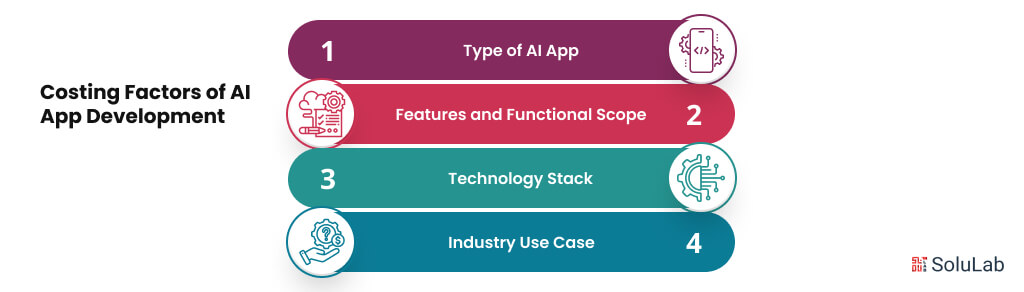
Costing Factors of AI App Development

When you’re planning to build an AI-powered app, knowing what drives the cost is essential. As a B2B company, you’re likely focused on performance, compliance, and long-term ROI. Below are the main things that shape the total AI app development cost:

1. Type of AI App

The kind of app you want to build plays a big role in its cost.

  • Basic AI apps (like rule-based systems or recommendation engines) are cheaper and faster to build.
  • Moderate AI apps use advanced tools like Natural Language Processing (NLP) for voice, image recognition, or basic predictions.
  • Advanced AI apps involve adaptive systems, decision automation, or intelligent agents. These often require help from an expert AI agent development company.

2. Features and Functional Scope

The number and complexity of features directly influence your AI app’s cost. Common AI app features include:

  • AI-powered chatbot and virtual agents 
  • Voice or facial recognition
  • Behavioral analysis and user personalization
  • Integration with IoT or even blockchain systems

More features mean more time, testing, and budget.

3. Technology Stack

What tools and platforms you use matters a lot.

  • Using ready-made models (like OpenAI, Google Vertex AI) reduces costs.
  • Building your own models from scratch requires more budget.
  • Running on cloud services like AWS or Google Cloud adds cost unless optimized well.
  • Partnering with an experienced team that offers MLOps consulting services can help manage infrastructure and deployment costs smartly.

4. Industry Use Case

Different industries have different needs, and that affects pricing, too.

  • Sectors like finance and healthcare often need compliance, extra security, and data privacy, which increases the AI development cost.
  • Other sectors like retail, logistics, or education are generally faster to build for.

These factors raise the overall AI development cost but are necessary for safe deployment.

Read Also: How to Create an AI-Powered App like Doppl?

CTA1

AI App Development Cost Breakdown by Category

If you’re planning to build an AI-powered app in 2026, here’s a simple look at how much it might cost based on the type of solution you choose.

Type of AI App Estimated Cost Range (USD) Ideal For
Basic AI App $15,000 – $30,000 Simple apps with limited AI logic
NLP-based Chatbot $25,000 – $50,000 Customer service, lead generation
AI Personal Assistant App $35,000 – $60,000 Virtual assistants for tasks or scheduling
Predictive Analytics App $60,000 – $90,000 Forecasting, demand planning, trend analysis
Custom Generative AI Application $80,000 – $150,000+ Content generation, Gen-AI chat, simulations

These ranges depend on factors like:

  • Project complexity
  • Platform (iOS, Android, Web)
  • Number of third-party integrations
  • Advanced AI app features like Natural Language Processing (NLP), Predictive Analytics, or Generative AI

For enterprises, a high-quality AI application solution isn’t just about features, it’s about scale, security, and future-proofing. Choosing the right AI development company or partner can make a big difference in both cost and performance.

If you’re unsure where to start or how to estimate the cost for your project, it’s best to hire AI developers who specialize in enterprise-grade AI solutions.

AI App Development Lifecycle and Associated Costs
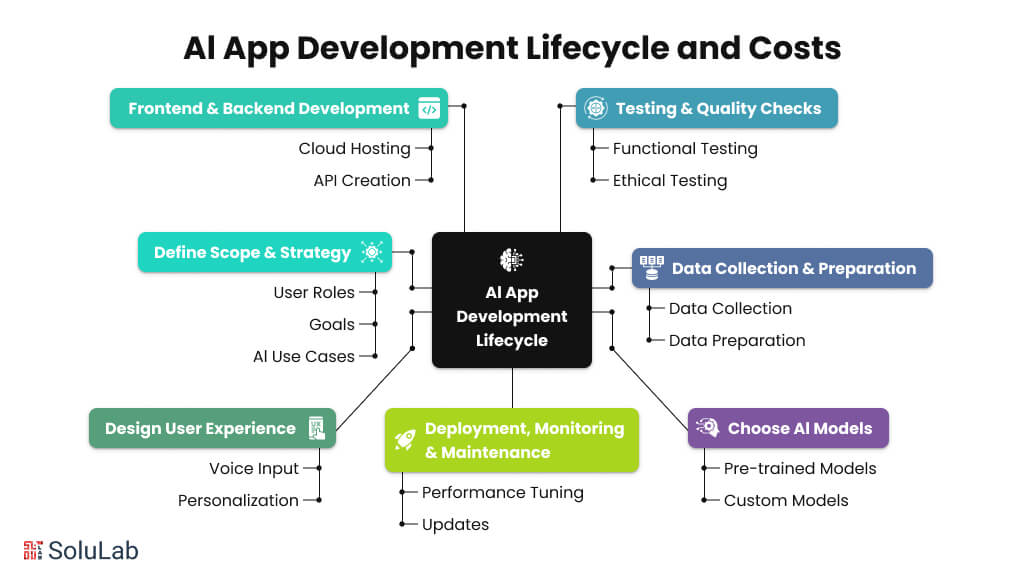
AI App development lifecycle

To understand the total AI app development cost clearly, it’s important to break it down step-by-step. Each phase in the development lifecycle impacts your budget and knowing where your money goes helps you plan smarter.

Here’s a breakdown of the key phases:

1. Define Scope & Strategy

Start by identifying user roles, goals, and the core AI use cases and applications. This ensures your app solves a real business problem and avoids unnecessary features.

2. Data Collection & Preparation

The heart of any artificial intelligence app is clean, labeled, structured data. This stage may require help from AI implementation services or in-house teams to collect and prepare the right training data.

3. Choose the Right AI Models

Decide between pre-trained models (like GPT, BERT) or building custom ones. This impacts speed, accuracy, and long-term cost. Custom training raises the AI development cost, but often brings better ROI.

4. Design the User Experience

Great AI apps feel natural to use. UX design focuses on intuitive flows based on how users think, not just how the tech works. At this point, AI app features like voice input, personalization, or recommendations are mapped.

5. Frontend & Backend Development

This is where your mobile app development company or internal team builds the actual app. They’ll connect the AI engine, create APIs, and host the app in a secure cloud environment. You’ll also need to handle security and data compliance. For companies seeking scalability and cost efficiency, nearshore backend development can provide the technical expertise needed to manage integrations, optimize performance, and ensure compliance with data protection standards.

6. Testing & Quality Checks

Apps go through functional and ethical testing to ensure they work and don’t create bias or risk. This helps reduce risks during deployment and can even lower long-term AI mobile app development costs.

7. Deployment, Monitoring & Maintenance

Once live, the app must be monitored, fine-tuned, and updated regularly. AI models learn over time, so performance tuning is ongoing. Many companies choose to partner with a trusted AI development company to handle updates and scale confidently.

At any stage, you can hire AI developers to speed up the process, reduce risk, and ensure high-quality output.

Read Blog: Cost To Build An App In Australia

Strategies to Reduce AI App Development Costs

Are you concerned that the cost of your AI development might exceed your budget? 

You’re not alone. Many businesses face the same challenge. But with the right approach, you can build a powerful AI app without overspending. Here’s how:

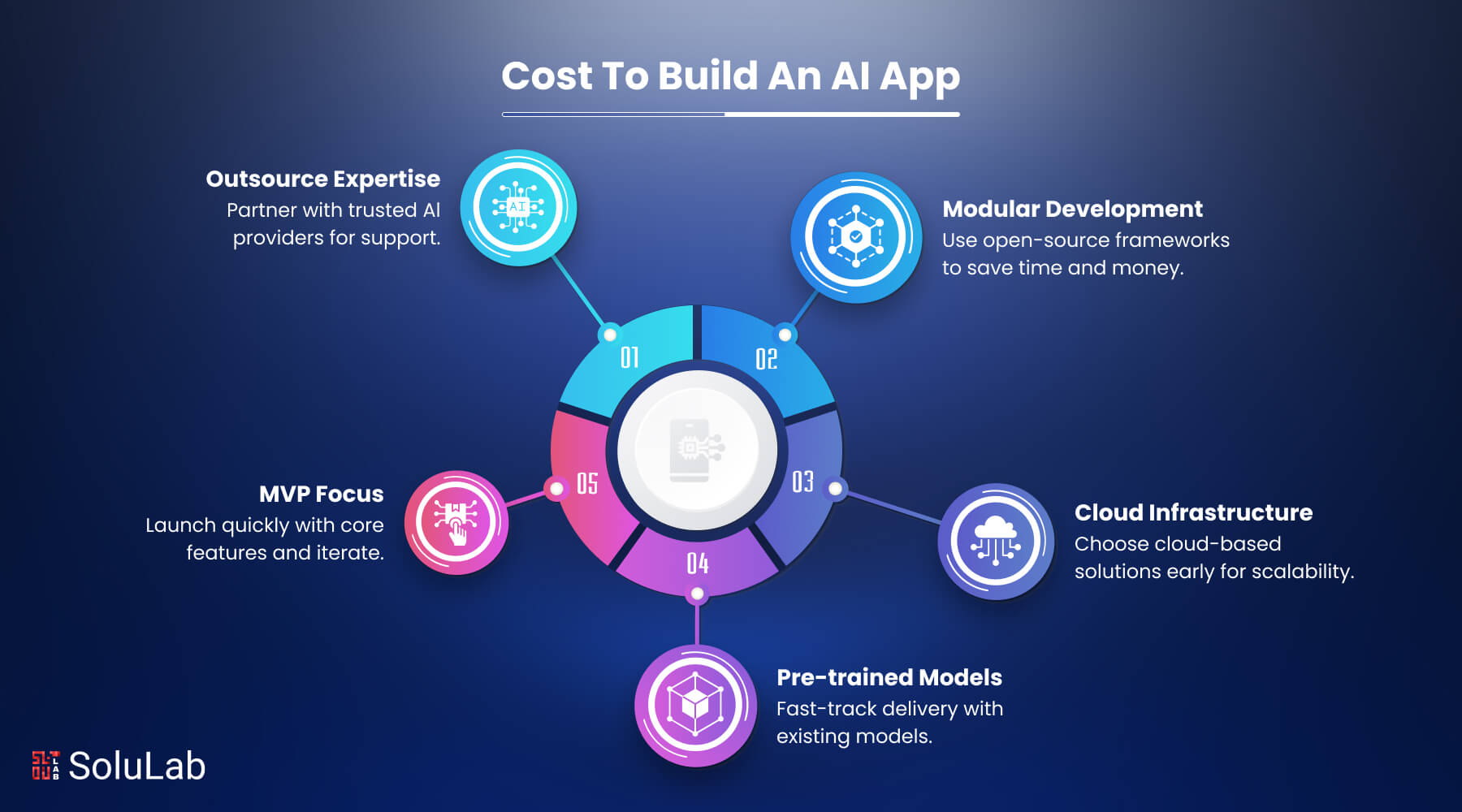
  • Utilize modular development and leverage open-source AI and ML frameworks. It saves both time and money.
  • Pick cloud-based infrastructure early and use MLOps consulting services to automate workflows.
  • Choose pre-trained models to fast-track delivery for most AI use cases and applications.
  • Focus on core MVP features first. Launch fast, then improve over time.
  • Outsource to a trusted AI application solutions provider with proven expertise.

Cutting costs doesn’t mean cutting value. It means making smart, scalable decisions that get your AI app to market faster and more efficiently.

CTA2

Conclusion

By now, you have a clear idea of what affects the AI app development cost. You’ve seen how features, app complexity, and industry use cases all play a role. Whether you’re building a Generative AI-powered chatbot, an AI personal assistant app, or a smart prediction tool, choosing the right mobile app development company is key to your success.

At SoluLab, we specialize in helping enterprises plan and build custom Artificial intelligence apps that are scalable, efficient, and built for real business impact. Our AI integration services are designed to support enterprise-grade apps from start to finish.

Contact us today to discuss your unique business idea, and we’ll power it with AI!

FAQs

1. How much does AI personal assistant app development cost today?

Building a personal assistant AI app like a smart scheduling or voice bot ranges between $50,000 and $150,000. The cost depends on how advanced your assistant is, simple apps are cheaper, but AI agents with NLP and voice capabilities need more development and testing.

2. Why does AI development cost vary so much across industries?

The AI development cost depends heavily on industry-specific use cases. For example, building AI for healthcare or finance often involves strict regulations and complex data, which means more time, security, and cost. In contrast, retail or HR apps may cost less due to simpler workflows.

3. Which Artificial intelligence apps are the most cost-effective to build?

Apps like chatbots, content recommenders, and image classifiers are the most budget-friendly Artificial intelligence apps. These use off-the-shelf models and are faster to build. More advanced tools like fraud detection or diagnostic engines require deeper AI expertise and bigger budgets.

4. How can I hire AI developers and manage the overall AI project cost?

To hire AI developers, work with an experienced AI development company that offers end-to-end support. Hiring a dedicated team ensures your project is scoped correctly, deadlines are met, and you’re not wasting budget on avoidable delays or poor architecture choices.

 

What is Parameter-Efficient Fine-Tuning (PEFT)?

Parameter Efficient Fine Tuning (PEFT)

Large language models like GPT-3 and BERT are developed with the help of transfer learning. It is a machine learning approach where a model that has been trained on one job is applied to another task that is different yet comparable. The theory underlying transfer learning is that a model may use the information it learns from solving one issue to help solve another.

One of the first applications of transfer learning was enhancing the capabilities of NLP-based models using pre-trained word embeddings, such as Word2Vec. Large pre-trained language models like BERT and GPT-3 have had a significant impact in the recent past, expanding the potential applications of transfer learning. One of the most often utilized techniques in transfer learning is fine-tuning. It entails training a pre-trained model using a smaller collection of task-specific labeled data in order to modify it for a certain task.

However, fine-tuning the whole model has become extremely costly and sometimes unfeasible due to the fact that huge language models include billions of parameters. As a result, in-context learning has gained more attention. In this method, the model receives reminders for a task and provides in-context updates. But it’s not always the best option due to inefficiencies like having to analyze the prompt each time the model predicts anything and occasionally performing terribly. This is where Parameter-efficient Fine-tuning (PEFT) is essential. Research by Houlsby et al. (2019) shows that Parameter-Efficient Fine-Tuning methods, such as adapters, can reduce the number of trainable parameters by up to 99% compared to traditional full fine-tuning methods while retaining competitive performance on various NLP tasks.

By focusing on a limited subset of the model’s parameters, PEFT can achieve performance that is equivalent to complete fine-tuning while using a substantially smaller amount of computing power. In this blog, we will discuss the PEFT approach along with its advantages and how it has developed into a productive tool for optimizing LLMs on downstream activities, despite common issues such as encountering the error no module named ‘PEFT’.

What is PEFT?

Parameter Efiicient Fine-Tuning

Parameter-efficient Fine-tuning (PEFT) is a natural language processing (NLP) approach that improves the efficiency of pre-trained language models on specified downstream tasks. It involves recycling the pre-trained model’s parameters and fine-tuning them with a smaller dataset, saving computing resources and time over training the complete model from scratch.

PEFT accomplishes this effectiveness by freezing portions of the pre-trained model’s layers and fine-tuning just the final few layers relevant to the downstream job. This approach allows the model to be modified to new tasks with minimal computational cost and fewer labeled instances.

Why is Parameter-efficient Fine-tuning Important?

Although PEFT is a relatively recent concept, upgrading the final layer of models has been used in the area of computer vision with the advent of transfer learning. Even in NLP, studies with static and non-static embedded words were conducted at an early stage. According to a study from Google Research, techniques like Low-Rank Adaptation (LoRA) and prefix-tuning can achieve over 95% of the performance of full fine-tuning with as little as 0.4% of the parameters being trained.

Parameter-efficient fine-tuning seeks to enhance the accuracy of pre-trained models, which include BERT and RoBERTa, on a variety of downstream tasks, involving sentiment analysis, named entity identification and question answering. It accomplishes this in low-resource environments with limited data and processing power. It merely changes a limited fraction of model parameters and is less susceptible to overfitting.

Difference Between Fine-Tuning and Parameter-Efficient Fine-Tuning

Fine-tuning and parameter-efficient fine-tuning (PEFT) are two methods used to enhance the performance of pre-trained models on specific tasks.

Fine-tuning involves taking a pre-trained model and further PEFT training it on new data for a new task. This process typically involves updating all the layers and parameters of the pre-trained model, which can be computationally expensive and time-consuming, especially for large models.

In contrast, parameter-efficient fine-tuning (PEFT) focuses on training only a select subset of the model’s parameters. This approach leverages adaptive budget allocation for parameter-efficient fine-tuning, which identifies the most critical parameters for the new task and updates only those. By concentrating on the essential parameters, PEFT significantly reduces the computational cost and time required for fine-tuning.

Parameter-efficient Fine-tuning vs. Standard Fine-tuning

Parameter-efficient Fine-tuning Standard Fine-tuning
Goal Enhance the performance of a pre-trained model on a specific task with limited data and computational resources.
Training Data Utilizes a small dataset (fewer examples).
Training Time Faster training time compared to fine-tuning.
Computational Resources Requires fewer computational resources.
Model Parameters Updates only a small subset of the model’s parameters.
Overfitting Less prone to overfitting as the model undergoes fewer modifications.
Training Performance Performance is good, though typically not as high as with full fine-tuning.
Use Cases Ideal for low-resource settings or situations where large training datasets are not available.

Benefits of PEFT

In this context, the benefits of PEFT over conventional fine-tuning will be explored. Let’s examine the advantages of parameter-efficient fine-tuning as opposed to fine-tuning.

  • Reduced Computational and Storage Costs

PEFT considerably lowers computational and storage costs by only requiring minor adjustments to a limited number of additional model parameters while freezing the majority of the pre-trained LLMs’ parameters.

  • Resolving Catastrophic Forgetting

When PEFT LLM is fully fine-tuned, there is a chance that the model will forget what it learned during pretraining. PEFT can get around this problem by changing a small number of settings.

  • Superior Performance in Low-data Regimes

Research has demonstrated that PEFT techniques outperform complete fine-tuning in low-data regimes and more effectively adapt to circumstances outside of the domain.

  • Portability

Unlike the enormous checkpoints of complete fine-tuning, users of PEFT techniques can acquire small checkpoints worth a few MBs. Because of this, it is simple to deploy and use the trained weights from PEFT techniques for a variety of applications without having to replace the entire model.

  • Performance Equivalent to Complete Fine-tuning

PEFT allows for the achievement of full fine-tuning performance with a minimal number of trainable parameters.

Few-shot Learning in Context (ICL) vs Parameter-efficient Fine-tuning (PEFT)

Methods for training natural language processing models include parameter-efficient fine-tuning and few-shot in-context learning. Though the methodologies used in both systems are technically different, they both allow large language models already taught to perform new tasks without requiring further training. The first method, called ICL, does not need gradient-based training; instead, it enables the model to execute a new job by entering prompted samples. ICL does, however, come at a high expense in terms of memory, processing power, and storage. The second method, called PEFT fine tuning, trains a model to do a new job with few modifications by adding or choosing a few additional parameters.

ICL is a method that incorporates contextual information during fine-tuning in order to enhance the few-shot learning efficiency of pre-trained language models. With this method, more contextual data is fed into a pre-trained language model to refine it on a few-shot job. The additional phrases or paragraphs that give more details about the work at hand might be this contextual knowledge. With just a small number of training instances, ICL seeks to leverage this contextual data to improve the model’s capacity to generalize to new tasks.

However, by identifying and freezing key model parameters, parameter-efficient fine-tuning is a strategy that seeks to increase the effectiveness of fine-tuning pre-trained language models on tasks downstream.

This method entails freezing a portion of the model’s parameters to avoid overfitting and fine-tuning the pre-trained model on a limited set of data. The model can keep more of its pre-trained information by choosing freezing key parameters, which enhances its performance on downstream tasks with sparse training data.

Contact Us

Is PEFT or ICL More Efficient?

Let us now discuss ICL vs. PEFT. For small language model programs, where models have to swiftly change to new tasks with minimal training samples, parametric few-shot learning (PFSL) is an essential job. ICL is one of the most widely used methods that have been proposed in recent years to address this difficulty. However, a 2021 study presents a novel method known as parametric efficient few-shot learning that performs better in terms of reliability than ICL while needing significantly fewer computational resources.

PEFT-fine tuning uses a unique scaling mechanism called (IA)^3 to rescale inner activations using learned vectors, which is one of the key reasons it performs better than ICL. With just a few more parameters added, this method outperforms fine-tuning the entire model. Alternatively, ICL uses a small sample size to fine-tune the whole model, which may result in overfitting and a decrease in accuracy.

The incorporation of two extra loss factors by PEFT methods, which encourages the model to output a lower probability for erroneous choices and takes the length of distinct response options into consideration, is another reason why it performs better than ICL. By avoiding overfitting, these PFT training loss terms improve the model’s ability to generalize to new tasks.

Parameter-efficient fine-tuning not only performs better than ICL, but it also uses fewer computing resources. According to the study report, PEFT trains on a single NVIDIA A100 GPU in under 30 minutes and needs over 1,000 times less floating-point operations (FLOPs) while inference than few-shot ICL with GPT-3. Because of this, PEFT is now a more viable and scalable option for NLP applications in the real world.

In general, few-shot learning for NLP applications has advanced significantly with the development of PEFT. For jobs requiring fast adaptation to novel few-shot learning contexts, it is a better option to ICL because of its utilization of (IA)^3 scaling, extra loss terms, and higher computing efficiency.

Parameter-efficient fine-tuning not only performs better than ICL, but it also uses fewer computing resources. According to the study report of PEFT paper, PEFT trains on a single NVIDIA A100 GPU in under 30 minutes and needs over 1,000 times fewer floating-point operations (FLOPs) while inference than few-shot ICL with GPT-3. Because of this, PEFT is now a more viable and scalable option for NLP applications in the real world.

In general, few-shot learning for NLP applications has advanced significantly with the development of PEFT. For jobs requiring fast adaptation to novel few-shot learning contexts, it is a better option for ICL because of its utilization of (IA)^3 scaling, extra loss terms, and higher computing efficiency.

Use Cases of PEFT

Classification of Texts

  • With PEFT, you can quickly and easily adapt huge models of language for sentiment analysis, which is perfect for online reviews, customer feedback, and real-time social media evaluation. 
  • Identify important entities in text, including names, organization, and locations by effectively refining models. Data extraction in industries like healthcare and finance is essential.

Translation by Machine

  • Use PEFT to modify pre-trained models for particular languages, pairs, or industries, producing translations of excellent quality with less computational demand that can be used in an environment with constrained resources.

AI that can Converse

By customizing, pre-trained models for conversation in specific sectors or business acting, PEFT can improve the model’s capacity to handle unique contexts and inquiry. 

Computer Vision

  • Apply small parameter changes to pre-trained visional algorithms were specific data sets. This method helps with imagining in hospitals, where models are adjusted to identify particular elements.
  • Improve models to quickly recognize and categorize items in pictures and movies. This is essential for applications in retail inventory management, autonomous, driving, and surveillance.

Recognition of Speech

With PEFT, you may modify pre-trained speech, recognizing models to fit certain accents, dialects, or languages, increasing accuracy, and useful Ness in a variety of linguistic contexts.

What are the Techniques of Parameter-efficient Fine-tuning?

New approaches are being developed through research, however, PFT approaches are currently limited to the following: 

1. Adapter

A sub-model called an adapter can be introduced to pre-train language models to adjust their underlying representation during fine-tuning. By placing the adapter behind the transformer architecture, multi-head, focusing, and feed layers, we may tune only the adapter parameters while freezing the rest of the model.

2. LoRA

Another method for fine-tuning big language models for specific activities or domains is a low-rank adaptation (LoRA). Like adapters, LoRA is a small adaptable module that fits into the PEFT transformer design. Freezing the train, the weight of the model, and injecting the rank breakdown matrix into each transformer architecture, layer drastically reduces downstream task trainable parameters. This approach can reduce trainable parameters by 10,000 times and GPU memory by three times while matching or exceeding fine-tuning the quality of models on various jobs.

3. Quick Training

PEFT also uses prompt tuning to adjust built-in language models to downstream requirements. Instead of model training where all pre-Trainin model parameters are modified for each job prompt, tuning requires practicing soft prompts by backpropagation and labeling samples to fine-tune them for individual tasks. Quick tuning outperformance, GPT three fuse shot learning, remains more competitive as the model size increases. It boosts domain transfer reliability and speeds up assembly. Instead of model Tweaking, which requires copying the complete treated model for each job, it stores a shot task-specific reminder for each work making it simple to reuse a frozen model for several downstream tasks.

4. Prefix Tuning

For natural language, production, prefix tuning is a lighter alternative to find tuning big pre-Trainin language models. Given the side of current models, fine-tuning calls for changing and storing all variables for each task, which is expensive. Prefix tuning optimizes a tiny continuous task. Pacific vector termed the prefix while freezing language model parameters. Prefix tuning trains, language models, and free parameters. Prefix tuning finds a context to guide the Model of language to generate task-specific content. the model.

What is the Process of Parameter-efficient Fine-tuning?

Process of Parameter Efficient Fine Tuning

Depending on the specific setup and the trained model being utilized, there might be variations in the stages required for parameter-efficient fine-tuning. However, the following provides a broad overview of the PEFT steps, which can be impacted by common issues like the no module named ‘PEFT’ error:

  • Pre-training: First, a large-scale model is developed for a generic job, such as language modeling or picture classification, on a big dataset. The pre-training stage aids in the model’s acquisition of useful features and representations from the data.
  • Task-specific Dataset: Assemble or produce a dataset tailored to the intended task for which you wish to optimize the trained model. This dataset needs to be representative of the intended job and labeled.
  • Identification of Parameters: Determine or assess the significance or applicability of parameters in the trained model for the intended use. This stage aids in figuring out which parameters to focus on during fine-tuning. Important parameters may be found using a variety of approaches, including gradient-based algorithms, importance estimates, and sensitivity analysis.
  • Subset Selection: Choose a portion of the parameters from the pre-trained model that best suits the intended job. One way to identify the subset is to apply specific criteria, like choosing the top k most significant attributes or imposing a threshold on the significance scores.
  • Fine-tuning: Preserve the other parameters and start the chosen subset of parameters using the values from the trained model. Use the task-specific dataset to adjust the chosen settings. This entails utilizing methods like Adam optimization or stochastic gradient descent (SGD) to develop the model on the target task data.
  • Assessment: Examine how well the adjusted model performs on a validation set or using other assessment metrics pertinent to the goal task. This stage aids in evaluating how well PEFT performs while utilizing fewer parameters to get the intended results.
  • Iterative Refinement (optional): To further enhance the model’s performance, you can choose to iterate and refine the PEFT model from pretrained process by modifying the parameter selection criteria, investigating various subsets, or fine-tuning for extra epochs. This is dependent on the performance and needs.

It’s crucial to remember, nevertheless, that applications and research articles may employ different PEFT implementation strategies and specifics.

Related: Comparison of Large Language Models

Step-by-Step Guide to Fine-Tuning with PEFT

Fine-tuning pre-trained models is a crucial step in enhancing the performance of AI systems for specific tasks. Parameter-efficient fine-tuning (PEFT) is an advanced technique that optimizes this process by fine-tuning only a subset of the model’s parameters, reducing computational costs and time. Here’s a step-by-step guide to fine-tuning with PEFT, while also addressing potential issues like the no module named ‘PEFT’ error:

Step 1: Select a Pre-Trained Model

Choose a pre-trained model that suits your specific application. Models like BERT, GPT, or RoBERTa are popular choices for natural language processing tasks. Ensure the model is compatible with PEFT methods.

Step 2: Define the Task

Clearly define the task for which you are fine-tuning the model. It could be text classification, sentiment analysis, named entity recognition, or any other specific NLP task. This definition will guide the selection of data and fine-tuning approach.

Step 3: Prepare the Dataset

Gather and preprocess the dataset required for your task. This involves cleaning the data, tokenizing text, and splitting the dataset into training, validation, and test sets. Ensure the dataset is representative of the task to achieve optimal results.

Step 4: Choose PEFT Techniques

Select appropriate PEFT techniques, such as:

  • Adapters: Small neural networks are added to each layer of the transformer, learning task-specific features while keeping the main model weights frozen.
  • Prefix-Tuning: Prepend trainable prefixes to the input embeddings, allowing the model to adapt to new tasks without modifying the original weights.
  • Low-Rank Adaptation (LoRA): Introduce low-rank matrices to adapt the model weights efficiently.

Step 5: Configure the Training Parameters

Set the training parameters, including learning rate, batch size, number of epochs, and optimizer. Ensure the parameters are fine-tuned for PEFT to avoid overfitting or underfitting.

Step 6: Implement Fine-Tuning

Utilize libraries like Hugging Face’s Transformers or PyTorch to implement the fine-tuning process. These libraries provide built-in support for PEFT methods, streamlining the fine-tuning workflow.

Step 7: Evaluate the Model

After fine-tuning, evaluate the model’s performance using the test dataset. Calculate metrics such as accuracy, F1 score, precision, and recall to measure the effectiveness of the fine-tuning process.

Step 8: Optimize and Iterate

Based on the evaluation results, adjust the fine-tuning parameters or PEFT methods if necessary. Iteratively fine-tune the model until the desired performance is achieved.

Step 9: Deploy the Model

Once the model performs satisfactorily, deploy it in your production environment. Monitor its performance and make adjustments as needed to ensure it continues to meet the required standards.

By following these steps, you can efficiently fine-tune pre-trained models using PEFT, achieving superior performance for your specific tasks while minimizing computational resources.

AI Services

Conclusion

Parameter-efficient fine-tuning (PEFT) represents a significant advancement in AI model optimization. By allowing fine-tuning of only a subset of parameters, PEFT minimizes computational resources and time, making it a cost-effective solution for enhancing the performance of pre-trained models. This approach is particularly beneficial for specific tasks such as text classification, sentiment analysis, and named entity recognition, where the ability to quickly adapt models to new datasets and applications is crucial. The use of techniques like adapters, prefix-tuning, and low-rank adaptation further amplifies the flexibility and efficiency of the fine-tuning process, ensuring that AI systems can be tailored to meet diverse and dynamic requirements.

However, implementing the PEFT model from pretrained comes with its own set of challenges, including the complexity of selecting appropriate techniques, configuring training parameters, and ensuring optimal performance across different tasks. As a leading AI development company, SoluLab is equipped to navigate these challenges, offering expertise in fine-tuning pre-trained models with PEFT.

Our team of skilled AI developers can help you use the full potential of PEFT, ensuring that your AI use cases solutions are both powerful and resource-efficient. Whether you need to hire AI specialists or seek comprehensive AI development services, SoluLab is your trusted partner. Contact us today to explore how we can enhance your AI capabilities and drive innovation in your projects.

FAQs

1. What is Parameter-Efficient Fine-Tuning (PEFT)?

Parameter-efficient fine-tuning (PEFT) is a technique used to optimize pre-trained models by fine-tuning only a subset of their parameters. This approach reduces computational costs and training time while enhancing the model’s performance for specific tasks. PEFT methods include adapters, prefix-tuning, and low-rank adaptation, each designed to adapt models efficiently without the need for full-scale retraining.

2. How does PEFT differ from traditional fine-tuning?

Traditional fine-tuning involves updating all the parameters of a pre-trained model, which can be computationally expensive and time-consuming. In contrast, PEFT focuses on updating only a small portion of the model’s parameters. This selective fine-tuning maintains the benefits of the pre-trained model while making the process more efficient and cost-effective.

3. What are the common applications of PEFT?

PEFT is commonly used in natural language processing tasks such as text classification, sentiment analysis, named entity recognition, and machine translation. It is also applicable in other domains where pre-trained models need to be adapted to specific datasets and tasks quickly and efficiently.

4. What challenges are associated with implementing PEFT?

Challenges in implementing PEFT include selecting the appropriate fine-tuning techniques, configuring the optimal training parameters, and ensuring the model’s performance meets the desired standards. Additionally, balancing efficiency with accuracy and avoiding overfitting are critical considerations that require expertise in AI model development.

5. How can SoluLab help with PEFT implementation?

SoluLab, as an AI development company, offers comprehensive services to help businesses implement PEFT effectively. Our team of experienced AI developers can guide you through selecting the right PEFT techniques, configuring training parameters, and optimizing model performance. Whether you need to hire AI specialists or seek full-scale AI development solutions, SoluLab can ensure your AI projects are efficient, cost-effective, and high-performing. 

The Roots of Data Revolts Against AI: What Does it Mean?

The Roots of Data Revolts Against AI What Does it Mean

In the rapidly changing digital landscape, the growth of Artificial Intelligence (AI) has been nothing short of remarkable. From AI-powered chatbots revolutionizing customer service to the top AI solution companies pioneering cutting-edge innovations, the impact of AI is undeniable. However, this journey has not been without its challenges. The rise of AI has also sparked discussions about the ethical implications and responsible integration of this technology. This blog will delve into the nuances of the AI revolution, exploring the role of various AI-related entities and their impact on the digital ecosystem.

The Rise of Artificial Intelligence

Artificial Intelligence (AI) has become an integral part of the modern technological landscape, revolutionizing the way businesses operate and transforming various industries. This section provides insights into the evolution of AI, its impact on customer interactions through AI-powered chatbots, and the transformative role it plays across different sectors.

  • Understanding the Evolution of AI

Artificial Intelligence (AI) has undergone significant evolution, from its early stages of rule-based systems to the complex deep learning models of today. This evolution has been driven by advancements in computing power, data availability, and algorithmic innovations. The initial stages of AI development focused on basic tasks such as decision-making and problem-solving. However, with the introduction of machine learning and neural networks, AI has expanded its capabilities to encompass complex data analysis, pattern recognition, and natural language processing.

  • AI-Powered Chatbots: Enhancing Customer Interactions

AI-powered chatbots have revolutionized customer interactions, providing businesses with efficient and effective ways to engage with their audience. These chatbots leverage natural language processing and machine learning algorithms to understand and respond to customer queries, thereby offering personalized and seamless experiences. The integration of AI-powered chatbots has streamlined customer service operations, allowing businesses to provide round-the-clock support and instant solutions to customer queries and concerns.

  • Analyzing the Impact of AI Revolution in Different Sectors

The AI revolution has made a significant impact across various sectors, including healthcare, finance, retail, and manufacturing. In healthcare, AI has enabled the development of predictive models for disease diagnosis and treatment planning, leading to more accurate and efficient healthcare services. In the financial sector, AI has facilitated the automation of routine tasks, fraud detection, and risk management, enhancing operational efficiency and security. Similarly, in the retail industry, AI has enabled personalized shopping experiences, recommendation systems, and inventory management optimization, leading to improved customer satisfaction and increased sales.

Top AI Solution Companies: Driving Innovation and Integration

Top AI Solution Companies: Driving Innovation and Integration

Amid the dynamic AI landscape, numerous top AI solution companies have emerged, leading the charge in driving innovation and integration. This segment highlights the services and offerings provided by these companies and their pivotal role in supporting businesses through digital transformation.

  • Overview of Leading AI Solution Providers

Several leading AI solution companies have emerged, offering a diverse range of AI-based products and services. These companies specialize in developing AI solutions tailored to specific industry requirements, including data analysis, automation, and predictive modeling. Some of the top AI solution companies include Google, Microsoft, IBM, Amazon Web Services (AWS), and Salesforce, among others.

  • Services and Offerings by Top AI Solution Companies

Top AI solution companies offer a wide array of services and offerings, including AI-powered data analytics, machine learning algorithms, natural language processing tools, and AI-driven automation solutions. These services cater to the specific needs of businesses, providing them with valuable insights, predictive analytics, and automation capabilities to streamline their operations and drive business growth. Additionally, AI solution companies offer consultancy services, training programs, and customized AI solutions to address complex business challenges and opportunities.

  • Role of AI Solution Companies in Digital Transformation

The role of AI solution companies in digital transformation is instrumental in driving innovation and integration across industries. These companies play a crucial role in helping businesses adopt and implement AI technologies, enabling them to leverage data-driven insights and automation to enhance their operational efficiency and competitiveness. By providing customized AI development solutions, consultancy services, and ongoing support, AI solution companies empower businesses to navigate the complexities of digital transformation and stay ahead in an increasingly competitive marketplace.

AI Development Company

AI Consulting Companies: Navigating Businesses Through AI Integration

AI consulting companies are crucial in guiding businesses through the intricate process of AI integration. This section delves into the significance of AI consulting in organizational development and emphasizes the collaborative strategies adopted by businesses and consulting firms for successful AI implementation.

  • Importance of AI Consulting in Organizational Development

AI consulting companies play a vital role in guiding businesses through the process of AI integration and adoption. These consulting firms provide expert guidance and strategic insights to help businesses identify the right AI solutions and develop customized strategies for successful implementation. By understanding the unique requirements and challenges of each business, AI consulting companies offer tailored solutions that align with the organization’s objectives and goals, facilitating a seamless transition to AI-driven operations.

  • Leveraging Expertise from AI Consulting Companies

Businesses can leverage the expertise and knowledge of AI consulting companies to gain a deeper understanding of AI technologies, their potential applications, and their impact on business operations. These consulting firms offer comprehensive assessments, feasibility studies, and roadmaps for AI implementation, enabling businesses to make informed decisions and investments in AI solutions that best align with their long-term objectives. By collaborating with AI consulting companies, businesses can gain access to a pool of AI experts, data scientists, and industry specialists, ensuring a holistic approach to AI integration and development.

  • Collaborative Strategies for AI Implementation and Integration

AI consulting companies work collaboratively with businesses to develop and implement effective strategies for AI integration. These strategies encompass the identification of AI use cases, data collection and analysis, AI model development, and deployment, as well as ongoing monitoring and optimization. By fostering collaboration and communication between cross-functional teams, AI consulting companies facilitate the seamless integration of AI technologies into existing business processes, enabling businesses to achieve operational excellence, cost optimization, and enhanced decision-making capabilities.

Exploring the Landscape of AI Development Companies

AI development companies are at the forefront of AI innovation, contributing to the development and deployment of cutting-edge AI solutions. This segment provides an overview of these leading companies, their innovations, and their contributions to shaping future technologies.

  • Overview of Top AI Development Companies

AI development companies are at the forefront of AI innovation, driving the development and deployment of cutting-edge AI solutions across industries. These companies specialize in AI software development, algorithm design, and machine learning model development, catering to the diverse needs of businesses seeking to leverage AI for enhanced productivity, efficiency, and competitive advantage. Some of the top AI development companies include OpenAI, DeepMind, and UiPath, among others.

  • Innovations and Technologies by AI Development Companies

AI development companies are known for their innovative approaches to Artificial Intelligence technology, including advancements in natural language processing, computer vision, and reinforcement learning. These companies continuously strive to push the boundaries of AI research and development, exploring new techniques, algorithms, and models that can address complex business challenges and opportunities. By staying at the forefront of AI research, AI development companies contribute to the continuous evolution and advancement of AI technologies, fostering a culture of innovation and excellence.

  • AI Development Companies and the Shaping of Future Technologies

The contributions of AI development companies are instrumental in shaping the future of technology, as they continue to drive advancements in AI research, development, and deployment. These companies are actively involved in addressing the evolving needs and demands of businesses, offering tailored AI solutions that can optimize operations, enhance decision-making, and drive innovation. By collaborating with AI development companies, businesses can tap into a wealth of AI expertise and knowledge, gaining access to state-of-the-art AI technologies that can propel them toward sustainable growth and success.

Decoding the AI Revolution: Challenges and Opportunities

Decoding the AI Revolution: Challenges and Opportunities

The AI revolution presents a myriad of challenges and opportunities for businesses, particularly in terms of workforce dynamics, ethical considerations, and harnessing the potential of AI technologies. This section sheds light on the implications of the Artificial Intelligence revolution and how businesses can navigate this transformative era.

  • Impact of the AI Revolution on Workforce Dynamics

The AI revolution has led to significant changes in workforce dynamics, impacting the nature of work, job roles, and skill requirements. As AI technologies continue to automate routine tasks and streamline business operations, there is a growing need for upskilling and reskilling the workforce to adapt to the changing demands of the digital era. While AI presents opportunities for increased efficiency and productivity, it also poses challenges related to job displacement, skill gaps, and workforce restructuring, necessitating a comprehensive approach to workforce development and management.

  • Addressing Ethical and Regulatory Concerns in AI Implementation

As AI technologies become more pervasive across industries, there is a growing need to address ethical and regulatory concerns related to data privacy, security, and bias in AI decision-making. Businesses and AI stakeholders must prioritize ethical considerations in AI development and deployment, ensuring that AI systems adhere to ethical guidelines and regulatory frameworks to protect user data and privacy. By implementing transparent and accountable AI practices, businesses can build trust and credibility with their stakeholders and foster responsible AI integration and usage.

  • Harnessing the Opportunities Presented by the AI Revolution

While the AI revolution presents challenges, it also offers numerous opportunities for businesses to innovate, grow, and thrive in an increasingly competitive marketplace. By embracing AI technologies, businesses can leverage data-driven insights, predictive analytics, and automation capabilities to streamline their operations, optimize their resources, and deliver enhanced customer experiences. The AI revolution also enables businesses to explore new market opportunities, develop innovative products and services, and expand their reach to new customer segments, driving sustainable growth and profitability in the digital age.

Enterprise AI Development Companies: Advancing Organizational Efficiency

In the quest for enhanced organizational efficiency, enterprise AI development companies play a pivotal role. This segment emphasizes the importance of these companies in optimizing enterprise-level operations and implementing AI solutions tailored to meet complex business challenges.

  • Role of Enterprise AI Development Companies in Business Optimization

Enterprise AI development companies play a critical role in advancing organizational efficiency by offering AI solutions and services tailored to the specific needs of enterprises. These companies focus on addressing complex business challenges, such as process automation, data analysis, and decision-making, by leveraging AI-driven technologies and applications. By partnering with enterprise AI development companies, businesses can optimize their operations, improve productivity, and achieve cost-effective solutions that drive business success and sustainability.

  • Implementing AI Solutions for Enterprise-Level Challenges

Enterprise AI development companies offer a comprehensive suite of AI solutions designed to address enterprise-level challenges and opportunities. These solutions encompass AI-driven data analytics, predictive modeling, intelligent automation, and cognitive computing, enabling businesses to make informed decisions, streamline their operations, and enhance their competitive edge. By integrating AI solutions, businesses can unlock valuable insights, mitigate risks, and capitalize on emerging opportunities, positioning themselves as industry leaders and innovators in their respective domains.

  • Driving Innovation and Scalability through Enterprise AI Development

Enterprise AI development companies are instrumental in driving innovation and scalability across industries, empowering businesses to explore new horizons and opportunities for growth. These companies specialize in developing scalable AI solutions that can adapt to the evolving needs and demands of enterprise-level operations, enabling businesses to achieve long-term sustainability and success. By harnessing the power of AI technologies, businesses can foster a culture of innovation, creativity, and agility, driving continuous improvement and transformation within their organizations.

Unveiling the Artificial Intelligence Model

Unveiling the Artificial Intelligence Model

The artificial intelligence model serves as the backbone of AI operations, encompassing a diverse range of components and frameworks designed to simulate human intelligence. This section provides insights into the functionality of an Generative AI models and its applications across various domains.

  • Components and Framework of an Artificial Intelligence Model

The artificial intelligence model encompasses a set of interconnected components and frameworks designed to simulate human intelligence and cognitive functions. These components include data collection and preprocessing, algorithm development and training, model testing and validation, and deployment and optimization. The framework of an artificial intelligence model is structured to enable the seamless integration of data-driven insights and machine learning capabilities, facilitating the development of predictive models, recommendation systems, and decision-making tools that can enhance business performance and outcomes.

  • Understanding the Functionality of an AI Model

The functionality of an AI model revolves around its ability to process and analyze vast amounts of data, extract meaningful patterns and insights, and generate predictive outcomes and recommendations. AI models leverage sophisticated algorithms and machine learning techniques to learn from data, adapt to changing environments, and make intelligent decisions based on predefined objectives and criteria. By understanding the functionality of an AI model, businesses can harness the power of data-driven insights and automation to optimize their operations, enhance their decision-making capabilities, and drive sustainable growth and profitability.

  • Exploring the Applications of AI Models in Different Domains

AI models find applications in various domains, including finance, healthcare, manufacturing, and retail, among others. In finance, AI models are utilized for risk management, fraud detection, and algorithmic trading, enabling businesses to optimize their investment strategies and minimize financial risks. In healthcare, AI models support disease diagnosis, treatment planning, and patient care management, empowering healthcare professionals to deliver personalized and efficient healthcare services. Similarly, in manufacturing and retail, AI models facilitate supply chain optimization, inventory management, and demand forecasting, leading to improved operational efficiency and customer satisfaction.

Generative AI: A Catalyst for Innovation and Creativity

Generative AI has emerged as a catalyst for fostering innovation and creativity, enabling businesses to explore new dimensions of creative design and multimedia production. This segment explores the concept of generative AI, its emerging trends, and its transformative applications in different industries.

  • Understanding the Concept of Generative AI

Generative AI refers to a subset of artificial intelligence that focuses on creating and generating new content, such as images, text, and multimedia, based on existing data and patterns. Generative AI models utilize deep learning techniques, including generative adversarial networks (GANs) and variational autoencoders (VAEs), to generate realistic and creative outputs that mimic human creativity and imagination. By simulating human-like behaviors and cognitive processes, generative AI fosters innovation and creativity, enabling businesses to explore new possibilities and avenues for product development and design.

  • Emerging Trends and Applications of Generative AI

Generative AI is witnessing a surge in popularity across various industries, driven by its applications in creative design, content generation, and multimedia production. In the field of creative design, generative AI is used for generating realistic images, 3D models, and visual artwork, allowing designers and artists to explore new aesthetics and design concepts. In content generation, generative AI facilitates the development of personalized content, storytelling, and multimedia presentations, enhancing user engagement and brand storytelling. Additionally, in multimedia production, generative AI enables the creation of realistic animations, special effects, and virtual environments, enhancing the overall visual appeal and immersive experience for users and audiences.

  • Leveraging Generative AI for Innovative Use Cases

Businesses can leverage generative AI for innovative use cases, such as product design, virtual prototyping, and creative marketing campaigns, to foster innovation and differentiation in the marketplace. By incorporating generative AI tools and models, businesses can streamline their creative processes, accelerate product development cycles, and introduce novel concepts and designs that resonate with their target audience. Generative AI also empowers businesses to personalize user experiences, deliver interactive content, and create immersive virtual environments, fostering deeper engagement and emotional connections with their customers and stakeholders.

Exploring the Role of Generative AI in Shaping Future Technologies

Generative AI plays a crucial role in advancing data analysis, pattern recognition, and creative design capabilities, significantly impacting the trajectory of future technologies. This section highlights the implications of generative AI and its collaborative integration with existing technologies.

  • Role of Generative AI in Advanced Data Analysis and Pattern Recognition

Generative AI plays a critical role in advancing data analysis and pattern recognition capabilities, enabling businesses to extract meaningful insights, trends, and correlations from complex datasets. By leveraging generative AI models, businesses can analyze large volumes of structured and unstructured data, identify hidden patterns and anomalies, and derive actionable insights that drive strategic decision-making and business performance. Generative AI also facilitates predictive modeling, forecasting, and trend analysis, empowering businesses to make informed predictions and projections that support long-term planning and growth.

  • Implications of Generative AI in Creative Design and Multimedia Production

The implications of generative AI in creative design and multimedia production are far-reaching, as businesses increasingly rely on AI-driven tools and technologies to enhance their creative capabilities and storytelling techniques. Generative AI enables businesses to automate the design process, streamline content creation, and generate personalized multimedia experiences that resonate with their target audience. By harnessing generative AI, businesses can unlock new dimensions of creativity, aesthetics, and user engagement, fostering a culture of innovation and experimentation in their creative endeavors and multimedia productions.

  • Collaboration and Integration of Generative AI with Existing Technologies

The collaboration and integration of generative AI with existing technologies are essential for driving innovation and fostering a cohesive digital ecosystem that supports business growth and sustainability. Businesses can integrate generative AI tools and models with their existing AI infrastructure, data analytics platforms, and creative design software, enabling seamless data exchange and collaboration across different departments and teams. By fostering a collaborative environment, businesses can leverage the collective expertise and insights of AI specialists, data scientists, and creative professionals, fostering cross-functional collaboration and knowledge sharing that drive continuous improvement and excellence.

Hire AI Developers

Conclusion

In conclusion, the evolution of Artificial Intelligence (AI) has ushered in a new era of technological advancement and innovation, redefining the way businesses operate and transforming various industries. The widespread adoption of AI-powered chatbots, the rise of top AI solution companies, and the pivotal role of AI consulting services have revolutionized the business landscape, paving the way for a more efficient and streamlined future.

Enterprise AI development companies have played a significant role in advancing organizational efficiency, providing tailored AI solutions to address complex business challenges and drive growth. The unveiling of the artificial intelligence model has provided businesses with a comprehensive framework to leverage data-driven insights and machine learning capabilities, propelling them towards optimized operations and enhanced decision-making.

Furthermore, the emergence of Generative AI as a catalyst for innovation and creativity has unlocked new dimensions of creative design and multimedia production. Generative AI trends and tools have empowered businesses to foster a culture of innovation, drive continuous improvement, and enhance customer experiences, thereby securing a competitive edge in the market.

Through strategic implementations and collaborative efforts with leading AI development companies like SoluLab, businesses can harness the full potential of AI technologies, drive sustainable growth, and differentiate themselves in an increasingly competitive landscape. By leveraging the expertise of dedicated AI developers and consulting services, businesses can navigate the complexities of the AI revolution, capitalize on emerging opportunities, and chart a successful path toward a more prosperous and technologically advanced future.

FAQs

1. What are the key benefits of integrating AI-powered chatbots into business operations?

The key benefits of integrating AI-powered chatbots into business operations include enhanced customer engagement, round-the-clock support, personalized interactions, and streamlined customer service operations.

2. How can businesses determine the right AI consulting services to meet their specific needs and objectives?

Businesses can determine the right AI consulting services by considering factors such as expertise, industry experience, tailored solutions, and a proven track record of successful AI integration and implementation.

3. What are the primary factors to consider when hiring dedicated AI developers for a project?

When hiring dedicated AI developers, businesses should consider factors such as technical proficiency, experience in AI development, adaptability to project requirements, and a collaborative approach to problem-solving.

4. How does Generative AI contribute to the enhancement of creative design and multimedia production?

Generative AI contributes to the enhancement of creative design and multimedia production by enabling automated design processes, personalized content generation, and the creation of immersive virtual environments that resonate with audiences.

5. What are the potential ethical implications and challenges associated with the widespread adoption of AI technologies?

The widespread adoption of AI technologies raises ethical implications and challenges related to data privacy, security, and bias. Businesses must prioritize transparent and accountable AI practices to build trust and credibility with stakeholders.

6. How can businesses effectively leverage the capabilities of the artificial intelligence model to optimize their decision-making processes?

Businesses can effectively leverage the capabilities of the artificial intelligence model by harnessing data-driven insights, predictive analytics, and automation to optimize their operations, enhance decision-making, and drive sustainable growth.

7. What are the emerging trends in AI development and how do they impact the future of various industries?

Emerging trends in AI development impact the future of various industries by enabling advanced data analysis, pattern recognition, and creative design solutions that drive innovation, efficiency, and competitiveness across different domains.

3 Deep Learning Techniques of 2025: Federated Learning, Reinforcement Learning, and Transfer Learning

Deep Learning Techniques

Deep learning, a subset of artificial intelligence (AI), has been on a remarkable journey of evolution. This remarkable technology has not only disrupted traditional machine learning but has also constantly adapted to meet the demands of an ever-evolving digital landscape. As we step into 2025, it’s crucial to delve into the significance of deep learning trends and understand how they are shaping the future of AI and machine learning.

One of the key trends in deep learning, which is gaining prominence in 2025, is federated learning. Federated learning represents a novel approach to training machine learning models, where data remains decentralized. This approach allows organizations to harness the collective intelligence of their data without exposing sensitive information. Federated learning promises to address privacy concerns while pushing the boundaries of machine learning capabilities.

The significance of deep learning trends in 2025 cannot be overstated. The technology continues to find applications in various industries, from healthcare to finance, and from autonomous vehicles to recommendation systems. These trends are not just theoretical concepts but practical solutions that businesses and developers can harness for real-world impact.

Reinforcement learning, a subset of deep learning, is gaining attention for its ability to enable machines to learn and make decisions through trial and error.

What Key Advantages and Challenges Does Federated Learning Present in the Context of Deep Learning Trends?

In the ever-evolving landscape of artificial intelligence, keeping up with deep learning trends is imperative to stay at the forefront of technological innovation. As we delve into 2025, the confluence of various cutting-edge techniques is poised to reshape the AI and machine learning domain. Among these trends, federated learning takes a prominent position. In this section, we will explore the basics of federated learning, its relevance in the context of deep learning trends, and how it is increasingly influencing business consultations for machine learning solutions.

A. Concept and Basics

Federated learning is a decentralized machine learning approach that emphasizes privacy and data security while harnessing the power of collective intelligence. Unlike traditional centralized models, federated learning operates on the principle of training models on local devices or servers, without sharing raw data.

These locally trained models aggregate their knowledge to create a global model. This concept aligns perfectly with the overarching deep learning trend, focusing on privacy and security, as well as machine learning approaches that empower distributed learning processes.

B. Applications in Real-World Scenarios

Federated learning finds its application in various real-world scenarios, showcasing its versatility and adaptability. In the healthcare sector, it allows different hospitals to collaborate on predictive models without exposing sensitive patient data. 

Moreover, it plays a vital role in personalized recommendations in platforms like social media, making the user experience more customized without compromising privacy. These applications exemplify how federated learning is at the forefront of new advances in machine learning, catering to the demands of modern data-driven industries.

C. Advantages and Challenges

The advantages of federated learning are multifaceted. Preserving data privacy, addresses ethical concerns, which is a crucial aspect of AI trends in 2025. Additionally, it enables efficient model updates without transmitting vast datasets, reducing bandwidth and computational costs. 

However, federated learning is not without its challenges. Synchronization of local models and dealing with non-IID (non-Independently and Identically Distributed) data can pose complexities. These intricacies necessitate continuous research and development, making it a prominent player in machine learning trends.

D. Federated Learning in Business Consultations

Federated learning is increasingly becoming a staple in business consultations for machine learning solutions. Companies are recognizing its potential in developing AI models while respecting data privacy and security. 

This approach is particularly vital when AI models are required to be deployed across diverse geographic locations or with sensitive customer data. Hence, as businesses aim to hire AI developers who can provide tailored solutions, federated learning is a powerful tool in their arsenal, aligning with the latest AI trends.

What Role Does Reinforcement Learning Play in the Broader Landscape of AI Trends in 2025?

In the rapidly evolving landscape of artificial intelligence, staying at the forefront of cutting-edge technologies is crucial for individuals and organizations seeking to harness the full potential of AI. Among the many facets of AI, Reinforcement Learning (RL) stands out as a powerful and adaptable methodology, making waves in the world of deep learning trends in 2025.

A. Understanding Reinforcement Learning

  • Definition and Fundamentals

Reinforcement Learning (RL) is a critical aspect of AI, involving an agent’s interaction with an environment to maximize cumulative rewards through decision-making.

  • Trial and Error

RL operates on the principle of trial and error, much like how humans learn through experience.

  • Agent-Environment Interaction

RL agents take actions in environments, receive feedback in the form of rewards or penalties, and adjust their strategies accordingly.

B. Reinforcement Learning in Deep Learning

  • Deep Reinforcement Learning

Deep RL combines deep neural networks with RL algorithms, enabling AI systems to handle complex, high-dimensional data.

  • Applications in Control

Deep RL is particularly effective in tasks involving decision-making, control, and sequential behavior.

  • Real-World Examples

Examples include robotics, autonomous vehicles, and game AI, where Deep RL allows machines to adapt and improve their actions based on environmental feedback.

CTA1

C. Real-World Applications and Success Stories

Healthcare OptimizationRL is used in healthcare to optimize treatment plans for patients, ensuring the most effective care and treatment strategies.

  • Financial Applications

In finance, RL algorithms are applied for portfolio management and algorithmic trading, maximizing returns while minimizing risks.

Historical Milestone 

AlphaGo’s victory over the world champion Go, player, stands as a significant success story, showcasing the potential of RL in complex tasks.

D. Advancements in Reinforcement Learning in 2025

  • Continuous Evolution

In 2025, Reinforcement Learning continues to evolve with several significant advancements.

Algorithmic Improvements

Improved algorithms contribute to RL’s enhanced capabilities and efficiency.

  • Integration with Other Techniques

RL’s integration with Transfer Learning and Generative AI expands its application horizons, allowing models to learn from pre-trained knowledge and generate more insightful decisions.

E. Role in Federated Learning

RL plays a crucial role in Federated Learning, where multiple decentralized devices collaborate to train shared models while keeping data locally, making RL a pivotal element in the new advances in machine learning.

  • Relevance for AI Development

Given its growing importance, organizations may look to hire AI developers and seek machine learning consultations to harness the capabilities of Reinforcement Learning effectively.

In the rapidly evolving landscape of artificial intelligence, transfer learning stands out as a game-changer, redefining the way we approach machine learning tasks. It has gained prominence as one of the pivotal deep learning trends of 2025. In this article, we delve into the world of transfer learning, exploring its applications across various domains, the state-of-the-art models in 2025, and its critical role in AI development.

What are the Applications Across Various Domains?

Applications Across Various Domains

Transfer learning, with its ability to transfer knowledge from one domain or task to another, has found applications across a wide spectrum of domains. From computer vision to natural language processing and beyond, it has left an indelible mark on the AI landscape.

  • Computer Vision

In the realm of computer vision, transfer learning has revolutionized object recognition, image segmentation, and object detection. Models pre-trained on extensive datasets have been fine-tuned for specific tasks, significantly reducing the need for large labeled datasets in novel applications.

  • Natural Language Processing

In NLP, transfer learning has led to remarkable breakthroughs in sentiment analysis, text classification, and language generation. Transformer-based models like GPT-3 and BERT, which incorporate transfer learning techniques, have set new standards for language understanding and generation.

  • Healthcare

In the medical domain, transfer learning has enabled the development of models for disease diagnosis, medical image analysis, and drug discovery. By leveraging pre-trained models, healthcare professionals can save time and resources while improving diagnostic accuracy.

  • Finance

Financial institutions have harnessed the power of transfer learning for fraud detection, stock market prediction, and risk assessment. The ability to adapt pre-existing models to specific financial scenarios has proven invaluable.

  • Autonomous Vehicles

In the quest for autonomous driving, transfer learning plays a pivotal role. Models trained on vast datasets can be fine-tuned for specific road conditions, weather, and terrains, accelerating progress in this field.

What are the State-of-the-Art Transfer Learning Models in 2025?

The year 2025 has witnessed remarkable advances in the realm of transfer learning models. Here are a few state-of-the-art models that have garnered significant attention:

  • GPT-4

The successor to GPT-3, GPT-4 represents the cutting-edge generative AI landscape. With 100 trillion parameters, it showcases the power of transfer learning in natural language generation and understanding. It’s not just a language model; it’s a knowledge model capable of multitasking across various domains.

  • CLIP

CLIP (Contrastive Language–Image Pre-training) is another milestone in transfer learning. It learns to understand images and text jointly, allowing for cross-modal understanding. This has applications in image classification, text-to-image generation, and much more.

  • ViT (Vision Transformer)

In the world of computer vision, Vision Transformers have taken center stage. Models like ViT demonstrate the success of transfer learning in image tasks. By pre-training on vast image datasets, ViT has excelled in image classification and object detection.

What is the Role of Transfer Learning in AI Development?

Transfer learning has become an indispensable tool in the toolkits of AI developers and machine learning practitioners. Its importance is highlighted by its role in addressing several critical aspects of AI development:

  • Efficiency

Transfer learning enables AI models to start with pre-existing knowledge, reducing the need for extensive training on new datasets. This significantly accelerates model development.

  • Resource Conservation

It conserves computational resources by leveraging pre-trained models, which is particularly beneficial for organizations with limited computational power.

  • Data Scarcity Mitigation

In domains where data is scarce, transfer learning allows for the adaptation of models from related domains, overcoming the data limitation challenge.

  • Generalization

Models that excel in one domain can be fine-tuned for another, promoting generalization and reusability of AI solutions. 

How is the Synergy of Deep Learning and Generative AI Reshaping the Landscape of AI and Machine Learning?

Generative AI Reshaping the Landscape of AI and Machine Learning

In the ever-evolving landscape of AI and machine learning, one remarkable synergy that has gained substantial attention is the fusion of Deep Learning and Generative AI. This amalgamation holds the potential to revolutionize various industries and drive innovative solutions. Let’s explore the role of deep learning in generative AI, current trends, case studies showcasing its impact, and future prospects, all while considering key concepts and keywords in the AI and machine learning realm.

A. Deep Learning’s Role in Generative AI

Deep learning, as a subset of machine learning, plays a pivotal role in the development and success of generative AI. Generative AI models aim to create content, whether it’s images, text, or other forms of data, that mimics human-generated content. Deep learning techniques, such as deep neural networks and recurrent neural networks, are at the heart of generative models like GANs (Generative Adversarial Networks) and VAEs (Variational Autoencoders).

These deep learning models, with their ability to learn complex patterns and representations from large datasets, empower generative AI to generate content that is not only realistic but also highly diverse. This capability is essential in various applications, including image synthesis, natural language generation, and data augmentation. The synergy of deep learning and generative AI opens up possibilities for creative content generation, enhancing human-computer interactions and providing businesses with powerful tools for content creation.

B. Current Trends in Generative AI

In 2025, generative AI is experiencing a surge in popularity and advancements. Some notable trends include:

  • Enhanced Creativity

Deep learning models are being used to develop generative AI systems capable of producing highly creative and artistic content, from music composition to digital art.

  • Realistic Content Generation

Generative AI is creating content that is increasingly difficult to distinguish from human-generated content. This is being leveraged in industries such as media and entertainment.

  • Personalised Content

AI is tailoring content generation to individual preferences and needs, leading to more personalised user experiences in areas like e-commerce and content recommendations.

  • Ethical Considerations

As generative AI becomes more sophisticated, there’s growing concern about its ethical implications, including the potential for misuse or bias in generated content.

C. Case Studies Highlighting Deep Learning’s Impact

To appreciate the impact of deep learning in generative AI, we can look at some real-world case studies:

  • Artistic Expression with DeepDream

Google’s DeepDream project showcases how deep learning can transform ordinary images into surreal, dream-like artworks. This demonstrates the artistic potential of deep learning in generative AI tools.

  • ChatGPT and Natural Language Generation

OpenAI’s ChatGPT is a prime example of deep learning-powered generative AI for natural language generation. It engages in meaningful text-based conversations, thanks to its deep learning architecture.

  • Image Generation with StyleGAN

NVIDIA’s StyleGAN2 illustrates how deep learning can generate high-quality images with fine-grained control over their appearance. This technology is revolutionizing creative content generation and visual effects.

D. Future Prospects

The future prospects of the synergy between deep learning and generative AI are incredibly promising. We anticipate the following developments:

  • Improved Realism

Generative AI will continue to produce content of even higher realism, making it indispensable for applications like virtual reality, gaming, and design.

  • Wider Adoption

More businesses and industries will leverage generative AI tools to automate content creation, reducing costs and enhancing productivity.

  • Ethical Advancements

There will be a stronger focus on ethical considerations, including bias mitigation, responsible AI usage, and transparency in generative content generation.

  • Integration with Other Techniques

Deep learning and generative AI will collaborate with other techniques like federated learning, reinforcement learning, and transfer learning to create more versatile and capable AI systems.

CTA2

Conclusion 

SoluLab is at the forefront of the latest deep learning trends in 2025, leveraging cutting-edge techniques like federated learning, reinforcement learning, and transfer learning to stay ahead of the AI game. This blog explores how these techniques, in conjunction with deep learning and generative AI, have set new benchmarks in the world of machine learning, making SoluLab a sought-after destination for businesses looking to hire AI developers and seek expert consultations in this dynamic field.

Federated learning, one of the most promising deep learning techniques of 2025, is transforming the way AI models are trained. Instead of centralized data repositories, federated learning takes a decentralized approach, which allows machine learning models to be trained on local devices while preserving user privacy. SoluLab has been quick to embrace this revolutionary concept, as it aligns perfectly with the company’s commitment to ethical data handling and privacy preservation.

One of the major advancements in reinforcement learning that SoluLab has capitalized on is its combination with a generative AI development company, which allows for the creation of AI systems that can generate novel solutions to real-world problems. This has opened up new horizons for industries such as healthcare, where SoluLab’s AI models can discover groundbreaking treatments and optimize patient care.

FAQs

1. What is Federated Learning and how does it fit into Deep Learning Trends in 2025?

Federated Learning is a machine learning approach that allows model training on decentralized data sources. It’s a part of the current Deep Learning Trends as it addresses privacy concerns and is suitable for distributed data environments.

2. How can Federated Learning benefit businesses in 2025?

Businesses can leverage Federated Learning to collaboratively train models across multiple devices without sharing raw data, ensuring data privacy and security.

3. What are the main challenges in implementing Federated Learning for AI projects?

Challenges include communication overhead, non-IID data distributions, and maintaining model quality across decentralized devices.

4. Are there AI consultants specializing in Federated Learning for businesses?

Yes, there are AI consultants who can provide guidance on implementing Federated Learning for various business applications.

5. How does Reinforcement Learning contribute to Deep Learning and Generative AI in 2025?

Reinforcement Learning is a vital component for training AI agents to make decisions, which is crucial for generative AI, autonomous systems, and robotics.