Talk to an Expert

How is Blockchain in Banking Modernizing the Industry?

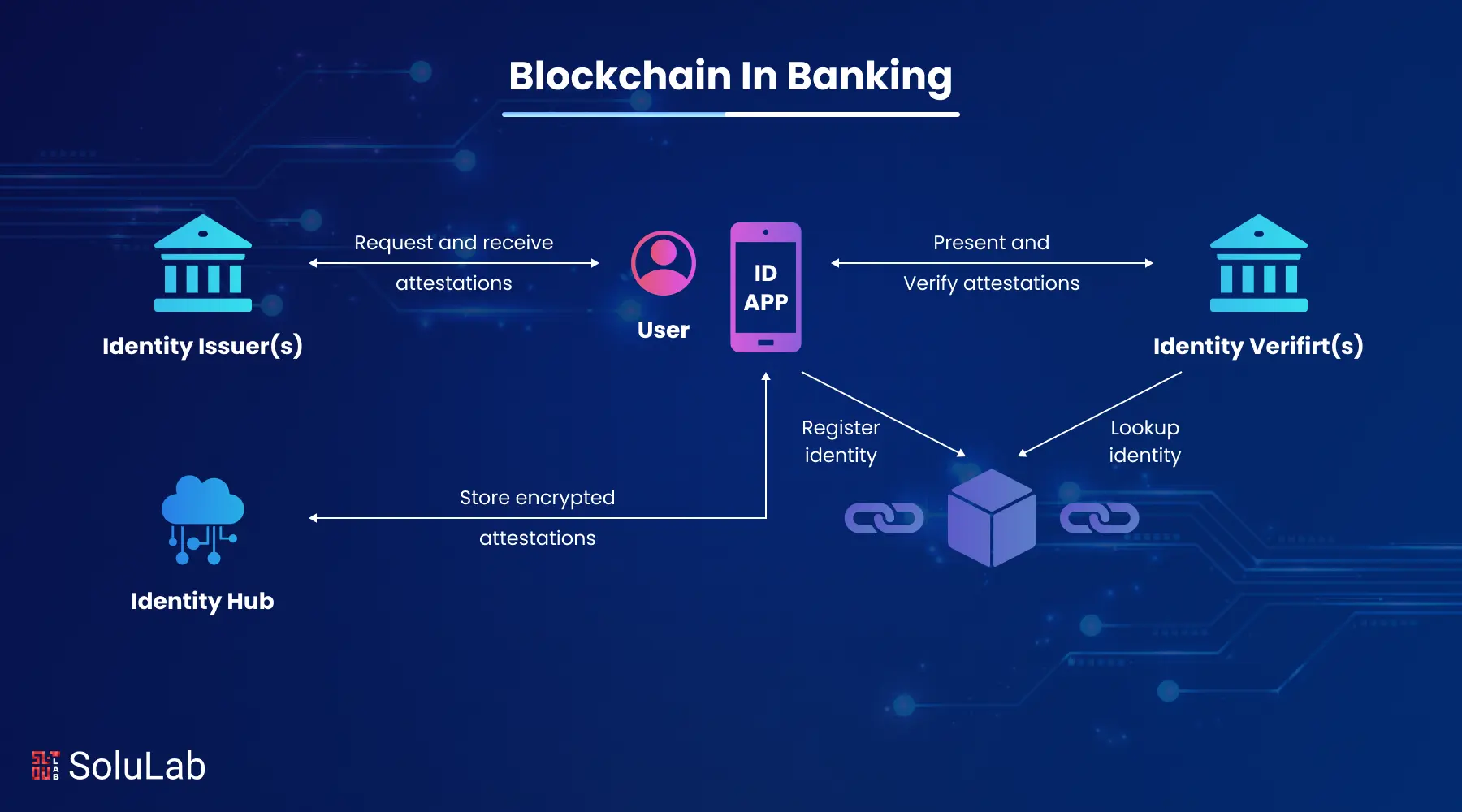
Blockchain in Banking

Traditional banking systems are often slow, expensive, and heavily dependent on intermediaries. Whether it’s cross-border payments taking days or the risk of fraud in financial transactions. Blockchain technology is solving these challenges by offering faster transactions, enhanced transparency, and security. It eliminates the need for middlemen. 

Banks now settle payments in real time while reducing costs. Smart contracts automate processes like loan disbursements and KYC, making operations more efficient and trustworthy.

Banks save up to 40% on operational costs, including compliance and document handling, by using blockchain for payments and KYC. In this blog, we’ll break down how blockchain is revolutionizing the banking industry with real-world examples

What is Blockchain in Banking?

Blockchain in banking refers to the use of blockchain technology to improve how banks handle transactions, data storage, and customer verification. At its core, blockchain is a secure, decentralized digital ledger that records transactions in a transparent and tamper-proof way. 

In banking, this means faster money transfers, reduced fraud, lower operational costs, and improved transparency. Instead of relying on multiple intermediaries, blockchain allows banks to complete cross-border payments almost instantly, with real-time tracking and verification. 

It also enhances security through encryption and reduces the risk of data breaches. Additionally, processes like KYC (Know Your Customer) and loan approvals can be automated using smart contracts, making banking more efficient and customer-friendly. 
CTA- 1

Key Implementation Models for Blockchain in Banking

Blockchain technology offers multiple implementation models in banking, each tailored to different levels of control, transparency, and collaboration depending on the use case and security needs.

1. Consortium Blockchains

Consortium blockchains are semi-decentralized networks governed by a group of banks or financial institutions. They offer better scalability and security while maintaining trust among known participants, ideal for shared services like interbank settlements or trade finance.

2. Private Blockchains

Private blockchains are controlled by a single organization, typically used within a single bank. They provide high levels of security, fast transaction speeds, and privacy, making them suitable for internal auditing, customer verification, or loan processing.

3. Public Blockchains

Public blockchains are open to everyone and fully decentralized. While less common in traditional banking due to privacy concerns, they are useful for issuing digital currencies or offering transparent financial services like P2P lending or crowdfunding.

Practical Blockchain Use Cases Reshaping Banking in 2025

Blockchain technology is transforming the banking industry by offering faster, safer, and more efficient solutions. Here are key use cases where blockchain is making a real difference in banking:

1. Cross-Border Payments: Blockchain allows near-instant international transactions with reduced fees and no need for multiple intermediaries. This not only speeds up the process but also brings transparency and real-time tracking to cross-border payments.

2. Fraud Prevention: With its tamper-proof ledger and secure encryption, blockchain helps banks detect and prevent fraud more effectively. It reduces the risk of double spending, data manipulation, and unauthorized access.

3. KYC (Know Your Customer): Banks can store and share verified customer data securely using blockchain. This reduces duplication, shortens onboarding time, and ensures compliance with regulations while improving the overall customer experience.

4. Smart Contracts: Smart contracts automate agreements between parties without human involvement. In banking, they can streamline processes like loan disbursement, insurance claims, and trade finance, ensuring faster and error-free execution.

5. Trade Finance: Blockchain simplifies trade finance by reducing paperwork, minimizing delays, and ensuring transparency across all participants in a trade deal. It allows real-time verification of documents and payments, increasing trust.

6. Syndicated Loans: Managing syndicated loans typically involves multiple banks and lots of paperwork. Blockchain ensures all parties have access to the same up-to-date information, reducing errors, delays, and operational costs.

7. Asset Tokenization: Banks can use blockchain to convert physical assets into digital tokens, making them easier to trade and manage. This opens up new investment opportunities and enhances liquidity in the market.

8. Clearing and Settlement: Traditional clearing and settlement can take days. Blockchain enables real-time or same-day settlement by providing a single source of truth, reducing counterparty risk, and freeing up capital.

Read Also: RWA Tokenization In Traditional Banking

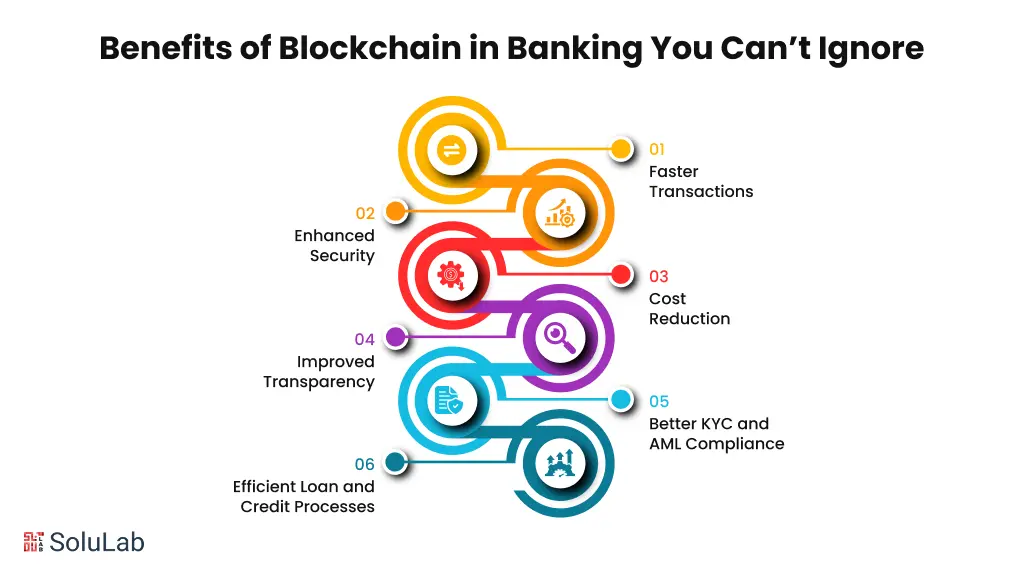
Top Benefits of Blockchain in Banking You Can’t Ignore
benefits of Blockchain in Banking

Blockchain is transforming the banking sector by making financial operations faster, safer, and more transparent. Here’s how it’s benefiting banks and customers alike:

  • Faster Transactions: Traditional banking systems take days for cross-border payments. Blockchain enables real-time or near-instant fund transfers by eliminating intermediaries, reducing settlement time, and increasing efficiency across international and domestic transactions.
  • Enhanced Security: Blockchain records are encrypted and stored across a decentralized network, making it nearly impossible to alter or hack data. This significantly reduces fraud, identity theft, and other security breaches in banking.
  • Cost Reduction: By removing third parties and automating processes through smart contracts, blockchain helps banks save on administrative and processing costs. It streamlines operations like clearing, settlement, and compliance checks.
  • Improved Transparency: Every transaction on the blockchain is recorded and time-stamped, creating an unchangeable audit trail. This builds trust with customers and simplifies regulatory reporting for banks.
  • Better KYC and AML Compliance: Blockchain allows secure sharing of verified customer data among institutions. This reduces duplication in Know Your Customer (KYC) and Anti-Money Laundering (AML) efforts, saving time and ensuring compliance.
  • Efficient Loan and Credit Processes: Smart contracts automate loan approvals, disbursements, and repayments. This speeds up the lending process, reduces paperwork, and minimizes errors or delays in credit evaluation.

Future of Blockchain in Banking

As more banks explore their potential to change the way banking services are provided. Blockchain is expected to become an essential component of the banking system as the need for quicker, safer, and more transparent processes grows. Blockchain will likely be used more often in the upcoming years for digital identity verification, real-time settlements, and cross-border payments. 

To simplify KYC, lower fraud, and save compliance expenses, banks may work together on shared blockchain networks. Smart contracts may further automate processes like trade financing and loan disbursement. Blockchain could be crucial to achieving financial equality. 

This would enable rural and unbanked communities to access banking services safely. Blockchain is anticipated to transition from trials to widespread implementation as laws and technology advance, redefining innovation, efficiency, and trust in the financial industry.

Real-World Examples of Blockchain in Banking

Banks around the world are actively using blockchain to improve operations, security, and reduce costs in real-world applications.

1. JPMorgan Chase – JPM Coin

JPMorgan created JPM Coin, a digital currency used for instant money transfers between institutional clients. It helps speed up transactions, especially for cross-border payments, while ensuring transparency and security using blockchain.

2. ICICI Bank – Blockchain for Trade Finance

ICICI Bank in India has used blockchain to execute trade finance and remittance transactions. This reduces paperwork, speeds up processing, and offers real-time tracking of documentation between exporters and importers.

3. HSBC – Forex Trade Settlement

HSBC uses blockchain to settle billions in foreign exchange trades through its platform “FX Everywhere.” This ensures faster settlements and reduces the need for manual reconciliation between banks.

4. YES Bank – Smart Contracts for Vendor Financing

YES Bank has implemented blockchain-based smart contracts to automate vendor financing. It minimizes delays, reduces fraud, and ensures that payments are released automatically when contract terms are met.

5. SBI – Blockchain Consortium BankChain

State Bank of India is part of the BankChain consortium, using blockchain for KYC, loan processing, and fraud prevention. It improves collaboration among banks and enhances customer verification across institutions.
CTA-2

Conclusion

Blockchain is changing the banking industry by making processes faster, safer, and more transparent. Across the globe, both private and public banks are testing and adopting blockchain. As adoption grows, we can expect more efficient financial systems that benefit both banks and their customers. 

Token World partnered with SoluLab to create a secure, scalable platform for emerging blockchain projects. Solutions included GenAI integration, smart contract auditing, compliance frameworks, and community engagement strategies, boosting investor confidence and delivering seamless token launches with innovative tokenomics and multi-chain interoperability.

Partner with SoluLab, a trusted blockchain development company in the USA, to build secure, scalable, and smart banking solutions.

FAQs

1. Why is it important to implement Blockchain in banking?

Implementing blockchain helps banks streamline processes, improve trust through transparency, reduce fraud risks, and offer more efficient customer services—all while saving costs.

2. Is blockchain secure for banking?

Yes, blockchain uses advanced cryptography and decentralized verification, making it highly secure and tamper-proof compared to traditional systems.

3. Will blockchain replace traditional banking systems?

Not entirely. Instead, it will complement and enhance existing systems by making them more efficient, transparent, and secure over time.

4. How does blockchain affect loan processing?

By automating documentation and verification through smart contracts, blockchain speeds up loan approvals and reduces the chances of fraud or delays.

5. Can blockchain reduce banking fraud?

Absolutely. Its transparent and immutable ledger makes tampering nearly impossible, reducing the risk of internal and external fraud.

 

Top 5 Enterprise Blockchain Platforms to Consider [2026]

Enterprises are under immense pressure to stay competitive, efficient, and transparent. But with rising data, slow transactions, and outdated legacy systems, many businesses are facing troubles in scaling their operations securely.

The enterprise blockchain market is expected to reach USD 145.9 billion by 2030, growing at a CAGR of 47.4% from 2024 to 2030.

This lack of trust, especially in sectors like finance, supply chain, and healthcare, is costing companies not just money but credibility. And while everyone’s talking about blockchain, the real challenge is figuring out which platforms are enterprise-ready, scalable, and future-proof in 2026.

In this blog, we’ll explore the top 5 enterprise blockchain platforms, the criteria to select the best platform, and more. Let’s get started!

How Blockchain Is Transforming Enterprises? 

Here’s how blockchain is impacting enterprises across industries:

1. Trust Without Middlemen: Blockchain enables secure, verifiable transactions without intermediaries. That means faster processes and fewer costs. 

2. Supply Chain Transparency: Every step can be tracked from farm to fork. Enterprises can now trace product origins, reduce fraud, and ensure compliance. This is perfect for FMCG, pharma, and agriculture.

3. Smart Contracts: No more manual checks. Smart contracts automate tasks when conditions are met. Great for legal, finance, and logistics.

4. Better Payments & Settlements: Faster cross-border payments with reduced transaction fees. Especially useful for export-import businesses in India.

5. Audit & Compliance Made Easy: Audits become simpler since every change is recorded. Blockchain makes financial data tamper-proof and regulator-friendly.

Criteria for Selecting the Top Enterprise Blockchain Platforms

With the proliferation of blockchain platforms catering to enterprise needs, it’s essential to establish a set of criteria to evaluate and select the most suitable options. Each platform comes with its strengths and weaknesses, making the selection process a nuanced task. Here are the key criteria to consider when selecting the top enterprise blockchain platforms of 2026:

  • Scalability and Performance: Scalability is crucial for enterprise applications that demand high transaction throughput. Platforms must demonstrate the ability to handle a large number of transactions per second while maintaining low latency. Considerations include the platform’s consensus mechanism, sharding techniques, and approaches to optimizing network performance as the user base expands.
  • Security and Data Privacy: Enterprises handle sensitive data, and security is paramount. Blockchain platforms must employ robust encryption, hashing, and access control mechanisms to safeguard data from unauthorized access. Privacy features, such as zero-knowledge proofs and private transactions, allow enterprises to share information selectively while preserving confidentiality.
  • Interoperability and Integration: In an ecosystem with multiple blockchain networks and existing IT infrastructure, interoperability is essential. Platforms should support seamless integration with legacy systems and other blockchain networks. Standards like cross-chain communication protocols enhance interoperability and facilitate data exchange between different platforms.
  • Smart Contract Capabilities: Smart contracts automate business processes, but their complexity varies between platforms. Evaluate the programming languages supported, the ease of writing and deploying smart contracts, and the platform’s support for oracles (external data sources).
  • Community and Support: A vibrant and active community indicates a platform’s vitality and ongoing development. Robust community support ensures quick issue resolution and a wealth of resources for developers. Platform documentation, developer tools, and user-friendly interfaces contribute to a positive user experience.

Top 5 Enterprise Blockchain Platforms

Ethereum

1. Ethereum

Ethereum, founded in 2015, is one of the most widely adopted blockchain platforms, known for its smart contract functionality, decentralized applications (dApps), and a robust developer community.

While originally public, Ethereum also offers enterprise-grade solutions through frameworks like the Enterprise Ethereum Alliance (EEA). It’s ideal for businesses looking to build transparent and automated systems.

2. R3 Corda

R3 Corda, launched in 2016, is a blockchain platform designed for regulated industries like finance, healthcare, and supply chain. Unlike public blockchains, Corda focuses on privacy, scalability, and interoperability by enabling only the involved parties to access transaction data.

It supports smart contracts and offers robust identity management, making it ideal for enterprise use cases. Its unique architecture ensures compliance and efficiency for complex workflows.

3. Hyperledger Fabric

Hyperledger Fabric, launched in 2015 by the Linux Foundation, is a modular and permissioned blockchain platform designed for enterprise use. It supports pluggable consensus mechanisms, private channels for confidential transactions, and chaincode (smart contracts) written in general-purpose programming languages like Go and Java.

Its architecture is ideal for businesses needing secure, scalable, and customizable solutions across sectors like supply chain, finance, and healthcare.

4. Hedera Hashgraph

Hedera Hashgraph, founded in 2018, is a high-performance public distributed ledger designed for enterprises. Unlike traditional blockchains, it uses a unique hashgraph consensus algorithm, making it faster and more energy-efficient.

Key features include fair transaction ordering, low fees, and high throughput, making it ideal for use cases like supply chain, identity management, and payments. Its governing council includes global giants like Google and IBM, ensuring robust governance.

IBM Blockchain

5. IBM Blockchain

IBM Blockchain (launched in 2017) is a robust enterprise-ready platform built on Hyperledger Fabric, designed to help businesses securely share data and streamline workflows. Known for its modular architecture, it supports permissioned networks, ensuring high privacy and scalability.

It also integrates with existing systems, making it ideal for sectors like supply chain, finance, and healthcare. IBM offers tools, templates, and support to help enterprises build and scale blockchain solutions efficiently.

Enterprise Blockchain Development Company

Conclusion

In 2026, enterprise blockchain platforms will no longer be optional — they’re a strategic necessity. Whether it’s improving operations, security, or transparency. Platforms like Hyperledger Fabric, Ethereum Enterprise, and others are redefining how businesses function. 

Each offers unique features tailored to different enterprise needs, from smart contracts to permissioned networks. As businesses continue to grow, choosing the right blockchain platform and hiring a blockchain developer can provide a competitive edge in the market. The key is to align technology with business goals.

Token World, a crypto launchpad platform, partnered with SoluLab to enhance smart contract security, scalability, and regulatory compliance. We built robust tokenomics, investor dashboards, and multilingual support. Our blockchain integration and community strategies empowered Token World to deliver secure, user-friendly token launches and drive global investor engagement.

SoluLab, a blockchain development company, can help you pick the best platform as per your business requirements.

FAQs

1. How is enterprise blockchain different from public blockchain?

Enterprise blockchains are usually permissioned, meaning only authorized participants can access or validate transactions, ensuring privacy and control. Public blockchains like Bitcoin and Ethereum are open to everyone, and transactions are fully transparent.

2. Is it expensive to build on an enterprise blockchain platform?

Costs vary depending on the platform, complexity of the solution, development time, and compliance needs. While some platforms are open-source and free to use, enterprise-level support or custom integrations can increase expenses. However, the long-term ROI often outweighs the initial investment.

3. Can enterprise blockchains support AI and IoT integrations?

Yes, many modern enterprise blockchain platforms support integration with AI, IoT, and cloud computing. This allows for powerful use cases like predictive maintenance, smart manufacturing, automated logistics, and real-time asset tracking with secure data layers.

4. Which industries are adopting enterprise blockchain platforms the most?

Major industries using enterprise blockchain solutions include finance and banking, supply chain and logistics, healthcare, insurance, government, energy, and real estate. These sectors benefit from enhanced transparency, data integrity, and automation.

5. How long does it take to build an enterprise blockchain solution with SoluLab?

Timelines vary based on complexity, but SoluLab typically delivers MVPs within a few weeks and full-scale enterprise-grade platforms in a few months. Their agile development process ensures fast iterations and transparent progress tracking.

How Blockchain Anonymity Is Maintained?

How is Blockchain anonymity maintained?

An assumption persists since long that cryptocurrencies such as Bitcoin were a refuge for criminals. This was because of their significant properties of being untraceable and being completely anonymous.

Meanwhile, as businesses and the general public grew more familiar with blockchain technology, it was becoming clear that the public transaction record of Bitcoin was, in reality, a gold mine of information for authorities. However, the issue of how anonymous cryptocurrency remains unanswered.

Difference between anonymity and privacy

To fully grasp the issue we’ll be discussing in this essay; we must first define those two – in reality, quite distinct – ideas. Anonymity “describes circumstances in which the actor’s name is unknown.” There is no mention of concealing the deed itself. In contrast, privacy is described as “the capacity of a person or group to seclude themselves, or information about themselves, and therefore express themselves selectively.”

Anonymity is about concealing the “who,” while privacy is about hiding the “what.” Anonymity in the context of blockchains refers to the capacity for parties to trade data without revealing any off-chain identifying information or previous transactions they have completed. Bitcoin, for example, is partly anonymous (each address is nothing more than a public key hash that seems random) but not private at all (we know all transactions done from/to that address

Blockchain Anonymity

Cryptocurrencies have sparked much interest from people, companies, and hackers, with Bitcoin once worth more than $5,000 per unit. Anonymity is one of the benefits of Bitcoin and other cryptocurrencies. However, there are worries that internet money transactions may not be as private as many would want.

There are many types of cryptocurrencies, the most popular being Bitcoin, Litecoin, and Ethereum. Altcoins are cryptocurrencies that were launched after the popularity of Bitcoin. Bitcoin, the father of all cryptocurrencies, mandates that the ledger, or record of transactions, be open to the public, making all transactions public knowledge. Many people are concerned about their anonymity and privacy as a result of this. In this post, we will look at some of the ways that cryptocurrency anonymity has been handled.

Bitcoin is regarded as pseudonymous

Fortunately, the blockchain doesn’t record everything. This means that the identities of the people involved in the transaction are not recorded. As a result, rather than being anonymous, bitcoin is pseudonymous. In many instances, though, one’s personal identity can be connected to one’s bitcoin address.

Bitcoin transactions with a person knowing that your identity exposes information that may be used for the identification of your past and future blockchain activities. Suppose, you send bitcoins to an online store, an exchange, or any business that collects client identification information. In that case, you allow them to connect that identity to your blockchain pseudonym, possibly exposing previous transactions you are involved in.

As a result, Bitcoin offers the ideal paper trail for law enforcement, tax authorities, and compliance experts. Because of this traceability, bitcoin theft becomes a much less appealing endeavor.

Of course, tools that launder bitcoin such as mixers,’ or tumblers’ have emerged. These services try to sever the paper trail by swapping one set of bitcoins for another, each with distinct addresses and transaction histories. But, these services come with limitations. They do not scale effectively for big quantities, and the laundering process is often traceable on the blockchain.

How can you purchase cryptocurrency anonymously?

  • Purchase it from a street vendor

This may seem suspicious, and it may even be counterintuitive to reveal your real identity at the time of purchase. However, if you do your homework, it is not as risky as it appears to be actually.

Bitcoin was exchanged in a particular manner in the early days. Bitcoin meetings would be held. Holders of the cryptocurrency would scream out prices. On the other hand, buyers used to come forward. After agreeing upon a particular price, cash would be exchanged for Bitcoin, sent immediately.

You may utilize services like Facebook, Localbitcoins.com, or Meetup.com to locate vendors in your area that you can get in touch with to exchange Bitcoin for cash. Additionally, you should utilize Tor, a VPN, and burner accounts to maintain more anonymity when you are searching and signing up for such events.

  • Purchase it at cryptocurrency or Bitcoin ATM

Purchasing Bitcoin at a cryptocurrency ATM isn’t always the greatest financial decision. To buy coins, Bitcoin ATMs mostly utilize APIs directly connected to cryptocurrency exchanges, and the person operating the ATM will surely charge a service fee for making the transaction.

They are, nevertheless, helpful for purchasing bitcoin secretly. However, one should choose their Bitcoin ATM wisely since some demand you to establish an account, thereby, exposing your name. You can go in, put some money in, and receive some bitcoin on a paper wallet for those who don’t. One may then transfer this Bitcoin to their preferred wallet using a mixer service. This will conceal its origin further and protect one’s identity.

Purchasing bitcoin by not disclosing your name is one thing. But, what one does with it may still expose your identity. Therefore, it’s important to be aware of how you’re utilizing your bitcoin at all times.

Techniques for preserving blockchain anonymity

1. Decentralized: Not under the control of governments

One of the most significant advantages of blockchain technology is its decentralized nature. Nobody has complete control over it. The blockchain of Bitcoin, for example, is maintained by hundreds of thousands of nodes. Hacking one percent, or even half, of the computer nodes, will not give you control over bitcoin.

To get power, you must launch a 51 percent assault on the whole blockchain. According to studies, a successful assault would cost $1.4 billion and months of effort. But, in exchange, you would have momentary control over the network and nothing to show for it monetarily since the coins would lose value immediately.

Blockchain communities rule themselves because they have such a high degree of security and no centralized authority. After all, self-rule was the original aim of bitcoin, and the policy was successfully handed down to all subsequent blockchain initiatives.

2.  VPNs and Tor

The best VPN and Tor services are both intended to protect the user and may be used to preserve anonymity. These technologies are utilized for both safety and privacy by researchers, journalists, businesses, governments, and others. Many bitcoin users with comparable worries utilize them as well. For example, many ransomware decryption tools are hosted on Tor as secret services.

VPNs are often used to conceal personal information while requesting bitcoin transactions. Both VPN and Tor can conceal a user’s personal information during a transaction by utilizing an alternative IP address or geolocation, which is occasionally customizable by the user. These technologies make it impossible for an attacker or analyst to observe traffic by correlating IP addresses and transactions. It may also be used to communicate with others, such as merchants while concealing your address from them.

VPNs are often used to conceal personal information while requesting bitcoin transactions. Both VPN and Tor can conceal a user’s personal information during a transaction by utilizing an alternative IP address or geolocation, which is occasionally customizable by the user. These technologies make it impossible for an attacker or analyst to observe traffic by correlating IP addresses and transactions. It may also be used to communicate with others, such as merchants while concealing your address from them.

3. CoinJoin

Typically, the back-end technology of decentralized mixers is the most frequently utilized technology. Gregory Maxwell proposed the CoinJoin protocol in 2013. The fundamental idea is that a group of payers combine their money and make a collective payment, obscuring the connection between payer and payee.

CoinJoin is made feasible because not every input in a transaction must originate from the same wallet or user. Because the signatures needed to verify a transaction are independent for each input, many users may agree to execute a single transaction to numerous unconnected payees. As a result, the information regarding which input paid which payee is not part of the blockchain and can be avoided.

CoinJoin is a critical tool for preserving anonymity since it serves as the foundation for numerous methods and implementations. SharedCoins, Darkwallet, CoinShuffle, PrivateSend, and JoinMarket are a few examples of implementations.

4. Ecosystems of Blockchain

Secure blockchain ecosystems can reduce many of the security risks associated with blockchain technology. However, using bitcoins to purchase items on Amazon does not provide much privacy. Amazon already has your name and address.

However, blockchain ecosystems that prioritize user privacy can remove all such risks. Blockchains may create secure chains that enable transparent, anonymous transactions ranging from product descriptions to purchasing and selling.

In the e-commerce industry, merchants post their products on the blockchain and enable customers to evaluate and verify the components used in their production. The transit of products from the shop to the delivery destination may be monitored safely without revealing any unnecessary addresses. Payments are made possible by digital currencies, and internet reviews help consumers discover the finest purchasing sites.

5. CryptoNote

A ring signature is a digital signature that enables one member in a group to sign on their behalf. This phase adds security by making it computationally difficult to identify which group members’ keys were used to generate the signature.

Conclusion

Bitcoin is a decentralized payment system that offers a method for obtaining numerous anonymous credentials, bitcoin addresses that may be used to conduct and receive payments. However, the previous study has shown that the system that utilizes such addresses may provide information about their owners. Furthermore, because all transactions conducted by the system are publicly accessible for study in the blockchain, it is possible to cluster various addresses belonging to the same user and classify certain usage.

Furthermore, if one of the cluster’s addresses can be linked to a real person, the payment history of the whole cluster may provide important information about that user. Although interesting research has been conducted in this area, the dynamism of the bitcoin ecosystem, which constantly modifies and improves bitcoin usage, implies that some of the hypotheses assumed for those blockchain analyses may not hold completely. Thus blockchain analysis still presents interesting open questions.

– Contact Us –

SoluLab being the top 3 Blockchain developers can help you build the perfect blockchain ecosystem.

Reach Out To Us Today

Blockchain in Media And Entertainment: Overview & Projects Across Industry

Everyone in the world wants to access data, information, media and entertainment digitally. People prefer to access digital content without any legal restriction or limitation. But, how many of us consider the possibility of digital piracy too? Everyone is so quick to blame the security threats and digital hacking concerns in internet when they run into digital troubles. As of today, all digital concerns are overwhelming and getting noisy rising the need for a solution. Here comes blockchain in media and entertainment world as superhero.

Blockchain development services for media and entertainment brings potential solutions in protecting digital content against digital duplication and digital theft. This is easier said than done but blockchain makes it look easier than saying it. Blockchain in media and entertainment uses proof of authenticity, proof of work and proof of evidence to authorize digital content. It provides artists with originality for all their work. By now, you might be one of the followers of blockchain development technology too.

Innovative Projects That Use Blockchain in Media And Entertainment Sector

This article discusses about blockchain projects in entertainment and media industry. The below ones are real life projects that are operating using blockchain development technology. Let’s get into industry overview from an eagle’s eye view from the perception of blockchain.

Civil

It is a journalism based reformulated project. This project uses blockchain in media and entertainment to provide readers and subscribers with original news in real-time without any manipulation of the content. It operates using Ethereum-based decentralized networks to start and create a transparent newsroom station where public and journalists can be in one single community. Blockchain also allows this project to self-govern and make intense decisions.

Steemit

It is a blockchain-based digital media rewarding platform. Everyone uses digital platform and social media for various purposes. However, only few of the companies reward digital users. This project focuses on using the opportunities provided by blockchain to reward artists, content creators and journalists to share stories and creative works without any censorship. With Steemit, say goodbye to traditional media infrastructure where artists were clashing with each other’s differences in interests. Now, every artist can express their thoughts with freedom.

Decentralized News Network (DNN)

It uses blockchain to combine content with blogs to create an open and transparent organizations for the news industry as well as digital reviews, writers and readers. Blockchain helps this project by providing independency in creating news and reviewing content for originality using proof of content. Applications and news submissions can be reviewed quickly than ever before and news can reach readers in real-time.

Hubii

It is a blockchain-based spokesman project. i.e. this particular project uses blockchain to digitally market content across boundaries without any restriction.  It is sole goal is to disintegrate information to ensure integrity, originality and let makers have control on what is to be marketed and how their content should be marketed digitally. This project also helping in prevention of fake-news by detecting them through a thorough digital verification with the help of an encrypted community. This community validates, evaluates and also predicts interests of readers.

UnionEdge

The Union Edge CAMA (collection account management application) guarantees that all stakeholders with a financial interest in a film or television production, from producer to investor to profit participant, will receive their pre-agreed share of the revenues collected – timely, securely and with full distributed ledger transparency.

Entertainment And Media Industry Overview With Blockchain

Industry of Music

Blockchain in Music

Musicians can now create music’s, sing and host digital orchestra events through encrypted recordings and digital ledgers to secure their content and monitor operations in real-time. Settling disputed between parties in achieving consensus to release a music album is easier through blockchain rather than going through a traditional process that involved a zoo of middlemen or even better to state as madmen.

Industry of News

Blockchain in News media

All of us see, read and hear a lot of news regarding political, technical, technological, scientific, automotive, cultural trend changes, etc. But, how many of those news articles are true? Or, how do we know that they are fake? Blockchain ensures that every single news article released and published is original. This can be accomplished by allowing journalists as well as readers to trace back every content back to its original source.

Industry of Media

Blockchain in digital media

Media industry can be divided into digital marketing media and entertainment media.

  • The digital marketing media sector is able to market idea, prototypes and even conduct marketing simulation in privacy and secrecy to save time and cost.
  • The entertainment media sector is able to release their media content globally at a lower cost. It can even reach remote area and expand their audience base with complete transparency.

Further, blockchain development technology allows animators to create better animations today by allowing them to share computational resources and without any border limitations. Professional animators can, now, rent computers instead of buying new systems. And, this is possible through a strong P2P network that comes in handy with blockchain.

Industry of Telecommunication

Blockchain in telecom

Blockchain allow tele-operators to set up telecommunication towers quickly, instantly and implement tele-networks with perfect certainty in quality. They use KYC integrated with blockchain to validate users and users can validate credibility of tele-operations by KPIs. Telecoms are able to have a well monetized and managed environment with blockchain.

Quick Read: Blockchain and Healthcare: Potential and Opportunities

Conclusion: Blockchain provides identity as a service

One of the major concerns and challenges faced in digital platform is the security protection to protect digital identities. Blockchain encrypts identity of makers and users under public or private network. Distributing content and conducting research has also become easier with blockchain in media and entertainment. What is your overview about blockchain in media and entertainment industry? Are you trying to consult any blockchain development company to explore further opportunities? Express your views and concerns with us.

Can Blockchain Technology Boost The Quality of Clinical Research?

Today, we are going to shed some light on how blockchain boost clinical research quality. Researchers are facing various challenges regarding trust and transparency in clinical data. The huge amounts of data created  in clinical trials are outpacing the ability of legacy data-management platforms to administer the competing needs of data sharing, patient privacy, and data integrity

The tricky and unpredictable nature of the clinical trial process is a crucial driver of high costs for pharmaceutical drugs. Many pharmaceutical companies aim to create  2-3 new drugs per year, to rationalize the costs of drug development. However, the success rate with clinical trials decreases the chances of a successful product to nearly zero.

This huge uncertainty results in higher prices for everyone, from the investigator to the end consumer.

Can Blockchain Boost Clinical Research Quality? How?

Today, there is a great demand for enterprise blockchain development solutions and blockchain development companies. Blockchain development technology is appearing as an innovative tool across all areas of industry. Fortunately,  blockchain technology for pharmaceutical industry is bringing significant attention in the research community that can provide solutions to all of these problems.     

blockchain clinical research quality

Blockchain technology utilizes a distributed computer network platform that enables databases to store time-stamped transaction records and documents. Each server in the network processes and verifies each data entry, then archives all transactions, along with the history trail.

The best part about blockchain is that data stored in a blockchain is essentially impossible to hack, temper, or steal. This is because the ledger is not kept on a single repository, but is spread throughout multiple databases in replicate copies. These verification requirements ensure that stored data remains intact and immutable. The blockchain technology is a safe and secure platform for storing and processing all types of valuable information, from clinical trial analysis results to business workflow documents to patients’ medical data and blueprints of genetic information.      

Blockchain in Healthcare and Pharmaceuticals

Blockchain development solutions in healthcare possess the capability to solve some of the biggest challenges in the industry. It enables real-time visibility into the entire clinical trial supply chain.

“Blockchain technology has the potential to solve many challenges facing clinical trial processes, such as accurately reproducing and sharing data, privacy concerns, and patient enrollment strategies”, said Caron Dhillon health care analyst at Results Healthcare.

Perhaps most importantly, through its ability to track events in chronological order and with full transparency, blockchain allows for a high level of data authenticity throughout the whole document flow in a clinical trial, ensuring the trust of the data and its integrity,” she told us.       

How Blockchain Technology Could Help in Clinical Trials?

blockchain in clinical trials

Improving patient recruitment

Blockchain in healthcare has the capacity to dramatically enhance the patient recruitment process. With blockchain solutions, one could share patient information with pharmaceutical or contract research organizations without disclosing the patient’s identity. This could provide more information about potential participants who are likely to be motivated to join a study.

Maintaining medical privacy

Blockchain technology can develop a secure tracking system for any data generated from patient-physician interactions. Blockchain anonymity allows storing and sharing of electronic health record (EHR) data transparently, along with maintaining patient privacy. This could free huge amounts of data for clinical research.

Securing data integrity

Good quality data from clinical trials requires security and an immutable audit trail. Blockchain secures data integrity with cryptographic validation of each transaction.

Read More: How Blockchain Projects Battle for Healthcare Data Protection

Traceability of consent

In a recent concept study, “researchers from the University of Paris and Columbia University applied cryptographic validation to transactions related to patient consent and the clinical research protocol for a fake experimental study. Each patient consent was time-stamped on the blockchain, as were consent renewals for protocol revisions. The resulting master data collection traced each consent to a version of the revised protocol. The result was a cryptographic representation of the real consent and protocol document data that can be verified on the web”.

Read More: How Blockchain Can Help Fight the Problem of Fake and Counterfeit Drugs?

Closing thoughts:

Let’s make a long story short! Yes, blockchain can boost clinical research quality. Three of the biggest pharmaceutical conglomerates – Pfizer, Amgen, and Sanofi – are working together to find the best ways to employ blockchain technology, from storing safe data to speeding up clinical trials and ultimately lowering drug development costs.  What are your thoughts on how can blockchain boost clinical research quality? In case of any queries, feel free to approach us for a no-obligation FREE consultation!                  

Enterprise Blockchain Development: Hurting or Helping Non-financial Industries?

What is enterprise blockchain for non-financial industries and how do it impact? In simple words, blockchain technology that focuses on providing decentralized services on a enterprise level is known as enterprise blockchain.  An enterprise blockchain helps to enhance the business performance highly and also increase the resilience. Thus, the downtime of due system failure is avoided which in turn, increases the enterprise performance. Enterprise blockchain development include ethereum development services, smart contract development services, development of Distributed Ledger Technology (DLT).

enterprise blockchain for non-financial industries

Though enterprise blockchain technology is considered to be helpful by many industries, still it is debated if it is helpful or hurting non-financial industries.

Enterprise Blockchain For Non-financial Industries

Non-financial industries include enterprises for which financial transactions are different from transactions handled by the enterprise owners themselves.  A non-financial industry includes enterprises of three types such as public, private and foreign controlled non-financial corporations.

A public non-financial corporation is handled by government institutions directly or indirectly. A private non-financial corporation is involved in trading one or more than one stock that is owned by other different private corporations or shareholder individuals or groups. A foreign controlled non-financial corporation deals with operations in a country that is not the parent country of the owner or the shareholder.

Enterprise Blockchain Develop Helps Non-financial Industries: This is how:

blockchain-helps non-financial

Reduction in Transaction Cost

Usage of smart contracts increases the accuracy of operations to avoid manual human mistakes in non-financial transactions. Automating operations save time and cost in large. It also eliminates multiple middlemen and thus allow non-financial industries to use valuable resources efficiently. Human force required to monitor and manage operations is reduced in large too with enterprise blockchain.

Increases Transparency in All Operations

Traditionally the number of eyes monitoring operations was huge, especially in the case of public non-financial transactions. This is because of centralized systematic usage of resources and operability. With enterprise blockchain, all operations are decentralized and everyone involved can access data and aggregate necessary information. With increased transparency, the compliance between parties and enterprises also increases between multiple non-financial corporations.

Enhances Traceability of Data And Information

Enterprise blockchain allows non-financial corporations to manage data seamlessly and access them anywhere anytime with necessary authorization. Such kind of protected administration maintains a strong record of all transactions and allows users and consumers to track any transaction from its point of origin till the transaction end. This is possible with the integration of Decentralized Ledger Technology (DLT) and smart contracts.

Prevents Fraudulent Hacks

With the help of public, private or consortium network with respective encryption keys, counterfeiting of products and services provided by non-financial industries is eliminated. This is accomplished by providing access to the blockchain platform based on permission. Proof of authenticity provides necessary validation of products and services with real-time stamp. Thus, data is protected even when transferred through untrusted or unknown channels and networks.

Enterprise Blockchain Development Hurt Non-financial Industries: This is how

blockchain hurting non-financial

Exploiting Enterprise Blockchain

Enterprise blockchain technologies may have loopholes since the technology is new without completely understanding it and does not yet have standardized regulatory compliance. Thus, some non-financial corporations may become vulnerable to security threats and thefts. However, the concept of blockchain by itself it to prevent such digital theft. But, yet still requires a huge some of money to be invested in building and maintaining the security firewall.  

Loss of Private Decryption Keys

Users and consumers are still getting used to the system of cloud storage and decentralized technology. Hence, consumers of non-financial industries are prone to store their private keys in a publicly accessible cloud storage without understanding its importance. Such kinds of public cloud storage systems are vulnerable to hacking. Thus, one wrong move and users might lose their accessibility or identity. This results in non-financial industries to lose their long-built brand image in seconds.

Enterprise Blockchain is Highly Volatile

The price of cryptocurrencies has the tendency to rise up to its peak point overnight and also fall below threshold point overnight. It is hard to predict the future trends and the outcome that come along with it. This makes the job of non-financial industries even harder in acquiring new customers with increased trust and confidence in terms transactions via digital platform.

Chances of Mismanagement is High

Without an expert organized team which has expertise knowledge in enterprise blockchain development, all transactions may tend to be stored imperfectly and dis-organized. This in turn also reduces quality of the data and non-financial industry will face challenges in accomplishing an efficient analysis of records and transactions.

Conclusion: Enterprise Blockchain Development Creates Value For Non-financial Industries

Storing, sharing and facilitating transfer of data across departments within a non-financial corporation and across multiple non-financial corporations in different countries is easier with enterprise blockchain. For example, in the case of franchised food business, maintaining the same quality of products and service is achievable with enterprise blockchain.

Though many governments and third-party enterprises may not accept enterprise blockchain, non-financial industries realize the importance of handling data digitally. It is high-time to protect content and profits earned by non-financial corporations with safety. In our opinion, despite the painful points, enterprise blockchain development will help non-financial industries in large.

Feel free to disagree or agree with us. Let us know what you think and why.


Take it or not: Blockchain Can Solve Major Problems for Gig Economy Freelancers

The main aspect of any business is finance. When it comes to digital disruption, finance is a favourite target too. That is why blockchain has been a key component of finance-technology use cases. Today, the number of independent workers and freelancers are increasing at an exponential rate. However, one key issue that is often coming up is the difficulty in getting paid on time. Most of the issues are due to transactional side problems, changing cross-border fees, and client-worker miscommunication. But, the blockchain technology provides the best solution by decentralizing all processes. This reduces bottlenecks across all transactions. Similarly, there are a lot of advantages of blockchain for the blockchain gig economy freelancers. Let’s take a look at these.

A better method of payment for both parties

The blockchain was actually designed to develop a secure method for financial transactions. It allows entry of payments and fund transfers in the form of blocks into a digital chain. The negligible fees involved in blockchain payments is another advantage.

freelancers payment

Besides, cryptocurrencies also allow payments without worrying about exchanging fiat currencies. Traditional transactions have remittance fees ranging up to 20% and cryptocurrency fees range from 0.05 – 0.25%. Also, blockchain helps in codifying the agreements between the contractors and clients. Further, cryptocurrency transactions with their lower fees benefit both freelancers and clients.

Lower middleman fees

Today, blockchain applications are becoming more and more popular. In fact, they are threatening the middlemen all over the economy. This is because blockchain aids users to interact directly with each other via a protocol. With a decentralized service, the role of middleman becomes useless. From international money transfers to online advertising, blockchain applications are ousting middlemen out of the market.

A perfect example is the Openbazaar that has 0% fees on all transactions of its Bitcoin online marketplace.  Moreover, several new blockchain freelance platforms are promising 0–1% fees on their platforms too.

Proof of work and protection of intellectual assets

Most of the freelancers face a lot of issues while working from different countries. One of these issues is the unnecessary control over their work product. Besides, clients also control their proof of work that they have actually completed their tasks. However, blockchain helps in getting rid of all these problems.

Blockchain helps to enter data into blocks, with the freelancer’s profile and real work examples. The best benefit of blockchain is that it permanently stores all the data in the chain. If any freelancer wants to change or add to the existing things, they can do it easily. They can actually add extra data into new blocks.

Copyright and intellectual property rights area which will not be problems with blockchain. Freelancers may want sole rights to their work products or wish to prove that they were the creators. Blockchain helps to codify the product’s creation with the time of creation too. Thus, freelancers will have well-established ownership rights that can’t be tampered with.

Tokens and smart contracts for new incentives

With blockchain applications, you can tokenise anything and everything. However, trust is the biggest issue that employers and freelancers face on the current platforms today. Also, many employers and freelancers don’t treat others fairly. This affects the whole system negatively. Besides, crypto-tokens and smart contracts can help to incentivize everyone. It can aid by working a clever way to act fairly and professionally at all times.

One such example is the Ethearnal that is tokenizing reputation. This company gives a real market value on its freelance platform. In fact, it can give a blow to your reputation as well as your wallet. Thus, it is a win-win situation for both freelancers and employers.

Further, the benefit of decentralization is that it helps in achieving fairer and distributed dispute resolution. This leads to better contract outcomes, accurate ratings, and less centralized authoritarian control.

Benefits for freelancers and employers

Both freelancers and employers benefit from the blockchain technology in many ways. Blockchain gig economy can solve the major issues for freelancers. Let’s take a look at how freelancers get the full benefit of the blockchain.

  • They get cash in their wallets faster than ever before.
  • They can either increase profits and reduce their rates too for being more competitive.
  • Tokenized reputation means that the better reputation you have, the more money you earn. Also, clients always have something on the line.
  • Decentralized control leads to a safer business. Thus, income can’t be unfairly held, hostage.

freelancer

While most of the benefits are for freelancers, they also affect employers directly. Blockchain can make their work easier in many ways. Also, payments won’t be a headache anymore. Apart from this, employers can also get quality freelancers. Let us see how.

  • Employers can have less at stake especially when the centralized authority decides to change anything or intervene.
  • There are some indirect benefits too. This is the 15–20% reduction in fees that will urge freelancers to reduce their rates to stay competitive. This will lead to the availability of cheaper freelancers. Moreover, if the blockchain platforms are better for freelancers, employers can attract the best freelancers.
  • Blockchain platforms run in a more efficient manner by leveraging smart contracts and tokenized incentives. This is an added advantage for employers because it would lead to less risk when hiring freelancers. Also, freelancers will produce only higher quality work.

Blockchain Solutions for freelancers

blockchain for freelancers

Openbazaar

Openbazaar.org is a general online marketplace. Here, anyone can sell anything peer-to-peer, using cryptocurrencies. They also found that a decentralized network actually works without central control. Besides, privacy and anonymity were the main motivations for Openbazaar. Moreover, the sole reasons for their success were in the support of the community and staff.

CanYa.io

CanYa is a blockchain-based freelance platform that follows decentralisation for everything.  From payments and governance to storage, almost everything is decentralised by CanYa. In fact, both digital and in-home freelancer services are available on this platform.  However, the main selling points of CanYa include simplicity and low fees. Moreover, you can find, book and even rate service providers. Also, if you want to buy real-world services, you can use the CanYaCoin too. The low fees at only 1% that gets converted into rewards is also another benefit. It actually encourages growth and helps in understanding the desired user behaviour.

Signing off…

More and more people are opting for freelancer jobs today. Also, the global freelance marketplace is huge. But, it also has many inefficiencies. Users struggle with high fees and slow payments. They also suffer from low work quality and dishonest employers.  Blockchain can ruin the careers of middlemen in mere seconds. But, this powerful decentralized structure can be beneficial for both employers and freelancers. In fact, the decentralized solutions of blockchain make the marketplace better for everyone. Freelancers and employers can even change their way of doing things. But, will they be able to pull off this new technology well?


A Beginner’s Guide To Hyperledger Blockchain

A hyperledger by its functionalities simplifies multiple process and operations on an enterprise level that helps you to transform your business with enhanced competitive advantage. Every hyperledger blockchain development company is focusing on how to use the decentralized distributed ledger system to automate processes and enhance business operations. With the need to control and monitor transactions in real-time, blockchain development companies have grabbed the opportunity to use blockchain in developing hyperledgers.

What is Hyperledger Blockchain?

Hyperledger is a blockchain technology-based tools that uses smart contract to create a globally distributed system. Such a kind of system allows transaction of data in real-time instantly without any lag, delay and also accomplish tasks with complete transparency. Hyperledger blockchain, when implemented successfully,  deploys an immutable business model that advances every business with profitable opportunities and bigger ROI generation.

Hyperledger provides multiple services such as open sourced security in applications and networks, higher accuracy rate in outcomeof operations, reliability in data transferred. This in turn increases the scalability of the business with confidence too. Hyperledgers build value to the existing system by integrating existing processes without the need for complete replacement of creation of a new infrastructure. Hyperledger blockchain also allows users to identify, track and trace back transactions to its source.

Hyperledger Blockchain, why do we need it?

Every industry especially after the birth of blockchain understood and realized the importance and need for running multiple operations and transactions simultaneously. But, this was not a major challenge either due to lack of hardware or inefficiency of hardware compatibility with software. Thus, the birth of hyperledger happened.

Hyperledger, how does it work?

Hyperledger directly connect peers and it is a perfect example of a P2P connected network. Any third-party of middlemen involved in the transaction will only be able to view and access very limited amount of information. However, hyperledger focuses on eliminating third-party services completely which will also be accomplished in the near future. It ensures that peers only with necessary permission and regulations can access data and information.

Hyperledger blockchain

(Image source: www.edureka.com)

Important Initial Hyperledger Framework Projects

Hyperledger Fabric

Hyperledger Fabric is a blockchain based hyperledger network that operates on a permission basis. These permissions can be customized and according to the preference of the enterprise consortium. It focuses on breaking down complex functions to provide simple enterprise solutions. The modular infrastructure of hyperledger fabric allow developer members to achieve consensus easily. Also, its smart contract known as chain code is beneficial as it connects multiple operations simultaneously. Yes, finally mission accomplished.

Hyperledger Burrow

It solely focuses on the usage of smart contracts and its integration with Ethereum Virtual Machine (EVM) to execute functions and internal operations automatically. In this system, all peers and nodes distribute information instantly without the requirement of a complete full disclosed signatory. It is known for avoiding gossip.

Hyperledger Iroha

It provides algorithms known as Byzantine Fault Tolerant (BLT) which is developed using C++ and is allows remote access to data and information. Enterprises can execute important functions and operations remotely and handle digital transition of assets conveniently. However, it is a little similar to hyperledger burrow because I also allow peers to transact data with the need for a signed transaction and just a half-signed proof of evidence is sufficient.

Hyperledger Sawtooth

It is simple hyperledger that provides typical decentralized functions to develop a simple distributed ledger. Hyperledger Sawtooth helps organizations to prevent data manipulation and face data storage challenges by building private or public large networks for data storage. It also ensures that all data stored is permanent and cannot be erased, deleted or manipulated.

Hyperledger Indy

It provides a library of decentralized features that allow building Distributed Ledger Technology (DLT) with a purpose. It allows components to be re-used and thus saves a lot of time and cost. Hence, this hyperledger increases the independency of operations by providing proof of authentication for all identities too. In short, this hyperledger is known for enhancing the communication between peers.

Tools Used To Develop Hyperledger Blockchain

Hyperledger Composer

It provides a quicker, faster and enhanced instrumental components that improves the smart contract operability. In addition, it creates a circulated environmental record and storage.

Hyperledger Cello

It a framework builder that helps to build advanced technology systems or automated infrastructures to oversee decentralized operations.

Hyperledger Explorer

It focuses on arranging data, conveying information, exchanging necessary data in chain codes for better interoperability between data transfers. Further, it omits all unnecessary data automatically based on the parameters set.

Hyperledger Quilt

It executes functions after interconnecting all data together to ensure that the data is of utmost quality and reliability. Also, it is an appropriate tool to use when the need for developing a record or storage system  does not require a typical circulatory environment.

Conclusion: Hyperledger is An Advanced Undertaking of Blockchain Taken To The Next Big Step

Hyperledger is easy to handle though it may be complex to understand in the initial stages. But, with practice and continuous usage, it becomes a piece of cake and you can gladly wave goodbye to traditional based data storage and transfer systems. It is currently attracting more and more industries to take part in its network and join the community to race towards a better future ahead in the digital ecosystem.  Let us know, what more would you like to know about hyperledger?


External Opportunities And Threat For Blockchain Start-ups Going Into 2019


The year 2017 proved to be huge for the ICOs (Initial Coin Offerings). And from these ICOs the blockchain start-ups have managed to raise a whopping amount of $1.3 billion in the year 2018 which as compared to the mainstream VC is more than the triple amount generated.

These ICOs allow the investors to become the part of the company. What differentiate these ICOs from others is the use of cryptocurrencies like bitcoin and ether in it instead of the cash. In recent years it has been observed that the blockchain start-ups have shown a lot of growth with most of it through the non-financial market segments.

As per experts, blockchain can help create better public services. According to an IBM study it is predicted that more than 90 percent of the government organisations are planning to incorporate blockchain-powered platforms in their work in the upcoming years.

Therefore, the upcoming year 2019 is definitely going to create a mark of its own for the blockchain start-ups. There are many trends that will impact these blockchain start-ups.

Upcoming blockchain regulations

From the past many years with the help of regulators both blockchain- based solutions and the blockchain- based infrastructure were largely unsupervised which had both positive as well as negative impact for the blockchain start-ups. As with the help of these unregulated environment the blockchain starts-ups had the freedom to innovate which results in for a number of solutions for both the financial and non-financial segments.

Well on the other hand due to this unregulated environment the bigger organisations such as banks and other institutes avoid staking claims in the blockchain environment.

In the year 2017, it was observed that many countries opted different aspects to regulate in the blockchain start-ups. Example- In Japan bitcoin was made part of the legal tender by the authorities while in China cryptocurrency markets were ruffled with the ban on virtual currency. Trends like this are expected to continue in the year 2019 as well.

Read more -: Enterprise blockchain development with hyperledger fabric and composer

War against Crypto volatility

As the market of cryptocurrencies is still emerging volatility has come up as the complicated issue which many businesses are facing. Due to the intrepid nature of the industry it is seen that the transactions lead to changing values which causes drop in the coin value.

However, to overcome this problem CanYo.io is launched which is a cryptocurrency-based online marketplace which protects both the buyer as well as the seller from losing the values when a cryptocurrency transaction is conducted.

ICOs will still fuel a large number of blockchain start-ups

Buying and selling of bitcoin is the traditional method for the crypto investors to make money. But as the crypto markets are becoming extremely volatile in the recent years ICOs has come up as the perfect investing platform for the investors who are looking to turn the profit into cryptocurrency.

ICOs became more and more popular and this increased popularity is the reason that many countries are opting regulate blockchain-related platforms. ICOs offer these blockchain start-ups quick and easy access to cash which is the main advantage of using the ICOs.

It has been observed that the value of the ICOs is continuously rising. In the year 2017 it was recorded $103 million in April which in the month of May rose to $232 million, $462 million was recorded in the month of June and a whopping $574 million was recorded for the month of July.

With these increasing numbers analysts predict that this trend will more increase in the upcoming years with the increase in the blockchain uses.

Read more –  Cost of ICO launch

Foray into non-financial industries

The main moto for The blockchain development was as a transactional platform for the cryptocurrencies but with its several advantages it is also being used in non- financial industries which means that blockchain start-ups can operate in other fields also where trust and security are the base.

Slow reception in some market segments

The strength of the blockchain is its weakness as well that is it allows transactions to be stored in public ledger. As with this public ledger the concern of privacy will emerge for the confidential transactions. This has led to slowing of the incorporation of the blockchain in some industrial segments.

The solution coming up for dealing with this problem is the development of the private blockchain networks where the members can only be added with the help of invitations and several other policies and norms.

Scalability issues

Scalability has come up as another big issue for the blockchain start-ups. Due to this the Bitcoin got splitted into two crypto coins recently due to disagreement among the stakeholders on how to scale. The traceability feature of blockchain works as it stores each transaction complete details on the storage nodes which led to increment in the block sizes and also the time to validate individual transactions.

This led to slowing of blockchain transaction as t was lowered to only seven transaction per second which is way too low for an industry where thousand of transactions are taking place every second.

The cryptocurrency networks such as Bitcoin and Ethereum are constantly working to increase these transaction volumes.

The blockchain industry is still developing potential and has a long way to go but will provide many opportunities for development of innovative blockchain start-ups in the upcoming years.