Talk to an Expert

Decoding DeFi Trends Every Investor Should Know in 2025


The Future of Finance: Decoding DeFi Trends

Tired of traditional banking systems wasting your time and money? Decentralized Finance (DeFi) is rewriting the rules of how we handle money. With no middlemen, global accessibility, and open-source protocols, DeFi is changing everything from lending and borrowing to insurance and asset management.

Now, you can take a loan without a bank, earn passive income by staking crypto, or trade assets 24/7, all from your smartphone. Innovations like decentralized identification systems, cross-chain integrations, and AI-powered investing are appearing as DeFi keeps expanding.

The global DeFi market is projected to grow at a CAGR of ~49%, reaching $351.8 bn by 2031. In this blog, we’ll explore why Defi is growing, how it works, and future trends. Let’s get started.  

Why is DeFi’s popularity rising now?

DeFi is gaining popularity as it eliminates the limitations associated with traditional financial systems. It has attracted customers by offering noticeably higher lending and borrowing interest rates than traditional banks, and it can reach people who would not typically meet the bank’s qualifying criteria.

Furthermore, DeFi of every blockchain transaction. Overall, DeFi’s attractiveness comes from its increased inclusion, lack of restriction, and high return potential, all of which have fueled its explosive expansion.

Core Pillars of DeFi: What Investors Should Know?
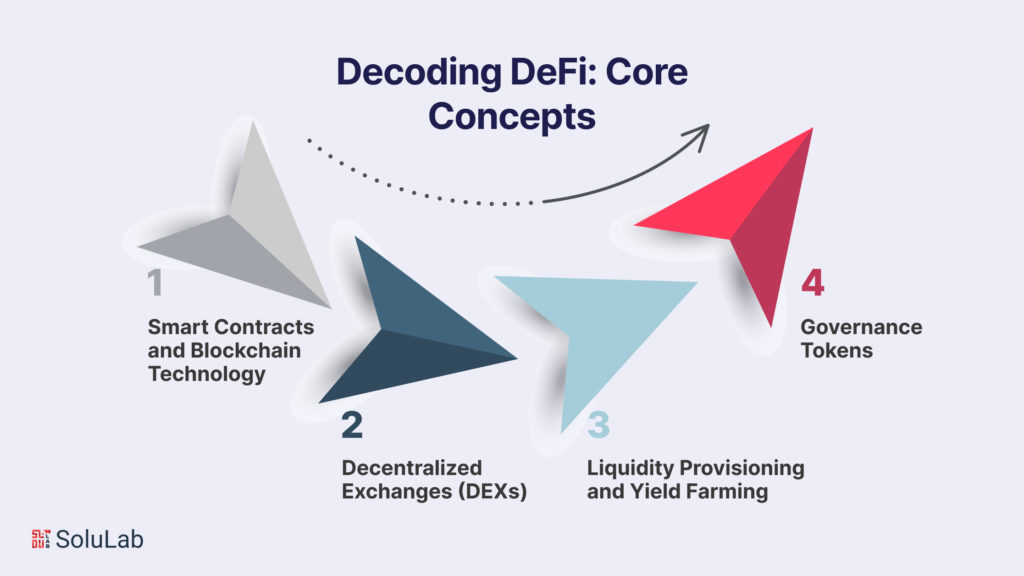
Decoding DeFi: Core Concepts

To truly grasp the trends and developments within the DeFi landscape, it’s essential to understand the fundamental concepts that underpin this financial revolution. DeFi isn’t just a buzzword; it’s a complex and innovative ecosystem built on a foundation of blockchain technology. In this section, we’ll decode the core concepts that are central to DeFi’s operation.

  • Smart Contracts and Blockchain Technology

At the heart of DeFi are smart contracts, self-executing agreements with the terms and conditions directly encoded into computer programs. These contracts automate financial processes, ensuring that transactions occur when predefined conditions are met. Ethereum, a blockchain platforms designed to support smart contracts, has been the epicenter of DeFi’s growth. Smart contracts have replaced the need for intermediaries, executing tasks like lending, borrowing, and trading without the involvement of traditional banks or financial institutions.

Blockchain technology, on the other hand, provides the decentralized and immutable ledger on which DeFi solutions operates. Transactions and data are stored across a network of computers, ensuring transparency and security. This foundation of blockchain ensures that DeFi transactions are trustless, meaning they can occur without the need for trust between parties.

  • Decentralized Exchanges (DEXs)

Decentralized exchanges are a key component of the DeFi ecosystem. These platforms enable users to trade cryptocurrencies directly with one another, without the need for a centralized intermediary. DEXs operate through smart contracts, facilitating peer-to-peer trading while allowing users to maintain control of their funds. This approach significantly reduces counterparty risk and enhances the security of transactions.

  • Liquidity Provisioning and Yield Farming

Liquidity provisioning is the practice of providing assets to decentralized exchanges, enabling other users to trade them. In return, liquidity providers earn fees and rewards. Yield farming, a popular DeFi practice, involves optimizing the use of these assets to maximize returns. Users can earn interest, lending fees, and governance tokens by participating in liquidity provision and yield farming protocols.

  • Governance Tokens

Governance tokens are tokens that provide users with decision-making power within a DeFi ecosystem. Holders of these tokens can vote on proposed changes, upgrades, and alterations to the protocol. This democratic approach to governance empowers the community to have a say in the development and management of DeFi lending platforms.

Understanding these core concepts is crucial for anyone looking to navigate the DeFi trends effectively. They serve as the building blocks for the multitude of financial services and applications that DeFi has to offer. As we move forward in this blog, we will explore the trends and innovations emerging within DeFi and how they relate to these core concepts.
DeFi Development Solutions

Top DeFi Trends to Look for in 2025

Decentralized Finance (DeFi) is evolving fast in 2025, redefining how we borrow, lend, trade, and earn. Here are the top DeFi trends shaping the future of finance this year:

1. Real-World Asset Tokenization: DeFi is bridging with the real world by tokenizing assets like real estate, gold, and bonds. This brings more liquidity to traditional markets and opens up fractional ownership for global investors.

2. Mobile-First DeFi Apps: With DeFi gaining traction in emerging markets like India, mobile-first platforms are on the rise. These apps offer smoother UX and simpler onboarding for users without a desktop or technical know-how.

3. DeFi Regulation Frameworks: Governments are moving from banning to regulating DeFi. Countries like the U.S., the UK, and India are exploring compliance tools, ensuring investor protection without stifling innovation.

4. AI-Powered DeFi Bots: AI is being integrated into DeFi protocols to help with risk management, automated trading, and lending decisions, making platforms smarter and safer for users.

5. Insurance & Risk Mitigation: More DeFi platforms are offering built-in insurance options against smart contract failures or hacks. This builds user trust and promotes long-term adoption.

6. Cross-Chain Interoperability: Movement of assets across blockchains is improving thanks to interoperability protocols. Users no longer need to worry about being locked into one chain.

7. Stablecoin Innovation: Beyond USDT and USDC, 2025 is seeing a rise in algorithmic and CBDC-backed stablecoins, enhancing payment efficiency and reducing volatility risks in DeFi ecosystems.

Future of DeFi: How Will It Evolve Beyond 2025?

The future of DeFi holds immense promise and potential for reshaping the global financial landscape. As we look ahead, several key factors and developments are likely to play a significant role in shaping the future of decentralized finance.

  • Scalability and Layer 2 Solutions

One of the most pressing challenges facing DeFi is scalability. Ethereum, the primary platform for DeFi projects, has struggled with high gas fees and network congestion. To overcome these limitations, Layer 2 solutions such as Optimistic Rollups and zk-Rollups are being implemented. These solutions aim to enhance the scalability of Ethereum and other blockchain networks, making DeFi more accessible and cost-effective for users.

  • DeFi in Traditional Finance

DeFi is no longer operating in isolation. It is increasingly intersecting with traditional DeFi and the future of finance. Traditional financial institutions are recognizing the potential benefits of DeFi, including reduced operational costs, enhanced transparency, and improved access to financial services. We can expect to see more partnerships, integrations, and collaborations between DeFi projects and traditional financial entities in the future.

  • AI-Powered DeFi Solutions

The integration of artificial intelligence into DeFi platforms will transform how investors interact with decentralized protocols. AI algorithms will help users analyze risk, forecast returns, automate portfolio strategies, and detect suspicious activity in real time. Think of it as having a smart DeFi assistant that constantly scans data, market sentiment, and yield opportunities, enabling users to make faster, data-driven decisions without deep technical expertise. 

  • Rise of Decentralized Identity (DID)

As regulation and compliance become critical for DeFi’s mainstream adoption, Decentralized Identity (DID) systems are emerging as a key enabler. DID allows users to verify their identity without handing over control of personal data to centralized entities. With verifiable credentials stored on-chain, users can access compliant DeFi services while retaining privacy and autonomy. This shift will be essential for unlocking secure, user-owned financial identities that can seamlessly interact across platforms and blockchains.

  • Use Cases Beyond Lending and Trading

While lending and trading have been the primary use cases in DeFi, the ecosystem is diversifying. Secure DeFi Smart Contract Development is leading the emergence of new solutions like decentralized insurance, prediction markets, and decentralized identity solutions. These innovations extend the scope of DeFi, offering users a broader array of financial services that were once the domain of centralized institutions.

  • Risks and Security Considerations

With the rapid expansion of the DeFi ecosystem, the risk landscape is evolving. Security remains a paramount concern. Smart contract vulnerabilities, hacks, and scams are real threats. Users and projects must remain vigilant and prioritize security. The development of decentralized insurance and risk management solutions within DeFi is a step toward mitigating these risks.
Decentralized Finance Development Services

Conclusion

With more people exploring decentralized platforms, smarter tools powered by AI, and better ways to stay secure. It’s becoming a real alternative to traditional banking. From easier access to loans to faster cross-border payments, everything’s getting more user-friendly and transparent. 

And as DeFi blends with regular finance, we’re heading toward a future where you control your money fully and freely. With rapid adoption and innovation, many experts believe that DeFi could be the future of financial services.

SoluLab, a top DeFi development company in the USA, can help you integrate decentralized finance into your business. Contact us today to discuss further!

FAQs

1. Why should investors care about DeFi trends in 2025?

In 2025, DeFi is evolving rapidly with trends like real-world asset tokenization, AI-powered DeFi, and institutional-grade platforms. For investors, staying updated on these trends is crucial to spotting new opportunities and understanding where the next wave of returns could come from in the decentralized ecosystem.

2. How can I invest in DeFi protocols in 2025?

Investors can participate in DeFi by staking, lending, yield farming, or buying DeFi tokens from decentralized exchanges (DEXs). Many platforms also offer liquidity pools or structured DeFi products. It’s essential to understand how each protocol works and monitor its TVL (Total Value Locked), audits, and community reputation.

3. What role does AI play in DeFi in 2025?

AI is increasingly integrated into DeFi platforms in 2025 to automate trading, enhance risk assessment, predict yield opportunities, and detect fraud. Smart DeFi dashboards and robo-advisors are helping both retail and institutional investors make more informed decisions based on real-time data.

4. Are stablecoins still relevant in DeFi in 2025?

Absolutely. Stablecoins remain the backbone of DeFi transactions, providing a stable unit of account in volatile markets. In 2025, there’s a shift toward fully transparent, regulated, or overcollateralized stablecoins to reduce systemic risks. They’re widely used in lending, liquidity pools, payments, and savings protocols.

5. How can beginners start investing in DeFi in 2025?

Beginners should start by learning the basics of blockchain, crypto wallets, and DeFi platforms. Use secure wallets like MetaMask or hardware options, and begin with popular platforms like Aave, Uniswap, or Curve. Start small, explore tutorials, and consider platforms that offer beginner-friendly interfaces with guided steps.

 

Top DeFi Protocols To Look For in 2026

Consider that your money isn’t confined to traditional banks but flows freely through decentralized protocols, eliminating the need for intermediaries. As we step into the year 2026, the Decentralized Finance (DeFi) space has witnessed an astonishing surge in innovation, with a myriad of protocols competing for supremacy. 

If you’ve been following the crypto space, you’ve likely encountered discussions about DeFi’s potential to change how we handle money. With a plethora of protocols, it can be challenging to discern which ones are leading the charge.​

In this article, we’ll explore the top DeFi protocols that are making significant impacts in 2026. We’ll explore what these protocols are, how they function, and why they matter. 

What are DeFi Protocols and How Do They Even Work?

A DeFi protocol is a collection of guidelines, code, and practices that control blockchain-based financial applications, mainly those used for cryptocurrency lending, borrowing, and trading. These protocols, such as Uniswap and Aave, use smart contracts on platforms like Ethereum to provide financial services without the need for conventional middlemen.

Unlike traditional financial systems, DeFi protocols are open source. This makes these services available to anybody with an internet connection, boosting financial transparency and inclusivity.

1. Smart Contracts: Decentralized finance protocols utilize smart contracts, self-executing pieces of code, to define the rules and conditions of various financial transactions and agreements. These smart contracts automate processes and ensure transparency and security without requiring a central authority.

2. Decentralized Governance: Many DeFi protocols have decentralized governance mechanisms, allowing token holders to participate in decision-making processes, such as proposing and voting on protocol upgrades or changes.

3. Liquidity Pools: In DeFi protocols like Uniswap and Curve Finance, liquidity is provided by users who deposit their assets into liquidity pools, which enable the trading of assets without the need for centralized order books.

4. Yield Farming: Some DeFi protocols offer incentives in the form of governance tokens or other rewards to users who provide liquidity or use their platform. This process, known as yield farming, encourages participation and liquidity provision within the ecosystem.

5. Interoperability: Decentralized finance protocols often work together through composability, meaning they can interact with each other’s smart contracts, creating complex financial systems with a wide range of functionalities.

Here are the Top DeFi Protocols in 2026

1. Uniswap

Uniswap continues to maintain its position as one of the best DeFi protocols within the cryptocurrency space, fundamentally reshaping the landscape of trading. Pioneering the use of automated market maker (AMM) technology, Uniswap facilitates direct asset exchanges from users’ wallets via liquidity pools. Its appeal lies in its abundant liquidity, transparent operations, and low transaction costs, drawing in a vast user base.

Looking ahead to 2026, Uniswap aims to further enrich its platform with enhanced user experiences, while also addressing scalability challenges to accommodate the surging demand. Additionally, it endeavors to broaden its array of services and features to meet the evolving needs of the decentralized finance ecosystem.

2. Aave

Aave has solidified its position as the leading decentralized lending and borrowing protocol. By allowing users to lend their assets and earn interest or borrow assets by providing collateral, Aave has democratized access to credit and interest-earning opportunities. Its innovative “flash loans” have enabled instant, uncollateralized borrowing and sparked a new wave of DeFi applications. In 2026, Aave is expected to expand its offerings with support for new assets, introduce new features for risk management, and strengthen its security protocols to protect user funds.

3. Synthetix

Synthetix stands at the forefront of the DeFi revolution, enabling the creation and trading of synthetic assets that represent real-world assets like stocks, commodities, and fiat currencies. These synthetic assets, or “synths,” allow users to gain exposure to various markets without holding the actual underlying assets. As demand for diversified investment opportunities rises, Synthetix is anticipated to roll out new assets, improve oracle mechanisms, and enhance its governance to meet the evolving needs of the DeFi community.

4. MakerDAO

MakerDAO, the creator of the first decentralized stablecoin DAI, has significantly contributed to the stability and liquidity of the DeFi ecosystem. It is one of the biggest players in this industry. DAI pegged to the US Dollar, has become a staple in DeFi and is utilized as collateral for various lending and borrowing activities. As the demand for stablecoins continues to soar, MakerDAO is likely to explore new collateral options, optimize its governance model, and expand its partnerships with other DeFi protocols to enhance its utility and reach.

5. Yearn Finance

Yearn Finance has redefined yield farming by automating the process of yield optimization. With its intuitive platform, users can deposit their assets, which are then moved across various DeFi protocols to maximize returns. As yield farming becomes more accessible and user-friendly, Yearn Finance is expected to unveil new strategies, offer integration with additional DeFi protocols, and implement governance improvements to enhance its value proposition.

6. Curve Finance

Curve Finance is a specialized decentralized exchange tailored for stablecoin trading. Its algorithm ensures low slippage and high liquidity for stablecoin pairs, attracting traders looking for stable asset swaps. As the demand for stablecoin trading rises, Curve Finance is anticipated to increase its liquidity provision strategies, launch new stablecoin pairs, and optimize its user experience to maintain its leading position.

7. SushiSwap

SushiSwap, an automated market maker (AMM) DEX, has gained significant traction due to its community-driven approach and innovative product offerings. As an evolution of the original Uniswap protocol, SushiSwap has introduced additional features, such as revenue-sharing for liquidity providers and unique tokenomics. In 2026, SushiSwap is poised to introduce new features, strengthen its governance, and enhance its liquidity incentives to remain a key player in the competitive DEX landscape.

8. Compound

Compound has emerged as a prominent decentralized lending and borrowing platform, allowing users to lend or borrow a variety of cryptocurrencies. Its straightforward and efficient user experience has attracted a massive user base. In 2026, Compound is likely to expand its asset offerings, refine its interest rate models, and introduce new governance features to maintain its position as a leading DeFi lending protocol.

9. PancakeSwap

Operating on the Binance Smart Chain, PancakeSwap has brought DeFi to a broader audience with its lower fees and faster transactions. Its familiar interface and diverse trading pairs make it a favorite among traders seeking a seamless experience outside the Ethereum network. PancakeSwap introduces its unique token called CAKE. Unlike being solely a governance token, CAKE serves as a liquidity provision token, effectively motivating liquidity providers to engage with the PancakeSwap platform. To begin using PancakeSwap, all you require is to link your non-custodial wallet containing the tokens you wish to trade.

10. Balancer

Balancer’s innovative platform allows users to create personalized liquidity pools and introduces a unique concept of “smart” pools. These smart pools automatically rebalance their asset allocations to maintain desired weightings, optimizing returns and minimizing the need for constant manual adjustments. This dynamic feature provides a hands-off approach for liquidity providers while ensuring efficient trading opportunities for users.

As one of the top DeFi protocols, Balancer aims to continue its trajectory of innovation and advancement. With its focus on user-centric solutions and automated features, Balancer strives to solidify its position as a cornerstone of the decentralized finance ecosystem. By further refining its platform functionalities and expanding its range of services, Balancer seeks to meet the diverse needs of its growing community of users.

CTA 2

Conclusion

DeFi protocols represent a substantial change in the way financial services are provided and used, not only a substitute for conventional financial systems. These protocols improve accessibility, security, and transparency by utilizing blockchain technology

The professionals will contribute their knowledge about how to overcome the obstacles. From developing smart contracts to integrating with well-known DeFi systems, they oversee a variety of duties. This ensures that your project will be secure and effective.

SoluLab recently helped DLCC build a solution, with two key platforms, Prime Product and Tokenet. It offers crypto trading, lending, and borrowing at negotiable fees. Eventually, it enhances user experience, strengthens security, and enables faster transactions. 

SoluLab, a DeFi development company has its team of experts to help you discuss DeFi protocol-related queries. Contact us today to discuss further!  

FAQs

1. Which DeFi protocols are leading in 2026?

Some of the top DeFi protocols in 2026 include Aave, Lido, EigenLayer, Uniswap, and Sky (formerly MakerDAO), based on metrics like Total Value Locked (TVL) and user adoption.

2. What role does AI play in DeFi protocols?

Artificial Intelligence is being integrated into DeFi protocols to enhance automation in trading, risk management, and yield optimization. AI-driven tools help users navigate complex DeFi platforms more efficiently.

3. How can users participate in DeFi protocols?

Users can engage with DeFi protocols by connecting their cryptocurrency wallets to platforms like Aave, Uniswap, or Lido. It’s essential to understand the risks involved, such as smart contract vulnerabilities and market volatility, before participating.​

4. How does SoluLab contribute to the DeFi ecosystem?

SoluLab, as a leading DeFi development company, offers tailored solutions and expertise to empower projects within the DeFi ecosystem. From smart contract development and auditing to decentralized application (dApp) development and protocol optimization, SoluLab ensures scalability, security, and strong user adoption.

5. What factors should investors consider before participating in DeFi protocols?

Investors interested in DeFi protocols should conduct thorough research and consider various factors before participating. Key aspects include the protocol’s technology, security audits, team expertise, tokenomics, governance framework, and awareness of regulatory risks.

DeFi 2.0: The Future of Decentralised Finance

DeFi 2.0: The Future of Decentralised Finance

Decentralized Finance, often referred to as DeFi, is a revolutionary concept within the world of finance. It leverages blockchain technology to create an open and permissionless ecosystem that enables various financial services, such as lending, borrowing, trading, and more, without the need for traditional intermediaries like banks. DeFi is characterized by its transparency, accessibility, and automation, which have contributed to its rapid growth and popularity.

DeFi has continually evolved, giving rise to DeFi 2.0, the next phase of decentralized finance. DeFi 2.0 represents the maturation of the initial DeFi concepts and the integration of cutting-edge technologies and practices. It builds upon the foundation laid by DeFi by enhancing scalability, security, and interoperability, ultimately aiming to provide a more comprehensive and seamless financial experience.

In this evolution, DeFi 2.0 is driven by the latest DeFi trends, which are shaped by the innovative efforts of DeFi development companies. These top DeFi trends include improved user experience, the expansion of DeFi lending platforms, advancements in DeFi protocols, and the proliferation of decentralized applications (dApps). DeFi 2.0 is not limited to specific platforms but rather encompasses the entire DeFi ecosystem, the DeFi space, and DeFi exchanges.

What is the importance of DeFi 2.0 in the Financial Landscape?

The introduction of DeFi 2.0 marks a significant turning point in the financial landscape, where the world of decentralized finance (DeFi) transcends its initial boundaries and takes a giant leap forward. DeFi, often characterised as the innovation that decentralized traditional financial services, has been on a transformative journey, and it’s in DeFi 2.0 that we witness the convergence of numerous trends and developments.

As DeFi continues to evolve, it’s essential to recognize the key drivers and players in this space. DeFi development companies have played a pivotal role in shaping the top DeFi trends. These companies are at the forefront of research and innovation, continually pushing the boundaries of what DeFi can achieve. Their expertise and contribution to DeFi development service are instrumental in building the DeFi ecosystem.

One of the most notable aspects of DeFi 2.0 is the advancements in DeFi exchange development. Decentralized exchanges, the backbone of DeFi, have grown exponentially. They have enabled seamless and permissionless trading of digital assets while providing unprecedented liquidity. DeFi exchange development continues to refine these platforms, making them more efficient, secure, and user-friendly.

DeFi lending platforms are another integral part of the DeFi ecosystem. They offer decentralized, borderless, and transparent lending and borrowing solutions. DeFi 2.0 enhances these platforms by introducing more sophisticated and efficient protocols. These protocols are designed to mitigate risks and optimise lending processes, ultimately making DeFi lending more accessible and attractive to a broader audience.

What are the Emergence of DeFi 2.0 Within These Trends?

The emergence of DeFi 2.0 represents a significant evolutionary step within the ever-evolving landscape of decentralized finance. As DeFi has gained momentum and popularity in recent years, it has brought about a multitude of trends and developments. DeFi 2.0 builds upon these trends, propelling the ecosystem into new and uncharted territories.

One of the top DeFi trends that has led to the emergence of DeFi 2.0 is the growing involvement of DeFi development companies. These companies play a pivotal role in the ongoing development of the DeFi space, creating innovative solutions, and building the infrastructure required to support the DeFi ecosystem. DeFi development services offered by these companies encompass a wide array of functions, including smart contract development, blockchain integration, and protocol creation.

DeFi development companies are at the forefront of pioneering DeFi 2.0, as they continue to refine existing protocols and create new ones that address the limitations of the first-generation DeFi projects. The development of robust and secure DeFi protocols is crucial for the sustainability and growth of the DeFi ecosystem. These protocols underpin DeFi lending platforms, decentralized exchanges, and a variety of decentralized applications (dApps).

How DeFi Development Companies Shape Trends?

DeFi development companies are entities that specialise in creating, maintaining, and upgrading various aspects of the DeFi space. These companies offer a range of DeFi development services, including the development of DeFi protocols, DeFi exchange development, DeFi lending platforms, decentralized applications (dApps), and DeFi wallets. Their expertise and contributions have a significant impact on the development of the DeFi ecosystem.

  • DeFi Protocol Advancements

DeFi development companies are instrumental in designing and implementing new DeFi protocols. These protocols serve as the backbone of DeFi applications, enabling functionalities such as lending, borrowing, trading, and yield farming. By creating cutting-edge protocols, these companies set the stage for top DeFi trends.

  • DeFi Exchange Development

DeFi development companies are responsible for the creation of decentralized exchanges (DEXs), which are critical components of the DeFi space. They enhance the user experience, security, and functionality of DEXs, directly impacting how users interact with DeFi platforms.

CTA1

  • DeFi Lending Platforms

DeFi development companies develop lending and borrowing platforms that facilitate peer-to-peer transactions. They influence the trends in the DeFi lending space by introducing innovative features and optimizing the lending experience.

  • DApps and DeFi Wallets

DeFi development companies contribute to the development of decentralized applications and DeFi wallets, ensuring they are user-friendly and secure. This shapes the way individuals access and use DeFi services.

What are the Services Offered by DeFi Development Companies?

Services Offered by DeFi Development Companies

In the ever-evolving landscape of Decentralized Finance (DeFi) 2.0, DeFi development companies play a pivotal role in driving innovation and shaping the future of finance. These companies offer a diverse range of services, capitalising on the top DeFi trends to create cutting-edge solutions for the DeFi ecosystem. Let’s delve into the services provided by these key players in the DeFi development space.

  • DeFi Protocol Development

DeFi development companies specialise in creating and enhancing DeFi protocols, the backbone of the DeFi ecosystem. These protocols facilitate various financial activities, such as lending, borrowing, trading, and yield farming. They are constantly adapting to the latest DeFi trends, ensuring optimal performance and security.

  • Smart Contract Development

One of the core components of DeFi 2.0 is the use of smart contracts. DeFi development service providers are experts in designing and developing secure and efficient smart contracts, which underpin DeFi applications and platforms.

  • DeFi Exchange Development

DeFi exchanges are at the forefront of the DeFi space. DeFi development companies specialize in building decentralized exchange platforms that offer seamless trading experiences while integrating the latest DeFi trends, such as automated market makers (AMMs) and liquidity pools.

  • DeFi Lending Platform Creation

The lending and borrowing sector within the DeFi ecosystem has gained significant traction. DeFi development companies offer services to build and optimize DeFi lending platforms, allowing users to earn interest on their assets or access loans without intermediaries.

  • Decentralized Application (dApp) Development

DeFi dApps are instrumental in expanding the DeFi space. DeFi development companies design and develop user-friendly and secure dApps that cater to a wide range of financial needs, including asset management, yield farming, and more.

  • DeFi Wallet Development

Security and usability are paramount in the DeFi 2.0 landscape. DeFi development service providers focus on creating secure and user-friendly DeFi wallets that enable users to store, manage, and interact with their assets while staying updated with top DeFi trends.

What is the Significance of Decentralized Exchanges in DeFi 2.0?

Significance of Decentralized Exchanges in DeFi 2.0

In the ever-evolving landscape of Decentralized Finance (DeFi) 2.0, decentralized exchanges (DeFi exchanges) play a pivotal role, embodying the cutting edge of this financial revolution. These exchanges are where digital assets are traded in a trustless, peer-to-peer manner, eliminating the need for intermediaries such as traditional banks and brokers. Let’s explore their significance in the context of DeFi 2.0 and their contributions to various aspects of the DeFi ecosystem.

  • Empowering DeFi Trends

Decentralized exchanges are at the forefront of the top DeFi trends, facilitating the trading of a wide range of assets, including cryptocurrencies, tokens, and even non-fungible tokens (NFTs). They provide liquidity and accessibility to these assets, thus contributing significantly to the DeFi space’s dynamism.

  • Enabling Defi Development Companies

DeFi development companies heavily rely on decentralized exchanges to create and launch DeFi projects. These exchanges offer the infrastructure and technology needed to build, test, and deploy DeFi protocols, lending platforms, and other decentralized applications.

  • Facilitating DeFi Lending Platforms

In the DeFi 2.0 ecosystem, lending and borrowing are essential services. Decentralized exchanges allow users to collateralize their assets, thus playing a critical role in DeFi lending platforms. This interaction between exchanges and lending platforms forms the core of DeFi’s decentralized financial services.

  • Adhering to DeFi Protocols

DeFi exchange development aligns with various DeFi protocols, ensuring interoperability and consistency within the ecosystem. Liquidity providers, yield farmers, and DeFi users benefit from this adherence, as it enables seamless transactions across multiple DeFi applications.

  • Expanding the DeFi Ecosystem

Decentralized exchanges are expanding the boundaries of the DeFi ecosystem. By listing new tokens and experimenting with innovative trading mechanisms, they drive the evolution of DeFi 2.0. This continuous innovation broadens the offerings and options available to DeFi participants.

  • Enhancing User Experience with DeFi Wallets

DeFi exchanges often integrate with DeFi wallets, providing users with a seamless experience. Wallets are instrumental in connecting users to decentralized applications (dApps), and the synergy between wallets and exchanges creates a user-friendly environment for interacting with the DeFi 2.0 landscape.

  • Navigating the Future of Decentralized Finance

As DeFi continues to evolve, the future of decentralized finance 2.0 relies heavily on the development and innovation within decentralized exchanges. Their adaptability, scalability, and security will determine the success and sustainability of DeFi in the broader financial ecosystem.

What are the Innovations in DeFi Wallet Innovations?

In the ever-evolving landscape of Decentralized Finance (DeFi), wallets play a pivotal role in shaping the future of the ecosystem. DeFi 2.0, the next phase of DeFi development, relies heavily on the functionality and security of these digital wallets. In this article, we explore the essential aspects of DeFi wallets, including their role, security, usability, and the innovations that are driving the space forward.

DeFi 2.0 has ushered in a wave of innovative wallet technologies, pushing the boundaries of what wallets can offer:

  • Interoperability

DeFi wallets are now built to seamlessly interact with various blockchain networks and DeFi protocols. This interoperability allows users to access a broader range of services and assets within a single wallet.

  • Delegated Access Control

Wallets are integrating more sophisticated access control mechanisms. Users can delegate access to specific functions or assets within their wallet while maintaining overall control. This feature is particularly valuable in the DeFi lending platform space.

  • Decentralized Identity

DeFi wallets are exploring the integration of decentralized identity solutions. This can enhance user privacy and security while ensuring a smoother user experience across DeFi applications.

  • Mobile Wallets

With the growth of mobile DeFi apps, mobile wallets are evolving rapidly. These wallets bring DeFi 2.0 to the fingertips of users, allowing them to manage their DeFi portfolios on the go.

What is the Potential Impact on Traditional Finance?

The evolution of DeFi 2.0 and the pivotal role of DeFi wallets have the potential to disrupt traditional finance in several ways:

  • Financial Inclusion

DeFi 2.0 can extend financial services to the unbanked and underbanked populations globally, reducing dependence on traditional financial institutions.

  • Reduced Intermediaries

Traditional financial intermediaries may see decreased relevance as DeFi wallets provide direct access to a wide range of financial services, from lending to trading.

  • Cross-Border Transactions

DeFi 2.0’s borderless nature can revolutionize cross-border transactions, rendering traditional remittance services obsolete.

What are the Challenges and Opportunities for DeFi 2.0?

Challenges and Opportunities for DeFi 2.0

Challenges

  • Scalability Issues

DeFi 2.0 seeks to address the scalability challenges that plagued the first generation of DeFi platforms. As the ecosystem grows, it must overcome issues related to slow transaction processing and high gas fees.

  • Regulatory Uncertainty

The evolving regulatory landscape poses a significant challenge. DeFi 2.0 projects need to navigate complex legal frameworks and compliance requirements, which may vary by jurisdiction.

  • Security Concerns

Despite advancements in security protocols, DeFi remains vulnerable to hacks and exploits. DeFi 2.0 must prioritise security and resilience to protect users and assets.

  • Interoperability

Achieving interoperability among various DeFi platforms and protocols is essential. The challenge is to enable seamless integration between different projects to create a cohesive DeFi ecosystem.

  • User Adoption

While DeFi is gaining traction, mass adoption remains a challenge. DeFi 2.0 must focus on improving user experience and education to onboard mainstream users

Opportunities

  • Innovation in DeFi Protocols

DeFi 2.0 offers the opportunity to develop more robust and efficient protocols. These can enhance transaction speed and security, leading to a more resilient ecosystem.

  • Enhanced User Experience

DeFi 2.0 projects can prioritise user-friendly interfaces and streamlined processes, making it easier for non-technical users to participate.

  • Cross-Chain Integration

Bridging different blockchain networks can expand the DeFi space and unlock new opportunities for cross-chain trading and lending.

  • Decentralized Finance for the Unbanked

DeFi 2.0 can extend its reach to the unbanked and underbanked populations, providing financial services to those who have limited access to traditional banking.

  • DeFi Integration with dApps

The integration of DeFi with decentralized applications (dApps) can unlock a multitude of use cases, from gaming to social networking, providing more opportunities for DeFi to grow.

CTA2

Conclusion 

In a rapidly evolving landscape, SoluLab has established itself as a pioneering force in DeFi 2.0, contributing to the transformation of the decentralized finance (DeFi) ecosystem. The company’s expertise in DeFi development, including Defi lending platforms, Defi exchange development, and Defi protocols, positions them as a key player in shaping the future of Decentralized Finance 2.0.

As the top DeFi development service provider, SoluLab is at the forefront of the most significant DeFi trends, offering cutting-edge solutions for DeFi exchanges and decentralized applications (dApps). Their dedication to innovation and commitment to enhancing the security and user experience of DeFi wallets demonstrates their vision for a more robust and accessible DeFi space.

In an era where the DeFi landscape is continually evolving, SoluLab’s commitment to pushing the boundaries of DeFi 2.0 technology makes them a strategic partner for those seeking to navigate the ever-expanding and complex world of decentralized finance. SoluLab is undeniably contributing to the brighter and more inclusive future of Decentralized Finance 2.0.

FAQs

1. What is DeFi 2.0, and how does it differ from traditional DeFi?

DeFi 2.0 is an evolution of traditional DeFi, characterized by improved scalability and enhanced user experiences.

2. What are the top DeFi trends in the DeFi 2.0 ecosystem?

Top DeFi trends in DeFi 2.0 include cross-chain interoperability, optimized DeFi protocols, and enhanced DeFi wallets.

3. How is DeFi 2.0 reshaping the future of decentralized finance?

DeFi 2.0 is shaping the future by addressing the limitations of scalability, security, and usability present in traditional DeFi, making it more accessible and efficient.

4. What services do Defi development companies offer for DeFi 2.0 projects?

Defi development companies offer services such as DeFi protocol development, DeFi exchange development, DeFi wallet integration, and dApp creation for the DeFi 2.0 ecosystem.

5. What are DeFi lending platforms, and how do they fit into DeFi 2.0?

DeFi lending platforms are integral to DeFi 2.0, offering users the ability to lend, borrow, and earn interest on crypto assets in a more advanced and secure manner.


Defi : The Influensive Trend in Blockchain- A Complete Guide

Defi The Influensive Trend in Blockchain- A Complete Guide

Decentralized Finance, often referred to as DeFi, has emerged as one of the most influential trends in the blockchain space. This revolutionary concept leverages blockchain technology to create a decentralized financial ecosystem that operates without traditional intermediaries like banks. In this comprehensive guide, we will delve into the world of DeFi, exploring its platforms, protocols, development companies, lending platforms, trading platforms, and how it all ties into the broader blockchain landscape.

What is DeFi?

Decentralized Finance, commonly known as DeFi, is a revolutionary movement within the blockchain ecosystem protocols that seeks to recreate traditional financial systems using blockchain technology. Unlike traditional finance, which relies on centralized intermediaries like banks and financial institutions, DeFi operates on decentralized platforms and smart contracts. 

It encompasses a wide range of financial services and applications, including lending, borrowing, trading, asset management, and more, all built on blockchain networks. DeFi platforms, protocols, and development companies play a pivotal role in enabling this ecosystem, while blockchain technology provides the foundation for its transparency and security. 

Furthermore, DeFi is closely intertwined with blockchain trends, as it leverages blockchain’s potential to disrupt traditional finance and expand into other industries beyond the financial sector. This transformative trend is redefining the way we think about and interact with financial services, offering users greater control and accessibility to their financial assets and transactions.

How Does DeFi Work?

DeFi applications are built on blockchain technology, which is a distributed ledger system that records transactions in a secure and transparent manner. Blockchain technology allows DeFi applications to operate without the need for a central intermediary.  Top DeFi protocols use smart contracts to automate transactions and interactions between users. 

Benefits of DeFi

Benefits of DeFi

Decentralized Finance (DeFi) is transforming the financial landscape in numerous ways, offering a wide array of benefits to users, developers, and the global economy. 

  • Financial Inclusion

DeFi opens up financial services to anyone with internet access, enabling global financial inclusion. This is especially significant in regions with limited access to traditional banking. According to the World Bank, around 1.7 billion adults worldwide remain unbanked. DeFi can bridge this gap and empower individuals to access and manage their finances.

  • Accessibility

Unlike traditional financial markets with set trading hours, DeFi operates 24/7, allowing users to trade, lend, and borrow at their convenience. This accessibility provides flexibility and empowers users to make real-time financial decisions.

  • Reduced Intermediaries

Traditional financial systems rely on intermediaries like banks, brokers, and clearinghouses, which charge fees for their services. DeFi minimizes or eliminates these intermediaries, reducing costs for users. Smart contracts execute transactions automatically, bypassing the need for intermediaries and their associated fees.

  • Transparency

DeFi leverages blockchain technology to ensure transparent and immutable record-keeping. Every transaction is recorded on a public ledger, providing users with complete transparency. This transparency enhances trust, as users can independently verify all transactions.

  • Security

DeFi benefits from the security features of blockchain technology. Smart contracts, once deployed, are immutable, reducing the risk of tampering or fraud. The security of blockchain has contributed to a significant decrease in successful attacks on DeFi platforms.

  • Global Reach

Cross-border payments are a significant part of the global economy. DeFi enables seamless cross-border transactions, allowing users to send and receive funds globally without the delays and high fees associated with traditional cross-border banking services.

CTA1

  • Programmability

DeFi platforms are highly programmable, allowing developers to create customized financial solutions. This programmability has led to the development of a diverse range of applications, including yield farming, decentralized exchanges, automated trading bots, and more. Users can participate in these innovative financial services.

  • Yield Opportunities

DeFi platforms like Compound and Aave offer users the opportunity to earn interest on their assets. Users can participate in lending or liquidity provision, often earning yields that surpass traditional savings account rates by a significant margin. This opens up new avenues for passive income and wealth creation.

  • Innovation and Rapid Development

DeFi is characterized by its rapid pace of innovation. New projects, tokens, and protocols continually emerge, offering new financial products and services. The open-source nature of DeFi fosters competition and innovation, driving the development of cutting-edge solutions.

  • Economic Empowerment

DeFi can empower individuals to take control of their finances. Users are not reliant on centralized institutions; they have custody of their assets and can engage in financial activities autonomously. This increased agency can lead to greater financial empowerment and self-reliance.

  • Risk Management

DeFi platforms often allow users to set their own risk parameters. For example, users can choose the level of collateral required for loans, mitigating risk to some extent. Additionally, DeFi insurance projects offer coverage against smart contract vulnerabilities and hacks, further enhancing risk management.

  • Community Governance

Many DeFi projects employ decentralized governance mechanisms. Token holders have a say in protocol upgrades and decision-making. This approach promotes a more democratic and community-driven ecosystem.

  • Reduced Barriers to Entry

In traditional finance, launching financial products and services can be highly regulated and costly. DeFi reduces these barriers to entry for entrepreneurs and developers, making it easier to create and launch financial innovations.

Applications of Defi

Applications of Defi

Decentralized Finance (DeFi) has a wide range of applications that are transforming the traditional financial landscape. These applications leverage blockchain technology to provide innovative and decentralized solutions to various financial services. Here are some key applications of DeFi:

  • Lending and Borrowing

DeFi lending platforms allow users to lend their crypto assets to earn interest, while borrowers can use their crypto holdings as collateral to secure loans. These platforms often offer more attractive interest rates than traditional banks.

Examples: Compound Finance, Aave, MakerDAO

  • Decentralized Exchanges (DEXs)

DEXs enable users to trade cryptocurrencies directly without the need for a centralized intermediary. They provide liquidity and allow for trustless and transparent trading.

Examples: Uniswap, SushiSwap, Balancer

  • Stablecoins

Stablecoins are digital currencies crafted with the intention of preserving a fixed value, frequently linked to a traditional currency such as the US dollar. They serve as a stable medium of exchange and a store of value within the volatile crypto market.

Examples: USDC, USDT, DAI

  • Yield Farming and Liquidity Provision

Yield farming encompasses the act of supplying liquidity to DeFi protocols in return for incentives. Users can earn tokens and interest by locking up their assets in liquidity pools.

Examples: Yearn.finance, Curve Finance, Balancer

  • Asset Management and Index Funds

DeFi allows users to create, manage, and invest in tokenized portfolios, enabling automated trading and diversification of assets.

Examples: Set Protocol, PieDAO

  • Insurance

DeFi insurance platforms provide coverage against smart contract vulnerabilities and hacks in the DeFi ecosystem, offering protection to users.

Examples: Nexus Mutual, Cover Protocol

  • Decentralized Identity

DeFi can be used to establish decentralized identity systems, giving users more control over their personal information.

Examples: uPort, SelfKey

  • Cross-Border Payments

DeFi facilitates cost-effective and rapid cross-border transactions, reducing the fees and delays associated with traditional international transfers.

Examples: Stablecoin-based remittance services

  • Prediction Markets

DeFi prediction markets enable users to create and participate in markets for predicting real-world events, offering a decentralized way to speculate on outcomes.

Examples: Augur, Gnosis

  • Blockchain Gaming and NFTs

DeFi and blockchain technology are integrated into the gaming industry, allowing players to buy, sell, and trade in-game assets and NFTs.

Examples: Axie Infinity, Decentraland

  • Decentralized Autonomous Organizations (DAOs)

DAOs are organizations governed by smart contracts and token holders, enabling decentralized decision-making and governance.

Examples: Yearn Governance, Compound Governance

  • Real Estate and Tokenization

DeFi can be used to tokenize real estate assets, making it easier for users to invest in properties and participate in real estate markets.

Examples: RealT, Propy

Blockchain and its Role in DeFi

Blockchain and its Role in DeFi

Blockchain technology plays a pivotal role in the success and functionality of Decentralized Finance (DeFi). It underpins the entire DeFi ecosystem, providing the infrastructure and key features necessary for its operation. Here’s how blockchain contributes to DeFi:

  • Trust and Transparency

Blockchain is a decentralized and distributed ledger technology. It records transactions in a secure and transparent manner across a network of nodes. This transparency ensures that all DeFi transactions are publicly verifiable, and participants can audit the transaction history. Users can trust that the information on the blockchain is accurate and tamper-proof.

  • Smart Contracts

DeFi relies heavily on smart contracts to automate and execute financial agreements without the need for intermediaries. These contracts are immutable and executed according to predefined rules, enhancing the security and reliability of financial transactions.

  • Decentralization

Blockchain networks, such as Ethereum, are decentralized, meaning there is no central authority or intermediary controlling the system. DeFi applications leverage this decentralization, eliminating the need for trusted third parties like banks. Users retain control of their assets and transactions, reducing counterparty risk.

  • Permissionless Access

DeFi platforms built on blockchain technology are generally permissionless, meaning anyone with an internet connection and the required assets can access and use these services. This inclusivity opens financial services to a global audience without regard for geographical location, background, or identity.

  • Immutable Records

Once a transaction has been added to a blockchain, it becomes immutable, i.e. it cannot be altered or deleted. This immutability enhances the security of financial transactions, making it difficult for fraudulent or unauthorized changes to occur.

  • Interoperability

Blockchain networks and protocols are often designed to be interoperable, allowing DeFi platforms to communicate and interact seamlessly. This interoperability enables various DeFi applications to work together and create a more interconnected financial ecosystem.

  • Decentralized Identifiers

Blockchain can provide a foundation for decentralized identity solutions, allowing users to control and manage their personal data and identity. This is particularly important in DeFi, where privacy and identity verification are essential.

  • Data Feeds and Oracles

To provide real-world data to smart contracts, DeFi projects often rely on oracles. These oracles are external data sources that feed information from the real world into the blockchain. They play a critical role in enabling smart contracts to respond to real-world events and conditions.

CTA2

Conclusion

Decentralized Finance (DeFi) is reshaping the financial landscape, offering a more inclusive and transparent way of managing assets and accessing financial services. As blockchain technology continues to advance, we can expect even greater innovation and adoption in both the DeFi space and across various industries. 

Bear in mind that the DeFi arena is ever-changing, and new entrants may come into play. Hence, it’s crucial to engage in comprehensive research and due diligence when deciding on a DeFi development company. With the right team and a forward-looking vision, your DeFi project has the potential to become a game-changing force in the financial realm.

If you’re still in search of the ideal DeFi development company, get in touch with Solulab without delay. Solulab boasts extensive experience in DeFi development services, a strong technical acumen, and a commitment to fostering innovation, making them an excellent option for businesses and entrepreneurs looking to embark on DeFi endeavors or enhance their existing DeFi solutions.

FAQs

1. What is DeFi, and how does it differ from traditional finance?

DeFi, short for Decentralized Finance, is a blockchain-based financial ecosystem that offers decentralized alternatives to traditional financial services like lending, borrowing, and trading. Unlike traditional finance, DeFi operates on blockchain technology, removing the need for intermediaries, providing transparency, and enabling users to have full control over their assets.

2. How do I get started with DeFi?

To start with DeFi, you need a crypto wallet, usually compatible with the Ethereum blockchain, as many DeFi projects are built on Ethereum. You can fund your wallet with cryptocurrencies, connect to a DeFi platform, and then explore and use various DeFi applications, such as lending, borrowing, or trading.

3. Are DeFi platforms safe and secure?

DeFi platforms prioritize security, but they are not immune to risks. Users should conduct thorough research, use reputable platforms, and follow best practices such as enabling two-factor authentication and using hardware wallets. Additionally, smart contract vulnerabilities and exploits have occurred, so it’s crucial to assess the risk before participating.

4. What is yield farming in DeFi?

Yield farming is a DeFi strategy where users provide liquidity to decentralized exchanges or lending platforms in exchange for rewards or interest. It involves staking assets in liquidity pools and earning tokens or a percentage of transaction fees. Yield farming can offer attractive returns but carries risks and should be approached with caution.

5. Can I earn passive income with DeFi?

Yes, DeFi offers opportunities for passive income. Staking assets in DeFi platforms, providing liquidity to DEXs, or participating in yield farming can all generate passive income. However, these strategies come with varying degrees of risk, so it’s essential to research and understand the potential rewards and risks associated with each method.

Security in DeFi: How to Protect Your Assets


Security in DeFi: How to Protect Your Assets

The rise of decentralized finance (DeFi) has revolutionized the financial landscape, offering innovative opportunities for users to engage in a wide array of financial activities without the need for traditional intermediaries. While DeFi presents a promising and accessible platform for users to participate in decentralized financial transactions, the security of DeFi assets remains a critical concern. With the growing adoption of DeFi protocols, ensuring robust security measures and protocols is paramount to safeguarding user assets and maintaining the trust and integrity of the DeFi ecosystem. This comprehensive guide delves into the intricacies of DeFi security, exploring the best practices, security measures, and compliance protocols essential for protecting DeFi assets and fostering a secure and resilient DeFi landscape. From understanding the importance of DeFi security to exploring future trends and innovations, this guide provides valuable insights into the critical aspects of DeFi security and the strategies necessary to protect assets within the dynamic world of decentralized finance.

What is DeFi Security?

Understanding the fundamental concepts and principles of securing assets in the decentralized finance (DeFi) space, this section provides a comprehensive overview of the critical components that constitute DeFi security and its significance in the evolving financial landscape.

Understanding the Importance of DeFi Security

Decentralized finance (DeFi) has gained significant traction in recent years, revolutionizing the traditional financial landscape by providing innovative and decentralized alternatives to conventional banking and investment services. With the increasing adoption of DeFi platforms and protocols, ensuring robust security measures has become imperative. DeFi security plays a critical role in fostering trust and confidence among users, investors, and stakeholders within the DeFi ecosystem. By prioritizing security, DeFi platforms can safeguard user assets, mitigate risks of potential vulnerabilities, and foster a secure and reliable environment for decentralized financial transactions.

Overview of Decentralized Finance (DeFi)

Decentralized finance (DeFi) refers to the movement aimed at creating an open and permissionless financial system using blockchain technology. DeFi platforms facilitate various financial services such as lending, borrowing, trading, and asset management without the need for intermediaries. These platforms utilize smart contracts and decentralized applications (DApps) to enable users to engage in financial activities directly without relying on traditional financial institutions. The DeFi ecosystem offers greater financial inclusivity, transparency, and accessibility, empowering users to have full control over their assets and investments.

The Need for Robust Security Measures in DeFi

As the DeFi landscape continues to expand, the need for robust security measures has become increasingly evident. The decentralized nature of DeFi platforms presents unique security challenges that require comprehensive solutions to protect user funds, data, and privacy. With the rise of various DeFi protocols, applications, and platforms, ensuring the security and safety of user assets has become a top priority. Implementing stringent security measures—including encryption, multi-factor authentication, and password protection—helps mitigate the risks associated with potential vulnerabilities, hacks, and data breaches, fostering a secure and resilient DeFi ecosystem for all participants.”

DeFi Security Measures: Best Practices and Protocols

DeFi Security Measures: Best Practices and Protocols

Exploring the various measures and protocols essential for ensuring the security of DeFi platforms, this section delves into the industry’s best practices and protocols that underpin a robust and resilient security framework in the DeFi ecosystem.

  • Exploring Key DeFi Security Protocols

In the context of the dynamic and evolving DeFi landscape, implementing robust security protocols is essential to safeguard user assets and maintain the integrity of the DeFi ecosystem. Various DeFi security protocols are designed to address potential vulnerabilities and security threats, offering a layered approach to fortify the overall security posture of DeFi platforms. These security protocols often include multi-layer authentication mechanisms, encryption techniques, and decentralized identity management systems to enhance the security and privacy of user transactions and data within the DeFi space.

  • Best Practices for Ensuring DeFi Security

Ensuring DeFi security involves adopting best practices that prioritize the protection of user assets and data. Several key best practices contribute to enhancing the security of DeFi platforms and protocols. Implementing robust authentication mechanisms, such as multi-factor authentication (MFA) and biometric security measures, strengthens user account security and prevents unauthorized access. Additionally, regular security audits, code reviews, and penetration testing are essential for identifying and addressing potential vulnerabilities and weaknesses within DeFi protocols and smart contracts. By following these best practices, DeFi platforms can bolster their security measures and create a more secure and reliable environment for users to engage in decentralized financial activities.

CTA1

  • Importance of Audits and Code Reviews in DeFi

Conducting comprehensive security audits and code reviews is critical to identifying and addressing potential vulnerabilities within DeFi platforms and protocols. Security audits help assess the overall security posture of DeFi platforms, identify potential loopholes or weaknesses, and recommend necessary security enhancements. Through thorough code reviews, DeFi developers and security experts can identify and rectify any coding errors, bugs, or vulnerabilities that may compromise the security and functionality of DeFi smart contracts and applications. By prioritizing regular security audits and code reviews, DeFi platforms can maintain a robust security posture and instill trust and confidence among users and investors.

Risks and Vulnerabilities in DeFi

Identifying the inherent risks and vulnerabilities associated with decentralized finance (DeFi), this section highlights the potential threats and challenges that users and platforms may encounter, shedding light on the critical areas where security breaches may occur.

  • Identifying Common Risks and Vulnerabilities in DeFi

Despite the numerous advantages and opportunities presented by DeFi, the ecosystem is susceptible to various risks and vulnerabilities that can compromise user funds and data. Identifying common risks and vulnerabilities is crucial in developing effective risk mitigation strategies and enhancing the security of DeFi Derivatives. Some of the common risks and vulnerabilities in DeFi include smart contract vulnerabilities, flash loan attacks, price oracle manipulation, and decentralized exchange (DEX) vulnerabilities. By understanding these risks, DeFi platforms can implement proactive security measures to protect user assets and prevent potential security breaches.

  • Analyzing the Impact of Security Breaches in DeFi

Security breaches in the DeFi landscape can have far-reaching consequences, affecting user trust, platform credibility, and overall market stability. A security breach can lead to the loss of user funds, sensitive data exposure, and compromised transactional integrity, resulting in significant financial losses and reputational damage for affected users and platforms. The impact of security breaches extends beyond financial implications, as it can erode user confidence and hinder the adoption and growth of the DeFi ecosystem. By analyzing the potential impact of security breaches, DeFi platforms can prioritize the implementation of robust security measures and risk mitigation strategies to minimize the likelihood and impact of security incidents.

  • Understanding Smart Contract Risks in DeFi Platforms

Smart contracts serve as the backbone of DeFi platforms, enabling the automation of various financial transactions and operations. However, smart contracts are not immune to risks and vulnerabilities, making them susceptible to potential security threats and attacks. Understanding smart contract risks in DeFi platforms involves recognizing potential coding errors, bugs, and vulnerabilities that can compromise the functionality and security of smart contracts. Vulnerabilities such as reentrancy attacks, integer overflow, and unauthorized access can expose DeFi platforms to various security risks, leading to potential financial losses and operational disruptions. By prioritizing smart contract security and conducting thorough code reviews, DeFi platforms can mitigate smart contract risks and create a secure and reliable environment for decentralized financial activities.

Safeguarding DeFi Assets: Wallet and Asset Protection

Focusing on the protection of assets within the DeFi space, this section delves into the intricacies of safeguarding DeFi assets through effective wallet selection, management, and advanced security measures, emphasizing the importance of protecting private keys and employing multi-signature wallets.

  • Securing DeFi Assets: Wallet Selection and Safety Measures

Safeguarding DeFi assets is paramount to maintaining the security and integrity of the DeFi ecosystem. Users must prioritize selecting secure and reputable wallets that offer robust security features and encryption protocols to protect their digital assets. Hardware wallets, cold storage solutions, and secure mobile wallets are popular options that provide enhanced security and protection for DeFi assets. By choosing secure wallets and implementing stringent safety measures, users can minimize the risks of unauthorized access, theft, and asset compromise, fostering a secure and reliable environment for managing and storing their DeFi assets.

  • Importance of Private Key Management in DeFi

Private key management is a crucial aspect of DeFi security that directly impacts the safety and accessibility of user assets. Safeguarding private keys is essential to prevent unauthorized access and protect user funds from potential security breaches and theft. DeFi users must adopt robust private key management practices, such as secure storage, encryption, and multi-signature authentication, to ensure the confidentiality and integrity of their private keys. By prioritizing private key management, users can maintain full control over their DeFi assets and prevent potential security risks and compromises associated with unauthorized access and key exposure.

Read Also: 9 Best Defi Staking Platforms in 2024

  • Exploring Multi-Signature Wallets for DeFi Security

Multi-signature wallets offer an additional layer of security and protection for DeFi assets, enabling users to secure their digital assets through a collaborative authentication process. Multi-signature wallets require multiple private key signatures to authorize transactions, enhancing the security and integrity of DeFi asset management. By leveraging multi-signature wallet solutions, users can prevent single points of failure, reduce the risks of unauthorized transactions, and protect their assets from potential security threats and breaches. Implementing multi-signature wallets is a proactive security measure that strengthens the overall security posture of DeFi asset management and fosters a secure and trusted environment for decentralized financial transactions.

DeFi Platform Security: Protecting User Funds and Information

Emphasizing the security of user funds and information on DeFi platforms, this section delves into the critical aspects of data privacy and security features, highlighting the measures necessary for mitigating the risks of hacks and data breaches within DeFi platforms.

  • Ensuring User Fund Security on DeFi Platforms

DeFi platforms must prioritize user fund security to instill trust and confidence among users and investors. Implementing robust security measures, such as secure authentication protocols, data encryption, and transaction monitoring, helps protect user funds from potential security breaches and unauthorized access. DeFi platforms must employ secure and reliable infrastructure, comprehensive security protocols, and advanced encryption technologies to safeguard user funds and ensure the integrity of financial transactions within the DeFi ecosystem. By prioritizing user fund security, DeFi platforms can create a safe and reliable environment for users to participate in decentralized financial activities with peace of mind and confidence.

  • Data Privacy Measures for DeFi Platform Users

Data privacy is a critical component of DeFi platform security that emphasizes the protection and confidentiality of user information and sensitive data. DeFi platforms must implement stringent data privacy measures, such as data encryption, access controls, and privacy policies, to safeguard user information from unauthorized access and data breaches. By prioritizing data privacy, DeFi platforms can enhance user trust and confidence, comply with regulatory standards, and foster a transparent and secure environment for users to engage in decentralized financial transactions and activities. Protecting user data privacy is essential in building a secure and trustworthy DeFi ecosystem that prioritizes user confidentiality and security.

Read Blog Post: The Role of Decentralized Exchanges (DEXs) in DeFi

  • Mitigating Risks of Hacks and Data Breaches in DeFi Platforms

Mitigating the risks of hacks and data breaches is a top priority for DeFi platforms seeking to create a secure and resilient environment for users and investors. DeFi platforms must implement robust security measures, proactive threat detection systems, and incident response protocols to prevent, detect, and respond to potential security incidents and breaches effectively. By prioritizing risk mitigation strategies and adopting comprehensive security measures, DeFi platforms can minimize the risks of hacks and data breaches, protect user data and assets, and maintain the overall security and integrity of the DeFi ecosystem. Proactive risk mitigation is essential in establishing a secure and reliable DeFi platform that prioritizes user safety and trust.

DeFi Exchange Security: Trading Safely in the DeFi Space

DeFi Exchange Security: Trading Safely in the DeFi Space

Addressing the security concerns associated with trading and asset exchange within the DeFi space, this section provides insights into the security features and strategies implemented by DeFi exchanges to ensure safe and secure transactions and swaps.

  • Security Features in DeFi Exchanges: An Overview

DeFi exchanges play a crucial role in enabling users to trade and exchange digital assets within the DeFi ecosystem. Implementing robust security features is essential for ensuring the safety and integrity of DeFi exchanges, protecting user funds, and maintaining a secure trading environment. Security features such as secure authentication, encrypted data transmission, and transaction monitoring help mitigate the risks of unauthorized access, data breaches, and fraudulent activities on DeFi exchanges. By implementing comprehensive security features, DeFi exchanges can foster user trust, enhance platform credibility, and create a safe and secure environment for users to trade and exchange digital assets with confidence and peace of mind.

  • Tips for Secure Trading and Asset Exchange in DeFi

Secure trading and asset exchange in the DeFi space require users to adopt proactive security measures and best practices that prioritize the protection and integrity of their digital assets. Users must prioritize secure authentication practices, conduct thorough due diligence on DeFi projects and platforms, and utilize secure wallets and authentication methods to protect their assets from potential security risks and vulnerabilities. By following secure trading tips and best practices, users can mitigate the risks of unauthorized access, fraudulent transactions, and asset compromise, fostering a secure and reliable trading environment within the DeFi ecosystem. Proactive security measures are essential in empowering users to trade and exchange digital assets with confidence and trust in the DeFi space.

  • Ensuring the Safety of Transactions and Swaps in DeFi

The safety of transactions and swaps is paramount in maintaining the integrity and reliability of DeFi exchanges and platforms. DeFi users must prioritize secure transaction practices, conduct comprehensive risk assessments, and leverage secure and reputable DeFi platforms to facilitate seamless and secure asset transactions and swaps. Implementing secure transaction protocols, such as encrypted data transmission, multi-factor authentication, and secure wallet integrations, helps protect user assets and transactional integrity from potential security threats and vulnerabilities. By prioritizing transaction safety, DeFi users can engage in secure and reliable asset transactions and swaps within the DeFi ecosystem, fostering a trusted and resilient trading environment for all participants.

DeFi Audits and Compliance: Ensuring Regulatory Standards

Exploring the critical role of audits and compliance in maintaining regulatory standards within the DeFi landscape, this section emphasizes the importance of adhering to legal frameworks and regulatory requirements, ensuring the security and compliance of DeFi platforms.

  • Importance of Regulatory Compliance in DeFi

Regulatory compliance is a crucial aspect of DeFi security that emphasizes the adherence to legal frameworks, industry standards, and regulatory guidelines to ensure the legality and legitimacy of DeFi operations. DeFi platforms must prioritize regulatory compliance by implementing comprehensive compliance programs, conducting regular audits, and adhering to regulatory standards to prevent legal implications and regulatory penalties. By prioritizing regulatory compliance, DeFi platforms can foster trust and credibility among users and investors, comply with legal requirements, and create a secure and transparent environment for decentralized financial activities and transactions. Adherence to regulatory standards is essential in building a reputable and compliant DeFi ecosystem that upholds industry best practices and legal requirements.

Read Our Blog: 7 Best Defi Trading Platforms in 2024

  • Role of DeFi Audits in Maintaining Security and Compliance

DeFi audits play a pivotal role in ensuring the security, reliability, and compliance of DeFi platforms and protocols. Regular audits help identify potential security vulnerabilities, assess platform integrity, and verify compliance with regulatory standards and industry best practices. DeFi platforms must conduct comprehensive audits, security assessments, and code reviews to mitigate the risks of security breaches, unauthorized access, and non-compliance with legal requirements. By engaging in regular audits, DeFi platforms can proactively identify and address potential security risks, strengthen platform security and compliance, and build a trustworthy and resilient DeFi ecosystem for all participants. Regular audits are essential in maintaining the security and compliance of DeFi platforms and protocols, fostering trust and confidence among users and investors.

  • Adhering to Legal Frameworks in the DeFi Landscape

Adhering to legal frameworks is critical for DeFi platforms to maintain the integrity, legality, and credibility of their operations within the DeFi landscape. DeFi platforms must prioritize legal compliance by understanding and adhering to legal requirements, regulatory guidelines, and industry standards to prevent legal implications and regulatory penalties. By engaging legal advisors, compliance experts, and industry professionals, DeFi platforms can navigate complex legal frameworks, ensure adherence to regulatory standards, and build a compliant and secure environment for decentralized financial activities and transactions. Adherence to legal frameworks is essential in establishing a reputable and trustworthy DeFi landscape that upholds legal requirements and industry best practices, fostering a secure and compliant environment for all participants in the DeFi space.

Case Studies: Successful DeFi Security Implementations

Analyzing successful implementations of DeFi security measures, this section presents case studies highlighting exemplary practices and strategies employed by leading DeFi projects to ensure robust security measures, providing valuable insights into effective DeFi security implementations.

  • Analyzing Case Studies of DeFi Platforms with Robust Security

Analyzing case studies of successful DeFi platforms with robust security implementations provides valuable insights into the best practices, strategies, and technologies that contribute to the security and reliability of decentralized financial activities. Case studies highlight successful DeFi platforms that have prioritized security, compliance, and user trust, demonstrating effective security measures, compliance programs, and risk mitigation strategies. By analyzing case studies, DeFi platforms can learn from successful implementations, identify key security challenges and solutions, and implement industry best practices to strengthen their security posture and build a secure and trusted DeFi ecosystem for all participants. Learning from successful case studies is essential in fostering a secure and resilient DeFi landscape that prioritizes user safety, trust, and compliance.

Read Blog Post: List of Top 10 Defi Savings Accounts

  • Learning from Successful DeFi Security Implementations

Learning from successful DeFi security implementations allows DeFi platforms to leverage industry insights, best practices, and successful strategies to enhance their security posture and compliance programs. Successful DeFi security implementations emphasize the importance of proactive security measures, comprehensive risk assessments, and regulatory compliance in creating a secure and reliable DeFi ecosystem. By adopting successful security strategies and practices, DeFi platforms can mitigate the risks of security breaches, unauthorized access, and non-compliance with regulatory standards, fostering a secure and compliant environment for decentralized financial activities and transactions. Learning from successful DeFi security implementations is essential in empowering DeFi platforms to strengthen their security posture, prioritize user trust and safety, and build a resilient and trusted DeFi landscape for all participants.

  • Exploring Best Practices from Leading DeFi Projects

Exploring best practices from leading DeFi projects provides valuable insights into the strategies, technologies, and approaches that contribute to the success and security of decentralized financial activities. Leading DeFi projects prioritize security, compliance, and user trust by implementing robust security measures, comprehensive compliance programs, and proactive risk mitigation strategies. By exploring best practices from leading DeFi projects, DeFi platforms can learn from successful implementations, identify key security challenges and solutions, and implement industry best practices to strengthen their security posture and build a secure and trusted DeFi ecosystem for all participants. Exploring best practices from leading DeFi projects is essential in fostering a secure and resilient DeFi landscape that prioritizes user safety, trust, and compliance.

Future of DeFi Security: Trends and Innovations

Future of DeFi Security: Trends and Innovations

Discussing the future trends and innovative developments in DeFi security, this section explores the emerging advancements and technologies shaping the future of DeFi security, providing valuable foresights into the evolving landscape of security measures within the DeFi ecosystem.

  • Emerging Trends in DeFi Security Measures

The future of DeFi security is shaped by emerging trends and innovations that aim to enhance the security, reliability, and compliance of decentralized financial activities and transactions. Emerging trends in DeFi security emphasize the adoption of advanced security protocols, technologies, and compliance frameworks to mitigate the risks of security breaches, unauthorized access, and non-compliance with regulatory standards. By embracing emerging trends, DeFi platforms can proactively address security challenges, implement innovative security solutions, and build a secure and trusted DeFi ecosystem for all participants. Embracing emerging trends in DeFi security is essential in fostering a secure and resilient DeFi landscape that prioritizes user safety, trust, and compliance, laying the foundation for a secure and innovative future of decentralized finance.

Read Our Blog Post: Top 10 Decentralized Crypto Exchanges to Consider in 2024

  • Advancements in DeFi Security Protocols and Technologies

Advancements in DeFi security protocols and technologies drive the evolution and innovation of security measures, compliance programs, and risk mitigation strategies within the DeFi landscape. Advancements in DeFi security protocols leverage cutting-edge technologies, such as blockchain, encryption, and authentication methods, to strengthen the security and reliability of decentralized financial activities and transactions. By adopting advanced security protocols and technologies, DeFi platforms can enhance their security posture, prevent security breaches, and ensure compliance with regulatory standards, fostering a secure and trusted DeFi ecosystem for all participants. Embracing advancements in DeFi security protocols and technologies is essential in building a resilient and innovative DeFi landscape that prioritizes user safety, trust, and compliance.

  • Predictions for the Future of DeFi Security

Predictions for the future of DeFi security highlight the evolution and transformation of security measures, compliance programs, and risk mitigation strategies within the DeFi landscape. Predictions emphasize the continued adoption of advanced security technologies, the development of comprehensive compliance frameworks, and the integration of innovative security solutions to strengthen the security and reliability of decentralized financial activities and transactions. By embracing predictions for the future of DeFi security, DeFi platforms can proactively address security challenges, implement effective security strategies, and foster a secure and trusted DeFi ecosystem for all participants. Embracing predictions for the future of DeFi security is essential in laying the groundwork for a secure, innovative, and resilient DeFi landscape that prioritizes user safety, trust, and compliance.

CTA2

Conclusion

In the rapidly evolving landscape of decentralized finance (DeFi), ensuring robust security measures is paramount to maintaining the trust and confidence of users and investors. By implementing comprehensive security protocols, users can safeguard their assets and information from potential threats and vulnerabilities. The critical understanding of DeFi security and its implications on the wider financial ecosystem serves as a crucial foundation for the successful adoption and integration of DeFi applications. As the DeFi space continues to witness exponential growth and innovation, the need for advanced security solutions and compliance measures becomes increasingly pronounced.

At SoluLab, we recognize the significance of DeFi security in fostering a secure and reliable financial ecosystem. Our expertise in DeFi development and our comprehensive range of DeFi development services are designed to provide tailored solutions that meet the unique security requirements of each project. With a commitment to excellence and a focus on delivering industry-leading DeFi exchange development solutions, SoluLab remains dedicated to shaping the future of DeFi applications and fostering a secure environment for the global DeFi community.

As the DeFi industry continues to expand and diversify, the integration of advanced security features and protocols will play a pivotal role in ensuring the safety and integrity of DeFi platforms and exchanges. With a focus on continuous innovation and technological advancement, SoluLab remains at the forefront of the DeFi development landscape, providing comprehensive security solutions and robust development services to propel the growth and adoption of decentralized finance applications worldwide. Contact SoluLab today to fortify your DeFi journey with cutting-edge solutions.

FAQs

1. What are the key security challenges in decentralized finance (DeFi) platforms?

The key security challenges in DeFi platforms primarily revolve around smart contract vulnerabilities, data breaches, and hacking incidents that can result in the loss of user funds and sensitive information.

2. How can users ensure the safety of their assets while using DeFi applications?

Users can ensure the safety of their assets while using DeFi applications by implementing robust security practices such as utilizing hardware wallets, practicing secure key management, and being cautious of phishing attempts and fraudulent activities.

3. What are the best practices for securing DeFi wallets and managing private keys?

Best practices for securing DeFi wallets and managing private keys include using hardware wallets, opting for multi-signature solutions, and employing encryption techniques to protect private keys from unauthorized access.

4. How do DeFi security audits contribute to maintaining regulatory compliance?

DeFi security audits contribute to maintaining regulatory compliance by identifying potential security loopholes, ensuring adherence to industry best practices, and implementing necessary measures to safeguard user funds and information.

5. What are some common risks associated with trading on DeFi exchanges, and how can users mitigate these risks?

Common risks associated with trading on DeFi exchanges include hacking incidents, unauthorized access to user funds, and potential vulnerabilities in the trading infrastructure. Users can mitigate these risks by utilizing secure wallet solutions, implementing multi-factor authentication, and conducting due diligence on the platforms they choose to use.

6. What measures can DeFi projects implement to protect user funds and personal information?

DeFi projects can implement various measures to protect user funds and personal information, including robust encryption protocols, data protection mechanisms, and compliance with data privacy regulations to ensure the security and confidentiality of user data.

7. What role do smart contracts play in enhancing the security of DeFi protocols, and what are some potential vulnerabilities to watch out for?

Smart contracts play a vital role in enhancing the security of DeFi protocols by automating various processes and transactions. However, they can also introduce potential vulnerabilities, such as coding errors and exploits, which can be mitigated through rigorous code audits, security testing, and continuous monitoring of the smart contract infrastructure.


The Future of Finance: Role of Blockchain Development in DeFi Ecosystem

The Future of Finance: Role of Blockchain Development in DeFi Ecosystem

The traditional financial system, despite its long-standing dominance, has shown glaring limitations that have prompted the search for a more inclusive, efficient, and transparent alternative. This archaic system, characterized by intermediaries, lengthy processing times, and restricted access, has left many individuals and businesses underserved, particularly in emerging economies. As technological innovation continues to reshape industries, the financial sector is no exception, giving rise to the phenomenon of Decentralized Finance (DeFi).

One of the primary limitations lies in the presence of intermediaries, which often result in cumbersome processes, increased transaction costs, and extended processing times. This not only contributes to inefficiencies but also excludes a significant portion of the global population from accessing financial services due to stringent requirements and geographical barriers. Furthermore, the lack of transparency within the traditional financial system has led to issues of hidden fees, unfair lending practices, and a general lack of accountability.

Read Also: Building Trust in a Digital World: The Power of Blockchain Development

At its core, DeFi represents a departure from the traditional financial system’s centralized control and intermediaries, replacing them with transparent, autonomous, and secure transactions enabled by blockchain. The crucial role played by Blockchain Development in shaping DeFi cannot be overstated, as it is the vehicle through which the principles of decentralization, automation, and security are realized.

What are the Core Principles of Decentralized Finance?

Decentralized Finance (DeFi) is a revolutionary concept that seeks to reshape the traditional financial landscape by leveraging blockchain technology and smart contracts to create an open, transparent, and permissionless financial ecosystem. At its core, DeFi envisions a world where financial services are accessible to anyone with an internet connection, eliminating the need for intermediaries and centralized authorities. This democratization of finance is underpinned by a set of core principles:

  • Decentralization

DeFi operates on decentralized networks like Ethereum, where transactions are validated by a distributed network of nodes rather than a central authority. This eliminates single points of failure and promotes censorship resistance.

  • Interoperability

DeFi aims to create a seamless environment where various applications and protocols can interact and complement each other, fostering a rich ecosystem of interconnected services.

  • Transparency

All transactions, agreements, and data on DeFi platforms are recorded on public blockchains, making them transparent and auditable by anyone. This transparency helps build trust among participants.

  • Accessibility

DeFi is designed to be accessible to a global audience, allowing individuals from all walks of life to engage in financial activities without the need for traditional banking infrastructure.

What are the Components of the DeFi Ecosystem?

What are the Components of the DeFi Ecosystem?

1. DeFi Protocols

DeFi protocols are the building blocks of the ecosystem, governing various financial activities through automated smart contracts. These protocols enable a wide range of functionalities, including decentralized exchanges (DEXs), lending and borrowing platforms, yield farming, and more. 

For instance, Uniswap and SushiSwap are popular DEX protocols that allow users to trade tokens directly without relying on centralized exchanges. Aave and Compound, on the other hand, facilitate lending and borrowing by allowing users to lend their assets and earn interest or borrow assets against collateral.

2. DeFi Derivatives

DeFi derivatives represent a realm of innovation within the ecosystem, offering ways to manage risk and speculate on various assets. Synthetic assets, for instance, allow users to gain exposure to traditional financial instruments like stocks, commodities, or indices without actually owning them. 

These assets are created through the use of smart contracts, which track the value of the underlying asset and replicate its price movements. This opens up new avenues for diversification and investment strategies within the DeFi ecosystem.

Read Our Blog: Top 10 Defi Lending Platforms in 2023

3. DeFi Wallets

DeFi wallets play a pivotal role in the ecosystem, serving as the gateway for users to interact with various DeFi protocols and applications. These wallets are often non-custodial, meaning users retain control over their private keys and funds. 

They enable users to seamlessly manage their assets, participate in liquidity provision, stake tokens for rewards, and execute transactions on DeFi platforms. By integrating with different protocols, DeFi wallets provide a unified and user-friendly interface for engaging with the ecosystem.

4. Decentralized Technology

Decentralized technology, primarily blockchain, forms the bedrock upon which the entire DeFi ecosystem is built. The immutability and transparency of blockchain enable secure and trustless transactions, while smart contracts automate the execution of agreements without the need for intermediaries. 

The adoption of decentralized technology allows DeFi to function seamlessly across borders, providing users with a level of control, security, and accessibility that traditional financial systems struggle to offer.

In the subsequent sections of this exploration, we will delve deeper into the evolution of DeFi protocols, the disruptive potential of DeFi derivatives, the role of DeFi wallets in enhancing user experience, and the challenges and prospects presented by decentralized technology within the DeFi landscape. As we unravel the intricate layers of the DeFi ecosystem, the transformative potential of blockchain technology becomes increasingly evident in reshaping the future of finance.

CTA1

How Does Blockchain Technology Play a Pivotal Role in Enabling the Functioning and Growth of the Decentralized Finance (DeFi) Ecosystem?

At the heart of the DeFi revolution lies the groundbreaking capabilities of blockchain technology. Blockchain serves as the foundational technology that underpins the entire DeFi ecosystem, providing the tools necessary to reshape traditional financial systems. One of the most significant contributions of blockchain to DeFi is its ability to eliminate intermediaries, promoting transparency, security, and efficiency in financial transactions.

By leveraging blockchain’s decentralized architecture, DeFi platforms can ensure that transactions are verified and recorded on a distributed ledger. This approach eliminates the need for traditional financial intermediaries, reducing costs and potential points of failure. Additionally, the immutability of blockchain ensures that once a transaction is recorded, it cannot be altered or tampered with, adding a layer of security and trust.

What are the Key Components That Drive the Innovation Behind DeFi?

What are the Key Components That Drive the Innovation Behind DeFi?

  • Immutable Ledgers and Transparency

At the core of blockchain’s value proposition is its ability to create immutable ledgers. Transactions are grouped into blocks, linked sequentially, and cryptographically sealed. This chain of blocks, or blockchain, forms a transparent and tamper-proof record of all transactions. In the context of DeFi, this transparency is crucial as it allows participants to independently verify transactions and activities, fostering trust within the ecosystem.

  • Smart Contracts Driving Automation

Smart contracts are self-executing contracts with code that automatically enforces the terms of an agreement. These contracts eliminate the need for intermediaries, as they execute actions based on predefined conditions being met. In DeFi, smart contracts enable various financial activities such as lending, borrowing, trading, and yield farming. This automation not only increases efficiency but also reduces the potential for human error and manipulation.

Read Also: 10 Best Defi Exchanges 2023

  • Interoperability and Scalability

Blockchain’s interoperability and scalability are essential for the expansion of DeFi. Interoperability allows different blockchain networks to communicate and share data, enabling users to access a wider range of services. Scalability, on the other hand, ensures that blockchain networks can handle a large number of transactions without congestion. As DeFi applications gain popularity, blockchain development focuses on enhancing these aspects to support the growing demand for efficient and seamless financial services.

In the subsequent sections of this exploration, we will delve deeper into the evolution of specific DeFi protocols, the innovative realm of DeFi derivatives, the significance of DeFi wallets, and the challenges and opportunities posed by decentralized blockchain technology. As we uncover the intricate layers of this transformative landscape, the indispensable role of blockchain development in shaping the future of finance becomes abundantly clear

Who are the Pioneers Of DeFi Protocols, and How Have They Transformed Decentralized Finance?

Top DeFi Protocols: A Closer Look at Pioneers

1. Uniswap

Uniswap stands as a trailblazer in the realm of decentralized exchanges (DEXs). By introducing an automated market maker (AMM) model, Uniswap enables users to trade tokens without relying on traditional order books. Instead, liquidity providers lock up assets in smart contracts, facilitating trading through algorithmic price adjustments. This innovation enhances liquidity and accessibility, paving the way for a new era of peer-to-peer token trading.

Read Our Blog Post: List of Top 10 Defi Savings Accounts

2. Compound

Compound has redefined the way individuals lend and borrow digital assets within the DeFi ecosystem. It introduced the concept of algorithmic interest rates, where lending and borrowing rates are dynamically determined based on supply and demand. This dynamic model ensures efficient capital allocation and has become a cornerstone of the DeFi lending landscape.

3. MakerDAO

MakerDAO has revolutionized stablecoins through its creation of DAI, a decentralized stablecoin pegged to the US Dollar. MakerDAO’s decentralized autonomous organization (DAO) governance model empowers users to participate in decision-making, ensuring the stability of DAI’s value. This fusion of stablecoins and governance exemplifies the democratic potential of blockchain technology in financial systems.

Advancements and Innovations in DeFi Protocols

  • Yield Farming and Liquidity Mining

Yield farming and liquidity mining represent groundbreaking mechanisms that incentivize users to contribute liquidity to DeFi platforms. Users can lock up their assets in liquidity pools, earning rewards in the form of additional tokens. These rewards act as a yield on their deposited assets, creating an ecosystem where users actively participate in protocol governance and growth while earning returns on their investments.

  • Flash Loans and Composability

Flash loans have introduced a new dimension to DeFi by allowing users to borrow assets without collateral as long as the loan is repaid within a single transaction block. This innovation has enabled complex financial operations, such as arbitrage and collateral swapping, within the DeFi ecosystem.  Composability, the ability of DeFi protocols to seamlessly interact with each other, further enhances the possibilities for creating intricate and efficient financial strategies.

Read Also: Top 10 Defi NFT Games to Look for in 2023

As we delve deeper into the innovative landscape of DeFi, it becomes evident that these protocols are not only redefining traditional financial paradigms but also pushing the boundaries of what is achievable in the digital realm. The subsequent sections will continue to explore the dynamic facets of DeFi, including the transformative potential of DeFi derivatives, the significance of DeFi wallets, and the role of decentralized technology in fostering this evolution.

What Role Do Blockchain Development Companies Play in the DeFi Ecosystem?

What Role Do Blockchain Development Companies Play in the DeFi Ecosystem?

Blockchain Development Companies stand at the forefront of driving innovation within the DeFi ecosystem. These companies possess the technical expertise and experience necessary to build, deploy, and enhance the protocols, smart contracts, and platforms that constitute the DeFi landscape. Their role is multifaceted and crucial for the continued growth and success of DeFi.

Technical Expertise and Protocol Development

Blockchain Development Companies contribute their technical prowess to create the protocols that underpin various DeFi functionalities. These protocols, including decentralized exchanges, lending platforms, and yield farming mechanisms, rely on intricate smart contracts and innovative design. These companies ensure that these protocols are not only secure but also efficient, scalable, and user-friendly.

Innovating User-Friendly Interfaces

Usability is a critical aspect of DeFi adoption. Blockchain Development Companies design user interfaces that make it easier for individuals, regardless of technical expertise, to interact with DeFi platforms. By offering intuitive and user-friendly interfaces, they lower the entry barriers and encourage broader participation in the DeFi ecosystem.

Read Our Blog: What are the Benefits of Using Digital Identity with Blockchain in the Future?

Auditing and Security

The DeFi space demands a robust security framework due to the potential financial risks associated with smart contracts and protocol vulnerabilities. Blockchain Development Companies perform security audits to identify and rectify vulnerabilities in smart contracts, enhancing the overall safety of DeFi platforms and protecting users from potential risks.

How Do Collaborations and Partnerships Shape the Future of DeFi?

How Do Collaborations and Partnerships Shape the Future of DeFi?

Collaborations and partnerships within the DeFi ecosystem are instrumental in driving innovation, expanding services, and fostering a more interconnected financial landscape.

  • Cross-Protocol Integrations

Blockchain Development Companies collaborate with other projects and protocols to create seamless integrations. These integrations enable protocols to interact and share data, creating a more holistic and interconnected DeFi ecosystem. For instance, a lending platform might collaborate with a decentralized exchange to provide users with convenient access to liquidity.

  • Scalability and Interoperability Solutions

Blockchain Development Companies play a pivotal role in developing solutions to address the scalability challenges faced by DeFi platforms. By working on layer 2 scaling solutions or cross-chain interoperability frameworks, these companies enable DeFi to accommodate a growing user base and diverse set of assets.

Read Also: DeFi Development – Use Cases, Challenges & Future

  • Industry-Wide Innovation

Collaboration within the DeFi ecosystem allows for the cross-pollination of ideas and expertise. This collaborative approach fosters industry-wide innovation, where projects learn from each other’s successes and failures, ultimately driving the evolution of DeFi to new heights.

As we explore the intersection of Blockchain Development Companies and the DeFi ecosystem, it becomes evident that these companies are not only the architects of DeFi’s infrastructure but also the catalysts for its growth and expansion. The subsequent sections will delve into the dynamic realm of DeFi derivatives, the innovative features of DeFi wallets, and the broader challenges and opportunities that lie ahead for this transformative financial landscape.

What are the Regulatory Challenges Faced by DeFi, and How Do They Impact its Growth and Adoption?

The rapid rise of Decentralized Finance (DeFi) has ignited a paradigm shift in the financial landscape, offering a decentralized and borderless alternative to traditional financial systems. However, as the DeFi ecosystem continues to expand, it encounters a complex web of regulatory challenges that have the potential to significantly influence its growth and adoption.

Uncertainty in Regulatory Frameworks

One of the key challenges faced by DeFi is the lack of clarity in existing regulatory frameworks. DeFi operates in a decentralized and cross-border manner, making it challenging for regulatory authorities to define the jurisdiction and establish rules that apply uniformly. The absence of clear guidelines leaves DeFi participants uncertain about the legality of their activities and exposes them to potential legal risks.

Conflict with Traditional Regulations

DeFi’s decentralized nature contradicts the traditional regulatory approach that relies on intermediaries for oversight. Concepts like pseudonymous transactions and smart contract automation, while central to DeFi’s innovation, may clash with traditional anti-money laundering (AML) and know-your-customer (KYC) regulations. This conflict between the DeFi ethos and traditional regulations can hinder adoption, particularly by institutions and risk-averse users.

Consumer Protection and Investor Risks

The decentralized nature of DeFi platforms can make it challenging to enforce consumer protection measures and address investor risks. Scams, hacks, and vulnerabilities can lead to significant financial losses for users. The absence of intermediaries means that users may have limited recourse in case of disputes or fraudulent activities.

Read Our Blog: 7 Best Defi Trading Platforms in 2023

Impact on Innovation and Development

Overly stringent regulations could stifle the innovative spirit of DeFi and deter developers from exploring new possibilities. Regulatory hurdles might lead to a fragmented ecosystem with projects either avoiding compliance or relocating to jurisdictions with more favorable regulatory environments. This could potentially limit the growth of the DeFi ecosystem and curtail the benefits it offers.

Fragmented International Approach

The global nature of DeFi exacerbates regulatory challenges, as different countries have varying approaches to blockchain and digital assets. A lack of harmonization in regulations can lead to confusion for global users and impede cross-border participation.

Impacts on Growth and Adoption

The regulatory challenges facing DeFi can significantly impact its growth trajectory and user adoption in several ways:

Read Also: 9 Best Defi Staking Platforms in 2023

  • Deterrence for Institutional Investors

Traditional financial institutions and institutional investors often prioritize regulatory compliance and legal certainty. Uncertainty surrounding DeFi’s regulatory status might discourage its entry into the ecosystem, limiting the influx of capital and expertise.

  • Reduced Retail User Participation

Regulatory concerns can discourage retail users from entering the DeFi space, especially those who are risk-averse or less familiar with the intricacies of blockchain technology. A lack of regulatory clarity may make potential users hesitant to engage with DeFi platforms.

  • Inhibited Innovation

Overly restrictive regulations might discourage developers from creating new and innovative DeFi protocols. This could limit the diversity of services offered within the ecosystem and hinder its overall development.

  • Geographical Fragmentation

Disparate regulatory approaches across jurisdictions can lead to fragmented services and platforms. Users might have limited access to certain DeFi services based on their geographical location, hampering the vision of a globally accessible financial ecosystem.

CTA2

Conclusion 

In the ever-evolving landscape of finance, the role of blockchain development in shaping the future cannot be overstated. As we’ve journeyed through the intricacies of the DeFi ecosystem and its reliance on blockchain technology, one name that stands out for its potential to drive transformative change is SoluLab.

SoluLab, a leading blockchain development company, showcases its prowess in blockchain development, placing it at the forefront of the DeFi revolution. With a deep understanding of the nuances of blockchain architecture, smart contracts, and decentralized applications, SoluLab, as a dedicated blockchain development company, is poised to shape the DeFi landscape in profound ways.

In a world where innovation and collaboration are paramount, SoluLab’s expertise becomes an invaluable asset. By crafting robust and secure protocols, they empower DeFi platforms to operate seamlessly while ensuring the safety of users’ assets. SoluLab’s contributions extend beyond just code; they are instrumental in creating user-friendly interfaces that break down barriers to entry, making DeFi accessible to a broader audience.

SoluLab, a leading deFi development company, places a strong emphasis on security and audit practices, bolstering the credibility of DeFi projects. In an arena where vulnerabilities carry significant repercussions, their meticulous approach and thorough testing effectively minimize potential hazards, cultivating an atmosphere of assurance and dependability. Furthermore, SoluLab’s commitment to innovation harmonizes seamlessly with the ever-changing realm of DeFi. As the landscape progresses, their proficiency equips them to adeptly craft and implement solutions tackling new obstacles, whether linked to scalability, interoperability, or regulatory adherence. To embark on a secure and forward-looking deFi journey, contact SoluLab today.

FAQs

1. What is the significance of blockchain development in the DeFi ecosystem?

Blockchain development plays a pivotal role in the DeFi ecosystem by enabling the creation of secure, transparent, and decentralized financial applications and protocols.

2. How does blockchain technology contribute to the growth of DeFi protocols?

Blockchain technology provides the underlying infrastructure for DeFi protocols, ensuring trustless transactions, immutability, and tamper-proof records, thereby fostering the growth of the DeFi ecosystem.

3. What is the role of a blockchain development company in the DeFi space?

A blockchain development company specializes in creating and optimizing the technology stack required for DeFi applications. They design, build, and maintain the decentralized architecture that powers DeFi protocols.

4. Can you explain the concept of DeFi derivatives and its relationship with blockchain development?

DeFi derivatives are financial contracts whose value is derived from an underlying asset. Blockchain development facilitates the creation and execution of smart contracts that enable the trading, settlement, and management of DeFi derivatives in a transparent and automated manner.

5. What are some of the top DeFi protocols that showcase the impact of blockchain development?

 Top deFi protocols like Aave, Compound, Uniswap, and MakerDAO exemplify the influence of blockchain development. These protocols utilize decentralized blockchain technology to offer lending, borrowing, decentralized exchanges, and stablecoin issuance.

6. How do decentralized blockchain technologies contribute to the security of DeFi ecosystems?

Decentralized blockchain technology enhances the security of DeFi ecosystems by eliminating single points of failure, reducing the risk of hacks, and ensuring that transactions and smart contracts are executed without the need for intermediaries.