Talk to an Expert

Decoding DeFi Trends Every Investor Should Know in 2025


The Future of Finance: Decoding DeFi Trends

Tired of traditional banking systems wasting your time and money? Decentralized Finance (DeFi) is rewriting the rules of how we handle money. With no middlemen, global accessibility, and open-source protocols, DeFi is changing everything from lending and borrowing to insurance and asset management.

Now, you can take a loan without a bank, earn passive income by staking crypto, or trade assets 24/7, all from your smartphone. Innovations like decentralized identification systems, cross-chain integrations, and AI-powered investing are appearing as DeFi keeps expanding.

The global DeFi market is projected to grow at a CAGR of ~49%, reaching $351.8 bn by 2031. In this blog, we’ll explore why Defi is growing, how it works, and future trends. Let’s get started.  

Why is DeFi’s popularity rising now?

DeFi is gaining popularity as it eliminates the limitations associated with traditional financial systems. It has attracted customers by offering noticeably higher lending and borrowing interest rates than traditional banks, and it can reach people who would not typically meet the bank’s qualifying criteria.

Furthermore, DeFi of every blockchain transaction. Overall, DeFi’s attractiveness comes from its increased inclusion, lack of restriction, and high return potential, all of which have fueled its explosive expansion.

Core Pillars of DeFi: What Investors Should Know?
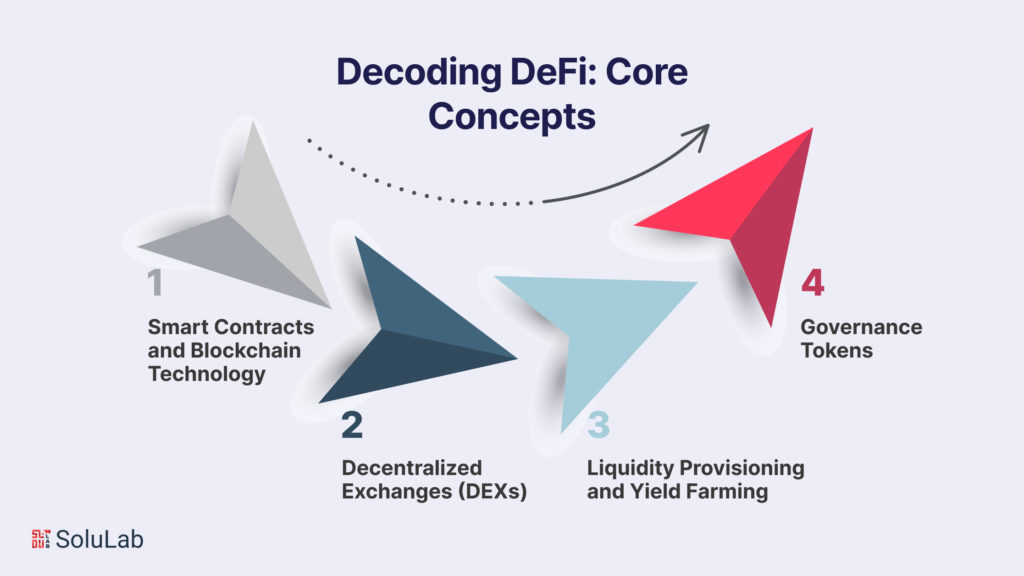
Decoding DeFi: Core Concepts

To truly grasp the trends and developments within the DeFi landscape, it’s essential to understand the fundamental concepts that underpin this financial revolution. DeFi isn’t just a buzzword; it’s a complex and innovative ecosystem built on a foundation of blockchain technology. In this section, we’ll decode the core concepts that are central to DeFi’s operation.

  • Smart Contracts and Blockchain Technology

At the heart of DeFi are smart contracts, self-executing agreements with the terms and conditions directly encoded into computer programs. These contracts automate financial processes, ensuring that transactions occur when predefined conditions are met. Ethereum, a blockchain platforms designed to support smart contracts, has been the epicenter of DeFi’s growth. Smart contracts have replaced the need for intermediaries, executing tasks like lending, borrowing, and trading without the involvement of traditional banks or financial institutions.

Blockchain technology, on the other hand, provides the decentralized and immutable ledger on which DeFi solutions operates. Transactions and data are stored across a network of computers, ensuring transparency and security. This foundation of blockchain ensures that DeFi transactions are trustless, meaning they can occur without the need for trust between parties.

  • Decentralized Exchanges (DEXs)

Decentralized exchanges are a key component of the DeFi ecosystem. These platforms enable users to trade cryptocurrencies directly with one another, without the need for a centralized intermediary. DEXs operate through smart contracts, facilitating peer-to-peer trading while allowing users to maintain control of their funds. This approach significantly reduces counterparty risk and enhances the security of transactions.

  • Liquidity Provisioning and Yield Farming

Liquidity provisioning is the practice of providing assets to decentralized exchanges, enabling other users to trade them. In return, liquidity providers earn fees and rewards. Yield farming, a popular DeFi practice, involves optimizing the use of these assets to maximize returns. Users can earn interest, lending fees, and governance tokens by participating in liquidity provision and yield farming protocols.

  • Governance Tokens

Governance tokens are tokens that provide users with decision-making power within a DeFi ecosystem. Holders of these tokens can vote on proposed changes, upgrades, and alterations to the protocol. This democratic approach to governance empowers the community to have a say in the development and management of DeFi lending platforms.

Understanding these core concepts is crucial for anyone looking to navigate the DeFi trends effectively. They serve as the building blocks for the multitude of financial services and applications that DeFi has to offer. As we move forward in this blog, we will explore the trends and innovations emerging within DeFi and how they relate to these core concepts.
DeFi Development Solutions

Top DeFi Trends to Look for in 2025

Decentralized Finance (DeFi) is evolving fast in 2025, redefining how we borrow, lend, trade, and earn. Here are the top DeFi trends shaping the future of finance this year:

1. Real-World Asset Tokenization: DeFi is bridging with the real world by tokenizing assets like real estate, gold, and bonds. This brings more liquidity to traditional markets and opens up fractional ownership for global investors.

2. Mobile-First DeFi Apps: With DeFi gaining traction in emerging markets like India, mobile-first platforms are on the rise. These apps offer smoother UX and simpler onboarding for users without a desktop or technical know-how.

3. DeFi Regulation Frameworks: Governments are moving from banning to regulating DeFi. Countries like the U.S., the UK, and India are exploring compliance tools, ensuring investor protection without stifling innovation.

4. AI-Powered DeFi Bots: AI is being integrated into DeFi protocols to help with risk management, automated trading, and lending decisions, making platforms smarter and safer for users.

5. Insurance & Risk Mitigation: More DeFi platforms are offering built-in insurance options against smart contract failures or hacks. This builds user trust and promotes long-term adoption.

6. Cross-Chain Interoperability: Movement of assets across blockchains is improving thanks to interoperability protocols. Users no longer need to worry about being locked into one chain.

7. Stablecoin Innovation: Beyond USDT and USDC, 2025 is seeing a rise in algorithmic and CBDC-backed stablecoins, enhancing payment efficiency and reducing volatility risks in DeFi ecosystems.

Future of DeFi: How Will It Evolve Beyond 2025?

The future of DeFi holds immense promise and potential for reshaping the global financial landscape. As we look ahead, several key factors and developments are likely to play a significant role in shaping the future of decentralized finance.

  • Scalability and Layer 2 Solutions

One of the most pressing challenges facing DeFi is scalability. Ethereum, the primary platform for DeFi projects, has struggled with high gas fees and network congestion. To overcome these limitations, Layer 2 solutions such as Optimistic Rollups and zk-Rollups are being implemented. These solutions aim to enhance the scalability of Ethereum and other blockchain networks, making DeFi more accessible and cost-effective for users.

  • DeFi in Traditional Finance

DeFi is no longer operating in isolation. It is increasingly intersecting with traditional DeFi and the future of finance. Traditional financial institutions are recognizing the potential benefits of DeFi, including reduced operational costs, enhanced transparency, and improved access to financial services. We can expect to see more partnerships, integrations, and collaborations between DeFi projects and traditional financial entities in the future.

  • AI-Powered DeFi Solutions

The integration of artificial intelligence into DeFi platforms will transform how investors interact with decentralized protocols. AI algorithms will help users analyze risk, forecast returns, automate portfolio strategies, and detect suspicious activity in real time. Think of it as having a smart DeFi assistant that constantly scans data, market sentiment, and yield opportunities, enabling users to make faster, data-driven decisions without deep technical expertise. 

  • Rise of Decentralized Identity (DID)

As regulation and compliance become critical for DeFi’s mainstream adoption, Decentralized Identity (DID) systems are emerging as a key enabler. DID allows users to verify their identity without handing over control of personal data to centralized entities. With verifiable credentials stored on-chain, users can access compliant DeFi services while retaining privacy and autonomy. This shift will be essential for unlocking secure, user-owned financial identities that can seamlessly interact across platforms and blockchains.

  • Use Cases Beyond Lending and Trading

While lending and trading have been the primary use cases in DeFi, the ecosystem is diversifying. Secure DeFi Smart Contract Development is leading the emergence of new solutions like decentralized insurance, prediction markets, and decentralized identity solutions. These innovations extend the scope of DeFi, offering users a broader array of financial services that were once the domain of centralized institutions.

  • Risks and Security Considerations

With the rapid expansion of the DeFi ecosystem, the risk landscape is evolving. Security remains a paramount concern. Smart contract vulnerabilities, hacks, and scams are real threats. Users and projects must remain vigilant and prioritize security. The development of decentralized insurance and risk management solutions within DeFi is a step toward mitigating these risks.

Decentralized Finance Development Services

Conclusion

With more people exploring decentralized platforms, smarter tools powered by AI, and better ways to stay secure. It’s becoming a real alternative to traditional banking. From easier access to loans to faster cross-border payments, everything’s getting more user-friendly and transparent. 

And as DeFi blends with regular finance, we’re heading toward a future where you control your money fully and freely. With rapid adoption and innovation, many experts believe that DeFi could be the future of financial services.

SoluLab, a top DeFi development company in the USA, can help you integrate decentralized finance into your business. Contact us today to discuss further!

FAQs

1. Why should investors care about DeFi trends in 2025?

In 2025, DeFi is evolving rapidly with trends like real-world asset tokenization, AI-powered DeFi, and institutional-grade platforms. For investors, staying updated on these trends is crucial to spotting new opportunities and understanding where the next wave of returns could come from in the decentralized ecosystem.

2. How can I invest in DeFi protocols in 2025?

Investors can participate in DeFi by staking, lending, yield farming, or buying DeFi tokens from decentralized exchanges (DEXs). Many platforms also offer liquidity pools or structured DeFi products. It’s essential to understand how each protocol works and monitor its TVL (Total Value Locked), audits, and community reputation.

3. What role does AI play in DeFi in 2025?

AI is increasingly integrated into DeFi platforms in 2025 to automate trading, enhance risk assessment, predict yield opportunities, and detect fraud. Smart DeFi dashboards and robo-advisors are helping both retail and institutional investors make more informed decisions based on real-time data.

4. Are stablecoins still relevant in DeFi in 2025?

Absolutely. Stablecoins remain the backbone of DeFi transactions, providing a stable unit of account in volatile markets. In 2025, there’s a shift toward fully transparent, regulated, or overcollateralized stablecoins to reduce systemic risks. They’re widely used in lending, liquidity pools, payments, and savings protocols.

5. How can beginners start investing in DeFi in 2025?

Beginners should start by learning the basics of blockchain, crypto wallets, and DeFi platforms. Use secure wallets like MetaMask or hardware options, and begin with popular platforms like Aave, Uniswap, or Curve. Start small, explore tutorials, and consider platforms that offer beginner-friendly interfaces with guided steps.

 

DeFi 2.0: The Future of Decentralised Finance

DeFi 2.0: The Future of Decentralised Finance

Decentralized Finance, often referred to as DeFi, is a revolutionary concept within the world of finance. It leverages blockchain technology to create an open and permissionless ecosystem that enables various financial services, such as lending, borrowing, trading, and more, without the need for traditional intermediaries like banks. DeFi is characterized by its transparency, accessibility, and automation, which have contributed to its rapid growth and popularity.

DeFi has continually evolved, giving rise to DeFi 2.0, the next phase of decentralized finance. DeFi 2.0 represents the maturation of the initial DeFi concepts and the integration of cutting-edge technologies and practices. It builds upon the foundation laid by DeFi by enhancing scalability, security, and interoperability, ultimately aiming to provide a more comprehensive and seamless financial experience.

In this evolution, DeFi 2.0 is driven by the latest DeFi trends, which are shaped by the innovative efforts of DeFi development companies. These top DeFi trends include improved user experience, the expansion of DeFi lending platforms, advancements in DeFi protocols, and the proliferation of decentralized applications (dApps). DeFi 2.0 is not limited to specific platforms but rather encompasses the entire DeFi ecosystem, the DeFi space, and DeFi exchanges.

What is the importance of DeFi 2.0 in the Financial Landscape?

The introduction of DeFi 2.0 marks a significant turning point in the financial landscape, where the world of decentralized finance (DeFi) transcends its initial boundaries and takes a giant leap forward. DeFi, often characterised as the innovation that decentralized traditional financial services, has been on a transformative journey, and it’s in DeFi 2.0 that we witness the convergence of numerous trends and developments.

As DeFi continues to evolve, it’s essential to recognize the key drivers and players in this space. DeFi development companies have played a pivotal role in shaping the top DeFi trends. These companies are at the forefront of research and innovation, continually pushing the boundaries of what DeFi can achieve. Their expertise and contribution to DeFi development service are instrumental in building the DeFi ecosystem.

One of the most notable aspects of DeFi 2.0 is the advancements in DeFi exchange development. Decentralized exchanges, the backbone of DeFi, have grown exponentially. They have enabled seamless and permissionless trading of digital assets while providing unprecedented liquidity. DeFi exchange development continues to refine these platforms, making them more efficient, secure, and user-friendly.

DeFi lending platforms are another integral part of the DeFi ecosystem. They offer decentralized, borderless, and transparent lending and borrowing solutions. DeFi 2.0 enhances these platforms by introducing more sophisticated and efficient protocols. These protocols are designed to mitigate risks and optimise lending processes, ultimately making DeFi lending more accessible and attractive to a broader audience.

What are the Emergence of DeFi 2.0 Within These Trends?

The emergence of DeFi 2.0 represents a significant evolutionary step within the ever-evolving landscape of decentralized finance. As DeFi has gained momentum and popularity in recent years, it has brought about a multitude of trends and developments. DeFi 2.0 builds upon these trends, propelling the ecosystem into new and uncharted territories.

One of the top DeFi trends that has led to the emergence of DeFi 2.0 is the growing involvement of DeFi development companies. These companies play a pivotal role in the ongoing development of the DeFi space, creating innovative solutions, and building the infrastructure required to support the DeFi ecosystem. DeFi development services offered by these companies encompass a wide array of functions, including smart contract development, blockchain integration, and protocol creation.

DeFi development companies are at the forefront of pioneering DeFi 2.0, as they continue to refine existing protocols and create new ones that address the limitations of the first-generation DeFi projects. The development of robust and secure DeFi protocols is crucial for the sustainability and growth of the DeFi ecosystem. These protocols underpin DeFi lending platforms, decentralized exchanges, and a variety of decentralized applications (dApps).

How DeFi Development Companies Shape Trends?

DeFi development companies are entities that specialise in creating, maintaining, and upgrading various aspects of the DeFi space. These companies offer a range of DeFi development services, including the development of DeFi protocols, DeFi exchange development, DeFi lending platforms, decentralized applications (dApps), and DeFi wallets. Their expertise and contributions have a significant impact on the development of the DeFi ecosystem.

  • DeFi Protocol Advancements

DeFi development companies are instrumental in designing and implementing new DeFi protocols. These protocols serve as the backbone of DeFi applications, enabling functionalities such as lending, borrowing, trading, and yield farming. By creating cutting-edge protocols, these companies set the stage for top DeFi trends.

  • DeFi Exchange Development

DeFi development companies are responsible for the creation of decentralized exchanges (DEXs), which are critical components of the DeFi space. They enhance the user experience, security, and functionality of DEXs, directly impacting how users interact with DeFi platforms.

CTA1

  • DeFi Lending Platforms

DeFi development companies develop lending and borrowing platforms that facilitate peer-to-peer transactions. They influence the trends in the DeFi lending space by introducing innovative features and optimizing the lending experience.

  • DApps and DeFi Wallets

DeFi development companies contribute to the development of decentralized applications and DeFi wallets, ensuring they are user-friendly and secure. This shapes the way individuals access and use DeFi services.

What are the Services Offered by DeFi Development Companies?

Services Offered by DeFi Development Companies

In the ever-evolving landscape of Decentralized Finance (DeFi) 2.0, DeFi development companies play a pivotal role in driving innovation and shaping the future of finance. These companies offer a diverse range of services, capitalising on the top DeFi trends to create cutting-edge solutions for the DeFi ecosystem. Let’s delve into the services provided by these key players in the DeFi development space.

  • DeFi Protocol Development

DeFi development companies specialise in creating and enhancing DeFi protocols, the backbone of the DeFi ecosystem. These protocols facilitate various financial activities, such as lending, borrowing, trading, and yield farming. They are constantly adapting to the latest DeFi trends, ensuring optimal performance and security.

  • Smart Contract Development

One of the core components of DeFi 2.0 is the use of smart contracts. DeFi development service providers are experts in designing and developing secure and efficient smart contracts, which underpin DeFi applications and platforms.

  • DeFi Exchange Development

DeFi exchanges are at the forefront of the DeFi space. DeFi development companies specialize in building decentralized exchange platforms that offer seamless trading experiences while integrating the latest DeFi trends, such as automated market makers (AMMs) and liquidity pools.

  • DeFi Lending Platform Creation

The lending and borrowing sector within the DeFi ecosystem has gained significant traction. DeFi development companies offer services to build and optimize DeFi lending platforms, allowing users to earn interest on their assets or access loans without intermediaries.

  • Decentralized Application (dApp) Development

DeFi dApps are instrumental in expanding the DeFi space. DeFi development companies design and develop user-friendly and secure dApps that cater to a wide range of financial needs, including asset management, yield farming, and more.

  • DeFi Wallet Development

Security and usability are paramount in the DeFi 2.0 landscape. DeFi development service providers focus on creating secure and user-friendly DeFi wallets that enable users to store, manage, and interact with their assets while staying updated with top DeFi trends.

What is the Significance of Decentralized Exchanges in DeFi 2.0?

Significance of Decentralized Exchanges in DeFi 2.0

In the ever-evolving landscape of Decentralized Finance (DeFi) 2.0, decentralized exchanges (DeFi exchanges) play a pivotal role, embodying the cutting edge of this financial revolution. These exchanges are where digital assets are traded in a trustless, peer-to-peer manner, eliminating the need for intermediaries such as traditional banks and brokers. Let’s explore their significance in the context of DeFi 2.0 and their contributions to various aspects of the DeFi ecosystem.

  • Empowering DeFi Trends

Decentralized exchanges are at the forefront of the top DeFi trends, facilitating the trading of a wide range of assets, including cryptocurrencies, tokens, and even non-fungible tokens (NFTs). They provide liquidity and accessibility to these assets, thus contributing significantly to the DeFi space’s dynamism.

  • Enabling Defi Development Companies

DeFi development companies heavily rely on decentralized exchanges to create and launch DeFi projects. These exchanges offer the infrastructure and technology needed to build, test, and deploy DeFi protocols, lending platforms, and other decentralized applications.

  • Facilitating DeFi Lending Platforms

In the DeFi 2.0 ecosystem, lending and borrowing are essential services. Decentralized exchanges allow users to collateralize their assets, thus playing a critical role in DeFi lending platforms. This interaction between exchanges and lending platforms forms the core of DeFi’s decentralized financial services.

  • Adhering to DeFi Protocols

DeFi exchange development aligns with various DeFi protocols, ensuring interoperability and consistency within the ecosystem. Liquidity providers, yield farmers, and DeFi users benefit from this adherence, as it enables seamless transactions across multiple DeFi applications.

  • Expanding the DeFi Ecosystem

Decentralized exchanges are expanding the boundaries of the DeFi ecosystem. By listing new tokens and experimenting with innovative trading mechanisms, they drive the evolution of DeFi 2.0. This continuous innovation broadens the offerings and options available to DeFi participants.

  • Enhancing User Experience with DeFi Wallets

DeFi exchanges often integrate with DeFi wallets, providing users with a seamless experience. Wallets are instrumental in connecting users to decentralized applications (dApps), and the synergy between wallets and exchanges creates a user-friendly environment for interacting with the DeFi 2.0 landscape.

  • Navigating the Future of Decentralized Finance

As DeFi continues to evolve, the future of decentralized finance 2.0 relies heavily on the development and innovation within decentralized exchanges. Their adaptability, scalability, and security will determine the success and sustainability of DeFi in the broader financial ecosystem.

What are the Innovations in DeFi Wallet Innovations?

In the ever-evolving landscape of Decentralized Finance (DeFi), wallets play a pivotal role in shaping the future of the ecosystem. DeFi 2.0, the next phase of DeFi development, relies heavily on the functionality and security of these digital wallets. In this article, we explore the essential aspects of DeFi wallets, including their role, security, usability, and the innovations that are driving the space forward.

DeFi 2.0 has ushered in a wave of innovative wallet technologies, pushing the boundaries of what wallets can offer:

  • Interoperability

DeFi wallets are now built to seamlessly interact with various blockchain networks and DeFi protocols. This interoperability allows users to access a broader range of services and assets within a single wallet.

  • Delegated Access Control

Wallets are integrating more sophisticated access control mechanisms. Users can delegate access to specific functions or assets within their wallet while maintaining overall control. This feature is particularly valuable in the DeFi lending platform space.

  • Decentralized Identity

DeFi wallets are exploring the integration of decentralized identity solutions. This can enhance user privacy and security while ensuring a smoother user experience across DeFi applications.

  • Mobile Wallets

With the growth of mobile DeFi apps, mobile wallets are evolving rapidly. These wallets bring DeFi 2.0 to the fingertips of users, allowing them to manage their DeFi portfolios on the go.

What is the Potential Impact on Traditional Finance?

The evolution of DeFi 2.0 and the pivotal role of DeFi wallets have the potential to disrupt traditional finance in several ways:

  • Financial Inclusion

DeFi 2.0 can extend financial services to the unbanked and underbanked populations globally, reducing dependence on traditional financial institutions.

  • Reduced Intermediaries

Traditional financial intermediaries may see decreased relevance as DeFi wallets provide direct access to a wide range of financial services, from lending to trading.

  • Cross-Border Transactions

DeFi 2.0’s borderless nature can revolutionize cross-border transactions, rendering traditional remittance services obsolete.

What are the Challenges and Opportunities for DeFi 2.0?

Challenges and Opportunities for DeFi 2.0

Challenges

  • Scalability Issues

DeFi 2.0 seeks to address the scalability challenges that plagued the first generation of DeFi platforms. As the ecosystem grows, it must overcome issues related to slow transaction processing and high gas fees.

  • Regulatory Uncertainty

The evolving regulatory landscape poses a significant challenge. DeFi 2.0 projects need to navigate complex legal frameworks and compliance requirements, which may vary by jurisdiction.

  • Security Concerns

Despite advancements in security protocols, DeFi remains vulnerable to hacks and exploits. DeFi 2.0 must prioritise security and resilience to protect users and assets.

  • Interoperability

Achieving interoperability among various DeFi platforms and protocols is essential. The challenge is to enable seamless integration between different projects to create a cohesive DeFi ecosystem.

  • User Adoption

While DeFi is gaining traction, mass adoption remains a challenge. DeFi 2.0 must focus on improving user experience and education to onboard mainstream users

Opportunities

  • Innovation in DeFi Protocols

DeFi 2.0 offers the opportunity to develop more robust and efficient protocols. These can enhance transaction speed and security, leading to a more resilient ecosystem.

  • Enhanced User Experience

DeFi 2.0 projects can prioritise user-friendly interfaces and streamlined processes, making it easier for non-technical users to participate.

  • Cross-Chain Integration

Bridging different blockchain networks can expand the DeFi space and unlock new opportunities for cross-chain trading and lending.

  • Decentralized Finance for the Unbanked

DeFi 2.0 can extend its reach to the unbanked and underbanked populations, providing financial services to those who have limited access to traditional banking.

  • DeFi Integration with dApps

The integration of DeFi with decentralized applications (dApps) can unlock a multitude of use cases, from gaming to social networking, providing more opportunities for DeFi to grow.

CTA2

Conclusion 

In a rapidly evolving landscape, SoluLab has established itself as a pioneering force in DeFi 2.0, contributing to the transformation of the decentralized finance (DeFi) ecosystem. The company’s expertise in DeFi development, including Defi lending platforms, Defi exchange development, and Defi protocols, positions them as a key player in shaping the future of Decentralized Finance 2.0.

As the top DeFi development service provider, SoluLab is at the forefront of the most significant DeFi trends, offering cutting-edge solutions for DeFi exchanges and decentralized applications (dApps). Their dedication to innovation and commitment to enhancing the security and user experience of DeFi wallets demonstrates their vision for a more robust and accessible DeFi space.

In an era where the DeFi landscape is continually evolving, SoluLab’s commitment to pushing the boundaries of DeFi 2.0 technology makes them a strategic partner for those seeking to navigate the ever-expanding and complex world of decentralized finance. SoluLab is undeniably contributing to the brighter and more inclusive future of Decentralized Finance 2.0.

FAQs

1. What is DeFi 2.0, and how does it differ from traditional DeFi?

DeFi 2.0 is an evolution of traditional DeFi, characterized by improved scalability and enhanced user experiences.

2. What are the top DeFi trends in the DeFi 2.0 ecosystem?

Top DeFi trends in DeFi 2.0 include cross-chain interoperability, optimized DeFi protocols, and enhanced DeFi wallets.

3. How is DeFi 2.0 reshaping the future of decentralized finance?

DeFi 2.0 is shaping the future by addressing the limitations of scalability, security, and usability present in traditional DeFi, making it more accessible and efficient.

4. What services do Defi development companies offer for DeFi 2.0 projects?

Defi development companies offer services such as DeFi protocol development, DeFi exchange development, DeFi wallet integration, and dApp creation for the DeFi 2.0 ecosystem.

5. What are DeFi lending platforms, and how do they fit into DeFi 2.0?

DeFi lending platforms are integral to DeFi 2.0, offering users the ability to lend, borrow, and earn interest on crypto assets in a more advanced and secure manner.


The Role of DeFi in Blockchain Game Development

The Role of Decentralized Finance (DeFi) in Blockchain Game Development

Decentralized Finance, commonly referred to as DeFi, represents a transformative paradigm within the blockchain space. DeFi encompasses a suite of financial services and applications that are built on public blockchain networks, enabling trustless and decentralized transactions without relying on traditional financial intermediaries. In the context of DeFi in the blockchain game industry, it signifies the integration of these financial services into the development and operation of blockchain-based games.

Blockchain game development is a dynamic sector that leverages blockchain technology to create innovative gaming experiences. This approach harnesses the transparency, security, and immutability of blockchain networks to facilitate the creation, trade, and ownership of in-game assets, such as Non-Fungible Tokens (NFTs). Blockchain games often utilize cryptocurrencies and smart contracts to underpin in-game economies, enabling unique ownership and provably scarce digital assets.

The role of DeFi in blockchain game development is of paramount importance, with several compelling facets. DeFi in blockchain games introduces a new dimension of financial services, including lending, borrowing, trading, and yield farming, into virtual gaming environments. This integration significantly enhances the economic ecosystem within these games, allowing players to interact with in-game assets in novel ways.

What is the Role of DeFi in Enhancing the Blockchain Game Ecosystem?

Role of DeFi in Blockchain Game Ecosystem

A. Empowering Blockchain Games through DeFi Integration

The role of DeFi in the blockchain game development process cannot be overstated. It comprises the creation of the infrastructure, protocols, and smart contracts that underpin the financial mechanisms within the game. Here’s how DeFi enhances the blockchain game ecosystem:

  • Cryptocurrency-Based In-Game Economies

DeFi allows for the creation of cryptocurrency-based in-game economies, where in-game assets and tokens hold real-world value. This shift from centralized in-game currencies to decentralized cryptocurrencies enables players to trade, invest, and own digital assets with true ownership and scarcity.

  • Smart Contracts for Asset Trading

DeFi development services enable the implementation of smart contracts that govern the trading of in-game assets. This enhances security and trust among players by ensuring that asset transactions occur automatically and transparently, without the need for intermediaries.

Read Blog: Top 25 Blockchain-Based Gaming Companies

  • Governance Tokens

DeFi also brings governance tokens into play, granting players a say in the direction and development of the game. This empowers the gaming community to have a direct influence on the game’s evolution, fostering a sense of ownership and engagement.

B. Enhancing the Blockchain Game Ecosystem

DeFi’s role in blockchain games extends beyond individual game mechanics. It fundamentally enhances the entire ecosystem in several ways:

  • Player Engagement

The integration of DeFi elements increases player engagement by offering unique opportunities for financial growth and decision-making. Gamers are no longer passive consumers but active participants in shaping the game world.

CTA1

  • Monetization Strategies

DeFi opens up new monetization strategies for both players and developers. Gamers can earn rewards by participating in the game, while developers can create innovative revenue streams through decentralized financial systems.

  • Transparency and Security

DeFi’s decentralized nature ensures transparency and security within the game ecosystem. Players can trust that the rules of the game are enforced by smart contracts, and asset ownership is immutable.

  • Cross-Game Economies

DeFi has the potential to enable cross-game economies, where assets earned in one game can be used in another. This interconnected ecosystem can significantly enrich the overall gaming experience.

What is the Interplay Between Decentralized Finance and Blockchain Games?

The interplay between decentralized finance (DeFi) and blockchain games represents a groundbreaking fusion of two innovative domains, significantly reshaping the landscape of blockchain game development. This interplay is at the forefront of revolutionizing in-game economies, digital asset ownership, and fostering player engagement in the blockchain gaming universe.

A. Utilizing DeFi in In-Game Economies

  • Cryptocurrency Integration

DeFi in blockchain games brings cryptocurrency integration to the forefront. Game developers are increasingly leveraging cryptocurrencies as in-game currencies, thereby providing players with a more versatile and decentralized means of transactions. This integration has significant implications for cross-border transactions, making in-game economies more inclusive and accessible.

  • Smart Contracts and Tokenization

Smart contracts, integral to DeFi, enable the automation of in-game processes, such as reward distribution, asset trading, and governance. Tokenization of in-game assets using these smart contracts ensures that players have full control over their digital possessions. This tokenization of assets through DeFi protocols makes assets more liquid, enabling players to trade, sell, or rent them in a decentralized manner.

B. DeFi for Digital Asset Ownership

  • NFTs (Non-Fungible Tokens) and DeFi

Non-fungible tokens (NFTs) have emerged as a powerful tool in blockchain game development. These unique digital assets are inherently tied to the principles of DeFi, ensuring that players have true ownership of their in-game items. Players can trade NFTs on decentralized marketplaces, establishing a secure and transparent environment for digital asset ownership.

  • Decentralized Exchanges (DEX) for In-Game Assets

Decentralized exchanges (DEXs) play a pivotal role in the DeFi-driven digital asset ownership ecosystem. These platforms facilitate the trading of in-game assets, NFTs, and other digital items without the need for intermediaries. Players can exchange assets directly with one another, thus reducing fees and increasing the accessibility of in-game assets.

C. Community Engagement Through DeFi

  • Governance Tokens for Players

DeFi principles extend to the governance of blockchain games, giving players a say in the game’s development and direction. By holding governance tokens, players can participate in decision-making processes, propose changes, and vote on crucial matters, thus enhancing community engagement and fostering a sense of ownership.

  • DeFi-Driven Player Incentives

DeFi models in blockchain games often introduce play-to-earn mechanisms. Players can earn tokens through in-game activities, which can then be utilized for various purposes within the game or traded on external DeFi platforms. These incentives encourage active gameplay, as players are rewarded for their participation and contributions to the game ecosystem.

What are the Benefits of Incorporating DeFi in Blockchain Game Development?

Benefits of Incorporating DeFi in Blockchain Game Development

Incorporating DeFi (Decentralized Finance) into blockchain game development offers a myriad of benefits that revolutionize the gaming experience. This innovative fusion of blockchain technology and financial services not only enhances gameplay but also empowers gamers in new and exciting ways.

A. Enhanced Security and Transparency

  • Trustless Transactions

DeFi, when integrated into blockchain games, brings a high level of trustlessness to transactions. In traditional gaming ecosystems, players often need to trust centralized intermediaries to handle in-game assets, which can be risky. 

However, with DeFi, smart contracts govern transactions, eliminating the need to rely on any central authority. This ensures that the exchange of assets is carried out without the risk of fraud or manipulation, providing players with a secure and transparent environment.

Read Blog Post: Play-to-Earn Games: Revolutionizing the Gaming Industry with Blockchain

  • Immutable Ownership Records

DeFi-based blockchain games leverage blockchain’s inherent immutability to create irrefutable ownership records. This means that players have complete control and ownership of their in-game assets, which are recorded on the blockchain. 

These records cannot be altered or deleted, enhancing player confidence in the integrity of their digital possessions. This feature also provides a solid foundation for a secondary market for in-game assets, typically in the form of NFTs (Non-Fungible Tokens), where ownership history is crucial.

B. Lower Transaction Costs

  • Eliminating Intermediaries

One of the primary advantages of incorporating DeFi in blockchain games is the reduction of transaction costs. In traditional gaming environments, intermediaries like banks or payment processors often charge fees for transferring funds or assets. 

DeFi systems bypass these intermediaries, enabling players to perform peer-to-peer transactions without the need for costly middlemen. This cost reduction makes microtransactions more feasible, even for small in-game purchases, ultimately enhancing the overall gaming experience.

Know More: 10 Best Defi Exchanges 2023

  • Microtransactions and Fractional Ownership

DeFi’s elimination of intermediaries facilitates microtransactions, allowing players to make small, frequent purchases within the game. This is particularly beneficial for in-game items, upgrades, or accessories that may only cost a few cents. 

Additionally, DeFi allows for fractional ownership, enabling players to invest in high-value in-game assets collaboratively. This opens up new opportunities for gamers to access rare and valuable items without the need to purchase them outright, further diversifying the in-game economy.

C. Play-to-Earn Mechanisms

  • Rewarding Player Activity

The integration of DeFi introduces innovative play-to-earn mechanisms that reward players for their in-game activity. 

These rewards often come in the form of cryptocurrency or tokens that have real-world value. As players achieve milestones or engage in specific in-game activities, they can earn these rewards, creating an enticing incentive to spend more time in the game.

D. Earning Opportunities for Gamers

Beyond mere entertainment, blockchain games that incorporate DeFi derivatives provide real earning opportunities for players. Gamers can sell or trade their in-game assets and cryptocurrencies on decentralized exchanges, converting their virtual achievements into tangible financial gain. This model not only fosters player engagement but also transforms gaming from a pastime into a potential source of income, appealing to a broader audience.

Incorporating DeFi into blockchain game development thus goes beyond improving gameplay; it creates an ecosystem where trust, transparency, cost-efficiency, and financial empowerment combine to redefine the gaming industry. As this fusion continues to evolve, players can look forward to more immersive, rewarding, and economically inclusive gaming experiences.

What are some key challenges and considerations of integrating Decentralized Finance (DeFi) into blockchain games?

Challenges in merging DeFi with blockchain games

Incorporating Decentralized Finance (DeFi) into the realm of blockchain gaming presents a multitude of opportunities and innovative possibilities. However, as with any emerging technology, there are inherent challenges and considerations that developers, players, and industry stakeholders must address in order to fully unlock the potential of DeFi in blockchain games. These considerations are crucial for navigating the path toward a seamless integration of decentralized finance in gaming.

A. Regulatory Compliance

The marriage of DeFi and blockchain games raises complex regulatory questions that necessitate careful consideration:

  • Navigating Legal and Regulatory Frameworks

The global regulatory landscape surrounding both blockchain and DeFi is still evolving. Developers and gaming companies must be diligent in understanding and adhering to the legal requirements in their respective regions and the regions where their players reside.

Check This Blog: The Role of Decentralized Exchanges (DEXs) in DeFi

  • DeFi and AML/KYC Concerns

Ensuring that the in-game transactions comply with Anti-Money Laundering (AML) and Know Your Customer (KYC) regulations can be challenging in decentralized environments. Maintaining a balance between privacy and security is a delicate task.

B. Scalability and Network Congestion

Blockchain networks, particularly Ethereum, which is commonly used for DeFi applications and blockchain games, have faced issues with scalability and network congestion:

  • Ethereum’s Scaling Challenges

Ethereum, a prominent platform for DeFi and blockchain games, has experienced network congestion and high transaction fees during peak usage. Developers need to explore Layer 2 solutions and alternative blockchains to mitigate these issues.

  • Solutions and Alternatives

The industry must continually seek and adopt scalable solutions to ensure seamless gaming experiences for players. This may involve transitioning to Layer 2 scaling solutions or exploring interoperability with other blockchains.

Read Also: Top 10 Defi Lending Platforms in 2023

C. User Education and Adoption

DeFi in blockchain games demands a certain level of understanding from the gaming community:

  • Bridging the Knowledge Gap

For many players, DeFi may be a new and complex concept. Game developers must invest in educating their user base, ensuring that players understand how to utilize DeFi features within the game.

  • Improving User Experience

The user interface and experience must be intuitive and user-friendly. Players should feel comfortable navigating the DeFi features without encountering barriers due to unfamiliarity.

The intersection of decentralized finance and blockchain games represents a promising frontier in the gaming industry, but these challenges and considerations cannot be overlooked. Industry stakeholders, from developers to regulatory authorities, must work together to address these issues effectively, ensuring that the potential of DeFi in the blockchain gaming ecosystem is fully realized.

How are emerging technologies like Layer 2 solutions and cross-chain integration shaping the future of decentralized finance (DeFi)?

The future of decentralized finance (DeFi) in blockchain game development promises to be a dynamic and transformative landscape, with emerging technologies playing a pivotal role. This article explores the upcoming trends and prospects in this exciting fusion of the gaming and financial sectors.

A. Emerging Technologies and Their Role in DeFi for Games

  • Layer 2 Solutions

As DeFi in blockchain games continues to gain momentum, scalability and cost-efficiency have become critical issues. Layer 2 solutions offer a promising way to address these challenges. By utilizing sidechains or off-chain scaling solutions, blockchain game developers can significantly enhance the performance of their platforms. Layer 2 solutions facilitate faster transaction processing and reduce network congestion, making DeFi applications in games more accessible and enjoyable for users.

These solutions not only enable seamless in-game asset transfers but also provide an ideal environment for implementing microtransactions, enabling players to participate in various in-game financial activities. Blockchain game development services can leverage Layer 2 solutions to create fluid and immersive gaming experiences while maintaining the security and decentralization of DeFi.

  • Cross-Chain Integration

The gaming industry is increasingly diverse, with various blockchain networks and ecosystems hosting different games. Cross-chain integration, which allows assets and data to move seamlessly between different blockchains, is a promising trend for DeFi NFT games. This approach promotes interoperability and the exchange of in-game assets between players from different platforms.

DeFi development companies can leverage cross-chain technologies to enhance the liquidity and utility of in-game assets. For example, a player’s NFT earned in one game can be seamlessly used in another, and decentralized exchanges can facilitate cross-chain asset swaps. The integration of multiple blockchains paves the way for a more connected and vibrant gaming ecosystem.

B. DeFi in Metaverse Development

  • Expanding Beyond Individual Games

The metaverse, a collective virtual shared space, is fast becoming the next frontier for DeFi in the gaming industry. Metaverse development aims to unify various blockchain games, social experiences, and virtual worlds into a cohesive digital universe. This expansion beyond individual games provides opportunities for DeFi to flourish on a grand scale.

Players can move their assets and financial activities seamlessly between different virtual realms within the metaverse, creating a unified virtual economy. DeFi development solutions that focus on metaverse integration are expected to enable a new level of player engagement and financial interactivity, as players traverse these interconnected virtual landscapes.

  • Virtual Economies and DeFi Ecosystems

The convergence of virtual economies with DeFi ecosystems is a powerful trend in metaverse development. In-game assets, currencies, and tokens can serve as valuable assets in the broader DeFi landscape, providing liquidity, yield farming opportunities, and decentralized finance services beyond the gaming world.

DeFi development services are likely to play a pivotal role in designing and maintaining these virtual economies. Users can invest, trade, and participate in decentralized financial activities while navigating the metaverse. DeFi protocols and governance structures within virtual worlds will create a new layer of financial interactivity, offering players more opportunities for growth and participation in decentralized finance.

CTA2

Conclusion

In conclusion, the fusion of Decentralized Finance (DeFi) and blockchain game development is a pioneering synergy that has unlocked boundless possibilities within the gaming industry. As blockchain technology continues to redefine the landscape of interactive entertainment, DeFi has emerged as an indispensable cornerstone, offering unprecedented transparency, security, and accessibility. 

Companies like SoluLab, with their expertise in blockchain game development services and DeFi development solutions, stand at the forefront of this revolution, empowering developers and gamers alike. The Role of DeFi in blockchain game development cannot be understated, as it not only enriches the player experience but also brings new financial opportunities to the forefront.

As the blockchain game industry continues to evolve, SoluLab’s commitment to advancing decentralized finance in blockchain game development service underscores its pivotal role in shaping the future of this dynamic and transformative ecosystem. Contact SoluLab to explore the possibilities.

FAQs

1. What is the Role of DeFi in Blockchain Game Development?

Decentralized Finance (DeFi) plays a pivotal role in blockchain game development by offering a new dimension of in-game economics. DeFi solutions enable the creation of decentralized assets, tokens, and marketplaces, providing players with true ownership and control over their in-game assets. This opens up possibilities for dynamic and player-driven economies in blockchain games.

2. How Does DeFi Impact the In-Game Economy of Blockchain Games?

DeFi in blockchain games disrupts the traditional gaming economy by allowing players to trade, lend, and borrow in-game assets in a trustless and transparent manner. It empowers players to make meaningful economic decisions, thereby making the in-game economy more vibrant and player-centric.

3. What Are the Benefits of Incorporating DeFi in Blockchain Game Development?

The integration of DeFi in blockchain game development offers benefits such as increased player engagement, real asset ownership, and the potential for players to earn real-world value from their in-game activities. It also reduces the risk of fraudulent in-game item sales and enhances the overall gaming experience.

4. How Does DeFi Influence the Monetization Strategy of Blockchain Games?

DeFi can revolutionize the monetization strategies of blockchain games by enabling new revenue streams, such as transaction fees from in-game asset trading, token sales, and DeFi-related activities. It offers developers innovative ways to generate income and sustain their game ecosystems.

5. How Can DeFi Development Services Enhance the Blockchain Game?

DeFi development services can enhance your blockchain game by providing solutions for creating decentralized tokens, building in-game marketplaces, and enabling DeFi functionalities like yield farming and staking. These services can make your game more interactive, engaging, and profitable for both developers and players.

6. What Risks Should you be aware of when Integrating DeFi in the Blockchain Game?

While DeFi brings numerous advantages, it also comes with risks, including smart contract vulnerabilities and potential regulatory challenges. It’s crucial to work with experienced DeFi developers and legal experts to ensure compliance and security when implementing DeFi in your blockchain game.

Security in DeFi: How to Protect Your Assets


Security in DeFi: How to Protect Your Assets

The rise of decentralized finance (DeFi) has revolutionized the financial landscape, offering innovative opportunities for users to engage in a wide array of financial activities without the need for traditional intermediaries. While DeFi presents a promising and accessible platform for users to participate in decentralized financial transactions, the security of DeFi assets remains a critical concern. With the growing adoption of DeFi protocols, ensuring robust security measures and protocols is paramount to safeguarding user assets and maintaining the trust and integrity of the DeFi ecosystem. This comprehensive guide delves into the intricacies of DeFi security, exploring the best practices, security measures, and compliance protocols essential for protecting DeFi assets and fostering a secure and resilient DeFi landscape. From understanding the importance of DeFi security to exploring future trends and innovations, this guide provides valuable insights into the critical aspects of DeFi security and the strategies necessary to protect assets within the dynamic world of decentralized finance.

What is DeFi Security?

Understanding the fundamental concepts and principles of securing assets in the decentralized finance (DeFi) space, this section provides a comprehensive overview of the critical components that constitute DeFi security and its significance in the evolving financial landscape.

Understanding the Importance of DeFi Security

Decentralized finance (DeFi) has gained significant traction in recent years, revolutionizing the traditional financial landscape by providing innovative and decentralized alternatives to conventional banking and investment services. With the increasing adoption of DeFi platforms and protocols, ensuring robust security measures has become imperative. DeFi security plays a critical role in fostering trust and confidence among users, investors, and stakeholders within the DeFi ecosystem. By prioritizing security, DeFi platforms can safeguard user assets, mitigate risks of potential vulnerabilities, and foster a secure and reliable environment for decentralized financial transactions.

Overview of Decentralized Finance (DeFi)

Decentralized finance (DeFi) refers to the movement aimed at creating an open and permissionless financial system using blockchain technology. DeFi platforms facilitate various financial services such as lending, borrowing, trading, and asset management without the need for intermediaries. These platforms utilize smart contracts and decentralized applications (DApps) to enable users to engage in financial activities directly without relying on traditional financial institutions. The DeFi ecosystem offers greater financial inclusivity, transparency, and accessibility, empowering users to have full control over their assets and investments.

The Need for Robust Security Measures in DeFi

As the DeFi landscape continues to expand, the need for robust security measures has become increasingly evident. The decentralized nature of DeFi platforms presents unique security challenges that require comprehensive solutions to protect user funds, data, and privacy. With the rise of various DeFi protocols, applications, and platforms, ensuring the security and safety of user assets has become a top priority. Implementing stringent security measures—including encryption, multi-factor authentication, and password protection—helps mitigate the risks associated with potential vulnerabilities, hacks, and data breaches, fostering a secure and resilient DeFi ecosystem for all participants.”

DeFi Security Measures: Best Practices and Protocols

DeFi Security Measures: Best Practices and Protocols

Exploring the various measures and protocols essential for ensuring the security of DeFi platforms, this section delves into the industry’s best practices and protocols that underpin a robust and resilient security framework in the DeFi ecosystem.

  • Exploring Key DeFi Security Protocols

In the context of the dynamic and evolving DeFi landscape, implementing robust security protocols is essential to safeguard user assets and maintain the integrity of the DeFi ecosystem. Various DeFi security protocols are designed to address potential vulnerabilities and security threats, offering a layered approach to fortify the overall security posture of DeFi platforms. These security protocols often include multi-layer authentication mechanisms, encryption techniques, and decentralized identity management systems to enhance the security and privacy of user transactions and data within the DeFi space.

  • Best Practices for Ensuring DeFi Security

Ensuring DeFi security involves adopting best practices that prioritize the protection of user assets and data. Several key best practices contribute to enhancing the security of DeFi platforms and protocols. Implementing robust authentication mechanisms, such as multi-factor authentication (MFA) and biometric security measures, strengthens user account security and prevents unauthorized access. Additionally, regular security audits, code reviews, and penetration testing are essential for identifying and addressing potential vulnerabilities and weaknesses within DeFi protocols and smart contracts. By following these best practices, DeFi platforms can bolster their security measures and create a more secure and reliable environment for users to engage in decentralized financial activities.

CTA1

  • Importance of Audits and Code Reviews in DeFi

Conducting comprehensive security audits and code reviews is critical to identifying and addressing potential vulnerabilities within DeFi platforms and protocols. Security audits help assess the overall security posture of DeFi platforms, identify potential loopholes or weaknesses, and recommend necessary security enhancements. Through thorough code reviews, DeFi developers and security experts can identify and rectify any coding errors, bugs, or vulnerabilities that may compromise the security and functionality of DeFi smart contracts and applications. By prioritizing regular security audits and code reviews, DeFi platforms can maintain a robust security posture and instill trust and confidence among users and investors.

Risks and Vulnerabilities in DeFi

Identifying the inherent risks and vulnerabilities associated with decentralized finance (DeFi), this section highlights the potential threats and challenges that users and platforms may encounter, shedding light on the critical areas where security breaches may occur.

  • Identifying Common Risks and Vulnerabilities in DeFi

Despite the numerous advantages and opportunities presented by DeFi, the ecosystem is susceptible to various risks and vulnerabilities that can compromise user funds and data. Identifying common risks and vulnerabilities is crucial in developing effective risk mitigation strategies and enhancing the security of DeFi Derivatives. Some of the common risks and vulnerabilities in DeFi include smart contract vulnerabilities, flash loan attacks, price oracle manipulation, and decentralized exchange (DEX) vulnerabilities. By understanding these risks, DeFi platforms can implement proactive security measures to protect user assets and prevent potential security breaches.

  • Analyzing the Impact of Security Breaches in DeFi

Security breaches in the DeFi landscape can have far-reaching consequences, affecting user trust, platform credibility, and overall market stability. A security breach can lead to the loss of user funds, sensitive data exposure, and compromised transactional integrity, resulting in significant financial losses and reputational damage for affected users and platforms. The impact of security breaches extends beyond financial implications, as it can erode user confidence and hinder the adoption and growth of the DeFi ecosystem. By analyzing the potential impact of security breaches, DeFi platforms can prioritize the implementation of robust security measures and risk mitigation strategies to minimize the likelihood and impact of security incidents.

  • Understanding Smart Contract Risks in DeFi Platforms

Smart contracts serve as the backbone of DeFi platforms, enabling the automation of various financial transactions and operations. However, smart contracts are not immune to risks and vulnerabilities, making them susceptible to potential security threats and attacks. Understanding smart contract risks in DeFi platforms involves recognizing potential coding errors, bugs, and vulnerabilities that can compromise the functionality and security of smart contracts. Vulnerabilities such as reentrancy attacks, integer overflow, and unauthorized access can expose DeFi platforms to various security risks, leading to potential financial losses and operational disruptions. By prioritizing smart contract security and conducting thorough code reviews, DeFi platforms can mitigate smart contract risks and create a secure and reliable environment for decentralized financial activities.

Safeguarding DeFi Assets: Wallet and Asset Protection

Focusing on the protection of assets within the DeFi space, this section delves into the intricacies of safeguarding DeFi assets through effective wallet selection, management, and advanced security measures, emphasizing the importance of protecting private keys and employing multi-signature wallets.

  • Securing DeFi Assets: Wallet Selection and Safety Measures

Safeguarding DeFi assets is paramount to maintaining the security and integrity of the DeFi ecosystem. Users must prioritize selecting secure and reputable wallets that offer robust security features and encryption protocols to protect their digital assets. Hardware wallets, cold storage solutions, and secure mobile wallets are popular options that provide enhanced security and protection for DeFi assets. By choosing secure wallets and implementing stringent safety measures, users can minimize the risks of unauthorized access, theft, and asset compromise, fostering a secure and reliable environment for managing and storing their DeFi assets.

  • Importance of Private Key Management in DeFi

Private key management is a crucial aspect of DeFi security that directly impacts the safety and accessibility of user assets. Safeguarding private keys is essential to prevent unauthorized access and protect user funds from potential security breaches and theft. DeFi users must adopt robust private key management practices, such as secure storage, encryption, and multi-signature authentication, to ensure the confidentiality and integrity of their private keys. By prioritizing private key management, users can maintain full control over their DeFi assets and prevent potential security risks and compromises associated with unauthorized access and key exposure.

Read Also: 9 Best Defi Staking Platforms in 2024

  • Exploring Multi-Signature Wallets for DeFi Security

Multi-signature wallets offer an additional layer of security and protection for DeFi assets, enabling users to secure their digital assets through a collaborative authentication process. Multi-signature wallets require multiple private key signatures to authorize transactions, enhancing the security and integrity of DeFi asset management. By leveraging multi-signature wallet solutions, users can prevent single points of failure, reduce the risks of unauthorized transactions, and protect their assets from potential security threats and breaches. Implementing multi-signature wallets is a proactive security measure that strengthens the overall security posture of DeFi asset management and fosters a secure and trusted environment for decentralized financial transactions.

DeFi Platform Security: Protecting User Funds and Information

Emphasizing the security of user funds and information on DeFi platforms, this section delves into the critical aspects of data privacy and security features, highlighting the measures necessary for mitigating the risks of hacks and data breaches within DeFi platforms.

  • Ensuring User Fund Security on DeFi Platforms

DeFi platforms must prioritize user fund security to instill trust and confidence among users and investors. Implementing robust security measures, such as secure authentication protocols, data encryption, and transaction monitoring, helps protect user funds from potential security breaches and unauthorized access. DeFi platforms must employ secure and reliable infrastructure, comprehensive security protocols, and advanced encryption technologies to safeguard user funds and ensure the integrity of financial transactions within the DeFi ecosystem. By prioritizing user fund security, DeFi platforms can create a safe and reliable environment for users to participate in decentralized financial activities with peace of mind and confidence.

  • Data Privacy Measures for DeFi Platform Users

Data privacy is a critical component of DeFi platform security that emphasizes the protection and confidentiality of user information and sensitive data. DeFi platforms must implement stringent data privacy measures, such as data encryption, access controls, and privacy policies, to safeguard user information from unauthorized access and data breaches. By prioritizing data privacy, DeFi platforms can enhance user trust and confidence, comply with regulatory standards, and foster a transparent and secure environment for users to engage in decentralized financial transactions and activities. Protecting user data privacy is essential in building a secure and trustworthy DeFi ecosystem that prioritizes user confidentiality and security.

Read Blog Post: The Role of Decentralized Exchanges (DEXs) in DeFi

  • Mitigating Risks of Hacks and Data Breaches in DeFi Platforms

Mitigating the risks of hacks and data breaches is a top priority for DeFi platforms seeking to create a secure and resilient environment for users and investors. DeFi platforms must implement robust security measures, proactive threat detection systems, and incident response protocols to prevent, detect, and respond to potential security incidents and breaches effectively. By prioritizing risk mitigation strategies and adopting comprehensive security measures, DeFi platforms can minimize the risks of hacks and data breaches, protect user data and assets, and maintain the overall security and integrity of the DeFi ecosystem. Proactive risk mitigation is essential in establishing a secure and reliable DeFi platform that prioritizes user safety and trust.

DeFi Exchange Security: Trading Safely in the DeFi Space

DeFi Exchange Security: Trading Safely in the DeFi Space

Addressing the security concerns associated with trading and asset exchange within the DeFi space, this section provides insights into the security features and strategies implemented by DeFi exchanges to ensure safe and secure transactions and swaps.

  • Security Features in DeFi Exchanges: An Overview

DeFi exchanges play a crucial role in enabling users to trade and exchange digital assets within the DeFi ecosystem. Implementing robust security features is essential for ensuring the safety and integrity of DeFi exchanges, protecting user funds, and maintaining a secure trading environment. Security features such as secure authentication, encrypted data transmission, and transaction monitoring help mitigate the risks of unauthorized access, data breaches, and fraudulent activities on DeFi exchanges. By implementing comprehensive security features, DeFi exchanges can foster user trust, enhance platform credibility, and create a safe and secure environment for users to trade and exchange digital assets with confidence and peace of mind.

  • Tips for Secure Trading and Asset Exchange in DeFi

Secure trading and asset exchange in the DeFi space require users to adopt proactive security measures and best practices that prioritize the protection and integrity of their digital assets. Users must prioritize secure authentication practices, conduct thorough due diligence on DeFi projects and platforms, and utilize secure wallets and authentication methods to protect their assets from potential security risks and vulnerabilities. By following secure trading tips and best practices, users can mitigate the risks of unauthorized access, fraudulent transactions, and asset compromise, fostering a secure and reliable trading environment within the DeFi ecosystem. Proactive security measures are essential in empowering users to trade and exchange digital assets with confidence and trust in the DeFi space.

  • Ensuring the Safety of Transactions and Swaps in DeFi

The safety of transactions and swaps is paramount in maintaining the integrity and reliability of DeFi exchanges and platforms. DeFi users must prioritize secure transaction practices, conduct comprehensive risk assessments, and leverage secure and reputable DeFi platforms to facilitate seamless and secure asset transactions and swaps. Implementing secure transaction protocols, such as encrypted data transmission, multi-factor authentication, and secure wallet integrations, helps protect user assets and transactional integrity from potential security threats and vulnerabilities. By prioritizing transaction safety, DeFi users can engage in secure and reliable asset transactions and swaps within the DeFi ecosystem, fostering a trusted and resilient trading environment for all participants.

DeFi Audits and Compliance: Ensuring Regulatory Standards

Exploring the critical role of audits and compliance in maintaining regulatory standards within the DeFi landscape, this section emphasizes the importance of adhering to legal frameworks and regulatory requirements, ensuring the security and compliance of DeFi platforms.

  • Importance of Regulatory Compliance in DeFi

Regulatory compliance is a crucial aspect of DeFi security that emphasizes the adherence to legal frameworks, industry standards, and regulatory guidelines to ensure the legality and legitimacy of DeFi operations. DeFi platforms must prioritize regulatory compliance by implementing comprehensive compliance programs, conducting regular audits, and adhering to regulatory standards to prevent legal implications and regulatory penalties. By prioritizing regulatory compliance, DeFi platforms can foster trust and credibility among users and investors, comply with legal requirements, and create a secure and transparent environment for decentralized financial activities and transactions. Adherence to regulatory standards is essential in building a reputable and compliant DeFi ecosystem that upholds industry best practices and legal requirements.

Read Our Blog: 7 Best Defi Trading Platforms in 2024

  • Role of DeFi Audits in Maintaining Security and Compliance

DeFi audits play a pivotal role in ensuring the security, reliability, and compliance of DeFi platforms and protocols. Regular audits help identify potential security vulnerabilities, assess platform integrity, and verify compliance with regulatory standards and industry best practices. DeFi platforms must conduct comprehensive audits, security assessments, and code reviews to mitigate the risks of security breaches, unauthorized access, and non-compliance with legal requirements. By engaging in regular audits, DeFi platforms can proactively identify and address potential security risks, strengthen platform security and compliance, and build a trustworthy and resilient DeFi ecosystem for all participants. Regular audits are essential in maintaining the security and compliance of DeFi platforms and protocols, fostering trust and confidence among users and investors.

  • Adhering to Legal Frameworks in the DeFi Landscape

Adhering to legal frameworks is critical for DeFi platforms to maintain the integrity, legality, and credibility of their operations within the DeFi landscape. DeFi platforms must prioritize legal compliance by understanding and adhering to legal requirements, regulatory guidelines, and industry standards to prevent legal implications and regulatory penalties. By engaging legal advisors, compliance experts, and industry professionals, DeFi platforms can navigate complex legal frameworks, ensure adherence to regulatory standards, and build a compliant and secure environment for decentralized financial activities and transactions. Adherence to legal frameworks is essential in establishing a reputable and trustworthy DeFi landscape that upholds legal requirements and industry best practices, fostering a secure and compliant environment for all participants in the DeFi space.

Case Studies: Successful DeFi Security Implementations

Analyzing successful implementations of DeFi security measures, this section presents case studies highlighting exemplary practices and strategies employed by leading DeFi projects to ensure robust security measures, providing valuable insights into effective DeFi security implementations.

  • Analyzing Case Studies of DeFi Platforms with Robust Security

Analyzing case studies of successful DeFi platforms with robust security implementations provides valuable insights into the best practices, strategies, and technologies that contribute to the security and reliability of decentralized financial activities. Case studies highlight successful DeFi platforms that have prioritized security, compliance, and user trust, demonstrating effective security measures, compliance programs, and risk mitigation strategies. By analyzing case studies, DeFi platforms can learn from successful implementations, identify key security challenges and solutions, and implement industry best practices to strengthen their security posture and build a secure and trusted DeFi ecosystem for all participants. Learning from successful case studies is essential in fostering a secure and resilient DeFi landscape that prioritizes user safety, trust, and compliance.

Read Blog Post: List of Top 10 Defi Savings Accounts

  • Learning from Successful DeFi Security Implementations

Learning from successful DeFi security implementations allows DeFi platforms to leverage industry insights, best practices, and successful strategies to enhance their security posture and compliance programs. Successful DeFi security implementations emphasize the importance of proactive security measures, comprehensive risk assessments, and regulatory compliance in creating a secure and reliable DeFi ecosystem. By adopting successful security strategies and practices, DeFi platforms can mitigate the risks of security breaches, unauthorized access, and non-compliance with regulatory standards, fostering a secure and compliant environment for decentralized financial activities and transactions. Learning from successful DeFi security implementations is essential in empowering DeFi platforms to strengthen their security posture, prioritize user trust and safety, and build a resilient and trusted DeFi landscape for all participants.

  • Exploring Best Practices from Leading DeFi Projects

Exploring best practices from leading DeFi projects provides valuable insights into the strategies, technologies, and approaches that contribute to the success and security of decentralized financial activities. Leading DeFi projects prioritize security, compliance, and user trust by implementing robust security measures, comprehensive compliance programs, and proactive risk mitigation strategies. By exploring best practices from leading DeFi projects, DeFi platforms can learn from successful implementations, identify key security challenges and solutions, and implement industry best practices to strengthen their security posture and build a secure and trusted DeFi ecosystem for all participants. Exploring best practices from leading DeFi projects is essential in fostering a secure and resilient DeFi landscape that prioritizes user safety, trust, and compliance.

Future of DeFi Security: Trends and Innovations

Future of DeFi Security: Trends and Innovations

Discussing the future trends and innovative developments in DeFi security, this section explores the emerging advancements and technologies shaping the future of DeFi security, providing valuable foresights into the evolving landscape of security measures within the DeFi ecosystem.

  • Emerging Trends in DeFi Security Measures

The future of DeFi security is shaped by emerging trends and innovations that aim to enhance the security, reliability, and compliance of decentralized financial activities and transactions. Emerging trends in DeFi security emphasize the adoption of advanced security protocols, technologies, and compliance frameworks to mitigate the risks of security breaches, unauthorized access, and non-compliance with regulatory standards. By embracing emerging trends, DeFi platforms can proactively address security challenges, implement innovative security solutions, and build a secure and trusted DeFi ecosystem for all participants. Embracing emerging trends in DeFi security is essential in fostering a secure and resilient DeFi landscape that prioritizes user safety, trust, and compliance, laying the foundation for a secure and innovative future of decentralized finance.

Read Our Blog Post: Top 10 Decentralized Crypto Exchanges to Consider in 2024

  • Advancements in DeFi Security Protocols and Technologies

Advancements in DeFi security protocols and technologies drive the evolution and innovation of security measures, compliance programs, and risk mitigation strategies within the DeFi landscape. Advancements in DeFi security protocols leverage cutting-edge technologies, such as blockchain, encryption, and authentication methods, to strengthen the security and reliability of decentralized financial activities and transactions. By adopting advanced security protocols and technologies, DeFi platforms can enhance their security posture, prevent security breaches, and ensure compliance with regulatory standards, fostering a secure and trusted DeFi ecosystem for all participants. Embracing advancements in DeFi security protocols and technologies is essential in building a resilient and innovative DeFi landscape that prioritizes user safety, trust, and compliance.

  • Predictions for the Future of DeFi Security

Predictions for the future of DeFi security highlight the evolution and transformation of security measures, compliance programs, and risk mitigation strategies within the DeFi landscape. Predictions emphasize the continued adoption of advanced security technologies, the development of comprehensive compliance frameworks, and the integration of innovative security solutions to strengthen the security and reliability of decentralized financial activities and transactions. By embracing predictions for the future of DeFi security, DeFi platforms can proactively address security challenges, implement effective security strategies, and foster a secure and trusted DeFi ecosystem for all participants. Embracing predictions for the future of DeFi security is essential in laying the groundwork for a secure, innovative, and resilient DeFi landscape that prioritizes user safety, trust, and compliance.

CTA2

Conclusion

In the rapidly evolving landscape of decentralized finance (DeFi), ensuring robust security measures is paramount to maintaining the trust and confidence of users and investors. By implementing comprehensive security protocols, users can safeguard their assets and information from potential threats and vulnerabilities. The critical understanding of DeFi security and its implications on the wider financial ecosystem serves as a crucial foundation for the successful adoption and integration of DeFi applications. As the DeFi space continues to witness exponential growth and innovation, the need for advanced security solutions and compliance measures becomes increasingly pronounced.

At SoluLab, we recognize the significance of DeFi security in fostering a secure and reliable financial ecosystem. Our expertise in DeFi development and our comprehensive range of DeFi development services are designed to provide tailored solutions that meet the unique security requirements of each project. With a commitment to excellence and a focus on delivering industry-leading DeFi exchange development solutions, SoluLab remains dedicated to shaping the future of DeFi applications and fostering a secure environment for the global DeFi community.

As the DeFi industry continues to expand and diversify, the integration of advanced security features and protocols will play a pivotal role in ensuring the safety and integrity of DeFi platforms and exchanges. With a focus on continuous innovation and technological advancement, SoluLab remains at the forefront of the DeFi development landscape, providing comprehensive security solutions and robust development services to propel the growth and adoption of decentralized finance applications worldwide. Contact SoluLab today to fortify your DeFi journey with cutting-edge solutions.

FAQs

1. What are the key security challenges in decentralized finance (DeFi) platforms?

The key security challenges in DeFi platforms primarily revolve around smart contract vulnerabilities, data breaches, and hacking incidents that can result in the loss of user funds and sensitive information.

2. How can users ensure the safety of their assets while using DeFi applications?

Users can ensure the safety of their assets while using DeFi applications by implementing robust security practices such as utilizing hardware wallets, practicing secure key management, and being cautious of phishing attempts and fraudulent activities.

3. What are the best practices for securing DeFi wallets and managing private keys?

Best practices for securing DeFi wallets and managing private keys include using hardware wallets, opting for multi-signature solutions, and employing encryption techniques to protect private keys from unauthorized access.

4. How do DeFi security audits contribute to maintaining regulatory compliance?

DeFi security audits contribute to maintaining regulatory compliance by identifying potential security loopholes, ensuring adherence to industry best practices, and implementing necessary measures to safeguard user funds and information.

5. What are some common risks associated with trading on DeFi exchanges, and how can users mitigate these risks?

Common risks associated with trading on DeFi exchanges include hacking incidents, unauthorized access to user funds, and potential vulnerabilities in the trading infrastructure. Users can mitigate these risks by utilizing secure wallet solutions, implementing multi-factor authentication, and conducting due diligence on the platforms they choose to use.

6. What measures can DeFi projects implement to protect user funds and personal information?

DeFi projects can implement various measures to protect user funds and personal information, including robust encryption protocols, data protection mechanisms, and compliance with data privacy regulations to ensure the security and confidentiality of user data.

7. What role do smart contracts play in enhancing the security of DeFi protocols, and what are some potential vulnerabilities to watch out for?

Smart contracts play a vital role in enhancing the security of DeFi protocols by automating various processes and transactions. However, they can also introduce potential vulnerabilities, such as coding errors and exploits, which can be mitigated through rigorous code audits, security testing, and continuous monitoring of the smart contract infrastructure.


Top 10 DeFi Exchanges To Consider in 2026

Traditional centralized exchanges control your funds, impose hefty fees, and can freeze your assets without warning. Many traders face limited access to emerging tokens, geographic restrictions, and the constant risk of exchange hacks that have cost investors billions.

Every day you stick with centralized platforms, you’re paying unnecessary fees, missing out on early-stage DeFi opportunities, and risking your crypto. 

Decentralized exchanges (DEXs) put you back in control of your assets while offering lower fees, global accessibility, and access to thousands of tokens unavailable on traditional platforms. 

This guide reveals the top 10 DeFi exchanges to look for when planning yours in 2026, including key features, things to consider before selecting any platform. Let’s get started! 

What is DeFi Exchange?

A DeFi (Decentralized Finance) Exchange, also known as a DEX (Decentralized Exchange), is a platform where users can trade cryptocurrencies without a central intermediary, like a traditional exchange. DeFi exchanges use smart contracts on blockchains to automate trading and allow users to connect directly with each other, eliminating the need for a middleman.

Key Features of The Best DeFi Exchanges

Decentralized Finance (DeFi) exchanges are a type of cryptocurrency exchange that operate on blockchain technology and aim to provide users with more control, transparency, and autonomy over their financial transactions. Here are some key characteristics of DeFi exchanges:

  • Decentralization: DeFi exchanges are decentralized in nature, meaning they don’t rely on a single central authority to manage transactions or hold user funds. Instead, they utilize smart contracts on blockchain networks like Ethereum to automate trading and asset management.
  • Non-Custodial: In a DeFi exchange, users retain control of their private keys and funds. This eliminates the need to trust a third party with custody of assets, reducing counterparty risk associated with centralized exchanges.
  • Peer-to-Peer Trading: DeFi exchanges enable users to trade directly with one another without intermediaries. This creates a more direct and transparent trading process.
  • Automated Market Making: Many DeFi exchanges employ automated market maker (AMM) protocols. These protocols use liquidity pools, where users contribute their funds, enabling instant trades and price discovery without relying on traditional order books.
  • Access to Diverse Assets: DeFi exchanges typically support a wide range of tokens and assets, beyond the major cryptocurrencies. This enables users to trade a variety of tokens and engage in unique investment strategies.
  • Programmability: Smart contracts on DeFi exchanges can be programmed to execute various functions automatically, such as providing liquidity, distributing rewards, and executing complex trading strategies.

It’s important to note that while DeFi exchanges offer numerous advantages, they also come with certain risks, including smart contract vulnerabilities, liquidity risks, and regulatory uncertainties. As the DeFi space evolves, users should exercise caution, conduct thorough research, and stay informed about potential risks before participating in DeFi exchanges.

Things to Keep in Mind while Selecting a DeFi Exchange

By staying informed and adopting best security practices, you can enjoy the benefits of cryptocurrencies while ensuring the safety of your investments in this dynamic and exciting financial landscape. Some key factors to keep in mind include:

  • Security and Audits: Security is the cornerstone of any leading DeFi exchange. Look for platforms that prioritize security by conducting thorough smart contract audits performed by reputable third-party firms. These audits help identify vulnerabilities and ensure the platform’s integrity. Prioritize exchanges that have a history of proactive security measures and prompt response to potential threats.
  • User Interface and Experience: An intuitive and user-friendly interface is crucial for a smooth trading experience. A well-designed platform enhances your ability to navigate through the exchange, execute trades, and manage your portfolio effectively. Prioritize platforms that prioritize user experience and provide clear, concise, and user-friendly interfaces.
  • Supported Tokens and Pairs: The availability of a wide range of supported tokens and trading pairs is essential. A diverse selection allows you to engage in various trading strategies and seize emerging opportunities within the DeFi space. Ensure that the exchange supports the specific assets you’re interested in trading.
  • Liquidity and Trading Volume: High liquidity and trading volume are indicative of a healthy trading environment. These factors lead to tighter spreads, faster order execution, and a more seamless trading experience. Opt for exchanges with strong liquidity and active trading activity to minimize slippage and maximize your trading potential.
  • Fees and Costs: Understanding the fee structure is critical to managing your trading costs. Be aware of trading fees, withdrawal fees, and gas fees (transaction fees on blockchain networks). Compare fees across different exchanges to ensure that you’re getting competitive rates that align with your trading frequency and volume.
  • User-Friendly Interface: The wallet’s user interface should be intuitive and easy to navigate, especially for beginners. Complicated interfaces might lead to mistakes that could compromise the security of your funds.
  • Reputation and Reviews: Research the exchange’s reputation within the DeFi community. Seek out user reviews, testimonials, and feedback to gain insights into the experiences of other traders. Positive feedback indicates reliability, while negative feedback can highlight potential issues or challenges.
  • Customer Support: Quality customer support is vital for resolving issues and addressing inquiries promptly. Prioritize exchanges with responsive customer support channels that can provide assistance in a timely manner. This ensures that you have a reliable source of help whenever you encounter challenges.
  • Privacy and KYC: Decide whether you value privacy or are comfortable with Know Your Customer (KYC) verification. Some DeFi exchanges require identity verification, while others respect user privacy. Choose from the best DeFi exchanges that aligns with your preferences regarding the level of personal information you’re comfortable sharing.
  • Regulation and Legal Compliance: Research the exchange’s reputation within the DeFi trends. Understand the regulatory environment in which the exchange operates. Ensure that the platform complies with relevant laws and regulations, reducing potential legal risks for both the exchange and its users.

Here are the Top 10 DeFi Exchanges in 2026

1. Uniswap

One of the top decentralized exchanges (DEXs) based on the Ethereum network is Uniswap. Without using middlemen, it enables users to exchange ERC-20 tokens straight from their wallets. Continuous liquidity is guaranteed by Uniswap’s automated market-making (AMM) model, which makes use of reserves rather than order books. The DeFi community as a whole has accepted this idea.

Key features include a user interface that is easy to use and intuitive, as well as support for numerous tokens, low slippage, and high liquidity.

2. SushiSwap

SushiSwap is a popular decentralized exchange (DEX) that runs on multiple blockchains, offering users the ability to swap tokens, earn rewards, and participate in yield farming—all without a middleman.

Known for its community-driven approach, SushiSwap has evolved from a simple Uniswap fork into a full-fledged DeFi ecosystem with lending, staking, and cross-chain swaps. SushiSwap works across Ethereum, Arbitrum, Polygon, and more, and earns rewards by providing liquidity. Also, token holders vote on platform upgrades.

3. PancakeSwap

PancakeSwap is a decentralized exchange (DEX) built on the BNB Smart Chain. It allows users to swap BEP-20 tokens with low fees, making it ideal for retail traders and DeFi beginners. PancakeSwap uses an automated market maker (AMM) model and offers liquidity pools for earning passive income.

It supports yield farming, staking through Syrup Pools, lottery games, and even NFT trading. With its user-friendly interface, fast transactions, and low gas fees compared to Ethereum-based DEXs, PancakeSwap continues to be a go-to choice for DeFi enthusiasts in 2026.

4. Curve Finance

Curve Finance is a decentralized exchange (DEX) designed specifically for stablecoin trading and low-slippage swaps. Launched in 2020, Curve has become a go-to platform for users looking to trade stable assets with minimal fees and high efficiency. Its unique market-making algorithm focuses on providing deep liquidity for similar-priced tokens.

Some key features of Curve include its AMM model optimized for stablecoins, support for yield farming through Curve DAO, and integration with other DeFi protocols. Benefits include reduced impermanent loss, efficient stablecoin trades, and the opportunity to earn CRV tokens for liquidity provision.

5. Aave

Aave is a leading lending and borrowing decentralized finance (DeFi) platform that allows users to lend and borrow cryptocurrencies without intermediaries. Built on the Ethereum blockchain, Aave enables users to earn interest on deposits and borrow assets against collateral in a secure, transparent way.

The platform’s non-custodial nature ensures full control of funds, making it a popular choice for DeFi users. Aave stands out for its flexibility, innovation, and user-friendly experience.

6. Compound Finance

Compound Finance is a leading decentralized lending platform. Users can earn interest on their crypto assets or borrow against them without intermediaries. Built on Ethereum, it automates the process using smart contracts, making borrowing and lending seamless and secure. Compound has become a key player in the DeFi space thanks to its transparency, ease of use, and community governance.

Compound supports a wide range of tokens like ETH, USDC, and DAI, offering variable interest rates based on supply and demand. Users retain full control of their funds, with no lock-in periods. Its governance model empowers token holders (COMP) to propose and vote on protocol changes, ensuring decentralization and community involvement.

7. Balancer

Balancer is a decentralized exchange and automated portfolio manager built on Ethereum. Unlike traditional DEXs, it allows users to create self-balancing liquidity pools with up to 8 different tokens in custom ratios. Known for its flexibility, Balancer empowers both traders and liquidity providers with more control and efficiency.

It offers customizable AMM pools, low slippage trades, and supports multi-asset liquidity. Liquidity providers earn fees and can create smart pools with dynamic parameters. Balancer’s innovative model makes it ideal for advanced DeFi strategies and efficient capital deployment.

Maker DAO

8. Maker DAO

MakerDAO is the protocol behind DAI, a stablecoin pegged to the US dollar. Unlike traditional stablecoins, DAI is fully decentralized and collateralized by various assets deposited into the Maker Vaults. Users can generate DAI by locking up assets like ETH as collateral.

The protocol’s primary innovation lies in providing a stable and decentralized currency through DAI, which maintains its dollar peg without relying on centralized entities. The system operates through collateralized debt positions (CDPs) that enable users to obtain asset-backed loans by depositing cryptocurrency as collateral.

Yearn Finance

9. Yearn Finance

Yearn Finance is a decentralized finance protocol that operates as a yield optimizer, automatically moving funds around the DeFi ecosystem to generate high returns for users. The platform functions like crypto savings accounts in cyberspace, where users deposit their assets and Yearn puts them to work within the DeFi ecosystem, returning earned yield to depositors.

Yearn Finance’s flagship product is its Vaults system, which revolutionizes yield farming by offering automated, risk-adjusted returns. Yearn Vaults aim to automate the process of yield farming, reducing complexity into simple deposit or withdrawal transactions, functioning like passive investing for yield farming

10. Synthetix

Synthetix stands as the backbone for derivatives trading in DeFi, providing liquidity for permissionless derivatives like perpetual futures, options, and parimutuel markets across EVM chains. The platform allows anyone, anywhere, to gain on-chain exposure to a vast range of synthetic assets.

Synthetix offers exposure to a wide range of assets without leaving the blockchain. High liquidity and low slippage for trading Synths. Innovative platform with ongoing development.

Final Words

The DeFi exchange in 2026 continues to grow rapidly, offering traders unprecedented opportunities for decentralized trading. From established giants like Uniswap and PancakeSwap to innovative newcomers, these platforms provide enhanced liquidity, cross-chain compatibility, and user-friendly interfaces. 

As institutional adoption accelerates and traditional financial institutions recognize DeFi benefits, the sector is poised for significant growth. When selecting a DeFi exchange, prioritize security, liquidity depth, supported networks, and fee structures that align with your trading strategy. 

Contact SoluLab, a leading DeFi development company in the USA, to discuss your project requirements and grow your business.

CTA2

FAQs

1. How is a DeFi exchange different from a traditional centralized exchange (CEX)?

Unlike centralized exchanges (like Binance or Coinbase), DeFi exchanges operate without middlemen. Users retain control of their funds and trade directly through smart contracts. This eliminates the need to trust a third party with your assets.

2. Do I need a special wallet to use DeFi exchanges?

You’ll need a Web3-compatible wallet like MetaMask, Trust Wallet, or Coinbase Wallet. These wallets let you connect directly to DeFi exchanges and execute trades while maintaining control over your funds.

3. Can I earn passive income on DeFi exchanges?

Yes. Many DeFi platforms offer opportunities like liquidity provision, staking, or yield farming, allowing users to earn rewards or interest on their crypto holdings.

4. Are there any fees involved in using DeFi exchanges?

Yes. Users typically pay network (gas) fees for transactions, and some platforms may charge trading or liquidity provider fees. These fees vary by blockchain and platform.

5. How do I get started with SoluLab for DeFi exchange development?

Getting started with SoluLab is simple! Begin by reaching out through our contact form or scheduling a free consultation with our blockchain experts. We’ll discuss your project goals, technical requirements, and user needs to create a customized roadmap.