

- AI Development
- AI App Development
- AI Consulting
- AI Software Development
- ChatBot Development
- Enterprise AI ChatBot
- AI Chatbot Development
- LLM Development
- Machine Learning Development
- AI Copilot Development
- MLOps Consulting Services
- AI Agent Development
- Deep Learning Development
- AI Deployment Services
- Deep Learning Consulting
- AI Token Development
- AI Development Company
- AI Development Company in Saudi Arabia
- AI Integration Services
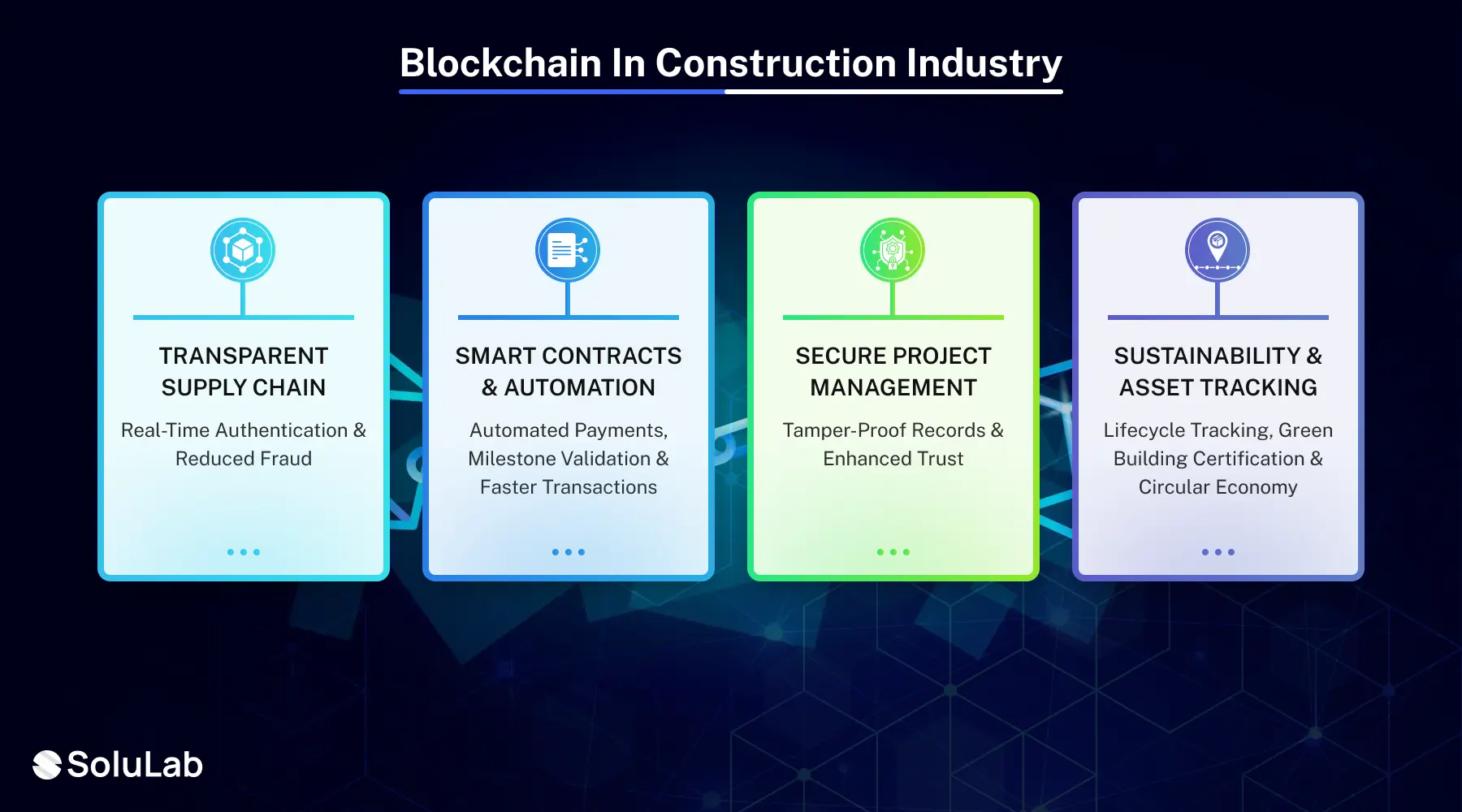
Construction is moving into a new digital phase. And blockchain technology is putting a checkmate to long-standing challenges like fragmented communication, supply chain delays, and limited transparency. Blockchain in the construction industry creates transparent records, automates transactions, and strengthens collaboration.
Along with AI-powered solutions, the sector is finding new ways to simplify decision-making, reduce errors, and ensure accountability. Also, the following data shows blockchain growth in the market, which businesses need to consider. With the market expected to reach $39.87 billion by 2034, the technology is becoming a core part of modern construction ecosystems. Let’s see how the construction industry can grow using blockchain platforms.
Key Takeaways
- Through blockchain adoption, construction companies can cut project delays and administrative costs by up to 35–40%.
- Blockchain strengthens traceability across the supply chain, ensuring better material tracking, compliance, and quality assurance.
- The right blockchain partner helps teams deploy scalable blockchain development solutions.
Why Blockchain Matters for the Construction Sector Today?
The global blockchain services market was valued at USD 6.75 billion in 2024. This is projected to reach USD 27.39 billion by 2028 with a strong CAGR of 41.9%. This rapid growth indicates rising demand for blockchain technology in construction as companies seek secure and efficient digital ecosystems.
1. The Need for Trust and Transparency in Complex Projects
Construction projects involve dozens of suppliers, subcontractors, and stakeholders. This creates gaps in information flow, which can lead to disputes, delays, and cost overruns. Blockchain technology provides a shared ledger that ensures everyone works from the same, immutable record.
2. Better Control Over Data and Documentation
Blueprints, contracts, approvals, and inspection reports pass through multiple hands. With blockchain technology in construction, every update is timestamped, tracked, and encrypted, which prevents manipulation and ensures full accountability throughout the project lifecycle.
3. Tackling Inefficiencies in the Supply Chain
Blockchain in supply chain management helps track materials from the manufacturer to the construction site. This offers clarity on sourcing, quality, and delivery timelines. This level of traceability improves compliance with safety, environmental, and sustainability standards.
Benefits of Blockchain in the Construction Sector
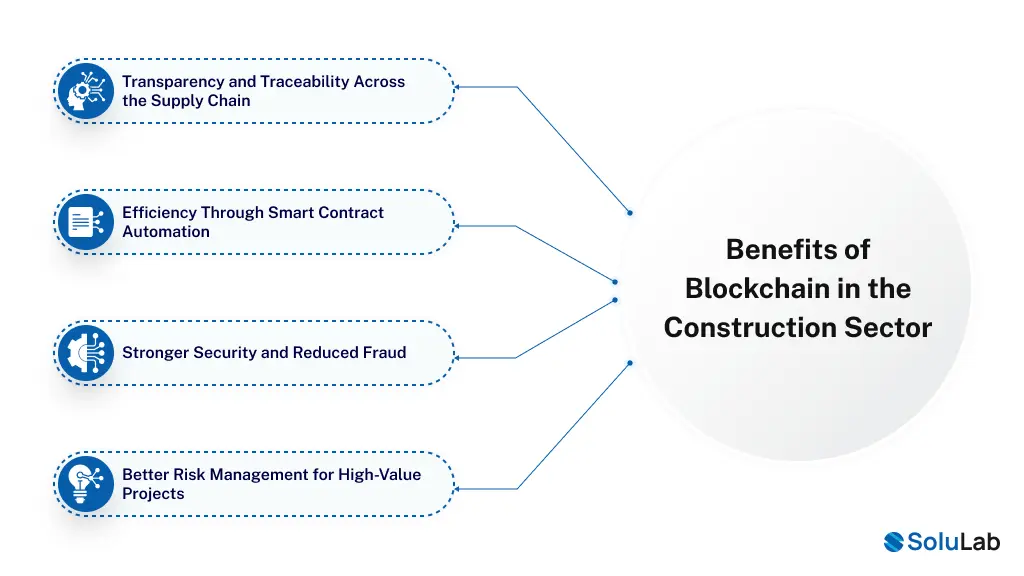
Blockchain technology in the construction industry delivers several innovations. Let’s check some of them below. Businesses must know what they are investing in and how it can help to cut their future costs and enhance growth.
1. Transparency and Traceability Across the Supply Chain
The benefits of blockchain in the construction supply chain include end-to-end material visibility. Every movement of goods is recorded on a decentralized ledger. This reduces counterfeit materials, improves compliance, and creates a transparent audit trail that strengthens supplier accountability.
- A transparent blockchain ledger enables stakeholders to track materials from origin to installation, reducing disputes and ensuring ethical sourcing across all project phases.
- Construction companies can verify product certifications instantly, making quality control more reliable and minimizing the risk of using substandard or fraudulent materials.
2. Efficiency Through Smart Contract Automation
Smart contract development automates payments, approvals, and milestone verification. This reduces administrative work and improves cash flow for contractors and subcontractors.
- When predefined conditions are met, smart contracts release payments automatically, which speeds up financial workflows and reduces delays across the supply chain.
- These contracts also minimize human intervention, which lowers operational costs and improves the accuracy of compliance and documentation review.
3. Stronger Security and Reduced Fraud
Blockchain technology in construction protects sensitive project data by distributing encrypted records across multiple nodes.
- Because blockchain entries cannot be altered, construction teams gain a more secure system for managing contracts, invoices, inspection records, and digital assets, reducing the risk of manipulation or fraud.
- Each block in the chain is linked to the previous one, making unauthorized changes nearly impossible and improving trust among all project participants.
4. Better Risk Management for High-Value Projects
With exact data logs and transparent workflows, project risks decline significantly.
- Blockchain helps identify supply chain delays early, allowing teams to take corrective actions that avoid costly disruptions during critical construction phases.
- Companies can also track environmental, safety, and quality compliance more effectively, lowering the risk of regulatory penalties and project delays.
Implementing Blockchain in the Construction Sector
Companies like Skanska have integrated blockchain for subcontractor onboarding, compliance checks, and supply chain transparency. In 2025, a project was proposed: a Blockchain‑based Circular Construction Supply Chain (BCCSC) framework. These are the game changers in the company’s growth.
Here are some areas where you can gain more through blockchain technology integration in the construction sector.
1. Integrating Blockchain Into Procurement
Implementation of blockchain technology in the construction industry begins with procurement, where transparency is most needed.
- Blockchain records every procurement step, ensuring that materials are ethically sourced and delivered in line with sustainability and quality standards required for modern infrastructure projects.
- Procurement teams can validate supplier performance and monitor purchase orders in real time, reducing procurement fraud and simplifying approval chains.
2. Bringing Smart Contracts Into Construction Management
Smart contracts sit at the heart of blockchain in construction industry operations. They support automated payments, faster dispute resolution, and more consistent compliance.
- These digital agreements execute themselves when milestones are verified, ensuring accurate payments and reducing manual paperwork during large construction projects.
- Smart contracts also help enforce timelines and responsibilities.
- This reduces communication gaps and improves coordination between general contractors and subcontractors.
3. Integrating Blockchain Platforms With BIM and IoT
AI and blockchain, when combined with Building Information Modeling (BIM) and IoT sensors, help construction companies create reliable digital records of site activity.
- IoT sensors track real-time material movement, safety conditions, and machinery operation, while blockchain stores the data securely for audits and analysis.
- BIM updates recorded on blockchain platforms ensure that all project stakeholders work from accurate, tamper-proof versions of the design and engineering plans.
Applications of Blockchain in Construction
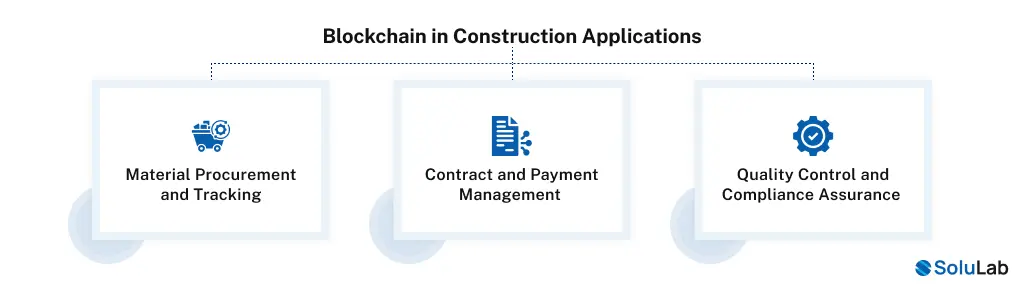
An integrated ecosystem of blockchain, AI, and IoT technologies is taking the construction sector to a new level. Digital designs, documentation, audits, tracking, and many more are done within minutes. No delay, no high budgets. Let’s see some applications of blockchain in construction that can change your business shape.
1. Material Procurement and Tracking
Applications of blockchain in construction start with procurement, where accurate and verified information is essential.
- Every supplier transaction is recorded on a decentralized ledger, helping companies validate the authenticity of materials, avoid delays, and maintain compliance with sustainability standards.
- Tracking materials from manufacturing to installation reduces the risk of errors and improves planning accuracy across multiple construction phases.
2. Contract and Payment Management
Self-executing smart contracts improve efficiency, reduce disputes, and secure financial workflows.
- By automating milestone-based payments, blockchain ensures faster fund disbursement, which strengthens subcontractor trust and keeps projects moving smoothly.
- Immutable transaction histories help resolve contract disagreements quickly, reducing time spent on legal escalation or manual verification.
3. Quality Control and Compliance Assurance
Blockchain use cases in construction focus heavily on quality control, where data integrity matters most.
- Tracking materials and equipment on a blockchain helps teams verify compliance with building regulations and quality standards at every stage of the project.
- Any deviation in quality is spotted early because blockchain offers complete traceability, enabling faster corrective action and protecting the final structure’s integrity.
Future of Blockchain Technology in the Construction Industry
Technology is growing to new levels, and adopting it early plays a key role in your growth. So, know the futuristic innovations of blockchain technology in construction and integrate them into your system.
Expansion of Blockchain-as-a-Service and Modern Platforms
Blockchain platforms will become easier to adopt through Blockchain as a Service (BaaS), allowing construction firms to integrate blockchain without deep technical expertise.
- BaaS platforms will streamline adoption by providing pre-built tools for contract management, supply chain visibility, and document authentication, lowering barriers for companies new to blockchain.
- These platforms will also support advanced analytics, enabling teams to track project performance, cost trends, and compliance metrics more accurately.
The Impact of AI and Blockchain on the Construction Industry
AI and blockchain together will unlock predictive insights, automated workflows, and stronger decision support systems.
- AI will analyze data stored on blockchain to predict delays, improve resource scheduling, and reduce project risks with actionable insights for project managers.
- This combination will enhance quality control, improve productivity, and strengthen construction management systems across large-scale infrastructure projects.
Sustainability and Green Building Verification
As green buildings grow in demand, blockchain will help track sustainable materials, verify eco-friendly sourcing, and maintain transparent environmental records.
- Immutable blockchain records will prove compliance with green building certifications, reducing verification costs and increasing trust among regulators and clients.
- Blockchain can also track carbon emissions, waste management, and energy usage, helping companies create fully traceable sustainability reports.
Conclusion
The construction sector is moving toward a more connected and data-driven future. Moreover, blockchain is becoming one of the most important technologies in the market. As companies work to modernize their work culture and improve supply chain visibility, the need for blockchain in the construction industry is inevitable. You can see the benefits and why the market is adopting it in the above blog.
Now, it’s your turn to decide what to integrate and whom to partner with to grow in the construction sector. We, SoluLab, a top blockchain development company, help you in building complex platforms efficiently. Our strength comes from a proven team of 250+ expert developers, backed by experience delivering 150+ blockchain solutions. Our expertise is across finance, logistics, documentation, and manufacturing, etc.
- Also, our DAO development capabilities enable decentralized governance for large infrastructure projects.
- Our DeFi development services give enterprises access to automated financial workflows, lending systems, and smart settlement protocols.
- Through this, you can reduce delays 40% and strengthen trust among your clients.
If you’re exploring or planning to integrate AI and blockchain into your upcoming project, our team can guide you through every stage of development. Connect with us to build secure, future-ready solutions that match the scale and ambition of your next project.
FAQs
1. How much does blockchain development cost?
Blockchain development costs typically start from $10,000. Depending on project complexity, integrations, security requirements, platform choice, and long-term scalability needs, cost increases.
2. How long does it take to develop a blockchain solution?
Most blockchain technology platforms take 1 to 4 months, depending on features, smart contracts, workflows, integrations, compliance requirements, and overall technical complexity.
3. Why choose SoluLab for blockchain development?
SoluLab offers deep technical expertise, strong architecture capabilities, and industry experience that help companies build secure, scalable blockchain solutions aligned with real business goals.
4. Which other industries benefit from blockchain technology?
Industries like finance, healthcare, logistics, manufacturing, energy, retail, insurance, real estate, and supply chain management gain transparency, automation, and security through blockchain adoption.
5. Can blockchain be integrated into my existing system?
Yes. Blockchain can be integrated with your current software, databases, or ERP systems through APIs, middleware, and custom connectors without disrupting existing operations.

