If you are planning a blockchain product in 2026, you are probably seeing wildly different numbers everywhere. One page says $10,000. Another says $300,000. Someone on a sales call says, “It depends,” which is technically true, but according to industry research, this uncertainty is a key reason why 67% of enterprise buyers overspend on blockchain projects they don’t fully scope.
The reality is simple and a little uncomfortable. The cost for Blockchain development in 2026 can range from around $10,000 for a simple token or proof of concept to $600,000+ for a production-grade enterprise system, depending on your platform, use case, compliance burden, security expectations, integrations, and delivery model.
This guide gives you the full picture, not just another recycled range. You will see:
- What drives the cost of blockchain app development
- How pricing changes by project type
- Why USA-based projects usually cost more
- What hidden costs hit after launch
- How to reduce waste without compromising quality
- How to evaluate whether a quote is realistic
Throughout this guide, we’ve included relevant internal resources and external authority links so your team can move from research to action without unnecessary research delays.
Quick Answer: What is the Average Blockchain Development Cost in 2026?
For most serious blockchain projects, you should expect these broad budgeting bands:
| Project Type | Typical Cost Range | Timeline |
| Proof of Concept or Basic Smart Contract | $10,000 – $40,000 | 3–8 weeks |
| MVP or Pilot Blockchain App | $40,000 – $120,000 | 2–5 months |
| Full Production Blockchain Product | $120,000 – $350,000 | 4–10 months |
| Enterprise-Grade Blockchain System | $300,000 – $600,000+ | 8–18 months |
These ranges are broad because the market is broad. A basic ERC-20 token, a mobile crypto wallet, a DeFi protocol, and an enterprise RWA tokenization platform may all be called “blockchain projects,” but they do not carry the same engineering load, security risk, or operational responsibility.
Why Blockchain Development Costs Changed in 2026?
If you compared a blockchain cost guide from 2024 with one from 2026, you would notice the market has shifted in a few real ways. These changes directly affect what you pay.
The Non-EVM Premium is Real
Ethereum blockchain and EVM-compatible chains still provide the most predictable development baseline because of mature tooling and developer availability. But if you build on Solana or Move-based ecosystems, your cost can rise meaningfully because specialized Rust and Move talent is scarcer and therefore more expensive.
That is one reason a Solana dApp can cost 25% to 40% more than an equivalent Ethereum-based build in some cases. If your use case genuinely needs Solana’s throughput or a non-EVM design, that premium may be justified. If not, you may be paying for complexity you do not really need.
Year-One Operating Cost Matters More Now
The build is no longer the whole budget. Modern buyers increasingly care about what it costs to operate the system after launch, not just what it costs to ship version one.
Your real first-year cost often includes:
- Node infrastructure and RPC services
- Monitoring and alerting
- Oracle services
- Support and maintenance
- Re-audits and security reviews
- Legal and compliance updates
Post-launch operations typically cost roughly 15% to 25% of the initial build cost annually. Development-only estimates often exclude audits, infrastructure, and post-launch work, which is why we’ve included a year-one total cost breakdown later in this guide.
AI and Blockchain Are Merging More Often
AI-driven workflows, autonomous on-chain agents, AI-powered analytics, and intelligent automation are becoming common additions in blockchain and enterprise builds. Meaningful AI-blockchain integration can add roughly $15,000 to $45,000 to a standard scope, depending on complexity.
This matters especially if you are building tokenization, DeFi, compliance automation, or enterprise workflow systems. You should budget for AI as a deliberate line item, not as a “nice to add later” afterthought.
What Is Included in Blockchain Development Cost?
When you estimate blockchain development cost, you are not just paying for smart contracts. You are paying for a system that needs to work under real conditions, often with real money, real users, and real compliance pressure.
A proper budget usually includes:
- Discovery and Solution Architecture: Understanding your business model, use case, and technical requirements
- Smart Contract Development and Testing: Smart contracts that implement your business logic safely and efficiently
- Frontend, Backend, Mobile, and Admin Interfaces: Where needed for user interaction and platform management
- API Integrations and Wallet Integrations: Connecting to wallet services, payment systems, KYC providers, oracles, and enterprise systems
- QA, DevOps, Deployment, and Launch Support: Ensuring your system is production-ready and operationally sound
- Security Planning, Audits, Remediations, and Monitoring: Professional code review and ongoing security monitoring
- Documentation, Handover, and Maintenance: Technical documentation and post-launch support
If your estimate ignores half of that, the quote may look attractive at first, but your real blockchain cost will show up later, usually at the worst possible time.
Blockchain Development Cost by Project Size
Before you estimate a blockchain use case, it helps to anchor around project maturity. A proof of concept is not a production app. An MVP development is not an enterprise platform. The gap between those stages is one of the biggest reasons budgets go off track.
| Project Stage | What You Are Building | Typical Cost | Timeline |
| PoC / Proof of Concept | Core logic validation, minimal interface | $10,000 – $40,000 | 3–8 weeks |
| MVP / Pilot | Core features live, limited user testing | $40,000 – $120,000 | 2–4 months |
| Full Production Build | Scalable, audited, production-ready product | $120,000 – $350,000 | 4–10 months |
| Enterprise-Grade System | Permissioned chain, compliance integrations | $300,000 – $600,000+ | 8–18 months |
The cost jump from MVP to production is where many teams get surprised. Production means your product must:
- Hold up under real-world load
- Integrate with existing systems
- Pass security audits
- Create clean operational records
- Meet regulatory requirements
That takes more than code. It takes process, infrastructure, and architecture discipline.
Blockchain Development Cost by Project Type
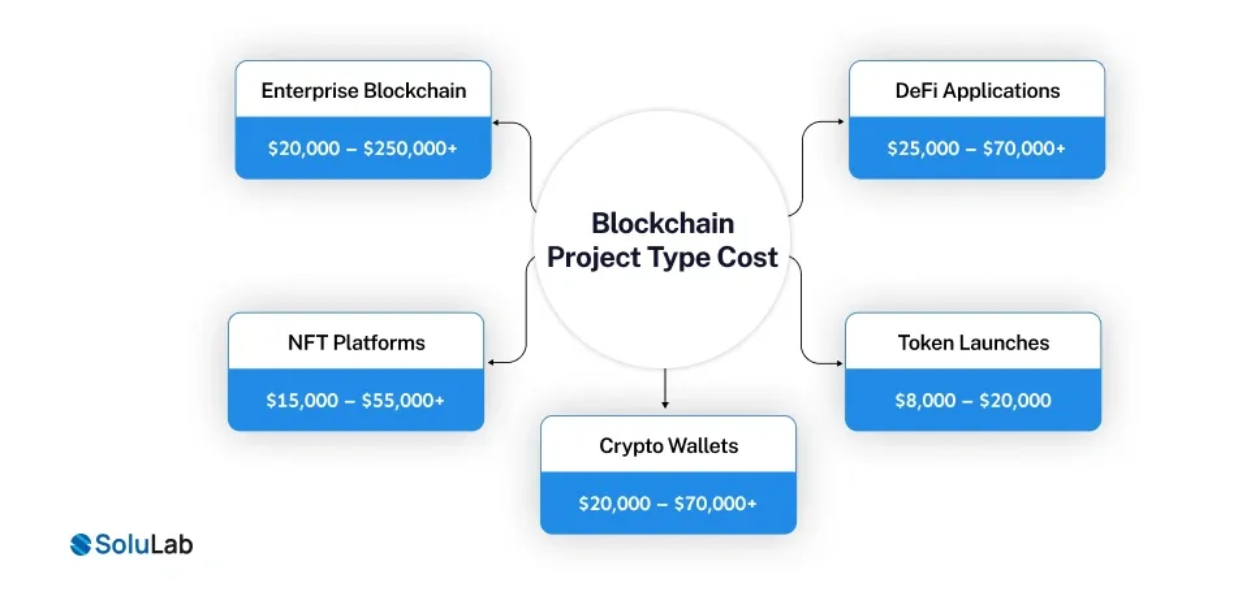
This is where budgeting becomes more useful. The label on your product matters, but the actual features and risk profile matter more.
DeFi Application Cost
If you are building a DeFi product, your budget rises quickly because security expectations are far higher than they were a few years ago. Liquidity logic, staking, yield workflows, treasury design, cross-chain functionality, and oracle dependencies all add engineering and testing load.
In practice, a DeFi build also forces you to budget for a real audit. Quality audits can add $10,000 to $40,000 on top of development cost for serious DeFi work.
Typical cost range for DeFi: $25,000 – $70,000+ (depending on complexity and audit scope)
Typical timeline: 2–5 months
Token Development Cost
A standard token launch remains one of the lowest-cost entry points into blockchain. But there is a big difference between a simple ERC-20 style token and a regulated or real-world-asset-aligned token that needs legal review, investor controls, or KYC workflows.
That is why a “cheap token launch” can suddenly become a $50,000+ engagement once compliance enters the picture. If your token touches securities, RWAs, investor onboarding, or regulated flows, your cost basis changes immediately.
Typical cost range for tokens: $8,000 – $20,000 (basic) to $50,000+ (regulated)
Typical timeline: 1–4 weeks (basic) to 2–3 months (regulated)
Crypto Wallet Development Cost
Crypto Wallet development looks simple from the outside, but it often becomes more expensive than founders expect. Seed phrase management, transaction signing, chain integrations, error handling, swap support, and mobile UX all introduce complexity. If you add MPC (Multi-Party Computation), HSM integration, or custodial features, you are no longer building a lightweight app. You are building security-critical infrastructure.
Typical cost range for wallets: $20,000 – $70,000+ (depending on custody model and supported chains)
Typical timeline: 2–6 months
NFT Marketplace Development Cost
The cost of an NFT platform in 2026 depends heavily on where you build and how much marketplace logic you need. Ethereum mainnet can push both development and user transaction costs higher, while Polygon, Arbitrum, or Base can lower user-side costs but may introduce bridging or ecosystem tradeoffs.
Support for features like royalty automation (ERC-1155) and advanced filtering logic impacts the timeline and budget.
Typical cost range for NFT marketplaces: $15,000 – $55,000+ (depending on chain and features)
Typical timeline: 2–5 months
Enterprise Blockchain Cost
Enterprise blockchain projects are often expensive for a boring reason that many buyers miss. The blockchain itself is not always the hardest part. The integration is.
Connecting a permissioned chain or private Ethereum network to SAP, Oracle, ERP, compliance systems, internal identity layers, and legacy databases is where timelines stretch, and budgets get heavier. This is also where a specialized partner matters most.
Typical cost range for enterprise systems: $20,000 – $250,000+ (depending on integration scope)
Typical timeline: 6–18 months
Blockchain Development Cost in the USA vs. Other Regions
If you want accurate USA budgeting, you need to know how USA pricing compares regionally. USA buyers are not just looking for “global cost.” They want to understand how their cost aligns with onshore talent, offshore teams, and hybrid models.
Regional Hourly Rates (Senior Developers, 2026)
| Region | Typical Hourly Rate | Notes |
| USA and Canada | $100–$250/hour | Higher cost, onshore expertise, strong compliance knowledge |
| Western Europe | $80–$200/hour | Strong security practices, GDPR expertise |
| Eastern Europe | $40–$100/hour | Cost-efficient, growing blockchain talent pool |
| India | $25–$60/hour | Budget-friendly, 24/7 support availability |
| Southeast Asia | $30–$70/hour | Emerging talent, growing expertise |
| Australia | $80–$150/hour | Strong technical culture, timezone overlap with APAC |
Senior Solidity and Rust specialists command premium rates in all regions due to scarcity.
Hybrid Delivery Model (Recommended for USA Projects)
For many USA companies, the smartest model is not fully onshore or fully offshore. It is a hybrid. You keep high-touch discovery, architecture, stakeholder communication, and compliance conversations tightly managed with a USA-based team, while leveraging a cost-efficient global engineering team for implementation.
This delivery model is aligned with SoluLab’s approach as a US-facing blockchain and AI development company with global execution strength.
Cost of Hiring Blockchain Developers in 2026
If you are evaluating whether to build in-house, use contractors, or work with a partner, you need role-level economics. If you are looking to hire blockchain developers, the pricing chart goes like:
Developer Salary Ranges in the USA (Annual, 2026)
| Seniority Level | Annual Salary Range | Typical Focus |
| Entry-Level | $75,000 – $115,000/year | EVM and Solidity basics, junior dApp development |
| Mid-Level | $120,000 – $185,000/year | DeFi protocols, audit preparation, multi-chain work |
| Senior | $150,000 – $220,000/year | Multi-chain architecture, mentoring, protocol design |
| Staff / Principal | $190,000 – $280,000/year | Core protocol design, technical leadership, strategy |
| Solana / Rust Specialist | $160,000 – $260,000/year | High-performance dApps, DeFi, and technical depth |
Reference: U.S. Bureau of Labor Statistics on Software Developer Compensation
Hidden Costs of In-House Hiring
If you hire in-house, those salary figures are not the whole cost. You also absorb:
- Hiring time and recruiter fees
- Benefits (health, 401k, PTO)
- Equipment and tooling costs
- Turnover and replacement risk
- Management bandwidth and coordination overhead
- Training and professional development
That is one reason many startups and mid-market firms still find agency or dedicated-team models more cost-efficient for projects under a few hundred thousand dollars.

How Much Does a Blockchain Security Audit Cost?
The short answer is yes, you almost certainly need one if your system handles user funds, tokens, wallets, governance rights, or sensitive logic. Blockchain code is much less forgiving than conventional app logic because deployed contracts are hard to patch cleanly after launch.
Audit Cost by Complexity
| Project Type | Audit Cost Range | Typical Duration |
| Simple Token or Basic Contract | $3,000 – $8,000 | 1–2 weeks |
| Moderate-Complexity DeFi MVP | $10,000 – $30,000 | 2–4 weeks |
| Complex DeFi or Multi-Contract System | $30,000 – $80,000 | 4–8 weeks |
| Enterprise or Critical Infrastructure | $50,000 – $150,000+ | 6–12 weeks |
The more important point, though, is this: you should not budget for just the audit fee. You should also budget for:
- Remediation time: Fixing issues discovered in the audit
- Re-audit scope: Verifying that fixes are correct
- Audit-ready development: Engineering effort to write auditable code from the start
Read more: Smart contract audit cost
Hidden Blockchain Development Costs Nobody Warns You About
Honestly, this is one of the best opportunities to plan realistically, because total ownership cost matters far more than build cost alone. Multiple costs are involved within the blockchain app development process, like:
Node Infrastructure and RPC Services
Managed providers like Alchemy, Infura, and QuickNode can cost roughly $200 to $1,000 per month in moderate setups, depending on:
- Request volume
- Number of chains
- Redundancy requirements
- Analytics and advanced features
- Uptime SLAs
The exact number depends on your traffic patterns and requirements. The key point is that this becomes a recurring bill, not a one-time setup fee.
Oracle Fees
If you rely on real-world data such as asset prices, events, weather, or financial triggers, oracle costs can quietly compound over time. DeFi platforms are particularly exposed to this because they often depend on reliable pricing data at regular intervals.
Popular Oracle providers:
Costs typically range from a few hundred to thousands per month, depending on frequency and data requirements.
Legal and Compliance Review
Budgeting around $10,000 to $30,000 for legal review in many USA or Europe-relevant token contexts is standard practice, with higher budgets for more public or regulated token activity. Ongoing legal and compliance consulting costs can reach $10,000 to $50,000 per year, depending on jurisdictions and project profiles.
Reference: SEC Digital Assets Guidance and FinCEN Cryptocurrency Guidance
Gas and Transaction Costs
On-chain deployment and user interaction costs vary by chain and by congestion. Consider:
- Ethereum deployments for simple contracts: tens to hundreds of dollars
- Complex DeFi deployments: thousands of dollars, depending on network conditions
You can monitor current costs on:
Post-Launch Maintenance
Plan for roughly 15% to 25% of the initial build cost annually for post-launch maintenance. That usually includes:
- UI fixes and improvements
- Infrastructure monitoring and alerting
- Contract upgrade support
- Analytics platform changes
- Minor roadmap improvements
- Bug fixes and security patches
Scope Creep and Contingency
Around 80% of blockchain projects encounter scope changes mid-build. It’s worth building a 10% to 15% contingency into the original budget. That figure will resonate with any product lead who has lived through “just one more feature” syndrome.
Year-One Total Cost Example
This example shows how abstract estimates become practical budgeting logic.
If your production DeFi build costs $100,000, you may need to add:
| Category | Cost Range | Annual / One-Time |
| Security audits (initial + re-audit) | $15,000 – $40,000 | Mostly upfront, partial ongoing |
| Infrastructure (RPC, nodes, monitoring) | $5,000 – $12,000 | Annual recurring |
| Legal and compliance review | $10,000 – $30,000 | Upfront, then annual update |
| Post-launch maintenance and support | $15,000 – $25,000 | Annual recurring |
| Year-One Total | $145,000 – $207,000 | Not just the $100K headline |
This realistic year-one budget is 45% to 107% higher than the headline build figure. That is why researching total ownership cost now saves painful budget surprises for blockchain services later.
How to Reduce Blockchain Development Cost Without Cutting Corners?
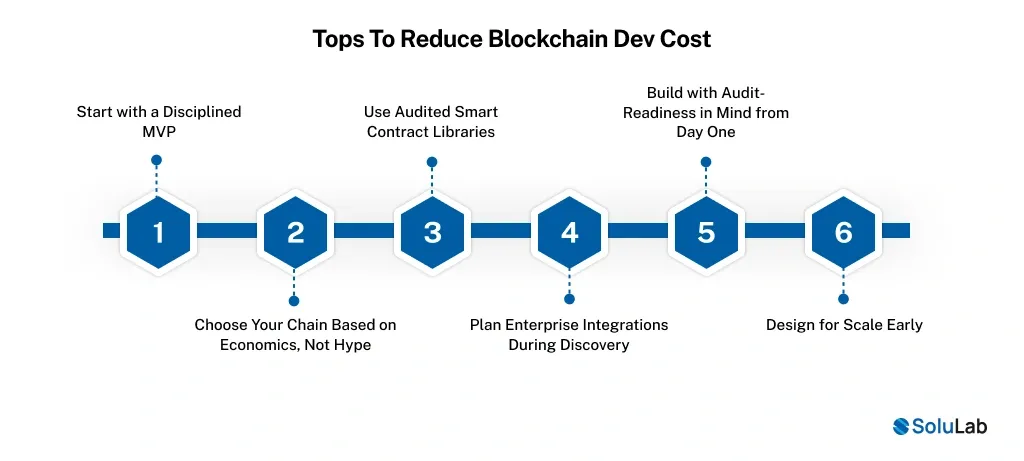
The right way to save money is not to cheap out on security or architecture. It is to reduce waste, choose the right tech stack, and scope intelligently.
Here is what tends to work best:
- Start with a Disciplined MVP: Launch the smallest version that proves the core value, not the full product vision. Validate demand before building features you don’t need yet.
- Choose Your Chain Based on Economics, Not Hype: Evaluate Ethereum, Polygon, Solana, and Layer 2 options for your specific use case’s cost structure, not for trends or ecosystem size.
- Use Audited Smart Contract Libraries: Don’t rebuild common logic from scratch. OpenZeppelin’s contract library provides battle-tested, audited implementations of tokens, governance, and other standard patterns.
- Plan Enterprise Integrations During Discovery: Don’t wait until architecture is locked. Understand your ERP, CRM, and legacy system requirements upfront so you don’t need expensive refactoring later.
- Build with Audit-Readiness in Mind from Day One: Use tools like Hardhat and Foundry designed for testability and auditability. This reduces audit cycles and remediation costs significantly.
- Design for Scale Early: Build your architecture to handle 10x your launch traffic so you don’t need to refactor everything after traction arrives.

Common Mistakes That Blow Blockchain Budgets
Most overruns do not happen because a single number was wrong. They happen because blockchain teams underestimate the hard parts until they are already committed.
The most common blockchain development budget traps are:
- Treating Production as a Minor Extension of the MVP: Production-ready systems need infrastructure, monitoring, redundancy, and operational processes that MVPs don’t. Don’t assume you can just “add scale” cheaply.
- Delaying Legal or Compliance Conversations Until Late: If your project touches regulated assets or investor onboarding, involve legal early. Late-stage legal work creates massive rework and delays.
- Choosing a Chain Based on Trend Rather Than Total Cost of Ownership: A trendy chain might have poor developer tooling, expensive infrastructure, or regulatory uncertainty that inflates your real cost.
- Underestimating Integrations: Connecting to wallets, ERPs, CRMs, or identity systems is often the hidden complexity that blows budgets. Plan integration effort explicitly.
- Treating Security Audits as a Checkbox: Security audits are not a final stamp of approval. They are part of an iterative engineering process. Budget for iteration and remediation, not just the audit fee.
- Building Too Much Before Validating Demand: That full product vision sounds good, but it keeps happening because teams get emotionally attached to features before the market proves the first version deserves to exist.
How to Choose the Right Blockchain Development Company in 2026?
A credible blockchain development company should demonstrate:
- Multi-Chain Experience: Not just one favorite stack, but proven work across Ethereum, Solana, Polygon, and Hyperledger or similar platforms.
- Clear Security-First Development Process: Audit readiness is built into the workflow from day one, not as an afterthought before launch.
- Domain-Relevant Case Studies: Proven work in sectors similar to yours (DeFi, RWAs, enterprise, etc.), not generic examples.
- Honest Pushback When Blockchain Is Not the Right Answer: A partner who knows when to recommend a simpler, cheaper alternative has your best interests in mind.
- Deliverables Beyond Code: Documentation, deployment planning, handover structure, and post-launch support are as important as the code itself.
SoluLab: #1 Blockchain Development Partner
SoluLab’s enterprise blockchain technology development showcases 1,500+ delivered projects across AI, blockchain, Web3, and digital transformation. We have worked on features across multiple blockchain solutions:
- Tokenization and RWAs
- Decentralized exchanges
- NFT and digital asset platforms
- Enterprise blockchain integrations
- AI-powered on-chain automation
To explore in detail, you can have a look at our recent case studies on delivered blockchain projects, especially focusing on AI native strategy integration:
- Real Estate Tokenization with AI: The project is an AI-powered blockchain real estate tokenization platform that enables fractional ownership, automated compliance, and seamless investor onboarding. This case study showcases how intelligent automation and smart contracts transformed traditional real estate investing into a transparent, scalable digital ecosystem.
- Multi-Chain Decentralized Exchange: The project is a secure multi-chain decentralized exchange platform with cross-chain liquidity, automated smart contract execution, and AI-powered transaction monitoring. This case study highlights how scalable DeFi infrastructure can deliver faster trading, enhanced interoperability, and seamless user experiences across blockchain networks.

When Blockchain Is Not Worth the Cost?
You may not need blockchain if:
- A Traditional Shared Database Can Solve the Problem Cleanly. If you control all parties and can use a central database or shared ledger, blockchain adds unnecessary complexity.
- There Is No Real Multi-Party Trust Problem to solve. If all parties trust each other or a central authority can mediate disputes, blockchain does not add value.
- You Do Not Need Verifiable Ownership, Programmable Assets, or Tamper-Resistant Records. Blockchain shines when these properties are critical. If they are not, traditional solutions are cheaper and faster.
- Your Team Is Trying to Force Blockchain Because It Sounds Innovative. This is common. If blockchain is a solution looking for a problem in your case, it will be expensive and disappointing.
Conclusion
The cost of blockchain development will fluctuate significantly based on several aspects, including the blockchain type, feature complexity, platform choice, and team configuration. Regardless of whether you are developing a basic dApp or a comprehensive business solution, possessing a well-defined development strategy and an appropriate pricing model may substantially impact both expenses and efficiency.
As a trusted blockchain development company in USA, SoluLab specializes in providing customized solutions across various sectors. Our flagship project, Obortech Smart Hub, exemplifies how enterprises may leverage the advantages of Blockchain-as-a-Service (BaaS). Through the management of third-party cloud-based infrastructure, we allow organizations to concentrate on functionality while we oversee the configuration, deployment, and maintenance of secure blockchain networks.
Have a unique idea on your mind? Let’s get started!
FAQs
Neha is a curious content writer with a knack for breaking down complex technologies into meaningful, reader-friendly insights. With experience in blockchain, digital assets, and enterprise tech, she focuses on creating content that informs, connects, and supports strategic decision-making.